

VOL. 4
A Scholar in Struggle
Clayborne Carson
As my life has come full circle, my memory is often drawn to the day when I was a nineteen-year-old student attending the 1963 March on Washington for Jobs and Freedom. I suspect that the novice protester at the Lincoln Memorial would have reacted with shocked disbelief if someone had predicted that he would later teach African American history at Stanford University or that he would edit the papers of the visionary leader of the march, who dreamed of the day that persons of all races would be judged “by the content of their character.” My former self might have seen such career predictions as comparable to a possibility of walking on the moon.
I saw more Black people in one day at that march than I had seen during my entire life to that point. Growing up as one of a handful of Black residents in the sequestered town of Los Alamos, New Mexico, I had dutifully rehearsed for the role of First Negro (to become what many whites already were) even before gaining full awareness of life’s greater possibilities. Although I had faith that doing well in school would enable me to become a famous First, my more modest pre-march ambitions centered on becoming the first member of my family to graduate from college.
Yet, even before the march, the southern freedom struggle had deeply affected my consciousness, strengthening my sense that being Black (or Negro at that time) was a special identity, infused with great promise. I had come to the event from the University of Indiana, where I had attended the annual convention of the National Student Association. Howard University activist Stokely Carmichael had vividly stamped himself on my memory as he mobilized support for the Student Nonviolent Coordinating Committee (SNCC). I was impressed by his articulate militancy, even as he derided my decision to attend what he called the “picnic” in Washington rather than joining the southern struggle in Albany, Greenwood, and Cambridge, or other such movement hot spots.
Simply attending the unprecedented mass march by myself was then sufficiently adventurous to satisfy my teenage curiosity, but I was nonetheless profoundly transformed by my initial encounters with Stokely and other Black activists. The evening afterward, I hitched a ride with a group of marchers returning to New York City. Arriving after midnight at Penn Station, I found my way by subway to Harlem, a place I knew only from books, but one I naively presumed would provide me a place to spend the night. Fortune smiled on me, as it would often afterward. The following day, I visited the famous landmarks of the city, enjoying myself despite the realization that my funds were sufficient only to buy a bus ticket back to Indiana, and that I would have to hitch rides from there to Albuquerque.
After tempting fate still more as a solitary Black hitchhiker in middle America, I was able to return for my sophomore year at the University of New Mexico. Political activism increasingly shaped my subsequent academic career, making it difficult to imagine one without the other. I soon switched my major from mathematics to history. Nothing I learned in the classroom, however, was as instructive as my initial contacts with SNCC organizers, who demonstrated to me that Martin Luther King, Jr., was a product of a multifaceted social movement sustained by many independent organizers and grassroots leaders. A few months after the March, I encountered the most influential role model of my college years when I heard SNCC organizer Bob Moses describe the Mississippi voting-rights campaign. Although I admired Stokely Carmichael’s outspoken militancy, my more subdued personality was instantly drawn to Moses’s soft-spoken, deferential leadership style. My subsequent activism would continue to intersect with that of Bob and Stokely; yet, despite my admiration of them and other courageous SNCC field secretaries, I continued to combine part-time activism with a full load of classes. Only gradually did my career ambitions become inextricably linked with experiences in the African American freedom struggle.
The fiery, deadly racial rebellion in Watts made our nonviolent, interracial militancy seem so insignificant and so inadequate. The spontaneous uprising attracted more community support than had all of our organizing efforts.
When I transferred to UCLA in 1965, my courses became occasional distractions from a burgeoning off-campus curriculum that included involvement in the Nonviolent Action Group (NAG), which became the center of my social life in Los Angeles and led to my first civil disobedience arrest. Soon there were writing assignments for the underground Los Angeles Free Press (my first article was on NAG founder Woody Coleman); numerous antiwar and antidraft protests; forays to Delano to participate in the farm workers movement; and necessary employment (an insipid advertising research job with Audience Studies on the Columbia Pictures lot in Hollywood) to pay educational expenses. Eager to contribute to SNCC’s voting rights campaign, but unable to participate in the Selma to Montgomery march, I helped organize massive demonstrations at the Los Angeles federal building and sat in the building’s lobby until I was removed by police. Later, attending the momentous May 1965 antiwar teach-in at Berkeley, I learned that Bob Moses had changed his surname to Parris in a vain attempt to free himself from the leadership role that had enveloped him. I recall that he spoke movingly about the connection between the Vietnam War and southern anti-Black violence. He expressed the growing racial resentments of many Black activists when he asked why white Americans had not reacted to the killing of Alabama voting rights worker Jimmy Lee Jackson as they had to the subsequent murder of a white minister, James Reeb.
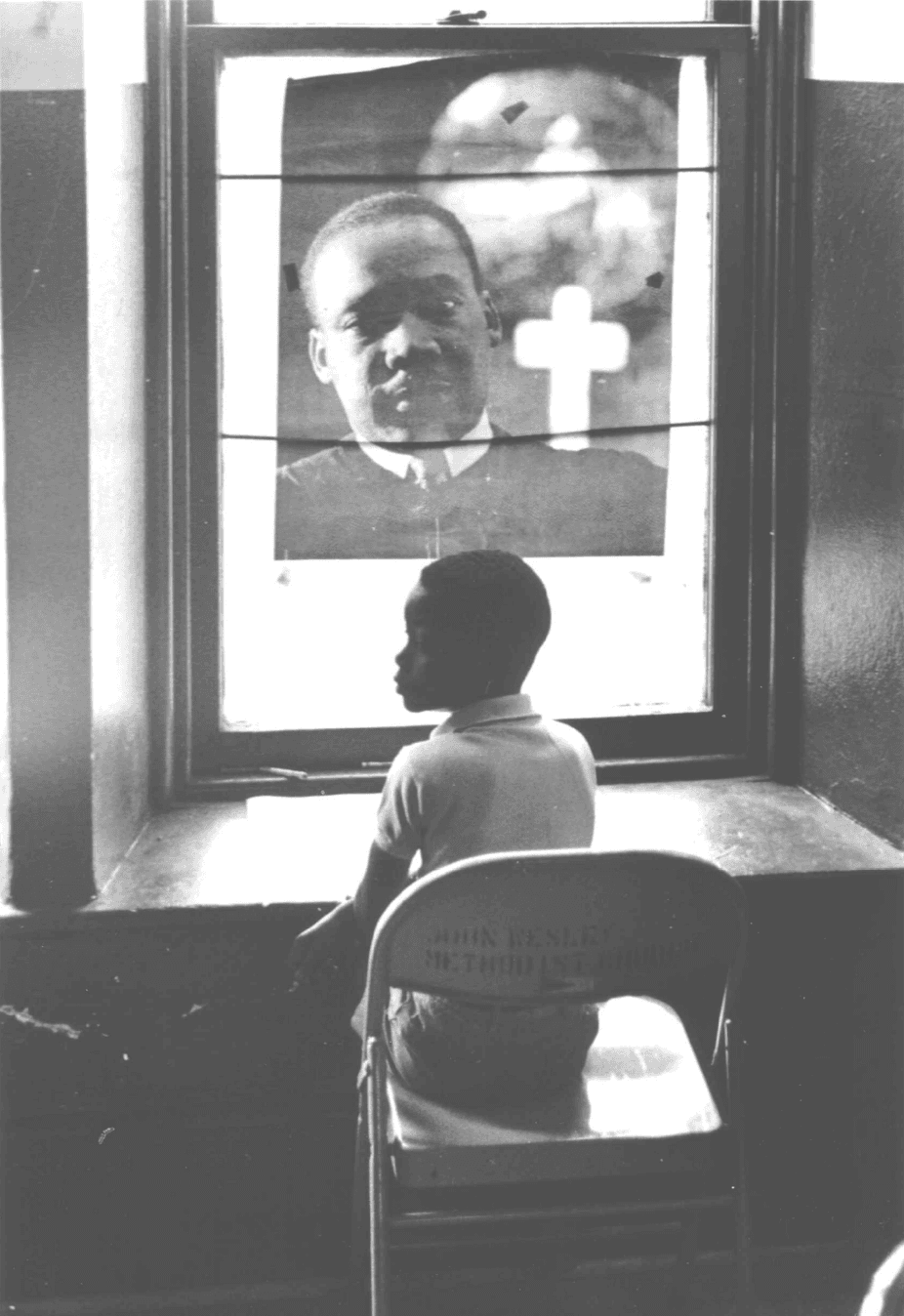
Sunday School. Photo by LeRoy Henderson
In August 1965, my political activism and my undergraduate career suddenly and unexpectedly reached a turning point when a mass protest against police abuse started in the Watts section of Los Angeles. The Watts “riot” was actually an insurgency that briefly transformed large sections of south-central Los Angeles into liberated zones of the Black freedom struggle. I recall standing outside NAG’s Central Avenue headquarters trying to make sense of the fiery, deadly, racial rebellion that made our nonviolent, interracial militancy seem so insignificant and so inadequate. The spreading violence attracted more community support than had all of our organizing efforts. The NAG cadre, which had been held together by a shared faith in the power of interracial nonviolent direct action, subsequently disintegrated as members came to realize that Black-white divisions inside and outside the group were deeper than we had imagined.
Ideological agitation for Black Power increasingly obscured community organizing, as “the people" were no longer sources of innovative political ideas, but targets of consciousness raising.
Searching for new political options, I served as cochair of the California Conference on Power and Politics held in October 1966. Those of us who organized the gathering envisioned it as the beginning of a movement for a third major political party, but instead it exposed how little we knew about power or politics. Rejecting the conventional liberalism of incumbent Governor Edmund G. Brown and refusing to take seriously his conservative challenger, Ronald Reagan, we audaciously called upon voters to boycott the election, expecting that we would soon offer a serious third-party alternative. Eventually, the New Politics movement spawned the Peace and Freedom Party and inadvertently stimulated the growth of the Reagan wing of the Republican Party.
During 1965 and 1966, as New Left radicalism and Black nationalism competed with one another as guiding themes of my activism and studies, I discovered posthumously the virtues of Malcolm X. I met with other UCLA students in a group called Harambee, which honored Malcolm each week by holding silent vigils beside a path leading to the UCLA Student Union. I saw myself as both a Black militant and a New Left radical, but increasingly found it difficult to straddle the widening gulf between these two small segments of the student body. I began to realize that the post-Watts period represented for me a decisive break with earlier activism. I had once considered myself part of a single movement, but after 1965 it began to separate into numerous movements. Black militancy increasingly consisted of fiery oratory rather than grassroots organizing.
Parris, SNCC’s best-known organizer, dropped out of sight after 1965, his whereabouts the subject of many rumors, but Stokely Carmichael’s whereabouts during this period were rarely a source of mystery. He had been an effective organizer, but soon after becoming chair of SNCC he quickly transformed himself into the group’s best-known ideologue. During the summer of 1966, I greeted him at a rally in Watts and responded enthusiastically to his call for Black Power. At the November 1966 Black Power Conference held in Berkeley, I was listed on the program as a “Watts organizer,” rather than more accurately as a UCLA student and part-time journalist. I did my best, though, to play the role of Black militant, warming the audience for Carmichael’s speech and then writing a laudatory participant-observer article about the event. Fascinated by Carmichael’s brash confidence that Black people would unite in a revolutionary struggle, I readily allowed Black Power rhetoric to obscure the reality that SNCC and NAG had declined in their ability to organize the Black people they supposedly represented. Ideological agitation increasingly obscured community organizing, as “the people” were no longer sources of innovative political ideas, but targets of consciousness raising.
College graduation in June 1967 coincided with my decision to resist the draft by leaving the United States with the intention of establishing residence elsewhere. Susan Beyer, a UCLA graduate who had shared some of my movement experiences and became my wife in August 1967, joined me in traveling through Europe and North Africa while Canadian officials considered our application for citizenship. A few of my Black activist acquaintances objected to my marriage to a white woman, who was moreover Jewish, but I felt fortunate to have company in my self-imposed exile. With ample opportunity to reflect on identity issues during our travels, we found temporary refuge from the intense anti-white animus that engulfed the Black struggle during that period.
In the spring of 1968, after Canada rejected us and Susan discovered she had a serious case of diabetes, we were forced to return to the United States. Back in Los Angeles, distracted by the pressing need to earn a living and avoid arrest as a draft dodger, I found it difficult to reestablish myself as an activist or as a writer capable of interpreting the tumultuous events that followed Huey Newton’s imprisonment on murder charges and King’s assassination. Although I attended rallies in support of the Panthers and embattled UCLA professor Angela Davis, I was no longer a political journalist or a member of any political organization. I found work as a computer programmer and managed to avoid the military draft. Only a year earlier I had been a student, but I returned to a political environment at UCLA that seemed greatly transformed. My earlier movement experiences no longer seemed of much relevance to the new generation of Black students who had arrived at UCLA in the aftermath of King’s assassination.
By then, the effort to unite all Black people under the Black Power banner had floundered because of government repression and internal conflicts within the Black struggle. Black leaders competed to become the “messiah” that FBI director J. Edgar Hoover imagined “could unify and electrify the militant Black nationalist movement.” I was attracted to the bravery and confrontational style of the Black Panthers, initially seeing them as SNCC’s urban contemporary counterparts. I ignored signs that the party’s leaders had little sympathy for SNCC’s consensus style of decision-making (Eldridge Cleaver later explained to me that a difference between SNCC and the Black Panthers was that the former had long meetings, and the latter had very short meetings).
The culture wars of the 1980s and 1990s served as a reminder that the freedom struggles of the 1960s had not ended, but had simply moved to new battlefields
In January 1969, I attended a meeting of the Black Student Union where Black Panthers and members of US (“wherever we are, US is”) stood glaring at each other from opposite sides of a classroom in which intimidated students discussed how to establish a Black studies program at UCLA. I had known US leader Ron (later Maulana) Karenga since 1966, when I interviewed him for the Free Press and was impressed by his seriousness and intelligence. Although I sided with the “revolutionary nationalist” Black Panthers in their escalating conflicts with the “cultural nationalists” of US, I was perplexed and disturbed by the Panthers’ vicious verbal attacks against Karenga and his followers. I was not completely surprised two days after the meeting when the escalating tensions between Black Panthers and US members exploded into a deadly clash. Two members of US killed two Panthers, Alprentice “Bunchy” Carter and John Huggins, in a cafeteria less than one hundred yards from my office.
I would later learn that the FBI’s counterintelligence program fostered these hostilities. Subsequent police raids severely damaged both groups, but for me the immediate consequence of the killings was that they reinforced my desire to maintain my distance from a Black Power movement that had become self-destructive. The Panther–US conflict also led me to become even more skeptical about the value of the prevailing rhetorical style of Black militancy, which had increased competition among Black leaders while achieving scant power or racial unity.
Although I admire some of those who have joined the growing ranks of Black “public intellectuals,” as they are called, I remain a reluctant spokesperson for anyone other than myself
During 1969, I considered returning to political journalism, but the emergence of the Black studies movement provided a new option. While continuing to work as a computer programmer, I began auditing Professor Gary Nash’s new class at UCLA on race relations in the United States. As one of a small number of Black college graduates on campus, I was soon recruited by Nash to be an informal teaching assistant, leading a section of his course devoted to Black political thought. Among the fifteen students in the section were the president and vice-president of the Black Student Union as well as members of the Black Panther Party, US, and the Nation of Islam. Intense class discussions provided a brutal yet instructive introduction to teaching. Political activism had once drawn me away from my undergraduate classes; now it gave me a reason to begin graduate studies. As an undergraduate, my curiosity about African American history and political thought could only be satisfied through extracurricular study. In contrast, I thought that graduate school might transform my avocation into a vocation. I began to formulate the central question that would guide my career as a professional historian: How have oppressed people with limited resources overcome the forces that oppress them?
In the fall of 1969, I entered UCLA’s graduate program in American history, part of a pioneering class of Black students who were suddenly deemed more academically qualified as a result of the nationwide Black rebellions following King’s assassination. Although I never doubted that the Black struggle had made possible my admission to graduate school, I was also convinced that the struggle strengthened my academic qualifications. I was able to draw on valuable insights from my movement experiences, even as I began to consider those experiences in a broader historical context. I soon realized that I could make an important contribution to the transformation of American historical scholarship that occurred during the early 1970s.
After two hectic years of graduate school, during which my enthusiasm compensated for the deficiencies in my academic preparation, I became an acting assistant professor at UCLA. The professors who engineered my recruitment were responding to forceful Black student demands for an African American history course taught by a Black professor. My hiring followed an interview session with leaders of the Black Student Union and was made possible by an expedient decision to deny tenure to a non-Black professor, Ronald Takaki, the superb historian who taught UCLA’s first African American history course. Despite my uneasiness regarding the racial politics associated with the hiring process, the suddenness of my transition from computer programmer to graduate student to professor was exhilarating (a few of my graduate school classmates had, two years later, become my students). Given my journalistic background, I worried less about pressures to publish or perish than I did about teaching courses that I had never taken, to students whose expectations were extraordinary and often contradictory—I often heard various versions of the assertion, “I don’t need to read books about Black history; I’ve lived it.”
Even after acquiring the protective shield of tenure, I learned that political struggles inside the academy were as vicious, if not as bloody, as those on the outside
When I began graduate studies, my movement experiences initially seemed too contemporary to become the subjects of historical study, but I benefited from the willingness of a few of my professors to depart from traditional notions of historical scholarship. My maturing reflections about the modern African American freedom struggle soon became the basis for my dissertation on SNCC, which Harvard University Press published in 1981 as In Struggle: SNCC and the Black Awakening of the 1960s. My research for In Struggle provided a welcome opportunity to reestablish contacts with many of the activists I had known during the 1960s. I was especially pleased to have the opportunity to conduct extended interviews with Bob Moses after his return from a long stay in Tanzania and with Kwame Ture (the former Stokely Carmichael) during his occasional visits to the United States from his home in Guinea, West Africa.
In 1974, I began my career as a Stanford professor, joining a small cohort of Black professors who struggled to find ways to build programs, serve the needs of Black students, and still produce scholarly publications. Among my colleagues was the late St. Clair Drake, a pioneering social scientist who had founded Stanford’s Program in African and African American Studies and who drew upon his own political activism to inform his teaching and scholarship. Some of the younger Black professors who came to Stanford (and to other universities) during this period sacrificed their opportunity to gain tenure by devoting themselves to administrative and teaching responsibilities. I experienced a degree of survivor’s guilt when I gained tenure, but I found it easy to immerse myself in historical research about my chosen subject matter and felt fortunate to be paid to follow my curiosity. Although I came to see my scholarly work as my most appropriate contribution to a still-evolving freedom struggle, there were times when I longed for the activist role I had left behind. Early in the 1980s, I obtained my FBI file and was somewhat dismayed to learn that it had been closed a decade earlier with the notation, “Subject no longer warrants surveillance” (was it the station wagon that a snooping FBI agent saw in my Palo Alto driveway?).
Even after acquiring the protective shield of tenure, I learned that political struggles inside the academy were as vicious, if not as bloody, as those on the outside. So long as my classes were simply electives taken largely by Black students, my presence on the faculty was accepted mainly with indifference or perhaps as one of the inevitable consequences of affirmative action. But I encountered open hostility during the mid-1980s when I became involved in the movement to alter Stanford’s Western Culture requirement for all undergraduates. In 1987, responding to Black student complaints, I developed an experimental course, “Western Culture: An Alternative View.” It represented a modest departure from the required Great Books reading list (instituted to distinguish essential knowledge from less essential subjects, such as the African American history courses I had taught). Along with other students and faculty members who advocated curriculum reform, I suddenly became a target for Dinesh D’Souza and other self-appointed defenders of Western culture and academic standards. The culture wars of the 1980s and 1990s served as a reminder that the freedom struggles of the 1960s had not ended, but had simply moved to new battlefields.
As the Western Culture controversy was beginning, my life’s circle came closer to completion when Coretta Scott King invited me to become the editor of her late husband’s papers. Because I had previously displayed little scholarly interest in King, I was surprised when she called me in January 1985. I quickly sensed, however, that the Martin Luther King, Jr., Papers Project offered a unique opportunity to study the modern African American freedom struggle from the perspective of the leader who sometimes served as a negative reference point for SNCC activists. As I drew closer to King through studying his papers, it was no longer sufficient to debunk so-called great-man interpretations of history, as I had when I speculated at a 1986 conference on Capitol Hill, “If King had never lived, the Black struggle would have followed a course of development similar to the one it did.” I wanted to understand the historical significance of the person who had been the featured speaker at my first major demonstration.
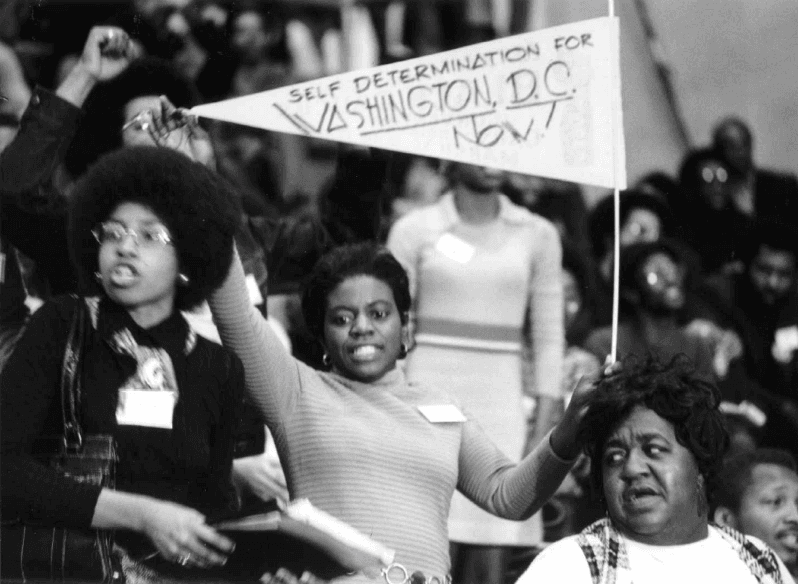
National Black Political Convention, Gary, Indiana, 1972. Photo by LeRoy Henderson
Having once empathized with the young SNCC militants who challenged King, my sympathies shifted somewhat as I studied King, who was, when he died, younger than I was when I became director of the King Papers Project. During the 1960s, my own youthful impatience and impetuousness led me to agree with some of SNCC’s attacks on King’s moderation and his firm commitment to integration and nonviolence in the face of white racist attacks. My later acknowledgment of the limitations of the Black Power movement fostered a greater degree of humility in my assessments of King’s alternative course. Although I still understood him as emerging from a freedom struggle he did not initiate, I came to appreciate him as a singularly prophetic leader who symbolized and cogently expressed many of the emergent values of the struggle. In short, he became wiser as I became older. My changing views of him have been affected not only by my personal experiences, but also by the unique opportunity I have had to study both the Black movement’s foremost spokesperson and its impetuous foot soldiers.
I still understood Martin Luther King as emerging from a freedom struggle he did not initiate, but I came to appreciate him as a singularly prophetic leader who symbolized and cogently expressed many of the emergent values of the struggle
Since its beginnings in 1985, the King Papers Project and the research projects related to it have become my principal means of expressing my views about the world and how it should be changed. The project has provided an opportunity for me to work closely with idealistic and committed students as well as with other dedicated scholars in a collective research effort that has documented not only King’s role in the struggle but also that of many other activists. The project’s research has drawn attention to aspects of the modern African American struggle that had been overlooked in previous writings that depicted it as a national campaign for civil rights legislation, rather than as a series of grassroots insurgencies. Realizing that some historians dismiss documentary editing as a rather mundane form of scholarship, I have appreciated the opportunity to devote my talent to the creation of publications with a value that is unrelated to transitory intellectual fashions.
Although I admire some of those who have joined the growing ranks of Black “public intellectuals,” as they are called, I remain a reluctant spokesperson for anyone other than myself. Only with considerable practice have I gradually become comfortable in the role of classroom lecturer and public speaker. Although I care deeply about many issues and still attend protest rallies and sign petitions, I am content to remain a teacher and writer, while more accomplished orators orate. I refrain from speaking publicly about matters that are beyond my chosen area of scholarly expertise (perhaps I still have within me some reticent qualities of that nineteen-year-old student in the crowd at the March on Washington). Nevertheless, since my area of expertise encompasses King’s life and ideas as well as the struggles in which he was involved, it is hardly surprising that my intellectual life has become wide-ranging and very public, particularly during the weeks surrounding the King holiday.
Furthermore, I have enthusiastically taken on some public education responsibilities, producing popular writings and multimedia presentations about the modern African American freedom struggle. Seeing our struggle as a valuable model for contemporary struggles, I take special pride in my works intended for popular audiences, such as Malcolm X: The FBI File, the docudrama Passages of Martin Luther King, and The Autobiography of Martin Luther King, Jr., compiled from his autobiographical writings. I am grateful for the opportunity to serve as historical advisor for documentary films such as Eyes on the Prize and Freedom on My Mind, and for the museum exhibits at the King Visitors Center in Atlanta and the National Civil Rights Museum in Memphis. Even computer skills have been useful as I explore new ways to use the Internet and multimedia technology to disseminate historical information.
Thus, since that day in Washington almost four decades ago, my career has been fulfilling in many unexpected ways. Even as I complain that Stanford has not done enough to support my work, I realize that I am fortunate to have resources far beyond those available to previous generations of Black scholars. I feel privileged to be able to make my own distinctive contributions—as an activist, scholar, and editor—to an ongoing, multifaceted freedom struggle. I am fortunate to have Susan as a scholarly colleague as well as a wife. Our now adult children, Malcolm and Temera, continually give us welcome assurance that our political values will survive us (our son’s midnight telephone call for advice from a student-occupied Howard University building was a generation-bridging experience). In addition, I am privileged to have known and learned from a diverse collection of extraordinary and fascinating individuals—Stokely Carmichael/Kwame Ture and Bob Moses, Ella Baker and Anne Braden, St. Clair Drake and John Hope Franklin, Coretta Scott King and Jesse Jackson, Sr., students and researchers who have shared my intellectual passions, and others too numerous to name who have broadened my social, intellectual, and cultural horizons in wondrous ways.
Past Editions
1.
"A Son of Afro-America": Talking with Amiri Baraka
The Editors
2.
A Scholar in Struggle
Clayborne Carson
3.
And the Beat Goes On: Challenges Facing Black Intellectuals
Kathleen Neal Cleaver
4.
Beyond the "Real" World, or Why Black Radicals Need to Wake Up and Start Dreaming
Robin D. G. Kelley
5.
Black Intellectuals: The Perennial Question
James Jennings
6.
Black Thinkers at Sea: Ferdinand Smith and the Decline of African American Proletarian Intellectuals
Gerald Horne
8.
Def America: Russell Simmons
Manning Marable & Cheryll Greene
9.
Thinking Black
The Editors