

VOL. 4
"A Son of Afro-America": Talking with Amiri Baraka
The Editors
Amiri Baraka, born LeRoi Jones on October 7, 1934, is one of the country’s most significant—and underappreciated—artist-intellectuals. A poet, playwright, novelist, essayist, and creative and political force for more than forty years, Baraka talked with Souls editors Manning Marable and Cheryll Y. Greene on June 11, 2001, about the origins and development of some of his work and ideas. The conversation, excerpts of which follow, took place at the Institute for Research in African-American Studies at Columbia University in New York City, as part of the Institute’s Malcolm X Project.
—The Editors
Souls: Amiri, one of the things that’s most intriguing about your background is your love affair, and sometimes your political-struggle affair, with the city of Newark. So, let’s go back in time, to the beginning of your sojourn in the city in the mid-1930s.
Amiri Baraka: Well, first of all, you have to understand the context of Newark, which is a country town of 350,000 people, twelve miles from New York City. So you’ve got that kind of mix of Black people just jumping off the trains and buses from places like lower Mississippi and Alabama. People who, at the end of our church services, would say, “All the Mississippians stand up. All the South Carolinians.”
My people were driven out of Alabama by the Klan or the Klan-like folk, whoever they were; they burned my grandfather’s stores, two stores that he had. They feared his power, so they threatened him. From there, my family moved to Pennsylvania—Beaver Falls—and then to Newark. He was a storekeeper there, and during the Depression, they ran him out of business again. Newark was known as a way station for that whole generation of people in the ’20s and ’30s who were rushing out of the South. That was my mother’s side of the family. My mother went to Tuskegee/Fisk; she was the second-fastest woman runner in the world at one point, but she couldn’t compete in the Olympics. My father was from South Carolina. They all converged in Newark. By about ’65, the place actually had a population that was some 57 percent Black.
We had, in Newark, Noble Drew Ali, that mix of old-country mythology—people talking about gooba dust and all kinds of things. We had Father Divine, who came with his group from Philadelphia and bought a hotel with cash, and we had Daddy Grace. In other words, the big, what was it? Six or seven biggest Black cult leaders—Prophet Jones, Daddy Grace—
Souls: Right there all in Newark?
AB: They all had followers and branches in Newark. These folks were headed North for prosperity, but they were still peasants in the main. And the New York stuff was so close that it shined them up a little bit. You can still go to Newark today and find places and streets that make you think you’re in Georgia, in a small town. That’s why I love it. It’s still my home. You know, you can be on the street where we live, and it’s absolutely quiet, perfectly quiet, but people are killing people on the corners.
The migrants at that time were looking for new lives, leaving the countryside, coming to the city, leaving the farms, coming to the factories, leaving the South, coming to the North. It was a big change for the people from the South, and the whole cultural mix in a city like Newark was especially deep. For instance, in the sixties you couldn’t go anywhere without seeing Muslims.
I’m a son of Afro-America. I’m not a tourist. If they go to war, I’m in it.
You know, my grandfather left me three things: J. A. Rogers, A Hundred Amazing Facts About the Negro (with Complete Proof), “The Masonic Secrets of the Masons” (or something like that), and a pistol. Now, he figured that was the mix you needed to succeed. He left it in a safe for me. Isn’t that something? There might have been money in there too, but somebody had taken the back of the safe off [laughs]. When I first discovered all of that, saw the Masons’ stuff, all that secret stuff, all that weird stuff, saw A Hundred Amazing Facts About the Negro—you know, it said Beethoven was Black, Rutherford B. Hayes was Black, everybody was Black—well, that was some amazing stuff. My grandfather was like the people Marcus Garvey dealt with, the newly arriving peasants.
Souls: The Garveyites were also there by the ’30s.
AB: Exactly, the newly arriving peasants from the South and the lower petty bourgeoisie. They were all there in Newark, all of them. You could go to get your hair cut at Father Divine. You know how it went, “Peace, truly wonderful.” “How much is the haircut?” “Whatever you think is right, brother.” Now that was when I was a little kid. You’d give the barber a dime and get your hair cut. So that town always had that mix of southern peasant life and at the same time was just twelve miles from New York.
When you consider all the people who came out of there, white and Black, it’s a very interesting and weird mix. Allen Ginsberg and I were both born in Newark. Phillip Roth, Jerry Lewis, Joe Pesci. Sarah Vaughn, Wayne Shorter. When you think of Jerry Lewis and Wayne Shorter both coming from Newark, and former New York City Mayor Ed Koch! Mayor Koch and Willie “the Lion” Smith were raised on the same street. Around that particular time there was a working-class district right up near a canal from the Passaic River that’s now filled in—now they call it Raymond Boulevard. Blacks, Jews, Irish, and Italians lived right around that canal because they all had jobs there. Just below that canal was the area called the Coast, which at the turn of the twentieth century was one of four major Black entertainment districts: Hell’s Kitchen, Bronzeville in Chicago, the Coast in Newark, and in San Francisco the Barbary Coast, which was run by a Black woman named Ellen “Mammy” Pleasant. Newark was called a “tickler’s town.” All of the great musicians had to go there. Duke Ellington received his spurs in Newark, Willie “the Lion” Smith was the master, James P. Johnson lived in Jersey City, Count Basie lived right down in Red Bank. Newark was the great ticklers’—piano players’—town.
Souls: Let’s move up in time a little bit to the late fifties in Greenwich Village: Allen Ginsberg is there, you’re listening to jazz. How did you get involved with the Beats and hooked up to radical politics? You got invited to go to Cuba in July of 1960—how did that happen?
AB: Well, see, it’s complicated because I had gotten kicked out of Howard—I didn’t qualify as a “Negro.” And then I got kicked out of the Air Force, undesirably discharged. I was the night librarian as well as the weather gunner. I ordered all the books. We had the best library in the Strategic Air Command. Had the complete works of everybody, you know. We taught ourselves Western music, the history of Western literature. So I thought that when I came to New York all the heavyweight intellectuals were going to be here. Alas, such was not the case. Most of them were poseurs. Except a couple of bloods I met. Allen Ginsberg was a person who I can say was deeply read. But my own becoming an artist—first I had to decide whether I wanted to be a painter or a writer. I realized painters got too much stuff to carry around, so I’d be a writer. But by that time I actually knew what I wanted to do, I had already kept journals when I was stationed in Puerto Rico. When I got here I wanted to write, and everything was happening at the same time; it was 1957 when I arrived.
Souls: The Montgomery bus boycott, the Little Rock school desegregation crisis.
AB: That’s right. Then in 1959, January 1, Fidel Castro in Cuba. Then the next year, zoom, because Langston [Hughes] couldn’t go to Cuba, he suggested that I take his place. That trip changed my life. I met Robert Williams there, where he was celebrated because he had fought the Ku Klux Klan in his town of Monroe, North Carolina. He got fired from his position as head of the NAACP there for saying we should meet violence with armed self-defense. And he had written a book, Negroes with Guns, that shook people up.
In Black Arts, we had assembled around the idea of Black. But Black is a damn splash of color, it’s not an ideology. You mean Mobutu Black? Roy Innis Black? Or Rochester Black?
Cuba turned me on. Some Latin American intellectuals were harassing me because I was saying that I’m not political, I’m a poet, I just write poetry, and all that. Nicolás Guillén, the Afro-Cuban poet, was a communist and the first person I met when I went to Cuba. A lot of folks from the States and Europe were there: Simone de Beauvoir and Jean-Paul Sartre, there was a huge gathering, and some Black Americans, [novelist] Sarah Wright, [writer] Harold Cruse, [painter] Ed Clark were there. Ed Clark and I hung out in all the jazz places, we really traveled around. I got to meet all of the leaders, Fidel Castro, Che Guevara, Juan Almeida, who was a Black man who was head of the army—and they were my age, you see. I was in my late twenties, and there I saw people walking around who had taken over a country and had guns. I was even in the Havana Hilton when someone called up from New York, and the operator said, “Hello, is this the Havana Hilton?” The Cuban operator said, “No, lady, this is Havana Libre.” The New York operator said, “No, this is the Havana Hilton.” The Cuban said, “No, this is the Havana Libre, you better get used to it, bitch.” Oh, oh, I said, this is a new world.
Souls: You remember when you were in Oriente, in the mountains, you remember the question you posed to Fidel?
AB: Yeah, “What’s going to happen? How is it going to stay like this? How are you going to stay alive? People are going to kill you, with this revolution.”
Souls: “. . . with this revolution of yours?” And he laughs right?
AB: He laughed because I think he knew who he was, and I didn’t, nobody else did. I mean, Fidel Castro has whipped every American president’s ass from John Kennedy, Lyndon Johnson, Carter, Ford, I mean he has beat them up. Down to Clinton. And Bush is going to get his in a minute, the minute he tries to do something. Because Fidel is not just a five-hour orator—
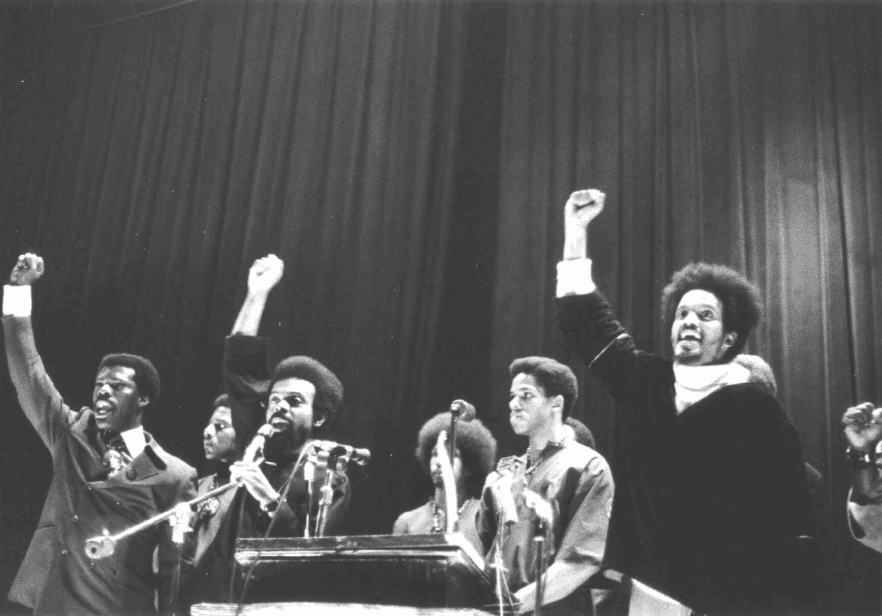
Right On! Photo by LeRoy Henderson
Souls: Think of Fidel when he came here to Harlem and met with Malcolm X.
AB: Well, they are my maximum culture heroes from that period. One of the reasons is that Fidel knew who Malcolm was. Fidel knew who Malcolm was clearly, he knew what Harlem was. That was a fantastic atmosphere in Cuba. I rode for sixteen hours on the train from Havana to Oriente province to hear Fidel speak. I sat in the mountains and listened to him speak for over three hours—to two million people standing up there in the sun.
That trip was the turning point for me. When I came back home, the fallout from The Hate That Hate Produced [the 1959 television program that brought the Nation of Islam and Malcolm X to broad public notice] was in the air.
Souls: That was the first time you saw him?
AB: Yes. I mean, I’d seen photos, but that was the first time I heard him speak.
Souls: When did you first hear Malcolm uptown in one of his rallies?
AB: Later the next year, ’61, ’62. But I didn’t meet Malcolm until a month before he was killed—in 1965 at the Waldorf Astoria Hotel. We were with Muhammad Babu, who had just overthrown the government of Zanzibar (and then they hooked up to Tanganyika to form Tanzania). The three of us talked for about six, seven hours, all night, until it was dawn. We were talking about a united front. I was saying that the NAACP is not doing anything, and Malcolm said, “You should be joining the NAACP.” And that’s what King said too: We don’t need these separate organizations, we need a united front. That’s why Stokely [Carmichael/Kwame Ture] and I have always said that. You can’t beat these people, you can’t establish democracy and self-determination with a thousand different organizations—from the vegetarians to the Katzenjammer Kids to the Muslims to the Baptists—you need a united front. In that way, we can argue about what it is that we’re going to do and say, but like the Congress of the United States—yes, we want representatives in the Congress—but we also want a Congress of Afro-American people to deal with what we want to tell the Congress of the United States to do.
Souls: You get back from Cuba, you have a whole new take on the Civil Rights Movement. One of the things you write is “What Does Non-Violence Mean?” It’s a wicked critique of the March on Washington. In many ways it parallels Malcolm’s “Message to the Grassroots” speech that he gave in Detroit in November of 1963. Can you talk about those parallels?
AB: Well, let me say this, it is heavily influenced by Malcolm. Looking back, I can see the stance I took in the essay was not wise in the sense that we should have all been working together instead of me beating up on Martin Luther King. But the reason I did that, to tell you the truth, had to do with the bombing of his house in Montgomery. I’m not criticizing Martin Luther King; I’m trying to analyze that situation. After the bombing, Black people show up at his house with rifles over their heads. They’re asking, “What shall we do, Dr. King? What shall we do?” He says, “If there be any blood shed, let it be ours.” That blew my mind! I was a young man, I didn’t do anything wrong. Why should I bleed? Are you crazy? We saw the folks getting beat up and spit on. We were from the North—remember, these are two different things now, Afro-Americans in the South, the Black Belt, and us, integrated up here, we did not take no shit from no white people because they were white. In the South they still had segregation, white and Black bathrooms, we didn't have that up here. There were more subtle forms here, but you could fight them. I went to a mostly Italian high school, and I'd walk up and down the street with my track spikes around my neck, tied together with strings, so I could hit them in the head if they bothered me. That was the difference between the North and the South. We couldn't understand what they were doing when King's house was burned. What is this? How are you going to let those people do that? Naw, get a baseball bat and whip their ass! But Dr. King was a master of manipulating that southern Afro-American Christian mythology and ideology.
Souls: Within that essay you also delineate a relationship between culture and politics. You're arguing that nonviolence means a proposed immersion into the mainstream of a bankrupt America.
AB: Well, that’s true. I still uphold that idea. It's Du Bois’s idea, essentially, the issue of: I want to be an American, but I don't want to have to dismiss my Afro-Americanness.
Souls: You're actually both, a higher consciousness.
AB: That's right, that’s exactly right. I finally learned, that’s the double consciousness that Du Bois teaches. That dichotomy in us—we are split in half if we're not clear that we are Black and Americans. One of those is, at this point, only theoretical. You definitely can’t question the Blackness—but you have to struggle for democracy as an American. We're Americans, Black Americans. I wasn't raised anywhere else, not Africa or the Caribbean. I was raised right in Newark. Our people come from the South. The South that my grandparents and mother, father, and uncle fled, to come up North—well, not being directly in that created a different sensibility in us. And that’s where Malcolm was coming from—the Midwest, Omaha, Roxbury, New York. He was a pimp, running with white girls, selling dope to Billie Holiday. That's a whole different sensibility than, say, the Black bourgeoisie in the capital of Afro-America, Atlanta. The capital of Afro-America in the North is Chicago. And Detroit is very close to that—Detroit Red, you see, that’s a different sensibility. Elijah Muhammad was from the South, but he came to Chicago, the capital, first Detroit, then Chicago.
Harold Cruse was our political teacher in Black Arts, but he couldn’t teach us nothing because we were irascible. There were three police agents in his class, can you believe that?
Souls: In 1963, ’64, you're still in the Village, yet all this ferment has occurred. In February and March 1964 three things happened: Jimmy Baldwin's Blues for Mr. Charlie opens, has mixed reviews—
AB: It's a great play.
Souls: Right, because at the core of the play is the struggle between the father and the rebellious son, and you see it as something like the dynamic between Malcolm and Martin, the tensions between them that were played up in the media.
AB: Right on the money, that’s exactly what it was.
Souls: Okay. Then a couple of weeks later Malcolm splits from the Nation of Islam. Three weeks later, on March 24, your play, The Dutchman, appears. Talk about this, those three things occurring at the same time.
AB: Hot, hot times. I met Jimmy when I was in college. The first performance of Amen Corner was at Howard University, and Owen Dodson was the director. I was just a big-eyed boy, eyes almost as big as his.
I think, of the voices that should be remembered from the ’60s, Malcolm, Martin, and Jimmy Baldwin have to be there. And to me [playwright] Lorraine Hansberry and James Baldwin are the ferment of the Black Arts Movement—A Raisin in the Sun and Blues for Mr. Charlie. I felt Jimmy was coming across so clearly that I knew the play wouldn’t last. That was the last time Jimmy was a fair-haired boy to the critical establishment. From that time on, he never had a front page in the New York Times Book Review; they replaced him. Jimmy and I became great, great friends—he was a very strong man, very clear, and an incredibly innovative novelist. People are not hip to that. I think his essays are more innovative linguistically, like that last one, Evidence of Things Not Seen.
Souls: In the summer of 1964 you were in Buffalo for a month giving lectures on poetry?
AB: Right, absolutely, in an all-white community.
Souls: Now Harlem was starting to erupt—what did you do?
AB: Me leaves Buffalo to get my gun [laughs] and goes to Harlem. Why?
Souls: The rebellion occurred.
AB: I’m a son of Afro-America, I’m not a tourist. I thought they were fighting. I’ve never had that kind of separation, that view of the artist as separated from the community. I’m a son of the Afro-American people, that’s what I believe. If they go to war, I’m in it.
Souls: You were still living, though, in the Village. How did you mediate this? And you were attracted to Malcolm during this period.
AB: Well, we did the play called The Slave. The kind of contradictions raging through me when Dutchman was done—I went down to the corner and read all of those reviews, there were a lot of newspapers in those days, and I thought, these people are going to make me famous. At that point, this huge sense of responsibility came over me, because I’d always been a wild young Bohemian. At that point I got very sober and felt, I can see my grandmother and grandfather and then thought, Oh well, this is what it was all about, they prepared you for this. All of those times we were in the kitchen eating sandwiches my uncle would take from the Pullman car. All those times you’re sitting there eating breakfast or lunch or dinner and someone says, “Remember that time down there in Dotson, Alabama, when them ole white people...”
I saw my mother do all kinds of things, short of boxing with those people. In Newark, we were in Fanny Farmer Candies one time, and she said, “I want a pound of these,” and the saleswoman said, “Oh, you mean the nigger toes?” And my mother says, “Those are Brazil nuts, lady.” I was a little boy, but you know what I heard, I heard her tone—that that’s the way you deal with that.
My mother had me taking trumpet lessons, drum lessons, painting lessons, piano lessons. I used to recite the Gettysburg Address on every anniversary of Lincoln’s birthday. I can recite James Weldon Johnson. I could sing Ave Maria and dance to A Little Girl from Calico. My sister was the only Black girl who took ice skating lessons. She took ballet, tap dance, singing. My mother was intent on having an artist or at least not a fool. No, it’s true. I read Black Boy when I was, like, twelve. I read Frank Yerby when I was a little teeny boy. I read King Solomon’s Mines, Dickens’s David Copperfield. Hey, we had it in our home. My grandmother claimed that the white lady [she worked for] gave it to her—now I can’t attest to that [laughs]. We had the whole library, I mean we had Dickens, H. Rider Haggard, Kipling, Yerby, Richard Wright’s first two books, the Rubaiyat of Omar Khayyam—and I would sit there and read them.
Souls: Can you talk about the Socialist Workers Party [SWP], as well as the party in relation to Malcolm X, while you were downtown around ’64–’65? You’d met Malcolm in early ’65, you’d just come back from a second trip to Africa, and he was hooked up with the Militant Labor Forum.
AB: Right. Everybody who heads toward socialism takes a look at the SWP first. They take notice of the Trotskyists because the Trots are talking directly about socialist revolution. And not understanding the relationship between democratic revolution and socialist revolution, you usually go for that—I did it too. I never embraced the Trots, but I used to read The Militant. I didn’t have any use for the SWP, though. First of all, I thought they were corny when I was down in the Village, and I never even checked them out until Malcolm got involved. Then I became interested. But when we start talking Black, a lot of the Blacks left the Socialist Workers Party and followed us back uptown, because they lived in Harlem, and they were working-class brothers, good brothers, strong brothers.
Souls: Malcolm is assassinated. You’re at the Eighth Street Bookstore, you hear that Malcolm is shot while a party is going on—
AB: It was a book party. I was down there being very literary, wearing dark glasses, you know, I was with my wife at the time, who was Jewish/white, and our little kids. We’re there on the steps with our friend Dorothy White, and the great photographer Leroy McLucas suddenly comes running in. “They killed Malcolm, man.” He’s crying, crying like a baby, and I'd never felt like that before—that was the end of that part of my life. Standing there, it seemed like there was nobody else around but me and the other Black people, crying; the rest of the folks had disappeared. And I was gone the next month. The next month I was out of there—wife, kids, everything—gone. Why? Because it suddenly felt as if it was a war going on. “What am I doing down here bullshitting with these people, and they’re killing Malcolm—that’s stupid!” I thought—and this is some more of that juvenile egotism—I thought, maybe, who knows, I might have saved his life, I might have jumped in front of the bullet or some shit, you know. I mean, what were we doing? We thought that we should not have been downtown. We should have been there with Malcolm. He’s the one who challenged Elijah Muhammad. We knew he was telling the truth, we knew that it was not the Nation of Islam that had attracted us. It was Malcolm, and it was about political struggle. This is not to say anything about Louis Farrakhan or the Nation today.
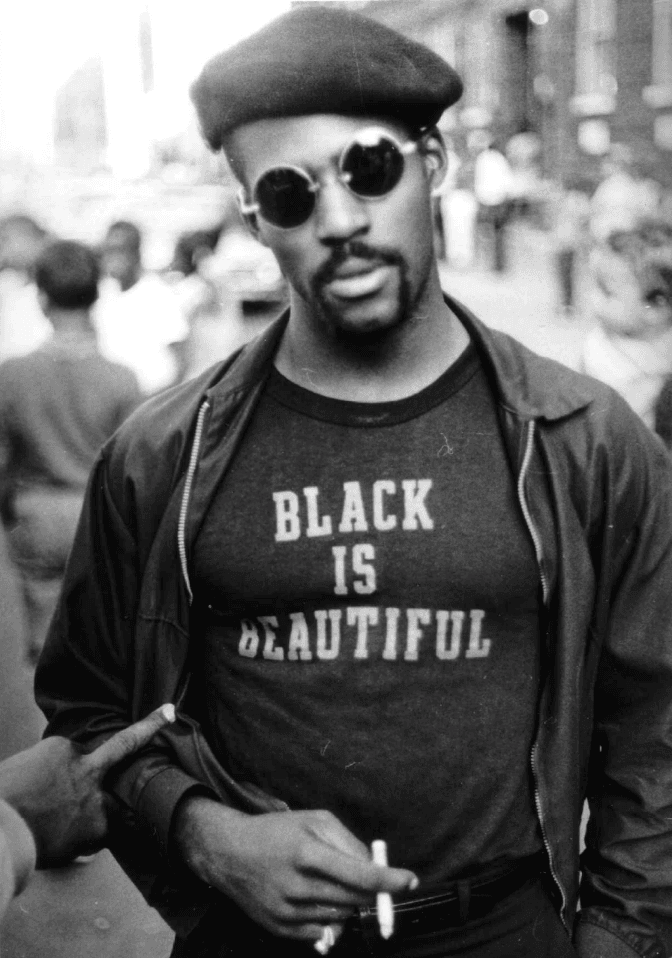
Photo by LeRoy Henderson
But then to actually leave where we had set down roots in that integrated community and to split to Harlem. . . . I had a little money, I bought a brownstone at 130th Street and Lenox Avenue, where the Black Arts Theatre was. All the artists were there every night, musicians like Sun Ra and Pharoah Sanders. We had the most advanced artists, the most advanced Black artists in the world there. We would put five or six trucks out every day, offering painting, music, poetry, drama, dance. They would go to parks, streets, bars. That’s why Black Arts became such an influential movement, because every night we were making presentations to the people and talking about art and politics. The aura of commitment was so deep, it wasn’t that you were blessed or nothing secret you possessed, it was that the people knew what you were doing, and they loved you for it.
But some people who disagreed with what we were doing were threatening us. Harlem had so many groups and factions operating, and a lot of them were violent, at least to each other. Those brothers who had left the SWP and come uptown with us probably saved my life during this time. The right wing of the Black nationalists got us locked up one time, and they busted my head on top of a police car. Then, because of the circumstances of Malcolm’s death, the Muslims were running around saying, “Don’t say anything about Malcolm X, don’t say anything about Malcolm X.” And we went around threatening certain people—stupidly—asking for money as if we were gangsters, and messing with Adam Clayton Powell, who was still so powerful in Congress then.
Next thing we knew, we had a visit from Bumpy Johnson [Elsworth “Bumpy” Johnson, dean of Harlem’s underworld]. Oh yeah. I was sitting in the Red Rooster [a Harlem night spot] one night eating, because I never went anywhere alone. I had just recently said something bad to Adam Powell, and this man comes up to me and says, “You’re LeRoi Jones? We love your work, we love what you’re doing, but everybody needs a friend.”
And then it dawned on me who he was—tall, slender, businessman-looking, and like somebody you know is telling you something for your own good. When he said, “Everybody needs a friend,” I turned into a little boy right about that time, and I said, “These people are threatening me and these people are trying to kill me.” He said, “Nobody’s going to bother you.” And nobody ever did after that.
He said, “Meet me tomorrow at my place, my office.” He had an office right next to FDR Drive, in a storefront. There were all these boxes stacked up, and they said Palmetto—you know, he was from Charleston—Palmetto Extermination Agency and at the bottom, We Kill Rats [laughs]. He said, “Well, welcome to Harlem.”
Because we were living downtown with white people, we didn’t know anything about Harlem. We thought we were going to go up there and be the liberators of Harlem—but you come talking like that and somebody will blow your head off, you know? So Bumpy came to straighten me out. He said, “Look, we love what you’re doing, but everybody needs a friend.”
Souls: Black Arts lasted for a year. Why did it crash?
AB: Because of the idea of Black. First of all, the idea spread around the world. That’s what its function was—that we represented and defended Black people. As a coordinator of that organization, though, I was a dismal failure. Why? Because people who disagreed over this or that wanted to kill each other. They would come up to me, “You kill...” or “Kill this m—f—” or “Please let me kill him.” That kind of stuff was happening every night, somebody was fighting.
Because we were Black; we had assembled around the idea of being Black. But Black is a damn splash of color, it’s not an ideology. You mean Mobutu Black? Roy Innis Black? Or Rochester Black? You know what I mean. What Black are you talking about? An African ideology, a European ideology?—what African, what European ideology?
In Black Arts there were Muslims, Black nationalists, the leftists, probably Communists. The police were spying on us. Harold Cruse was our political teacher, but he couldn’t teach us nothing because we were irascible. There were three police agents in his class, can you believe that? Maybe there were ten individuals in his class, three of them were agents. One of them was the one you saw bending over Malcolm after he was shot [Gene Roberts]. We had taken a photo of the class; a woman and two dudes were agents.
All art is political. It’s all propaganda. It’s all trying to convince you of something — emotionally, intellectually, by an analogy, a metaphor
Souls: What other ways did Malcolm’s assassination affect you?
AB: I wasn’t, as you know, ever connected with the Nation of Islam, but I became more connected to Islam when I left Harlem, because Malcolm had converted to Orthodox Islam, and I flirted with that. The only reason I didn’t go farther was my wife. Because Amina said, “I was in that, I’m not going back to it.” So it was a choice between the lady [laughs] or the religion.
Souls: What’s interesting is that your touchstone to Islam was Malcolm—as he developed ideologically, culturally—
I was raised with a kind of perhaps eccentric romantic kind of macho bullshit. To some extent, that helped sustain you going up against the biggest devil on the planet, but at the same time a lot of that is incorrect in terms of strategy and tactics
AB: He was our leader. We had no other leaders, you understand? We were young northern men, many of whom were intellectuals and artists. We couldn’t follow Martin Luther King. That Afro-Christian southern mytho-ideology did not take hold with us. I would not turn the other cheek. I did not believe in any God. I thought power came out of the barrel of a gun. I had been closer to Robert Williams than anybody else. [Williams, the revolutionary ex-NAACP official, was then in exile because politically motivated charges had been brought against him for a bogus kidnapping in Monroe, North Carolina.] In Cuba, I went with Robert into the American embassy when the state police back in North Carolina were coming up on his land, threatening his wife and kids. He went into the American embassy and pulled a gun on the ambassador. He said, “You call Washington, motherfucker, and get those people off my land!” Rob knew that nothing was going to happen to him in Cuba.
That’s what I was raised with—that kind of perhaps eccentric romantic kind of macho bullshit. To some extent, that helped you sustain going up against the biggest devil on the planet, but at the same time a lot of that is incorrect in terms of strategy and tactics. How do you organize? If you want to win, it’s not about what comes out of your mouth so much as, What is your practice? How do you organize people? How do you preserve yourself and destroy the enemy? Those ideas are what’s important.
Souls: You wrote a piece about Malcolm right after his death called “The Legacy of Malcolm and the Coming of the Black Nation.” Could you flesh out what you were thinking when you wrote this?
AB: What I’m describing is my own transition, because for the first time I could see past the rhetoric of church or religion, Islam and Yacub [in Nation of Islam theology, Yacub is the mad Black scientist who invented the white race]. I could see the political line that Malcolm was laying out. The question first is self-determination, that you must declare yourself. As long as we are content to be simply Americans and not Black Americans, then we are in trouble, you understand? This is not separatism—it’s the attempt to unify the two halves of your own development. We have always fought for democracy, though we had none—we were slaves for three hundred years. How could this be a democracy if we were slaves? How can it be a democracy when this president stole the election? We have to struggle for democracy, but even to do that, we have to create the weapon, the vehicle, the instrument ourselves. Martin Luther King helped create SCLC [Southern Christian Leadership Conference]; the U.S. government didn’t. Stokely and the others created SNCC [Student Nonviolent Coordinating Committee]. There wouldn’t be any voter registration in the South if not for a Martin Luther King or a Stokely Carmichael—the government didn’t achieve that. It was those kids, including the white folks who went down there and fought those people, who achieved that. It was the Stokelys and the Rap Browns and the Viola Liuzzos, and the Chaneys, Goodmans, and Schwerners who fought those people for voter registration, not the U.S. government—they were against it. That’s what’s going to have to happen for us to get democracy: We’re going to have to create our own instruments, our own organizations to become full citizens of this country. How long will it take us to get democracy if we wait for G. B. the II [George W. Bush]?
Souls: Malcolm is killed, you go to Harlem, then you go back to Newark, and during this period you’re creating a series of works that deal with the connection between race, white supremacy, and the necessity to construct out of culture a new kind of politics and consciousness. You do the play Black Mass. Talk a little bit about this, because there is a great deal of controversy about it. There is a body of literature that critiques it because it lifts up what was considered by many the Nation of Islam’s Black supremacist, anti-white story of Yacub.
AB: It doesn’t matter that I was writing about Yacub and the creation of white people as preached by Malcolm from Elijah Muhammad. If you look at Black Mass, it’s about the relationship between art and politics. The main argument is, “What are you creating that for? You do not need to create that; create only that which needs to be created.” Because Yacub, according to Elijah Muhammad, is creating the white man, the play is arguing over the question, “Why are you creating this creature? This thing has no soul”—it’s art for art’s sake. What is he saying, Yacub?: “I am creating, brother; creation is its own reward.”—that’s art for art’s sake.
Now that’s been my concern all the time, but what I gleaned from my interpretation of Malcolm and Elijah Muhammad is that the story of Yacub speaks about creation that is disconnected from human needs. When people say, “Well, your art is political,” I say, “All art is political.” Mao Tse-tung says what? “All art is propaganda, not all propaganda is art.” It’s all propaganda. It’s all trying to convince you of something—emotionally, intellectually, by an analogy, a metaphor. But the point is, what good is it, does it do us any good?
Souls: Going back to your earlier comments regarding the struggle for democracy and self-determination, what approach do you think we should take to build our case here in the U.S.?
AB: Well, here in the United States we’re going to have to go to the UN, we have to go to Congress, we’re going to have to build institutions—and we’re going to have to be able to stalemate these people and tell them what we want. There has to be in the United States a bureau of Afro-American affairs. We have to have autonomy. The Afro-American nation, if you will, the Black Belt, that contiguous area down South where we lived—South Carolina, North Carolina, Georgia, Mississippi, Florida—versus the twenty-seven cities that we lived in the North. Each one of those cities replicates the Black Belt; the ghetto is nothing but a little Black Belt. We have to understand that we must come together. We are forty million people who constitute a plurality or majority in twenty-seven cities in this country, and we have a gross national product of 490 billion dollars a year. We should be ashamed to be beholden to anybody.
We have to have guaranteed political power in all these places where we're a majority and proportional representation in all of the places where we're a plurality. We do not need to be no unrepresented bumpkins, you see. It’s going to have to result from a deal. Because otherwise. ... We've never fought any kind of major revolutionary war against the white rulers of this country, except in the Civil War; two hundred thousand Black people went and killed every one of those slaveowners they could find. But that was in the name of the United States government.
The point is, we are Americans. We're not asking, and we're not trying to pull any sedition. You have to get very clear on that or otherwise you'll be in jail. We're not trying to pull sedition. We are Americans. We want our full citizenship rights. We want reparations, we want political power, we want regional autonomy. Those are clearly things that have to be dealt, negotiated, you understand? Now the threat of “you got a gun” and all that—naw, you'll lock me up.
But I'll have forty million people here organized to stop every fucking thing that you want to do. No mail, no trucks, no food, can’t even get your hotel room clean. I can bring this country to a stop. I'll let the garbage pile up to the sky. That’s the way it’s going to be done. Our sons and our daughters, they'll say, “Okay. America, when you get smart enough to understand we're persons too and we're Americans, we'll start it again. But now we're gonna go fishing.”
We are Americans. We want our full citizenship rights. We want reparations, we want political power, we want regional autonomy
Hey, forty million people here, gross national product of 490 billion dollars a year. We have a larger population, a larger gross national product than most of the nations in the United Nations. We're not a little people. We're better educated than most people, even as poorly educated as we are. Look at the Black students walking around Columbia, Yale, Harvard—this is no joke. When we decide what we want, the white rulers will follow, because they have no choice. That's the point. We can scream and holler about crazy white people all we want to, but it’s not on them, it’s on us. When we become mature enough to say, This is the Afro-American Congress, this is our commonwealth of 490 billion dollars—we want reparations to match that, we want damages, the national debt you've given away, we want that. Those tax cuts you're giving away, we want that, we want equality in every sphere—housing, education, health. Everything you’ve got, we want—except the ignorant ideas.
Souls: And how do you think we can achieve this?
AB: That’s going back to the idea of the united front. I've known the issue of the united front was strong from the time I got to know Percy Sutton, when he was Borough President of Manhattan, and when he began to put together the National Black Assembly [following the Gary, Indiana, National Black Political Convention in 1972]—that’s how I got to meet all the major politicians. We were organizing that together, and Percy headed up the New York State Delegation, which was very powerful. He and Charles Rangel, Basil Patterson, they had a part. Once they secured power in the coalition, though, the electoral politicians neutered us [the community and independent political organizations] more and more. I was going to the left politically, and I started making stupid statements, ultraleft statements. But most important, the National Black Political Convention and the Black Assembly were what we needed at the time. Every state was represented at the convention proportionally according to the percentage of Black people in the state’s population. Eight thousand people were there, and it was a struggle, but every major electoral politician came out of that struggle, every one.
I’ve learned that the united front has to be based on the struggle for democracy and opposition to imperialism. It cannot be based on religion, or strictly on one ideology. It has to be based on what we are trying to get. Now, I’m not going to make Farrakhan a communist, and he’s not going to make me a Muslim. I have great respect for Farrakhan, who I mostly do not agree with—but I agree with him in his opposition to imperialism.
Black people can sit in a congress just like Teddy Kennedy and Trent Lott sit in the U.S. Senate—that’s what I mean, they’re in there together. When they have to deal with an issue, they say, Well, I don’t agree with that, but that’s the law. They’ll have to say, I don’t agree with what these Negroes are talking about, but they voted for it, so we’re going to do it. That’s the way it has to be.
If you’re not sophisticated enough to handle things that way, then you don’t know anything about world power. You're never going to get everybody to agree with you totally. You live with folks, you love them, but you can’t get them to agree on everything. That’s the nature of human life. You can say, “We don’t want nobody coming in our house,” and yet she can like a red shoe, and I’ll like a green shoe—but if you come in our house, we’ll both shoot you at the same time [laughs]. That’s the point.
Past Editions
1.
"A Son of Afro-America": Talking with Amiri Baraka
The Editors
2.
A Scholar in Struggle
Clayborne Carson
3.
And the Beat Goes On: Challenges Facing Black Intellectuals
Kathleen Neal Cleaver
4.
Beyond the "Real" World, or Why Black Radicals Need to Wake Up and Start Dreaming
Robin D. G. Kelley
5.
Black Intellectuals: The Perennial Question
James Jennings
6.
Black Thinkers at Sea: Ferdinand Smith and the Decline of African American Proletarian Intellectuals
Gerald Horne
8.
Def America: Russell Simmons
Manning Marable & Cheryll Greene
9.
Thinking Black
The Editors