Aftermath
Hazel Carby
Although I have been writing and thinking about geographies of race and gender in the United Kingdom, I find it deeply disconcerting to see how rapidly many around me have adapted to a new calendar to govern their lives. They have found a way to measure time and a means by which to locate the body in relation to the world that existed before and the world that existed after September 11, 2001. By this new calendar, this way of measuring and locating the self, I do not mean to conjure the triggers for memory and positioning of the type that articulates itself as, “I will never forget where I was and what I was doing when President Kennedy was shot,” or, “when British troops were first sent to Northern Ireland.” Rather, what I want to name, to bring into focus, is a seismic shift in public and private discourse about the relation of the self to the other, of friend to foe, of home to foreigner, that has occurred within the borders of the United States since September 11. As I write, bodies seem to be in suspended relation to each other while concepts of citizen and subject are renegotiated.
In this discursive crisis the United States, as a national body politic, is being reconfigured as “home,” the exact nature of that home having yet to be determined. What has been established by the Bush Administration through its invention of the Office of Homeland Security and confirmed by the media, particularly The New York Times and CNN, is that the nation is a home that needs to be defended not only from an external but also from an internal threat: Within the confines of “home,” its inhabitants are subject to a rapid surveillance of their legitimacy, a process overdetermined by the language and practices of racialization.
There is a vast disjunction between the everyday familiarity with the language of globalization and the utter incomprehension that the foreign policies of the United States, which cause death and destruction on a daily level abroad, have any effect at “home.” Because we have just now experienced these effects, we are, as President Bush initially characterized it, on a “crusade.” To protect and preserve freedom, freedom must be curtailed for some; perhaps for many it will be destroyed.
The United States is also an empire. The world’s most powerful nation has enormous reach: the home has a back garden, which justifies the overthrow of democratically elected presidents of foreign countries and the invasion of Grenada; the home has international interests, which justifies the maintenance of United States troops near the oil fields in Saudi Arabia; and so it goes. When Madeleine Albright was asked on national television what she had to say about the deaths of 500,000 Iraqi children, deaths directly attributable to U.S. sanctions, she responded in the august tones of a U.S. Secretary of State that it was “a very hard choice,” but “we think the price is worth it.” The political calculation and weighing of bodies is absolutely central to foreign policy and the defense of the homeland. Arundhati Roy has recently called this thinking, “the sophistry and fastidious algebra of infinite justice.” She asks, “How many dead Iraqis will it take to make the world a better place? How many dead Afghans for every dead American? How many dead mojahedin for each dead investment banker
Our new homeland threatens to look nothing like the international, cosmopolitan, multicultural and multi-ethnic urban community that was destroyed along with the World Trade Center Towers.
The moment of crisis—as I write, it is difficult to imagine when this historical moment will end—is riven with contradictions. “Home” is full of multiple bodies seemingly endlessly divided, in which neighbor can be, has been, cast as potential enemy. Although these divisions appear to be absolutely transparent, exactly who should be blessed by God as opposed to subjected to his wrath (courtesy of the U.S. military), exactly who is to be unified with whom, exactly who should be embraced and comforted while others are spat upon, assaulted, even murdered, is not in fact clear. It is at this precise moment of crisis and confusion that the racialized politics of the body plays out its most deadly logic at home and abroad.
But racialization is not the only lethal weapon at work. For example, the persecution of gays and lesbians in the military has been suspended so they may go and fight for us—are “they” to be fully embraced within the confines of national domesticity permanently or merely temporarily? While the bodies of gays and lesbians are deemed suitable to be launched against the enemy, wherever it may be, their blood, which will obviously be shed in such confrontation, is not classified as suitable to be donated to the Red Cross.
We are deeply divided despite the endless sea of Stars and Stripes that hang from the porches of my neighbors, which I can see from the window of my study and out of the corner of my eye as I write in my local coffee shop. The Stars and Stripes flutter from pick-up trucks, minivans, and SUVs, the favored vehicles of the small New England town in which I now live—palpable evidence, supposedly, of their drivers’ love for, and preparedness to defend, this homeland, as they simultaneously belch their carbons into the atmosphere in complete disregard of the consequences. (In 2001, in Connecticut, there have already been twice as many days of “bad air” as there were in 2000 Bodies have to breathe, but, hey, we can’t put limits on freedom, even if asthma is killing our children! I guess the principle at work is that we are allowed to kill our own children in order to preserve our right to pollute, as long as others don’t threaten their lives. And now we march off to kill the “others” in defense of these freedoms.
We as a nation are deeply divided despite the endless sea of Stars and Stripes that hang from the porches of my neighbors
Stars and Stripes, with declarations that “We will prevail” and “God Bless America,” have been hastily but carefully drawn on blankets and draped over the bridges of I-95, under which I drive every morning. Stars and Stripes, cut from the pages of a local newspaper, are glued to the front of the desk of my administrative assistant as a wall of defiance should any terrorist enter our departmental office. Many of us in our department could be racially profiled at a glance as potential terrorists, with our brown skins, dark hair and eyes: We must be careful about the way we dress. My flag-waving neighbors (white) are very satisfied that they live in almost total segregation from the residents of New Haven (black), let alone New York City, a veritable Sodom and Gomorrah that very few ever visit. I do not mean that their outpouring of grief for New York is not genuine, but I do mean that One Nation Under God cannot, must not, be taken for granted as an obvious historical entity. On the contrary, it is being ideologically constructed anew: It is being called into being every day: a homogeneity is being forged in front of our very eyes. It is being shaped by fear; it is being heralded by a blind jingoistic fantasy; and it is being fueled by racial thinking. Our new homeland threatens to look nothing like the international, cosmopolitan, multicultural, and multiethnic urban community that was destroyed along with the World Trade Center Towers.
Meanwhile, in Britain, as gung ho Tony Blair treads the globe rallying folks to the American cause, October is Black History Month, and the BBC Radio 4 ferrets me out of exile to talk about whether C.L.R. James should be regarded as an Uncle Tom!
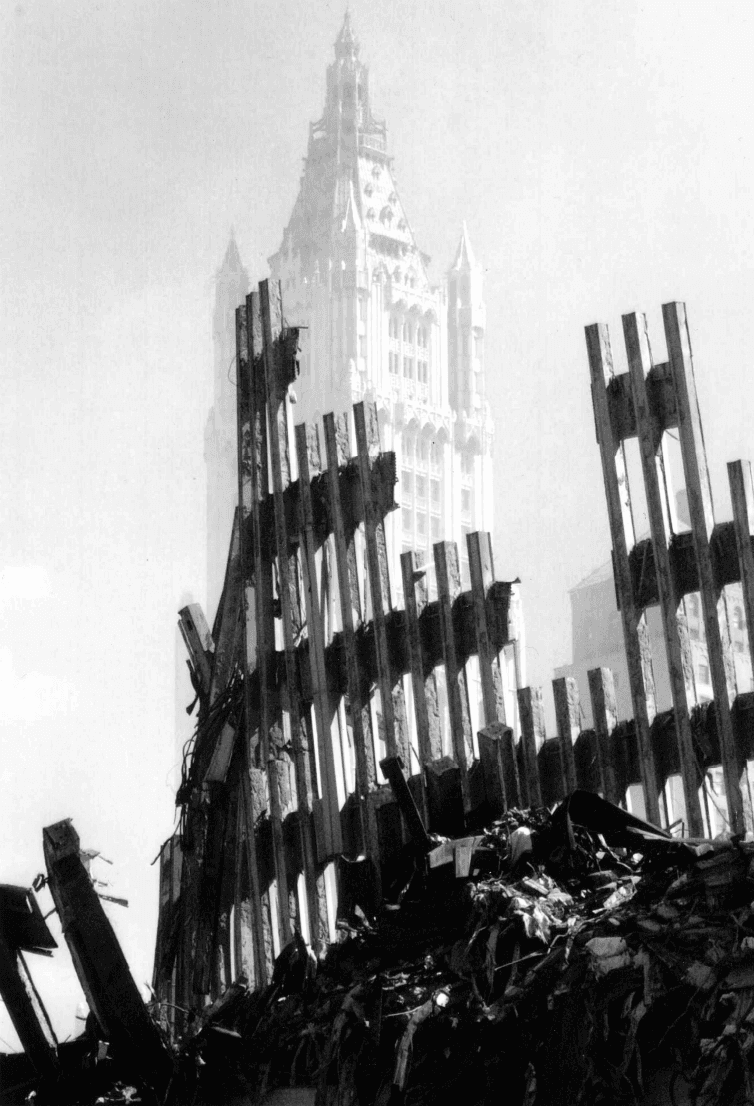
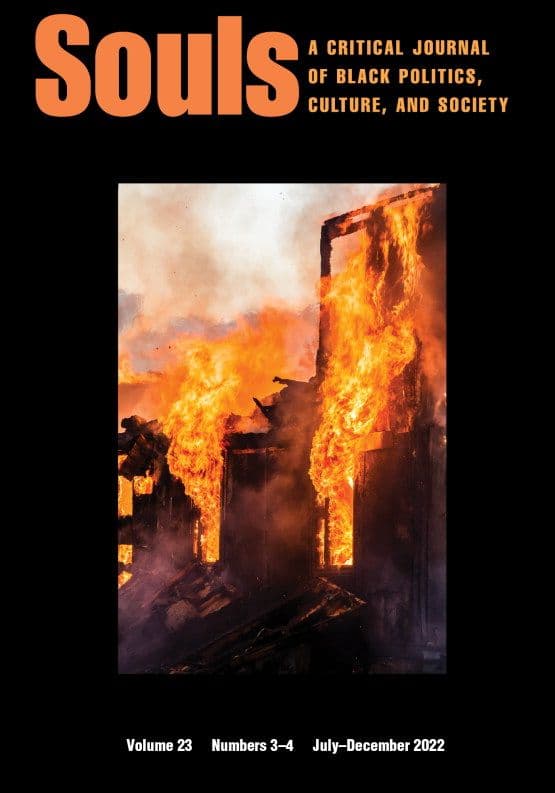
The Remains. AP Photo/Ruby Washington
FOOTNOTES
1Arundhati Roy, "The Algebra of Infinite Justice," www.guardian.co.uk/Archive/Article/0,4273,4266289,00.html
2As reported on NPR, October 3, 2001, there were 13 days of bad air in 2000. There have already been 25 days of air designated as bad as of October 1, 2001.