B-Boys and Bass Girls:Sex, Style, and Mobility in Indian American Youth Culture
Sunaina Marr Moira
New York City is home to a flourishing youth subculture created by second-generation South Asian Americans. This subculture centers on music and dance, specifically the fusion of Hindi film music and bhangra, a North Indian and Pakistani dance and music, with American rap, techno, jungle, and reggae In this article, I focus on the sampling of hip-hop by Indian American youth and the implications that this remix youth culture has for their social relationships with black youth and their political understandings of race. The racial project that second-generation Indian Americans undertake in positioning themselves vis-à-vis black and Latino youth in the racial formation of the United States is negotiated through performances—and fantasies—of authentic Indianness that are deeply gendered and sexualized. | argue that desi youth use this remix culture to negotiate not just questions of ethnic authenticity but also their relationships to ideologies of class mobility and representations of blackness, particularly black masculinity. In doing so, I want to offer a materialist analysis of sexuality as performed in this youth culture, linking cultural nostalgia to wet dreams of escape from the model minority myth.
Remix music parties are obviously just one of many social spaces that youth traverse on a daily basis, and the racial ideologies negotiated in this space are linked to the experiences of youth at school and work or in family or peer relationships. This article is based on an ethnographic study that focuses on second-generation Indian Americans in these various sites (Maira forthcoming), but 1 have found that it is in youth popular culture where many of these discourses of racial ambiguity, ethnic yearning, and gendered authenticity converge. Youth culture has been constructed as a site where young people can perform these various social identities, partly through the campaigns of the music, fashion, and media industries. At the same time, as Robin Kelley points out, it is important to consider the ways in which youth may be at “work” while they are presumably at “play,” for the divide between “leisure” and “labor” is blurred by the increasing commodification of youth culture and the entrepreneurial activity of youth who put “culture to work” for them as a source of income (Kelley 1997). This article traces the complex and often contradictory discourses and performances of race in this subculture at a particular moment in the late 1990s when the Indian remix music party scene had exploded in New York City.
Sunaina Marr Maira
Bhangra Beats and Desi Parties
Bhangra remix music constitutes a transnational popular culture in the Indian/South Asian diaspora; it emerged among British-born South Asian youth in the mid-1980s and since then has flowed between New York, Delhi, Bombay, Toronto, Port-of-Spain, and other nodes of the South Asian diaspora (Gopinath 1997). Although this “remix youth culture” has emerged in other urban areas in the United States that have large Indian American populations, such as Chicago and the San Francisco Bay Area, these expressions are necessarily shaped by local contexts. There has not as yet been much comparative work on this topic, but it is clear that the New York setting lends certain distinctive features to this youth culture in Manhattan: DJ Tony, of TS Soundz in Chicago, pointed out to me that whereas Chicago remixes tend to use house and techno music, New York deejays favor remixes with rap music, and participants in this local subculture tend to adopt a more overtly “hoody,” hip-hop—inspired style (see Sengupta 1996). Hip-hop, however, is remixed with elements of Indian popular culture (folk music and Hindi film music) and with Indo-chic style (bindis and nose rings) even as it remains a powerful referent in this desi youth culture; there exists, however, a parallel, but not always convergent, subculture of Indian American youth who enjoy rap and who sometimes remain on the fringes of this party scene. The politics of the remix youth subculture emerges in the context of a very specific, hybridized cultural formation and is not always coeval with that of what DJ Key Kool calls “Asian Americans in hip-hop
The subculture that has sprung up in New York around Indian remix music includes participants whose families originate from other countries of the subcontinent, such as Bangladesh and Pakistan. Yet these events are often coded by insiders as the “Indian party scene” or “desi scene,” where the word “desi” signifies a pan-South Asian rubric that is increasingly emphasized in the second generation and that literally means “of South Asia,” especially in the context of the diaspora. Although these groups share certain cultural codes in South Asia and common contexts in the United States, certain aspects of ethnic and national identity obviously play out in particular ways for different national and religious, not to mention regional, groups. The “scene” is a differentiated one: There are Indian American youth who are not in college and who also attend these parties, and there are “Indian parties” held outside Manhattan as well, such as on campuses in New Jersey and Long Island where there are large South Asian student populations. Manhattan, however, provides a particular context for desi parties because of the presence of city clubs, such as the Madison, the erstwhile China Club, or S.O.B.’s (Sounds of Brazil), that draw large droves of South Asian-American youth, who get down to the beats of bhangra. S.O.B.’s, a world music club in downtown Manhattan, has been home to one of the most well-known regular “bhangra parties” since March 1997, when DJ Rekha launched BaseMent Bhangra, the first Indian remix music night to be featured monthly on the calendar of a Manhattan club—and the first to be hosted by a woman deejay. The phenomenon of desi parties fits in with the larger structure of clubbing in New York and other cities, where clubs host different “parties,” or nights that are ethnically, racially, and sexually segregated, and that feature deejays who can spin the right kind of mix for their targeted audience, as noted in a special New York Times Magazine issue on New York subcultures: “If you club in New York these days, you spend your daylight hours in a living, breathing United Nations and end your nights in an all-but-segregated society. There are the Italian American jams (where they spin house and hip-hop), Russian-Jewish (hip-hop, R & B), gay (dance, house, disco), black highbrow (hip-hop, R & B, soul), black lowbrow (hip-hop, hip-hop, hip-hop)” (Touré 1997: 98). The marking of distinctions such as “lowbrow” and “highbrow,” associated with particular club spaces and music genres, illustrates the ethnomusicologist Martin Stokes’s observation about the production of social spaces in music: “The musical event ... evokes and organizes collective memories and present [sic] experiences of place with an intensity, power and simplicity. ... The ‘places’ constructed through music involve notions of difference and social boundary. They also organize hierarchies of a moral and political order” (1994: 3). It is this power of music, and dance, to evoke a sense of “place” in a social hierarchy as well as a spatial location that makes possible the collective nostalgia for India as well as the gauging of subcultural status evident at remix music parties (Maira 1999). With the pervasiveness of popular culture consumption by youth, music has become a ritual that is important in the socialization of youth into racialized, ethnicized, and class-specific subcultures that extend in scope from local to transnational.
The music at desi parties is remixed by Indian American deejays who perform at events hosted at local clubs, restaurants, and college campuses by party promoters, generally young Indian American men and women, some of whom are college students who do this as a source of part-time income and who have helped create an urban South Asian-American youth subculture. (Nearly all the deejays that I met or heard about were Indian American, a point that deserves further reflection.) Every weekend, remix parties in Manhattan attract desi youth from New York, New Jersey, Connecticut, and even Pennsylvania, areas that have large concentrations of Indian, and South Asian, immigrant families as well as South Asian-American student populations. Cover charges are steep but not atypical for New York parties, ranging from ten to twenty dollars, yet the parties draw hordes of youth from a range of class backgrounds who are willing to fork out money for leisure activities. Partygoers are for the most part second generation, although there are generally some first-generation South Asian youth in the crowd as well who participate in the redefinition of desi “cool,” in its urban, New York/Northeast incarnation, through the creative use of elements of popular culture. In conjunction with the fusion of musical genres, this subculture displays the construction of a culturally hybrid style, such as wearing Indian-style nose rings and with hip-hop fashion, and performing ethnic identity through dance, as in the borrowing of folk dance gestures from bhangra while gyrating to club remixes. Underlying the debates about youth popular culture is always the problematic of consumption and the relationship of youth to the labor market, for there are Indian Americans who are not in college and who attend these parties, and there are strains of materiality and class mobility that are mixed with the vibes of nostalgia in this subculture.
The creation of this Indian American, and South Asian-American, youth culture in Manhattan has, in part, been made possible by the presence of a large local Indian immigrant community. New York City currently has the “largest concentration of Indians [of any metropolitan area] (about 10 percent of total 1990 population in the country)” (Khandelwal 1995: 180). According to the 1990 census, New York City had 94,590 Indian residents of a total of 815,447 in the United States. Although the earlier wave of Indian immigrants who arrived in the late 1960s and 1970s and spread to the suburbs of America were mainly professionals and graduate students, New York City and New Jersey have seen an influx of South Asian immigrants in the 1980s and 1990s who are less affluent and highly educated. New York City is one of the primary receiving areas for Indian immigrants to the United States because of two major factors: First, the local labor market offers a range of employment opportunities, ranging from engineering jobs in New Jersey and Connecticut to employment in hotels, motels, banking, insurance, public health, garment and jewelry businesses, and the import/export trade (Lessinger 1995). New York City has traditionally favored small, family-owned retail businesses over national chain stores, accounting for the increasing number of Indian entrepreneurs and small business owners, some of whom run the newsstands dotted throughout the city and others of whom own businesses that serve the growing South Asian-American market. Working-class Indian immigrants or middle-class Indians who could not find the jobs they had hoped for sometimes find employment in the service sector or unskilled labor market (Lessinger 1995). An industry that has absorbed many South Asian immigrant men, particularly from agricultural regions in the Punjab, is the taxi industry in New York; in 1992, the Taxi and Limousine Commission of New York City reported that 43 percent of Manhattan-based yellow cabs were driven by South Asians, equally represented by Indians, Pakistanis, and Bangladeshis (Advani 1997); in 1999–2000, that figure was close to 60 percent (Esser et al. 1999). The second reason that has motivated many Indian immigrants to settle in New York City, at least initially, is that many have immigrated through family reunification categories, especially in the 1980s and 1990s, and choose to live close to relatives already settled in the area or in localities where they know there are other Indian families.
Khandelwal (1995) points out that whereas earlier immigrants primarily founded pan-Indian organizations and sponsored public performances of classical Indian arts, later immigrant waves have spawned the growth of regional organizations and sectarian religious institutions that cater to specific subgroups within the Indian American community. There has been a popularization of Indian “culture,” with Indian film stars and musicians playing to packed stadiums, such as the Nassau Coliseum, and spectacular celebrations, such as the Gujarati festival of Navratri, accompanied by the traditional dandiya-raas dance, organized in towns in New Jersey. These events, and the organizational and material structures that sustain them, form part of the landscape in which the desi party subculture was created by second-generation youth, drawing on bhangra, hip-hop, and techno beats and remixing cultural nostalgia with the polychromatic sounds of “cool.”
Subcultural Theory and Second-Generation Youth Culture
Viewing this Indian-American youth music and youth style as products of a subculture draws on the particular tradition of Marxist cultural studies associated with the Center for Contemporary Cultural Studies in the United Kingdom and is an attempt to highlight the importance of its incipient materialist ethnography (Kirschner 1998; Turner 1996). The term “youth subculture” refers to a social group that is distinguished by age or generation, but theorists of youth subcultures also note that the category of “youth” is one that is socially and culturally constructed and has often been the focus of debates over social control as well as a marketing principle for the music and fashion industries (Clarke et al. 1976). The Birmingham theorists strategically chose to use the term “subculture,” rather than “youth culture,” because they argued that the latter descriptor obscured the links between the cultural construction of youth as a distinct category and the creation of a “teenage [consumer] market”; the concept of a “subculture,” in their framework, was embedded in a deeper structural explanation of the dialectic between “youth” and youth industries (Clarke et al. 1976: 16).
This provides the basis for the Birmingham school’s central argument, which has had a significant influence on cultural studies, that youth subcultures are based on rituals that resist the values inherent in the dominant culture. The creation of a subculture is understood as a response to the personal, political, and economic contradictions or crises that youth confront on the brink of adulthood (Clarke et al. 1976). The Birmingham school’s approach to subcultures has met with some criticism from cultural studies theorists and sociologists who point out that this school of subcultural theory often overinterpreted social action in terms of resistance and symbolic resolution (Cahen 1997; Epstein 1998). Contemporary subcultural theorists and researchers have a more complex vision of subcultures, but acknowledge that the basic tenets of subcultural theory, reaching back to its early Chicago school roots, are still useful (Duncombe 1989; Leblanc 1999; Sardiello 1998).
A contemporary American youth subculture that has been analyzed through the lens of subcultural theory and provides an important idiom for Indian American youth culture in New York is hip-hop. Tricia Rose (1994a, 1994b) views the language, style, and attitude of hip-hop as embodying a critique of the condition of urban youth who face unemployment, racism, and marginalization in a postindustrial economy. She suggests that rituals of clothing and the creation of a distinctive hip-hop style show not only an “explicit focus on consumption” (1994b: 82) but offer an alternative means of attaining status for urban African-American and Latino youth who have limited opportunities for social mobility. Rose describes hip-hop as a hybrid cultural form that relies on Afro-Caribbean and African-American musical, oral, visual, and dance practices. Thus it weaves a commentary on existing circumstances with references to ancestral cultures from the Afro-Caribbean diaspora to create a “counterdominant narrative.” Although interpretations of resistance and oppositionality have been problematized in contemporary youth culture studies, the politics of hip-hop as a social movement become apparent when the experiences of the youth Rose describes are juxtaposed with those of the Indian American youth in this study. By sampling Indian music, second-generation youth draw on the sounds from Hindi movies and Indian music that their parents introduced to them as children to inculcate an “Indian” identity. By remixing this with rap and reggae and donning hip-hop “gear” or the appropriate brand-name labels, Indian Americans display the markers of subcultural affiliation and material status used in a multi-ethnic, commodity culture. These second-generation youth occupy a very different class and racial location from most black and Latino youth in New York City, but they have adopted certain elements of hip-hop in fashioning their own second-generation style, particularly the use of clothing, of dialect, and of musical bricolage. What does this particular performance of ethnic “cool” tell us about the racial and ethnic locations Indian American youth are choosing for themselves, and what are the meanings of this consumption of blackness by desi youth and other Asian American youth?
‘Hoods and Hoochy Mamas: The Innocence of Tradition
The politics of “cool” in this hip-hop-inflected youth subculture become apparent in the contestation of sexual and gender roles and of racialized images of desire. The atmosphere at desi parties is as sexually charged as at most dance clubs, but the vibe is generally heterosexist, with the exception of parties that are more queer-friendly and attract slightly older crowds, such as Basement Bhangra, where there is an occasional drag performance, or the defiantly non-bhangra party Mutiny, which is cohosted by DJ Siraiki and DJ Rekha and has an explicitly progressive mandate encapsulated in its name. Notions of style and body image are embedded in deeper contradictions in the constructions of gender and heterosexual roles that are played out in remix youth culture and that are contested by some who find this constricting. Often this contestation is played out in not only gendered but also racialized terms, with an underlying concern about appropriate femininity and the perils of racial border-crossing. Manisha, an Indian American woman whose friends were mainly African American and Latino and who often dressed in hip-hop gear—with a gold “Om” pendant dangling around her neck—reflected that “Guys can get away with [the ‘hoody’ look] but girls who are considered ‘cool’ dress prettier. I think the guys are intimidated by that [girls with a hip-hop look], it’s taken as a sign of being closer to Latinos or blacks, of being outside of the Indian circle, as I am ... the guys may think we’re rougher, or not as sweet.” Women are expected to embody a certain kind of ethnic affiliation through style and through the performance of an authentic Indian American femininity that resists influences of black and Latino cultures. There seemed to be two other kinds of heterosexual femininities idealized in this second-generation subculture that fitted into the virgin/’ho (whore) dichotomy and that not only contradicted the “gangsta girl” image of black-identified femininity but also, through opposition to each other, evoked the tensions between desires for nostalgia and “coolness.” Many women noted that the sexually provocative style of women at remix parties—the “hoochy mamas”—was considered more alluring than the androgynous hip-hop look and contrasted with male ideals of chaste Indian womanhood. I argue elsewhere that the chastity, of second-generation women becomes emblematic not just of the family’s reputation but also, in the context of the diaspora, of the purity of tradition and ethnic identity (1998a, 1999). This chaste, presumably unhybridized femininity becomes a defense against the promiscuity of “American influences” and of the ethnic betrayal enacted through adopting a presumably black or Latino style, as suggested by feminist and postcolonial analyses of the gendering of nationalism and of “the woman question” (Bhattarcharjee 1992; Chatterjee 1989; Dasgupta & Das Dasgupta 1996; Mani 1993). Images of heterosexuality and style for Indian American men are seemingly not used to index issues of ethnic authenticity as they are for women. Here ] want to focus on the production of a particular masculinity that mediates the tensions of racial positioning and class aspirations for second-generation youth by drawing on both the local codes of “hipness” in urban youth culture and the immigrant mythologies of class mobility that rationalize the family and community’s displacement.
Appropriating Hip-Hop: Masculinity, Racialization, and Subcultural Capital
Dharmesh, a young man whose family lives in New Jersey, remarked that Indian American youth who grew up with blacks and Latinos, and even some who did not, often acquire “the style, and the attitude, and the walk” associated with these youth on coming to college. Hip-hop is not just “the Black CNN.” to use Chuck D’s famous phrase, but has become the channel for youth culture information in general, as Peter Christenson and Donald Roberts point out: “Of all the current popular music styles, the rap/hip hop culture most defines the pop cultural cutting edge, thus providing adolescents concerned with ‘coolness’ and peer status much crucial information on subjects such as the latest slang and the most recent trends in dance and fashion” (1998: 111). The music and media industries have helped make hip-hop a language increasingly adopted by middle-class and suburban youth (Giroux 1996; Kleinfeld 2000; Roediger 1998), with white consumers accounting for about 75 percent of rap album sales (Lusane 1992, cited in Christenson & Roberts 1998: 111). Hip-hop culture is resignified by Indian American “homeboys” when it crosses class boundaries, Sujata, a woman who grew up in suburban Connecticut, pointed out: “A lot of them are like total prep school, but they put on a, like, it’s this preppie boy-urban look, you know, it’s like Upper East Side homeboy, you know. Huge pants, and then, like, a nice button-down shirt, you know.”
There are various positions, nearly all of them hotly contested, taken by cultural critics on the issue of consuming cultural commodities across racial, ethnic, and class lines. Perry Hall offers a trenchant critique of the historical appropriation of black popular music, arguing, “A complex love-hate relationship connects mainstream society and African American culture—in which white America seems to love the melody and rhythm of Black folks’ souls while rejecting their despised Black faces” (1997: 31). Hall views this ambivalence, arising from racialized structures of power and difference, as an underlying current in the simultaneous denial of, and attraction to, appealing forms of black musical culture. The appropriation and diffusion of ragtime, jazz, rhythm and blues, disco, and rap at different moments have been marked by cycles of innovation of black musical forms, suppression and aesthetic rejection by the mainstream, followed by co-optation by white artists, absorption into the mainstream, and in some cases rejuvenation by contact with dominant cultural forms (Hall 1997). David Roediger, in his writing on ‘‘wiggers,” or “white niggers,” observes that
the proliferation of wiggers illuminates issues vital to the history of what Albert Murray has called the “incontestably mulatto” culture of the United States. The dynamics of cultural hybridity have long featured much that is deeply problematic on the white side. From minstrelsy through Black Like Me, from the blackfaced antebellum mobs that victimized African Americans to the recent film Soul Man, the superficial notion that Blackness could be put on and taken off at will has hounded hybridity. (1998: 361-362)
The question of hybridity is doubly complicated for desi youth in New York, for they are reworking hip-hop not only into their own youth culture but into a remix youth culture, one that expresses the cultural imaginaries of second-generation youth from an immigrant community of color. Dest youth turn to hip-hop, most fundamentally, because it is key to marking their belonging in the multi-ethnic, urban landscape of New York City. Sharmila noted that for many second-generation men, hip-hop style connotes a certain image of racialized hypermasculinity that is the ultimate definition of “cool”: “South Asian guys give more respect to African Americans than to whites because they think the style is cool. The guys look up to them because it’s down [fashionable]. They think, ‘I’m kinda scared of them but I want to look like them because they're cool.’” Black style is viewed as the embodiment of a particular machismo, the object of racialized desire and, simultaneously, of racialized fear. Ravi, who began going to Indian parties while in high school in California and has continued to do so in New York, reflected, “The hip-hop culture has just really taken off. It’s really appealed to the Indians, maybe just listening pleasure, the way it sounds, I guess. Maybe the toughness it exudes.” Roediger points out that “in a society in which the imagination of Blackness so thoroughly frames what both attracts and repulses whites,” American male youth often “identify with violence, scatology, and sexism in rap rather than with Black music and culture more broadly” (1998: 359, 361).
Some may argue that Indian American men are drawn to symbols of “tough” masculinity to counter the popular construction of South Asian, and more generally Asian American, men as somehow emasculated. Oliver Wang, in his work on East Asian—American hip-hop artists, argues that “Asian Americans use hip hop as a space to reshape their own self-image, to lay claim to a long-denied masculine and sexual character, and to challenge racially gendered stereotypes ... from sexually perverse and predatory opium addicts at the turn of the century to present-day caricatures devoid of masculinity and sexuality” (1997: 6-7). Yet very few of the young desi men I spoke to felt strongly about mainstream representations of Indian American masculinity as emasculated; although some did speak of being pegged as model students in school, they did not—at least consciously—connect this to the lure of hip-hop. Rather, Sunil, a member of an Indian American fraternity, was concerned about class-coded images of Indian American men as “convenience store owners” or innately nerdy students. Sunil traced these images to the two major waves of post-1965 Indian immigration to the United States: “Like toward the lower middle class, they say, ‘You’re the shopkeeper,’ the upper middle class, they’d say, ‘Oh, you’re this intellectual’” (for more on Indian American masculinity and its meanings, see Maira 1998a, 1998b). The fact that the critique of emasculation did not explicitly resonate with these Indian American men does not mean that they were unconcerned with the particular overtones of masculinity that are available to them through hip-hop, but this line of argument brings to light the ways in which “the authentic black subject in hip-hop” is rendered hypermasculine in the context of wider racist constructions of black and Latino men as hypersexual or macho and Asian American men as historically emasculated (Wang 1997: 14-15, 17) From what these Indian American men have to say, it is apparent that it is also the powerful appeal of hip-hop music and youth style, not to mention the sheer pleasure of the music, as they remind us, that draw them to hip-hop, as is the case perhaps for many other American youth and youth worldwide (Kelley 1997; Rose 1994a)—the resonance is “rhythmic” and not just “symbolic” (Christenson & Roberts 1998: 111).
Sharmila, however, thought that the “bad boy” image for Indian American men that presumably draws on hip-hop only had short-term appeal:
Because the whole ‘hood culture has entered Indians so much, a lot of girls are attracted to that. But that’s ... a lot of times it’s temporary, when they think about long-term, they want something stable, or they'll push their boyfriend to be more stable. ... But in the beginning girls are always attracted to the kind that are like more dangerous and more mysterious.
Sharmila hints at the underlying racialization of this “mysterious,” black-identified masculinity as excitingly “other.” This masculinity is sexy, at least while youth are immersed in this subculture, because it is read as contradicting the “stability” that women presumably find attractive later. This stability, for Sharmila, is defined in terms of psychological maturity as well as financial security, as typified in the “stable” image of a “doctor.” Sharmila said that this was because women can “brag” about their partner’s profession, again portraying women as deriving satisfaction from men’s social and economic capital.
Second-generation men were very concerned with the class ideal of masculinity held up for them by their families, more so than the women, who presumably desired this in a partner. Vijay said, “[To be} financially [successful is] very important; professionally, very important. You can’t date, like, a grunge figure or anything like that. He might be exceptional, but he doesn’t dress well, that sort of stuff matters a lot. I mean, basically, if he’s a lawyer, investment banker-sort of thing, right, fine.” None of the women I spoke to said that the traditional breadwinner role is what they desired in a partner themselves; on the contrary, several were explicit in noting that they wanted an egalitarian heterosexual relationship.
This idealized masculinity does not emerge solely from within this youth subculture but from the class aspirations and material concerns of families and communities. The desire for class reproduction or upward mobility is infused into the masculinity that is presumably the ideal for Indian American men that everyone wants but about which several youth are deeply ambivalent. A “hoody” image, connoting a dangerous, hypersexual masculinity, becomes a counterpoint to white-collar stability, suggesting that Indian American youth are not immune from the wider racialized stereotypes of black and Latino men as oversexed and underachieving. This “mysterious” masculinity is still portrayed as only a short-term alternative, a temporary spurt of macho play with “other” images, but there seems to be some degree of resistance to, or at least ambivalence about, the white-collar masculinity that awaits Indian American men. Homeboys may be sexy and exciting, but can white-collar masculinity be desirable?
An upward mobility that will increase the economic and social capital of an immigrant community depends in part on the assurance not only that members of the next generation will move into well-paying professions but also that they will marry and reproduce the heterosexual family structure. The transition from college to the workforce involves structural factors, as noted by sociologists concerned with predictions of second-generation class mobility, but also a willingness to participate in this class mobility, a subjectivity that is deeply gendered and sexualized and often worked out through struggles over what it means to be “cool” or “authentic” as an Indian American man or woman. Remix youth culture becomes a space in which the anticipation of heterosexual relationships between second-generation Indian Americans and the reproduction of the family and community’s boundaries is held in tension with fantasies about what a life outside of a “near-white” middle-class would be like. Black masculinity and economic instability become a counterpoint to the “traditional” heterosexual family structure and upward mobility that are linked to a nostalgia recalling an imaginary past, yet focused on its fulfillment in an imagined future.
Consumption becomes an important terrain for the negotiation of racial projects by youth because the use of music and fashion to express social identities in adolescence is an option made available by particular industries that target youth as eager consumers. The desi party scene is a space that is used as a source of part-time, or sometimes even full-time, income by deejays and party promoters who are young entrepreneurs savvy to the economics of popular culture. Indian American deejays in New York charge between two hundred and five hundred dollars, and up, for spinning at a party for one night, and many are now organized in conglomerates headed by a single star deejay. As in other dance cultures dominated by men at the turntables, this perhaps has something to do with the emergence of deejaying in the 1980s as a source of employment for young men of color who needed a source of income and who “put culture to work for them,” as Robin Kelley (1997) notes, a pathway now available to urban youth in various music subcultures who have become entrepreneurs in the culture industry (McRobbie 1999: 145). But the preponderance of male deejays, despite the prominence of DJ Rekha and a few other, less well known, women deejays in New York, also reflects the larger patterns in the music industry; the way musical knowledge and technology are shared and developed reinforces the homosocial bonds of generally masculinist music subcultures (Straw 1997; Whitely 1997: xviii).
Furthermore, although hip-hop has always been a hybrid form based on the sampling of sounds and words, many of the Indian remixes that sample rap lyrics are bootleg albums that do not respect copyright laws (Sominia Sengupta, personal communication 1997). As bhangra and Indian film remixes move into the mainstream and Indian deejays consider the possibility of signing on to major record labels, as the British-Asian artist Bally Sagoo did with Sony, there might be greater pressure to legalize this appropriation, but this does not necessarily transtate into equitable acknowledgment or economic payback for hip-hop artists, given the white-dominated ownership of the music industry (Feld 1998; Hall 1997). Or as the performance artist Danny Hoch sums up in Jails, Hospitals, and Hip Hop, his brilliant analysis of hip-hop and the white-dominated culture industry: “We'll take your culture from you, soup it up, and then sell it back to you.”
One way of rethinking the debates about “cultural appropriation” that holds in tension these material and ideological forces is offered by Daniel Miller, who describes consumption as a “moral project,” for commodities offer possibilities to reimagine cultural ideologies, such as those of “self” and “other.” He observes: “Consumption is simply a process of objectification—that is, a use of goods and services in which the object or activity becomes simultaneously a practice in the world and a form in which we construct our understandings in the world” (1995: 30). This, of course, draws on the classic Marxist notion of reification through commodity fetishism, that is, the relations between people become embodied in the relations between commoditics (°i*ek 1989: 31). °i*ek points out that human subjects often recognize, in theory, that social relationships underlie the relations between material objects, such as money, but in practice they act as if things have inherent properties; it is “in practice, not theory,” he argues, that they are commodity fetishists (31). This formulation may not always be true, for one can think of situations where the social relationships underlying consumption are indeed obscured or other contexts in which the line between “practice” and “theory” may be more blurred than °i*ek suggests, as subjects remain self-conscious about the social meanings of their acts of consumption. It is perhaps true of this remix youth subculture, however, that its participants recognize that their use of commodities, such as music and style, are linked to larger discourses of cultural nostalgia or racialized notions of hipness but may also desire these objects in and of themselves.
The dual discourses of authenticity operating in remix youth culture, the authenticity of subcultural cool and that of collective nostalgia, are embedded in each other and sometimes reinforce but also contradict each other, as their “moral projects” lead youth to different understandings of how to be “Indian” at this particular moment in New York. There may be no “authentic” reading of the consumption of hip-hop by desi youth, but there is indeed a politics of authenticity that has meaning in the lives of these youth at this particular moment in New York City and that is constantly being negotiated with references to their positionings in a larger Indian diaspora and to global flows of culture. The globalization of mass media in the era of late capitalism has certainly resulted in the seeping of black-identified American popular culture and fashion into remote comers of the world, at huge profits to American and multinational corporations (Skoggard 1998). Indian youth living in rural areas can now listen to American rap or Indian remixes from the United States, and children of the transnational elite in India wear Nike shoes that are manufactured in sweatshops in East and Southeast Asia (LaFeber 1999). Through the consumption of music and style and the performance of remixed dance movements, desi youth participate in a vision of “authentic locality” that positions them as Indian Americans but also New Yorkers, and they also construct a sense of belonging to a diasporic community that is embedded in the material context of immigration.
The Racial Politics of “Cool”
The meanings of this appropriation of black Style obviously have different implications for youth depending on the particular racial and class locations they occupy; an understanding of the politics of cool is necessarily conjunctural. Codes of hip(hop)ness at work in Asian American youth subcultures are always in relationship to the racialization of Asians and the black-white racial paradigm of the United States. Dorinne Kondo, commenting on urban Asian Americans who identify with African Americans and borrow their dialect, observes that this reflects “the persistence of the black-white binary in the dominant imagery and the in-the-middle position of Asian Americans and Latinos on that unidimensional hierarchy. If you are Asian American or Latino, especially on the East Coast, white and black are the poles, and if you don’t identify with one, you identify with the other” (1995: 53). Gary Okihiro (1994) probes more deeply into the positioning of Asian Americans within this racial binary by addressing the political implications of the question, “Is yellow black or white?” Or, if you will, is brown black or white? Okihiro notes that Asian Americans, Native Americans, and Latinos are classified as either “near whites” or “just like blacks” depending on the operation of model minority myths or their subordination as minorities:
Asian Americans have served the master class, whether as “near-blacks” in the past or as “near-whites” in the present or as “marginal men” in both the past and the present. Yellow {or brown] is emphatically neither white nor black; but insofar as Asians and Africans share a subordinate position to the master class, yellow is a shade of black, and black, a shade of yellow. (1994:34)
Okihiro concludes that the question, as posed, is a false proposition because it reinscribes the bipolar racial framework of the United States, disciplining ethnic minorities and erasing histories of alliances (62). Yet like the very notion of racial formation, racial polarity is a system of representation that still plays a role in shaping social structures and individual experiences (Omi & Winant 1994; 55). The turn to hip-hop by desi youth in New York is a “racial project,” in Michael Omi and Howard Winant’s sense of the term: an ideological link between structures and representations of race, connecting “what race means in a particular discursive practice and the ways in which both social structures and everyday experiences are racially organized, based upon that meaning” (56).
This racial project can be seen as a response to the black-white racial binary and the attempts of second-generation Indian Americans to position themselves in relation to the monochromatic racial boundaries of the United States. In this sense, the work of hip-hop for Indian Americans is similar to the use of images of blacks in Japanese mass culture, which John Russel! links to a “tendency to employ the black Other as a reflexive symbol through which Japanese attempt to deal with their own ambiguous racial status in a Eurocentric world, where such hierarchies have been largely (and literally) conceived in terms of polarizations between black and white and in which Japanese as Asians have traditionally occupied a liminal state” (1995: 299). Russell identifies two reflexive uses of the black Other: one is to accept the “racial status quo” but to compensate for this inferior status of Japanese/Asians by asserting superiority over the supposedly “backward” group, internalizing racist models from “the West”: the second strategy is to “reject the status quo” and assert solidarity with other non-whites (306-307). Joe Wood's brilliant ethnographic essay, “The Yellow Negro,” points out that Japanese “blackfacers, b-boys and girls who darken their skin with ultraviolet rays” are eager to “embrace black people” and hang out at parties with African-American soldiers and African immigrants (1998: 43). The racial strategies identified by Russell mirror the findings of Nitasha Sharma's (1998) preliminary study of Indian American youth at the University of California at Santa Barbara, where she found that there were generally two kinds of hip-hop fans. One group accepted the notion that Indian Americans occupied a mediating position in the black-white racial hierarchy and tended to be interested in rap primarily for its beats, rather than the content of its lyrics. The second group viewed hip-hop as a social movement critical of the racial status quo and identified with other youth of color, distancing themselves from, or feeling marginalized within, Indian American communities. The Indian American youth I spoke to in New York City demonstrated both kinds of strategic identifications, but they were not as clear-cut as the ones Russell or Sharma outline; rather, they seemed to be partial and conjunctural responses and closer to the situational, often ambiguous racial identifications Wood described. In some instances, as I will show, they seemed to show an acceptance, or more of a passive nonrejection, of the racial status quo, but in other contexts they explicitly identified as nonwhite and resisted antiblack racism. What makes these responses complex and contingent is that the particular youth culture I am discussing here is not based only on hip-hop but is an Indian remix youth culture that samples hip-hop and therefore is also an overt expression of ethnicity. The emphasis on an ethnic identity in response to racial ambiguity is perhaps a third reflexive strategy, or more plausibly one that contains within it some degree of distancing from, or solidarity with, blacks, or both
Ethnicizing Moves
The discourse of ethnic identity, according to some youth as well as scholarly commentators, is a way to resolve, or perhaps deflect, the question of racial positioning for Indian Americans as it is for certain other second-generation groups, including black West Indian youth in New York (Waters 1999). Chandrika, who was actively involved with Asian American student activism on her campus, commented, “No matter what it is, if you haven’t been accepted, you’re not going to be black, like all your friends, or white, like all your friends, it’s not going to happen. You seek refuge.” Most of the second-generation Indian American youth | spoke to had not been drawn to articulations of Indian American-ness until they arrived at college and found a sizable community of ethnic peers and a racially segregated campus social life, created in the context of the ethnic student organizations and ethnic identity politics prevalent in U.S. colleges and universities. Chandrika thought this explained why some of her peers began flaunting Indian symbols of dress and jewelry and literally performing their ethnic identity with “bhangra moves” on the dance floor, using these symbolic markers to assert their ethnic identity.
These ethnicizing moves reflect broader patterns of emphasizing ethnicity by certain segments of the Indian American community, which are viewed by some critics as attempts to position Indian Americans outside the racial stratification of the United States and deflect identification with less privileged minority groups of color (George 1997; Mazumdar 1989; Visweswaran 1997). Kamala Visweswaran suggests that these tactical evasions have historical precedents in the early twentieth century when Indian immigrants, and other Asian Americans, were contesting their sometimes ambiguous racial classifications to become naturalized as U.S. citizens, then defined as “free white peaple” and persons of “African nativity or descent” (Jensen 1988: 247) In a landmark case in 1923, the Supreme Court rejected the petition of Bhagat Singh Thind, an Indian immigrant, claiming that although Indians were technically Caucasian, the definition of race had to be based on the “understanding of the common man.” Visweswaran argues that by not “challenging the racial basis of the exclusion laws,” Thind and other South Asian immigrants “‘actively disavowed racial identification with other Asian (and non-white) groups in order to be counted as ‘white,’ while after 1965, Indian immigrant organizations lobbied to be classified as an ‘Asian,’ and hence minority, group to receive affirmative action benefits” (21) The political implications of Thind’s move are not completely straightforward, given the anti-Asian racism enshrined in immigration and naturalization law during this period of exclusion of Asians from the United States; as a result of the Thind decision, Indians were legally barred from acquiring citizenship and this case became the basis of antimiscegenation laws, exclusion from immigration quotas, and denial of land ownership in California (Daniels 1989; Takaki 1989).
In the present moment, notions of racial and cultural citizenship in public discourse and the media are somewhat different for Asian Americans, if still revealing hidden suspicions of Asians as aliens or potential traitors (Palumbo-Liu 1999: 5); the category of “Asian American” is, however, a racial project now available to Indian Americans as a pan-ethnic identification, as are multiculturalist constructions of ethnicity, particularly on college campuses. Second-generation performances of ethnicity are motivated by needs that are perhaps more complex than a simple evasion of racial classification. Having grown up as youth of color in the United States, unlike their parents, their search for categories of belonging are necessarily shaped by the ethnic identity frameworks available to them in the United States and by their experiences of growing up as minorities. The question is, of course, whether these youth can build a racial politics that would allow them to participate in spheres based on both ethnicity and alliances with youth of color, and whether they can resist the ethnic chauvinism of South Asian student organizations that view other group allegiances with suspicion. Chandrika, a second-generation college student, observed that Indian Americans who participated in the remix subculture at Columbia generally did not unite with African American and Latino students in the coalition of students of color that had been battling the university administration for adequate representation in the curriculum. Students belonging to the South Asian student organization on campus were less politicized, in her opinion, and more interested in organizing events largely to promote “cultural awareness.” Although small groups of youth within most of these South Asian student organizations in New York are more politicized and interested in building alliances with other minority student groups, what most of these South Asian student organizations seem to share is an emphasis on performing a strictly cultural Indian-/South Asian-American identity in an exclusively Indian-/South Asian—American social space. The larger backdrop for second-generation youth who are involved in this desi youth subculture is one in which identification as Indian American is generally not a political stance, let alone a position of solidarity with other youth of color. Commenting on discussions of “keeping it real” in hip-hop, Andrew Ross (1994: 287) notes the cruel irony that the “authentic” group—young, black males—is itself vanishing, under attack from and incarcerated by the state. Black style travels more freely across racial and class borders than young black men do.
Remix youth culture’s sampling of hip-hop allows desi youth to hold the two impulses, of ethnicization and also of participation in the U.S. racial formation, in a somewhat delicate balance; as a racial project perhaps it defers the question of “black or white” through the ambiguity of adopting black style in an ethnically exclusive space. If the production of cool symbolically crosses racial boundaries, it is still for some youth only a transitional flirtation with black popular culture and one that has been, for many, almost an American rite of passage in adolescence (Roediger 1998). Jeffrey Melnick observes that the crossing of racial boundaries through music tends to wane as adolescents move into adulthood and is “temporally bounded by the fact that... teenagers have to grow up into a labor economy deeply invested in racial division” (1996: 227). Sunita reflected that, in her view, many desi youth immersed in hip-hop culture “at the back of their minds are thinking, this is not long-term.” She commented that the appropriation of what is perceived by the mainstream to be an oppositional style is mediated by the often unstated, but always present, location of class status and remarked, “I know for me there’s this cushion, my parents are supporting me, they’re paying for my college ... you know [the identification] is only up to a certain point, there are big, distinct differences.”
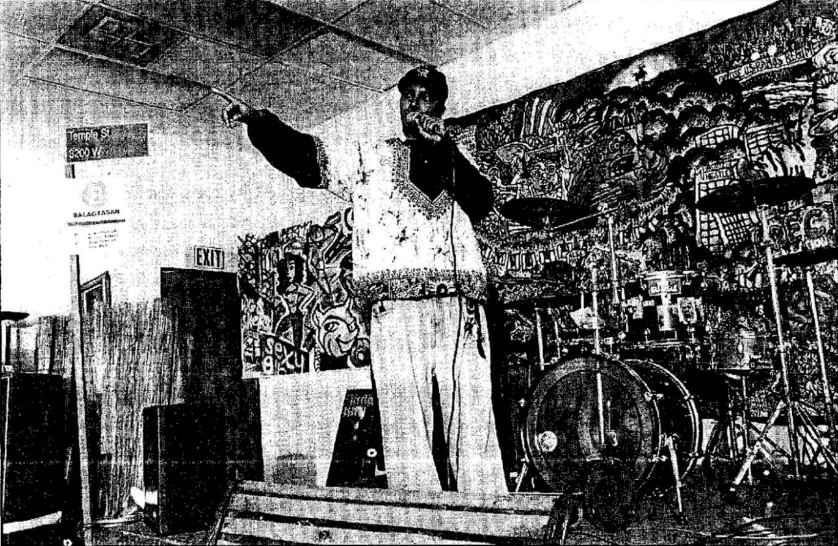
Spoken Word. Courtesy of D'Lo
In New York, many of the college students I spoke to seemed to envision a future in which they would move into the professional, college-educated class to realize their immigrant parents’ aspirations for upward mobility. Unlike the creators of hip-hop, most Indian American youth I spoke to did not view this remix popular culture as resistance to a system of economic and racial stratification; in fact several seemed bent on succeeding within that system. Although they were aware that as youth of color they are often targets of racial discrimination, many did not believe that would translate into economic discrimination in their own lives. But second-generation youth who grew up in less affluent, racially diverse neighborhoods often know what it is like to live in communities struggling for city and state resources, and regardless of class location many of these youth had experienced racial harassment and were sometimes mistakenly identified as black or Latino (George 1997).
Generational Alienation and Ethnic Anxiety
The emulation of urban African-American style has more subtle implications if situated in differentials of privilege and generational divides over racial politics. There are some youth for whom the turn to hip-hop is clearly related to a rejection of the racial hierarchies of dominant U.S. racial formations and of their own families, and for a few the interest in hip-hop grew out of friendships and intimate relationships with other youth of color. Sunita pointed out that the adoption of hip-hop sometimes becomes a gesture of defiance against parents, such as her own, who belong to the wave of Indian immigrants who came to the United States in the mid-1960s and 1970s and were highly educated professionals and graduate students. Manisha, who grew up in a middle-class neighborhood in Spring Valley (now New City), New Jersey, and who has hung out with, and dated, black and Latino youth since she was in high school, said that there are Indian immigrants who do not want their children listening to “that music”: “I think because it’s definitely associated with black ... people. And I definitely know that there’s big racist views in the community and they don’t like ... the fact that a lot of Indian kids are heading towards that, the hip-hop scene, which is mostly the black and Latino scene.” Manisha has an astute materialist analysis of the ways in which the racial and political alignments of affluent Indian Americans are read by other people of color. In response to an African American student in her class who had “heard that Indians are like the Hindu whites,” and ignoring the distorted label for the moment, she observed, “I said the basic reason I think that we're associated like that is because most of them that come over here came with an education and we got wealthy pretty quick even though we were poor when we came over, we right away got wealthy, we moved into the white neighborhoods and that scattered us . . . we assimilated quicker in a sense.” Manisha was very critical of the racism she had witnessed toward youth of color in her high school and of racial discrimination against people of color in general. Referring to the Thind decision, she concluded that she could not understand how an Indian American might “feel like the Hindu white . . . because it is [based on] like the definition of what the common man would see now, and that’s not us, you know.”
For several lower-middle-class as well as upper-middle-class youth, identification with African Americans is often fraught with conflicts with immigrant parents on issues of race politics. Perhaps the most emotional critique of the antiblack prejudices of immigrant parents was expressed by women who had dated African-American men and struggled with parental disapproval. One of them, Purnima, spoke of the anger and frustration she felt on hearing her mother and her Indian relatives say, “You can’t bring a kallu [darkie] home”; she eventually ended the relationship with her black boyfriend, but said that she was unable to forgive her mother for her racial prejudices and the family was “torn apart.” The antiblack prejudices of South Asian immigrants are reinforced by the black-white lines of American racial formations and the historical scapegoating of African Americans by new immigrants (Kondo 1995; Mazumdar 1989; Morrison 1994; Prashad 2000; Singh 1996). As Toni Morrison writes in her incisive essay, “On the Backs of Blacks,”
Although U.S. history is awash in labor battles, political fights, and property wars among all religious and ethnic groups, their struggles are persistently framed as struggles between recent arrivals and blacks. In race talk the move into mainstream America always means buying into the notion of American blacks as the real aliens. Whatever the ethnicity or nationality of the immigrant, his [or her] nemesis is understood to be African American. (1994: 98)
Second-generation youth who participate in this youth culture are not unaware of the contradictions of consuming black style and are often uneasy about the politics of this “cultural appropriation” in light of antiblack racism. This paradox was clearly articulated to me by DJ Baby Face in an interview at an Indian party held in the cavernous tunnels of a Manhattan club, with the beat of Indian remix pounding against the walls: “Blacks are the scapegoat for Indians, but when it comes to fashion and style, we hold them high, they have power.” His succinct observation reveals the underlying politics of being “cool”—the group emulated in style is also the one on whose back immigrants tread to preserve their sense of superior status.
For Indian immigrants, this racialized entry into the United States defined in relationship to African Americans is further complicated because they leave one color-conscious society with a history of caste stratification for another (Mazumdar 1989; Ogbu 1978). Vijay Prashad, however, in The Karma of Brown Folk, cautions against an easy acceptance of the “thesis that desis have a racist tradition that can be seen in the mysteries of the caste complex,” pointing to radical South Asian traditions of solidarity with black liberation that have been have been articulated by the likes of Mohandas Gandhi, Jawaharlal Nehru, and the poet Faiz. Ahmed Faiz—and that have largely been erased in the diaspora. Prashad argues that many Indian—and South Asian—immigrants accept antiblack racism as part of the “conservative desi culture that is being created in the U.S.” in their need to belong to a diasporic community that will bolster their sometimes-fragile foothold in a new country (2000: 175-177). Prashad is right, I think, in pointing to a more dynamic view of cultural tradition and of history that does not leave all Indian immigrants branded irrevocable racists but that simultaneously points to the willingness of some to accommodate to antiblack racism.
Manisha, for example, points out that immigrant parents view the identification with hip-hop among desi youth through the framework of an assimilationist “moral project” that constructs white America as the preferred destination for their children, refusing to acknowledge that hip-hop is an integral part of white American youth culture as well. Manisha’s observation echoes the views of those who argue that, for the most part, the Indian immigrant elite strives to ally itself with “white middle-class America” (Helweg & Helweg 1990; Hossain 1982). Amritjit Singh notes that some affluent Indian immigrants complain, as did an acquaintance of his, that “if middle-class people like us are paying unusually high taxes, it is only because of ‘all those blacks on welfare’; that blacks do not want to work or work hard; that blacks have contributed ‘brawn’ but no ‘brain’ to the development of this country” (1996: 99). This rhetoric of antiblack racism among Indian Americans reached its most publicized extreme in the writings of the infamous author of The End of Racism, Dinesh D'Souza, who resurrected the specter of the model minority as a “weapon against African Americans” with his question: “Why can’t an African American be more like an Asian?” (cited in Prashad, 2000: 4). Yet the hardening of racist beliefs tied to the model minority myth among Indian immigrants in the United States is violently jolted by incidents of racial assaults on Indians, disrupting the denial of their presence as people of color in this country (Mazumdar 1989). In the aftermath of the Dotbusters episode, a group of young South Asian-American activists mobilized to bring justice against the perpetrators of the attack and formed one of the first community-based progressive South Asian youth organizations in New York, Youth Against Racism (Misir 1996).
Some argue that the turn to hip-hop among desi youth is explained in part by the alienation of second-generation youth from the model minority leaning of their parents, including its manifestations as antiblack racism. Singh is hopeful that second-generation youth have been socialized into a different kind of race politics, mediated through black popular music:
Unlike their parents, they have African American friends and have developed a better understanding of how racism and poverty operate in American society. ... maybe the deep sense of “alienation” expressed in contemporary black music resonates with their own sense of rebellion against their parents’ double standards: an insistence on seeing African Americans harshly through the prism of caste even as they cloak themselves in the highest ideals of fairness and equal opportunity. (1996: 98)
This political and racial awareness of race politics, expressed by some of the youth I spoke to, was based on friendships and everyday social interactions, as in the case of Manisha, and on a critique of race politics, as articulated by Chandrika, Sunita, and others. Yet I want to distinguish between an “alienation” felt by youth who are politically or economically disenfranchised or critical of the status quo, a “structural alienation,” and a resistance arising out of a generational difference, or a “social-psychological alienation” (Epstein 1998: 5-6). Adolescent rebellion against parents and the generational ideologies they represent is a common trope that has long been embedded in theories of adolescence and coming-of-age narratives in the United States, even as these have varied by gender, ethnic, and class location (Erikson 1968; Mead 1928). Rebellion through popular music, moreover, is a familiar rite of youth culture—often a particularly masculinized one (Whitely 1997)—that perhaps offers Indian American youth a cultural form to express their distancing from parents. But for some Indian American youth there seems to be a convergence between both kinds of responses; a style that subverts their parents’ expectations and racial prejudices may also be an expression of their own critique of the racialized caste stratification of U.S. society.
Conclusion
The turn to hip-hop by desi youth in the 1990s is rooted in larger histories of appropriating black music by non—African Americans as part of the reinvention of ethnic identity by various groups. George Lipsitz, commenting on white American artists who were drawn to African-American and Latino musical traditions, writes:
Black music provided them with a powerful critique of mainstream middle-class Anglo-Saxon America as well as with an elaborate vocabulary for airing feelings of marginality and contestation. They engaged in what film critics Douglas Kellner and Michael Ryan call “discursive transcoding”—indirect expression of alienations too threatening to express directly. (1994: 55)
This alienation, for Indian American youth, may be partly as a result of what Michael Fischer (1986: 197) calls “ethnic anxiety,” a deep desire to maintain a sense of difference in the face of homogenization and to redefine the relationship between self and community. In part, as for the musicians of Greek, German, or Jewish descent that Lipsitz discusses, this ethnic anxiety sometimes arises from a political understanding of relationships of racial dominance and subordination. For Indian American youth, the tun to hip-hop is not always based on clearly articulated political dissent or moral outrage, but it may at least provide a discourse for coding an alienation from parents that is bound up with struggles over what it means to be Indian in the United States. Their alienation is not simply a rejection of their parents’ racial ideologies but also perhaps expresses an ambivalence toward the upwardly mobile path that their parents have attempted to carve out for them, with its burden of suitable educational fields and careers. These and other “hidden injuries of class” are perhaps indirectly expressed, using Lipsitz’s argument, through cultural alignments with a subculture that symbolically represents a different trajectory through America. Adolescent rebellions against middle-class parents through “representations of lower-class affiliation” are threatening precisely because they challenge not just their parents’ class values but their investments in class reproduction (Ortner 1991: 171, 177). This analysis echoes the Birmingham school’s theory of youth subcultures, but it, too, does not presume that the appropriation of black popular culture is an intervention with lasting social or material impact Neither do I want to offer a functionalist reading of class alienation from the “parent culture”; rather, as suggested by Peter Stallybrass and Allon White’s analysis of carnival, I see hip-hop’s insertion into Indian American youth culture as but “one instance of a general economy of transgression and of the recoding of high/low relations across the whole social structure” (1986: 19).
This project on desi youth and hip-hop did not provide me with any easy answers or definitive insights into the politics expressed by Asian American B-Boys and what Vijay Prashad in a lucid moment once referred to as “bass girls.” But it did convince me of the need to rethink my vision of the project of ethnic studies in response to these new and not-so-new racial formations on the ground. The relationship between urban black and Latino youth culture and issues of sex, style, and mobility for Asian American youth forces us to think not only of the relationship between Asian American studies, Latino studies, and African-American studies, but also of the racial imaginaries, strategic alliances, and coded ambivalences that are embedded in the efforts to build links between these areas of knowledge and activism, just as they are inevitably part of these polychromatic cultural formations.
WORKS CITED
Advani, Anuradha, G. “Against the Tide: Reflections on Organizing New York City’s South Asian Taxicab Drivers.” In Making More Waves: New Writing by Asian American Women, ed. Elaine H. Kim, Liliia V. Villanueva, and Asian Women United of California. Boston: Beacon Press, 1997, 215-222.
Banerjea, Koushik, and Partha Banerjea. “Psyche and Soul: A View from the ‘South.’” In Dis-orienting Rhythms: The Politics of the New Asian Dance Music, ed. Sanjay Sharma, John Huntyk, and Ashwani Sharma. London: Zed Press, 1996, 105-124.
Bhattacharjee, Annanya. “The Habit of Ex-Nomination: Nation, Woman, and the Indian Immigrant Bourgeoisie.” Public Culture, Vol. 5, no. 1 (1992): 19-44,
Bourdieu, Pierre. In Other Words: Essays Towards a Reflexive Sociology. London: Polity, 1990.
Chatterjee, Partha. “Colonialism, Nationalism, and Colonialized Women: The Contest in India.” American Ethnologist, Vol. 16, no. 4 (1989): 622-633.
Christenson, Peter G., and Donald F. Roberts. It's Not Only Rock & Roll: Popular Music in the Lives of Adolescents. Cresskill, N.J.: Hampton Press, 1998.
Clarke, John, Stuart Hall, Tony Jefferson, and Brian Roberts. “Subcultures, Cultures, and Class.” In Resistance Through Rituals: Youth Subcultures in Post-War Britain, ed. Stuart Hall and Tony Jefferson. London: Hutchinson, in association with Centre for Contemporary Cultural Studies (University of Birmingham), 1976, 9-74.
Cohen, Stanley. “Symbols of Trouble.” In The Subcultures Reader, ed. Ken Gelder and Sarah Thornton. London: Routledge, 1997, 149-162.
Daniels, Roger. History of Indian Immigration to the United States: An Interpretive Essay. New York: The Asia Society, 1989.
Dasgupta, Sayantani, and Shamita Das Dasgupta. “Women in Exile: Gender Relations in the Asian Indian Community.” In Contours of the Heart: South Asians Map North America, ed. Sunaina Maira and Rajini Srikanth. New York: Asian American Writers’ Workshop, 1996, 381-400.
Duncombe, Stephen. “Let's Ali Be Alienated Together: Zines and the Making of Underground Community.” In Generations of Youth: Youth Cultures and History in Twentieth-Century America, ed. Joe Austin and Michael Willard. New York: New York University Press, 1998, 427-451.
Epstein, Jonathon S. “Introduction: Generation X, Youth Culture. and Identity.” In Youth Culture: Identity in a Postmodern World, ed. Jonathon Epstein, Malden, Mass.: Blackwell, 1998, 1-23.
Erikson, Erik. Identity: Youth and Crisis. New York Norton, 1968; 1994 edition.
Esser, Dominique, et al. “Reorganizing Organizing: Immigrant Labor in North American—lInterview with New York Taxi Workers’ Alliance.” Amerasia (Special Issue—Satyagraha in America: The Political Culture of South Asians in the U.S., ed. Biju Mathew and Vijay Prashad), Vol. 25, no. 3 (1999): 191-181.
Feld, Steven. “Notes on World Beat.” Public Culture Bulletin, Vol. 1, no. 1 (1988): 31-37.
Fischer, Michael. “Ethnicity and the Post-Modern Arts of Memory.” In Writing Culture: The Poetics and Politics of Ethnography, ed. James Clifford and George Marcus. Berkeley: University of California Press, 1986, 194-233.
Flores, Juan. From Bomba to Hip Hop. New York: Columbia University Press, 2000.
Frith, Simon. “The Cultural Study of Popular Music.” In Cultural Studies, ed. Lawrence Grossberg, Cary Nelson, and Paula Treichler. New York: Routledge, 1992, 174-196.
Gelder, Ken. “Introduction to Part Three.” In The Subcultures Reader, ed. Ken Gelder and Sarah Thornton. New York: Routledge, 1997, 145-148.
George, Rosemary M. “‘From Expatriate Aristocrat to Immigrant Nobody’: South Asian Racial Strategies in the Southern Californian Context." Diaspora, Vol. 6, no. 1 (Spring 1997): 31-60.
Giroux, Henry A. “White Panic and the Racial Coding of Violence.” In Fugitive Cultures: Race, Violence, and Youth, ed. Henry Giroux. New York: Routledge, 1996, 27-54.
Gopinath, G. “Nostalgia, Desire, Diaspora: South Asian Sexualities in Motion.” Positions: East Asia Cultures Critique, Vol. 5, no. 2 (1997): 468-489.
Gupta, Akhil, and James Ferguson. “After ‘Peoples and Cultures." “ In Culture, Power, Place: Explorations in Critical Anthropology, ed. Akhil Gupta and James Ferguson. Durham, N.C.: Duke University Press, 1997, 1-29.
Hall, Perry A. “African American Music: Dynamics of Appropriation and Innovation.” In Borrowed Power: Essays on Cultural Appropriation, ed. Bruce Ziff and Pratima V. Rao. New Brunswick, N.J.: Rutgers University Press, 1997, 31-51.
Hebdige, Dick. Subculture: The Meaning of Style. London: Methuen, 1979.
Helweg, Arthur, and Usha Helweg. An Immigrant Success Story: East Indians In America. Philadelphia: University of Pennsylvania Press, 1990.
Hossain, Mokerrom. “South Asians in Southem California: A Sociological Study of Immigrants from India, Pakistan, and Bangladesh.” South Asia Builetin, Vol. 2,0. 1, (1982): 74-83.
Jensen, Joan. Passage from India: Asian Indian immigrants in North America. New Haven: Yale University Press, 1988.
Kelley, Robin D.G. “Looking to Get Paid: How Some Black Youth Put Culture to Work.” In Yo’ Mama’s Disfunktional!: Fighting the Culture Wars in Urban America. Boston: Beacon Press, 1997, 43-77.
Khandelwal, Madhulika S. “Indian Immigrants in Queens, New York City: Pattems of Spatial Concentration and Distribution, 1965-1990.” In Nation and Migration: The Politics of Space in the South Asian Diaspora, ed. Peter van der Veer. Philadelphia: University of Pennsylvania Press, 1995, 178-196,
Kirschner, Tony. “Studying Rock: Towards a Materialist Ethnography.” In Mapping the Beat: Popular Music and Contemporary Theory, ed. Thomas Swiss, John Sloop, and Andrew Herman. Malden, Mass.: Blackwell, 1998, 247-268.
Kleinfeld, N. R. “Guarding the Borders of the Hip-Hop Nation: In the "Hood and in the Burbz, White Money Feeds Rap. True Believers Fear Selling Out.” New York Times, July 6 (2000): Al, Al8-A19.
Kondo, Dorinne. “Bad Girls: Theater, Women of Color, and the Politics of Representation.” In Women Writing Culture, ed. Ruth Behar and Deborah A. Gordon. Berkeley: University of California Press, 1995, 49-64.
LaFeber, Walter. (1999). Michael Jordan and the New Global Capitalism. New York: W. W. Norton.
Leblanc, Lauraine. Pretty in Punk: Girls' Gender Resistance tn a Boys’ Subculture. New Brunswick, N.J.: Rutgers University Press, 1999.
Lessinger, Johanna. From the Ganges to the Hudson: Indian Immigrants in New York City. Boston: Allyn and Bacon, 1995.
Lipsitz, George. ““The Shortest Way Through’: Strategic Anti-Essentialism in Popular Music. In Dangerous Crossroads: Popular Music, Postmodernism, and the Poetics of Place. London: Verso, 1994, 49-68.
Maira, Sunaina. “Chaste Identities, Ethnic Yearnings: Second-Generation Indian Americans in New York City.” Doctoral dissertation, Harvard Graduate School of Education, 1998a.
——. “Desis Reprazent: Bhangra Remix and Hip Hop in New York City.” Postcolonial Studies, Vol. 1, no. 3 (1998b): 357-370.
——. “Identity Dub: The Paradoxes of an Indian American Youth Subculture (New York Mix).” Cui-tural Anthropology, Vol. 14, no. ) (1999): 29-60.
——. Desis in the House!: indian American Youth Culture in New York City. Philadelphia: Temple University Press, forthcoming.
Mani, Lata. “Gender, Class, and Cultural Conflict: Indu Krishnan’s Knowing Her Place.” In Our Feet Walk the Sky: Women of the South Asian Diaspora, ed. Women of South Asia Descent Collective. San Francisco: Aunt Lute Books, 1993, 32-36.
Mazumdar, Sucheta. “Racist Responses to Racism: The Aryan Myth and South Asians in the United States.” South Asia Bulletin, Vol. 9, no. t (1989): 47-55.
McRobbie, Angela. “New Times in Cultural Studies.” In Postmodernism and Popular Culture. London: Rout-ledge, 1994, 24-43.
——. “Come Alive London’: A Dialogue with Dance Music.” In In the Culture Society: Art, Fashion, and Popular Music. London: Routledge, 1999, 144-156.
Mead, Margaret. Coming of Age in Samoa. New York: William Morrow, 1928; 1961 edition.
Melnick, Jeffrey. “R ‘n’ B Skeletons in the Closet: The Men of Doo Wop.” Minnesota Review, Vol. 47: 217-229,
Miller, Daniel. “Consumption As the Vanguard of History.” In Acknowledging Consumption: A Review of New: Studies, ed. Daniel Miller. London: Routledge, 1995, 1-57.
Misir, Deborah N. “The Murder of Navroze Mody: Race, Violence, and the Search for Order.” Amerasia, Vol. 22, no. 2 (1996): 55- 75.
Morrison, Toni. “On the Backs of Blacks.” In Arguing Immigration, ed. Nicolaus Mills. New York: Touch-stone, 1994, 97-100.
Ogbu, John. Minority Education and Caste: The American System in Cross-Cultural Perspective. New York: Academic Press, 1978.
Okibire, Gary. “Is Yellow Black or White?” In Margins and Mainstreams: Asians in American History and Culture. Seattle: University of Washington Press, 1944, 31-63.
Omi, Michael, and Howard Winant. Racial Formation in the United States: From the 1960s to the 1990s. New York: Routledge, 1994.
Ontner, Sherry. “Reading America: Preliminary Notes on Class and Culture.” In Recapturing Anthropology: Working in the Present, ed. Richard Fox. Santa Fe, N.Mex.: School of American Research Press, 1991, 163-189.
Palumbo-Liu, David. Asian/American: Historical Crossings of a Racial Frontier. Stanford, Calif.: Stanford University Press, 1999.
Prashad, Vijay. “Desh: The Contradictions of ‘Home-land.” In Contours of the Heart: South Asians Map North America, ed, Sunaina Maira and Rajini Srikanth. New York: Asian American Writers’ Work-shop, 1997, 225-236.
——. The Karma of Brown Folk. Minneapolis: University of Minnesota Press, 2000.
Roediger, David. “What to Make of Wiggers: A Work in Progress.” In Generations of Youth: Youth Cultures and History in Twentieth-Century America, ed. Joe Austin and Michael N. Willard. New York: New York University Press, 1998, 358-366.
Rose, Tricia. “A Style Nobody Can Deal With: Politics, Style and the Postindustnal City in Hip Hop.” In Microphone Fiends: Youth Music and Youth Culture, ed. Andrew Ross and Tricia Rose. New York: Routledge, 1994a, 71-88.
——. Black Noise: Rap Music and Black Culture in Contemporary America. Hanover, N.H.: Wesleyan/University Press of New England, 1994b.
Ross, Andrew. “Tribalism in Effect.” In On Fashion, ed. Shari Benstock and Suzanne Ferriss. New Brunswick, N.J.: Rutgers University Press, 1994, 284-299.
Russell, John. “Race and Reflexivity: The Black Other in Contemporary Japanese Mass Culture.” In Rereading Cultural Anthropology, ed. George Mar-cus. Durham, N.C.: Duke University Press, 1992, 296-318.
Sardiello, Robert. “Identity and Status Stratification in Deadhead Subculture.” In Youth Culture: Identity in a Postmodern World, ed. Jonathon Epstein. Malden, Mass.: Blackwell, 1998, 118-147.
Sengupta, Somini. “To Be Young, Indian and Hip: Hip-Hop Meets Hindi Pop As a New Generation of South Asians Finds Its Own Groove.” New York Times, June 30 (1996), The City, Sect. 13: 1.
Sharma, Nitasha. “Identities Un-Rapping Race: The Role of Hip-Hop in the Identity Formation of Second-Generation Indian Americans.” Paper presented at the Annual Conference on South Asia, University of Madison, Wisconsin, 1998.
Sharma, Sanjay. “Noisy Asians or ‘Asian Noise’?” In Dis-Orienting Rhythms: The Politics of the New Asian Dance Music, ed. Sanjay Sharma, John Huntyk, and Ashwani Sharma. London: Zed Press, 1996, 32-57.
Singh, Amritjit. “African Americans and the New Immigrants.” In Between the Lines: South Asians and Post-coloniality, ed. Deepika Bahri Bahti and M. Vasudeva. Philadelphia: Temple University Press, 1996, 93-110.
Skoggard, Ian. (1998). “Transnational Commodity Flows and the Global Phenomenon of the Brand." In Consuming Fashion: Adorning the Transnational Body, ed. A. Brydon and S. Niessen. Oxford, U.K.: Berg, 57-70.
Stallybrass, Peter, and Allon White. The Poetics and Politics of Transgression. Ithaca, N.Y.: Cornell University Press, 1986.
Stokes, Martin. “Introduction: Ethnicity, Identity, and Music.” In Ethnicity, Identity, and Music, ed. Martin Stokes. Oxford, U.K.: Berg, 1994, 1-27.
Straw, Will. “Sizing Up Record Collections: Gender and Connoisseurship in Rock Music Culture.” In Sexing the Groove: Popular Music and Gender, ed. Sheila Whitely. London: Routledge, 1997, 3-16.
Takaki, R. India in the West: South Asians in America. New York: Chelsea House. 1989.
Touré, “Members Only.” New York Times Magazine, October 19 (1997): 98-99.
Turer, Graeme. British Cultural Studies: An Introduction, 2nd ed. London: Routledge, 1996.
Visweswaran, Kamala. “Diaspora by Design: Flexible Citizenship and South Asians in U.S. Racial Formations.” Diaspora, Vol. 6, no. 1 (Spring 1997): 5-29.
Wang, Oliver. “Big Yellow Knuckles: The Cultural Politics of Asian American Hip-Hop.” Paper presented at the annual meeting of the Association for Asian American Studies, Seattle, April 1997.
Waters, Mary. Black Identities: West Indian Immigrant Dreams and American Realities. New York: Russell Sage Foundation, 1999.
Whitely, Sheila. “Introduction.” In Sexing the Groove: Popular Music and Gender, ed. Sheila Whitely. London: Routledge, 1997, xxviii-xxxvi.
Wood, J. “The Yellow Negro.” Transition, Vol. 7, no. | (1988): 40-66.
°i*ek,Slavoj. The Sublime Object of Ideology. New York: Verso, 1989.
FOOTNOTES
1Bhangra music traditionally involves three instruments: the dhol and dholki (drums), and the thumri (a stringed instrument). The lyrics traditionall celebrate the beauty of Punjab, village life, and women.
2Comment at panel , "Asian American Hip Hop," FrEe ZoNe: Symposium on Asian/Pacific/ American Youth Culture, New York University, April 8, 2000.
3Traditionally, powdered dots and, more commonly today, small felt or plastic designs, worn by women between the eyebrows.
4In turning to hip-hop to challenge representations of Asian American masculinity, Wang points out that these rappers reinscribe a "hegemonic ideology" of "ideal masculinity and sexuality" that rests on a stereotypical notion of "the authentic black subject in hip hop" and that ultimately uses an "idealized white masculinity" as its normalizing frame of reference (1997: 14-1 5,17).
5An example of Asian American youth cultural production using hip-hop to resolve the perception of racial ambiguity while asserting solidarity with youth of color is the progressive zine Native Tongh, by the hip-hop identified MaddBuddha, whose credo is: "A yellow shade in a black and white world." Key Kool, a Japanese American hip-hop artist, expressed a similar view at the plenary session of the conference FrEe ZoNe: Symposium on Asian/Pacific/American Youth Culture and argued that rather than speaking of Asian American hip-hop, which implies that hip-hop is ethnic-specific, he preferred to speak of Asian Americans in hip-hop, a common language and youth movement. For other examples of Asian American musicians in hip-hop taking similar positions, see Wang (1997).
6In 1922, the Supreme Court decided that Takao Ozawa, a Japanese immigrant, was not Caucasian and hence ineligible for citizenship. From 1906 to 1923, the courts struggled with how to racially classify Asians and Arabs and define the ambiguous term "white," granting naturalization rights to some Indian immigrants in opposition to the arguments of government attorneys that Indians were not "white" or "Caucasian," At least sixty-nine Indians were naturalized between 1908 and 1922, but definitions of their racial classification were based on amorphous and often contradictory anthropological, geographical, and popular understandings of race, reflecting the debates of the time.
7Although it is important to point out that Thind and others did not attempt to overturn the fundamentally racist premise of naturalization laws at the time, the case is complicated by knowing that Thind was an open, although not militant, critic of British imperialist rule in India and, at the same time, had served in the U.S. army during World War I.
8The politics of bhangra/remix youth culture in New York, or more generally in the United States, stands in contrast to that in Britain, where the late 1970s and early 1980s saw a "new symbolic unity primarily between African-Caribbean and Asian people" through identification with the category "Black" (Sharma 1996: 39). This coalitional identification, Sanjay Sharma notes, was a political project involving "autonomous, anti-racist community struggles in Britain." But he also points out that the label black, "had a certain way of silencing the very specific experiences of Asian people" (Hall 1991, cited in Sharma 1996: 39). Bhangra remix emerged as a "new Asian dance music" that offered an Asian identity as a possible racial location, but still one that, in Sharma's view, "continues to be intimately tied to rethinking the possibilities of the Black anti-racist project" (1996: 34).