

VOL. 4
Black Thinkers at Sea: Ferdinand Smith and the Decline of African American Proletarian Intellectuals
Gerald Horne
The signal legacy of the Red Scare has been a toxic intellectual landscape that has had a devastating impact on African Americans in particular. Once-radical ideas such as redistribution of the wealth—and its close cousin, reparations—were deemed beyond the pale and derided as “Communist inspired,” the stage was set for the crippling of intellectual life: As has been so often said, this meant that up for discussion was merely the right to eat at a lunch-counter, rather than the key question of whether one had the wherewithal to pay the bill. Out the window went serious trafficking in virtually all ideas beyond the mainstream. In a cruel return to the origins of literacy itself, this helped to shrink the circle of intellectuals to a priesthood centered principally at universities.
This hairpin turn on the road of history was so harmful for African Americans because this community over the years had come to rely heavily on intellectuals, notably proletarian intellectuals, whose forte was radicalism. From the slavery era to the dawn of the anti-Communist witch hunt known as the Red Scare, these working-class intellectuals were, disproportionately, sailors: They were the tissue that connected the nodes along the so-called Black Atlantic Sailors helped originate the idea of repatriation to Africa; it was sailors who spread the insurrectionary message of Haiti to the dankest precincts of the slave South They were internationalists who early on perceived the links between their own plight in North America, the degradation of Africa, and the rise of capitalism. Thus, when in the 1950s racial concessions were granted as the labor movement itself was frog-marched to the right, many of the ultimate gains of African Americans were vitiated. Hence, in the intellectual sphere, African Americans were obligated to fish for intellectual sustenance from a limited number of docks. The decline of these internationalists, axiomatically though not automatically, set the stage for the rise of various forms of nationalism—particularly of the narrow and petit-bourgeois varieties—among African Americans generally and Black intellectuals especially. When Black thinkers at sea were virtually eliminated, Black thinking was at sea: adrift, shorn of its moorings, at times confused.
“The Ocean, If Not the Land...”
In an era when teaching enslaved Africans to read and write was proscribed severely, sailors—who circumnavigated the globe—not only were often literate, but frequently multilingual as well. Certainly they were among the most creative and innovative of those who had been dragged into the Western Hemisphere. It was not accidental that, in 1838, the preeminent Black activist intellectual of the nineteenth century—Frederick Douglass—escaped northward dressed in sailor’s clothes and carrying a free Black sailor’s pass. “You cannot write the bloody laws of slavery on those restless billows,” he thundered. “The ocean, if not the land, is free Sailors were the means by which enslaved Africans escaped the suffocating reality of white supremacy and mobilized the international community on behalf of their compatriots.
The National Maritime Union (NMU), which for a while in the twentieth century was a fountainhead of Black proletarian intellectual radicalism, “estimated” that in “1850 . . . more than half of the American seamen were colored men “The sea,” said their journal, “offered a haven to the most militant and aggressive slaves as an escape from bondage.” This list included Crispus Attucks, whose martyrdom on behalf of the “American Revolution” was inscribed in blood in 1770. The importance of sailing to Black intellectual life was ratified when the “New York African Free Schools . . . established to provide education for Negro children . . . introduced in the 1820s the study of navigation, since many of the best pupils subsequently went to sea. . . .” In an era before intellectuals were thought to be solely habitués of universities, Blacks recognized that the kind of education one received sailing from port to port could be invaluable for liberation. Denmark Vesey, yet another martyr for freedom—he led a major uprising of enslaved Africans in South Carolina—also had been a seaman
The accumulation of capital through international trade required the creation of an international working class. Perhaps not surprisingly, enslaved Africans—an early form of capital—were essential to this process. The floating communities that were ships were crucibles of internationalism, the distinguishing characteristic of proletarian intellectuals. Sailing was a total life situation, a community apart where, disconnected from family and church, sailors formed new ways of thinking. The perils of their work and their collective need for safety forged a kind of solidarity that proved useful to Africans fighting oppression on dry land.
Sailors were the tissue that connected the nodes along the so-called Black Atlantic. They helped originate the idea of repatriation to Africa and spread the insurrectionary message of Haiti to the dankest precincts of the slave South
But it was the closed world of sailing that helped to manufacture a kind of consciousness that left a deep impression on Africans: “[T]he isolation of life at sea produced . . . intensified awareness of actual and symbolic uses of power and a powerful need for self-defense.” This also had ideological consequences in that the sailor’s experience “tended to generate irreligion through a process of de-christianization. Certain forms of religious belief were actively [discouraged], even eradicated, by seamen. . . .” Praying was frowned on “until all was lost, because praying was, in a sense, an admission that human effort had failed . . . their outlook, fundamentally shaped by the nature and the setting of their work, was based upon an essentially materialistic view of nature, a desire to make an omnipotent nature seem orderly and comprehensible, and a need to entrust each other with their prospects for survival.” On board ships, egalitarianism grew out of the encumbrances of sea life: this “community of suffering” fomented “hospitality and cooperation, reciprocity and mutuality, and generosity over accumulation.” Their extreme mobility hindered, in any case, their ability to accumulate property, and their common oppression circumscribed material differences among sailors. These patterns were not unique to sailors, but inhere among nomads generally The isolation of sailing often left many hours for reading and writing, while the constant travel engendered a facility with language, along with a keen and detailed knowledge of the world—a prerequisite for any intellectual. The intensely homosocial environment ensured that sailors would be in the forefront of those challenging the definition of Black masculinity that stressed “docility”; likewise, this environment also provided fertile soil for the flowering of a gay male community The irreligion, sailors’ extraordinary traditions of militancy and mutinies, and the favorable conditions for intellectual growth assured that seafarers—particularly African American seafarers—would be in the vanguard of radical thinkers.
A Star to Steer By
The rich intellectual traditions of sailors continued in the twentieth century. Though it is not often recognized, a significant number of leading African American intellectuals toiled at sea and were marked irrevocably by this experience. This worthy list includes Langston Hughes Ralph Ellison and Kwame Nkrumah—perhaps the premier activist intellectual of the twentieth century, whose later works in particular continue to merit attention Nkrumah, as a young student in the U.S., had belonged to the National Maritime Union, whose second in command was the Communist of Jamaican origin, Ferdinand Smith St. Clair Drake has noted that Nkrumah “sailed out of some east coast ports
It was not accidental that, in l838, the preeminent Black activist intellectual Frederick Douglass escaped northward dressed in sailor’s clothes and carrying a free-Black sailor’s pass
Many Black sailors were not as acclaimed in the intellectual realm as Hughes, Ellison, and Nkrumah, though they were no less gifted. Take Harold Donald Harper, for example. His mother was an escaped slave and his father was Irish. On the night he was born in Kansas City, Missouri, the Ku Klux Klan “burnt down the house where his mother was living.” His father moved to Siberia about a century ago where he became a wealthy fur trader, but he left his son behind. Harper, however, would travel to Russia two or three times a year. At age twelve he was sent to boarding school in Great Britain; from there he went to Vienna to study the piano, but like so many African American men, he “was always crazy to go to sea.” So he shipped out from Hamburg and embarked on numerous travels that led him to convert to Islam after a visit to Cameroon. Eventually he was stationed in Brussels as a translator for the travel agency Thomas Cook—he read and wrote eight languages and spoke twelve, including French, German, Russian, English, Japanese, Arabic, Greek, Gaelic, Icelandic, Hindustani, and Basuta, a Zulu dialect. Along the way he also picked up a B.A. from the University of Edinburgh and an M.A. from the University of Berlin. When the Germans invaded Belgium during World War I, he was not “molested,” perhaps because of his facility with their language. Still, during the war he served with Great Britain in various posts abroad. After the war, he worked in Egypt for a while and in Tokyo, where he was running a club when the 1923 earthquake hit. By 1942, he was fifty-four years old and had returned to sailing. Jim Crow meant that his manifest intelligence and acumen would face limited opportunities. Seafaring was one of the few escape routes for a man like Harper. On the other hand, this choice meant that his organizing ability, his dazzling literacy—his intellectual candlepower—would be contributed to a left-led union that was energetic in opening the door of equality for African Americans as a whole
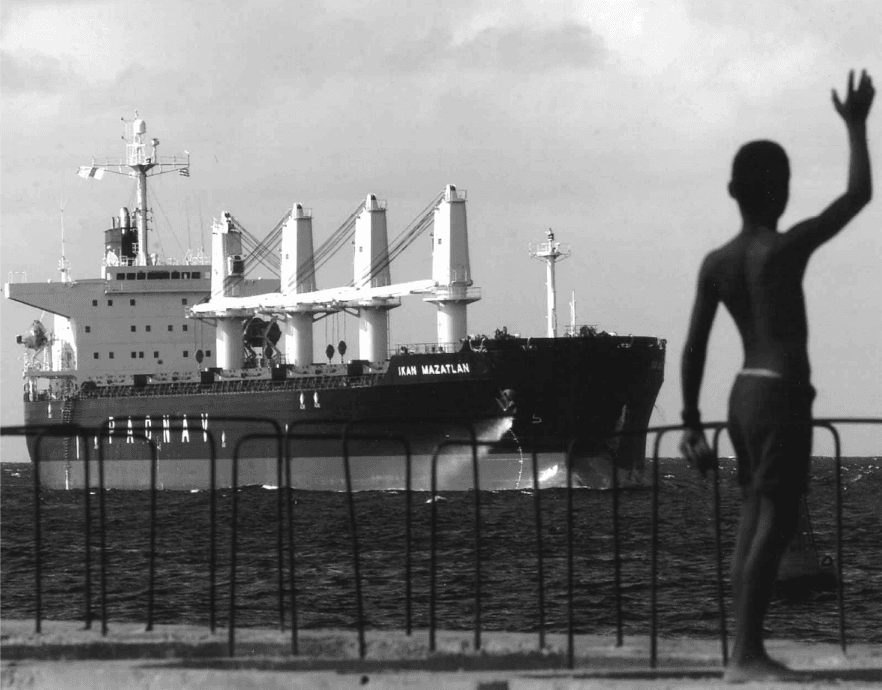
To Sea. AP Photo/Jose Goitia
Harper, though, was not unique. Hugh Mulzac was born in St. Vincent in 1886 and was of Scottish and African descent. After graduating from high school in 1907, he, like many African men in the diaspora, fulfilled a dream by going to sea. By 1918 he was a U.S. citizen and sailing out of ports here. A controversy erupted as a result of his effort to pierce a Jim Crow barrier by becoming captain of a ship, a goal he met with distinction during World War II. Mulzac, whose ship contained “men of 28 nations was also, like many sailors, a fervent internationalist, asserting at one point, “‘What happens in Morocco or in Italy or Java . . . is just as important to me and to all Americans as what happens in New York or Texas or South Carolina. You can’t solve the problems of America without solving the problems of the world. . . . Sailors, who witnessed the unity of humankind and the commonality of problems, knew, for example, that the kind of fascism visited on huge swaths of colonial Africa could not be localized there and eventually would spread to Europe and beyond. His book, A Star to Steer By, the lasting testament of this Black working-class intellectual, remains a central, albeit neglected, text of an era when Black proletarian intellectuals wielded profound influence
“A New Kind” of Intellectual
In early 1947, Ebony magazine, a budding arbiter of trends among African Americans, told its readers bluntly, “no longer can A. Philip Randolph . . . speak for ‘all Negro labor.’” Graphic evidence of this assertion was nearby: a photograph of Ferdinand Smith, who was second in command of one of the most important unions in the nation, the National Maritime Union, a body that dwarfed Randolph’s comparatively tiny and virtually all-Black Brotherhood of Sleeping Car Porters Thus, it was equally unsurprising when President Franklin D. Roosevelt in 1944 sent a special message to a testimonial dinner in Manhattan honoring Smith With tens of thousands of members, the NMU had members from eighty-seven nationalities, including Filipinos, Latinos, Asians and Asian Americans, Europeans, and Euro-Americans—not to mention Africans and African Americans. The latter were 10 percent of the membership of a union that was instrumental in the import-export trade essential to the smooth functioning of U.S. imperialism
Though born in Jamaica in 1893 and passing away there in 1961, Smith spent some of the most eventful years of his life in New York City, where he served with the NMU from the mid-1930s to the late 1940s. A towering six-feet-three-inches tall and built along the same muscular lines as his good friend, Paul Robeson, the dark-skinned Smith had narrow eyes and spoke with a lilting Jamaican accent. During his tenure as a trade union official, he was simultaneously a leading Black proletarian intellectual, writing frequent columns for the union and Negro press, addressing numerous rallies, and declaiming frequently on the radio.
Though he was without a doubt a gifted organizer and highly intelligent, it would be a mistake to assume that Smith’s high-ranking status in the trade union movement was due solely to his sterling qualities. The participation of African Americans in sailing had survived the “black purges” of the Jim Crow era. Strikingly, even the right-leaning International Seamen’s Union (ISU)—which NMU supplanted—felt compelled to have as a leader David Grange, yet another Jamaican
They were internationalists who early on perceived the links between their own plight in North America, the degradation of Africa, and the rise of capitalism
Like their African American counterparts, Jamaican men also looked to the sea for employment and education. Thus, Smith, instead of going to college, left the island for Panama in 1913, as the opening of the canal—built largely with Afro-Caribbean labor—attracted him and many others. From there he left for Cuba, where he worked for a while before arriving in the U.S., just as the false promise provided by the conclusion of World War I led inexorably to the bloody pogroms directed against newly energized Black communities. Sailing out of Mobile, Alabama, he was able to witness firsthand the ravages of Jim Crow.
He also received a primary education in the pitfalls of seafaring. Aboard most ships the food was lousy, the living quarters crowded and hot, reeking with the stench of unwashed bodies and ruined stomachs. There were vermin-lined bunks sharing the mean air that small portholes let in—depending upon the weather. Wages were meager and racial discrimination was rampant
For years he was involved in rank and file seafarers’ struggles, which culminated in a massive strike in 1936–37; Smith served on the Strike Strategy Committee and was chairman of the Food Committee that was designed to prevent the shipping companies from starving sailors into submission. He accepted these posts “on one condition: if we win, the new union will not tolerate segregation or discrimination of any sort It was “Smith who played a major part in getting the support of Negro seamen for the 1936–37 strike, the first time in American history that white and Negro labor had fought as one during an industrial dispute When the NMU was formed during this period he served as trustee of the Stewards Division until his election as vice-president in 1938. The next year, he was elected national secretary—the number-two position—of the only U.S. union that circled the planet. Under his leadership the union effectively vindicated its promise to be intolerant of “segregation or discrimination of any sort.”
The NMU carried forward the tradition of those Black sailors who in the late eighteenth century had brought the word of insurrection in Haiti to the Deep South and southern Africa. There were NMU members in prisons from India to South Africa to Germany to Brazil as a result of participation in democratic struggles Over eight hundred members of the NMU fought in Spain in the 1930s to save a democratically constituted regime that included Communists. At a time when many in the U.S. barely knew a life beyond their own neighborhoods, NMU members wrote about—and participated in—struggles on all continents. Sufficiently impressed, the writer Richard Boyer was moved to call them “a new kind of American. They know that the world whose seas they sail is one world. They know that what happens in Indonesia or Africa is as important as what happens in Brooklyn or Chicago.” NMU members—such as Ferdinand Smith—were also a “new kind” of intellectual in that, in Boyer’s words, “they have little division between thought and action
Proletarian Internationalist
Though much has been made of Communist domination of unions before the onset of the Red Scare, this point is largely overstated On the other hand, the NMU was a union that included Reds at the highest levels of leadership: this cadre included Smith. In 1953, years after having been driven from the U.S., Smith—whose lack of a college degree did not prevent him from becoming an excellent and frequent writer—told his Jamaican audience why he joined the Communist Party. Though he had a “privileged position” as a chief steward, “soon after” his arrival in the U.S. he came “face to face with [the] harsh realities of racial discrimination. . . . I had been in the Southern states of the USA and tasted of this bitter fruit of degradation and segregation. I resented it. . . .” His struggles on behalf of “workers and especially for Negroes” were a primary form of education for him, as it was for other Black proletarian intellectuals. The “theory of class struggle,” he proclaimed, “has been more than demonstrated in my years of working. I know the class struggle to be true, because I have been an active leader and participant all my life. . . .” These actual struggles led him to sober reflection and self-education: “I began a study of Political Economy as early as 1925 and had been satisfied with the theoretical justification of Marxism but this I had to check with practical experiences and observations.” Extending a tradition that stretched back for centuries, he too discovered that “the life of a seaman affords a remarkable opportunity to study the life of people in various countries. Within a few years of seafaring, I had known most of the world, had spoken to and intimately observed the modes of living of people in North, South and Central America, Britain, France, Germany, Italy, Spain, Belgium, India, China and Africa among other places.” He was moved particularly by the “miserable over-worked, underfed prisoners in their own country I saw” in the various regions of Africa. When he “visited Russia, I was met by a people rich in culture and material goods,” who received him “warmly”—unlike his sojourn in Alabama. The culmination of these experiences was his deciding to join the Communist Party
From the Popular Front of the mid-1930s to the aftermath of World War II was the high-water mark for the Communist Party and Black proletarian intellectuals. Ferdinand Smith was at the crux of these developments, as writer, thinker, speaker, and activist. Though Colin Powell has observed that “American blacks sometimes regard Americans of West Indian origin as uppity and arrogant Smith’s internationalism impaired the possibility that he would be seen as engaged in special pleading on behalf of those of the Caribbean. To be sure, he did not neglect his Caribbean roots. For example, the U.S. government during World War II became concerned with a dearth of West Indian sympathy for the cause of the Allies in that Caribbean islanders had to fight alongside their colonial overlord—London—while ignoring Japan’s magnetic claim to be “champion of the darker races.” Thus, the influential Smith was asked by Washington’s Office of War Information to speak “in a shortwave . . . broadcast” to his compatriots in the Caribbean; dutifully, he complied and spoke to tens of thousands, telling them that “the hope of independence for the colonial peoples of the world depend on a United Nations victory. . . . We West Indians are proud to work and fight with other brothers, colored and white of the United Nations.
The internationalism of “West Indians” like Smith allowed them to embrace Blacks in the U.S. who were their neighbors, just as they embraced Spaniards and South Africans thousands of miles away. Smith was not alone in this regard. New York City was enriched when such intellectuals as the lawyer Hope Stevens and writers like Richard Moore arrived in Harlem With W. A. Domingo and others, they were part of a West Indies National Council that the FBI thought was led by “members of the Communist Party.” They worked with Smith and others during the war in building the Negro Labor Victory Committee, which—said J. Edgar Hoover—was “exceedingly active in holding meetings and agitating among the Negroes in Harlem . . . it is supported by quite a number of international and local unions of the CIO and the AFL which are reported to be Communist dominated. . . . Worse, in the eyes of Hoover, their speaking and writing—and “agitating”—was affecting the thought patterns of Harlemites, indigenous and migrants alike, nudging them to the left.
As the Red Scare spread, out the window went serious trafficking in virtually all ideas beyond the mainstream. This helped to shrink the circle of intellectuals to a priesthood centered principally at universities
Smith was also a leader of the National Negro Congress, an attempt to build a “popular front” embracing Blacks of various national origins, ideologies, and class backgrounds. He frequently addressed their rallies and wrote for their publications; he assisted them in aiding evicted tenants, helping Black women workers, and a myriad of related tasks
Here are just the newly scanned bits, with OCR line breaks/hyphenation cleaned up and the obvious OCR errors corrected:
A significant portion of Smith’s contribution as an intellectual was as a speaker addressing mass rallies. Here he often outlined the political task at hand, providing historical context and, frequently, comparative global examples gleaned from study, travel, and insight from NMU members alike. This skill was called on during the “Harlem Riot” of 1943 when allegations about the murder of a Negro soldier caused Blacks to surge into the streets in anger, which led to U.S. leaders fearing that national unity in the titanic combat with fascism might be jeopardized. Smith joined Hope Stevens, Mayor Fiorello La Guardia, and NAACP leaders in touring Harlem in a sound truck reassuring furious Blacks that the soldier was not killed; they were greeted with “raucous shouts of disbelief,” not to mention the “rat-tat-tat of bricks and bottles This was the dilemma faced by Smith and other Black proletarian intellectuals during the war: They allied with the U.S. rulers so that fascism could be defeated and, indeed, worked overtime speaking and writing to convince disgruntled African Americans to do likewise, but the reward they received for this tireless labor was fierce persecution immediately after the war’s conclusion.
Throughout his career as an NMU official, Smith also sought to assist other artists and intellectuals. Inevitably, this meant that his left-wing influence could spread. The dancer Pearl Primus was among those who performed at the “NMU’s regular Monday and Thursday noon-hour entertainment features. . . . Seafarers not only had time to write and read, they also had time to paint and, over the years, created hundreds of works
Seeing the Possibilities. Photo by Philippe Cheng
Still, what distinguished Smith and other Black proletarian intellectuals was their internationalism. It was Smith who called on Brazil in 1942 to initiate a “speedy restoration of democratic rights” and “the reestablishment of a free trade union movement,” along with the “release of all labor and political prisoners including Luiz [sic] Carlos Prestes. Smith and other NMU members were picketing South Africa’s consulate in Manhattan well before the inauguration of apartheid in 1948 Smith’s union was “among the few” that “protested against the internment of the Japanese Americans When Indonesian seamen in New York struck six Dutch ships in 1945, Smith joined Robeson and Communist leader Ben Davis in assisting them; their internationalism was emulated by the “people of Harlem who [were] feeding them, helping them find shelter and providing them with other essential services
This proletarian internationalism was not mere charity. It was based on a profound intellectual cum political realization. Smith felt that “the successful struggle of Negroes in America” would in turn aid “colored peoples all over the world”—and vice versa. Smith sought to “channelize this through the international labor conference” that established the World Federation of Trade Unions, which met in Paris in 1945, at roughly the same time the Fifth Pan-African Congress (PAC) was meeting in Manchester As Smith and other proletarian intellectuals from the African diaspora saw it, these two meetings were complementary and were timed to coincide. This PAC was marked by the heavy participation of Black labor, particularly seafarers who were in a better position than most to attend such a gathering
By the conclusion of these two important gatherings in the fall of 1945, Black proletarian intellectuals—fresh from the vanquishing of fascism—were poised to move to the next stage of their ongoing struggle: paving the ground for decolonization and redistribution of the wealth, up to and including socialism. Though it was hardly recognized at the time, the PAC in Manchester signaled the decline of a phenomenon that had served African Americans well over the centuries: the seafarer in the guise of proletarian intellectual.
Insult and Agony
It was mid-February 1948 and Harlem had been dusted with a finely granulated wafting of snow. Ferdinand Smith had just left his Convent Avenue residence en route to a high-level NMU meeting where he intended to use all of his formidable powers of persuasion on behalf of opposition to the Marshall Plan—a U.S. effort to sink its claws deeper into the Western European economy. He intended to escalate his ferocious opposition to U.S. foreign policy, which he had displayed at a January 1948 meeting of the Congress of Industrial Organizations: There he “denounced the plan” as a “war plan.” The NMU would be essential in implementing the Marshall Plan, this Smith knew; in fact, he said, the NMU—which carried goods back and forth from the U.S. to far-flung points on the planet—was the “most strategic industry in the Administration war scheme.” But he never made it. At about 9 a.m. on February 16 he was arrested by a combined force from the FBI and the Immigration and Naturalization Service. He would be released, but he was detained again, this time, as he later wrote, after “I had organized and led a picket line of some 12,000 workers around the clock at the office” of Joseph Ryan, the corrupt and racist leader of the International Longshore Association, who sought to lift the charter of Local 968, a progressive and mostly Black unit of the union. This time he was sent to Ellis Island, though he was released again—after 37 days in detention and bail that had been raised from $3,500 to $10,000. He was arrested again after protesting the death-penalty sentence inflicted on Lt. Leon Gilbert, an African American who refused to lead his troops into a suicidal mission during the war in Korea. He was arrested again in August 1951, just before he was deported back to Jamaica—where he went on to continue his proletarian intellectual activism
Yet, perhaps more than the ouster, the ultimate insult and agony for Smith was the expulsion he endured from his own union, the NMU, as a tidal wave of anticommunism engulfed its leadership His ouster was a prelude to the purge of numerous Blacks from the ranks, as it was thought—and this was not far wrong—that this group was more likely to be sympathetic to proletarian intellectuals like Smith. In 1950 Congress passed the Port Security Act, and President Harry S. Truman issued an executive order authorizing the Coast Guard to screen off the waterfront from any seamen or dockworkers whose loyalty to the U.S. was questioned. At a Harlem labor conference in 1952, a shipyard worker described the rise of unemployment among Black workers because of the government screening program. He estimated that a staggering 80 percent of those labeled “security risks” were Black. Among those barred from ever sailing again was Smith’s close friend and confidant, Hugh Mulzac
The kind of practical education that sailing once provided disappeared and along with it the Black proletarian intellectual, who saw the globe as his battlefield and the international community as the audience for his written and spoken words
From this shore, a number of intellectual activists from the NAACP heartily participated in these purges—which had the incidental effect of removing from the scene radical challengers to their ideological hegemony. Herbert Hill, the organization’s labor liaison who went on to become a professor at the University of Wisconsin, in 1952 proudly took credit for “exposing” Communist “operatives and preventing their participation in legitimate Trade Union and Civil Rights activities.” Boastfully, he acknowledged that his work had been cited by the Voice of America in their dubious effort to convince the international community that Negroes were not the second-class citizens they in fact were—an important consideration in that historically Black proletarian intellectuals had relied on assistance from abroad in their battles with a majority racial grouping that at times appeared to be uniformly hostile
Though the NAACP was quite successful in undermining their proletarian challengers, their bountiful assistance to the anticommunists was less helpful to the Black constituency they purported to represent. Soon thereafter they were fielding complaints alleging that the now right-wing leadership of the NMU had “condoned” a “concerted effort... to slander members of the organization who are of minority groups. At present, it is being directed against Negroes and Puerto Ricans.” Days before the 1954 Brown v. Board of Education was rendered, thereby effectuating what was thought to be a watershed in the Negro’s crusade for equality, it was reported in the New York Amsterdam News that NMU leadership was “permitting Jim Crow and racketeerism to flourish Simultaneously racist critics were alleging that Negroes and Puerto Ricans were “being given privileges and were ‘taking over the union.’” This latter allegation was a pure falsehood; actually, these groups were systematically purged from the ranks. One remaining Black NMU member stated that he had “sworn statements . . . by responsible officials and members, testifying to discriminatory remarks made by [NMU leader Hedley] Stone against Negro members. . . .” He had other affidavits that concerned the “sale of union [memberships] by officials of the NMU,” a process that both facilitated the entry into the union of relatives and cronies of the now heavily Euro-American leadership and the simultaneous reduction in numbers of Negroes and Puerto Ricans With that, the base, from which had emerged a Black proletarian intelligentsia that had served African Americans so well over the years, had been eroded into dust.
Drifting at Sea
In order to eliminate the NMU as a rich source for Black proletarian intellectuals, the union itself—indeed, the entire industry—had to be weakened, if not destroyed. The NMU did indeed descend into racketeering, corruption, and right-wing politics. By 1980, Shannon Wall, the top NMU leader and a pale imitation of the kind of leadership formerly provided by the likes of Ferdinand Smith, became “the only Maritime Union leader to support President . . . Ronald Reagan in the election.” As a reward, he was being examined for the powerful “Labor Secretary post”—a job that eluded him despite his rank opportunism
Wall was presiding over a union whose numbers had dwindled precipitously. This was due in part to shipping companies fleeing to the low wages and declining working conditions of “flags of convenience,” registering their ships in Panama, Liberia, and other nations where U.S. imperialism had enervated unions. Construction of ships themselves, once a thriving industry in Philadelphia and elsewhere, had become a distant memory, with Japan and South Korea now leading the world in this critically important sector. By late 1999 the New York Times was reporting that the shipping industry was “inside our waters and outside our laws” as “migrant workers of the oceans”—hailing mostly from poor and developing nations—were “laboring as long as 18 hours a day, seven days a week” at a pay of “$400 to $450 a month
Fewer and fewer African Americans had a dream of going to sea as had Langston Hughes and Ferdinand Smith and countless others. Not coincidentally, the internationalism that the Black proletarian intellectual exemplified had diminished correspondingly, to be replaced by a form of nationalism that at once excoriated this nation’s majority as hopelessly racist, yet refused to follow the logic of this position by seeking alliances abroad. The kind of practical education that sailing once provided had disappeared and along with it the Black proletarian intellectual, who saw the globe as his battlefield and the international community as the audience for his written and spoken words. As these Black thinkers at sea disappeared over a distant horizon, Black thinking itself began a process of drift—it too was at sea.
FOOTNOTES
2See, e.g., Lamont D. Thomas, Rise to Be a People: A Biography of Paul Cuffe (Urbana, Ill.: University of Illinois Press, 1986); W. Jeffrey, Black Jacks: African American Seamen in the Age of Sail (Cambridge, Mass.: Harvard University Press, 1997); Julius Sherrard Scott, “The Common Wind: Currents of Afro-American Communication in the Era of the Haitian Revolution” (Ph.D. diss., Duke University, 1986).
1Paul Gilroy, The Black Atlantic: Modernity and Double Consciousness (Cambridge, Mass.: Harvard University Press, 1993).
3Alan J. Rice and Martin Crawford, “Triumphant Exile: Frederick Douglass in Britain, 1845–1847,” in Alan J. Rice and Martin Crawford, Liberating Sojourn: Frederick Douglass and Transatlantic Reform (Athens, Ga.: University of Georgia Press, 1999), 1–12.
5NMU Pilot, 8 November 1940. See also Charles H. Wesley, Negro Labor in the United States, 1850–1925: A Study in American Economic History (New York: Vanguard Press, 1927); David Robertson, Denmark Vesey (New York: Random House, 1999).
4NMU Pilot, 3 May 1940.
6See Marcus Rediker, Between the Devil and Deep Blue Sea: Merchant Seamen, Pirates, and the Anglo-American Maritime World, 1700–1750 (New York: Cambridge University Press, 1987), 76, 90, 147, 161, 174, 185, 248, 249, 250.
7Hans Turley, Rum, Sodomy and the Lash: Piracy, Sexuality and Masculine Identity (New York: New York University Press, 1999); B. R. Burg, Sodomy and the Pirate Tradition (New York: New York University Press, 1982). See also Allan Berube, Coming Out Under Fire: The History of Gay Men and Women in World War II (New York: Plume, 1991). Seafaring, to be sure, was not the sole bastion of radicals of the left; “like the adherents of orthodox religion . . . some seamen apparently believed that women . . . were potential sources of conflict and perhaps an eventual breach in the solidarity order of the ship.” Rediker, Between the Devil and Deep Blue Sea, 182. Some sailors in the first few decades of the twentieth century formed the Anti-Social League, an organization of “bachelor militants who warred openly on women and the bourgeois [sic] influence of home-life.” See Beth McHenry and Frederick N. Myers, Home Is the Sailor: The Story of an American Sailor (New York: International, 1948), 76. (This roman à clef provides a useful picture of life aboard ships.) From its beginnings in the mid-1930s, the left-led National Maritime Union struggled against this retrograde orthodoxy. NMU Pilot, 16 April 1943. During World War II the union backed “shipping women” in their “efforts to get jobs,” though “some men expressed fear that women would replace them at their jobs.” Still, women were a distinct minority in the maritime unions. See also NMU Pilot, 6 March 1942: “Ex-NMU Phoney [sic] Faces Army Trial on Sex Charges. . . . [Peter J. Innes] stripped of his rank as sergeant . . . [after] morality crimes in the Chelsea district and in his apartment in a West Side hotel . . . he was a member of the King-Carlucci ring of labor spies in the NMU . . . next turned up as a star witness for the [House Un-American Activities] Committee. . . .” For an exploration of these and related ideas, see Gerald Horne, Black Labor at Sea: Ferdinand Smith from the National Maritime Union to the Communist Party to Jamaica (forthcoming).
8Langston Hughes, The Big Sea (New York: Hill and Wang, 1993); Langston Hughes, I Wonder as I Wander (New York: Hill and Wang, 1993).
9See, e.g., Maryemma Graham and Amritjit Singh, eds., Conversations with Ralph Ellison (Jackson, Miss.: University Press of Mississippi, 1995); Ralph Ellison, Going to the Territory (New York: Random House, 1986); Ralph Ellison, Shadow and Act (New York: Random House, 1964).
10See, e.g., Kwame Nkrumah, The Struggle Continues (London: Panaf, 1973); Kwame Nkrumah, Class Struggle in Africa (London: Panaf, 1970). In these two works—particularly the first—he sought to rebut forms of narrow nationalism, including aspects of the Black Power trend that had emerged in the U.S. See also Kwame Nkrumah, Neo-Colonialism: The Last Stage of Imperialism (New York: International, 1966). In this conscious homage to V. I. Lenin, he sketched the lineaments of the system that had oppressed Africans globally.
11June Milne, Kwame Nkrumah: A Biography (London: Panaf, 1999), 76.
12"Intellectual Climate Among Black Americans Between 1929 and 1945,” Box 23, Folder 7, St. Clair Drake Papers, Schomburg Center for Research in Black Culture.
13NMU Pilot, 8 March 1942.
14NMU Pilot, 23 October 1942; NMU Pilot, 18 September 1942.
15Biography of Hugh Mulzac, circa 1944, Box 9, Nelson Frank Papers, New York University Library.
16Hugh Mulzac, A Star to Steer By (New York: International, 1963). See also his obituary: New York Times, 1 February 1971. Mulzac’s daughter, Una Mulzac, continues to be a beacon of intellectual vitality in Harlem, where she has for decades run Liberation Bookstore at 131st Street and Malcolm X Boulevard.
17"Labor Leaders,” Ebony (February 1947), 12–16.
18Message from Franklin D. Roosevelt, 7 September 1944, Official File 4177, Franklin D. Roosevelt Papers, Franklin Delano Roosevelt Library.
19"Equality for All: The Stand of the NMU on Discrimination,” undated, Box 91, NMU Papers, State University of New Jersey at Rutgers, New Brunswick Library.
20Winston James, Holding Aloft the Banner of Ethiopia: Caribbean Radicalism in Early Twentieth Century America (New York: Verso, 1998), 72; Hawsepipe 1, no. 4 (May–June 1982): 3. Grange “over six feet in height” was a “Jamaican with a smooth light brown skin . . . swinging a cane, wearing spats, with a flower in his lapel”; he also packed a pistol regularly, a reflection of the raging class battles of the era.
21See, e.g., McHenry and Myers, Home Is the Sailor, 34.
22"Steering to Victory,” NMU pamphlet, circa 1943, Box 97, NMU Papers. See also NMU Pilot, 30 March 1940.
23Richard Boyer, The Dark Ship (Boston: Little, Brown, 1947), 270. Smith was not the only Black proletarian intellectual who was a seafarer. Revels Cayton, grandson of Senator Hiram Revels of Reconstruction fame, was secretary of the “powerful District Number 2 of the Maritime Federation of the Pacific” and, like Smith, had worked as a steward on ships. By the late 1930s, MFP was a “coordinating body” that included the International Longshore and Warehousemen’s Union and the Marine Cooks and Stewards Union and encompassed about “20,000,” of which about a thousand were Black. See NMU Pilot, 28 July 1939.
24Ibid., Boyer, 97–98. NMU members also populated prisons below the Mason-Dixon line as a result of antiracist and related activity. By 1940 there were about fifty NMU members in prison in the Deep South. See NMU Pilot, 14 June 1940.
25Clipping, “New Masses,” 18 June 1946, Box 95, NMU Papers.
26See, e.g., Steven Rosswurm, ed., The CIO’s Left-Led Unions (New Brunswick, N.J.: Rutgers University Press, 1992).
27Ferdinand Smith, “Why I Am a Communist,” Spotlight 14, nos. 6–7 (May–July 1953): 16–17.
28Colin Powell, My American Journey (New York: Random House, 1995), 22.
29NMU Pilot, 1 January 1943.
30See, e.g., W. Burghardt Turner and Joyce Moore Turner, Richard B. Moore, Caribbean Militant in Harlem: Collected Writings, 1920–1972 (Bloomington, Ind.: Indiana University Press, 1998).
31J. Edgar Hoover to Jonathan Daniels, 11 August 1943, Official File 4245g, Box 6, Roosevelt Papers.
32See Helen Powell to Ferdinand Smith, 18 June 1943, Part IV, Reel 4, no. 453; Ferdinand Smith to Dorothy Funn, 22 October 1942, Part IV, Reel 4, no. 371, National Negro Congress Papers, Schomburg: “I should very much like to know whether there have been any developments in the case of the eviction of the Harlem tenants (week of October 8th, I believe), the exact status of the matter at the present time and whether there is anything the NMU can do to further the interests of the evicted tenants in an organizational way.”
33Nat Brandt, Harlem at War: The Black Experience in World War II (Syracuse, N.Y.: Syracuse University Press, 1996), 194–195; Dominic Capeci, The Harlem Riot of 1943 (Philadelphia: Temple University Press, 1977), 103.
34NMU Pilot, 15 October 1943.
35Catalogue of NMU Exhibition at ACA Gallery (63 East 57th Street, New York City), 6–25 August 1945, Box 96, NMU Papers.
39NMU Pilot, 26 October 1945.
38Hawsepipe 2, no. 3 (March–April 1983): 2. The NMU also had a “standing committee” that “pressured the U.S. government to clear many [Japanese American] seamen in order for them to sail on American ships during the latter part of the war.”
37NMU Pilot, 29 November 1946.
36NMU Pilot, 9 October 1942.
40Undated Memorandum, “Notes on Jim’s Remarks of 11.4,” Part III, Reel 7, no. 0136, Negro Congress Papers.
41Hakim Adi and Marika Sherwood, The 1945 Manchester Pan African Congress Revisited (London: New Beacon, 1995).
42Ferdinand Smith, “From Worker’s Overalls to Soldier’s Uniform,” World Trade Union Movement 23 (5 December 1951): 9–15. See also “The Facts About Ferdinand C. Smith,” Box 95, NMU Papers; see also NMU Pilot, 27 February 1948.
43Expulsion of Ferdinand Smith, 18 August 1948, Box 76, NMU Papers.
44See, e.g., Martha Biondi, “The Struggle for Black Freedom in New York City” (Ph.D. diss., Columbia University, 1997), 413. See also New York Amsterdam News, 15 March 1952.
45Affidavit in New York State Court by Herbert Hill, 1952, Part 18, Series B, Reel 6, no. 552, NAACP Papers, Schomburg.
46New York Amsterdam News, 10 April 1954.
47See Juan Mendoza to NAACP, 12 January 1954, Part 13, Series A, Reel 16, no. 343, NAACP Papers. See, e.g., no. 349, Reginald Gooden to Walter White; no. 359, Herbert Hill to Walter White; no. 379, Press Release from NMU faction, NAACP Papers.
48Clipping, Panama Star and Herald, 29 November 1980, Box 923, George Westerman Papers, Schomburg.
49New York Times, 24 December 1999.
Past Editions

1.
"A Son of Afro-America": Talking with Amiri Baraka
The Editors
2.
A Scholar in Struggle
Clayborne Carson
3.
And the Beat Goes On: Challenges Facing Black Intellectuals
Kathleen Neal Cleaver
4.
Beyond the "Real" World, or Why Black Radicals Need to Wake Up and Start Dreaming
Robin D. G. Kelley
5.
Black Intellectuals: The Perennial Question
James Jennings
6.
Black Thinkers at Sea: Ferdinand Smith and the Decline of African American Proletarian Intellectuals
Gerald Horne
8.
Def America: Russell Simmons
Manning Marable & Cheryll Greene
9.
Thinking Black
The Editors