Bodies of Work: A Meditation on Medical Imaginaries and Enslaved Women
Nicole Ivy
In the fall of 1884, the American Gynecological Society convened its ninth annual meeting in Chicago, Illinois. For the three days between September 30 and October 2, twenty-two of the society’s fellows—all physicians practicing obstetric and gynecological medicine—gathered at the Palmer House in downtown Chicago. Situated at the intersection of Monroe and State streets, the Palmer House was no mean lodge. This eight-story, luxury hotel boasted over seven hundred guest rooms and spanned more than 76,500 square feet. The Palmer House reported that it accommodated between six hundred and one thousand souls at its facility regularly. Its sprawling array of menu items included nine different preparations of oysters; porterhouse steak and mutton; and stuffed veal with tomatoes. The Chicago Tribune profiled the meeting in its section on city events in an article under the primary heading, “Gynecologists.” Acknowledging the society’s members as “distinguished physicians,” the publication itemizes the speakers and papers given on the first day of the assembly. The article ends with a comment on the sophistication of the affair. “In the evening,” an unnamed author muses, “there was an elegant banquet at the Palmer House, with speeches and toasts. It was a great success in all respects.”[1]
On the third day, physician Nathan Bozeman rose to give a paper summarizing the failures of the suturing technique pioneered by James Marion Sims, a man lionized as the “father of modern gynecology” and under whose tutelage the former had honed his gynecological training. Between 1845 and 1849, with Bozeman as his assistant, Sims had developed what became known as the first widely replicable surgical cure for vesicovaginal fistula, an inappropriate connection between the bladder and vagina typically caused by trauma to the soft tissues.[2] The doctors had honed their techniques by conducting experimental surgeries on a cohort of up to a dozen enslaved women in Montgomery, Alabama in a clinic procured and set aside by Sims for that purpose. Bozeman, after having purchased the clinic from Sims in the early 1850s, eventually sold the clinic to embark on a European tour to promote his practice.
Sims’s career had paralleled and eclipsed Bozeman’s. Sims had spent the better part of the Civil War in Europe, refining his international reputation and serving as surgeon to France’s Empress Eugenie, Crown Princess of Saxony. After the war, he emerged as a preeminent leader and firebrand in the field of professional gynecology. His Women’s Hospital in New York City, the first hospital in the nation dedicated to the treatment of women, became a popular site for surgical observation and training, with the board ultimately voting to cap the number of attending physicians in its surgical theaters at fifteen. In protest, Sims had resigned his position on the hospital’s medical board but continued to demonstrate his techniques throughout the country. He was elected as president of the American Medical Association in 1875, and as president of the American Gynecological Association in 1880. By contrast, Bozeman had served on the Examining Board of Army Surgeons for the Confederacy during the Civil War. After the war, he remained in the South for a time before relocating to New York City. Taking up where Sims left off, Bozeman became a surgeon at the Women’s Hospital after Sims’s departure. Although he was respected within the field as a talented and pioneering surgeon, Bozeman never achieved the level of professional prominence attained by his former mentor and remained bedeviled by comparisons to Sims throughout his lifetime.
It is this bedevilment that provides the professional context for Bozeman’s speech in Chicago in the fall of 1884, and for his deployment of the labor of enslaved black women as the certification of his success. Presented less than eleven months after Sims’s death, the paper was intended to outline the failures of the late surgeon’s methods and, in so doing, evidence Bozeman’s superiority in the nascent field of gynecology. Here, before an audience of his fellows, Bozeman reiterated the singular nature of his doctoring work:
The importance of the subject is sufficient to justify the time and labor which I have bestowed on it, and the statistics collected can not fail to prove of more than ordinary interest to the profession, in connection with the labors of Dr. Sims at this time, especially to the younger members of the society, who may not have a clear understanding of the peculiar difficulties that surrounded the treatment of the lesions in question only thirty years ago.[3]
In comparing his surgical record to that of his erstwhile colleague, Bozeman foregrounded the doctors’ intellectual labors as the primary grounds of his case for professional superiority. He posed doctoring work as a kind of labor that was at once intellectual and marked by expert execution of a series of fine manual manipulations. Surgery, especially, was lifted up in this moment at the nexus of thought work, practice, and professional expertise. But this surgical success was made possible by (and through) the injured bodies of enslaved women who, in their labor as test subjects, were made available for experimentation, exhibition in the surgical theater, and statistical representation as proof of the doctors’ fallibility or accuracy. Amid a conference space marked by material wealth, gustatory plenty, and the erudition portended by good taste, the wounded bodies of enslaved women were re-animated and made to testify about the failures of Sims’s method.
I am interested in the forms of enslaved women’s labor that created the conditions of possibility for Bozeman’s speech—and in those forms of black women’s labor which also exceeded the text or remained hidden within it. I argue that the labor that black women’s bodies were mandated to generate was necessarily capacious and multiform: the work of enslaved women in the production of gynecological knowledge at once evidences, confounds, and surpasses our current vocabulary for naming both labor and the circuit of capital’s value exchange.[4] Enslaved women were made to perform physical labor through the act of childbearing and in the very fact of undergoing experimental surgeries—a labor that we might call endurance work, in the manner of Elaine Scarry’s theorization of the work of the tortured. Describing the labor of a soldier’s survival, she explains:
It is another soldier’s direct object to kill him and his own work to be for the other a target yet to keep himself alive. The form of world alteration to which he devotes himself does not simply entail the possibility of injuring but is itself injuring, and it is this form of self-alteration to which his body is at every moment subject.[5]
Scarry’s reliance on male-gendered pronouns notwithstanding, her description of the injurious work of endurance gives us nomenclature for engaging the labor that enslaved black women performed under the surgeon’s knife. The concept of endurance-as-labor indexes the myriad, ultimately uncountable self-alterations that made endurance possible even as it acknowledges the ways that survival itself can be constituted as/through harm.
As part of slavery’s system of value exchange, black women’s endurance work along with their productive and reproductive labor power rendered them fungible with other kinds of commodities (e.g., cotton, sugar, money) and also interchangeable with one another. Karl Marx’s description of commodity equivalency captures precisely this alchemical project of value generation whereby enslaved persons were rendered as commodities and not as laborers proper. Marx explains capitalism’s equivalent mode of value by noting that “when we say that a commodity is in the equivalent form, we express the fact that it is directly exchangeable with other commodities.”[6] Importantly, enslaved women concurrently served as the producers of (re)productive labor and as the units of commodity value. In her piece, “Labor’s Aphasia: Toward Antiblackness as Constitutive to Settler Colonialism,” Tiffany King answers this duality by resolving that “Blackness is constituted by a fungibility and accumulation that must exist outside the edge and boundary of the laborer-as-human.”[7] I want to extend Marx’s notion of equivalency by thinking with King’s reading of black bodies outside the boundary of the traditional labor form. By engaging the physician Nathan Bozeman’s rhetorical and visual conscriptions of enslaved black women’s bodies within his narratives of professional self-promotion, I aim to highlight the specifically representational labor that the bodies of enslaved women were made to perform— labor that, as King aptly suggests, does not require the presumption of its subject’s humanity. I borrow the term “representational labor” from the field of semiotics in order to name the surrogacy enacted by enslaved women’s bodies rendered knowable—and tell-able—within professional medical discourse. The work of representation is, in essence, meaning-making work in which a sign is deployed in order to create (or index) some relation between objects.[8] Hortense Spillers lays out the stakes of black women’s representational labor in her foundational essay, “Mama’s Baby, Papa’s Maybe: An American Grammar Book.” “Let’s face it,” she begins, “I am a marked woman … I describe a locus of confounded identities, a meeting ground of investments and privations in the national treasury of rhetorical wealth.” “The names by which I am called in the public place render an example of signifying property plus,” Spillers observes; black women’s “personal pronouns are offered in the service of a collective function.”[9] Her text poignantly lays out the representational labor of black women, who function as signs of a figurative or parabolic relation between an objectified black female body and an/other collective.
Following Spillers, then, I name the representation and enumeration of flayed black female flesh within Nathan Bozeman’s medical narratives as work.[10] Bozeman’s writing and speechifying about his own surgical success called upon the bodies of enslaved women to serve as proof of his expertise. The doctor’s preoccupation with attribution and priority erases the physical and representational labor performed by black women in the physical spaces of surgical theaters and in the syntagmatic spaces of the published medical report. Indeed, not only were black women made to be the ciphers through which medical knowledge about an imagined constituency of suffering white womanhood could be telegraphed, they also remained rendered knowable and fungible across time and geographic space.
Scholars of slavery’s history, of black women’s reproductive lives—and of the history of labor writ large—have contributed to a growing corpus of texts that track the productive and reproductive labor of enslaved women. Jennifer Morgan’s Laboring Women: Reproduction and Gender in New World Slavery, specifically, points up the ideological sleights required for transforming black women’s maternity and their very physicality into capitalizable metrics of value.[11] Dorothy Roberts’s Killing the Black Body: Race, Reproduction, and the Meaning of Liberty engages questions of representation by exploring how U.S. national narratives of threat and danger converge to medically surveil black women’s birthing work.[12] Saidiya Hartman’s Scenes of Subjection: Terror, Slavery and Self-Making in Nineteenth-Century America provides a foundational grammar for naming the terror of forced representational work, especially where black injury is made to signify as black delight. I am indebted to both Hartman and Leopoldina Fortunati for their work on reproductive labor as value creation. I take up Fortunati’s re-visioning of Marx’s property in my reading of (slave) reproduction as the creation of capitalist value.[13]
I engage the insights of these path-breaking texts to intervene in the historiography of slavery and medicine with questions about black women’s use-value in the production of medical knowledge: How do we name the labor of the gynecological test subject? What happens when the nature of black women’s reproductive work itself lies in the representation of labor’s potentiality? Can technology by unmarked? Can implements carry histories? My treatment of Bozeman builds upon John Harley Warner’s compelling argument about southern physicians and the promotion of “southern medical distinctiveness” within southern medical schools in order to highlight the experiences of the enslaved people who proved the literal stuff of medicine for surgical theaters—and the study of medicine in the South. Tracing the circulation of knowledge derived from the bodies of enslaved black women through nodes of medical authority in the Northern and Midwestern regions of the United States, and into European lecture spaces, I think with Warner and medical historian Steven M. Stowe to consider the ways that the work of “doctoring the South” became internationalized.[14] I want to consider what it might mean for Sims and Bozeman to have pursued the designation of the American medical man par excellence through their repeated tellings of the anatomization of black women’s bodies.
This article also shares archival ground with Harriet Washington and Marie Jenkins Schwartz, whose Medical Apartheid and Birthing a Slave, respectively, offer invaluable historical recoveries that detail James Marion Sims’s experimentation with enslaved women.[15] I especially build upon Washington’s critiques of the visual representations of Sims’s experiment and echo her skepticism of the iconography of the so-called “innocuous tableau” promulgated by the medical field’s representation of Sims’s—and Bozeman’s—clinic.[16] But, although I share their interest in archival excavation, I intentionally route my critical itinerary away from the issue of Sims’s guilt or innocence, which both texts engage to varying degrees. Rather, I focus on the experiments performed by Sims’s colleague, Nathan Bozeman, in order to destabilize J. Marion Sims’s primacy as a singular figure in the history of American gynecology. To place Sims’s and Bozeman’s particular iconoclasm at the center of any narrative—even this one—is to risk obscuring the replicability of their work, along with the medical field’s insistence of that replicability. I read Bozeman’s experiments with enslaved women not as singularly or exceptionally heinous, but instead locate them inside of a circuit of knowledge production that constituted the broader gynecological field. In so doing, I engage the spectral, nearly counterfactual, presence of black women’s representational work.
(Re)Birth of the Clinic
Nathan Bozeman’s biography is considerably less well-documented than that of his former collaborator, J. Marion Sims. He published no autobiography, was never elected president of the American Medical Association, and his name appears in the annals of medical history primarily as an elaboration on Sims’s career. However, the story of Bozeman’s professional life, like that of J. Marion Sims, can be read, in part, through a series of migrations in search of advancement. Bozeman pursued social and geographical mobility in the period prior to and during the Civil War. Like Sims, his search for acclaim within the EuroAmerican medical community brought him through the antebellum South into Western Europe and back again, and then, finally, to New York City. Bozeman’s patient rosters reflect these movements just as Sims’s do: his first fistula patients during the antebellum period were overwhelmingly black while his subsequent patients, following his post–Civil War relocation to New York, were almost exclusively Irish-American. The doctor’s frequent relocations, of course, stand in sharp contrast to the conscripted motility of his enslaved patients, as subsequent examinations of his case reports demonstrate.
Nathan Bozeman settled in Montgomery in June of 1849, the same year that J. Marion Sims pronounced his first surgical cure of vesico-vaginal fistula. There, he eventually formed a close association with Sims, beginning an apprenticeship in the latter physician’s clinic in March of 1853. A few months later, when Sims decided to move to New York in an attempt to revitalize his failing health, Bozeman agreed to purchase Sims’s Montgomery house and practice, and even entered into a brief business partnership with him before his relocation was effected. Between March and May of that year, Sims collaborated with Bozeman, “indoctrinat[ing] him in my peculiar method of operating for vesico-vaginal fistula, instructing him in my various modes of using silver wire as a suture.”[17] After Sims finally completed his move to New York, Bozeman purchased the elder doctor’s property—including his family’s house and his downtown clinic. Extant sources are inconclusive on how much of this transferred estate was in human property. Census records depict Bozeman as a young man living alone in Montgomery with no slaves in 1850. By 1860, however, he appears in New Orleans as the proprietor of a Surgical and Women’s Hospital and as owner of six enslaved persons ranging in age from nine to thirty-four years old; of these enslaved, only one eighteen-yearold person was male.
What is clear is that throughout the 1850s, Bozeman carried on in Sims’s stead— and in Sims’s former clinic. He continued to treat patients in Montgomery while steadily pursuing innovations on Sims’s methods and tools. Working initially with the benefit of Sims’s consecration, he operated on black and white women fistula patients, documenting their cases with meticulous detail. His work with enslaved women, like Sims’s, would form the foundation of his career as a respected, publishing gynecological surgeon. Moreover, like Sims, Bozeman would replicate this early clinical work in his gynecological surgeries on Irish-American women at the Women’s Hospital in New York City after the end of the Civil War.
The Montgomery clinic functioned as a sui generis site of fugitive medical knowledge. Bozeman invited other surgeons to witness his works. Despite his penchant for tropes of benevolent gentlemanliness—or, perhaps, because of it— Nathan Bozeman espoused the belief in black female indomitability held by many of his professional peers. Writing of a European patient who died after her fistula surgery, Bozeman contrasts her state of ill-health to the presumed heartiness of enslaved black women:
In deciding upon the course, however, to be pursued, as regarded an operative procedure, it did not enter my mind that I had a broken-down constitution to deal with—a condition of things, according to my experience, seldom met with in the United States. The class of patients we mostly have in this part of the Union— negroes [sic]—are well-fed, have good constitutions, and stand operations, perhaps better than any other population in the world.[18]
Black women are named as the superlative candidates for fistula surgery. Exhibiting a kind of indomitable heartiness, they are figured as world leaders in surgical tolerance. However, the images of suffering women and broken bodies that emerge from his case reports tell a story that defies this controlling narrative of indestructibility. The work of black women’s endurance was made to represent a natal state of indomitability.
Several of the enslaved women initially treated by Sims found their way back to the clinic and into Bozeman’s case reports. These women were not turned over to him automatically; they were brought back to the clinic for further treatment by their owners.[19] The transfer of enslaved women between and across white men who possessed varying forms of access to their bodies—for example, owners, physicians, and lessors—was neither natural nor inevitable, but rather deliberate, uneven, and managed. According to Bozeman, Sims solicited his assistance in several cases. However, Bozeman was also presented with patients by other colleagues near and far. Of the nineteen patients identified in his first three published articles on vesicovaginal fistula, only five were white.
Injury and Inconvenience
Bozeman’s publications on vesico-vaginal fistula mobilize a fictive language of care to describe black women’s experiences in his surgical infirmary. He depicts his work as fundamentally careful, writing his surgeries as meticulous and almost gentle. Any injury is shown to be carefully anticipated and, where it occurs, is presented as an unfortunate, inevitable occurrence. Bozeman’s discourse of care manages to strip injury of its function as a mechanism of accountability.[20] The term’s chief significance in the texts, beyond its more literal meaning as a medical impairment, lies in its disavowal of the injurious state of chattel slavery and its displacement of the subject of harm. Bozeman makes use of a language of pity to describe his patients’ surgical experiences. His deployment of the concepts of aid and injury, to borrow the language of scholar Susan Sontag, “proclaims [his] innocence as well as [his] impotence” in the face of certain, inevitable pain.[21]
In an 1857 article on his button suture, Bozeman provides a meditation on the nature of injury in the context of vaginal fistula. Outlining the various classes of fistula that he has observed, Bozeman identifies the traumatic union of the urethra and the vagina a first distinct type: “Class 1st. This class comprises all injuries of the urethra which establish a communication between it and the vaginal canal.” But here, Bozeman makes a telling move; he pauses the narrative to explicate his use of the word injury. He defines the term thusly:
I say injuries, so as to include every variety; for there is one form of communication, at least, according to my experience, which cannot properly be termed a fistule. I refer to a rent extending from the meatus urinarius backwards, to a greater or lesser extent. The distinctions I consider of very great practical utility, and I am surprised that they should have been overlooked by M. Velpeau and other writers upon the subject. The shortening which the urethra undergoes by such an injury, is attended by some very unpleasant consequences: as, for instance, an irritable condition of the sides of the rent, and an escape of a small portion of the urine into the vulva during [urination]; the fluid running down upon the thighs and adding very much to the annoyance of the unfortunate subject.[22]
The doctor’s italicization of “injuries” enforces the word’s prominence on the page and reiterates its importance in his narrative of surgical repair. But injury here comes to signify only a small portion of its multiple meanings. Bozeman narrows the concept of injury down to its strictly medical referent. He reduces the notion of injury to fleshly wounding, and to gynecological damage specifically. Although the doctor argues that his framing of the term is “of very great practical utility,” his construction of injury also has ideological effects. Injury gets tethered to the body and produced as a neutral act; there is not one who injures; rather, injury appears as autochthonous to the female genitalia. Bozeman’s redefinition of the term ultimately divests it of its ability to name the unjust infliction of harm. His above text sublimates suffering and loss into the radical understatement of “very unpleasant consequences.” Those women afflicted with class one fistulae become “unfortunate subjects,” their pain an “annoyance.” The very means of naming injustice is assimilated into Bozeman’s project of medical mastery. Black women’s injury, then, is called upon to do the representational labor of certifying his professional success.
Despite his silences around the ethical implications of fistula’s injury, Bozeman nevertheless frequently references the inconvenience of both his free and enslaved patients in the moment of examination. In the article cited above, he relays the case of yet another black woman suffering from fistula: “Nancy, colored girl.” He describes twenty-seven-year-old Nancy as “of medium stature, stout, heavily built, and healthy-looking.”[23] Bozeman immediately localizes the injury of vaginal fistula to the hidden spaces of Nancy’s body, and to the female reproductive organs. His assessment of her as “healthy-looking” covers over the severity of her illness. The text offers her as a picture of health even as it dramatizes her impairment.
The author trivializes Nancy’s discomfort. He remarks that after the surgery, she “found that she could retain and pass her urine as well as she ever did, excepting the inconvenience resulting from the urethral injury.”[24] Here Bozeman usurps Nancy’s ability to claim even her own bodily pain. In fact, the consequences of her urethral damage may not have been as minor as the doctor asserts. Physicians today note that common side effects of urethral injury include: painful urination, difficulty emptying the bladder, chronic pain in the pelvis and lower abdomen, and intermittent bleeding. It is possible that Bozeman’s report masks other symptoms that she might have had, concealing them under the sign of “inconvenience.” We cannot know. Paradoxically, the text names the condition of Nancy’s parts as injury but overwrites her experience of that illness as inconsequential. As with the doctor’s initial assessment of her condition, his post-operative observation resolutely insists on Nancy’s good health over and against any evidence to the contrary. What emerges from Bozeman’s discourse of injury, then, is a continuum of legibility in which black women’s total experiences of bodily pain are posited as less significant—less vital—than the state of their organs. Black female personhood is subordinated to the sum of the body’s parts, which are summarily held up as transcendent of the racialized bodies in which they are housed. The surgeon may be blameworthy only insofar as he does damage to the organs; black women remain always already as good as they ever were. Their bodies are made to testify to health.
Bozeman introduces another young woman as follows:
The patient was a young colored girl of small stature and delicate constitution. She was confined with her first and only child, August, 1852. … The following spring she was operated on according to the method of Dr. Sims’, but was not relieved. She came under my charge a short time afterwards, and upon examination, I readily discovered a circular opening about the size of a No. 6 catheter, occupying the vesico-vaginal septum near the neck of the uterus and a little to the right side.[25]
Although Bozeman does not directly identify the young woman as enslaved, it is most probable that she was. The free black population of Montgomery in the late antebellum years was increasingly small. After the Fugitive Slave Act of 1850, even freed black persons could be captured into slavery across state lines by traders or individuals who often needed little more than a verbal claim that they had escaped as proof. Additionally, his use of the phrase “young colored girl” to describe her—as opposed to the phrase “free colored woman” or, for that matter, her name—further hints at her enslaved status. Although he does not say so here, the young woman was actually Julia McDuffie, whom Bozeman and J. Marion Sims had jointly treated as the first patient in their co-partnered infirmary.[26] His above avowal that Julia “came under my charge” passively conceals these details of her arrival. If, in fact, she was enslaved, she would have been brought to the clinic by an owner or lessee who would have paid her medical fees. This person, or persons, would have arranged the particulars of her lodging with Sims and Bozeman and would have left her in the doctors’ “charge.” This chain of handoffs between white citizens remains, perhaps not coincidentally, just beyond the letter of the report.
In his 1856 publication on Julia’s case, he diplomatically writes, “The following spring she was operated on according to the method of Dr. Sims’, but was not relieved.”[27] Bozeman does not state outright that it was Sims who performed the operation, but, this was, in fact, the case. He makes the point decades later in his aforementioned 1884 retrospective, diminishing the narrative distance between author and reader to assert that, “it will be seen in my [earlier] report that I avoided direct reference to Dr. Sim’s [sic] failure with his clamp suture.” Bozeman there directly attests to the failure of Sims’s clamp suture, and to his own attempts at tactfulness and professional, gentlemanly comportment. But this detail also reveals that Julia McDuffie had been detained in the same Montgomery surgical infirmary on two separate occasions, under the treatment of two doctors deploying various experimental surgical methods in order to correct her fistula. As such, she functioned as a negotiated term inside of their professional interactions, representing Sims’s failure to both Bozeman and the broader medical community. Although Sims’s clinic had been passed from one physician to another, it remained a geographical constant for McDuffie. Sims operated on her using the clamp suture—and probably no anesthesia—in March of 1853, to no avail. Three months later, on June 1, Bozeman “performed the same operation … with precisely the same unfortunate result.”[28]
Julia McDuffie suffered tremendously during the course of these first procedures, becoming so physically depleted that she was ultimately unable to bear up her body weight on the examining table. “Not being able to maintain the knee-elbow position,” Bozeman recalls, “she sank into that of the knee-face, in which the procedure was completed, as usual under such circumstances.”[29] Yet, despite her exhaustion, and the repeated failed efforts of the surgeons at the time, McDuffie found herself back at the clinic less than two years later. On April 17, 1855, Bozeman re-applied the same clamp suture that had failed repeatedly in the past—and, again, was unable to close the fistula. The doctor recalls this botched experiment only in terms of his perseverance and fatigue. While at first “sanguine of success,” he notes that he quickly became “much discouraged, and had serious thoughts of abandoning the case altogether.” Bozeman’s expression of sanguinity carries with it the weight of the word’s corporeal etymology. His word choice links his keenness to succeed with the specter of blood-thirst, his anticipation and unfulfillment forming part of the larger structure of his libidinal desire. Moreover, his enthusiasm for continuing the surgery diminishes Julia McDuffie’s distress. In the moment that the narrative foregrounds Bozeman’s longing, McDuffie’s capacity to even wish for immediate relief recedes into the background of the case report. Her potential to exist as an individual who desires—as a human person endowed with the faculty of desire—is curtailed in the body of the text and in its author’s framing of the clinical experience more generally. It becomes apparent that the legal priorities of chattel slavery, which denounce the personhood of the enslaved, were also made to extend into and through the clinical space via enslaved women’s endurance work.
Bozeman describes a second woman, “Kitty, a colored girl of small stature, aged 18” as having been “sent to me from a neighboring county, on the 24th of May, 1855.” As with Julia McDuffie, he presents her unfreedom through the use of the passive verb tense. He expands the history of her labor and delivery:
She stated to me that she always enjoyed good health until the birth of her second child, the preceding October, with which she was in labor three days; the child was of large size, and had to be mutilated before delivery could be effected. She did not discover dribbling of urine until the second week; during labor and for some time afterward, she had a numb [sic] of feeling in the lower extremities; was not able to leave the bed for two months, and even then could not walk. From that time until she came to me, she sat the greater portion of her time upon a stool with a hole in it, to allow the urine to dribble into a vessel placed beneath. Owing probably to the constancy of that position, sciatica was induced and greatly augmented her sufferings.[30]
The arresting details of Kitty’s injury are folded into a chronology that overwrites the specifics of her movement with vague language. Not only is her history of parturition and subsequent illness made captive to Bozeman’s narration, the particulars of her case are made murky through the imputation of the passive voice. Further, Bozeman elects to represent her health through the emotional abstraction of enjoyment. We might wonder to what extent even enjoyment of good health would have been possible in the context of antebellum slavery in a cotton state.
Saidiya Hartman’s reading of slave will proves especially instructive here. She explains in her book, Scenes of Subjection, that “the term ‘will’ is an overextended approximation of the agency of the dispossessed subject/object of property or perhaps simply unrecognizable in a context in which agency and intentionality are inseparable from the threat of punishment.” For Hartman, the figuration of agency in the condition of enslavement tethers the former to the latter such that the former is, effectively, unraveled. In the same text, she elsewhere contemplates the destabilizing torsion that the condition of New World chattel slavery places on the notions of free will and agentive action: “For how does one express an individual will when one is without individual rights? After all, the rights of the self-possessed individual and the set of property relations that define liberty depend upon, if not require, the black as will-less actant and sublime object.”[31] Hartman’s explication of the slave’s will can be applied to an understanding of the slave’s individual will in the medical context. We know that Kitty did not have freedom to refuse treatment, although she did resist. However, Bozeman’s description of her in the clinical space imagines that she is, somehow, at liberty to move about. He poses her resistance as effective in delaying the treatment, but fails to mention the measures he took to restrain her and complete the operation. As Hartman makes clear, in the property relation of enslavement, where agency and punishment are inseparable, Kitty’s resistance and her supposed enjoyment of her good health are always already limited by the overarching prerogative of state-sanctioned white supremacy. So, what, then, shall we say about Bozeman’s interest in “satisfaction?” In a social field engendered and governed by racial slavery, what are the stakes of white men’s satiation? What are the human costs? Further, what is knowable about Kitty Johnston’s fulfillment? Does not slavery, by violently submerging the will of the slave within the will of the enslaver, make a travesty of slave pleasure? Can the slave ever be satisfied?
Although Bozeman’s text does not hazard a response to all of these questions, it does seem to answer the last in the affirmative. Bozeman concludes the case on a resiliently positive note. “The improvement of the patient, in every respect, was now rapid,” he muses, “and when I discharged her in September, she was as active and sprightly as though she had never been sick a day.” Here, an imagined past is collapsed within Kitty’s bright present. Her experience of illness is symbolically erased in favor of an idyllic pre-position to which Bozeman’s expertise returns her. Slavery, force, and the technology of slave management are elided within the fabula of the report. The “satisfaction” of the enslaved is manufactured as a function of the surgeon’s power; Kitty’s perceived sprightliness constitutes her as cheerfully animated amid the imagined bliss of American chattel slavery. Bozeman’s depiction of Kitty’s satisfaction illustrates a tactical application of representational labor: her activity is made to convey the doctor’s success, the activity of her limbs works, in the space of the narrative, to signal Bozeman’s surgical superiority.
Bozeman explicitly performs the absurd conflation of slave misery and luxury in his depiction of his operations on Matilda Stamper. “Matilda, colored girl, property of Col. M. Stamper of Earl county, Ga.,” was brought to his practice in February of 1855. At the time, he diagnosed her with three fistulae: two between the bladder and vagina, and one involving the urethra directly. She had developed the condition some five years before when, at about age sixteen, she had delivered her first child following a labor that had lasted for two days. Undoubtedly, the birth had been difficult. Matilda’s baby had been delivered by a physician who had used implements— probably forceps—to extract the child. As it was customary for enslaved midwives to principally attend mothers during the birthing process, the presence of a doctor signaled a problem of particular concern. Only in the most critical of circumstances would planters spare the expense of a doctor’s care on a slave. The transmogrification of coercion into satiation points up the slippery work of meaning-making activated in Bozeman’s narrative.
By the time Matilda had entered Bozeman’s practice, she had been living with obstetric fistula for five years. We might imagine that she would have spent a good portion of that time washing her clothes and bedding, perhaps in addition to performing other tasks at Col. Stamper’s place. Although some women did bear children while suffering from fistula, many did not. Bozeman does not indicate whether Matilda had borne additional children after her first child, but remarks that her “general health was somewhat impaired.”[32] Surely, Col. Stamper would have been interested in the prospect of her recovery, as any children she produced would have meant increased wealth for his estate. Bozeman describes her as “short, heavy built, and stout,” ostensibly, indicating her physical durability and potential for childbearing. However, her poor health gives the lie to that assumption. After her delivery, she had passed several months “confined to bed.”[33] Indeed, the relative immobility imposed by her enslaved status was refracted and amplified in her confinement upon the sickbed.
As a result of her fistulae, Matilda’s vagina had become extremely contracted. Before Bozeman could operate, he had needed to correct this condition. He explains in an 1884 article revisiting the case: “As a preparatory measure now for this operation, I had to make deep incisions in the contracting bands of the vagina, and then dilate the organ by the use of tents. This took up considerable time, and was the cause of much suffering to the patient, owing to the irritability of the parts.”[34] After traveling over one hundred and twenty miles to receive treatment, Matilda was now subjected to grueling regimen of forced, prolonged vaginal dilation and regular surgical incisions that lasted for more than a month. Her confinement in Bozeman’s fistula clinic was shaped, therefore, not only by the context of a thriving urban slave market and an influx of other black women “patients,” but also by routinized lacerations that preceded a still-experimental surgical procedure. Here was not a woman made “as well as she ever was” by Bozeman’s hand, but a woman injured by it. Given his penchant for under-stating the pain of enslaved women, the doctor’s admission here is noteworthy. It discloses the extremity of her fistula and also intimates the great extent of her pain. That Bozeman makes mention of Matilda’s suffering more than three decades after-the-fact demonstrates the indelibility of her agony, even as it charts the degree of the work of endurance that Matilda performed.
After this series of preparatory operations, Bozeman had attempted, unsuccessfully, to close Matilda’s fistula using Sims’s clamp suture method. The procedure had only effected more damage: “The whole [clamp suture] had sloughed out and lay loose in the fistulous opening, now greatly enlarged.”[35] As he would find with Julia McDuffie in the months to come, the clamp suture had proven roundly unreliable. It was after this failure that he began to search for a more reliable surgical solution. He recollects:
I should have discharged the patient without ever making another trial, had not the idea fortunately occurred to me of protection to the approximated edges of one fistule from the irritating effect of the urine passing through the other. From this thought, scarcely need I say, the principle of our button suture originated and was put into practice.[36]
Bozeman applied this new surgical strategy to several other cases, closing the fistula in each one before returning to Matilda. Armed with the knowledge of the button suture, he resumed his trials with her. However, in the lapse of time between the cessation of Matilda’s surgical program and his renewal of her case, her vagina had returned to its contracted state. Bozeman had had to surgically re-open the vaginal canal through “several months’ perseverance” in “making daily incisions into the indurated bands, and then dilating the vagina as far as was practicable.”[37] Her treatment program illuminates the degree of control that Bozeman wielded over the enslaved women who functioned as his test cases. He does not provide an intimate study of the clinic’s composition. Nevertheless, the extent of time that Matilda remained sequestered in the clinic, awaiting the next round of incisions and surgeries, exposes the force of his influence. It is possible that she would have been kept on a regimen of opiates and very little food during this time, so that her treatment would not have been greatly disturbed. She might have passed this time in various states of consciousness, due to the opiates’ effects, or she may not have.
What we know, for certain, is that Bozeman began again. He renewed his application of the button suture, initiating yet another cycle of failed surgery, inflammation, repeated vaginal incisions, and subsequent fistula surgery. The process stretched on across three years as Bozeman corrected the fistulae of other women who were brought to his practice by their enslavers. But Matilda was never completely cured. Despite multiple operations, he was never able to close the wound permanently. He explains:
Every effort of ours, seemingly, was attended with a loss of ground, until finally one cicatrix after another yielded to destructive morbid action, and our patient was placed where we started with her. In this condition I discharged her, April, 1858, she having been under treatment something over three years. I performed in all, according to my recollection, ten operations.[38]
Ten surgeries and three years after she was first brought to Bozeman’s Montgomery surgical workshop, Matilda was returned to Col. Stamper. Bozeman provides no more details of her progress after this point. But, she was, in fact, worse for the wear. Bozeman’s conclusion errs on this point: she did not end up as she started. Rather, her fistula was larger than it was at the time of her arrival in the clinic. Although Bozeman was using anesthesia regularly in his practice by the time she was admitted there, Matilda’s multiple surgeries would still have taken a physical toll. Her post-operative treatment would still have taken place within earshot of the cries of Julia McDuffie, Kitty Johnston, and other enslaved women brought to the clinic for fistula surgery. She would have passed multiple malarial seasons in the confines of Bozeman’s hospital; if her child had survived the delivery, she would have been granted no contact with her daughter or son.
And yet, Bozeman ultimately elects to depict her as a contented, relaxed patient. His 1884 publication revisiting the history of his button suture spends more time laying out the particulars of Matilda Stamper’s surgeries than does his initial publication of the case two decades prior. He expounds on her difficulty maintaining the “kneeelbow” position he placed her in during the surgery, devoting a considerable segment of this later publication to a discussion of his solution to this problem. He writes:
It is also important to mention here the fact that, during the stage of preparatory treatment, the patient bore badly the fatigue of the knee-elbow position, she having to change all the while from this to the very objectionable knee-face position, according to her fatigue or the severity of her sufferings. To obviate this unsteadiness of the patient, and insure greater safety and certainty in making the incisions, I resorted to the expedient, adopted in earlier cases for a year or so before, of placing her body in a horizontal position and supporting it there upon pillows, piled one upon another, under the chest and head—the most comfortable and useful of all the anterior positions. By this plan, and a sufficient number of assistants to hold her upon the pillows, it was found quite possible to make her comfortable, and to secure the advantages of an anesthetic with safety. But, from the softness of the pillows, and their readiness to become disarranged attending the excitement of the anesthetic and the resistance of the patient, a bench of suitable height, surmounted by a firm cushion, was finally substituted for the former.
Bozeman takes great pains to specify Matilda’s comfort. He depicts a surgical setup that is quite overrun with pillows: pillows piled on top of each other, piled under Matilda Stamper, soft, abundant, “disarranged.” This image of an explosion of comfort, however, contrasts starkly with the phrases “bore-badly,” “very objectionable,” and “the severity of her sufferings.” The idea of comfort also stands in fundamental contraposition to the very process by which it is carried out: Matilda was forcibly held down upon the pillows by a “sufficient number” of Bozeman’s assistants. The act of making comfortable is, in its application, injurious. Comfort and harm are twinned in Bozeman’s surgical theater, the former implying the latter. Bozeman writes that it was “quite possible” to make Matilda Stamper comfortable, but this ease could only have existed as a parody of itself. Her comfort is deranged by the forces of white supremacist possessorship, which, in this scene, include the medical gaze. But this plushness is also magnified by the circumstances of the narrative’s public (re)telling, for Stamper’s body is called up before an audience assembled in Chicago’s posh Palmer House. She is served up to Bozeman’s peers in that macabre convening of pain, luxury, nostalgia, and value transformation that was so constitutive of much of white America’s post-Emancipation public memory of slavery.[39] This intermingling of the language of luxury and the fact of punishment is, further, the fruit of Stamper’s representational labor. Following Saidiya Hartman’s important observations about forced performance of slave delight, we might understand that in its joint figurations as the “pained body” and the body made comfortable, Matilda Stamper’s represented corps profoundly “underscores the affiliations of spectacle and sufferance.”[40] We might name this underscoring as representational labor.
The dissonance that obtains between comfort and enslavement is reflected in Bozeman’s unsettling pictorial representation of Matilda Stamper’s case (Figure 1). He provides a woodcut demonstrating her in the position he finally deemed as optimal. In the image, a naked, whitened female figure poses on all fours atop the table, her thighs perpendicular to its surface. Her body appears in profile. Her knees and legs rest upon a cloth-covered end of the table, presumably protected from wooden splinters. Her unshod feet hang over the table’s left edge. The woman’s posterior is raised high, the curve of her body greatest there. Her torso is parallel to the table below, her genitalia perhaps presented to a watchful Bozeman standing behind her, beyond the picture’s frame. This Matilda is not “heavy built.” Her arms are slender; her hands are small. Except for the shading along her body’s curves, the woman is completely white. Her hair is short, cropped straight across the forehead. It flows neatly from its center part in loose waves and curls softly at the nape of her neck. It’s not immediately apparent, from the picture alone, that Matilda is a “colored girl” or that she is the property of a Georgia colonel.
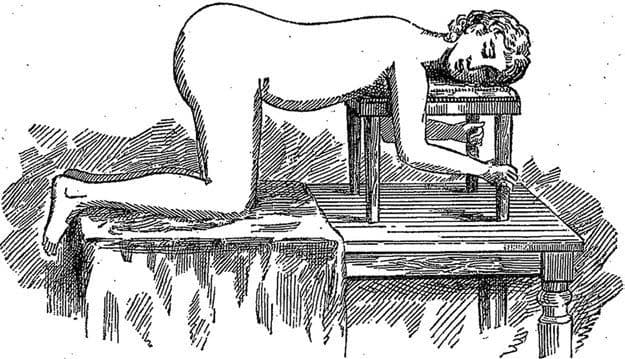
Figure 1 Matilda Stamper in the raised horizontal position. The original 1884 caption notes that the woodcut “shows the patient in this position, held by assistants.”
She is unaccompanied in the picture. Although Bozeman’s caption states that the image “shows the patient in this position, held by assistants,” neither the doctor nor his assistants are actually depicted. This comment may refer to any number of the fellow physicians who often attended his surgeries. Conversely, he may have simply meant the other enslaved women who were present in the clinic at that time. At any rate, Matilda seems to hold herself up. Her head languishes on the covered bench. Her eyes are closed peacefully, her mouth relaxed. She grasps the bench’s legs almost lovingly and embraces the apparatuses of her examination.
Matilda’s serene countenance, as visualized in the woodcut, stands at odds with Bozeman’s earlier report of the case. Several key details are omitted from the image. Along with its spurious proclamations of Matilda’s comfort, Bozeman’s written account also points out her suffering, albeit in a minimized fashion. The visual text offers none of the written narrative’s clues about the difficulty of Matilda’s surgeries. There is no evidence of her pain or resistance. The image literally whitewashes her experience of subjugation in order that it might present a fantasy of choice and well-being. But I argue that Matilda’s repose in the woodcut does not totally eradicate the traces of her discomfort. The bench/table structure is not naturalized by the look of pleasure on her face. No matter her closed eyes and cushioned head, she is still a woman completely disrobed and awkwardly kneeling on a table. While the image attempts to confirm the author’s claims that his procedures were ultimately comfortable for Matilda, it undoes that work in its portrayal of her vulnerable body on display. Might the shading next to the legs of the bench also indicate grooves worn on the table by Matilda’s pained wrenchings? Might the hatch marks surrounding the image also be foreboding? In this obfuscation of pleasure and contortion, we witness the inherent fissures in Bozeman’s narrative of care. His nostalgic conjuring of Matilda and other enslaved women as willing and pleased is shown to be, at its core, unstable. The haphazard nature of the medical fiction is powerfully dramatized in the irreconcilability of Matilda’s pained blackness with the contented white female figure presented in Bozeman’s later report. And so the question remains: Can we properly term this whitewashed image representational labor? Perhaps this is not labor at all, but an example of the destructive power of thingification identified by Aime Cesaire, in which black bodies are transformed, by the “relations of domination and submission … into an instrument of production.”[41] Perhaps it is this destructive work, which is both labor and also a more metaphysical kind of value relation, that attends the production of the slave/body into a representation of white professional expertise.
Toward a Conclusion
The names of the enslaved women subjected to Bozeman’s first fistula surgeries resound across his exhaustive series of case reports: Kitty Johnston; Lavinia Bondurant; Julia McDuffie; Dinah; Delia; Amanda; Minerva; Louisa; Ann; Nancy; Rachel; Ann; Jane, “colored girl of [Montgomery] county;” Jane, “colored girl of West Point, Georgia;” Jane, “colored girl, of Columbus, Mississippi.”[42] Several of these women cycled through both mens’ practices. But there is a vexed and constitutive tension between “what happened and what is said to have happened.”[43] We have little more than Bozeman’s accounts of the events to rely on for the narrative’s source material. We have only Bozeman’s words, and those of his collaborators, to look to for the historicity of the experiments. The women’s names are obscured, shortened, confused, and elided so often that it becomes difficult to determine who was present as a test subject and when. Bozeman’s writing and re-writing of their names is inextricably linked to the ways in which he catalogs their bodies. In these women, he creates a repository of historical source material. His power as a medical specialist is both surgical and archival; his work of assemblage takes place both within the clinic and in the chronicles of his clinical trials.
Considering Bozeman as archivist profoundly highlights his active role in the ordering work inherent in the technologies of professional medicine that he and his colleagues crafted during the 19th century. This consideration, in turn, compels us to attend to the multiple forms of black women’s labor on which Bozeman’s archive depended. By the time Bozeman had arrived in Chicago in September of 1884, the country had witnessed a national retrenchment of the promises of black civic personhood held out by Reconstruction. Emancipation had been declared nearly two decades earlier and many of Alabama’s formerly enslaved labored under various forms of conscription as sharecroppers or tenant farmers. The conditions of wage labor and production had changed dramatically by the closing decades of the century. It is possible that some of the women who Bozeman first treated in Montgomery had migrated to points further north—including to Chicago—after the close of the Civil War. It is also plausible that some of the enslaved women he treated were no longer alive at the time of his Palmer House speech. Yet, in spite of the temporal and spatial distances between Bozeman’s first work with black women who suffered from vesicovaginal fistula in Montgomery in the late 1840s and his latter Chicago talk, the knowledge and techniques produced through the bodies of enslaved women remained a central element of the way in which the doctor told his story. Decades after Emancipation, enslaved women’s bodies were still being called upon to represent white men’s surgical prowess.
By reading against Bozeman’s archive, we might locate the repetition of black women’s names, the fabrication of representative white female bodies, and also Bozeman’s collection of enslaved patients more generally as part of what Hortense Spillers names as the “signifiying property plus” of black women’s bodies. Black women’s images—and textual afterimages—were made useable through a flexible interpretive frame that combined their productive and reproductive labor with the revivifying power of medical men’s authorial voices. Their bodies were made to speak at the point where they were also physically absent. The lapses in the historical records ensure that we cannot know the precise routes of the transfer of enslaved women. Yet, the women’s lives reach out to us through these archival gaps.
WORKS CITED
1. “Opening Sessions of the American Society—Papers Read,” Chicago Tribune, October 1, 1884.
2. This fistula develops from fissures that produce abnormal passageways between organs as they heal, subsequently prohibiting bladder and/or rectal control. Today, medical researchers widely recognize compromised, extended labor, and gynecological surgical injury—including injury resulting from the use of foreceps—as the condition’s immediate causes. They also identify pregnancy at a young age and improper prenatal nutrition as significant risk factors. Present-day treatment options range from conservative methods—such as the chronic draining of the bladder with an indwelling catheter to encourage spontaneous closure in smaller fistulas—to surgery; surgical repair is prescribed for most incidences, as spontaneous closure is uncommon. For more on etiology and history of treatment strategies see: Kikelomo Bello, “Vesicovaginal Fistula (VVF): Only to a Woman Accursed,” The Female Client and the HealthCare Provider, edited by Janet Hatcher Roberts and Carol Vlassoff (Ottawa: International Research Development Center, December 1995) 19–41; Neeraj Kohli and John R. Miklos, “Managing Vesico-Vaginal Fistula,” Women’s Health and Education Center Homepage, August 13, 2006. http://www.womenshealthsection.com/content/urog/urogvvf002.php3 (accessed August 13, 2006); and Robert F. Zacharain, “A History of Obstetric Vesicovaginal Fistula,” ANZ Journal of Surgery, 70.12 (December 2000): 851.
3. Nathan Bozeman, The Clamp Suture and the Range of its Applicability, Considered in Relation to the Cure of the Injuries Incident to Parturition, With Statistics. 1884, emphasis mine.
4. I am grateful to Calvin Warren and Sarah Haley for their thinking on the inabilities of prevailing labor discourses to account for all of the uses to which black women’s bodies were put and on the flexibility of black women’s forced labor, respectively.
5. Elaine Scarry, The Body in Pain (New York: Oxford Paperbacks, 1987), 82–83.
6. Karl Marx, Capital: A Critique of Political Economy (Chicago: Charles H. Kerr and Company, 1915), 64. My citation of Marx is constrained by the limits of his treatment of chattel slavery as a proto-capitalist form. I include his description of equivalency only to describe the value of slave-as-commodity in a capitalist system.
7. Tiffany King, “Labor’s Aphasia: Toward Antiblackness as Constitutive to Settler Colonialism,” Decolonization: Indigeneity, Education & Society, June 10, 2014, https:// decolonization.wordpress.com/2014/06/10/labors-aphasia-toward-antiblackness-as-consti tutiveto-settler-colonialism/ (accessed December 15, 2015). King maintains that “Black bodies cannot effectively be incorporated into the human category of laborers.”
8. Semioticians have, of course, differed widely in their interpretations of the relations that signs themselves enact. An exhaustive survey of the genealogies and major debates in the signobject relation is beyond the scope of this article. However, my reading of the work of the sign tracks back through the work of philosopher C. S. Peirce, who explicated the links between representation, signs, and truth claims. Peirce defined the sign as “something which stands to somebody for something in some respect or capacity” (CP 2.228, ca. 1897). He maintained that “a sign cannot exist as such the first time it is presented, because it must become a sign” (Hoopes, Peirce on Signs, 21). This identification of the sign’s becoming here points up the work of representation. For more on Peirce, see: James Hoopes, ed., Peirce on Signs: Writings on Semiotic by Charles Sanders Peirce (1991) and Kelly A. Parker, The Continuity of Peirce’s Thought.
9. Hortense Spillers, “Mama’s Baby, Papa’s Maybe: An American Grammar Book,” Diacritics, 17.2 (1987): 65.
10. Ibid., 67. I am indebted here to Spillers’s explication of the flesh as that “zero degree of social conceptualization that does not escape concealment under the brush of discourse, or the reflexes of iconography.” For more on Spillers’s concept of ungendered female flesh and the relation of property, see also Alexander G. Weheliye, Habeas Viscus: Racializing Assemblages, Biopolitics, and Black Feminist Theories of the Human (Durham, NC: Duke University Press, 2014).
11. Jennifer L. Morgan, Laboring Women: Reproduction and Gender in New World Slavery (Philadelphia, PA: University of Pennsylvania Press, 2004).
12. Dorothy Roberts, Killing the Black Body: Race, Reproduction, and the Meaning of Liberty (New York: Vintage Books, 1998).
13. Leopoldina Fortunati, The Arcane of Reproduction: Housework, Prostitution, Labor and Capital (New York: Autonomedia, 1995). For more on her discussion of women’s labor at/as the excess of Marx’s formation of waged work see especially her fifth chapter, “In the Sphere of Circulation … ”
14. Steven M. Stowe, Doctoring the South: Southern Physicians and Everyday Medicine in the MidNineteenth Century (Chapel Hill, NC: The University of North Carolina Press, 2004).
15. Harriet Washington, Medical Apartheid: The Dark History of Medical Experimentation on Black Americans from Colonial Times to the Present (New York: Doubleday, 2006); Marie Jenkins Schwartz, Birthing a Slave: Motherhood and Medicine in the Antebellum South (Cambridge, MA: Harvard University Press, 2010).
16. Harriet Washington, Medical Apartheid, 2.
17. J. Marion Sims, Silver Sutures in Surgery: The Anniversary Discourse before the New York Academy of Medicine, Delivered in the New Building of the Historical Society on November 18, 1857 (New York: Samuel S. and William Wood, 1858), 11.
18. Nathan Bozeman, Urethro-Vaginal, Vesico-Vaginal, and Recto-Vaginal Fistules: General Remarks: Report of Cases Treated with the Button Suture in This Country and in London, Edinburgh, Glsgow and Parisian Hospitals (New Orleans: Printed at the Bulletin Book and Job Office, 1860), 39. Referencing the aforenamed article, Deborah Kuhn McGregor cites Bozeman’s argument that “women in bondage recovered more quickly than impoverished British victims of vesico-vaginal fistula” in Sexual Surgery and the Origins of Gynecology: J. Marion Sims, His Hospital, and His Patients (New York: Garland Publishing, 1990), 186. She reads this thinking as rooted in antebellum Southern regionalism and as example of Bozeman’s pro-slavery medical perspective.
19. Although Nathan Bozeman entered the professional discourse on vesico-vaginal fistula through the pained bodies of black women, it is not the case that all of J. M. Sims’s enslaved patients were sold to him along with the clinic. As noted in the previous chapter, Sims, as lessee, would not have retained legal ownership of the women and would not have been free to legally deed them to Bozeman. While Sims’s personal papers trace the sale of his personal slaves to a local broker, they do not confirm a sale to Bozeman.
20. Following Adriana Cavarero and Judith Butler, I choose accountability over identification here in a tacit acknowledgment of the latter’s ethical limits. Butler cites Cavarero’s assertion that an “altruistic ethics of relation … desires a you that is truly an other, in her uniqueness and distinction” without forcing the false security of an absolute presence to oneself. Thus, we might imagine, as a corrective of Bozeman’s enacted sympathy, a relational strategy of selfmaking that relies on the “giv[ing] of an account to someone” such that “I” am always already implicated in the other and not transparently self-evident. This notion of accountability as a basis for ethical narration, I think, cuts in another way: Bozeman’s failure to name as injurious the very clinic in which he operates effects the additional violence of sanctioning enslavement. Judith Butler, Giving an Account of Oneself (New York, Fordham University Press, 2005), 34, emphasis in the original.
21. Susan Sontag, Regarding the Pain of Others (New York: Picador, 2003), 102.
22. Nathan Bozeman, Urethro-vaginal and Vesico-vaginal Fistules: Remarks upon Their Peculiarities and Complications: Their Classification and Treatment: Modifications of the Button Suture: Report of Cases Successfully Treated (Montgomery: Barrett and Wimbish, 1857), 9.
23. Ibid., 45.
24. Ibid.
25. Nathan Bozeman, Remarks on Vesico-Vaginal Fistule, with an Account of a New Mode of Suture, and Seven Successful Operations (Louisville: Hull and Brother, 1856), 95.
26. It bears reiterating here that Sims advertised the clinic as a “Surgical Infirmary for Negroes” during his ownership of it. Although the archive is unclear about many of the specifics of Bozeman’s proprietorship of the property, it is possible that he continued to use it as an exclusively black-populated surgical space—especially given his continuance of Sims’s fistula work. Extant records neither confirm nor deny the clinic’s integration.
27. Bozeman, Remarks on Vesico-Vaginal Fistule, 94.
28. Nathan Bozeman, Transactions of the American Gynecological Society 9 (New York: D. Appleton and Co., 1885), 381.
29. Ibid., emphasis mine.
30. Bozeman, Remarks on Vesico-Vaginal Fistule, 24.
31. Saidiya Hartman, Scenes of Subjection: Terror, Slavery and Self-Making in Nineteenth-Century America (New York: Oxford University Press, 1997), 62, emphasis mine.
32. Bozeman, Urethro-vaginal, Vesico-vaginal, and Recto-vaginal Fistules, 25.
33. Ibid.
34. Bozeman, Transactions 9, 36.
35. Bozeman, Urethro-vaginal, Vesico-vaginal, and Recto-vaginal Fistules, 24.
36. Ibid.
37. Bozeman, Urethro-vaginal, Vesico-vaginal, and Recto-vaginal Fistules, 25.
38. Ibid.
39. For more on the romance of reunion and post-slavery nostalgia, see: David W. Blight, Race and Reunion: The Civil War in American Memory (Cambridge, MA: Belknap Press, 2002), especially the chapter, “The Lost Cause and Causes Not Lost,” 255–99.
40. Hartman, Scenes of Subjection, 37.
41. Aime Cesaire, Discourse on Colonialism, tr. Joan Pinkham, Discourse on Colonialism (New York: Monthly Review Press, 1972), 42.
42. Bozeman, Remarks on Vesico-Vaginal Fistule; Transactions 9.
43. Michel Rolph-Trouillot, Silencing the Past: Power and the Production of History (Boston: Beacon Press, 1997), 52.