

VOL. 4
Def America: Russell Simmons
Manning Marable & Cheryll Greene
On January 28, 2002, hip hop mogul Russell Simmons participated in a public dialogue hosted by the Institute for Research in African American Studies at Columbia University. Before an audience of nearly three hundred people, Simmons candidly discussed his life—from his juvenile encounters with gangs to his remarkable accomplishments in entertainment, media, and related commercial enterprises. As the founder and chairman of Rush Communications, a multimedia empire that includes Def Pictures, Def Jam Recordings, Russell Simmons Television, Rush Art Management, the magazine Oneworld, and the lucrative and trendy clothing company Phat Farm, Simmons helps set the standards for popular youth culture throughout the United States and the world.
The dialogue at Columbia with Manning Marable, the Institute’s director and a professor of history and political science, was only one of a series of events in which Simmons has recently participated with the objective of developing a hip hop presence in politics and public affairs. Several weeks after this interview, the Hip Hop Summit Action Network, funded and led by Simmons, hosted an historic West Coast Hip Hop Summit in Los Angeles. Hundreds of influential performance artists, music executives, grassroots activists, public leaders, and others gathered to address key issues and establish a progressive political agenda. The keynote address was delivered by the leader of the Nation of Islam, Minister Louis Farrakhan, who, in the Columbia dialogue, Simmons called “the conscience of Black leadership.”
Farrakhan’s central position as a political and spiritual mentor to Simmons and the hip hop nation at large reflects their profound estrangement from the politically traditionalist leadership of the Black middle class—and speaks volumes about the cultural divisions and political stratification within the African American community. For example, as Simmons observes below, the groundbreaking rap group Run-D.M.C. was featured in the mainstream magazines Rolling Stone and Vanity Fair before the group appeared in the venerable African American publication Ebony. “These big old civil rights organizations with all this money and infrastructure don’t do shit with the people,” Simmons said. “We are constantly working to connect the old civil rights leaders with creative young people.”
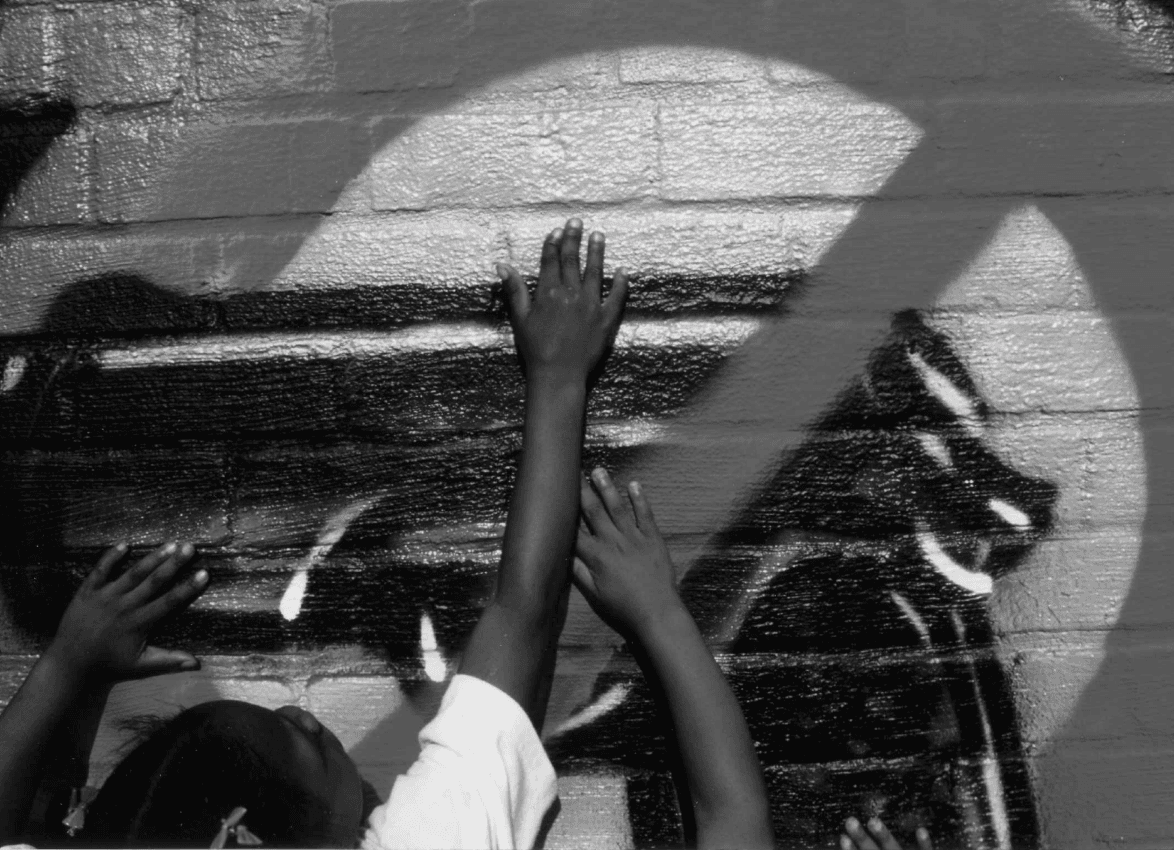
Gun Play. Photo by Philippe Cheng
The reluctance of the civil rights generation to come to terms with its own children’s music hampers its ability to advance a meaningful political agenda reflecting widespread Black interests, observations, and concerns. At their peril, members of this generation—who tend to be more politically powerful and conservative than their successors—turn a blind eye to the life-and-death struggles of the young and the working poor. What was yesterday considered merely youth music is now the primary prism through which urban Black folk under age thirty-five view their lives, public and private. If for no other reason than this—and there are many others—hip hop’s emergence must be taken seriously as the robust and unwieldy historical event that it is.
It is crucial to note that hip hop did not erupt from America’s inner cities by happenstance. Rather, it emerged in response to a variety of social factors that converged on the poor and urban young in the early 1970s: the widespread loss of industrial jobs in cities, slashed funding for the performing arts in public schools, an increase in the trafficking and use of heroin and cocaine, the ubiquity of Blaxploitation imagery, the vacuum of Black leadership following the suppression of the Civil Rights and Black Power movements, and, finally, the fiercely destructive rioting of the previous years. For these reasons and others, Black America as it had previously existed would not be again. The Civil Rights Movement created unprecedented opportunities for upward mobility for many African Americans, but the quality of life of urban Blacks simultaneously deteriorated—and the community splintered even further.
Thus, hip hop was born of poverty, and the young creators of the genre inherited a severely diminished Black freedom movement, a legacy that served to alienate an entire generation. In addition, even as hip hop was still emerging, music industry executives immediately co-opted the music and culture wholesale, dictating the content, images, and marketing strategies that would define the music. These factors gave rise to a profound struggle among today’s hip hop cultural workers over what their music should and could be—a struggle that manifests itself today in the deep-seated tension between politically conscious rappers and more mainstream artists. The former critique the political, social, and economic systems that subjugate African American life, and they promote an informed consciousness about the African diaspora. The latter celebrate youth party culture, voicing messages of misogyny, homophobia, corporate greed, and excessive materialism in an unmitigated reflection of the nation’s mainstream popular culture. On closer examination, however, the distinctions between these two groups become difficult to sustain. Some of the so-called conscious rappers are also, in their own way, misogynistic and homophobic; thus, it is difficult to identify a truly progressive element within the culture.
These subcategories of hip hop—mainstream and politically conscious—offer a sort of symbolic resolution to Black America’s historical oppression and exploitation by U.S. society. They offer two versions of idealized Blackness. On the one hand, artists such as Jay-Z, through their music and entrepreneurial ventures, represent a kind of Black capitalist spirit of self-determination. Having built hugely influential, lucrative music companies, such artists view their corporate success as evidence of their politics—of their push for Black empowerment through gaining wealth. Ultimately, however, their politics take a distant backseat to their self-proclaimed moneymaking prowess. On the other hand, groups such as Black Star and Dead Prez, at the core of their music, critique U.S. capitalism (domestic and global) and express a utopian, twenty-first century Africanity. Their politics of performance challenges the bold consumerism of mainstream rap. Neither genre, however, responds to—let alone maps an agenda to address—the poverty-born social psychology of today’s inner cities. Above all, then, hip hop artists are struggling for a share in the industry of Black cultural representation. They are positing two distinct but politically impotent visions of an urban utopia: gold chains versus African medallions.
Along what lines, then, does the struggle for hip hop’s soul play out?
Although young African Americans persistently suffer escalated unemployment, drug addiction, police profiling, and family alienation because of their race, it is crucial to note that hip hop-generation African Americans no longer experience their race through the American apartheid system known by their parents and grandparents. Their oppression today is not unique to African American life. Marginalized groups around the world occupy similar sites of disadvantage and discrimination. These universal themes are the source of hip hop’s unifying, cross-cultural resonance, its ability to transform the margin into a network of shared group experience extending around the globe. Viewed in this light, hip hop can provide a much-needed space where radical dialogue that interrogates the status of global, marginalized selfhood—its psychic vigor and well-being—can take place.
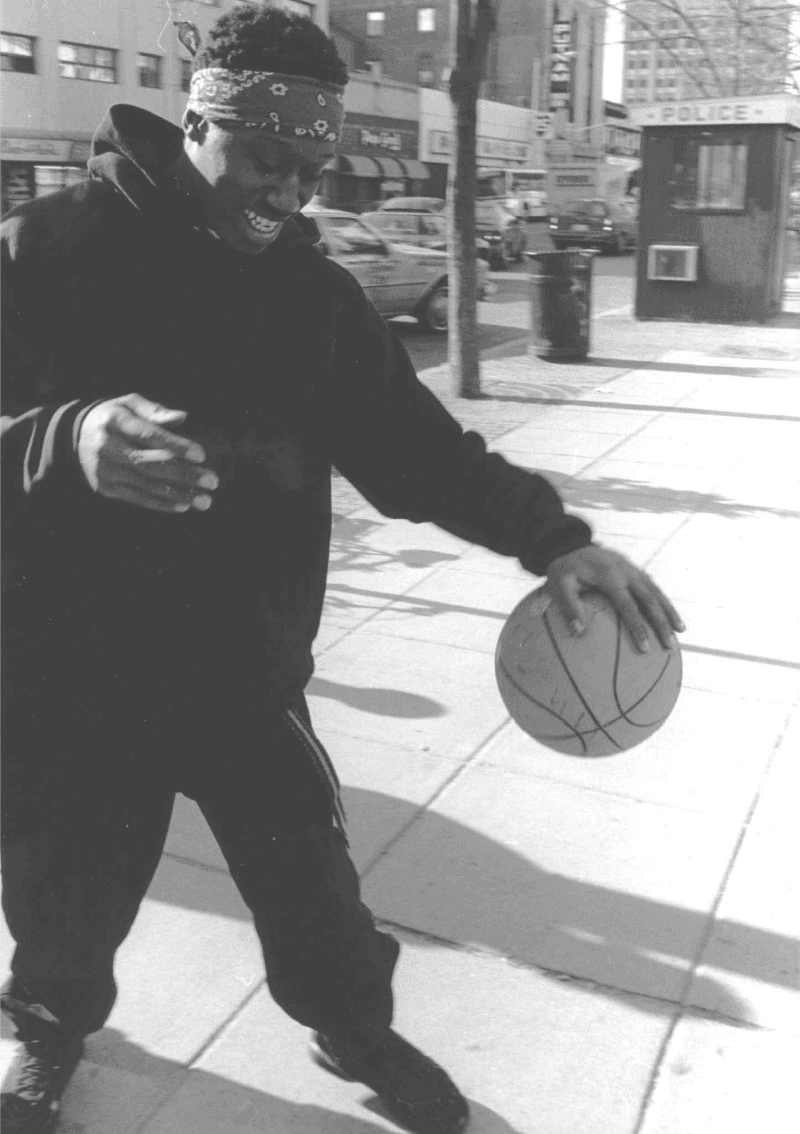
Ballin'. Photo by Kristen M. Clarke
To transform an oppressed community’s political behavior, one must first begin with the reconstruction of cultural and civic imagination. Malcolm X’s greatest strength as a Black leader was his ability to change how Black people thought about themselves as racial subjects. Revolutionary culture can do the same thing. Through music and the power of art, including hip hop, we can imagine ourselves in exciting new ways—as makers of new history. As Robin D. G. Kelley suggests in this very issue of Souls, the essential “politics of art” is the politics of collective imagination, the transformative politics of freeing one’s mind. “We need to consider love and poetry and the imagination as powerful forces,” he writes. In the same vein, KRS-One in a recent interview observed that hip hop music is practically “the only place where Dr. Martin Luther King’s ‘I Have a Dream’ speech is visible [in American culture]... . Today, with the help of hip hop, they’re all hip hoppers out there. .. . I mean Black, white, Asian, Latino, Chicano, everybody. Hip hop has formed a platform for all people, religions, and occupations to meet on something . . . beyond music.”
Russell Simmons estimates that his record label's customers are 80 percent white. This figure brings into sharp focus the central political contradiction socially conscious hip hop cultural workers must address: how to anchor their art in the experiences and struggles of African American and Latino communities—the people they’re rapping about—even if white listeners are paying the bills. The 80 percent figure also makes clear that hip hop now has the reach to impact significantly how Americans of every racial group envision and communicate future political agendas.
Even if, as Simmons details in the interview below, hip hop artists are reaching nearly every segment of America and, increasingly, the globe, even as they are forging new ground as entrepreneurs, entertainment moguls, and even as political actors, we should not romanticize the hip hop nation. As it exists today, the genre is far from realizing its potential: It scarcely impacts mainstream political debate in America. But the seeds of progress and change are there, waiting to be sowed. If we utilize the power embedded in hip hop culture as a matrix for constructing new movements and institutions for Black empowerment, even—as Public Enemy eloquently rapped—“a nation of millions” cannot “hold us back.”
—The Editors
Souls: One of the things that’s truly striking about hip hop is that it represents the voice of a new America. This voice has been growing for about two decades, and it brings a cultural pulse of vitality to America and international arenas.
Russell, in your candid new autobiography, Life and Def: Sex, Drugs, Money and God, you talk about growing up in Hollis, Queens, in the early 1970s. Like many young people who grow up in the inner city, when you were a teenager, you were pulled into a gang. You became involved in activities that your parents opposed.
Russell Simmons: That's the story of our ghettos today.
If you listen to the hip hop songs that some of the adults are offended by, they present a picture of young life in America—young Black life in America, for the most part—and that’s something that I wanted readers to see again in my book. The type of youth I had is not uncommon for someone coming out of the "hood, so the situations in the book were ones that readers could see themselves in. Most of my friends either died or went to jail over drugs—over heroin, specifically—when I came up. I was fortunate.
On our street corners, we had Black Muslims, and we had heroin addicts. We had nice kids who were heroin addicts who died or went to jail over drugs. They became criminals, those who went to jail, because of harsh drug laws. So my story is an important story, I think, but it’s not unlike most stories of kids coming out of the “hood.”
Souls: When you were a young man, when was the first time that you can recall becoming fascinated by music?
RS: I always loved music, but it didn’t occur to me that that would be my business until I was in college and I went to a club on 125th Street in Harlem, Charles’ Gallery. I saw Eddie Cheeba, who was one of the first rap stars on the scene at that time. He was great, a big inspiration—and a light bulb went off. I wanted to somehow work with him. The idea not to sell drugs but to sell concerts was appealing, safer, and more obvious. It seemed like it was where I wanted my life to be.
Souls: That’s how you become involved in the business of promotion?
RS: Right, I saw Eddie Cheeba and right then and there I knew that I wanted to promote. There was a kid named Gene Pendergrass who was promoting that weekly event and I wanted to do what he was doing. I saw him doing it and he was getting money. It was an easy hustle and it was a fun hustle. I wanted to be in the club every night, so this was an opportunity.
I think that I’ve been fortunate enough to have the courage—I think this is mostly what people lack—to stick with ideas that suited my vision of where I could go in life. I always say to young people: Stick with your dreams. Because they’re going to laugh at you if you’ve chosen some profession and you’re not successful after two weeks. That time in my life was the first time I stuck with a goal, especially when so many people in the field were more talented than I was. In concert promotion, there were many other promoters who were better than I was. Many people in every field that I’ve joined have been better than I was. But I learned the lesson of sticking with it. As they say, “Some with persistence, some with resistance.” That really is a key to a lot of people who are not so talented or so smart being more successful than all the geniuses. That’s where I’ve been lucky.
Souls: The hip hop group that first defined the genre in the first decade of hip hop’s cultural and artistic development was probably Run-D.M.C. I’m sure the audience has a lot of questions about Run-D.M.C.—your brother Joey Run (Joseph Simmons), Darryl McDaniel, and Jam Master Jay, Jason Mizell. Talk about how Run-D.M.C. was put together and how this group had the breakthrough that other hip hop artists attempted but did not achieve.
RS: I think that Run-D.M.C.’s success was based on the fact that they weren’t aspiring to be anything but what they were. Their honesty and their integrity took them to the heights that they went to. They were the greatest rappers of that era. Run-D.M.C. were amazing songwriters and great performers.
They took the whole community and culture to heart. Other rappers were trying to escape the ghetto—they were putting on outfits that looked like the people in the punk rock clubs because that crossover was their greatest escape. It got them bookings and was their chance to travel. Rappers at that time never went to adult Black clubs like Leviticus in midtown Manhattan.
But Run-D.M.C. wore the black leather outfit that was back then the official uniform from Queens. The shell-toe Adidas and velour hats. That was official. But that in itself was a costume to all those outside the ghetto. That was fascinating, that integrity. I’ve learned to always try to protect artists from the idea that they can be greater by changing themselves, because what’s inside them, what’s honest, is the greatest part of their artistic success or input. So I always try to get that out of them. That’s what Run-D.M.C. did, and it made them different.
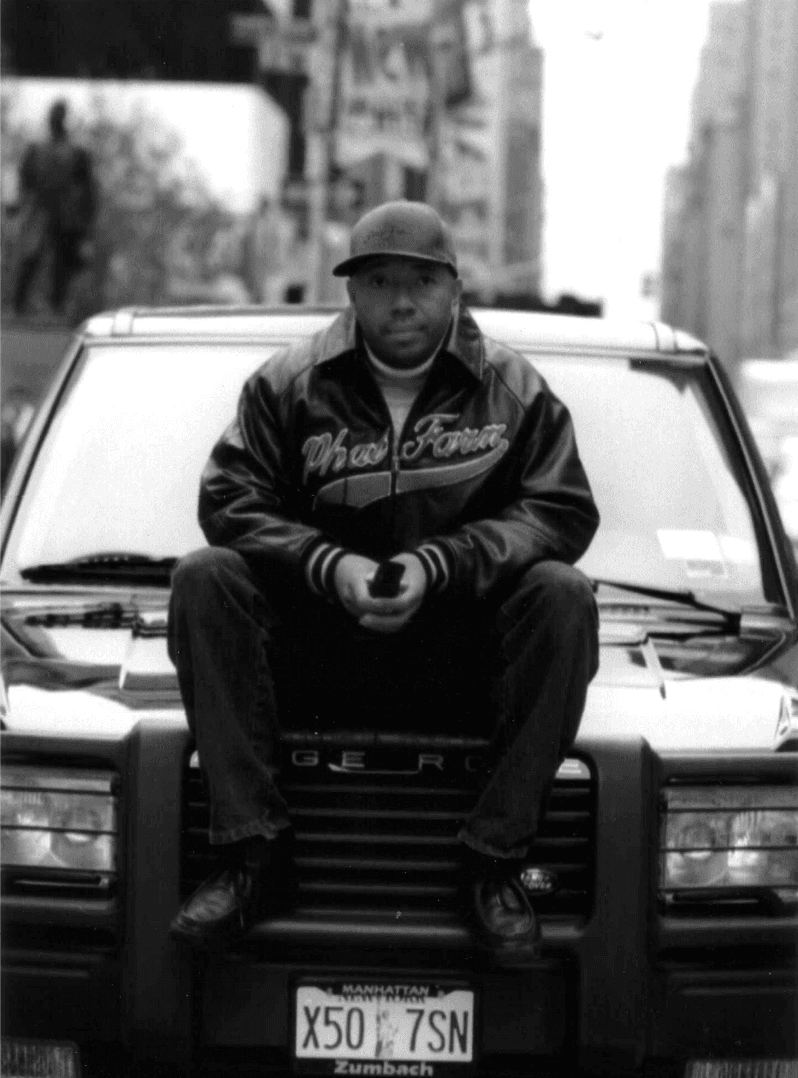
Russell Simmons. AP Photo/Jim Cooper
Souls: One of the things that’s characteristic about old-school hip hop is that, very much like the R&B days of the 1950s and early ’60s, a number of artists who created musical art forms found themselves shortchanged financially when they were relating to record companies. You once told Snoop Dogg during a radio interview that your profit sharing with Kurtis Blow, for example—the royalty points that you offered Kurtis in his first record deal—was ten points out of one hundred. Snoop nearly fell out of his chair when he heard that. He could not believe the split was so generous.
RS: Yes, a lot of the artists signed deals that upped their ante from where they were but didn’t really give them an opportunity to share moneywise in their success. They might have got cars leased and apartments leased for them by the record companies, and they were able to travel and leave the projects—and that was a big deal. For example, before he got a record deal, the great Grand Master Flash lived in an abandoned building. His lights and electric came from the pole downstairs. So when he got a record deal, they told him he had a real apartment and they said, “We’re going to lease you a car.” And there was only one company that was interested in these artists at that time—so he got more than he could have got elsewhere. It wasn’t illegal.
But I always felt that if you protect your relationship with people—generous is not the word. Fair. If you are fair, then twenty years down the road someone like Kurtis Blow can look back and say that the deal that I gave him—although he didn’t know any better at the time, and he had no alternatives—the deal I gave him was fair. And that’s why that’s my man still. We have a good relationship and we still work together.
You know, people don’t go away. Some ideas change and evolve, but people—hopefully, you’re going to see them again. You should try to make yourself at peace with them when you deal with them. So, give everybody incentives. Make sure that everybody’s got a reason to go to work.
Souls: In 1980, you said the first trip that you took outside of the United States was to Amsterdam. Before that, the longest trip you had taken outside New York City was to Philadelphia. When you went to Amsterdam and you saw the response to hip hop culture, the music, you realized instantly that this could be a global force. How many people shared that vision at that time?
RS: Well, you can have great aspirations and a big vision for the work you’re doing, but really it’s a step at a time. It’s really about the little building blocks. So, seeing the response to the music in Amsterdam was great. We were willing to tour and to visit those markets and develop those careers.
That trip gave me the energy to pursue all the opportunities that were developing. Like pushing to get my artists exposed to the whole rock-and-roll world and get covered in the alternative press. Run-D.M.C. must have been in Rolling Stone magazine ten times before they were ever near Essence or Ebony magazines. Twenty times. Not only Rolling Stone but Vanity Fair.
So I began to see—where were the opportunities? They were developing in the alternative rock world and in the kind of artistic, new age, new ideas—everybody with new ideas. Not the kind of conservative obvious crossover formats for Blacks, young and old. So we were starting to see the wide support we could get for our artists, and seeing the crowds in Amsterdam was a reinforcement. It reaffirmed that many of those who didn’t really know what the music was about could learn to respect it. On the other hand, a lot of those who saw it for what it was, which was a reflection of those kids’ lives, they couldn’t respect it because it was too close to home.
Souls: By 1984, you had become through Rush Management the largest hip hop management firm in the United States. You had preeminent acts, you had Kurtis Blow, you had Orange Krush, you had Run-D.M.C. There was a transition from ’84 into ’85 and ’86 with the development of Def Jam. I wondered if you could talk about Def Jam, the role of Rick Rubin and yourself as the cofounders, and how Def Jam’s creation helped to bring hip hop to another level?
RS: Well, the problem with the labels that we were dealing with was that they didn’t have any real vision for the future of the artists. But we always believed that we were developing artists who could last forever.
For example, Kurtis Blow. By the early ’80s, he had sold a million twelve-inches with “Christmas Rappin’.” It was the biggest record that a major label had ever had on vinyl except “No More Tears (Enough is Enough),” the hit duo with Donna Summer and Barbra Streisand. So “Christmas Rappin’” was huge, but the label would not put his picture on the twelve-inch cover. The struggle that we went through over the picture was ridiculous. They just would not do it. They didn’t believe in him. They thought he was a gimmick.
His next opportunity comes along, and he did it again. In the second go ’round, we finally got a picture of Kurtis Blow on his album jacket. At that point, we had no music videos, as you know. There was no vehicle for marketing ideas and lifestyles and attitude. It was only music—we had to always promote everything through just the music. So we called Kurtis Blow the “King of Rap,” and he was the King of Rap because we said so.
No one else was marketing their artists and protecting them. So the idea for starting Def Jam was to develop artists, building lasting, stable careers. No one else had really bought into that at that point.
Souls: How difficult was it to get the hip hop artists that you were managing then included in mainstream outlets. What was the first hip hop act that you managed that had a video on MTV?
RS: Run-D.M.C. That was one of the first Black acts on MTV, period. The group wasn’t even on BET at the time. MTV played them before BET and before Black radio, which was typical. But we’ll talk about that later. The point is, Run-D.M.C. got on MTV, and at that point the only Black person on MTV was Michael Jackson. His nose was broken, his hair was straightened. And on the first Run-D.M.C. record they said,
No curl, no braid
Peasy head, and still get paid.
They made a point of not trying to fit the mold.
That was the beginning of the dialogue between the trailer parks and the projects, between Beverly Hills and the projects. It was the beginning of having artists who understand and reflect the real—not only the plight of the people in the community but the lifestyle, the attitude, the culture. With honesty. To really see the culture.
Souls: If one had to make a short list of videos that had the most profound impact on popular music in the last twenty-five years, you’d have to include Run-D.M.C. and Aerosmith’s “Walk This Way.”
RS: Yeah, I'd say that that was good, but I wouldn’t put that at the top of the list because I think of Rock Box and King of Rock, two early Run-D.M.C. hit records. But the reason I wouldn’t put “Walk This Way” on a short list is Run-D.M.C. almost never does the song live. They do songs that really speak to the heart of the culture—the songs that stick with their core fans. “Walk This Way” and those crossover records opened doors. Same with the Beastie Boys. I couldn’t take one of their first hit singles, “Fight For Your Right to Party,” and put it on that short list either because they never do it live. Ever. Vanilla Ice made those types of records. “Walk This Way” was a record. It was honest and it was not a sellout, but it was not a record that was dear to Run-D.M.C.’s artist heart or to the core community’s heart.
Souls: But it did open up a whole new market?
RS: Yes, and those people who were opened up because of it eventually liked Rock Box and King of Rock better.
Souls: Tell me about the development of the Beastie Boys.
RS: The Beastie Boys were young kids who had a band called Young and the Useless. It was an alternative, kind of a punk band. They also had the Beastie Boys, which was their rap band. They came to me and they had red sweat suits and red Pumas and red do-rags, which was kind of demeaning to them and to their audience.
But they had records that really represented their appreciation of hip hop. The “Back in Black,” AC/DC record that I re-mixed for them—that was a record that sounded like the Beastie Boys. That was honest and had integrity. The only thing that they were missing was someone to remind them that it was okay to be themselves. I saw them playing in their Young and Useless band and they wore what they usually wear. So that became their uniform off the street and onstage as opposed to trying to emulate Black rap bands.
Souls: How did Will Smith come to your attention? Talk about your relationship with DJ Jazzy Jeff and the Fresh Prince?
RS: Well, Will Smith was an artist who came to us with a record already on the radio in Philadelphia called “Girls in the World Ain’t Nothing But Trouble.” In the first few bars, before the music dropped, he was talking about getting punched in the eye. His man was like, “Well, what you gon’ do?” And he gave the appropriate answer for who Will Smith is—he said, “I’m gonna hold my eye.” Like, if you punch me in my face, I’m gonna hold my eye, which is what a lot of us would do. So he said something that was truthful. And that integrity made him feel so much more real than a lot of the rappers who were getting a third Rolls Royce? You park it and you get out and you’re like, “That’s it?” The third Rolls Royce is a bitch.
So Will Smith was one who was courageous and honest and artistic.
People still don’t understand why he’s still maybe one of the biggest rappers in the world. It’s because he speaks from his heart. Sometimes he’s made records that have not been as honest but mostly his integrity shines. That’s why he sells so many records.
Souls: You described in your book that the first golden age of hip hop was roughly between 1986 and 1990. More than any other label, Def Jam defined that. If you look at the artists that you came out with, arguably, the most influential group that hip hop has produced over the last quarter century is Public Enemy. I wondered if you could talk about them—how the concept evolved, how the group was presented and marketed.
RS: Run-D.M.C. first brought us the tape of their live radio show that aired on a Long Island radio station. Their records spoke to a lot of their frustration. They didn’t really preach anything. Chuck D didn’t have a mission statement, but he had insight. The songs were disjointed—and that was part of what was good about it—because they made honest statements about things that were going through Chuck D’s head. The way things go through our heads, they’re not always organized and made to make you think something. They’re made to make you feel a certain way. They were artistic expressions, and that’s what develops when you find an artist that has this kind of real dialogue with his fans.
People like to compare Public Enemy to hip hop today. Maybe Chuck was more focused and direct, bordering on preaching, than rappers are today. But it’s not that these guys today aren’t saying it. Some people say, “What is Tupac [Shakur] about?” Well, he wakes up and says he loves his mama, the next day he wakes up and says bitches ain’t shit, then the next day he wakes up and says something else. He’s being honest.
DMX is like that. He talks to God, and he tells you how frustrated he is and how God is the only thing that keeps him alive everyday. The next day he talks to the devil and he’s frustrated with the devil too. But you can see his connection—he’s in torment. That’s his thing. And that’s what a lot of artists have.
So Public Enemy was like that. The audience pushed them, and the marketing pushed them. They had a record called “My Uzi Weighs a Ton,” and it meant a lot of things. But one of the things you could tell if you listen closely was that his Uzi was his mouth and the bullets were his words. So I said that to him—that was the only input that I ever had. The press picked up on that meaning, and it kind of influenced Public Enemy to take on a role and fill a void. So Chuck D didn’t ask to be a leader, it was kind of put on him.
Their political approach changed the way people thought about a lot of things. It helped make the climate for a movie like Malcolm X. They took the gold chains off and put on African medallions and suddenly there were so many records by so many artists about social and political issues in the Black community. The trend was started by them, and their success inspired a lot of other artists.
Certainly for Def Jam, Public Enemy was our most influential group of that time.
Souls: Fear of a Black Planet, one of Public Enemy’s most pivotal albums, frames a political and economic and social analysis of what was going on in the 1980s and early 1990s in the African American community: the prison industrial complex, police brutality, the cutting of public institutions, and social policies that were repressive. The music spoke to that better than almost any—with a few exceptions—any African American political leader. So young people looked to Public Enemy and they looked to the artists as really a voice of discontent, a voice of rage, but also a voice of creativity and power.
RS: Yes, and today you get that from a lot of rappers. People are telling me now that our Def Poetry Jam show on HBO is saying such important stuff and it’s so inspiring because these things aren’t being said anywhere else. They’re saying that because they can’t hear the messages on the rap records. The poetry and the rap are saying the same thing.
I want to clear one thing up. I keep hearing, because I love the poetry, “Well, Russell is critical of rap.” I love rap today as it is but [have greater aspirations for it—or different aspirations for it—as well. I love the new poets and what they’re saying because they help people understand what the rappers had already been saying. It’s a little easier when you hear from the mouths of poets. Sometimes rappers do discuss solutions versus just venting their frustrations. Maybe rappers vent a little more than poets, but it’s mostly the same message. Poetry is just another way to get this voice out there. They’re all saying the same thing, and there are different ways of saying it.
Souls: Many of us come out of a generation that was influenced by Black Power, the antiapartheid struggle. What resonated for us about Public Enemy was this uncompromising position. By any means necessary. Opposing racism, opposing the oppression of the Black community. Now in your book you talk about racism, and I want to read a quotation from page 121. “I don’t use the word racist much. It’s not productive. ...I realized a while ago that I have the ability to stomach racist white people, and accept the rest of them for what they are.” What do you mean by that quotation?
RS: What I meant was that there’s a young generation here that has a great opportunity. Racism still exists, and it’s very strong, and it’s damaging and difficult. It is a burden on us. But to rise above it is in part to realize that there was so much struggle that came before you and to appreciate the work that’s been done for you.
Integration took a hell of a toll on our communities, from the Black doctor to the Black lawyer to the Black plumber. They were integrated so they got pulled away from the community. We were all affected, all of our communities. There was a lot of struggle involved in us getting legal rights. Then, despite opportunities legally, there were still so many roadblocks. So many people woke up in the morning just saying, “I hate niggers.” Now, not too many people in power are waking up saying that. They’re just not doing it. They don’t even know that they’re racists, and so they can be dealt with. You don’t have to deal with the fact that they are racist either. All you have to do is work around it. Do what you do, businesswise or from whatever your agenda is.
For example, the thing that’s the most influential thing in American culture is Black culture. Eighty percent of our records are sold to non—African Americans.
Souls: Eighty percent?
RS: Eighty percent of our records are sold to non—African Americans. So our young culture is driving mainstream American culture.
No one was out getting platinum diamond Franck Muller watches before my wife, Kimora Lee Simmons, and Puffy [Sean “P Diddy” Combs] and Jay Z got them. They didn’t even know about them. They didn’t know about the new Bentley before my wife and Puffy and Reverend Run. So we influence a lot of mainstream and luxury and American ideas and ideals.
Example: a Black Hollywood party. You’d be amazed at the number of stars that attend Black Hollywood parties. There’s Eddie Murphy and Chris Tucker and other Black stars. So why can’t we make a movie? Other than $5 million movies—nigger movies. Because there are no Black producers in Hollywood. That job is reserved for white men. There is not one Black producer of any real substance. I should qualify this to make this clear: Damon Wayans is a producer but not in the movies. Eddie Murphy is a producer but that’s because he’s an actor. Chris Tucker is a producer and gets the credit because he’s an actor. But the job of riding around in a go-cart with no talent, that job is reserved for white men. [Audience laughs.]
It is. Well, in part that’s because the institution of Hollywood has a certain hold, controlling access to this arena. That’s the way it always has been. But we are also shut out partly because we don’t accept that it’s our job to collaborate and be partners with people who have interests like we have. Because of our lack of a willingness to take advantage.
Puffy is not being told he’s a nigger and he can’t do nothing. Damon Dash is not. Master P is not. So the hip hop generation is going to defy those ideas. Whenever they move to L.A., they’re going to make movies, as many as they want because that’s the way they think. That’s the way they operate. They have ideas and culture, and they’re not limited in terms of where they go.
I guess about eight years ago now, when I decided I wanted to make movies, I rented a house in Malibu. I lived next door to David Geffen and John Davis and Jerry Brookheimer and Larry Gordon and Ronnie Meyer. The whole beach was full of filmmakers, and a house was available to rent in the neighborhood. There was no attitude of “No niggers can come here.” None of that. And when they were trying to make a movie and they’re walking up and down the beach trying to figure out what’s cultural, whose house did they come to? Mine. So, it was easier to get movies made and easier to collaborate and easier to build relationships. Because we have the goods and we can sell them.
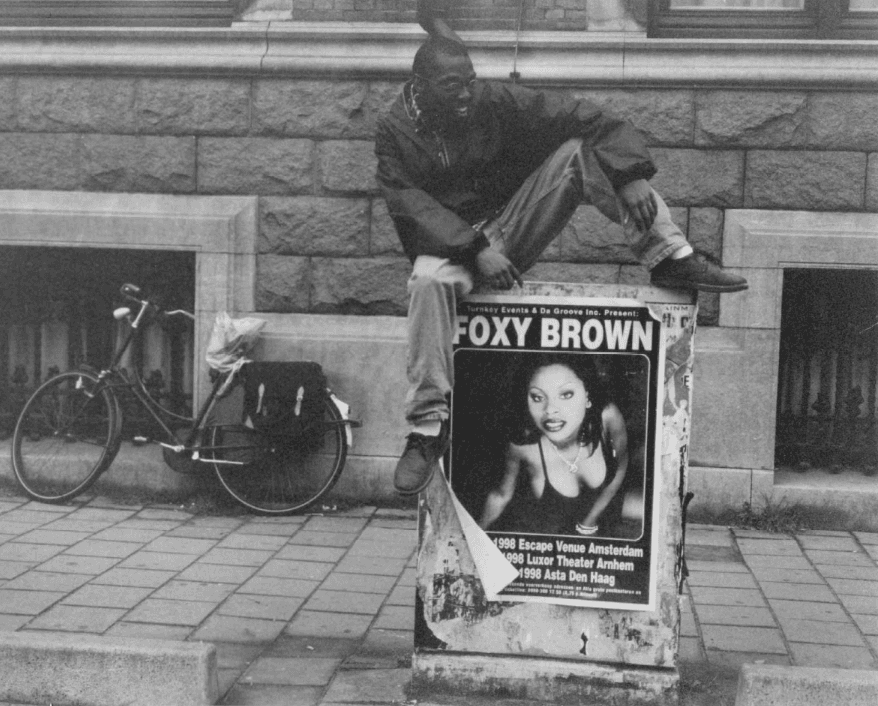
Amsterdam, March, 1997. Photo by Khary Jones
That’s why Black record executives make more than their white counterparts. Period. You don’t have to pay the white rock-and-roll guy what you have to pay Murder, Inc. Records CEO Irv Gotti. Because Irv Gotti don’t give a fuck. He’ll leave you. He’ll start his own company in a minute. They got a mouthful of gold teeth now, and they say, “I don’t need nothing from you.” They just want to do their thing. They were doing it already independently and they say, “You can’t do this shit without me. It’s impossible. You can own the distribution if you pay me a fortune. I can make the records, and I’m going to own the company and I’m gonna own the masters and I’m gonna own every goddam thing and y’all can distribute it and I don’t know what you all gonna make.”
The idea is about us not being handcuffed. It speaks to all of the businesses that hip hop has gone into.
Another example: A few years ago, there were no Black people at all at the clothing distribution Magic Convention every year in Las Vegas. None. There are thousands of booths, and the buyers from all over the country come and shop. And hip hop—because they didn’t know that that was reserved for other people—decided they wanted to be in it. Now it’s like a hip hop convention at Magic. That’s an amazing transformation.
So that kind of attitude is part of the new young Black America, and I think hip hop did it for them.
Souls: In your book, you make a very important point in talking about the differences within the Black business community. You said that there were two kinds of African American businesses. There was the John H. Johnson model of Ebony and Fashion Fair Cosmetics, and then there was the Motown model. The Johnson model looked at developing and marketing commodities to a segregated Black audience. But the Motown model took Black culture, kept its integrity, but spoke to everybody.
RS: Well, that’s not quite what I said. The Motown model watered down them ghetto songs and made them in a way that kind of appealed to both whites and Blacks. It changed the culture. It was so beautiful that it worked for Black people—but it wasn’t Stax Records out of Memphis. It wasn’t the ghetto. It wasn’t the real flavor. So there was something compromised with Motown, although it was done tastefully. So there’s a little difference: Motown was sold to a mass audience and hip hop is specifically geared toward the African American community.
Today’s artists have kept the line. They have been able to be successful and keep their music Black because of changes in the world. Young people of all backgrounds have accepted a lot of the ideas that we used to think were so radical. Young people are talking to each other—even if it’s only through rap music—more than they ever have. The trailer parks and the projects are connected, and they’re telling the same story. They’re suffering from the same conditions, and so they’re talking to each other. There’s an honest dialogue that even touches the kids in Beverly Hills. They can feel it.
Look at MTV. You hope and wish that one day the world would be as racially mixed as MTV. Young people really believe it’s possible. They’re watching the shit every day. It’s a reason to be optimistic. The way people speak to each other and collaborate and respect one another—that’s a dramatic change in America, and hip hop has had a lot to do with that change. So that’s a reason to be optimistic.
Like I said about Run-D.M.C., they had on their official Brooklyn-Queens uniform: leather suits, shell-toe Adidas, velour hats. That was a crossover. The changes that were made by a lot of the other rap artists so that they could cross over to a rock-and-roll crowd didn’t feel right. But no one sold out Run-D.M.C.’s culture. No one changed their ideas, and they were successful with all kinds of audiences because they didn’t change. That’s the difference. Hip hop is not compromised.
Again, it’s able to be this way partly because people suffered and struggled before them. So it’s different from both of those models, the Motown and John Johnson approach.
Souls: It’s been about ten years since your clothing line, Phat Farm, was developed. How did that evolve? You moved from music promotion to Def Jam to developing a series of business enterprises in different corporate sites and seeing hip hop not as music but as a culture that related to Def Comedy Jam, Phat Farm, Baby Phat. And then developing a political agenda as well.
RS: Well, it wasn’t that I moved the culture in those directions. The culture allowed it—there was an obvious need for these things. When we made Phat Farm, for instance, Tommy Hilfiger was a buddy of mine and he was doing about $35 million in business. Now he’s a $2 billion company, but when he was doing $35 million—I’m sure they were bleeding money. And the Grand Puba put on Tommy’s sweater and said Tommy was fly. He put a stamp of approval on it. That was an early sign of how powerful hip hop was. A year later when he was really soaring, Snoop Dogg made his first appearance on Saturday Night Live and he was wearing a big Tommy jersey. So Blacks chose Tommy, and they built his company.
It was obvious to me at that time that we needed clothing that expressed what we were trying to aspire to and what statements we wanted to make from an image standpoint—what kind of clothes we wanted to wear.
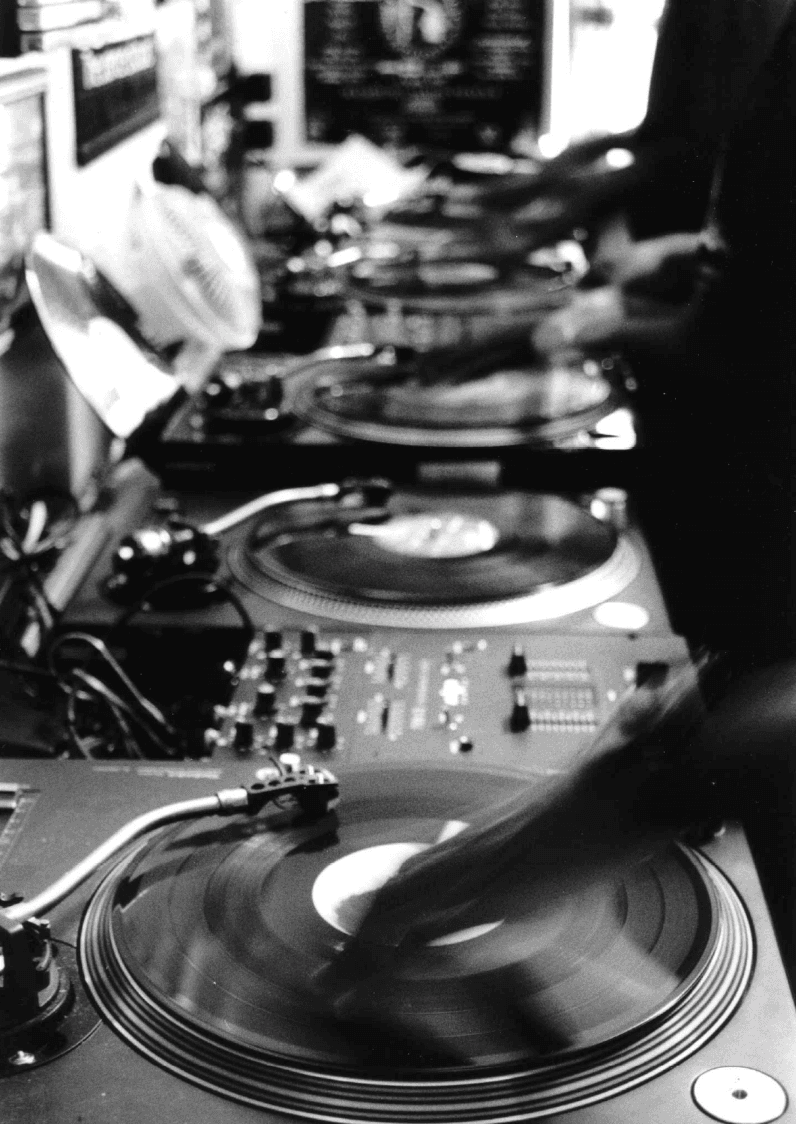
Th X-ecutioners. Photo by novel
Souls: I had a few questions about your political activities. You’ve been criticized for your relationship with Minister Louis Farrakhan and the Nation of Islam (NOI).
RS: I grew up on Minister Farrakhan.
Souls: Talk about that.
RS: Yeah, I knew why he was in Hollis. There were dope fiends and there were Muslims always on the corner. If you were nodding from being high and the Muslims came by, you’d stand up straight. So the Muslims were always a positive influence, and it was obvious to me and anybody my age that they reformed a lot of lives. I always had an appreciation for the work that the Minister did in the community. To me, that was much more important than some of the other things that have come up about him such as his being called anti-Jewish.
What people probably don’t realize is that so many of my partnerships are in the Jewish community. The hip hop community, what they’re doing culturally in terms of becoming entrepreneurs, is a gift from the Jewish community. Young hip hop kids are the next Jews. There are no WASPS coming and being partners with me. Jews have some of the same issues and conditions and/or civil rights issues and racism as Blacks. So there’s a connection between Blacks and Jews.
I went on a tangent because when you mention my brother the Minister, God knows we’ve done so much work to try to mend his relationship with the Jewish community and he’s always willing to try to move in this direction. In fact, next week we were going to the Museum of Tolerance. Now this is a museum of tolerance and the rabbi who is a buddy of mine said that the Minister is not welcome. Shit, the Museum of Tolerance!
But there’s a lot of caution on the part of the Minister and the NOI in terms of what they do and how they can make a symbol to help Blacks and Jews, and Muslims and Jews in America work together. One of the things he wanted to do was take more steps to improve the relationship of the whole NOI and the African American Muslim world and African Americans and Jews.
The truth is that when he has a march and Reverend Al Sharpton, who is a great leader, and Reverend Jesse Jackson, who is another great leader, when they come and speak, they’re welcomed and people cheer them. But people didn’t come to Washington at a million strong or 600,000 strong to see Reverend Jackson. I’m not saying this to demean him, but the truth about leadership and Black America is we don’t have young Black leadership.
Minister Farrakhan is really the conscience of Black leadership in America. He may not be in the news every day, but he is certainly the biggest leader and the most powerful leader in Black America. That’s a fact, and so I think it’s really important that if he’s been said to be the greatest divider of Blacks and Jews, he’s working to change that. Some say, “Oh, he’s not important.” They want to dismiss him. But that’s not the way to build bridges, because it’s not true.
Souls: You’ve been very active in the last several years in various political activities. There’s the group that you’ve established, New America, a political action committee—a national network that’s growing out of the hip hop summits you’re doing around the country. In 2000, you became involved in the presidential campaign in a very big way as an endorser of the Al Gore/Joseph Lieberman presidential ticket. But then after the election was over, or should I say stolen, Senator Lieberman went back to the Senate and participated in hearings around the issue of music and censorship. I wondered if you could talk about that.
RS: The thing we’re talking about here is the Marketing Accountability Act. It’s something that Lieberman came up with to force record companies and movie and video game companies to put labels on everything if it has adult content. Hillary Clinton signed onto it too, although she said that she’s sorry.
Souls: Hillary signed on this?
RS: Yeah, Hillary Clinton was a cosponsor of the bill. Twenty-three of the twenty-six people they criticized were Black and rap artists; one of the white artists was Eminem. This is a cultural debate and a First Amendment issue. They figure out ways to shut out these voices—as many as they can, from different angles.
So one of the things that we spend our time doing is protecting our artists’ freedom of speech. I’m disappointed that these politicians chose to do what they’re doing. But everybody I support, I can’t control.
Souls: You were a major financial supporter of the Gore/Lieberman presidential campaign.
RS: Nope. I didn’t give anybody any money. [Laughs] I give money to charities. Really what I think I’m best at is raising questions, promoting issues that people need to think about before they make their choices, then giving people a roadmap that they can follow.
By the way, I’m not one of them happy Black people with George W. Bush. With him in office, everything is at risk. So much of what we worked hard for is really at risk, and I’m just disappointed.
I work to try to engage Black people, young people, and poor people. That’s always first: poor people. But if you notice, Gore never talked about issues of the poor, Black, or young again after the Democratic Convention.
Souls: That’s right.
RS: This Democrat made a speech in the beginning which was in line with the party’s desire to position itself to win certain votes, and it worked. Everybody was excited about him talking about equal, high-quality education, and poor people, and to hell with big business—it’s not going to control me. I mean, we knew that wasn’t true, but to some extent at least it seemed like he wasn’t going to completely be a puppet for big business. He didn’t sound better than Ralph Nader, but shit, he was our best opportunity, in my opinion, and so I worked very hard for him. I think he made a lot of mistakes, and so we lost. But I don’t regret that I chose him. I still think he would have been the best President of the two.
Souls: You used your now defunct online magazine 360 Hip Hop to sponsor Rap the Vote and to get young people involved in electoral politics. But I think that the Democratic Party to its peril writes off young people and does not put the kind of resources in it to expand the electorate, in part maybe because they’re afraid of what young people have to say.
RS: I don’t think that they should be too afraid. Young people are part of what their agenda still is. I’m not a Democrat. I’m not a member of any party. But the Democrats have more to say about the conditions of suffering Black and brown and poor people than the Republicans. So I think that the Democrats are still our best opportunity.
If you watch MTV you see that young people in general are more compassionate and concerned with other people. That’s just their thing. What young rebellious people want to do is change things, and they want more progressive agendas by their politicians.
So in the future we’re going to go on a very, very aggressive Rap the Vote campaign. And we have support from the NAACP and the Urban League and all the record companies—that’s financial, it’s helpful—and then we have the BETs of the world, and the VH1s, and the Radio Ones, and so we’re going to put together a Rap the Vote campaign, and the NAACP has agreed to really push this.
One of the things that Minister Ben Muhammad has been amazing at doing as president of the Hip Hop Action Network is sitting and talking to some of these old folks who don’t realize the value of young people because they don’t like their language or their attitude. They say to Ben, “As a minister, you should be offended by all this language and the content in hip hop music.” He says, “I’m offended by poverty and the conditions that these people are in. I’m not offended by any language.” There are much more important things to deal with—like trying to engage young people more—than these rigid old ideas.
What they’re saying is, “We don’t like what they’re saying and we’re not sure we understand the way they’re saying it.” The ideas that the kids are communicating aren’t that bad compared to what we see all day, every day. Really, they say much worse shit on the 6 o’clock news. But the politicians don’t like the language. A lot of these adults can’t hear the words for the language and don’t understand what these statements mean. So they say, “Those aren’t our children. That’s not our shit.” In denial. Not interested in it. Don’t want to address these mirrors of their society. Well, the language is cultural. It’s an honest representation of the way people talk. We don’t agree that it’s something that you should censor.
They just don’t get it. They don’t see these statements and this music as a kind of roadmap for change and success in the future. A lot of rappers are saying important things today and just nobody’s listening except young people.
Rappers have very generous souls—just about everybody’s got a foundation, but they lack finance and infrastructure. Then we got these big old civil rights organizations with all this money and infrastructure and don’t do shit with the people. Young people don’t know who the fuck they are or what they do. The people who work at the board of directors at the NAACP and the Urban League sit there and say, “Why don’t the young people come to our convention and help us?”
So I applaud the work that Minister Ben has been able to do to make these older folks aware. Not that it matters what adults think anyway—we always hope that they just continue to criticize. That makes young people know it’s their shit, it’s their music, because they got the Hillary Clintons and Senator Lieberman and before that Tipper Gore and Delores Tucker criticizing them—all those people just make rap bigger. They make those words more important.
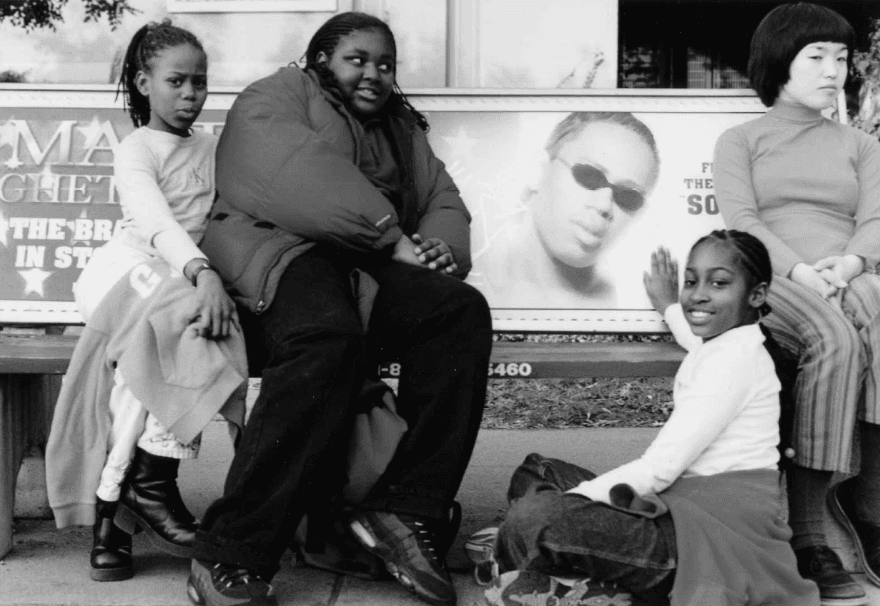
The Girls and Master P. Photo by Robyn Twomey
Souls: Criticism has been leveled at you around the New York gubernatorial race this year. You’re supporting Andrew Cuomo against Carl McCall, the African American New York State comptroller.
RS: I think that Carl McCall is a very nice man. He’s been to my office many times. I’ve gotten calls from all of my rich friends saying please be nice to him. All these people say how great Carl is and ask why can’t I support my brother. I’m not concerned with getting one Black person into any office. I’m concerned with the suffering of the masses in our communities. I don’t have a political agenda. I don’t have a personal agenda. I don’t give a fuck about politics. I care about people. But Black people on Wall Street—ask anybody, and they say: McCall had $130 billion dollars of state pension fund money to invest and no board of directors, and he gave less than a half of one percent to Black and brown people.
And it’s not just that one issue. I mean, I was co-chair of the Redeem the Dream March with Rev. Sharpton and Martin Luther King III, and there was one white speaker. It was Andy Cuomo. Carl McCall is not going near no angry Black people marching nowhere. And that’s been true for thirty-five years. I’m not saying that he’s not a nice guy, but we need progressive politics. We need people who are concerned with change.
Andy does not have as long a career as Carl, and he’s not that smooth. Homes is a little bit abrasive. He speaks well onstage, but generally he’s not as smooth and polished as Carl. But he built H.E.L.P. [Housing Enterprise for the Less Privileged], the homeless organization. I think it’s the biggest one in America now. He also tried to do a lot of stuff with HUD [Department of Housing and Urban Development].
I don’t vote for my wallet. I don’t vote for myself. I vote for who I think will help poor people, and mostly that’s Black and brown people in this state.
I started alone supporting Andy, but I got a chorus over time. I noticed that Cornel West and Jesse Jackson, Jr., and Martin Luther King III, and Minister Ben Muhammad have joined me and my uninformed self, as I’ve been painted. Certainly I’m not a sophisticated about politics, so I feel a little better now. These brothers, they don’t have no agenda. Jesse, Jr., might come into a little trouble, but I think it’s great that he stood up. I can’t understand how the dad [Jesse Jackson, Sr.] can have a Wall Street initiative and try to whisper by and not address this issue. All the civil rights leaders, they all got personal politics, and that’s okay. But don’t try to come after me for doing what’s obvious for Black people and poor people when that’s your job.
And I love Freddy Ferrer [the Puerto Rican who ran for mayor in New York last year and lost], but just because he’s brown doesn’t necessarily mean he’s had anything to do with poor people. His opponent, Mark Green, whom I supported in the race, spent a lot of his thirty years in politics, fighting the power. He ran a shitty campaign, but backing him was a choice I made early on. Whether I was going on the transition team or not was not my concern. How much I was going to be able to get for my art program was not my concern.
My concern with these elections that I’ve been involved in was, when every day a different paper comes across the desk, who leans toward the poor people more and does more for them? What has the obvious history of doing it? So I made a simple choice. I tried to promote those people because I hoped they would do good for the community.
Souls: Russell, we have some questions from the audience. What are some of the things that have come out of the Hip Hop Summit that was held last summer, and in particular are there any plans for a Hip Hop Think Tank at Columbia University?
RS: We made a lot of promises and a lot of summits make promises but can’t always live up to them. We were fortunate enough to get Brother Ben to join us and to be the president of the Hip Hop Summit Action Network.
We talked about mentorship programs, and they’re in place.
We’re going to do a literacy program with Hugh Price of the National Urban League. It’s not going to be the next Urban League literacy program. It’s going to be Daddy’s House, and we’re going to get Puffy to help pick the curriculum. I’m going to make it a movement. The Urban League has over one hundred offices and plenty of money. That will affect literacy. If Puffy tells you to read something it’s better than if Hugh Price tells you. It’s true. The literacy program was very difficult to get done. On the surface it sounded good, but it’s done now, it’s agreed to. It’s going to be national and very, very well publicized, and very popular. Hopefully we can create little gangs all over the country where people get together and read and deal with the curriculum that’s set forth by Daddy’s House. And that will be with the infrastructure and the money of the Urban League.
We talked about getting MTV and BET and Radio One, a Black-owned radio company, and the Southern Christian Leadership Conference and the Million Family movement and these people involved in Rap the Vote. There are meetings every day about how we’re going to launch Rap the Vote. Everybody from Julian Bond to Kweisi Mfume, who run the NAACP, has signed on.
Just the fact that the Urban League and the NAACP are participating with us on these projects—that these doors are opening—is a very encouraging sign of being able to connect these older people who have been disconnected for twenty-five years.
We’ve also had summits all over the country, smaller ones. We had one in L.A. about healing wounds between gang members. It was a meeting between Black and brown gang members. Also, there have been meetings with the rappers who’ve had disagreements. Conflict resolution is an ongoing job of the network.
We’re going to have annual summits, like the one that was held last June in New York City.
Also, as I said, we want to protect the artists’ right to freedom of speech. So we’re back and forth to Washington all the time. We’ve met with Senator McCain and Senator Lieberman and obviously Hillary Clinton two or three times. We met with everybody in the Congressional Black Caucus. Many have been turned around. Many now understand why the issue—the Marketing and Accountability Act—is not as simple as it’s been presented to them. We’ve met with the Federal Trade Commission and the Federal Communications Commission. They just decided to leave Eminem alone. They reversed their decision to attack him.
The record companies help to underwrite our work because it will affect their business. Record company funding is the only money we take that has any commitments attached to it. We don’t mind doing that so we can protect our artists’ right to say what they have to say.
Even though we were against the approach they took with that act, we have also expanded on putting warning labels on records. So now every time you see a TV commercial for a Def Jam artist, you get the label. Every time you hear a radio commercial, you hear the label. And every time you see a print ad, you see the label, which is something that was not being done. We wanted to make sure that parents knew what they were buying. If the records had language that they disagreed with it’s now very clear on every record they buy. Also, we’ve made sure that, on the Web sites, 80 percent of the records that come out have their lyrics posted on the Internet.
So we’re at work trying to live up to some of the promises we made.
Souls: We have two questions that deal with the representation of hip hop on television: Has video enhanced or detracted from hip hop both lyrically and musically? Second, what do you think about the role in the Black community of BET—or, as it has been called, “Black exploitation television”?
RS: I think that video has been tremendously important in selling and creating the lifestyle that goes along with the music. Jazz and blues and rock-and-roll could never affect the people the way hip hop has. Like I said, look at how much work we went through to get Kurtis Blow’s picture on his record cover and how important that was to his fans. But a moving picture, if it is used properly, really lets you see the essence of the artist through his clothes and his personality. Those are intangibles that the audience can now see, and so the connection between artist and audience is much stronger. And business has grown. I don’t know what percent. Records now go platinum that you’ve never even heard, much less records that sell ten million. So, it’s really made a dramatic impact on our ability to sell music and sell ideas.
Now the role of BET?
Souls: Why did it take longer to get on BET than MTV?
RS: Well, as I touched on earlier, that’s part of that disconnect. We couldn’t go to adult Black clubs with early hip hop music either. Everybody at those clubs had on a suit. They went to work. The adults just didn’t—it was too close to home. The rappers were talking about their community, what they wear, the way they live, all that shit. That wasn’t R&B. They didn’t want to hear it.
So I don’t want to blame BET more than I would blame anyone else who does the same thing. People get old and rigid, they don’t remember that they were children too and they were rebellious and their energy and their fire was not appreciated by their parents. But older people’s parents were better at embracing them and using their energy than we have been in embracing our children. So, I don’t want to single out BET.
There’s this attitude that you have when you get older about the way things should be. Young people hopefully will break those attitudes and create new and better solutions. Even if you think that their solutions are not so good, you have to kind of ride with them and gently lead them. We haven’t been doing that.
We didn’t do that in music. The older executives did everything they could to stomp out rap music. Black radio couldn’t stand rap music.
I remember when I got Run-D.M.C. on American Bandstand with Dick Clark. Seemed like Dick was saying, like, “Whatever you niggers are doing, I’m happy to be here.” He was thrilled to have Run-D.M.C. on. But I remember the words of Don Cornelius of Soul Train—he said, not real happy about it, “There’s a changing of the guard going on.” You know how many times Dick Clark changed the guard? I’m not saying that there aren’t rigid white people. But Don Cornelius’s first response to Kurtis Blow—and he said this on television—was, “You know I really can’t stand this music. But it’s a hit, so here it is.” And that was his introduction to Kurtis Blow.
So that was kind of the way that we were perceived by Black radio and Black executives who didn’t embrace us. But young people came in and built their own and so a lot of those older people don’t have jobs now and the ones who embraced them do. So that’s the story.
Bob Johnson has supported the Million Family March with ads and so on, and he’s supported Sharpton and Farrakhan, even when he was under fire for that. But he can’t change and mold the culture. It’s not his job. He doesn’t know anyway. He’s a businessman. He’s not to be held to a higher standard than anyone else.
Souls: Russell, you often talk about spirituality. How does hip hop express your spirituality? What does spirituality mean to you?
RS: I grew up not really appreciating religion. Now, I love a lot of religious leaders and I work with many. I’m hoping to bring the Dalai Lama to Harlem to talk at the Apollo Theater this year. I love the Dalai Lama’s work. I believe that we all rise to one God.
About seven years ago, my priorities were arranged differently after one yoga class. I didn’t realize how significant it was and what it meant until I thought about it later. I came out of that class knowing that the whole practice of breathing is an important part of the spirituality of achieving your aim, your higher self. I tried to breathe like they taught me for an hour and a half and be focused and try to be present, which is the center of most spiritual beliefs—presence. I said, “If I keep doing this shit, I’m going to lose all my money.” [Laughs.]
Of course I made a lot of money and I got a whole bunch of shit. I learned to drive, I got married, I had children, and I got a lot of things I think that were part of whatever a real success story is. I spent the first thirty-odd years of my life just on consumption—how much shit could I get, how many drugs could I take. I stopped taking drugs about twelve years ago, but even after that it was about consumption of other things.
Do you know what it’s like getting a third Rolls Royce? You know, you drive around the corner, you park it and that’s it. You get out and you’re like, “That’s it?” It’s true. The third Rolls Royce is a bitch. People don’t realize that it is really a hell of a let-down when you attach yourself to things.
When you let go, things come to you. When you’re present, you forget the anxiety of the future and the past. The yogis say pure consciousness is God itself, and it’s true. When you’re present in focus and energy, you become not so attached to the results of your work, but you just enjoy your work. And I think that people who are always concerned with the future and have anxiety all the time miss the beauty of life; they miss God’s contribution, which is everything. Every single thing is God’s work. But the personal things that changed in my life were a direct result of my spirituality, my relationship with God.
Souls: You mentioned your family and you were just talking about things that had a powerful impact on you. What about 9/11? How did that impact you, how did it impact your family?
RS: Well, it impacted me because there was a tremendous amount of anxiety and fear, and my priorities changed even more—if they were shifting, then they shifted more. You start to realize that you were at a risk a lot of times. You realize what life’s priorities should be, could be, and you move more toward that.
I mean there wouldn’t have been a Def Poetry Jam without 9/11. We had been pushing for it for years but HBO had not been interested in putting poetry on. I remember speaking to Judy McGrath, who was the head of programming at MTV, and she said, “Jackass [one of their shows] ain’t shit now. I can’t show Jackass. I can’t show this girl shopping for Prada bags all day long. I can’t. I have to show something else. I don’t have any programming.” She really had nothing to put on television. HBO I guess felt the same way. They wanted a more serious subject matter because people had more serious subjects on their minds. So the poetry show was born.
This is why I’m always hopeful that the culture will provide us with good clues and good support for a better tomorrow. Now, I think, people are thinking more often about more than themselves.
Souls: This has been an extraordinary discussion, but let me ask one more question. Looking back on your career in the music industry—Internet, clothing, and music aside—looking just at the music industry, what was the best decision you ever made and what was the worst decision you ever made?
RS: Well, I think that I’ve been part of great decisions. In other words, I’ve had consultants and friends and partners help me make good decisions. The best decision we made in music is fucking with Kevin Liles, the president of the company [Def Jam Records]. He started as an intern, and he grew and became a giant. He’s quiet, people don’t know him but he’s a big part of this. He’s responsible for most of our success now in hip hop.
A bad decision that I was part of was allowing the Beastie Boys to go. Rick [Rubin] and I went over it, I really didn’t want to do it but I agreed to let them go. They were a very important band culturally and they are special, spiritual people who do a lot for their community and for the world. I’m sorry that I didn’t get to work with them more.
Souls: One of the things that I would like to do is to highlight the extraordinary philanthropic works that you do. The hours that you spend going out into communities. I saw the number of events that you did just around the Martin Luther King Day here in New York City. Russell, talk a little bit about the Rush Foundation, the kind of work that you’re doing with Black and Latino kids.
RS: As I said, so much of my life was about consumption. But over the last few years I found that I have much more fun and a much more fulfilling life of service. I enjoy visiting those kids. I enjoy the work that we do. We used to raise money for charities, and it would be nice, it was part of our duty. But now it’s selfish—I love doing it.
The same thing goes for the political stuff. It’s really about getting the right person in office. With my little philanthropic programs, we give away some money, but it’s nothing like what the governor can give away. So that’s part of the whole effort. When you get people in place that can help you help other people, you get a lot more fun out of it than you do at just piling up more shit.
So that’s why I do what I do in terms of those programs. So long as we can raise money and do things that matter by using my celebrity or my business relationships then I want to continue to do it.
Past Editions

1.
"A Son of Afro-America": Talking with Amiri Baraka
The Editors
2.
A Scholar in Struggle
Clayborne Carson
3.
And the Beat Goes On: Challenges Facing Black Intellectuals
Kathleen Neal Cleaver
4.
Beyond the "Real" World, or Why Black Radicals Need to Wake Up and Start Dreaming
Robin D. G. Kelley
5.
Black Intellectuals: The Perennial Question
James Jennings
6.
Black Thinkers at Sea: Ferdinand Smith and the Decline of African American Proletarian Intellectuals
Gerald Horne
8.
Def America: Russell Simmons
Manning Marable & Cheryll Greene
9.
Thinking Black
The Editors