

VOL. 10
Diasporan Intellectuals in Post Independent Guyana, Jamaica, and Trinidad and Tobago: A Generational Analysis
Maurice St. Pierre
This article, which is part of a larger study, deals with the knowledge-producing activities of a group of West Indian academic intellectuals (also referred to as scholar politicians), based primarily at the University of the West Indies, who used that space and various infrastructural factors to contest the post political independence approaches of a prior generation of social movement intellectuals who were elected to . While there have been various efforts to analyze intellectualism in the Caribbean (Best 1967a; Lewis 1968; Dupuy 1991; Hennessy 1992 vols. 1 and 2; Benn 1987, 2004) there has been no real effort to locate these studies in an overall theoretical framework. With this in mind, this intervention is guided by a framework that privileges generations theory and poses questions about how generational differences promote conflict between generations, the nature of intellectual activity, how the intellectual activities of scholar politicians lend themselves to conflict with elected politicians, and in the process what ‘‘new’’ knowledge gets produced. This article argues that the intellectual activities of scholar politicians must be viewed against the backdrop of a set of ambient conditions that were put in place by political independence movement intellectuals and must seek to understand their use of knowledge associated with disciplines such as history and the social sciences which were perceived as threatening to elected politicians.
Theoretical Groundings
The question of generations has largely been examined in terms of age-cohort (Riley 1978, 1987), the life experience (Elder 1974), and famous people being born around the same time (Jaeger 1985: 281–82). For our purposes, however, the most thorough conceptual treatment of the subject of generations was offered by Karl Mannheim (1952), who suggests that, like social classes, generations have (a) a similar location—not in terms of relationship to the means of production, but from the perspective of time and periodicity and (b) limit individuals to a range of experiences by virtue of their having a similar birth period.
For Mannheim, generations can be said to have similar locations when, as age cohorts, they are in a position to experience similar phenomena, such as exposure to educational experiences (and in this case, the struggle for political independence) that are likely to give cohort members a specific kind of consciousness peculiar to that generation. This has implications for intergenerational as well as intra-generational conflict, especially if the subjective meaning of experience is important to the translation of that experience into future action (Schuman and Scott 1989:309). However, individuals born around the same period may have different forms of consciousness as a consequence of being members of different social classes, family, region, racial/ethnic group, or occupation/profession and therefore may view the same situation differently. Thus, one may be of the same generation location, but of a different generation actuality, because of the superior influence of any of the above variables (Mannheim 1952:303).
According to Mannheim, as a person reaches their late teens or early 20s, the mental data they have acquired over the course of their lives begins to shape and give character and direction to their life experiences in such a way that a certain degree of bonding takes place among similarly situated individuals, who then become generational units. Finally, Mannheim also argues that although not every generation location creates new collective impulses original to itself and adequate to its particular situation (Mannheim 1952:309), generations nevertheless tend to be associated with a particular spirit of the age or zeitgeist, which he refers to as a generation entelechy.
Various theorists have sought to define and conceptualize the ‘‘.’’ Lewis
Coser defines intellectuals as those individuals ‘‘who never seem satisfied with things as they are’’ (Coser 1997:viii); S. M. Eisenstadt speaks of intellectuals as ‘‘critics of existing regimes [and] creators of social or cultural orientations and activities opposed to tradition’’ and as ‘‘guardians or would-be guardians of a society’s conscience—but only when that conscience was thought to be opposed to the established order’’ (Eisenstadt 1972:1); and Harry Goulbourne views intellectuals as persons ‘‘whose ideas are such that they challenge conventional wisdom or, at least, invite us to see the obvious in a new light’’ (Goulbourne 1992:21). Intellectuals, however, have also been viewed as ‘‘betrayers’’ (particularly in newly independent countries) who compromise the interests of the nation by way of a false nationalism that benefits them and their successor elite class and dubs them ‘‘heroes’’ (Hennessy 1992:3). Finally, intellectuals always seek to make their knowledge socially relevant (Eisenstadt 1972; Lipset and Dobson 1973; Lipset and Basu 1976; Flacks 1991), which may lead to conflict between them and other groups (like political authorities), who may be of another generation and who may see themselves as their patrons.
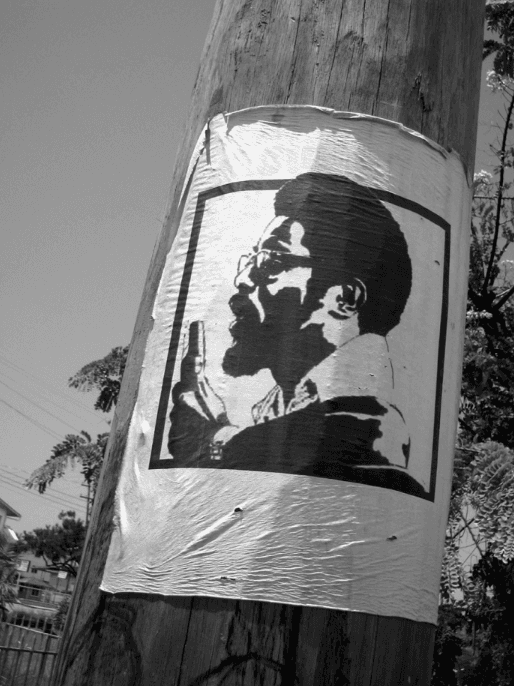
‘‘Walter Rodney commemorative poster, Georgetown, Guyana,’’ July 2005 © Nicholas Laughlin.
Additionally, intellectual activity needs something to rail against for its existence. Though this may not be obvious to wider society, intellectuals may feel it necessary to interrogate issues that they feel are of concern not merely to them and their group, but also to the whole society. Railing against the system, as others have shown, enables the intellectual to move issues of concern from the periphery to the center for more serious consideration and ventilation, as well as to make space for his/her ideas in the political . This is done in a variety of ways, but more usually by efforts ‘‘to make ‘scientific’ sense of the world’’ by generating various theories of society which in turn make history. Social theories, therefore, ‘‘are levers intellectuals use to influence power structures, to facilitate political outcomes, to enable groups interested in exercising control to improve their [chances of doing so], to justify their ascendancy, to achieve their goals, or to advance their interests’’ (Flacks 1991:3). This is often the case for diasporan intellectuals, who may find that it is not merely that their work is rejected, rather that it is simply ignored (Marable, 1999:100).
To sum up preliminarily, since intellectuals are never satisfied with the way things are, they continually advance contestatory positions. Their positions, which are very much conditioned by various experiences such as education and travel, also undergird their generation location and are likely to put them at odds with preceding generations. Additionally, as they seek to make space for their ideas by making them relevant, intellectuals may put in place and/or capitalize on an infrastructure that includes a tradition of printing and reading, and often seek to transform physical spaces for the production of their knowledge. In its written form, in particular, intellectuals’ knowledge is preserved for current and future generations to access, re-examine, and critique, thereby adding to the store of knowledge in a particular geographical area. With this in mind, this article first turns to the intellectual activities of social movement intellectuals who railed against colonialism and championed the cause of political independence in the Caribbean, and who also later became elected politicians.
Political Independence and the Emergence of Social Movement Intellectuals
In all three of the territories under discussion (Jamaica, Trinidad and Tobago, and Guyana), the nationalist struggle was often headed by a generation comprising members of an interstitial stratum who were products of an elite secondary education that enabled them to go abroad to study and return home as independent professionals. This is perhaps not surprising since, as organic intellectuals, their travel and education experiences acquired while living abroad equipped them with the knowledge to better challenge the colonial hegemony than the less privileged, while their status as professionals made them less vulnerable to economic reprisals from their colonizers.
In Jamaica, the struggle for political independence began in the wake of the 1938 island-wide disturbances, when working class Jamaicans took to the streets to protest unpalatable working conditions. One of the prominent figures involved in the movement was Norman Manley, born in 1893, who attended the island’s leading secondary educational institution, Jamaica College, and who returned to the island in 1922 after qualifying as a lawyer at Oxford University in England. Manley was instrumental in the 1938 formation of the People’s National Party (PNP), which also functioned as a social movement organization, and the National Workers’ Union, founded in October 1952. Manley announced in 1940 that the PNP would be a socialist party, by which he envisaged more than a reform of the existing system. Manley emphasized that socialism was not intended to be rigid dogma, rather, he asserted that it was ‘‘essentially a principle of social organization which has to be applied to the particular place where you are trying to apply it because it must depend on the particular conditions which exist from time to time in that place’’ (Sherlock 1980:104). This, in Manley’s view, would involve intensive study of the country’s ‘‘potentialities and the opportunities that open up before us for the realization of such a programme’’ (Sherlock 1980:104). A new way of thinking, then, was being introduced in Jamaica. By 1944, as a precursor to political independence, the island had achieved adult suffrage and Manley’s PNP had swept to victory during that year’s elections.
Manley’s cousin, Alexander Bustamante (né Clarke), the other major figure in the independence struggle, was born in 1884, lived on the island until he was about 20 years of age, and left Jamaica for a lengthy period, only returning in 1934 at 50 years old. Upon his return he opened a small office in Kingston, worked as a moneylender, and began to take an interest in public affairs. Initially, he wrote letters to newspapers on a variety of topics that included unemployment and some of its devastating consequences; these appeared in the Daily Gleaner in April . Just a few years later, the 1938 disturbances enabled Bustamante and Manley to join forces to combat worker exploitation at the hands of colonial administrators. Bustamante was instrumental in the formation of the Bustamante Industrial Trades Union in late 1938, the Jamaica Labour Party (JLP) in 1943, and in calling for a referendum that led to Jamaica’s exit from the West Indian Federation and later to a JLP victory at the 1962 elections, enabling him to become the country’s first Prime
Minister when political independence was achieved that year.
In Guyana, the two most important figures in the struggle for political independence
were Forbes Burnham, a lawyer, and Cheddi Jagan, a dentist. Burnham, who was born in 1923, attended the colony’s leading secondary institution, Queen’s College, where he excelled academically and won the Guyana scholarship in 1942. A gifted orator, while in England Burnham won the Best Speaker’s Cup of his law faculty, was President of the West Indies Students’ Union, and along with fellow West Indian, African, and Asian students, helped to organize mass demonstrations through the streets of London aimed at sensitizing the average Briton to the determination of colonial peoples to free themselves from the yoke of imperialism. Returning to Guyana in 1949, Burnham later joined forces with Jagan (who himself had returned to Guyana in 1943 with his American-born wife, Janet), in establishing the People’s Progressive Party (PPP), the country’s first mass-based political party, in 1950. He also served as President of the British Guiana Labour Union and Legal Advisor to the British Guiana Teachers’ Association.
Jagan himself was born in 1918 and attended Queen’s College briefly, before continuing his secondary education elsewhere in Guyana, and leaving for dental studies in the U.S. He was elected to the legislature in 1947 and used that space to speak against the exploitation of the economy by foreign interests. As Jagan observed in his autobiography, The West on Trial (first published in 1966), his intention regarding anti-colonial protest was to introduce a new dimension to politics by effecting a meaningful continuity between the legislature and the street corner, whereby the legislature was brought to the ‘‘streets’’ and the ‘‘streets’’ to the legislature. The latter, therefore, would no longer be ‘‘the hallowed Chamber where ‘gentlemen’ debated at leisure and had their words recorded in Hansard for posterity,’’ but would become at last, ‘‘part and parcel of the struggle of the people’’ (Jagan 1975:70). Jagan used the written word to pen another book, Forbidden Freedom (1954). Both of his books were written in a popular narrative form and enabled Jagan to reach a wide audience.
With Burnham and Jagan at the helm, the PPP soon set about educating and raising the consciousness of the Guyanese people regarding the benefits of political independence and the disadvantages of colonialism. Using the spoken word in an unprecedented manner, the two leaders took the message of decolonization to such spaces as marketplaces, yards, sugar estates, and open squares, where along with other PPP leaders they made space for themselves and their views regarding nationalism by addressing large numbers of ordinary Guyanese (Burnham 1970; Jagan 1975; St. Pierre 1999). Both Jagan and Burnham also involved themselves in trade union activities and thus were in a position as organic intellectuals, not merely to have more contact with, and speak on behalf of, the working class, but also to strengthen their political base. However, the perceived communist predilections of the PPP so alarmed the Americans and the British that the latter first suspended the country’s Constitution and later dismissed the PPP Ministers of Government (who had been elected in March 1953, following the attainment of universal adult suffrage) after only 133 days in office.
In Trinidad and Tobago, the principal figure in the struggle for political independence (achieved in 1962), was scholar politician Eric Williams. Williams was born in 1911 and attended the elite Queen’s Royal College (QRC), the twin island’s leading secondary school. At QRC, Williams distinguished himself both academically and in the field of sport. After winning the island scholarship in 1931, Williams studied History at Oxford University, where he graduated with first class honors. He then did postgraduate work at Oxford and was awarded a D.Phil. in 1938 for his thesis, ‘‘The Economic Aspect of the Abolition of the West Indian Slave Trade and Slavery.’’
Feeling that because of racism the prospect for obtaining employment in England commensurate with his qualifications was unlikely, Williams departed for the U.S. There, he taught at Howard University and arranged a Conference with Howard University sociology professor E. Franklin Frazier on The Economic Future of the Caribbean. During his U.S. sojourn, Williams also authored a document advocating the creation of an independent West Indian university which would be in a position to avoid the ‘‘insidious dangers of imitation and affiliation,’’ which flowed from association with established, (colonial) . While abroad he published The Negro in the Caribbean (1942), a historical materialist analysis of the impact of the sugar industry on non-white Caribbean people, with a particular focus on family life, social stratification, and physical health. In 1944, after much difficulty and various efforts to marginalize his scholarly , he published Capitalism and Slavery, a revised version of his doctoral thesis, which later turned out to be a seminal work.
Returning to Trinidad in 1948, Williams continued to establish himself as a public intellectual. During a speech first delivered in 1955 (entitled ‘‘My Relations With the Caribbean Commission, 1943–1955’’), Williams identified his personal struggle with racism in the Commission with the collective historical experiences of Trinbagonians and announced his intention to ‘‘let down my bucket where I am, now, right here with you in the British West .’’ Williams was instrumental in the 1956 formation of the the first mass-based party in Trinidad, the People’s National Movement (PNM), and used his autobiography, Inward Hunger (first published in 1969) to delineate his nationalist program. Accordingly, he transformed Woodford Square, an open square in downtown Port-of-Spain, the capital city, into what he referred to as ‘‘The University of Woodford Square,’’ he argued in favor of the removal of the American base at Chaguaramas, he pushed for the establishment of democracy, interracial solidarity, and a departure from politics of corruption and cronyism, what he referred to as the politics of
Because efforts were made to taint his political aspirations with the specter of communism, Williams found it necessary in early 1956 to assert that the party was not ‘‘communist, Fascist, Jaganist, or Poujadist,’’ but derived its inspiration from the best in democratic theory and democratic practice, ‘‘which, in the opinion of the PNM, are lacking in the political life of our .’’ In the end, Williams, along with other island scholars like physicians Patrick Solomon and Winston Mahabir, enabled the PNM to secure a majority of votes and seats in the 1961 elections, and led the twin island to political independence in August 1962.
As social movement intellectuals and members of a common generation location, the most prominent political independence leaders (with the exception of Bustamante) were educated at elite secondary institutions and qualified as independent professionals after a period of study abroad. As a generation-unit their anti-colonialism was influenced by the formation and leadership of new political parties and trade unions, as well as the introduction of new infrastructures for publishing that facilitated their use of the written word, especially as they worked in written styles that might reach the widest possible audience. These intellectuals converted such physical spaces as open squares, marketplaces, the
legislature, and party conventions into locales for the transmission of their knowledge. Again, recourse to the written word by way of articles in party newspapers and party manifestoes and the use of autobiography in the case of Williams and Jagan was instrumental in transforming the personal into the political and enabled leaders to make space for their ideas in the public .
The Emergence of theAcademic Intellectual as Scholar Politician
In contrast to the strategies and tactics of these social movement intellectuals, academic intellectuals used the University of the West Indies, as well as other entities such as the New World Group, Abeng in Jamaica, and Moko and Tapia in Trinidad and Tobago, as settings for their knowledge production. Here, the existence of the University was of great importance as it provided a space for individual employment, and rewarded specialized knowledge in disciplines other than law, medicine, and dentistry. Williams’s views notwithstanding, the members of the West Indies Committee of the Commission on Higher Education in the Colonies (the Irvine Commission), appointed in January 1944, recommended that the first step in the establishment of a single University of the West Indies ‘‘at the earliest possible date,’’ should be ‘‘the foundation of a University College which, in order to establish its academic standards and win public confidence and esteem, should work for the most part for the external degrees of a University of repute ... and should be entirely .’’ In addition to being ‘‘the main centre of research into
the physical and social problems of the whole region’’ the Commission noted presciently that the region’s problems would never be fully solved ‘‘unless they are understood and investigated, to a far greater extent than at present, in the West Indies by West Indians.’’
Consistent with the Irvine Commission’s recommendations, the University College of the West Indies (UCWI) came into existence as a College of the University of London in 1948, and remained in that capacity until 1963, when it became an independent university. Beyond that, the Institute of Social and Economic Research (ISER) was established at the university in 1948, with the intention of playing ‘‘a major role in advancing the thinking and research on social and economic issues in the .’’ This was followed by a quarterly journal, Social and Economic Studies (SES), established in March 1953 by the ISER, which provided an opportunity for publishing original scholarship, and research activities by Caribbean diasporan intellectuals, who would then be unencumbered by teaching responsibilities.
In contrast to that of the University of the West Indies, the University of Guyana’s emergence was based mainly on a political decision by the People’s Progressive Party government, led by Cheddi Jagan. This decision ignored the recommendations of the Irvine Commission, which considered British Guiana to be part of the West Indies, and the colony declined to participate in the development of UWI.
The knowledge production activities of academic intellectuals were also furthered by the development of groups like the New World Group (NWG), the New World Quarterly (NWQ) and the New World Fortnightly, all of which allowed the scholar politicians to transmit their views on the region’s problems, mostly in non-technical language and without scholarly references and footnotes. The NWG developed in 1962 out of a discussion group in Guyana, among whose members were Trinidadian economist Lloyd Best (then Economic Adviser to Jagan) and Guyanese economist Clive Thomas and was ‘‘formed to encourage Guyanese to reflect on their problems and to state the positions they take publicly and lucidly,’’ regardless of ‘‘race, class, and political persuasion.’’
Abeng, the publication with which Trevor Munroe (educated at Jamaica College, the
UCWI, and Oxford University) was closely associated, appeared in Jamaica and took
as its mission to ‘‘help us discover ourselves not just the past, but also what we are today and what we can be tomorrow if we move forward together,’’ and to be ‘‘an instrument for Jamaicans to communicate with one another.’’ The abeng after which the publication was named is made from the small horn of a cow and was used by Maroons to communicate with each other. Apart from providing a basis for communication, naming it Abeng suggested that the journal was to further historically constituted forms of resistance.
In Trinidad, Moko started publication in October 1968, as a result of the efforts of
Adrian Espinet and later, those of UWI lecturers James Millette and Gordon Rohlehr.
Describing itself as a ‘‘serious review,’’ Moko got its name from the word mokojumbie, which refers to a spirit on stilts thought of as a God of Justice and who to the guilty appeared as a God of Vengeance. Mokojumbie Gods functioned as ‘‘guardians of the moral law of the tribe. They see .’’ Moko’s intention, then, was to provide a fair and balanced view of current affairs and to do so in an ethical fashion. Also in Trinidad, following Lloyd Best’s departure from his post as Lecturer in Economics at the St. Augustine campus of UWI and a well-publicized disagreement with other New World Group members, Best established Tapia House and helped to found the Tapia House Group in November 1968. As a literary magazine, Tapia, like the New World Quarterly, was used by Best and other diasporan intellectuals as a setting for popular knowledge production. Tapia House was a spacious palm-thatched shed built by Best, his followers, neighbors, and associates (Oxaal 1975:35). The word tapia describes a mixture of cow dung and mud used as construction material by the rural poor in Trinidad. Thus, like Abeng, and Moko, the word Tapia had a deep cultural provenance.
West Indianization and the University
The academy was transformed by the scholar politicians into a space of contestation for the interrogation of issues associated with West Indianization, particularly within two departments at the Mona campus of the University of the West Indies: Economics and History. After the increase in the number of West Indian economists in the Department in 1965 and in keeping with the goal of making their scholarship relevant to the region, these economists chose to tailor their work to Caribbean specificities and to use it to inform public . This was followed by efforts of the West Indian economists during the 1964–65 academic year to propose a course on Caribbean Economic Problems, a move that was opposed by the senior British leadership in the Department, on the grounds that there were no economic problems that were specific to the Caribbean and secondly, on the grounds that such a course would lead to undesirable intellectual parochialism. Ultimately the position of the West Indian economists prevailed after the University
Faculty Board decided in their favor.
During the 1965–66 academic year the government of Jamaica, without giving any reason, seized the passports of two Jamaican members of the Department, George Beckford and LeRoy Taylor, both of whom had traveled to Cuba during the previous summer. The seizure of their passports led to public objection, a public debate which lasted for nearly two years, and a spirited response on the part of the New World Group. First, the Group brought public attention to the issue not only in Jamaica, but elsewhere in the Caribbean, Canada, North America, and England through one of their publications (‘‘The Withdrawal of Dr. Beckford’s Passport,’’ New World Pamphlet, 1965; Beckford, 1966).
Second, the NWG argued that since in a free society there will be a wide diversity of opinions, open discussion remained ‘‘the most important instrument available in a democratic society for reconciling internal differences. This is the process through which reasonable men with different values seek to clarify the grounds on which they have based their opinions, their judgements, and their .’’ In appealing to the special responsibility of the University, and by extension to that of academic intellectuals, the pamphlet went on to note that a special few institutions had been assigned the task of ‘‘conducting inquiry and analysis, evaluation and discussion, and have accordingly come to have the professional responsibility of making the results of their efforts known to the whole community.’’ However, the NWG opined that while partisan views may be expressed, it is in the very nature of the
university that its members ‘‘accept the task of clarification and dissemination as their first obligation’’ and even where their own interests are involved their first responsibility must be ‘‘not to negotiate for advantage behind closed doors, but to submit the problem to reasoned discussion in public’’ (New World Pamphlet, 1965:6).
In their response to the seizure of the passports, the West Indian economists who were studying regional economic integration determined that they would no longer accept governmental financial support, but would continue their efforts using their own resources and equally important, make their results available to the public. They made a distinction between the interests of the government and those of the people, with the latter taking precedence over those of the former. Their research was eventually published in two volumes by the Institute for Social and Economic Research, and was instrumental in the formation of the Caribbean Free Trade Area (CARIFTA), the immediate forerunner of the Caribbean Community (CARICOM).
By this time the government had begun to view the connection of academics with the people as ‘‘subversive’’ and decided that some form of action was required. Thus, in 1969 Guyanese economics lecturer Clive Thomas (who was born in 1936 and was educated at Queen’s College and London University), was declared to be an undesirable inhabitant or visitor to Jamaica by Jamaica Labour Party Minister of Home Affairs Roy McNeil. In addition to his university position as lecturer in Economics, Thomas was Head of the Economic Mission to advise the Government of Grenada on a long-term Development Programme and was Head of a Monetary Research Studies Programme at the University of the West Indies (see ‘‘The University Student Speaks: Statement on Dr. Thomas,’’ Abeng, Vol. 1 No. 32, September 6, 1969). Clearly then, in addition to university duties, Thomas (like other West Indian economists) was working in the interests of various governments (and people) of the West Indies.
With respect to the Department of History, although the discipline was taught in elite secondary schools in the region, it was not of the West Indian variety. Indeed, Eric Williams recalls in his autobiography that while he was a student at Queen’s Royal College, his special subject was British Colonial History and it was not until 1939, eight years after he had left that institution, that West Indian History was included in the secondary school curriculum and then at the School Certificate level, where it was expected that it would be studied ‘‘only by the weaker boys’’ (Williams 1969:35). However, with the appointment to the UWI History Department of historians such as Guyanese Elsa Goveia (1925–80), St. Lucian Fitzroy Augier, Jamaican Douglas Hall and Trinidadian Keith Nurse, the study of the history of the region was taken over by professional .
Also, following the demise of the Jamaica Historical Review, West Indian historians
sought to provide outlets for the dissemination of historical knowledge from a
professional standpoint with the Journal of Caribbean History (founded in 1970), and with the Association of Caribbean Historians (founded in 1973) which, among other things, through its annual conferences envisioned a constant review of the state of history teaching in the Caribbean region (Higman 1999:129).
The Department’s emphasis was further enhanced by the 1968 appointment of
Guyanese scholar Walter Rodney, who was born in 1942 and earned his doctorate in History at London University. Rodney introduced to UCWI a course in African History and in keeping with his contention that scholarship should not be divorced from politics and that the essence of knowledge comes from an understanding of the condition of the people, Rodney took his pedagogy off campus and to the so-called ‘‘dungles,’’ the most dispossessed parts of Kingston, Jamaica’s capital city. In seeking to make space for himself and his ideas in the political spectrum, as Eric Williams had done before in Trinidad and Tobago, Rodney utilized the ‘‘dungles’’ as a space beyond the university for the production of knowledge about history and the Black experience in Jamaica. Having first determined that the role of the Black intellectual was threefold, namely, to attack the distortions of white imperialism resident in his/her own discipline; to go beyond his/her own discipline to attack the ‘‘social myth’’ that Jamaica was a multi-racial society; and finally ‘‘to attach himself to the activity of the black masses’’ (Rodney 1969:61–62), Rodney noted that in order to carry on ‘‘family discussions’’ with the people:
I would go to the radio if they wanted me, I would speak on television if they allowed me ... I would go further down into West Kingston and I would speak wherever there was a possibility of our getting together. It might be in a sports club, it might be in a gully. (Those of you who come from Jamaica know those gully corners). They are dark, dismal places with a black population who have had to seek refuge there. You will have to go there if you want to talk to them. I have spoken in what people call ‘dungle’, rubbish dumps, for that is where people live in Jamaica. People live in rubbish dumps. That is where the Government puts people to live... I have sat on a little oil drum, rusty and in the midst of garbage, and some Black Brothers and I have grounded together. (Rodney 1969:63)
Evidently then, for Rodney the gullies and rubbish dumps of Jamaican society were not merely spaces inhabited by the economically and politically disenfranchised, they were spaces where, as a diasporan intellectual, he might teach and reach, and more importantly learn as he carried on a conversation with a ‘‘family’’ of his brothers. This effort to provide a spatial symbiosis between the university and the ‘‘dungles’’ led Rodney to a sustained criticism of the policies of, and ultimately into conflict with, the Jamaican government. After attending a Conference of Black Writers at McGill University in Montreal, Canada in October 1968, Rodney was declared persona non grata, and upon returning to Jamaica was not allowed to deplane, and was banned from re-entering the island.
Rodney’s exclusion from Jamaica is of further contextual relevance for a number of reasons. First, his expulsion led to a number of protest demonstrations and clashes between police and students at the University, and the events clearly exemplified the conflict between elected politicians and scholar politicians, and particularly their inter-generational contours. Second, by voicing his concerns about the dispossession of dark-skinned Jamaicans in terms of social class, Rodney broke certain silences concerning hierarchical power relations on the . Given the circumstances, retaliation from elite groups was to be expected. As James C. Scott notes, ‘‘A direct, blatant insult delivered before an audience is, in effect, a dare,’’ which, if not squashed ‘‘will fundamentally alter those relations. Even, if it is beaten back and driven underground, something irrevocable has nonetheless occurred,’’ as it is now in the pubic domain that ‘‘relations of subordination, however immovable in practice, are not entirely legitimate’’ (1990: 215).
Third, Rodney’s expulsion was illustrative of a conflict between the government and the University at the highest levels. Prime Minister Hugh Shearer sought to justify the ban on the grounds that Rodney had ‘‘openly declared that as Jamaica was predominantly a black country, all brown-skinned mulatto people and their assets should be destroyed [and] this could only be achieved by revolution and that no revolution had ever taken place without armed .’’ Shearer also claimed that Vice-Chancellor Sir Philip Sherlock, in response to a query regarding whether he could terminate Rodney’s contract, responded that ‘‘the terms of Rodney’s contract of appointment were related only to his academic performance and the Appointments Committee of the University Council would not be able to go beyond those terms in finding reasons for his dismissal.’’ The Prime Minister also declared that it was at this point that ‘‘the Vice-Chancellor himself volunteered the information that the Government had the authority to declare anyone persona non grata and if this was done the University would accept the right and power of the Government in this matter.’’
Shearer then explained that since Rodney’s appointment could not be terminated for cause, ‘‘the Cabinet decided to accept the Vice-Chancellor’s suggestion that Dr. Rodney should be declared persona non grata, which according to the law permitted only two kinds of action, namely, if the individual is in the country he would be required to leave or if he is away, he would be precluded from entering.’’ However, Shearer’s recollection was disputed by the Vice Chancellor who contended, in reference to a report in the Daily Gleaner, that the ‘‘report is grossly unfair to me in leaving the impression that I knew of, and agreed with, the decision of the Government to ban Dr. Rodney. This is not so. I told the Prime Minister and Members of the Cabinet that I had no grounds for any action by the University against Dr. Rodney. This remains so. Dr. Rodney remains a member of the staff of the University of the West Indies’’ (comment by Edward Seaga, JLP Minister of Finance and Planning and Representative of the Government on the University Council, Report of Meeting of the House of Representatives October 17, 1969 regarding an article in the Daily Gleaner, the island’s leading newspaper).
In also casting doubt on Shearer’s recollection, opposition leader Norman Manley
argued that it was difficult to believe that since Rodney was under close surveillance by security forces that the government was unaware of the fact that when the expulsion order was made Rodney was not in the country. Manley, therefore, wondered whether in view of Rodney’s absence from the island, the Government then felt that ‘‘...it would be a good thing to make an Order that he never lands in Jamaica at all so that we don’t have the trouble of getting him out of the island?’’ (Rodney Debate, p. 397, column 3). Views of a not dissimilar nature were expressed by Ralph Gonsalves, then President of the UWI Guild of Undergraduates at the time of the Rodney affair, who felt that the government was planning for several weeks to get rid of Rodney and that their strategy was to push the University into doing it for them, and that having failed to obtain Sherlock’s agreement to fire Rodney, Shearer decided to act promptly when he learned that Rodney was outside the country (Gonsalves 1979:3) and as Anthony Payne suggests, ‘‘to seize the opportunity to prevent him (Rodney) from returning’’ (1983:161).
For its part, Moko accused the Press in Jamaica and Trinidad of sensationalizing the incident and concluded that Rodney was excluded on evidence whose reliability the Courts of Law had not been permitted to evaluate, and was denied the opportunity to defend . Further, in a comment that spoke directly to the issue of inter-generational conflict and the role of the West Indian intellectual, UWI Professor of West Indian Literature and social commentator Gordon Rohlehr, a colleague of Rodney’s at Queen’s College, pithily observed that:
Each age defines for itself what is radical and what is conservative. Today’s young people are inevitable products of that ferment of emotions and ideas which began in the twenties and thirties and which increased when West Indians started to write West Indian history. Since such reconstruction had meant a bitter rejection of old colonial modes of thinking, and a conscious effort to conquer the self contempt which white racial prejudice and the plantation system left in their wake, today’s generation waivers between a justifiable bitterness and a stridently self-assertive racial .
Sherlock himself put it sometime later, ‘‘The University neither censured nor dismissed Rodney. It had no ground for taking action against him but on the other hand it could not prevent the Government from acting as it did’’ (Sherlock and Nettleford 1990:200). Placing the matter in the wider context of the vagaries of nationalism, the Vice-Chancellor later indicated that efforts of newly politically independent territories would have to deal with the demands of nationalism, and that conflict of an inter-generational nature between governments and ‘‘young activists’’ was probably inevitable. Thus, he maintained that ‘‘the imperatives were, in my view, to safeguard the University as a regional institution, to protect its autonomy in academic matters, and to go to the limit to avoid—or defuse—conflict with national governments while preserving the institution’s integrity and inner unity.’’
The Guyana Experience
Following his expulsion from Jamaica, Rodney went back to Tanzania (where he
taught until 1974), after which he returned to his native Guyana where he became a founding member of a political party, the Working People’s Alliance. As part of his political activities Rodney addressed thousands of listeners using history and the spoken word as his main weapons in attacking both the repressive regime of then-President Forbes Burnham and Burnham himself. Once again Rodney found himself in conflict with the government of a country of which he was a resident. And once again this led to retaliatory action orchestrated by the government. For instance, in July 1979 Rodney, along with seven others, were arrested and charged, but later acquitted, with arson in connection with the burning of two government offices. Then, at a mass rally in 1980, Rodney attacked both Burnham and the country’s Constitution, which arrogated tremendous amounts of power to its ‘‘maximum leader.’’ Rodney also claimed that a ‘‘brother’’ had been executed by the police on orders of the regime (Rodney 1980).
On June 13, 1980, Rodney was killed instantly when a walkie-talkie in his possession, allegedly given to him by an electronics expert in the Guyana Defense Force, exploded. In the same period an attempt was made to kidnap Clive Thomas (who had written a number of articles criticizing the Burnham regime and its policies), and Rupert Roopnaraine, a Queen’s College alumnus and Guyanese scholar, who was forced to seek refuge in a cane-field to avoid being captured by people who it is widely believed were agents of the government. Both Thomas and Roopnaraine, at the time, were members of the WPA.
Ironically, despite the institutionalization of a politics of fear by the Burnham regime,
the government nationalized the country’s bauxite industry, with the help of a number of Caribbean economists, notably Norman Girvan (a UCWI alumnus). Girvan’s scholarly study of the Caribbean bauxite industry (1967) published by the Institute of Social and Economic Research in which he made a case for what he calls the ‘‘rationalization’’ of the industry, was significant. Most importantly, Girvan noted that the fusing of academic research and governmental policy was mutually beneficial in that it provided a relatively cheap and efficient way for the government to mobilize existing resources. Clearly then, despite the tension occasioned by the experiences of Beckford, Thomas, and Rodney, to name some, the elected politicians and he scholar politicians needed each other.
The Trinidad andTobago Experience
In this context, the activities of Lloyd Best provide another example of the thinking of diasporan intellectuals in post-political independence Caribbean nations, and the process by which such knowledge developed in the region. Best, who was born in 1934, in Trinidad, was the son of a carpenter and attended Queen’s Royal College and Cambridge University where he studied Economics. Upon graduation, he did post-graduate studies at Oxford University, but before completing his studies for the doctorate returned to the West Indies to take up an appointment as a Junior Research Fellow at the University of the West Indies in Jamaica. As an academic intellectual, Best was responsible for work on plantation society that provided the foundation for West Indian dependency theory, which proceeds from an assertion that an historical understanding of the mechanics of the plantation provides a meaningful point of departure for understanding contemporary West Indian society.
In a book-length monograph Best and Canadian economist Kari Levitt contended that a feature of post politically independent West Indian societies was that as ‘‘hinterland’’ societies they remained part of, and were externally dependent on the overseas economy of the industrial metropole, possessed the characteristics of a total institution, and had monetary arrangements that benefitted the overseas economies and which were not ploughed back into local economies (Best and Levitt 1968; Best 1975). Hinterland societies were therefore very much influenced by the residual workings of the plantation, a key facet of the former’s existence during the days of slavery and indenture. Best noted that the post-political independence experience lent itself towards authoritarian leadership among those in positions of authority, or what he would refer to as ‘‘doctor politics’’ and the concept of ‘‘maximum’’ leaders. Maximum leadership, which tends to be highly personalized and therefore centralized, is fueled by weak community structures, and characterized more by symbol than by substance. As a subordinate political system deriving its legitimacy from the imperial center and a political system that is reflective of cleavages which are mainly ethnic and ancestral rather than existential, maximum leaders, Best contended further, typically are more adept at electioneering and campaigning than at government and administration. Best’s view of plantation society was related to the concerns that began to appear in the early 1960s when economists like Alister McIntyre and Clive Thomas began to describe the structure and functioning of Caribbean economies as dependent on overseas .
In addition to his technical publications, Best used the New World Quarterly and later both Tapia, and Trinidad and Tobago Review (which replaced Tapia), for publication. Writing in an issue of the NWQ, he maintained that the time was not ready for the transformation of the New World Group into a political party. Further, he maintained that (later Nobel Laureate) Sir Arthur Lewis’s recommendation that industrialization by invitation, favored by the Trinidad government, whereby foreign investment would bring capital, technology, and market , which in turn would stimulate growth, employment, wages, and provide jobs, more foreign exchange and thus a higher standard of living, had not worked in Trinidad and Tobago, as outflows of income had largely out-stripped inflows of capital during the 1957–65 .
Finally, in the wake of the Black Power protests of 1970 that occured when dissident Trinbagonians took to the streets to vent their displeasure with the Eric Williams government Best took the opportunity to express his views in a wide-ranging document. Among the topics he covered were the ‘‘Afro-Saxon’’ who Best described as ‘‘a man steeped in self-contempt, displaying his decolonization in the colonizer’s clothes,’’ the emergence of Eric Williams as a messiah, who in 1956, Best contended, was ideally suited for that role, given the ‘‘Negro strategy of advancing through education and churching,’’ and the concept of ‘‘localization,’’ which he portrayed as an antidote to the country’s economic problems, in contrast to the industrialization by invitation formula. For the common person, Best advocated the establishment of a ‘‘ten cent Sou-Sou Bank involving a levy on every hand drawn which would go into a central savings pool from which small business might be financed. Industrialization, in his analysis, would be driven locally, rather than by external invitation.
WORKS CITED
Beckford, George. 1966. ‘‘Infringement of Freedom’’ A statement by George Beckford, a lecturer at the University of West Indies, which he issued in Jamaica on 10th January 1966. New World Fortnightly, no. 33, (February 4):9–10.
———. 1984. ‘‘The Struggle for Relevant Economics.’’ Social and Economic Studies, 33(1):47–57. Benn, Denis. 1987. Ideology and Political Development: The Growth and Development of Political Ideas in the Caribbean 1774–1983. Kingston, Jamiaca: Institute of Social and Economic Research.
———. 2004. The Caribbean: An Intellectual History 1774–2003. Kingston, Jamaica: Ian Randle. Best, Lloyd. Circa 1970. ‘‘Black Power and National Reconstruction: Proposals following the February Revolution.’’ Tapia. San Fernando: Vanguard Publishing Co., 1–8.
———. 1967a. Independent Thought and Caribbean Freedom. New World Quarterly. 3(4):13–34, reprinted pp. 1–34. In Independent Thought and Caribbean freedom: Essays in Honour of Lloyd Best, ed. Selwyn Ryan, St. Augustine Trinidad: Sir Arthur Lewis Institute of Social and Economic Studies.
———. 1967b. ‘‘Whither New World.’’ New World Quarterly, 4(1), 1–6.
———. 1975. West Indian Society 150 Years after Abolition: A Re-examination of Some Classic Theories. In Out of Slavery: Abolition and After, ed. Jack Hayward, 132–158. London: Routledge.
Best, Lloyd and Kari Levitt. 1968. ‘‘Outlines of a Model of Pure Plantation Economy.’’ Social and Economic Studies, 17(3), (September): 283–326.
Brym, Robert J. 1980. Intellectuals and Politics. London: George Allen & Unwin.
Burnham, Forbes. 1970. A Destiny to Mould: Selected Discourses by the Prime Minister of Guyana. compiled by C.A. Nascimento and R.A. Burrowes, Longmans Caribbean.
Calhoun, Craig. 1992. Introduction: Habermas and the Public Sphere. In Habermas and the Public Sphere, ed., Craig Calhoun, 1–48. Cambridge, MA: MIT Press.
‘‘Comment on the name Moko.’’ 1969. Moko A Serious Review, no. 16 (June 6).
Carrington, Edwin. 1968. ‘‘Industrialization in Trinidad and Tobago Since 1950.’’ New World Quarterly, 4(2), 37–43.
Collins, Patricia H. 1998. Fighting Words: Black Women and the Search for Justice. Minneapolis: University of Minnesota Press.
Coser, Lewis. 1997. Men of Ideas: A Sociologist’s View. New York: Free Press.
Dupuy, Alex. 1991. Political Intellectuals in the Third World: The Caribbean Case. In Intellectuals and Politics: Social Theory in a Changing World, ed., Charles Lemert, 74–93. Newbury Park, CA: Sage.
Elder, Glen. 1974. Children of the Great Depression: Social Change in Life Experience. Chicago: University of Chicago Press.
Eisenstadt, S. N. 1972. ‘‘Intellectuals and Tradition.’’ Daedalus, 102, (Spring=Summer), 1–16.
Eyerman, Ron. 1994. Between Culture and Politics: Intellectuals in Modern Society. Cambridge UK: Polity Press.
Eyerman, Ron & Andrew Jamison. 1991. Social Movements: A Cognitive Approach. University Park, PA: The University of Pennsylvania Press.
Feuer, Lewis. 1976. What is an Intellectual? In The Intelligentsia and the Intellectuals, ed., Aleksander Gella, 47–58. Beverly Hills: Sage.
Flacks, Dick. 1991. Making History and Making Theory: Notes on How Intellectuals Seek Relevance. In Intel- lectuals and Politics: Social Theory in a Changing World, ed., Charles Lemert, 3–19. Newbury Park, CA: Sage.
Gella, Aleksander. (ed.) 1976. The Intelligentsia and the Intellectuals. Beverly Hills: Sage.
Girvan, Norman. 1968. ‘‘After Rodney—The Politics of Student Protest in Jamaica.’’. New World Quarterly, 4(3), 50–68.
———. 1967. The Caribbean Bauxite Industry. Studies in Regional Economic Integration, Institute of Social and Economic Research, University of the West Indies, Jamaica, 2(4).
———. 1973. ‘‘The Development of Dependency Economics in the Caribbean and Latin America: Review and Comparison.’’ Social and Economic Studies, 22(1), (March): 1–33.
Gonsalves, Ralph. 1979. ‘‘The Rodney Affair and Its Aftermath.’’ Caribbean Quarterly, 25(3), (September): 1–24.
Goulbourne, Harry. 1992. ‘‘The Institutional Contribution of the University of the West Indies to the intellectual life of the Anglophone Caribbean.’’ In Intellectuals in the Twentieth-Century Caribbean, volume 1, Spectre of the New Class: the Commonwealth Caribbean, ed., Alistair Hennessy, 21–49. London and Basingstoke: Macmillan.
Gouldner, Alvin. 1979. The Future of Intellectuals and the Rise of New Class. New York: Seabury Press.
Gramsci, Antonio. 1976. Selections from the Prison Notebooks. Q. Hoare and G. Smith (Eds.). London: Lawrence and Wishart.
Habermas, Jürgen. 1991. The Structural Transformation of the Public Sphere: An Inquiry into a Category of Bourgeois Society. Cambridge MA: MIT Press.
Hennessy, Alistair. 1992. ‘‘Intellectuals: The General and the Particular.’’ In Intellectuals in the Twentieth- Century Caribbean, volume 1, Spectre of the New Class: the Commonwealth Caribbean, ed., Alistair Hennessy, 1–20. London and Basingstoke: Macmillan.
Higman, B.W. 1999. Writing West Indian Histories. London and Basingstoke: Macmillan.
Jaeger, Hans. 1985. ‘‘Generations in History: Reflections on a Controversial Concept.’’ History and Theory, 24(3), 273–292.
Jagan, Cheddi. 1954. Forbidden Freedom: The Story of British Guiana. London: Lawrence & Wishart.
Jagan, Cheddi. 1975. The West on Trial: The Fight for Guyana’s Freedom. Berlin: Seven Seas.
Lewis, Gordon. 1968. The Growth of the Modern West Indies. London: Macgibbon and Kee.
Lipset, Seymour M. & Asoke Basu. 1976. The Roles of the Intellectual and Political Roles. In The Intelligen- tsia and the Intellectuals, ed., Aleksander Gella, 111–150. London: Sage.
Lipset, Seymour M. 198. New York: Humanities Press.
Mannheim, Karl. 1952. Essays on the Sociology of Knowledge. New York: Oxford University Press.
———. 1936. Ideology and Utopia. New York: Harvest Books.
Marable, Manning. 1999. Black Leadership: Four Great American Leaders and the Struggle for Civil Rights. New York: Penguin.
———. 1974. ‘‘The Bustamante Letters 1935.’’ Jamaica Journal. 8(1), 4–15.
Oxaal, Ivar. 1975. ‘‘The Dependency Economist as Grassroots Politician in the Caribbean.’’ In Beyond the Sociology of Development, ed., Ivar Oxaal, Tony Bennett and David Booth, 28–49. London: Routledge & Kegan Paul.
Palmer, Colin A. 2004. Introduction. In Capitalism and Slavery, ed., Eric Williams, xi–xxii. Chapel Hill: The University of North Carolina Press.
Payne, Anthony. 1983. ‘‘The Rodney Riots in Jamaica: The Background and Significance of the Events of October.’’ Journal of Commonwealth and Comparative Politics, xxi(2) July: 158–174.
———. 1978. ‘‘Aging, Social Change and the Power of Ideas,’’ Daedalus, 107(4), 39–52.
Riley, Matilda. 1987. ‘‘On the Significance of Age in Sociology.’’ American Sociological Review, 52(1), 1–14.
‘‘Rodney: The Other Side.’’ 1968. Moko A Serious Review, no. 1 (October 28).
Rodney, Walter. 1980. A Sign of the Times: Walter Rodney’s Last Public Address. Georgetown, Guyana (June 6).
———. 1969. The Groundings with My Brothers. London: Bogle-L’Ouverture.
Rohlehr, Gordon. 1968. ‘‘The Generation Gap.’’ Moko A Serious Review, no. 2 (November 15).
Schuman, Howard and Jacqueline Scott. 1989. ‘‘Generations and Collective Memories.’’ American Sociologi- cal Review, 54(3), 359–381.
Scott, James C. 1990. Domination and the Arts of Resistance: The Hidden Transcripts. New Haven, CT: Yale University Press.
Sherlock, Philip. 1980. Norman Manley. London: Macmillan.
Sherlock, Philip & Rex Nettleford. 1990. The University of the West Indies: A Caribbean Response to the Challenge of Change. London: Macmillan.
Shils, Edward. 1972. The Intellectuals and the Powers and Other Essays. Chicago: University of Chicago Press.
Spitzer, Alan B. 1987. The French Generation of 1820. Princeton, NJ: Princeton University Press.
St. Pierre, Maurice. 1999. Anatomy of Resistance: Anti-Colonialism in Guyana, 1823–1966. London and Basingstoke: Macmillan.
The University of Guyana Guild of Graduates. 2002. The University of Guyana Perspectives on the Early History. Toronto: University of Toronto Press.
‘‘The Withdrawal of Dr. Beckford’s Passport.’’ 1969. New World Pamphlet, Reprint from 1965 in Tapia, no. 2 (October 19): 6.
Williams, Eric. 1964. Capitalism and Slavery. London: Andre Deutsch.
Williams, Eric. 1969. Inward Hunger: The Education of a Prime Minister. London: Andre ́ Deutsch.
FOOTNOTES
1For a discussion of this term see Eyerman and Jamison (1991).
2The literature on intellectuals is voluminous. For our purposes, helpful theorists include Feuer (1976), Gella (1976: 59–78), Karl Mannheim (1936), Eyerman (1994), Gouldner (1979), and Brym (1980), and especially Antonio Gramsci (1976), who defines organic intellectuals as those who produce knowledge on behalf of the masses.
3Habermas (1991).
4Munroe concludes, however, that while Bustamante did draw attention to the restrictions in the political rights and freedoms of the colonial people, he did not call for an end to colonialism. This would occur later in the wake of the island-wide disturbances (p. 15).
5See Eric Williams, ‘‘The British West Indian University,’’ Library of the University of the West Indies, St. Augustine, Trinidad. For a truncated version of Williams’s views on this topic see ‘‘The Idea of a British West Indian University,’’ Phylon (1946): 147–56.
6For an account of the difficulty Williams encountered in finding a publisher for this book see Palmer (2004).
7A public lecture given under the auspices of the People’s Education Movement of the Teachers’ Economic and Cultural Association, in Woodford Square, Port-of-Spain, Trinidad, 21 June 1955.
8On the manifestation of existentially determined knowledge see Mannheim (1936: 269).
9See ‘‘The PNM Restates Its Fundamental Principles.’’ A Lecture delivered at the University of Woodford Square by Eric Williams, Political Leader of the P.N.M. on 14 June 1956. Eric Williams Memorial Collection (EWMC) Folder No. 757. For a slightly different version of this statement in which Williams also denied that the PNM was ‘‘messianic,’’ see his Inward Hunger, p. 150.
10The term ‘‘public sphere’’ is used in Habermas (1991) and Calhoun (1992) in terms of moving relevant issues from the periphery to the center as a space for argumentative debate and rational-critical discourse on poli- tical matters, especially people’s public use of their reason.
11The term West Indies, was taken by the Commission, which submitted its Report in August 1944, to include British Guiana and British Honduras.
12See The ISER Story. Produced by Corporate Services Ltd. n.d. This document provides a wealth of information on the emergence and scholarly activities of the Institute.
13See ‘‘Comment on the name Moko,’’ Moko A Serious Review, no. 16, Friday 6 June, 1969.
14My portrayal of the efforts of the Department of Economics to provide a more West Indian frame of reference to the dispensation of knowledge in connection with that discipline leans heavily on the information contained in Beckford (1984).
15Reprinted in Tapia, no. 2, 19 October, 1969, 6.
16For a fuller discussion of this topic see Higman (1999: chapter 4).
17For a discussion of this facet of what has been referred to as standpoint theorizing on the part of the intel- lectual as knowledge producer, from a feminist perspective see Collins (1998: chapter 2).
18Proceedings of the Honourable House of Representatives, Sessions 1969–69, Thursday 17 October 1968.
19‘‘Rodney: The Other Side,’’ Moko, no. 1, Monday 28 October, 1968.
20See ‘‘The Generation Gap,’’ Moko, no. 2, Friday 15 November, 1968.
21See Norman Girvan (1973).
22See Carrington (1968). This article contains a detailed treatment of the failure of the industrialization by invitation policy to fulfill these expectations.
23See ‘‘Who Owns Trinidad and Tobago?’’ Tapia, Independence Special and Economic Bulletin 29 August, 1971.
24It should be noted that since the disorganization reached the St. Augustine campus of the University of the West Indies, the Williams Government reacted by detaining two scholar politicians, Pat Emanuel of Barbados and Bill Riviere of Dominica, and locking the gates of the University of Woodford Square.
25Best, ‘‘Black Power and National Reconstruction,’’ (circa 1970).
Past Editions

1.
Book Review: Black Women in the Ivory Tower, 1850–1954: An Intellectual History by Stephanie Y. Evans
Lee Baker
3.
Caribbean Studies, Anthropology, and U.S. Academic Realignments∗
Karla Slocum & Deborah Thomas
4.
Diasporan Intellectuals in Post Independent Guyana, Jamaica, and Trinidad and Tobago: A Generational Analysis
Maurice St. Pierre
5.
Nuclear Imperialism and the Pan-African Struggle for Peace and Freedom: Ghana, 1959–1962
Jean Allman
6.
Peace Was the Glue: Europe and African American Freedom
Brenda Gayle Plummer
7.
Searching for Restorative Justice: The Trial of Edgar Ray Kille
Rita L. Bender
8.
When the “Good One” is “Baaad”: Modern Racism in John Singleton's Shaft
Peter Parisi