

VOL. 25
Divestment and Its Terrain: Abolition, the State, and Racial Capitalism
Philip V. McHarris
DOI: 10.66455/10999949.2026.ITTA2382
Acknowledgements:
I am grateful to Guy Emrich, who served as my research assistant and provided important feedback throughout the writing process; Tamara K. Nopper, whose developmental editing strengthened the manuscript; Lucien Baskin, who offered crucial feedback on the essay and on reading drafts; and my sister Thenjiwe McHarris, a generative thought partner throughout. I am also indebted to the Movement for Black Lives, from which I have learned a great deal about divestment, abolition, and more, as well as all those who rise up against police violence to demand something different. Finally, my thanks to the generous editorial team at Souls: A Critical Journal of Black Politics, Culture, and Society.
Introduction
The 2020 uprisings against police violence propelled the demand to defund the police to the forefront of national political debate. What had circulated for years within largely Black-led organizing networks — particularly among abolitionists critical of bloated police budgets and the expanding reach of the carceral state — suddenly became a flashpoint in municipal politics, media discourse, and academic debate (Smiley 2024; Hudson 2025; Akbar 2020). For many organizers, defund was not merely a fiscal proposal but one of many forms of divestiture within a broader divest/invest framework seeking to shrink the power of policing while building infrastructures of community-based safety capable of rendering carceral institutions obsolete (Kaba and Ritchie 2022; McHarris and McHarris 2020; Purnell 2022). Yet defund has meant different things to a range of actors, including abolitionist organizers, politicians, and reformists. For some, it was a tactical stage within a longer abolitionist horizon; for others, a pragmatic case for shrinking the carceral state without abolishing it; or, it represented a demand that revealed the futility of routing radical change through state institutions at all. This article offers a critical review of divest/invest as a contested tactic within abolitionist struggle — tracing the movements that produced it, the tactical and strategic forms it has taken, its limitations when institutionalized, and the lessons it carries for abolitionist organizing now. It traces what divest/invest has meant across different movements and political traditions, what gets lost or transformed when it enters state policy discourse, and what those tensions reveal about deeper disagreements over the state, racial capitalism, and the meaning of abolition itself.
Divest/invest's roots run through the Black freedom tradition. Though this tradition's lineage reaches further back — into abolitionist boycotts, the mass Black consumer boycotts of the early twentieth century, and the parallel institutions of the Great Migration (Sinha 2016; Parker 2019; Wilkerson 2010) — the Civil Rights era offers one clear scaled precedent in which economic withdrawal and reinvestment were consistently paired as strategies for contesting racial domination. From the Montgomery Bus Boycott and other economic boycotts of the civil rights movement to Martin Luther King Jr.'s critique of militarism and state violence in his seminal 1967 speech “Beyond Vietnam: A Time to Break Silence” (King 1967), movements deployed withdrawal alongside the construction of infrastructures needed to sustain refusal. Coretta Scott King and other organizers likewise advanced visions of redirecting public resources toward housing, education, and social welfare as conditions for genuine freedom (Stein 2016). Crucially, these traditions never treated divestment as reducible to a financial maneuver. Withdrawing money was inseparable from withdrawing consent — from refusing the ideological premises that legitimize the state as guarantor of safety, order, and racial hierarchy. Divestment, in this sense, has always operated on material, ideological, and cultural registers at once: dollars, discourses, and the everyday practices that sustain institutional authority.
Later formations such as the Movement for Black Lives extended these traditions, articulating divest/invest frameworks that demanded divestment from policing and prisons but also investment in housing, healthcare, education, and community-controlled safety infrastructures (Movement for Black Lives 2016; Movement for Black Lives 2020). In these formulations, divest/invest names both subtraction and construction — dismantling carceral systems while building the conditions that make them unnecessary. What distinguished these later formulations from earlier Black economic organizing was less the tactic than the target. Where mid-century campaigns concentrated on withdrawing consumer and institutional support from the Jim Crow political economy, these later framings extended divestment to the fiscal architecture of the state itself, demanding not only refusal but the redirection of public resources into community-controlled infrastructures of safety and provision. That extension opened a new political terrain — and a specific vulnerability to state absorption that the rest of this article traces. That vulnerability lies less in the framework itself than in how it travels: in practice, the invest side of divest/invest tends to fall away, and divestment gets reduced to withdrawal or lessened consumption rather than a demand that scrutinizes the shape of institutions and the distribution of public resources.
“Defund the police” emerged as a specific demand incubated within a broader divest/invest framework — a strategic approach abolitionist organizers had been developing for years to engage municipal budgets and shift resources from policing toward community institutions and non-carceral safety responses. The specific language of defund the police was initially propelled by Minneapolis organizers who had already been running divest/invest campaigns (McHarris 2020). Defund then spread rapidly across the nation in 2020, taken up by organizers and activists as the central demand of the moment. Within movement spaces and among broader publics, defund carried different valences: for some it named complete defunding of police departments as a goal, for others partial reallocation — but all versions centered on withdrawing resources from policing and redirecting them into community-based safety infrastructure. In mainstream political discourse, however, the relationship between defund, the broader divest/invest framework from which it emerged, and the abolitionist horizon it served became increasingly obscured.
Defund's definition grew heavily contested. What had emerged from abolitionist organizing as a critique of the political economy of policing was often reduced to a set of narrow technocratic questions — whether modest reallocations of municipal spending might improve or worsen public safety, how the public would receive such reallocations, and how media framed the debate (Lum, Koper, and Wu 2022; Craig and Reid 2022; Jackson et al. 2023; Smith, Flick, and Michalski 2024; Silver and Moule 2025; Eaglin 2021; Koziarski and Huey 2021). Mariame Kaba's 2020 New York Times op-ed, “Yes, We Mean Literally Abolish the Police,” articulated the abolitionist horizon that animated the demand — part of a broader project to delegitimize and dismantle carceral institutions altogether. In the same piece, Kaba also framed defund as a demand that transcended the abolitionist question: “Regardless of your view on police power — whether you want to get rid of the police or simply to make them less violent — here’s an immediate demand we can all make: Cut the number of police in half and cut their budget in half (Kaba 2020). Defund thus operated as both a strategy within an abolitionist horizon and an entry point for broader publics — a demand that could gather organizers, reformists, and reallocation-minded publics into a single political moment around the fiscal reality that policing receives an outsized share of municipal resources while community and social spending is starved.
This obscuring proved politically consequential: opponents weaponized defund as a slogan while the broader project fell out of view. Divest/invest is the framework: a multidimensional withdrawal of material, ideological, and cultural support from carceral institutions, paired with reinvestment in community-based resources and safety responses. Defund was one demand within it. Treating the two as identical flattens what divestment names and refuses. The scale of this rupture is visible in patterns of public attention.
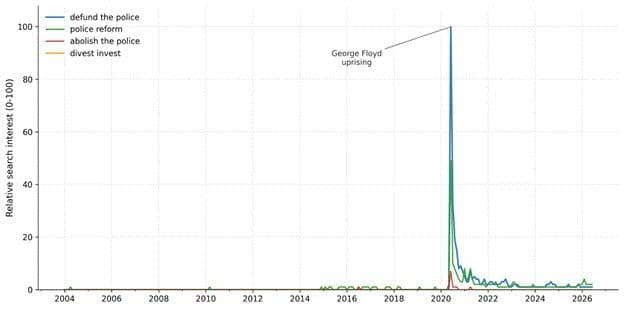
Bar graph documenting changes in relative search interest. All values spike in 2020 with lines representing the following searches: "defund the police" "police reform" "abolish the police" and "divest invest"
Figure 1. Search interest for “defund the police,” “police reform,” “abolish the police,” and “divest invest” in the United States, January 2004 – June 2026. Values are normalized 0–100 relative to the peak monthly search volume of any term in the comparison; “defund the police” reaches 100 in June 2020. Source: Google Trends, US web searches. Retrieved 13 July 2026.
Google Trends data for US web searches between January 2004 and June 2026 tracks four terms chosen to sample distinct positions in the debate: "police reform" as the reformist alternative, "defund the police" as the specific 2020 demand, "abolish the police" as the abolitionist horizon, and "divest invest" as the paired framework of subtraction and reinvestment. Queries for "defund the police" registered near-zero for every month before May 2020, then spiked to their all-time high in June 2020 in the weeks following the George Floyd uprising and fell by roughly two-thirds within a single month, continuing to decline through 2021. "Police reform" tracked a smaller parallel spike in June 2020 before subsiding into near-zero registers, and "abolish the police" registered only a modest June 2020 bump. "Divest invest" — the paired framework beneath calls to defund the police — does not visibly register on the chart at all. This is an artifact of the normalization: Google Trends scales all terms to the peak search volume of the highest-scoring term in the comparison — a well-documented feature of the tool that shapes how comparative queries appear (Hölzl, Keusch, and Sajons 2025). On the same scale as "defund the police," "divest invest" rounds to zero across every month of the window. Pulled in isolation, the term shows a longer search history with elevated interest during periods of intensified movement activity across multiple, often overlapping struggles. This includes the mid-2010s, when fossil fuel divestment campaigns, post-Ferguson organizing, and BDS mobilizations all activated divestment framings; the June 2020 defund moment; and the 2024 campus solidarity encampments, which linked Palestine solidarity with climate and Cop City divestment demands. This overlapping quality is itself part of what divest/invest is: a traveling tactic taken up across movements, whose vocabulary registers publicly during moments when multiple struggles converge around demands to withdraw resources and redirect them. Even at these peaks of elevated interest, however, the paired framework registered at scales orders of magnitude below the "defund the police" spike of June 2020.
The pattern makes visible the argument developed above: a short-lived opening in the hegemonic common sense of policing, followed by its rapid closure — and a paired framework that has circulated across movements, but at scales that have never approached the shorthand it was compressed into during the defund moment. Following Phillips and Chagnon (2026), the defund moment can be read as a hegemonic rupture that immediately triggered a project of hegemonic repair, in which media and political actors worked to restore the settled discursive terrain that policing had occupied. In Stuart Hall's terms, this is the shape of a conjunctural crisis: a rare moment when the settled common sense of an institution loses its self-evidence, and when the political question becomes whether that opening is extended into something durable or absorbed back into what preceded it (Gilbert 2019; Hall et al. 1978). Search interest is not itself a measure of movement power — but the shape of these curves indexes what defund's centrality overshadowed: the paired framework it emerged from and the transformative project that framework was designed to carry.
These struggles over defund's meaning raise a broader question about divestment as a political strategy: what political work does divest/invest actually perform when it moves from insurgent organizing into state policy discourse? Part of the answer lies in a discursive compression that has largely gone unnamed. Within movement and abolitionist spaces, defund emerged as a specific demand that mobilized the divest/invest framework around the fiscal architecture of policing — one application of a broader strategic approach abolitionist organizers had developed for shifting resources from carceral institutions toward community-controlled ones. Divest/invest campaigns had been active in cities across the country for years, including sustained organizing in Minneapolis, but they had been largely ignored by mainstream political discourse (McHarris 2020). What the 2020 uprising forced was attention: paired with the intensity of the moment, defund shattered the hegemonic common sense that policing should continue to command ever-increasing municipal resources. As defund entered mainstream discourse that summer, however, the form of the phrase proved consequential. Divest/invest weds withdrawal and reinvestment into a single formulation; “defund the police,” like “abolish the police,” names only the subtraction side. The broader framework and the constructive project remained part of the political vision, but they were not linguistically carried by the phrase itself. This asymmetry made defund a particular kind of target — one that opponents could attack as pure destruction, portraying it as an absence rather than the reordering of resources it named, and pressuring some supporters to walk back their positions. It also opened the demand to absorption into administrative debates disconnected from the broader framework it had mobilized.
As it relates to carceral systems, divest/invest is best understood as one tactic deployed within abolitionist struggle — and a tactic that is itself contested among organizers, scholars, and movements over what it can and cannot accomplish. Its political meaning depends on what broader project it is tethered to: whether it functions as a step toward delegitimizing carceral power and building autonomous infrastructures of safety, or whether it becomes absorbed into administrative debates over the optimal distribution of state resources. While material divestment can delegitimize police power and redirect resources to produce immediate harm reduction, it is neither synonymous with abolition nor necessary to it. Rather, it should be understood as one strategic lever among many within abolitionist organizing, whose transformative potential depends on the broader political terrain in which it operates.
As the core intervention of this article, I argue that the strategic value of divestment cannot be read off the tactic itself. Such evaluations treat the tactic as if it possesses inherent qualities apart from the conditions of its deployment, abstracting it from the political work it must do to mean anything at all. What divestment actually does depends on three interrelated factors: the relations of force into which it intervenes, the organizing infrastructure that sustains and extends it, and the political horizon it points toward.
The relations of force concern whether mobilized publics, organized opposition, electoral backlash, or institutional absorption shape what political space divestment opens. The organizing infrastructure turns on whether the demand is tethered to movements building autonomous capacity for collective safety and provision, or routed through state institutions that can metabolize it. And the political horizon depends on whether its proponents understand divestment as a step in a broader project of transformation, or as a self-sufficient endpoint that, once achieved, requires nothing further. Anchoring this account is Huey P. Newton's theory of revolutionary intercommunalism (Newton 1972; Rodriguez 2006), which supplied the language of survival-pending-revolution that this article takes as the model for how divestment and construction must operate together. Newton's framework — that survival programs are necessary infrastructure for enduring long enough to build political capacity, but never the horizon itself — describes the relationship between divestment and abolition this article develops.
These three factors do not operate independently. When divestment is tethered to abolitionist projects of building autonomous infrastructures of safety, it can erode the conditions that reproduce carceral power. When routed through the state's own administrative apparatus, it can just as easily be metabolized into legitimating reform — restoring, rather than displacing, the institutions it sought to dismantle. Reading divestment this way reframes a debate too often waged at the level of slogan into a question about political conjuncture: what conditions, allied tactics, and infrastructural commitments determine whether withdrawing resources delegitimizes carceral governance or merely refines it? Understanding these tensions requires situating contemporary defund debates within a longer history of divestment as a political strategy. Social movements have repeatedly mobilized forms of economic withdrawal to challenge systems of domination—from anti-apartheid divestment campaigns targeting South Africa’s racial regime, to pro-Palestinian boycott, divestment, and sanctions (BDS) organizing, and contemporary climate justice movements demanding divestment from fossil fuel industries (Hall 2023a; Barghouti 2011; Indigenous Climate Action 2024).
Across contexts, divestment functions as a tactic for stripping governments, corporations, and financial institutions of the public consent that sustains their moral, political, and economic legitimacy — and that underpins their status as neutral arbiters of order. My analysis is informed by ethnographic research and sustained engagement with abolitionist organizing since 2015, situating this inquiry within the movement ecosystem surrounding campaigns against police violence that helped shift national discourse toward defund, divest/invest, and abolitionist reimagining. This engagement includes organizing with BlackYouth Project 100 (BYP100), where I was a founding member of the NYC chapter, and within the broader Movement for Black Lives ecosystem, whose national platforms helped shape the divest/invest framings this article examines. Engaging abolitionist theory and practice, movement documents, and policy debates, this article examines what happens when divestment moves from insurgent movement strategy into state-centered governance debates. Tracing the genealogy of divest/invest across anti-colonial, abolitionist, and environmental struggles, I analyze how the goals of divestment shift when routed through the fiscal apparatus of the state. The tension this article explores, therefore, is between divestment as abolitionist demand and divestment as administrative reform — between what the tactic asks for and what state institutions are willing to metabolize. The same act of withdrawing resources can serve transformative ends or stabilize the very institutions it sought to weaken, depending on the political conditions of its deployment.
This article contains four sections. The first section examines the structural limits of divestment within racial-capitalist governance. The second section traces the genealogy of divestment across anti-apartheid, Palestinian, Indigenous, and ecological movements. The third section then analyzes the distinctive shift that occurs when divestment is routed through the fiscal machinery of the state in contemporary defund campaigns. Finally, the fourth section situates these debates within broader political traditions that contest the role of the state itself, including Huey P. Newton's theory of revolutionary intercommunalism as one crucial framework for thinking beyond the state as the sole political horizon.
Policing, Carcerality, and the Limits of Divestment
Within abolitionist spaces, divestment has typically referred to organized efforts to withdraw financial, political, or institutional support from carceral institutions while redirecting resources toward life-affirming infrastructures. Campaigns have targeted public budgets, private investment, university endowments, and corporate partnerships that sustain policing, prisons, detention, and border enforcement. Examples include demands to divest municipal funding from police departments, campaigns to pressure universities and pension funds to withdraw investments from private prison corporations, and organizing that links prison divestment to broader struggles against militarism, surveillance, and fossil capital. Divestment functions both as a material intervention in resource allocation and as a political strategy for contesting the institutions that administer carceral power. As a tactic, divestment exerts pressure by contesting how resources, legitimacy, and participation are distributed within existing political and economic arrangements. However, on its own, divestment does not necessarily contest the deeper architecture through which those arrangements are organized. As a result, divestment can reallocate funds while leaving intact the state–market formations that drive dependence on policing and carcerality.
The divest/invest framework has proven especially effective as a pragmatic entry point for abolitionist organizing. By framing reductions to police budgets as rational responses to the failures of policing, organizers have engaged broader publics who might not otherwise identify with abolitionist politics. In the context of racial capitalism, policing and punishment are not merely budget lines but governing technologies embedded within relations of property, labor discipline, and territorial control (Robinson [1983] 2000; McHarris 2024; Maynard and Simpson 2022; bean 2025). Policing expands because it stabilizes dispossession—managing populations rendered surplus by deindustrialization, austerity, housing precarity, and racialized extraction (McHarris 2024; Vargas and McHarris 2017; Hall et al. 1978).
Mariame Kaba and Andrea Ritchie argue that struggles to defund police are fundamentally contests over the nature of the state itself: fights over what it funds, what it withholds, and whose lives it organizes through violence (Kaba and Ritchie 2022). As they write, “Questions remain about whether experiments in remaking states around different priorities can be both anti-capitalist and abolitionist, and whether they can be sustained in a global capitalist order in which they have historically been consistently isolated and crushed” (Kaba and Ritchie 2022, 209). Rather than treat the state as a neutral instrument that can be recalibrated through technical reform, they draw on Ruth Wilson Gilmore and Craig Gilmore's formulation of the state as a set of institutions that develop through “conflict, compromise, and cooperation” (Gilmore and Gilmore 2008, 143) — a contradictory ensemble “fraught by intrastate antagonisms” (Gilmore and Gilmore 2008, 145). In this frame, reorienting the state toward abolitionist and liberatory ends is a matter of political struggle over how its collectivized resources are directed. As Kaba and Ritchie (2022, 209) put it, “it comes down to what the state decides to do with its collectivized resources…. Under this view, the state as a form of governance is not inextricably linked to violence in service of racial capitalism.” Gilmore's work, grounded in socialist traditions, leaves open the possibility that large-scale public institutions — housing, infrastructure, health care — may remain necessary sites of collective provision and democratic struggle (Gilmore 2022).
Whether divestment can do meaningful political work through state institutions depends on what kind of thing the state is. Max Weber defines the state not by its welfare functions or administrative scope but by its claim to the “monopoly of the legitimate use of physical force within a given territory” (Weber [1919] 2004). If Weber is correct that the state's defining feature is its monopoly on organized violence, then policing, prisons, and militarized enforcement are not peripheral functions but constitutive of what allows the state to cohere as a political form. Without these organized capacities for violence, the state would cease to be recognizable as a state. When read together, the institutional ensemble that Gilmore and Gilmore (2008) describe alongside Weber's formulation yields a particular reading: the state is a contested field of institutions whose coherence rests on its monopoly on organized violence. The implication for divestment is structural. To ask the state to defund the apparatus through which it claims a monopoly on organized violence is to ask it to dissolve a function central to its political form. This is why state-routed divestment will always face pushback, recomposition, and absorption—even as the state's various institutional capacities for provision and infrastructure remain constrained sites of struggle.
Beyond the constitutive violence the state mobilizes, the political-economic system the state sustains also shapes what divestment can do. As Ruth Wilson Gilmore (2015b) puts it, “capitalism requires inequality and racism enshrines it” — a reminder that criminalization and mass incarceration operate as a form of class war waged through the institutions of the state (Gilmore 2007). And as Assata Shakur (1998) wrote on the prison-industrial complex:
The prison-Industrial Complex is not only a mechanism to convert Public tax money into profits for private corporations, it is an essential element of modern neo-libral [sic] capitalism. It serves two purposes. One to neutralize and contain huge segments of potentially rebellious sectors of the population, and two, to sustain a system of super-exploitation…
What Gilmore and Shakur together make visible is the analytical condition that frames the article's claim about divestment's limits: targeting the fiscal architecture of specific carceral institutions, without engaging the racial-capitalist structure those institutions sustain, addresses symptoms while leaving the underlying system intact.
Dylan Rodríguez (2006, 2010, 2019) argues that the prison regime functions as a central technology of racial-capitalist domestic warfare, producing the categories of criminality through which racialized populations are captured and contained. This perspective helps further clarify why struggles over police budgets have become central terrain for contemporary abolitionist organizing. Campaigns to reduce police funding challenge the assumption that safety requires armed enforcement, raising broader ethical questions about whose lives are protected, whose suffering is tolerated, and what forms of violence society is willing to authorize (Su, O'Rourke, and Binder 2022). Michelle Alexander argues that dismantling mass incarceration requires a transformation in public consciousness about who deserves dignity, care, and belonging within the political community—work that technocratic policy reform alone cannot accomplish (Mock 2016). Moten and Harney's critique of “policy” names how technocratic solutions tend to re-secure administered scarcity and institutional legitimacy, leaving the conditions of harm intact (Wallace 2018; Harney and Moten 2013). Translating insurgent demand into legislative proposal or administrative reallocation transforms the demand itself. Divestment thus operates as a budgetary intervention and as a strategy for destabilizing the moral and political legitimacy of carceral governance.
Joy James argues that the growing emphasis on care, service provision, and social work within abolitionist discourse risks stabilizing the very systems it seeks to undo — what she describes as the displacement of abolition's “security aspect” — community defense against state violence — by its “social worker aspect” (Rivera 2023). In such cases, abolition can be reframed primarily as the expansion of care infrastructures, sidelining more difficult questions about security, power, and the dismantling of carceral institutions. James (2020) also argues that the popularization of abolition risks softening its revolutionary lineage, decentering revolution and the political prisoners whose struggles have historically foregrounded the necessity of rupture. Abolition, she insists, can “airbrush revolution” (James 2020, 2023). For James, abolitionist organizing must remain accountable to those for whom the stakes are most direct and material (James 2020; Wilson et al. 2020). I share James’s caution. The article’s insistence that divestment be understood in ideological and infrastructural registers — not only as budgetary reallocation — is in part a refusal of the airbrushing James names. To hold divestment to the standard of what is actually being built, and what political prisoners and precarious communities actually need, is to keep abolition tied to the material stakes she foregrounds.
The trajectory of post-2020 reforms illustrates this tension. Minneapolis is often cited as emblematic to this effect: following the murder of George Floyd, the city council pledged to dismantle and replace the police department. What distinguished the city was the scale of the local rebellion that immediately followed, including the burning of the Third Precinct police station. While only a fraction of those in the streets participated in such direct actions, they became a widely recognized symbol of the uprising’s intensity and breadth. The council’s subsequent pledge cannot be understood apart from this pressure. Municipal leaders were pushed into a posture of reformist counterinsurgency by viral media attention and by massive street protests that included militant sectors whose actions reshaped the political horizon of what appeared possible (Chua 2020). Public opinion reflected this reality: a national poll conducted at the height of the uprising found that 54 percent of Americans believed the burning of the precinct was justified (Impelli 2020).
The uprising that sprang in 2020 helped crystallize a new political demand: to defund and dismantle the police. That demand sent shock waves across the country, reshaping public discourse and galvanizing organizers who had already been developing divest/invest frameworks. Yet, the city’s proposal was diluted, stalled, and ultimately blocked through procedural constraints, legal requirements, and state-level intervention (Herndon 2020). These obstacles reflected the institutional difficulty of dismantling policing through existing governance structures. At the same time, the proposed solution itself—replacing the police department with a differently structured public safety agency—remained situated within the framework of state administration. The struggle therefore revealed two tensions: the resistance of entrenched institutions to structural change, and the limits of pursuing abolitionist demands through reforms that remain embedded within state governance.
Defund was itself only one demand amid a wider set of demands moving through the 2020 moment. The 8 to Abolition platform, released by abolitionist organizers in June 2020 as a direct response to Campaign Zero's reformist 8 Can't Wait, articulated eight interlocking demands that together compose a divest/invest architecture in miniature — four demands to withdraw resources and personnel from carceral institutions, one to strip away the laws that criminalize survival, and three to build the community infrastructure that would make the apparatus unnecessary: defund the police; demilitarize communities; remove police from schools; free people from prisons and jails; repeal laws that criminalize survival; invest in community self-governance; provide safe housing for everyone; and invest in care, not cops (8 to Abolition 2020). Pre-2020 formations like MPD 150 and Black Visions Collective had been advancing versions of these demands for years (Akbar 2020; McHarris 2020). Framings of divestment as a strategy to disrupt cycles of carceral power circulated in Black organizing and policy spaces well before 2020, including in arguments for withdrawing federal funding from the military-to-police pipeline that undergirds local carceral capacity (McHarris 2015). The burning of Minneapolis's Third Precinct — an act that turned the uprising into a national event — is what created the political conditions in which defund became legible to a wider public (8 to Abolition 2020; MPD150 2017; Chua 2020; Kass and Dunlap 2025). Defund did not arrive in isolation; it rose because direct action, mass uprising, transformative-justice work, and mutual-aid organizing had already built the ground on which the demand could stand.
The Minneapolis case of reimagining an approach to safety demonstrated how readily the state metabolizes challenges that threaten its monopoly on organized violence. Municipal debates over defunding frequently resulted in modest reallocations or symbolic reforms rather than structural reductions in policing budgets. Empirical studies of major U.S. cities find little evidence that local governments substantially reduced police budgets in the aftermath of the 2020 uprisings (Hoang and Benjamin 2024). In several cities across the country, organizers did secure modest reallocations, civilian crisis-response programs, and investments in housing and mental health infrastructure (Interrupting Criminalization 2022). These gains mattered materially, as they expanded the community’s capacity to reduce harm and utilize community-based practices of care. Yet many proved partial or reversible, largely a result of police unions and the electoral calculations of politicians, with some cities temporarily reducing funding then increasing it beyond what they were at before (Fegley and Murtazashvili 2023). Police budgets rebounded, hiring resumed, and political backlash re-centered “law and order” narratives. These reversals were not contingent or accidental. Several structural conditions made them predictable. Police unions leveraged contract negotiations and qualified immunity litigation to insulate departments from budget reductions, while Democratic officials in cities like New York and Los Angeles faced electoral pressure from constituencies for whom public safety remained defined through policing. Additionally, the concurrent media framing, which had briefly centered the uprising's demands, shifted rapidly toward crime-rate coverage that gave political cover to budget restoration. This process reflected the institutional architecture through which the market-state (Seigel 2018) absorbs and metabolizes insurgent pressure — a lineage that traces back to the racialized “frontlash” politics that scholars have identified as constitutive of the modern carceral state (Weaver 2007). I argue that frontlash operates as the political-economic mechanism through which the 2020 defund opening was metabolized back into carceral expansion — working across state institutions, media framing, electoral competition, and police union power in ways conventional accounts of state absorption leave implicit.
The case of Minneapolis’ diluted defunding proposal makes evident the limits of pursuing divestment through the institutions of the state. Beyond the proposals of an ostensibly progressive progressive city council, even Black radical organizations who have devised more expansive abolitionist proposals for divestment have become stunted in their efforts when their demands become translated into policy. The Vision for Black Lives policy platform, first released in 2016 by the Movement for Black Lives—a coalition of more than fifty Black-led organizations including groups such as the Black Youth Project 100, the Black Alliance for Just Immigration, and the Organization for Black Struggle—offered one of the most comprehensive articulations of divest/invest as a political strategy (Movement for Black Lives 2016). The multifaceted platform aimed at local, state, and federal governments—demanding an end to the war on Black people—called for reducing public spending on policing, prisons, and immigration enforcement while redirecting those resources toward housing, healthcare, education, environmental justice, and community-based systems of safety. In this framework, divestment was a broader transformation of the conditions that produce racialized harm, not a fiscal adjustment alone. The 2016 platform's specific demands reflect the breadth of this vision: it called for reparations for the harms of slavery, Jim Crow, and contemporary state violence; universal healthcare guaranteeing culturally competent services; and direct democratic community control of local law enforcement, including the power to hire and fire officers, determine disciplinary action, and control police budgets and policies. Taken together, these demands did not treat divestment from policing as an end in itself but as the fiscal precondition for a reconstruction of public life.
These demands laid a foundation that was later translated into federal legislative proposals through the BREATHE Act, developed by Movement for Black Lives organizers and introduced in Congress by members of the Congressional Black Caucus in the aftermath of the 2020 uprisings against police violence (Movement for Black Lives 2020). The bill proposed eliminating certain federal funding streams for policing and incarceration, restricting the transfer of military equipment to local police departments, and investing in housing, healthcare, environmental justice, and community-based violence prevention. More concretely, the BREATHE Act proposed eliminating the Edward Byrne Memorial Justice Assistance Grant Program and the Community Oriented Policing Services grants—federal programs that have channeled billions to local police departments—while redirecting federal investment toward housing, mental health services, environmental justice, and community-based safety alternatives. The act also proposed over $1 trillion for the creation of permanently affordable social housing and a $200 billion grant program to combat gentrification in communities harmed by decades of disinvestment.
At the same time, competing proposals such as the George Floyd Justice in Policing Act, drafted by Democrats in Congress, pursued a different path. While framed as a response to the mass protests following George Floyd’s murder, the legislation focused primarily on procedural reforms—such as expanding body camera requirements and adjusting standards around police conduct—while leaving the institutional structure and funding architecture of policing largely intact (U.S. House of Representatives 2021). The contrast between these two legislative proposals illustrates the tension between demands to shrink the carceral state and racial liberal reforms that seek primarily to regulate it. The trajectory of both of these proposals also reveals the limits of pursuing divestment through the institutions of the state. Although initiatives such as the Vision for Black Lives platform and the BREATHE Act articulated expansive visions of investment in Black communities, they inevitably entered legislative arenas structured by compromise, procedural constraint, and opposition from both political parties. None were enacted in their original form. Their significance therefore lies less in legislative success than in what they reveal about the terrain of contemporary abolitionist struggle: a terrain where radical demands are translated into policy proposals and constrained by the institutional logics of the state itself.
These state-centered limits are not confined to legislation; they also shape what candidates who arrive in office through movement-affiliated politics can afford to say and demand once they are inside it. Much contemporary democratic socialist electoral politics in the United States operates within the reformist lineage of Eduard Bernstein and evolutionary social democracy — pursuing socialist commitments through the existing capitalist state rather than through the revolutionary rupture Marx and the classical Marxist tradition envisioned (Marx and Engels [1848] 1969; Bernstein [1899] 1993). That inheritance has produced meaningful gains in wages, housing, and welfare policy, but it has proven structurally uneasy with abolitionist demands to dismantle the prison industrial complex. When democratic socialist candidates who articulated abolitionist and defund demands in 2020 reached the threshold of state power in the 2025 and 2026 electoral cycles, the demands quietly receded. Zohran Mamdani, elected mayor of New York City in 2025 with the endorsement of the Democratic Socialists of America (DSA), walked back his 2020 calls to defund the NYPD — telling reporters after a police officer's death in July 2025, “I am not defunding the police. I am not running to defund the police” — apologized in October 2025 on Fox News to NYPD officers for describing the department as racist, and pledged that he would neither defund nor reduce police headcount as mayor (Pazmino 2025; Fernández and Honan 2025). These trajectories are less about individual candidates than about the structural pressure electoral politics exerts on left-leaning discourse: what candidates can afford to say and demand narrows sharply as they approach the threshold of governing power.
Mariame Kaba and Andrea Ritchie (2022, 204) note that abolitionist movements continue to work through fundamental strategic considerations, writing: “Abolitionists continue to grapple with questions around which economic systems and forms of governance will make space for and bring us closer to abolitionist futures. We don’t all agree, nor do we have all the answers.” The tensions that exist within abolitionist politics themselves are not new (Felber 2020). While many organizers emphasize building autonomous infrastructures beyond the state, others argue that abolition requires substantial public investment in housing, healthcare, education, and social welfare. In this sense, abolition is not always framed as a rejection of governance altogether but as a project of reimagining how resources and institutions are organized.
What is clear from debates is that without a parallel project to build autonomous infrastructures of care and transform the political economy that produces disposability, divestment risks becoming a cycle of concession and retrenchment. Many abolitionist organizers therefore argue that shrinking the carceral state must be paired with efforts to build collective forms of safety and care capable of making policing materially unnecessary. The question, then, is not only whether resources should be redirected, but whether investment itself should be understood as a necessary component of abolition—or whether abolition may also require forms of rupture that exceed the logic of policy redistribution. Turning to the historical uses of divestment is instructive for these considerations.
Divest/Invest: A Genealogy
The four movements traced here — anti-apartheid, Palestinian solidarity, Indigenous, and ecological — are not offered as direct antecedents to defund. They are elements of a broader social movement reservoir that defund has drawn on and contributes to. Each answers a different question about what divestment can do: at what scale, against what kind of institutional target, under what conditions of state or imperial protection, and in what relation to direct action and infrastructural construction. Contemporary divest/invest organizing draws on this reservoir the way any strategy draws on the accumulated experience of prior struggles: selectively, imperfectly, and with the meaning of each borrowed logic shifting when it enters a new political terrain.
Where the previous section identified the structural limits divest/invest confronts within racial-capitalist state formations, this section maps where the framework comes from—and what its origins reveal about the possibilities and limits of the tactic in the present. The divest/invest framework that US abolitionists deploy today did not emerge from US carceral politics alone. It is shaped by a wider movement geography: the anti-apartheid divestment campaigns that pressured South Africa in the 1970s and 1980s, the ongoing Boycott, Divestment, and Sanctions movement against Israeli apartheid, Indigenous land defense, and the climate-justice movement's targeting of fossil fuel finance. Some of these are historical predecessors. Others are contemporary peer movements, running parallel to defund and shaping its tactical repertoire in real time. I trace these connections because reading defund only through US municipal politics obscures both what divest/invest is doing and what it cannot do alone.
Each of these movements teaches the present something specific. Anti-apartheid divestment shows how withdrawing institutional consent can shift the terrain of moral legitimacy globally. BDS shows how divestment from a settler-colonial regime exposes the limits of external economic pressure without infrastructural transformation. Indigenous and climate organizing make visible the entanglements of land, capital, and carcerality. Read together, these movements share a tactical repertoire and a set of unresolved problems — about scale, the market, the state, and whether withdrawing resources from violent institutions is sufficient to address the relations that make those institutions necessary. This article argues that it is not, and that what divest/invest can do depends entirely on what else is being built alongside it.
Anti-Apartheid Divestment
As Archbishop Desmond Tutu has remarked, “In South Africa, we could not have achieved our democracy without the help of people around the world, who through the use of non-violent means, such as boycotts and divestment, encouraged their governments and other corporate actors to reverse decades-long support for the apartheid regime.” (News24 2014). One of the most influential laboratories of modern divestment strategy was the U.S. student anti-apartheid movement spanning from the late 1970s into the 1980s. As Hall (2023a) demonstrates, these campaigns were the product of sustained Black internationalist organizing that linked campus governance to global racial capitalism. Black students—initially at historically Black colleges and universities—understood themselves as participants in the South African struggle rather than distant observers. Inspired by the 1976 Soweto Uprising, they reframed university endowments as political instruments and treated institutional investment as complicity with apartheid. Hall identifies three overlapping waves: an initial HBCU-led phase from 1976-1978 that articulated divestment as an extension of Black freedom struggle; a second phase from 1978-1981 in which organizing spread to predominantly white institutions and built broad coalitions; and a third period of mass direct action between roughly 1982 and 1988, when shantytowns, sit-ins, arrests, and trustee pressure forced dozens of universities to sever ties with corporations operating in South Africa.
Crucially, these campaigns located the university itself within the circuits of empire. Students targeted not only stock holdings but the dense web of corporate philanthropy that bound campuses to multinational firms. Hall’s article on Emory University’s relationship with Coca-Cola shows how corporations attempted to blunt divestment by substituting “ethical investment,” charitable giving, and development rhetoric for economic withdrawal, positioning themselves as partners in racial uplift while maintaining profitable operations in apartheid South Africa (Hall 2023b). This corporate counterstrategy sought to neutralize divestment’s coercive power and preserve legitimacy without relinquishing capital flows. Yet, despite these maneuvers, coordinated student pressure succeeded in making divestment a material threat to corporate and state actors alike.
The lesson here is strategic as much as it is historical. Student divestment campaigns worked because they treated financial infrastructure as a site of struggle and translated moral claims into institutional costs (Hall 2024a; 2024b). Organizers moved beyond moral appeal, creating reputational, political, and financial pressures that universities and corporations were forced to weigh. In this sense, divestment operated through a kind of inverted cost-benefit logic: activists transformed ethical claims about injustice into material risks—threats to legitimacy, investment portfolios, donor relations, and institutional stability—that decision-makers could not easily ignore. In doing so, organizers built a model of global-local organizing by way of boycotting and divestment that connected U.S. Black freedom movements to anticolonial liberation abroad—a blueprint that contemporary movements, from fossil fuel divestment to Palestine solidarity, continue to adapt. Divestment thus functioned as leverage rather than symbolic protest: a way to withdraw consent, disrupt capital, and force institutions to choose sides around systems of domination.
The recent wave of student divestment activism around Palestine reveals both the endurance of this tradition and its changed terrain. Universities in the 1970s and 1980s eventually conceded — often after years of coalitional pressure — because the moral legitimacy of apartheid had collapsed globally and because institutional prestige remained tied to public standing. During the 2024 encampments, universities responded with procedural entrenchment, expanded disciplinary architectures, coordinated police and private security responses, and public relations campaigns aimed at reframing student protest as safety threat (Palestine Legal 2024; Bridging Divides Initiative 2024; American Association of University Professors 2024; Ziadah 2025). The response is not evidence that divestment has ceased to matter; it is evidence that institutions have learned from the earlier moment and rebuilt their capacity to absorb, deflect, and repress the pressure such campaigns generate (McHarris and Doughty 2024; Salaita 2015).
Boycott, Divestment, and Sanctions
The contemporary Boycott, Divestment, and Sanctions (BDS) movement extends and clarifies the strategic logic that animated earlier anti-apartheid divestment campaigns: the deliberate withdrawal of economic, institutional, and cultural support from regimes sustained through racialized dispossession. Formally launched in 2005 by a coalition of more than 170 Palestinian unions, refugee networks, and civil society bodies, BDS calls for coordinated boycotts, divestment, and state sanctions to pressure Israel to comply with international law. Its demands are explicitly structural and systemic: ending occupation and colonization, ensuring full equality for Palestinian citizens of Israel, and respecting the right of return for Palestinian refugees (BDS Movement 2005; Ananth 2013). As Omar Barghouti argues, BDS is not oriented toward persuading the Israeli state to govern differently but toward isolating it politically and economically by constricting the global flows of capital, legitimacy, and institutional participation that make occupation possible (Barghouti 2011). Like South African divestment, the strategy of divestment seeks to raise the costs of complicity rather than to negotiate improved administration within the existing order.
BDS's own demands — end of occupation and colonization, equality for Palestinian citizens of Israel, right of return — are calibrated as rights-based principles anchored in international law rather than as commitments to a particular political solution (BDS Movement 2005; Barghouti 2011). But the broader Palestinian liberation movement in which BDS operates has long centered decolonization as its horizon: the transformation, not merely the reform, of the political authority that governs the land. In this genealogy, a through-line emerges. Anti-apartheid did not demand a better-administered apartheid; BDS does not demand a less-brutal occupation; Indigenous refusal does not demand a more inclusive settler state; the Indigenous-led and grassroots strands of ecological divestment do not demand a greener capitalism. Each pairs the withdrawal of support with a call for a fundamental reorganization of governing authority and collective resources.
This orientation emerges directly from the anti-apartheid lineage. BDS organizers have consistently invoked South Africa not as metaphor but as precedent. As Desmond Tutu reflected in defending BDS against U.S. legislative suppression, the defeat of apartheid depended in part on international boycotts and divestment that withdrew support from a regime that was difficult to dislodge without some form of international support; similar nonviolent pressure, he argued, remains a legitimate and necessary tactic wherever states rely on systematic dispossession (Tutu 2014). In both contexts, divestment functions as leverage. It translates ethical claims into institutional costs, forcing universities, pension funds, churches, and corporations to decide whether they will continue underwriting racial domination.
Solidarity with Palestine has long been embedded within Black radical internationalism. From Malcolm X's visit to Gaza in 1964 to the Black Panther Party's public solidarity with the Palestine Liberation Organization PLO, Black organizers have repeatedly read Palestinian dispossession through a connected analytic lens used to understand U.S. racial capitalism and policing (Evans 2024). This tradition continued through figures such as Angela Davis and June Jordan, whose anti-apartheid and anti-imperialist writings explicitly linked South Africa and Palestine as connected theaters of colonial governance. June Jordan understood Palestinian struggle not as foreign policy but as part of the same global system that structured Black confinement and surveillance in the United States (Hall 2024c).
These connections have only deepened in the present. Black organizers associated with the Movement for Black Lives, Dream Defenders, and allied formations have repeatedly traveled to Palestine on solidarity delegations, meeting with civil society groups, political prisoners’ advocates, and BDS organizers to study the mechanics of occupation and resistance firsthand (Evans 2024). Participants describe these exchanges not as symbolic gestures but as strategic learning: comparing Israeli military governance with U.S. policing, surveillance, and incarceration. Out of the Ferguson uprising, networks such as Black4Palestine emerged explicitly to formalize this connection, arguing that struggles against anti-Black policing and against Palestinian occupation confront overlapping systems of colonialism, militarization, and carceral control (Black4Palestine 2015). Divestment tactics emerging from these formations emerge as a refusal to participate in connected infrastructures of domination that operate across borders. The October 7, 2023 Hamas attacks and Israel's subsequent military campaign in Gaza — what UN bodies, human rights organizations, and genocide scholars have described as genocide — have intensified and transformed this terrain. BDS experienced both unprecedented growth in campus and institutional support—with divestment resolutions passing at dozens of universities—and intensified state repression, including federal anti-boycott legislation and Title VI investigations targeting pro-Palestinian student organizers. For many Black abolitionist formations, Gaza made explicit what had long been argued theoretically: that the carceral, colonial, and military dimensions of racial capitalism are not analogous but structurally linked, sharing technologies, personnel, and political rationale.
Like the anti-apartheid campaigns, contemporary BDS strategy has found one of its most potent terrains on university campuses. Students, faculty associations, and graduate unions have pressed institutions to divest from corporations tied to occupation, cut academic partnerships with complicit institutions, and refuse cultural normalization. These campaigns deliberately echo the earlier South African playbook: treat the university’s financial architecture as political, expose endowments as sites of complicity, and force administrations into visible choices. Student divestment campaigns can be effective precisely because they make neutrality impossible—because they transform institutional investments into liabilities (Hall 2024a; 2024b). They also drew on strategies and lessons from organizing against police power in preceding years (McHarris and Doughty 2024). At the same time, these efforts have been met with increasingly aggressive repression: legislative efforts to penalize BDS support, threats to student funding, disciplinary action, surveillance, police removals of encampments, arrests, and violent crackdowns on campus protest (Palestine Legal 2024; American Association of University Professors 2024; American Civil Liberties Union 2024; Ziadah 2025). The very intensity of this backlash underscores the tactic’s effectiveness. As in the 1980s, divestment alarms administrators and state officials because it threatens material and reputational costs.
A contemporary parallel surfaces in transnational Palestinian solidarity organizing, where the same tensions between institutional divestment and direct action play out in real time. While the Boycott, Divestment, and Sanctions (BDS) movement has focused on financial, institutional, and consumer pressure, groups such as Palestine Action in the United Kingdom — proscribed under UK terrorism law in 2025 — have targeted the physical infrastructures of the Israeli arms trade, including repeated sabotage and occupations of facilities linked to Elbit Systems, Israel's largest weapons manufacturer (Al Jazeera 2025; Zhang 2025). In some cases, sustained direct action campaigns have reportedly contributed to the closure or relocation of Elbit-linked sites. Similar dynamics have appeared in the United States, where campaigns combining public boycotts, tertiary targeting, and disruptive actions against landlords, banks, and facilities helped force the closure of an Elbit subsidiary office in Cambridge, Massachusetts (Anonymous and CrimethInc. 2025). These parallels reveal divestment's terrain-dependence as a structural feature of contemporary social movement organizing.
These developments echo earlier anti-apartheid struggles, in which student divestment campaigns often operated alongside—and were sometimes explicitly framed as supportive of—armed liberation movements in southern Africa. The relationship between divestment and direct action, then and now, has been uneasy but mutually constitutive: financial pressure can place pressure on regimes and constrain capital flows, while disruptive or militant tactics target the infrastructures that sustain and enable those flows. Read in this light, contemporary campaigns against Elbit or other military contractors illustrate the limits of divestment as a standalone strategy. Divestment appears most effective when embedded within a broader ecosystem of struggle that includes disruption, refusal, and the construction of alternative political infrastructures.
What this reveals about the present is not that any single tactic has failed but that no tactic is sufficient in isolation. The strategic question — then and now — is not which single tactic works, but how divestment, direct action, refusal, and infrastructural construction compose together into a viable political horizon. Taken together, these histories clarify what divestment accomplishes in this lineage. In South Africa and Palestine alike, it operates less as a tool of policy reform than as a strategic lever: withdrawing consent, isolating institutions, and raising the cost of racialized governance. For abolitionist politics, this distinction is instructive. Divestment is most durable when it remains a lever within a broader horizon—decolonization, return, or collective self-determination—rather than becoming a stand-in for that horizon.
Ecological Justice
Within struggles against extractive capitalism and carceral expansion, divestment has been articulated as a refusal of settler-colonial and carceral governance. Well before universities and large foundations adopted fossil fuel screens, Indigenous organizers were targeting the financial infrastructure that sustains pipelines, mining projects, and land theft. Coalitions such as Mazaska Talks, formed during the resistance to the Dakota Access Pipeline, reframed banks—not just oil companies—as the true leverage points of extraction, staging coordinated campaigns to move municipal accounts, pension funds, churches, and individual deposits away from institutions underwriting fossil fuel expansion (Mazaska n.d.). On the Mazaska Talks website, these efforts are organized across multiple campaigns—”Divest Yourself,” “Divest Your Community,” and “Divest the Globe”—as coordinated sites of divestment action (Mazaska n.d.). As Lakota organizer Matt Remle (2020) put it, the battlefield had shifted: if pipelines are built with syndicated loans and insurance markets, then banks and asset managers become the sites where resistance must intervene. In this formulation, divestment operates as economic disruption—cutting the credit lines that make extraction possible in the first place.
The stakes of this shift are transnational and often lethal. In states that have long prioritized international corporate interests over the material well-being of their populations, opposition to extractive projects meets both organized violence and legal-financial coercion. Honduras illustrates this pattern vividly. Lenca organizer Berta Cáceres was assassinated in 2016 for her opposition to the Agua Zarca dam; executives and hit men from the Honduran company DESA were later convicted for orchestrating the killing (Lakhani 2020). The Prospera v. Honduras dispute — in which a private 'charter city' project sued the Honduran government for over $10 billion after the country moved to nullify the enabling law — illustrates how the same financial architecture that funds extraction increasingly claims sovereignty itself, disciplining states that attempt to withdraw consent (Slobodian 2023). These are not aberrations. They are what happens when states configured as facilitators of corporate extraction encounter movements demanding withdrawal — and divestment operates within, and against, these material infrastructures of coercion.
Importantly, this organizing has consistently linked ecological destruction to gendered and racialized violence. Indigenous women’s networks and environmental justice groups have articulated divest/invest as a dual strategy: divest from extractive industries, policing, and carceral infrastructure while investing in land defense, community health, and sovereignty-based governance (Maida 2018). Here divestment is refusal—withdrawal of participation from racial-colonial economies that treat Indigenous territories as sacrifice zones. Investment, correspondingly, is not state benevolence but community-determined survival. The political horizon is self-determination beyond the settler state. In this context, climate divestment emerges from a similar analytic terrain as abolitionist divest/invest demands: both identify state-backed extraction and carcerality as interlocking mechanisms for managing and reproducing dispossession.
One recent illustration of this broader movement strategy can be seen in the struggle to stop the Atlanta Public Safety Training Center—widely known as “Cop City.” Organized to defend the Weelaunee Forest, land historically belonging to the Muscogee people who were forcibly removed from the region in the nineteenth century, the Stop Cop City movement mobilized multiple strategies simultaneously. Activists pursued divestment campaigns targeting the corporate funders of the Atlanta Police Foundation, urging institutions to withdraw financial support from the project, while also organizing protests, community pressure campaigns, and petition drives (Stop Cop City n.d.; Herskind, Parker, and Franklin 2025; James 2024). In parallel, organizers gathered more than 116,000 signatures seeking a public referendum on the training center—far exceeding the threshold required under Atlanta law—yet city officials refused to process the petitions, leaving the democratic challenge suspended (Rico 2023). Alongside these institutional tactics, some participants engaged in forest defense, establishing encampments and tree-sits to prevent the destruction of the forest. Scholars examining the movement note that Stop Cop City brought together environmental justice organizers, racial justice activists, and anarchist forest defenders whose tactical repertoire ranged from petitions and public testimony to sabotage and property destruction, reflecting the convergence of distinct political traditions within the movement (Brown 2025). These dynamics have led scholars and theorists to situate the struggle within a broader framework of abolition ecology, highlighting how policing expansion, environmental degradation, and racialized governance are intertwined (Edgett 2026; Demos 2024). State authorities responded with sweeping repression, including domestic terrorism charges and later RICO indictments against dozens of activists, demonstrating how movements challenging policing infrastructure often encounter expansive legal and carceral responses.
From these frontline origins—and from contemporary struggles linking environmental defense and policing—divestment diffused rapidly through societal institutions, becoming one of the most widely adopted tactics of the contemporary climate justice movement. The result has been over a decade of decentralized campaigns that have pressured institutions to sever ties with coal, oil, and gas producers. These efforts have produced measurable effects: extractive firms face rising borrowing costs, reputational risk, and difficulty securing capital, while large asset managers increasingly concede that fossil fuels are long-term liabilities rather than stable investments (Yona and Lenferna 2016; Cojoianu et al. 2021; Healy and Debski 2017).
University campuses have once again served as key laboratories for this tactic’s refinement. At Columbia University, for example, climate justice organizers explicitly situate fossil fuel divestment alongside anti-apartheid and Palestine solidarity campaigns, treating them as variations of the same strategy: threaten profits, not just consciences (Sunrise Columbia 2024). Groups such as Sunrise Movement’s campus chapters and coalitions like Columbia University Apartheid Divest have framed the endowment as a political instrument, demanding divestment from both fossil fuels and corporations complicit in Israeli apartheid. Their arguments echo earlier student movements: universities cannot claim commitments to justice while materially underwriting harm. What is notable here is how divestment has become the common language linking climate justice, carceral divestment, and Palestine solidarity. Across these campaigns, the tactic circulates as a shared repertoire—evidence that financial withdrawal has become a primary means through which students translate moral claims into institutional risk.
Coalitions now lobby treasurers, organize state pension boards, and pressure cities to cut ties with fossil-fuel financiers (Ayling and Gunningham 2017). These efforts recognize that public money—teachers’ retirements, municipal reserves, union funds—often bankrolls the very industries accelerating climate catastrophe (Rainforest Action Network et al. 2026). Divestment becomes a struggle over the governance of collective wealth itself. The scale of these pools—trillions of dollars globally (OECD 2025)—renders finance an arena where even modest reallocations can materially constrain extractive growth. But there are constraints to the approach. Financial economists have noted that divestment does not automatically depress share prices or force managerial change, and under certain compensation structures it can even produce counterintuitive effects (Davies and Van Wesep 2018). Such findings underscore a broader point visible across genealogies: divestment alone rarely compels transformation. Its effectiveness depends on scale, coordination, and the presence of complementary strategies—labor disruption, public pressure, regulatory shifts, and alternative infrastructures of care. For this reason, the most successful campaigns treat divestment not as an endpoint but as one lever among many: a way to stigmatize, destabilize, and raise the cost of extraction while simultaneously building community-controlled alternatives.
Collectively, these histories show how social justice movements expanded divestment strategy into a broader critique of financial infrastructure itself. Anti-apartheid campaigns, fossil fuel divestment movements, and Palestinian solidarity organizing treated banks, investment portfolios, and institutional endowments as sites of political struggle, pressuring financial actors whose capital flows sustained systems of domination. Contemporary police divest/invest campaigns, by contrast, have often been routed primarily through municipal budgeting processes and state governance. While these struggles similarly contest where public resources are allocated, their terrain is different: the fight centers less on disrupting private financial circuits and more on challenging the state's priorities and coercive capacities.
This genealogy concretizes the article's central claim about divestment's terrain-dependence. The same withdrawal of resources does very different work depending on whether it targets corporate capital that can sever ties without dissolving itself, or state institutions whose authority is defined by the very budgets being challenged. The next section traces what happens when abolitionist demands are directed at the fiscal architecture of policing and prisons, where state institutions retain the power to absorb, defer, or recompose those demands.
Defund Through the State: The Politics of Absorption
When abolitionist divest/invest is routed through state institutions, it confronts the state precisely where its coercive capacities are concentrated — and the state retains the power to absorb, recompose, or reroute the demand into administrative reform. After Ferguson and the 2020 rebellions, abolitionist divest/invest shifted both its target and its political logic. The target changed first: where earlier campaigns had largely pressured corporations from the outside, organizers now named policing and prisons—institutions of the state itself—as central to racial-capitalist governance and demanded the reallocation of public resources away from them. That shift in target carried a corresponding shift in logic. Demanding that a corporation withdraw exerts external pressure on an actor that can comply without dissolving itself. Demanding that the state defund its own coercive apparatus is different in kind: it asks an institution to surrender a function constitutive of what it is. Routed through municipal budgets, federal appropriations, and the very administrative agencies the demand sought to dismantle, divestment became legible to the state on the state's own terms—and absorbable into them. That absorption appeared wherever abolitionists tried to make the demand stick. In the post-2020 budget fights, defund was metabolized into administrative reform, while critiques like Dayvon Love's (2022) Pan-African intervention contested the very vocabulary of reinvestment. As I take up in detail below, the absorption intensifies when abolitionist demands target the federal scale of immigration and border enforcement, where state coercion is most concentrated and most central to the state's claim to organized violence.
Defund functioned as one strategy within a broader divest/invest ecosystem — alongside direct action, mass uprising, narrative shift, mutual aid, transformative-justice work, and campaigns such as 8 to Abolition — not the totalizing horizon it was often taken to be. In the political terrain that emerged after 2020, defund came to stand in for divest/invest itself in the public imaginary, while the invest dimension often fell away from the discourse entirely. The pattern of divestment’s structural limits is clear: when divestment is pursued through the apparatus of the state, the state retains the direct power to absorb it. The absorption of defund first began in public discourse. Once largely confined to movement spaces, the slogan “defund the police” circulated rapidly through national media and electoral politics. Members of Congress, including Representatives Ilhan Omar and Alexandria Ocasio-Cortez, publicly defended reallocating police budgets toward social services (Rodriguez 2020), while others — such as President Donald Trump and numerous Republican lawmakers — condemned the proposal as a threat to public safety (Gittleson 2020). Even critics helped propel the demand into mainstream discourse, as major outlets including The New York Times, The Washington Post, and cable news networks devoted sustained coverage to debates over police budgets and alternative safety models. This visibility was costly: as defund became legible to mainstream actors, it became contestable on their terms. Abolitionist organizers had to spend significant rhetorical labor correcting the framings that had attached to it — framings that sympathetic coverage and electoral opposition had together produced. As Angela Davis clarified at the height of the protests, the demand to defund “is not about removing all possibilities of safety and security, but rather about enhancing them,” recognizing that armed state force cannot be the default response to social needs (Davis 2020).
The efforts of abolitionist organizers were a textbook case of insurgent demand meeting institutional translation. By the late summer of 2020, defund had moved from chants in the street to the agendas of city councils, foundation programs, and primetime debate panels. “Defund” began to mean something other than what abolitionists meant. Deep tensions surfaced. These were not abstract disagreements but concrete conflicts between three overlapping camps. The first camp was made up of abolitionist organizers committed to dismantling carceral institutions; the second camp included municipal officials and policy intermediaries seeking to repackage the demand as administrative reform; and the third camp constituted electorally-oriented Democratic actors treating “defund” as a public relations liability to be managed. Each camp pushed defund in a different direction, and each had different capacities to materialize and/or earn support for their goals and reading of defund. Media coverage and electoral backlash quickly narrowed the demand into either a technocratic budget debate or a misguided reactionary response (Mays 2020; Londoño 2023). As Mariame Kaba has observed, for abolitionists, defunding the police functions as an entry point—opening space for broader questions about safety, care, and the limits of reform (Kaba 2020; Kaba 2021a). These demands are often situated within a wider divest/invest framework that calls for reallocating resources toward life-affirming infrastructures. My own experience writing and organizing around these demands confirmed how profoundly they unsettled dominant assumptions that equate safety with policing. Public backlash has revealed that divestment, when aimed directly at state violence, threatened not only budgets but political common sense and the affective logics of fear that sustain it.
Municipal responses have frequently fallen short of the transformative horizon organizers articulated. New York City’s widely publicized $1 billion “cut” to the NYPD, for example, relied largely on accounting maneuvers rather than substantive reductions or reinvestment in housing, health care, or youth programs (Justice For All Coalition 2021; Citizens Budget Commission 2020). Similar patterns appeared nationwide: symbolic reallocations, temporary freezes, or administrative reshuffles rather than durable shifts toward care-based infrastructure (Interrupting Criminalization 2022; Peltz and Sisak 2020). These outcomes illustrate how easily divestment can be diluted when routed through state budgeting processes.
Seen genealogically, contemporary defund campaigns therefore represent both continuity and departure. They inherit divestment’s strategic logic—withdraw consent, disrupt material support, force institutions to choose sides—but deploy it in a domain where concessions can be granted without structural transformation. The result is a persistent tension: divestment remains a powerful tactic for reshaping political discourse, yet insufficient on its own to dismantle the institutional architectures of racial capitalism (Levenson and Paret 2023; Paret and Levenson 2024). Understanding this tension is crucial for assessing both the appeal and the limits of divest/invest as an abolitionist strategy. The limits of divestment are visible across contemporary defund debates and in the longer histories of divestment struggles themselves.
It is important not to overstate what divestment has historically achieved. Anti-apartheid divestment campaigns contributed materially to the eventual dismantling of formal apartheid, yet scholars have long noted that the transition left intact deeper structures of racial capitalism. Political inclusion did not automatically yield economic transformation. Instead, post-apartheid governance often incorporated a narrow stratum of Black elites into existing circuits of capital accumulation while land dispossession, precarity, and mass inequality persisted for the majority (Freund 2007; Southall 2004; Makgetlaneng 2016; Levenson 2022; Paret 2022). As Levenson and Paret argue, the end of apartheid curtailed racial exclusion at the level of law without uprooting the material relations that organized dispossession, producing what might be understood as racial inclusion without structural redistribution (Levenson and Paret 2026; Paret and Levenson 2025). The political regime changed while the underlying political economy largely endured.
A similar tension—between divestment’s capacity to reshape discourse and its inability to interrupt the underlying military, settler, and imperial infrastructures—shadows contemporary Palestine solidarity. The Boycott, Divestment, and Sanctions movement has successfully reframed Israel as a site of political and financial risk, shifting public discourse and pressuring institutions to withdraw complicity. Yet the ongoing intensification of siege, displacement, and mass killing highlights the limits of external economic pressure when settler colonialism remains backed by overwhelming state and imperial power. As Edward Said ([1979] 1992) reminds us, colonial formations persist not simply through policy but through durable structures of territorial control, militarization, and racialized governance that exceed any single tactic.
Within Pan-African and Black nationalist traditions, the politics of reinvestment carry distinct stakes around self-determination and institutional autonomy. Writing from the Baltimore context, Dayvon Love (2022) of Leaders of a Beautiful Struggle argues that segments of the “progressive mainstream” advanced defund demands without sufficiently addressing two central questions: how communities might confront immediate forms of interpersonal violence, and what kinds of institutions should replace the infrastructures being dismantled. Love contends that vague calls to “reinvest” in social services risk channeling resources into the white-dominated nonprofit and human-service sectors, thereby reproducing dependence on institutions structured by racial hierarchy rather than building autonomous, Black-controlled formations capable of meeting community needs. This critique emerges from a Pan-African and Black nationalist framework that prioritizes independent Black institutional development as the basis of self-determination. What Love's analysis makes visible is that the “invest” side of divest/invest is not politically neutral—different reinvestment targets do different political work. Redirecting resources into existing nonprofit infrastructures may reproduce the very arrangements abolitionist politics seeks to undo; building autonomous Black-controlled formations advances toward a different horizon. Read alongside the earlier discussion of Joy James, Love's intervention underscores that the tensions surrounding divest/invest are not simply disputes between reformists and abolitionists, but debates within Black radical politics over how abolition should confront violence, build institutions, and transform the structures of governance that sustain racial domination.
Defund organizing also engaged carceral power across multiple scales. Some organizers anchored their campaigns at the municipal scale—police departments, city budgets, council politics—where divestment's leverage is most immediate. Others, particularly migrant-justice and abolitionist formations working at the federal scale, insisted that “defund” had to name ICE, CBP, federal prisons, and the contractors who profit from them, or it would simply displace policing rather than dismantle it. These scalar arguments make a shared problem visible: defund emerged as a set of locally and scalar-specific formations, and the question of which carceral institutions are within its horizon is itself a political contest. That contest has key implications in the terrain of borders and immigration enforcement.
Borders, Divestment, and the Racial State
Borders extend the carceral apparatus far beyond municipal police departments. Detention, deportation, surveillance, and the power to exclude operate alongside police as infrastructures of racial statecraft through which surplus populations are managed, contained, and rendered disposable. As Achille Mbembe argues, race itself functions as “a security device” that sorts populations according to “a logic of enclosure” — at once “an ideology and a technology of governance” that neutralizes perceived dangers “through immobilization, incarceration, or deportation” (Mbembe 2017, 35). In Necropolitics, Mbembe extends this analysis: contemporary sovereignty “largely resides in the power and capacity to dictate who is able to live and who must die” (Mbembe 2019, 66). Borders are where this necropolitical capacity takes spatial form — “no longer sites to be crossed but lines that separate” (Mbembe 2019, 3) — militarized terrain on which the state determines who is protected, who is detained or deported, and who is exposed to violence and death. For abolitionist divestment, this matters: engaging municipal police budgets alone leaves intact the federal, territorial, and corporate networks through which racial capitalism reproduces itself.
This expanded scope of policing matters for the article's central argument: abolitionist divestment cannot be evaluated solely by how much it withdraws from municipal police budgets, because policing as a structure of racial-capitalist governance extends across federal, territorial, and corporate networks that municipal budgets cannot reach. A tradition of scholarship—Robyn Maynard (2017), Andrea Ritchie (2017), Stuart Schrader (2019), Micol Seigel (2018), and Julian Go (2023), among others—has insisted on this expansive understanding of policing, tracing how it extends through immigration enforcement, border patrol, deportation, and surveillance regimes that differentially regulate mobility along racial lines. Simone Browne (2015) sharpens the surveillance dimension specifically, showing that the surveillance of Blackness, traced from slave passes and lantern laws to contemporary biometric technologies, is constitutive of racial governance rather than incidental to it. From colonial slave patrols and pass systems to contemporary federal detention centers and interior enforcement, the governance of racialized populations has always depended on controlling where people live, move, and work. Borders are carceral technologies that confine, sort, expel, and expose populations to violence and premature death (Bradley and de Noronha 2022)—a spatial grammar of exclusion that constitutes another articulation of the state's coercive architecture.
This continuity between policing and border enforcement complicates questions of strategy. Abolishing or shrinking a single agency (e.g., a local police department) does not abolish the regime it serves. Immigration enforcement long predates the modern apparatus of U.S. Immigration and Customs Enforcement (ICE) and U.S. Customs and Border Protection (CBP) and is distributed across federal, state, local, and private actors. Police collaborate with border agents; detention centers are managed by corporations; surveillance technologies are subcontracted to private firms. Even if one node were dismantled, enforcement persists through others—often more entrenched and less visible.
These dynamics have animated recent debates within abolitionist organizing around the demand to abolish ICE. The slogan emerged as a critique of the agency’s role in detention and deportation, but it also opened broader questions about the architecture of immigration enforcement itself. While the demand centers on a specific institution, scholars have cautioned that eliminating ICE alone would not dismantle the underlying regime of border control if enforcement capacities simply migrate to other agencies or institutional forms (Gowayed and Ray 2026). Public debate over the proposal has nonetheless expanded dramatically as recent polling suggests that roughly half of Americans now support abolishing the agency altogether (Huppke 2026).
Framed in this way, the debate raises a practical and political question central to this article: what would it mean to divest from immigration enforcement? Unlike municipal police departments whose budgets are debated through city councils, immigration enforcement is financed through federal appropriations, multi-agency funding streams, and extensive private contracting. Detention and deportation infrastructure is sustained through a wide network of firms providing detention facilities, transportation, biometric surveillance technologies, data systems, and logistical support (Golash-Boza 2015; Walia 2021). Immigration enforcement therefore illustrates how deeply punitive governance is embedded within broader circuits of capital accumulation (Blanc, McEnany, and Sandberg 2026). Yet this entanglement is not unique to immigration enforcement but characterizes carceral power more broadly. Policing and prisons are similarly intertwined with private contractors, technology firms, construction industries, surveillance companies, and municipal labor markets. The carceral state — including immigration detention and enforcement — is therefore not simply a set of agencies but an expansive political economy.
Recognizing this interconnectedness shifts the terrain of divestment. Defunding border enforcement cannot be limited to cutting a federal line item; it also involves targeting the corporate and financial networks that make enforcement possible. Campaigns have therefore pressured companies supplying detention infrastructure, surveillance technologies, and transportation services—from technology firms to private prison contractors—to withdraw their participation or face reputational and economic consequences. Such strategies attempt to disrupt the infrastructural support for border violence in ways that simple budgetary reallocation cannot. At the same time, they reveal a deeper limit: the violence of borders does not arise only from particular contracts or agencies but from the political logic of border regimes themselves. The contested ground here — even within traditions sympathetic to abolition — is what measures divestment's success in the first place. When divestment is evaluated by fiscal outcomes alone (did budgets fall, were agencies shrunk, was reallocation sustained), it can be declared a failure or a partial win without any account of what political capacity was built through the effort. Divestment operates across material, ideological, and cultural registers simultaneously, and its strategic viability depends less on which fiscal reallocation is achieved than on whether the political capacity built through the campaign outlasts the campaign itself.
This insight returns us to a central question: who are movements demanding from, and what forms of power are legitimized through those demands? If policing, detention, and immigration enforcement operate through overlapping institutional and economic networks, divestment must target more than municipal, state, and federal agencies. It must confront the political-economic arrangements that sustain coercive governance — the corporate contractors, surveillance technologies, and logistical infrastructures that enable policing, prisons, and border enforcement alike. Immigration enforcement makes especially visible how carceral power extends beyond municipal budgets into federal appropriations, private contracts, and transnational supply chains — the market-state formations (Seigel 2018) that organize and profit from punitive governance.
The State and Abolition
The tensions surrounding contemporary defund debates echo a long-standing argument within socialist, anarchist, and abolitionist traditions: is the state's coercive function — its monopoly on policing, prisons, and militarized enforcement—essential to what makes the state a state, or is it a feature that could be reorganized away? In political-theoretical vocabulary, this is the question of whether state coercion is constitutive of the state's form (essential to what it is) or contingent on it (one historical configuration among others that could be remade). Having established earlier that policing and prisons are not aberrations of an otherwise neutral state but central technologies through which racial capitalism reproduces itself, this question now bears directly on strategy. If state coercion is constitutive, then divestment routed through the state will be perpetually vulnerable to absorption—not because organizers chose the wrong tactic, but because the institution being asked to defund itself is the same institution whose authority is defined by that funding. If state coercion is instead contingent—a historically produced configuration that can be reorganized — then state-routed divestment becomes a coherent, if difficult, terrain of struggle. What follows traces how abolitionist thinkers, in conversation with socialist and anarchist traditions, have answered that question, and what those answers mean for the strategic horizon of contemporary divest/invest organizing.
Returning to Kaba and Ritchie's account, while they treat the state as an unavoidable terrain of contestation, they also emphasize the cultivation of commons-based infrastructures of care, mutual aid, and community governance. The two abolitionists write that, “rather than be immobilized by these contradictions, we ask ourselves what additional possibilities emerge if we move beyond the dichotomy of capturing or dismantling the modern Western state” (Kaba and Ritchie 2022, 210). Their framework of abolition emphasizes simultaneous practices: limiting immediate harm, meeting urgent needs, and building collective capacities that reduce dependence on punitive governance. This orientation treats divestment not as an endpoint but as a hinge—a tactic that weakens carceral capacity while creating space to construct different forms of social provision. The emphasis here is not on replacing one state agency with another, but on commons-building: developing housing, food distribution, healthcare access, crisis response, and mutual aid infrastructures that are collectively governed rather than administratively policed. As they further note, “defunding police and refunding the commons would generate resources and create space for community programs to grow and practice nonpolice and non-carceral responses to crisis” (Kaba and Ritchie 2022, 217). These distinctions clarify that debates over divest/invest involve both tactical disputes about budgets and disagreements about the role of the state in projects of abolition and social transformation.
Abolitionist strategy sits in a constitutive tension. Some organizers engage the state as a terrain to contest, extracting redistributions that materially improve life and shrink police power. Others treat the state itself as irreducibly coercive, prioritizing refusal, autonomy, and infrastructures that operate beyond it, even while at times engaging it with specific aims (Ansfield et al. 2023). Still others draw on socialist and communist traditions that imagine seizing state power as a transitional step toward its eventual dissolution. These differences matter. Because when these strategies operate under the same banner of “abolition,” divestment can slide between incompatible meanings: reformist endpoint, transitional tactic, or revolutionary rupture. That ambiguity creates openings for co-optation, which proved true following the 2020 uprisings (Kaba and Ritchie 2022). Budget cuts that leave intact the architecture of coercion can be declared victories, and new agencies can be framed as alternatives while expanding administrative control—the state can appear responsive while consolidating authority. In this sense, divestment can unintentionally perform ideological work for the very structures it seeks to weaken.
Divestment therefore does more than pressure the state to reallocate funds; it can also expose the mechanisms through which authority is reproduced across both financial and coercive institutions. Earlier divestment campaigns—from anti-apartheid struggles to fossil-fuel and pipeline resistance—often targeted corporate capital and financial intermediaries, seeking to raise the economic costs of domination by disrupting investment flows. Contemporary abolitionist deployments of divestment, however, have frequently turned inward toward the fiscal architecture of the state itself, focusing on police budgets and carceral spending as sites of struggle. Yet financial markets have often moved in the opposite direction: research finds that incidents triggering protests associated with the Movement for Black Lives corresponded with significant increases in the stock prices of firms producing policing technologies and equipment (Ba, Rivera, and Whitefield 2023). This dynamic highlights how financial markets can absorb political crises by translating demands for transformation into new opportunities for accumulation. Under racial capitalism, financial power and organized coercion operate together: capital structures inequality while policing stabilizes it. Abolitionist strategy must therefore engage budgets and investment flows alongside the political form of the state and the role of organized violence within it.
What the defund debate revealed is that the state has commitments it will not surrender under electoral pressure. When even progressive politicians defaulted to expanding or preserving police budgets, they were showing that the American state — and the political competition organized around it — requires policing as one of its central instruments. Left-leaning politicians default to the police because the nation-state does. Divestment routed through the state exposes those commitments, and forces a confrontation with what “safety” means when its dominant institutional form is enforcement. If policing and prisons produced safety, a country with more police and more incarceration than almost anywhere in the world would not leave so many vulnerable to violence, harm, and exploitation — interpersonally, communally, and structurally.
Abolitionist Lineages Beyond the State
Anna Terwiel argues that abolition is inherently revolutionary because it understands policing and imprisonment not as isolated institutions but as structural features of the social order itself; abolitionists therefore seek transformative change rather than incremental criminal legal reform (Terwiel 2023). While some abolitionists and theorists reject the claim that abolition is inherently revolutionary, Terwiel’s formulation underscores that abolition cannot be confined to institutional policy change; it requires the remaking of the social relations that produce punishment in the first place. However, even this formulation reveals a tension within abolitionist thought. While many organizers frame abolition as a project of social reconstruction—building infrastructures of care, mutual aid, and collective provision—others caution that proceduralizing abolition risks domesticating it by translating insurgent struggle into developmental or policy-oriented frameworks (Lang 2022). In this view, abolition is not primarily a program for constructing new institutions but a practice of refusal and fugitivity—a mode of social life that exceeds the governing logics through which carceral power organizes society (James 2005; Shulman 2021; Moten 2003; Moten 2018; Harney and Moten 2013).
If the limits of divest/invest reveal a structural problem with the state, abolitionist traditions offer a longer historical record of organizers grappling with that problem in practice. The political terrain on which divestment can do its work is not given. It has to be built. And it has been built, slowly, partially, often against repression, by movements that long predate the post-2020 turn. Black radical, abolition-communist, and Indigenous-refusal lineages each carry that work in a different register. Set against this longer history, post-2020 divest/invest emerges as a recent entry in a much older practice — building communities, institutions, and ways of life that exceed the state's carceral capacities, even as they confront its violence. Divestment names what to refuse; these traditions are among the archives for imagining what to build. Across those lineages, organizers confronted a recurring strategic dilemma: whether liberation could be secured through capturing state power, forcing concessions from it, or building forms of life that exceed the state altogether. These debates did not emerge at the level of theory alone. They were forged through concrete encounters with repression, incarceration, and the routine failure of the state to deliver safety or justice.
Black Radical Traditions
One critical lineage appears in Huey P. Newton’s theory of revolutionary intercommunalism (Narayan 2019; Rodriguez 2006). In a speech at Boston College in 1970, Newton argued that the nation-state could no longer be treated as the primary terrain of political struggle (Newton 1972, 20–38). Under conditions of U.S. imperialism and racial capitalism, communities were increasingly subordinated to global networks of military and economic power. As Besenia Rodriguez notes, Newton developed intercommunalism to explain how imperial dominance reorganized political life beyond the boundaries of nation-states, producing local communities governed through transnational structures of military, economic, and political control (Rodriguez 2006). Within this framework, local police and prisons were not simply municipal governance tools; they were local expressions of a global order that managed surplus and racialized populations across borders. Carcerality thus appears not as an isolated institutional problem but as one technology among many for stabilizing imperial accumulation.
Intercommunalism shifts the horizon of struggle away from the nation-state as the primary unit of liberation and toward building networks of survival, solidarity, and collective capacity across communities dominated by U.S. empire. This is not equivalent to a simple anti-state politics. Newton’s formulation remains Marxist in its orientation toward what he called “total transformation” (Newton 1972, 20), even as it questions whether socialism can be achieved within an imperial world system without a broader intercommunal redistribution of power and resources (Rodriguez 2006). In practice, this produced a strategic both/and: the Panthers built community infrastructures aimed at “survival pending revolution” (Hilliard 2008, 35; Narayan 2019). They also engaged electoral politics and policy struggles as tactical sites through which to contest state power. These engagements, however, were deeply contested within the organization and contributed to internal fissures and factionalization, particularly around questions of state power, strategy, and the limits of reform (Bloom and Martin 2016; Williams 2015).
The Black Panther Party’s survival programs illustrate this orientation materially. Free breakfast programs, community health clinics, transportation initiatives, and political education were not charitable supplements to state governance, but rather functioned as infrastructural experiments designed to keep people alive and organized under conditions of state abandonment and repression (Bloom and Martin 2016; Heynen 2009). Newton explicitly cautioned that these programs were not the solution to oppression, but were necessary for people to endure long enough to make revolution possible. Read this way, the programs contested the idea that safety and provision flow naturally from armed state authority while cultivating collective capacities that could outlast—rather than simply petition—state power. This is one of the central inheritances the article draws on. Newton’s insistence that survival programs are necessary but not sufficient — that they must be understood as infrastructure for enduring long enough to build political capacity, not as the horizon itself — describes exactly the relationship between divestment and abolition this article is arguing for. Divestment names what is being withdrawn from. Survival programs, mutual aid, autonomous infrastructure, and community-controlled safety are what make the withdrawal sustainable. Neither is the endpoint. Together they compose the terrain on which abolitionist and revolutionary politics have long operated.
Black anarchist traditions deepen this critique of the state (Bey 2020). As Dana Williams (2015) shows, Black anarchism emerged not from abstract anti-statism but from lived disillusionment with hierarchical and state-centered revolutionary formations within the Black freedom struggle. The key architects of Black anarchism such as Lorenzo Kom’boa Ervin, Kuwasi Balagoon, Ashanti Alston, Ojore Lutalo—all of whom were members of the Black Panther Party with Alston and Balagoon also being Black Liberation Army, as well as Martin Sostre—came to develop distinct aspects of Black anarchist thought (Ervin 2021; Balagoon 2019; Williams 2015). Garrett Felber argues that Sostre’s political work and prison struggle helped lay an often-overlooked foundation for contemporary Black anarchism and abolitionism, even though Sostre himself did not use those terms and identified as a revolutionary anarchist (Felber 2023, 2025). Sostre’s own account clarifies what is at stake strategically in anarchist organizing. In the Open Road interview (Sostre 1976), Sostre insists that, in the “struggle or the war of liberation,” movements should “start off with an anarchistic form of society” rather than build a centralized “headquarters” with the promise that state hierarchy will later “wither” (Sostre 1976). Sostre grounds this argument in both security and political autonomy. In his own conceptualization of his anarchistic defense committees, Sostre argues that centralized headquarters become easy targets for infiltration and compromise, whereas decentralized defense committees require the state to infiltrate each node independently. But Sostre also emphasizes that decentralization is not only defensive: centralized commands can misread local conditions and drive the entire movement “over the cliff,” whereas decentralized formations allow for situated judgment and help cultivate “a microcosm of the society that we’re trying to build” (Sostre 1976). In this sense, prefigurative structure is itself part of the struggle—not an afterthought to be achieved later (Sostre 1976; Felber 2025).
Sostre’s strategic orientation also clarifies the tension between abolitionist and state-centered revolutionary projects. When asked about Marxist-Leninist anti-imperialist struggles in the interview, Sostre acknowledged their role in weakening imperialism, but he remained skeptical that such struggles would produce emancipatory outcomes (Sostre 1976). Rather than assuming unified revolutionary fronts, he anticipated “competition” among political formations once imperial power destabilized, drawing on examples from Angola, China, the Soviet Union, and the anarchist experience with Nestor Makhno. For Sostre, the collapse of imperial authority would not automatically produce freedom; it would open a contested terrain in which new state formations might reproduce domination. The strategic lesson, he argued, was the need to build autonomous bases, infrastructures, and armed revolutionary capacities in advance, so that anarchist and abolitionist formations would not simply be subordinated to the next state project (Sostre 1976). His organizing after his 1975 release reflected this orientation. Sostre became involved in tenant organizing and later helped lead the Juvenile Education and Awareness Project (JEAP), which combined job training, political education, and youth mentorship. Over nearly a decade, the project employed close to one hundred teenagers to renovate five abandoned buildings, transforming them into a community center, a daycare, and below-market-rate apartments. These efforts reflected his commitment to building autonomous community infrastructures as part of a broader revolutionary practice (Martin Sostre Institute n.d.).
William C. Anderson discusses Black anarchism’s insistence on revolutionary abolitionism and building forms of collectivity that refuse the state as the horizon of political possibility. As Anderson (2021, 140–141) writes, “If the state offers us no home as Black people, why not reject it as a concept wholeheartedly? The same goes for capitalism, policing, prisons, and so on.” Anderson goes on to write, “The politics of Black anarchism are not interested in trying to repair or reform the state; they call for its abolition…Let us be clear, abolition is not the revolution itself. However, abolition is a step to bring us closer to revolution, which is a much more extensive process that holds abolition as a method within it” (Anderson 2021, 159-160). These traditions broaden divestment beyond moving money away from police, foregrounding the cultivation of collective capacities that reduce dependence on the state altogether. In doing so, they reopen a deeper strategic question: not only how the state should allocate resources, but whether the state—or even transitional forms of state power—can serve as the vehicle for revolutionary transformation at all. As Anderson argues, Black anarchist traditions insist that the state itself is not a tool to be repurposed but an institution to be abolished. Historically such insistence has been violently repressed, as we see with the bombing and incarceration of MOVE in Philadelphia throughout the 1980s (Africa Jr. 2024).
The turn toward Black anarchism did not abandon collective struggle or material demands. It emphasizes mutual aid, community defense, and autonomous survival infrastructures. This orientation is further developed within anarchist and abolitionist thought. Dean Spade theorizes mutual aid as a process of building autonomous infrastructures that reduce dependence on punitive and authoritative institutions (Spade 2020). As Spade also notes in a conversation with Rachel Herzing and Bench Ansfield:
Being an anarchist does not mean avoiding engaging with the governments we live under. We get into city councils and defund the cops. We oppose new criminalizing laws and new criminalization expansion projects. This is not a purity thing—not about ignoring current governments. It’s about what we are imagining we are going towards. Our task is to build our capacity for collective self-determination. Are we ready to run our own lives together? (Ansfield et al. 2023)
These questions of collective self-governance and autonomy also surface in adjacent debates on abolition and communism.
Abolition Communism
Abolitionist thought has also developed through communist and socialist lineages. Robin D. G. Kelley (2023) reminds us that abolition historically names both deconstruction and construction: the dismantling of oppressive institutions alongside the making of new social worlds. In his reflections on “abolition communism,” Kelley underscores that many abolitionist organizers emerged from Marxist organizing traditions. Read in this context, abolition is both anti-carceral and anti-capitalist in a structural sense: incompatible with a system that relies on organized abandonment (Gilmore 2015a), racialized extraction, and state violence to reproduce itself. Kelley reminds us that across classical communist texts—Marx and Engels’ Communist Manifesto—the language of abolition recurs numerous times: abolition of private property, abolition of class antagonisms, abolition of the bourgeois state, abolition of nations and nationality, to name a few (Marx and Engels [1848] 1969; Kelley 2023). In this frame, abolition does not denote reform or institutional redesign but rupture. It signals the elimination of the underlying relations—property, wage labor, colonial dispossession, racial hierarchy—through which coercive institutions become thinkable.
Rinaldo Walcott extends this abolitionist horizon by arguing that the dismantling of policing and prisons also requires confronting the property regime that underwrites them. In On Property, Walcott traces modern policing to the defense of property relations forged through slavery and colonial conquest, where Black people were legally constituted as property and policing emerged to protect regimes of ownership and racialized order. In this account, abolition demands confronting the social relations that render policing necessary in the first place. Walcott therefore suggests that the call to abolish the police implicitly raises a deeper question about the persistence of property itself as a governing principle. The horizon he sketches draws on what Ruth Wilson Gilmore has described as “small c communism,” a commons-oriented social order grounded in collective care and shared provision rather than privatized ownership (Gilmore, Toscano, and Bhandar 2022; Walcott 2021, 87). Such a framework, he argues, would reorient social life around collective care and public stewardship, undermining the property logics that organize carceral governance in the present.
The broader communist inheritance surrounding abolition also reveals a historical contradiction. While communist traditions repeatedly invoked abolition rhetorically, twentieth-century socialist states rarely dismantled police, prisons, or militarized authority. In practice, coercive apparatuses were often retained or expanded in the name of revolutionary transition. Engels himself observed that the emergence of the state historically coincided with the need for a public force—what he described as the “police force”—to manage internal order (Engels [1884] 1942, 65). Lenin, writing before the Bolsheviks seized power, called for the “abolition of the police, the army and the bureaucracy,” proposing instead the arming of the people (Lenin [1917] 1964, 23). However, historically existing socialist regimes did not abolish these institutions. Instead, they reconstituted them under new authority. As Kelley notes, even avant-garde revolutionary traditions—such as the 1924 Surrealist Manifesto’s call to open prisons and disband the army—remained largely aspirational rather than realized (Kelley 2023).
This tension—between abolition as revolutionary promise and the persistence of carceral authority—animates contemporary debates around abolition communism. Alberto Toscano warns that abolition's post-2020 mainstreaming produces a double risk: triumph and domestication. As “defund” circulates more widely, abolition may become both politically legible and institutionally absorbable—transformed into managerial reform rather than structural transformation (Toscano 2025). For Toscano, this is why abolition's affinity with communism matters: abolition is at root “a radically egalitarian remaking of the social world,” not the destitution of specific agencies alone (Toscano 2025). Otherwise, abolition risks becoming compatible with the very order it seeks to dismantle.
In “Against Carceral Communism, For Abolition Communism”, Simoun Magsalin argues that any revolutionary project that retains prisons or policing under proletarian administration reproduces the logic of carcerality rather than overcoming it. As they write, “Abolition communism is the idea that communist measures must simultaneously be abolitionist steps” (Magsalin 2022). Since policing and incarceration are historically central to the production and management of proletarianization itself, they cannot simply be repurposed. They must be dismantled alongside wage labor, the state, and the broader relations of domination that sustain capital (Magsalin 2022). The danger, in other words, is “carceral communism”: prison-breakers who become prison-builders. These authors collectively caution that communism without abolition risks reproducing carceral authority. They also highlight the importance of anti-capitalism for abolition. Relatedly, as Ruth Wilson Gilmore explains, abolition is a project of “making the world we want,” grounded in overlapping traditions of small-c communism and anarchist self-organization (Gilmore, Toscano, and Bhandar 2022).
Indigenous Refusal and Decolonization
A central animating current in Indigenous and decolonial scholarship refuses the assumption that the settler state is the primary container of legitimate social and political life. These traditions foreground the repatriation of Indigenous land and life as central to decolonization, refusing recognition within existing political frameworks (Tuck and Yang 2012). Audra Simpson (2014) and Glen Coulthard (2014) similarly show how colonial governance operates through recognition regimes, territorial control, and the management of Indigenous political claims. Practices of refusal, land defense, and collective autonomy therefore emerge as strategies that confront the structures through which settler colonialism is reproduced as an ongoing formation rather than a historical event, as Patrick Wolfe (2006) reminds us. Abolition and decolonization, as Robyn Maynard and Leanne Betasamosake Simpson (2022) argue in Rehearsals for Living, must be understood as relational struggles against both the prison-industrial complex and the settler colonial state.
Debates about punishment and governance also emerge within Indigenous communities themselves. Luana Ross (2004) critiques “zero tolerance” drug policies adopted in some Indigenous contexts that rely on banishment, disenrollment, or exclusion as responses to harm. Such approaches, she argues, risk reproducing punitive logics rooted in colonial governance rather than transforming them. These discussions underscore that struggles over safety, accountability, and collective life extend beyond settler institutions alone; they also appear within movements seeking autonomy from them. What they share is a recognition that enforcement regimes—whether policing, courts, prisons, or borders—are not aberrations of state power but constitutive mechanisms of racial capitalism and colonial order (Maynard 2020; Walcott 2021; Aliverti et al. 2023).
King (2019, xv) states that “Black abolition and Native decolonization as projects that frustrate liberal (and other) modes of humanism offer new forms of sociality and futurity.” Jackson (2024) further shows how Black and Indigenous struggles are historically and materially entangled. Together these texts illuminate the entanglement of abolition and decolonization, addressing both anti-Indigeneity and anti-Blackness. As Fanon (2004, 3) reminds us, “The colonized world is a world divided in two. The dividing line, the border, is represented by the barracks and the police stations.” Decolonization and abolition are mutually constitutive projects (Maynard and Simpson 2022; King 2019; McHarris forthcoming).
Recent articulations of Indigenous anarchism sharpen this refusal by rejecting not only state recognition but the state form itself as a viable terrain of liberation. In No Spiritual Surrender: Indigenous Anarchy in Defense of the Sacred, Diné organizer Klee Benally advances what he describes as an “anti-colonial anti-politics,” arguing that Indigenous sovereignty projects mediated through settler-state recognition risk reinscribing containment rather than dismantling domination (Benally 2023, 7). Benally foregrounds Indigenous-Rooted Direct Action and unmediated land defense as practices of refusal aimed at eroding colonial infrastructure itself, refusing rights-based inclusion and institutional recognition.
This orientation resonates with broader anarchist critiques of civilization and development articulated in writings by Alexander Dunlap (2022), which highlight how decolonial discourse can reproduce statist and industrial assumptions even while claiming to oppose coloniality. As Dunlap (2021) also argues, statist reform frequently reorganizes socio-ecological domination at lower intensity rather than dismantling the infrastructural foundations of colonial power—foundations that include policing, prisons, militarized enforcement, and the extractive apparatus through which the state consolidates territorial control. This anti-statist critique is echoed empirically in eco-territorial defense movements documented by Gilbert (2026), who traces Indigenous–anarchist convergences in Amazonian resistance to oil infrastructure, including acts of sabotage framed not as gratuitous violence but as dismantling the material foundations of state-capitalist domination. Taken together, these perspectives complicate any assumption that decolonization can be achieved through recognition, representation, or fiscal redistribution alone. They instead foreground direct confrontation with the coercive and extractive infrastructures through which settler colonial governance is reproduced.
These collective traditions — from sovereignty-centered refusal to anti-statist Indigenous anarchism — do not offer a single blueprint for change. They illuminate multiple, sometimes competing, strategies for confronting state violence. What they share is skepticism toward the nation-state and reform efforts that reproduce its structural legitimacy. These tensions structure the strategic choices abolitionist movements continue to face: whether to petition the state, pressure it, withdraw from it, build beyond it, or pursue some combination of these.
Conclusion
Any assessment of divest/invest as an abolitionist strategy must begin from a simple but often obscured fact: abolition has never meant the same thing across abolitionist traditions (James 2005). It also requires holding apart two terms that are often collapsed. Abolition names the broader project of dismantling carceral institutions and building the social conditions that make them unnecessary. Divestment names a specific tactic — the withdrawal of fiscal, institutional, and material support — that can serve abolitionist aims but does not constitute them on its own. How these two terms relate is itself part of what abolitionist traditions contest. For some, divestment from policing and prisons is understood as a tactical intervention into the fiscal architecture of racial capitalism—a way to materially weaken the institutions that organize punishment while redirecting resources toward life-sustaining infrastructures. For others, however, the coupling of divestment and investment itself is contested. Some organizers view reinvestment in social services as a necessary component of abolitionist transition, while others caution that tying abolition to new forms of state investment risks reaffirming the state as the central guarantor of safety and provision. From this perspective, the tension is not only what the state funds, but the presumption that liberation must pass through the state’s redistributive authority at all. These divergences reflect fundamentally different theories of the state, power, and political transition.
The article does not resolve these tensions. What matters strategically is not which position within the debate one holds, but whether the position — refusal, reconstruction, or their combination — is sustained by the political conditions its proponents have actually built or are actively building. If the state is understood as a neutral vehicle, redistribution appears straightforward: move money from punishment to care. But if the state is instead understood as a historically produced formation of coercive power — one that governs through abandonment, extraction, and violence — then redistribution alone cannot resolve the problem. Racial capitalism does not allocate resources accidentally; it organizes exploitation, structural violence, and disposability (Sharpe 2016; Mbembe 2019). Ultimately, the state can offer partial redistribution while preserving the underlying architecture that makes carcerality necessary. Without the parallel construction of autonomous infrastructures, divestment risks stabilizing the very apparatus it seeks to weaken.
The post-2020 cycle of cuts, backlash, and restoration illustrates this dynamic with unusual clarity. While some cities announced reductions or freezes, many police budgets quickly rebounded amid claims of crime surges, staffing shortages, and electoral risk (Interrupting Criminalization 2022; Sances 2023; Ebbinghaus, Bailey, and Rubel 2025). Minneapolis—often remembered as the site where the police department’s dismantling briefly seemed plausible—revealed how quickly rupture could be absorbed into procedural delay, institutional redesign, and the reassertion of carceral governance (Herndon 2020; Smiley 2024). From this vantage point, some abolitionists, particularly within anarchist and Indigenous traditions, remain skeptical of organizing directed at primarily seeking state concessions. For them, petitioning the very institutions that organize abandonment risks reaffirming their legitimacy. Mutual aid, community defense, survival programs, and collective self-organization are therefore understood not as supplements to state provision but as practices of withdrawal: ways of building life beyond state authority altogether (Ervin 2021; Williams 2015).
These positions cannot be reconciled at the level of tactics alone because they rest on different diagnoses of power itself. The task, analytically, is not to choose one as definitive but to recognize that abolitionist strategy has always unfolded across this contested terrain. Importantly, this diversity is not new. Black radical movements have long contained multiple, sometimes competing traditions—anarchist, communist, nationalist, feminist, intercommunalist—that alternately fractured and coalesced. Yet despite ideological differences, organizers have repeatedly found ways to act together. Fred Hampton’s Rainbow Coalition (Middlebrook 2019) offers one historical example: distinct formations organizing under shared commitments to revolutionary struggle, working-class survival, and opposition to state violence. In this frame, coalition requires principled struggle around material conditions.
Divestment can similarly function as such a space, a shared tactical terrain, so long as its limits remain clear. But it becomes politically dangerous when severed from broader projects of autonomy and transformation. When defund is reduced to budgetary reform or framed primarily in terms of “non-violent” or “low-risk” substitutions—such as additional funding for mental health specialists or traffic response while leaving armed forces intact—it risks legitimating the premise that the police remain the appropriate response in every other domain. What began as a strategy to shrink police power can harden into a narrower project of administrative efficiency. In these moments, abolition’s horizon contracts into reform.
Abolitionist practice has always required more than demands on the state. It has involved survival programs, mutual aid networks, community defense formations, transformative justice practices, prisoner solidarity, and struggles to free incarcerated revolutionaries. Divest/invest is neither abolition’s solution nor its betrayal. It is one tactic among many—a pressure point within a much longer and more uneven struggle. Its political context is contingent, shaped by what it is tethered to: whether it narrows the horizon to technocratic redistribution or opens space for building commons-based, relational, and collective forms of life.
What abolition ultimately demands is the dismantling of the social conditions that make the carceral state appear necessary in the first place: colonial dispossession, racial hierarchy, patriarchal violence, and capitalist extraction. That task cannot be completed through any single strategy. It requires multiple sites of struggle, multiple traditions, and what Mariame Kaba (2021b) has called “a million experiments”—trying, failing, revising, and trying again. Kaba also raises unresolved questions about the trajectory of abolitionist struggle. In an interview with Eve Ewing, reflecting on the role of the Civil War in the abolition of slavery, she asks what future phases of abolitionist struggle might entail, stating, “…I’m thinking a lot about how we’re going to organize ourselves in this moment, in our oppressive proto-fascist moment, and I’m thinking about if we’re going to need war again in order to actually facilitate the next phase of the long abolitionist phase” (Ewing and Kaba 2019). These questions point to the reality that abolition has never promised a clean or linear path—only an ongoing commitment to refusing the world as it is while building toward something beyond it.
The future is not prefigured. It must be built. If there is a principle that cuts across these traditions, it may be less a blueprint than a commitment: to people, to the environment, to collective survival, and to relationships that refuse disposability. Abolition is not a fixed program. It is ongoing practice — flexible, experimental, relational — grounded in the recognition that the world we are trying to create does not yet exist. Divestment may help loosen the grip of carceral power, but only the collective work of building new forms of life will make it obsolete.
WORKS CITED
8 to Abolition. 2020. “8 to Abolition: Abolitionist Policy Changes to Demand from Your City Officials.” https://www.8toabolition.com/.
Africa, Mike, Jr. 2024. On a Move: Philadelphia’s Notorious Bombing and a Native Son’s Lifelong Battle for Justice. New York: Mariner Books.
Akbar, Amna A. 2020. “How Defund and Disband Became the Demands.” New York Review, June 15, 2020. https://www.nybooks.com/online/2020/06/15/how-defund-and-disband-became-the-demands/.
Al Jazeera. 2025. “Palestine Action Trial Begins in London: What We Know.” November 17, 2025. https://www.aljazeera.com/news/2025/11/17/palestine-action-trial-begins-in-london-what-we-know.
Albanese, Francesca. 2024. “Anatomy of a Genocide: Report of the Special Rapporteur on the Situation of Human Rights in the Palestinian Territories Occupied Since 1967 to Human Rights Council.” UN Human Rights Council, A/HRC/55/73. July 1. https://www.un.org/unispal/document/anatomy-of-a-genocide-report-of-the-special-rapporteur-on-the-situation-of-human-rights-in-the-palestinian-territory-occupied-since-1967-to-human-rights-council-advance-unedited-version-a-hrc-55/.
Aliverti, Ana, Henrique Carvalho, Anastasia Chamberlen, and Máximo Sozzo, eds. 2023. Decolonizing the Criminal Question: Colonial Legacies, Contemporary Problems. Oxford: Oxford University Press.
American Association of University Professors. 2024. Crackdowns on Campus Protests. December. https://www.aaup.org/sites/default/files/AAUP_Campus_Protests.pdf.
American Civil Liberties Union. 2024. “Open Letter to College and University Presidents on Student Protests.” April 26, 2024. https://www.aclu.org/news/free-speech/open-letter-to-college-and-university-presidents-on-student-protests.
Amnesty International. 2024. ‘You Feel Like You Are Subhuman’: Israel's Genocide Against Palestinians in Gaza. December 5, 2024. https://www.amnesty.org/en/documents/mde15/8668/2024/en/.
Ananth, Sriram. 2013. “The Politics of the Palestinian BDS Movement.” Socialism and Democracy 27 (3): 129–143. https://doi.org/10.1080/08854300.2013.836317.
Anderson, William C. 2021. The Nation on No Map: Black Anarchism and Abolition. Chico, CA: AK Press.
Anonymous, and CrimethInc. 2025. “We Shut Elbit Down! Reflections from the Cambridge, Massachusetts Campaign Against Elbit Systems.” CrimethInc, October 10, 2025. https://crimethinc.com/2025/10/10/we-shut-elbit-down-reflections-from-the-cambridge-massachusetts-campaign-against-elbit-systems.
Ansfield, Bench, Rachel Herzing, and Dean Spade. 2023. “Abolition Infrastructures: A Conversation on Transformative Justice with Rachel Herzing and Dean Spade.” Radical History Review 147: 187–203. https://doi.org/10.1215/01636545-10637246.
Ayling, Julie, and Neil Gunningham. 2017. “Non-State Governance and Climate Policy: The Fossil Fuel Divestment Movement.” Climate Policy 17 (2): 131–149. https://doi.org/10.1080/14693062.2015.1094729.
Ba, Bocar A., Roman Rivera, and Alexander Whitefield. 2023. “Market Response to Racial Uprisings.” NBER Working Paper 31606. https://www.nber.org/papers/w31606.
Balagoon, Kuwasi. 2019. A Soldier’s Story: Revolutionary Writings by a New Afrikan Anarchist. 3rd ed. Oakland, CA: PM Press.
Barghouti, Omar. 2011. BDS: Boycott, Divestment, Sanctions: The Global Struggle for Palestinian Rights. Chicago: Haymarket Books.
Bartov, Omer. 2025. “I Am a Genocide Scholar. I Know It When I See It.” New York Times, July 15, 2025. https://www.nytimes.com/2025/07/15/opinion/israel-gaza-holocaust-genocide-palestinians.html.
BDS Movement. 2005. “Palestinian Civil Society Call for Boycott, Divestment and Sanctions (BDS) Against Israel Until It Complies with International Law and Universal Principles of Human Rights.” July 9, 2005. Accessed February 3, 2026. https://bdsmovement.net/bds-call.
bean, brian. 2025. Their End Is Our Beginning: Cops, Capitalism, and Abolition. Chicago: Haymarket Books.
Benally, Klee. 2023. No Spiritual Surrender: Indigenous Anarchy in Defense of the Sacred. Olympia, WA: Detritus Books.
Bernstein, Eduard. (1899) 1993. The Preconditions of Socialism. Edited and translated by Henry Tudor. Cambridge Texts in the History of Political Thought. Cambridge: Cambridge University Press.
Bey, Marquis. 2020. Anarcho-Blackness: Notes Toward a Black Anarchism. Chico, CA: AK Press.
Black4Palestine. 2015. “2015 Black Solidarity Statement with Palestine.” August 18, 2015. https://www.blackforpalestine.org/2015-statement.html.
Blanc, Eric, Wes McEnany, and Claire Sandberg. 2026. “Want to Stop ICE? Go After Its Corporate Collaborators.” The Nation, January 9, 2026. https://www.thenation.com/article/activism/ice-businesses-boycott-campaign/.
Bloom, Joshua, and Waldo E. Martin, Jr. 2016. Black against Empire: The History and Politics of the Black Panther Party. Berkeley: University of California Press.
Bradley, Gracie Mae, and Luke de Noronha. 2022. Against Borders: The Case for Abolition. London: Verso.
Bridging Divides Initiative. 2024. “Issue Brief: Analysis of U.S. Campus Encampments Related to the Israel-Palestine Conflict.” Princeton School of Public and International Affairs. https://bridgingdivides.princeton.edu/updates/2024/issue-brief-analysis-us-campus-encampments-related-israel-palestine-conflict.
Brown, Joseph M. 2025. “Stop Cop City!—Understanding the Strategic Choices of Protest Movements.” Terrorism and Political Violence. https://doi.org/10.1080/09546553.2025.2489740.
Browne, Simone. 2015. Dark Matters: On the Surveillance of Blackness. Durham, NC: Duke University Press.
B'Tselem. 2025. Our Genocide. July 28. https://www.btselem.org/sites/default/files/publications/202507_our_genocide_eng.pdf.
Chua, Charmaine. 2020. “Abolition Is a Constant Struggle: Five Lessons from Minneapolis.” Theory & Event 23, no. 4 supplement: S-127–S-147. https://dx.doi.org/10.1353/tae.2020.0072.
Citizens Budget Commission (CBC). 2020. “Was the NYPD Budget Cut by $1 Billion?” August 13, 2020. https://cbcny.org/research/was-nypd-budget-cut-1-billion.
Cojoianu, Theodor F., Francisco Ascui, Gordon L. Clark, Andreas G. F. Hoepner, and Dariusz Wójcik. 2021. “Does the Fossil Fuel Divestment Movement Impact New Oil and Gas Fundraising?” Journal of Economic Geography 21 (1): 141–164. https://doi.org/10.1093/jeg/lbaa027.
Coulthard, Glen Sean. 2014. Red Skin, White Masks: Rejecting the Colonial Politics of Recognition. Minneapolis: University of Minnesota Press.
Craig, Miltonette Olivia, and Jonathan C. Reid. 2022. “Progressive or Problematic? A Comparative Analysis of Media Depictions of Demands to Defund the Police.” Policing: An International Journal 45 (4): 600–617. https://doi.org/10.1108/PIJPSM-09-2021-0124.
Davies, Shaun William, and Edward Dickersin Van Wesep. 2018. “The Unintended Consequences of Divestment.” Journal of Financial Economics 128 (3): 558–575. https://doi.org/10.1016/j.jfineco.2018.03.007.
Davis, Angela Y. 2020. “Angela Davis in Conversation with Christiane Amanpour.” Amanpour & Company (CNN International/PBS), October 12, 2020. https://www.cnn.com/videos/world/2020/10/13/angela-davis-scotus-amanpour-coronavirus.cnn.
Demos, T. J. 2024. “Counterinsurgent: Cop City, Abolition Ecology, and the Aesthetics of Counterreform.” e-flux Journal, no. 143. https://www.e-flux.com/journal/143/590415/counterinsurgent-cop-city-abolition-ecology-and-the-aesthetics-of-counterreform.
Dunlap, Alexander. 2021. “Toward an Anarchist Decolonization: A Few Notes.” Capitalism Nature Socialism 32 (4): 62–72. https://doi.org/10.1080/10455752.2021.1879186.
Dunlap, Alexander. 2022. “‘I Don’t Want Your Progress! It Tries to Kill … Me!’ Decolonial Encounters and the Anarchist Critique of Civilization.” Globalizations, 1–27. https://doi.org/10.1080/14747731.2022.2073657.
Eaglin, Jessica M. 2021. “To ‘Defund’ the Police.” Stanford Law Review Online 73: 120–140.
Ebbinghaus, Mathis, Nathan Bailey, and Jacob Rubel. 2025. “The Effect of the 2020 Black Lives Matter Protests on Police Budgets: How ‘Defund the Police’ Sparked Political Backlash.” Social Problems 72 (3): 1198–1215. https://doi.org/10.1093/socpro/spae004.
Edgett, Kayla. 2026. “Toward Autonomous Abolition Ecologies: Lessons from Stop Cop City at the End of Liberal Democracy.” Environment and Planning E: Nature and Space 9 (1): 293–311. https://doi.org/10.1177/25148486251384770.
Engels, Friedrich. (1884) 1942. The Origin of the Family, Private Property and the State. Translated by Alick West. Marxists Internet Archive. https://www.marxists.org/archive/marx/works/download/pdf/origin_family.pdf.
Ervin, Lorenzo Kom’boa. 2021. Anarchism and the Black Revolution: The Definitive Edition. London: Pluto Press.
Evans, Nia T. 2024. “Black Activists Began Traveling to Palestine in the 1960s. They Never Stopped.” Mother Jones, January 15, 2024. https://www.motherjones.com/politics/2024/01/black-activists-palestine-delegations/.
Ewing, Eve L., and Mariame Kaba. 2019. “Mariame Kaba: Everything Worthwhile Is Done with Other People.” Adi Magazine, September 16, 2019. https://adimagazine.com/articles/mariame-kaba-everything-worthwhile-is-done-with-other-people/.
Fanon, Frantz. 2004. The Wretched of the Earth. Translated by Richard Philcox. New York: Grove Press.
Fegley, Tate, and Ilia Murtazashvili. 2023. “From Defunding to Refunding Police: Institutions and the Persistence of Policing Budgets.” Public Choice 196: 123–140. https://doi.org/10.1007/s11127-023-01063-y.
Felber, Garrett. 2020. “The Struggle to Abolish the Police Is Not New.” Boston Review, June 9, 2020. https://www.bostonreview.net/articles/garrett-felber-police-abolition-not-new/.
Felber, Garrett. 2023. “A Spirit, Unbroken.” Inquest, March 23, 2023. https://inquest.org/a-spirit-unbroken/.
Felber, Garrett. 2025. A Continuous Struggle: The Revolutionary Life of Martin Sostre. Chico, CA: AK Press.
Fernández, Raymond, and Katie Honan. 2025. “Mamdani on Fox News Apologizes to NYPD, Offers to Work With Trump.” The City, October 15, 2025. https://www.thecity.nyc/2025/10/15/mamdani-fox-news-nypd-trump/.
Freund, Bill. 2007. “South Africa: The End of Apartheid & the Emergence of the ‘BEE Elite’.” Review of African Political Economy 34 (114): 661–678. https://doi.org/10.1080/03056240701819533.
Gilbert, David E. 2026. “Domination and Sabotage: Oil, Indigenous Anarchism, and Eco-Territorial Defense in Amazonia.” Human Geography. Advance online publication. https://doi.org/10.1177/19427786251415438.
Gilbert, Jeremy. 2019. “This Conjuncture: For Stuart Hall.” new formations: a journal of culture/theory/politics 96: 5-37. https://muse.jhu.edu/article/730832.
Gilmore, Ruth Wilson. 2007. Golden Gulag: Prisons, Surplus, Crisis, and Opposition in Globalizing California. Berkeley: University of California Press.
Gilmore, Ruth Wilson. 2015a. “Organized Abandonment and Organized Violence.” Lecture. https://vimeo.com/146450686.
Gilmore, Ruth Wilson. 2015b. “The Worrying State of the Anti-Prison Movement.” Social Justice (blog), February 23, 2015. https://socialjusticejournal.org/the-worrying-state-of-the-anti-prison-movement/.
Gilmore, Ruth Wilson. 2022. Abolition Geography: Essays Towards Liberation. London: Verso.
Gilmore, Ruth Wilson, Alberto Toscano, and Brenna Bhandar. 2022. “The Prison-Industrial Complex Goes Beyond Cops and Jails. It’s All Around Us.” Jacobin, August 2, 2022. https://jacobin.com/2022/08/prison-industrial-complex-race-capitalism-abolitionism.
Gilmore, Ruth Wilson, and Craig Gilmore. 2008. “Restating the Obvious.” In Indefensible Space: The Architecture of the National Insecurity State, edited by Michael Sorkin, 141–162. New York: Routledge.
Gittleson, Ben. 2020. “Trump Says No Defunding, Dismantling or Disbanding of Police.” ABC News, June 8, 2020. https://abcnews.com/Politics/trump-defunding-dismantling-disbanding-police/story?id=71138273.
Go, Julian. 2023. Policing Empires: Militarization, Race, and the Imperial Boomerang in Britain and the US. Oxford: Oxford University Press.
Golash-Boza, Tanya Maria. 2015. Deported: Immigrant Policing, Disposable Labor and Global Capitalism. New York: NYU Press.
Gowayed, Heba, and Victor Ray. 2026. “Abolishing ICE Isn’t Enough — It’s Time to Center People’s Humanity.” The Guardian, January 18, 2026. https://www.theguardian.com/commentisfree/2026/jan/18/ice-abolition-humanity.
Hall, Amanda Joyce. 2023a. “Students Are the Spark: Anti-Apartheid in the Long 1980s.” Journal of African American History 108 (3): 369–397. https://doi.org/10.1086/725828.
Hall, Amanda Joyce. 2023b. “Coke Money and Apartheid Divestment in U.S. Higher Education.” Black Perspectives, May 10, 2023. https://www.aaihs.org/coke-money-and-apartheid-divestment-in-u-s-higher-education/.
Hall, Amanda Joyce. 2024a. “Student Divestment Campaigns Can Work.” Jacobin, June 13, 2024. https://jacobin.com/2024/06/student-divestment-israel-gaza-south-africa.
Hall, Amanda Joyce. 2024b. “Calls for Divestment from Apartheid South Africa Gave Today’s Pro-Palestinian Student Activists a Blueprint to Follow.” The Conversation, May 23, 2024. https://doi.org/10.64628/AAI.tkrgsysyr.
Hall, Amanda Joyce. 2024c. “June Jordan’s Anti-Apartheid Drafts from South Africa to Palestine.” The Funambulist, February 20, 2024. https://thefunambulist.net/magazine/prison-uprisings/june-jordans-anti-apartheid-drafts-from-south-africa-to-palestine.
Hall, Stuart, Chas Critcher, Tony Jefferson, John Clarke, and Brian Roberts. 1978. Policing the Crisis: Mugging, the State, and Law and Order. London: Macmillan.
Harney, Stefano, and Fred Moten. 2013. The Undercommons: Fugitive Planning & Black Study. Wivenhoe: Minor Compositions.
Healy, Noel, and Jessica Debski. 2017. “Fossil Fuel Divestment: Implications for the Future of Sustainability Discourse and Action within Higher Education.” Local Environment 22 (6): 699–724. https://doi.org/10.1080/13549839.2016.1256382.
Herndon, Astead W. 2020. “How a Pledge to Dismantle the Minneapolis Police Collapsed.” New York Times, September 26, 2020. https://www.nytimes.com/2020/09/26/us/politics/minneapolis-defund-police.html.
Herskind, Micah, Mariah Parker, and Kamau Franklin, eds. 2025. No Cop City, No Cop World: Lessons from the Movement. Chicago: Haymarket Books.
Heynen, Nik. 2009. “Bending the Bars of Empire from Every Ghetto for Survival: The Black Panther Party’s Radical Antihunger Politics of Social Reproduction and Scale.” Annals of the Association of American Geographers 99 (2): 406–422. https://doi.org/10.1080/00045600802683767.
Hilliard, David, ed. 2008. The Black Panther Party: Service to the People Programs. Albuquerque, NM: UNM Press.
Hoang, Bai Linh, and Andrea Benjamin. 2024. “‘Defund’ or ’Refund’ the Police?: City Council Responsiveness to the Black Lives Matter Protests.” Urban Affairs Review 60 (1): 387–419. https://doi.org/10.1177/10780874231187131.
Hölzl, Johanna, Florian Keusch, and Christoph Sajons. 2025. “The (Mis)use of Google Trends Data in the Social Sciences: A Systematic Review, Critique, and Recommendations.” Social Science Research 126: 103099. https://doi.org/10.1016/j.ssresearch.2024.103099.
Hudson, Sandy. 2025. Defund: Black Lives, Policing, and Safety for All. New York: Pantheon Books.
Human Rights Watch. 2024. Extermination and Acts of Genocide: Israel Deliberately Depriving Palestinians in Gaza of Water. December 19. https://www.hrw.org/report/2024/12/19/extermination-and-acts-genocide/israel-deliberately-depriving-palestinians-gaza.
Huppke, Rex. 2026. “Half of Americans Now Say ‘Abolish ICE.’ It’s about Time.” USA Today, March 5, 2026. https://www.usatoday.com/story/opinion/columnist/2026/03/05/abolish-ice-kristi-noem-hearing-dhs/88982540007/.
Impelli, Matthew. 2020. “54 Percent of Americans Think Burning Down Minneapolis Police Precinct Was Justified After George Floyd’s Death.” Newsweek, June 3, 2020. https://www.newsweek.com/54-americans-think-burning-down-minneapolis-police-precinct-was-justified-after-george-floyds-1508452.
Indigenous Climate Action. 2024. Healing the Land: Indigenous Perspectives on Divestment. https://www.indigenousclimateaction.com/entries/new-divestment-report.
International Association of Genocide Scholars. 2025. “Resolution on the Recognition of Genocide in Gaza.” August. https://genocidescholars.org/wp-content/uploads/2025/08/IAGS-Resolution-on-Gaza-FINAL.pdf.
International Court of Justice. 2024. Application of the Convention on the Prevention and Punishment of the Crime of Genocide in the Gaza Strip (South Africa v. Israel). Order on Provisional Measures, January 26. https://www.icj-cij.org/case/192.
Interrupting Criminalization. 2022. The Demand Is Still #DefundPolice. https://www.interruptingcriminalization.com/resources-all/the-demand-is-still-defund-police.
Jackson, Jonathan, Adam Fine, Ben Bradford, and Rick Trinkner. 2023. “Social Identity and Support for Defunding the Police in the Aftermath of George Floyd’s Murder.” Group Processes & Intergroup Relations 26 (4): 833–858. https://doi.org/10.1177/13684302221128230.
Jackson, Shona N. 2024. Beyond Constraint: Middle/Passages of Blackness and Indigeneity in the Radical Tradition. Durham, NC: Duke University Press.
James, Joy. 2005. “Introduction: Democracy and Captivity.” In The New Abolitionists: (Neo)Slave Narratives and Contemporary Prison Writings, xxi–xlii. Albany, NY: SUNY Press.
James, Joy. 2020. “Airbrushing Revolution for the Sake of Abolition.” Abolition Journal. https://abolitionjournal.org/airbrushing-revolution-for-the-sake-of-abolition/.
James, Joy. 2023. In Pursuit of Revolutionary Love: Precarity, Power, Communities. London: Divided Publishing.
James, Joy, ed. 2024. Beyond Cop Cities: Dismantling State and Corporate-Funded Armies and Prisons. London: Pluto Press.
Justice For All Coalition. 2021. Defund the NYPD & Fund NYCHA: The Contours of Hyper-Policing in the Projects. February 27, 2021. https://nycharising.info/wp-content/uploads/2021/02/Policing-the-projects.pdf.
Kaba, Mariame. 2020. “Yes, We Mean Literally Abolish the Police.” New York Times, June 12, 2020. https://www.nytimes.com/2020/06/12/opinion/sunday/floyd-abolish-defund-police.html.
Kaba, Mariame. 2021a. We Do This ‘Til We Free Us: Abolitionist Organizing and Transforming Justice. Chicago: Haymarket Books.
Kaba, Mariame. 2021b. “Episode 1 – The Hypothesis.” Interview by Daniel Kisslinger and Damon Williams. One Million Experiments Podcast, October 15, 2021. https://millionexperiments.com/podcast/season-1/podcast-episode-1.
Kaba, Mariame, and Andrea J. Ritchie. 2022. No More Police: A Case for Abolition. New York: The New Press.
Kass, Hannah, and Alexander Dunlap. 2025. “Rioting as Legitimate Abolitionist Practice: Counterinsurgency Versus Radical Place-Making in the George Floyd Rebellion.” Dialogues in Human Geography. https://doi.org/10.1177/20438206251316036.
Kelley, Robin D. G. 2023. “Making History, Making Worlds.” American Quarterly 75 (2): 383–390. https://dx.doi.org/10.1353/aq.2023.a898167.
King, Martin Luther, Jr. 1967. “Beyond Vietnam: A Time to Break Silence.” Speech delivered at Riverside Church, New York City, April 4, 1967.
King, Tiffany Lethabo. 2019. The Black Shoals: Offshore Formations of Black and Native Studies. Durham, NC: Duke University Press.
Koziarski, Jacek, and Laura Huey. 2021. “#Defund or #Re-Fund? Re-examining Bayley’s Blueprint for Police Reform.” International Journal of Comparative and Applied Criminal Justice 45 (3): 269–284. https://doi.org/10.1080/01924036.2021.1907604.
Lakhani, Nina. 2020. Who Killed Berta Cáceres? Dams, Death Squads, and an Indigenous Defender’s Battle for the Planet. London: Verso.
Lang, Justin A. 2022. “Sustain the Riot: From ‘Defund the Police’ to Revolutionary Abolitionism after the George Floyd Uprisings.” Institute for Anarchist Studies, December 20, 2022. https://anarchiststudies.org/sustain-the-riot-from-defund-the-police-to-revolutionary-abolitionism-by-justin-a-lang/.
Lenin, Vladimir Ilyich. (1917) 1964. “The Tasks of the Proletariat in the Present Revolution.” In Collected Works, vol. 24, 19–26. Moscow: Progress Publishers. https://www.marxists.org/archive/lenin/works/1917/apr/04.htm.
Levenson, Zachary. 2022. Delivery as Dispossession: Land Occupation and Eviction in the Postapartheid City. New York: Oxford University Press.
Levenson, Zachary, and Marcel Paret. 2023. “The Three Dialectics of Racial Capitalism: From South Africa to the US and Back Again.” Du Bois Review: Social Science Research on Race 20 (2): 333–351. https://doi.org/10.1017/S1742058X22000212.
Levenson, Zachary, and Marcel Paret. 2026. “Confronting Racial Authoritarianism: Lessons from Apartheid South Africa.” Race and Class. Advance online publication. https://doi.org/10.1177/03063968261417118.
Londoño, Ernesto. 2023. “How ‘Defund the Police’ Failed.” New York Times, June 16, 2023.
Love, Dayvon. 2022. “The Politics of ‘Defund Police’ Advocacy in Baltimore.” Leaders of a Beautiful Struggle, January 16, 2022. Accessed February 7, 2026. https://lbsbaltimore.com/the-politics-of-defund-police-advocacy-in-baltimore/.
Lum, Cynthia, Christopher S. Koper, and Xiaoyun Wu. 2022. “Can We Really Defund the Police? A Nine-Agency Study of Police Response to Calls for Service.” Police Quarterly 25 (3): 255–280. https://doi.org/10.1177/10986111211035002.
Magsalin, Simoun. 2022. “Against Carceral Communism, For Abolition Communism!” Haters Magazine, March 26, 2022. https://haters.noblogs.org/post/2022/03/26/against-carceral-communism-for-abolition-communism-by-simoun-magsalin/.
Maida, Kim. 2018. “Divest, Invest, Protect: Indigenous Women Lead Divestment Campaign.” Cultural Survival Quarterly, March 2, 2018. https://www.culturalsurvival.org/publications/cultural-survival-quarterly/divest-invest-protect-indigenous-women-lead-divestment.
Makgetlaneng, Sehlare. 2016. “How Capitalism and Racism Continue to Shape the Socioeconomic Structure of South Africa.” Africanus 46 (1): 1–19. https://hdl.handle.net/10520/EJC-50a771048.
Martin Sostre Institute. n.d. “Martin Sostre.” Accessed February 15, 2026. https://martinsostre.com.
Marx, Karl, and Friedrich Engels. (1848) 1969. The Communist Manifesto. Translated by Samuel Moore. In Marx/Engels Selected Works, vol. 1, 98–137. Moscow: Progress Publishers. https://www.marxists.org/archive/marx/works/1848/communist-manifesto/.
Maynard, Robyn. 2017. Policing Black Lives: State Violence in Canada from Slavery to the Present. Halifax: Fernwood Publishing.
Maynard, Robyn. 2020. “Police Abolition/Black Revolt.” TOPIA: Canadian Journal of Cultural Studies 41: 70–78. https://muse.jhu.edu/article/776390.
Maynard, Robyn, and Leanne Betasamosake Simpson. 2022. Rehearsals for Living. Chicago: Haymarket Books.
Mays, Jeffery C. 2020. “Who Opposes Defunding the N.Y.P.D.? These Black Lawmakers.” New York Times, August 10, 2020. https://www.nytimes.com/2020/08/10/nyregion/defund-police-nyc-council.html.
Mazaska Talks. n.d. “Divestment.” Accessed February 7, 2026. https://mazaskatalks.org/.
Mbembe, Achille. 2017. Critique of Black Reason. Translated by Laurent Dubois. Durham, NC: Duke University Press.
Mbembe, Achille. 2019. Necropolitics. Translated by Steven Corcoran. Durham, NC: Duke University Press.
McHarris, Philip V. 2015. “Military Gear, Local Policing, and the Carceral State.” Yale ISPS Blog, December 7, 2015. https://isps.yale.edu/news/blog/2015/12/military-gear-local-policing-and-the-carceral-state.
McHarris, Philip V. 2020. “Increases in Police Funding Will Not Make Black People Safe. It’s Time City Leaders Listened.” Black Youth Project. https://blackyouthproject.com/article/increases-in-police-funding-will-not-make-black-people-safe-its-time-city-leaders-listened.
McHarris, Philip V. 2024. Beyond Policing. New York: Legacy Lit.
McHarris, Philip V. Forthcoming. “Abolition as Decolonization: Land, Carcerality, and a New Humanity.” Journal of Social and Cultural Possibilities.
McHarris, Philip V., and Kristin Doughty. 2024. “Policing the University: Protests, Police Power, and Reimagining Safety.” Hot Spots, Fieldsights.
McHarris, Philip V., and Thenjiwe McHarris. 2020. “No More Money for the Police.” New York Times, May 30, 2020. https://www.nytimes.com/2020/05/30/opinion/george-floyd-police-funding.html.
Middlebrook, Jeb Aram. 2019. “Organizing a Rainbow Coalition of Revolutionary Solidarity.” Journal of African American Studies 23 (4): 405–434. https://doi.org/10.1007/s12111-019-09454-6.
Mock, Brentin. 2016. “Life After ‘The New Jim Crow’.” Bloomberg CityLab, September 30, 2016. https://www.bloomberg.com/news/articles/2016-09-30/michelle-alexander-on-black-lives-matter-and-radical-safety.
Moten, Fred. 2003. In the Break: The Aesthetics of the Black Radical Tradition. Minneapolis: University of Minnesota Press.
Moten, Fred. 2018. Stolen Life. Durham, NC: Duke University Press.
Movement for Black Lives. 2016. “A Vision for Black Lives: Policy Demands for Black Power, Freedom, and Justice.” https://m4bl.org/policy-platforms/.
Movement for Black Lives. 2020. “The BREATHE Act.” https://breatheact.org/.
MPD150. 2017. Enough Is Enough: A 150-Year Performance Review of the Minneapolis Police Department. Minneapolis: MPD150. https://www.mpd150.com/report.
Narayan, John. 2019. “Huey P. Newton’s Intercommunalism: An Unacknowledged Theory of Empire.” Theory, Culture & Society 36 (3): 57–85. https://doi.org/10.1177/0263276417741348.
News24. 2014. “Israel Reminds Me of Apartheid — Tutu.” March 10, 2014. https://www.news24.com/israel-reminds-me-of-apartheid-tutu-20140310.
Newton, Huey P. 1972. To Die for the People: The Writings of Huey P. Newton. New York: Random House.
OECD. 2025. Global Debt Report 2025: Financing Growth in a Challenging Debt Market Environment. Paris: OECD Publishing. https://doi.org/10.1787/8ee42b13-en.
Palestine Legal. 2024. Reverberations of October 7: Mobilization Against Genocide Undeterred by Peak Anti-Palestinian Repression. https://palestinelegal.org/2023-report.
Paret, Marcel. 2022. Fractured Militancy: Precarious Resistance in South Africa after Racial Inclusion. Ithaca, NY: Cornell University Press.
Paret, Marcel, and Zachary Levenson. 2024. “Two Racial Capitalisms: Marxism, Domination, and Resistance in Cedric Robinson and Stuart Hall.” Antipode 56 (5): 1802–1829. https://doi.org/10.1111/anti.13054.
Paret, Marcel, and Zachary Levenson. 2025. “Communists and Black Liberation Movements: Divergent Trajectories in the United States and South Africa, 1939–1969.” Social Forces 103 (4): 1374–1392. https://doi.org/10.1093/sf/soae171.
Parker, Traci. 2019. Department Stores and the Black Freedom Movement: Workers, Consumers, and Civil Rights from the 1930s to the 1980s. Chapel Hill: University of North Carolina Press.
Pazmino, Gloria. 2025. “Mamdani Confronts His Past Calls to Defund Police After an Officer’s Death in New York.” CNN Politics, July 31, 2025. https://www.cnn.com/2025/07/31/politics/mamdani-defund-police-shooting.
Peltz, Jennifer, and Michael R. Sisak. 2020. “NYC Passes Austere Budget That Cuts $1B from NYPD.” AP News, July 1, 2020. https://apnews.com/article/nypd-budget-cut-2020-george-floyd-209504bd04c49ed759ef9ac438ea84e2.
Phillips, Nickie D., and Nicholas Chagnon. 2026. “From Defund to Refund the Police: The Hegemonic Rupture and Repair of Policing Logics.” Crime, Media, Culture. https://doi.org/10.1177/17416590241306011.
Purnell, Derecka. 2022. Becoming Abolitionists: Police, Protests, and the Pursuit of Freedom. New York: Astra Publishing House.
Rainforest Action Network, BankTrack, Indigenous Environmental Network, Oil Change International, Sierra Club, Reclaim Finance, Urgewald, and Center for Energy, Ecology, and Development. 2026. Banking on Climate Chaos: Fossil Fuel Finance Report 2026. https://www.bankingonclimatechaos.org/.
Remle, Matt. 2020. “Divest Wall Street, Save the Planet.” Last Real Indians, June 6, 2020. https://lastrealindians.com/native-news-desk/2020/2/27/wall-street-funding-the-destruction-of-earth-and-your-social-justice-non-profit-matt-remle.
Rico, R. J. 2023. “Stop Cop City Petition Campaign in Limbo as Atlanta Officials Refuse to Process Signatures.” PBS NewsHour, September 11, 2023. https://www.pbs.org/newshour/politics/stop-cop-city-petition-campaign-in-limbo-as-atlanta-officials-refuse-to-process-signatures.
Ritchie, Andrea J. 2017. Invisible No More: Police Violence Against Black Women and Women of Color. Boston: Beacon Press.
Rivera, Cheryl. 2023. “Not Your Guru.” Interview with Joy James. Lux Magazine, Issue 8 (Fall 2023). https://lux-magazine.com/article/joy-james/.
Robinson, Cedric J. (1983) 2000. Black Marxism: The Making of the Black Radical Tradition. Chapel Hill: University of North Carolina Press.
Rodriguez, Besenia. 2006. “‘Long Live Third World Unity! Long Live Internationalism’: Huey P. Newton’s Revolutionary Intercommunalism.” Souls 8 (3): 119–141. https://doi.org/10.1080/10999940600882889.
Rodríguez, Dylan. 2006. Forced Passages: Imprisoned Radical Intellectuals and the U.S. Prison Regime. Minneapolis: University of Minnesota Press.
Rodríguez, Dylan. 2010. “The Terms of Engagement: Warfare, White Locality, and Abolition.” Critical Sociology 36 (1): 151–173. https://doi.org/10.1177/0896920509347145.
Rodríguez, Dylan. 2019. “Abolition as Praxis of Human Being: A Foreword.” Harvard Law Review 132: 1575–1612.
Rodriguez, Eddy. 2020. “Which Lawmakers Support Defunding the Police?” Newsweek, June 12, 2020. https://www.newsweek.com/which-lawmakers-support-defunding-police-1510556.
Ross, Luana. 2004. “Native Women, Mean-Spirited Drugs, and Punishing Policies.” Social Justice 31 (4): 54–62. https://www.jstor.org/stable/29768274.
Said, Edward W. [1979] 1992. The Question of Palestine. New York: Vintage Books.
Salaita, Steven. 2015. Uncivil Rites: Palestine and the Limits of Academic Freedom. Chicago: Haymarket Books.
Sances, Michael W. 2023. “Defund My Police? The Effect of George Floyd’s Murder on Support for Local Police Budgets.” The Journal of Politics 85 (3): 1156–1160. https://doi.org/10.1086/723979.
Schrader, Stuart. 2019. Badges Without Borders: How Global Counterinsurgency Transformed American Policing. Oakland: University of California Press.
Segal, Raz. 2023. “A Textbook Case of Genocide.” Jewish Currents, October 13. https://jewishcurrents.org/a-textbook-case-of-genocide.
Seigel, Micol. 2018. Violence Work: State Power and the Limits of Police. Durham, NC: Duke University Press.
Shakur, Assata. 1998. “Letter from Assata on the Prison Industrial Complex.” September 25, 1998. http://www.assatashakur.org/prisoncomplex.htm.
Sharpe, Christina. 2016. In the Wake: On Blackness and Being. Durham, NC: Duke University Press.
Shulman, George. 2021. “Fred Moten’s Refusals and Consents: The Politics of Fugitivity.” Political Theory 49 (2): 272–313. https://doi.org/10.1177/0090591720937375.
Silver, Jason R., and Richard K. Moule, Jr. 2025. “Should We Defund ‘Bad Police’ or Reform ’Bad Policing’? Examining Person-Centered and Act-Based Moral Evaluations of Police and Policing Policy Preferences.” Crime & Delinquency 71 (12): 3868–3897. https://doi.org/10.1177/00111287231210838.
Simpson, Audra. 2014. Mohawk Interruptus: Political Life Across the Borders of Settler States. Durham, NC: Duke University Press.
Sinha, Manisha. 2016. The Slave’s Cause: A History of Abolition. New Haven: Yale University Press.
Slobodian, Quinn. 2023. Crack-Up Capitalism: Market Radicals and the Dream of a World Without Democracy. New York: Metropolitan Books.
Smiley, Calvin John. 2024. Defund: Conversations Toward Abolition. Chicago: Haymarket Books.
Smith, Olivia K. H., Cassandra Flick, and Nicholas D. Michalski. 2024. “To Eliminate Police or Redirect Police Funds? The Impact of Framing on Public Support for Defunding the Police.” Frontiers in Psychology 15: 1439463. https://doi.org/10.3389/fpsyg.2024.1439463.
Sostre, Martin. 1976. “The Open Road Interview with Martin Sostre.” Interview by David Spaner. Open Road, Summer 1976. Reprinted 2021 by the Martin Sostre Institute. https://offshootjournal.org/martin-sostre-and-the-open-road-interview/.
Southall, Roger. 2004. “The ANC & Black Capitalism in South Africa.” Review of African Political Economy 31 (100): 313–328. https://doi.org/10.1080/0305624042000262310.
Spade, Dean. 2020. Mutual Aid: Building Solidarity During This Crisis (and the Next). London: Verso.
Stein, David P. 2016. “This Nation Has Never Honestly Dealt with the Question of a Peacetime Economy: Coretta Scott King and the Struggle for a Nonviolent Economy in the 1970s.” Souls 18 (1): 80–105. https://doi.org/10.1080/10999949.2016.1162570.
Stop Cop City. n.d. “Organize With Us.” Accessed March 7, 2026. https://stopcop.city/organize-with-us/.
Su, Rick, Anthony O’Rourke, and Guyora Binder. 2022. “Defunding Police Agencies.” Emory Law Journal 71 (6): 1197–1271. https://scholarlycommons.law.emory.edu/elj/vol71/iss6/3/.
Sunrise Columbia. 2024. “Divestment Unites Us, from Environmental Justice to a Free Palestine.” Columbia Daily Spectator, March 8, 2024. https://www.columbiaspectator.com/opinion/2024/03/08/divestment-unites-us-from-environmental-justice-to-a-free-palestine/.
Terwiel, Anna. 2023. “The Revolutionary Politics of Abolition.” Polity 55 (4): 662–672. https://doi.org/10.1086/726388.
Toscano, Alberto. 2025. “Abolition Communism.” Salvage, June 11, 2025. https://salvage.zone/abolition-communism/.
Tuck, Eve, and K. Wayne Yang. 2012. “Decolonization Is Not a Metaphor.” Decolonization: Indigeneity, Education & Society 1 (1): 1–40. https://jps.library.utoronto.ca/index.php/des/article/view/18630.
Tutu, Desmond. 2014. “Statement by Archbishop Emeritus Desmond Tutu on U.S. Efforts to Curb Freedom of Speech.” Middle East Policy Council. https://mepc.org/commentaries/statement-archbishop-emeritus-desmond-tutu-us-efforts-curb-freedom-speech/.
United Nations Human Rights Council. 2025. Legal Analysis of the Conduct of Israel in Gaza Pursuant to the Convention on the Prevention and Punishment of the Crime of Genocide. A/HRC/60/CRP.3. September 16, 2025. https://www.ohchr.org/sites/default/files/documents/hrbodies/hrcouncil/sessions-regular/session60/advance-version/a-hrc-60-crp-3.pdf.
U.S. House of Representatives. 2021. George Floyd Justice in Policing Act of 2021. H.R. 1280, 117th Cong. https://www.congress.gov/bill/117th-congress/house-bill/1280.
Vargas, Robert, and Philip V. McHarris. 2017. “Race and State in City Police Spending Growth.” Sociology of Race and Ethnicity 3 (1): 96–112. https://doi.org/10.1177/2332649216650692.
Walcott, Rinaldo. 2021. On Property: Policing, Prisons, and the Call for Abolition. Windsor: Biblioasis.
Walia, Harsha. 2021. Border and Rule: Global Migration, Capitalism, and the Rise of Racist Nationalism. Chicago: Haymarket Books.
Wallace, David S. 2018. “Fred Moten’s Radical Critique of the Present.” The New Yorker, April 30, 2018. https://www.newyorker.com/culture/persons-of-interest/fred-motens-radical-critique-of-the-present.
Weaver, Vesla M. 2007. “Frontlash: Race and the Development of Punitive Crime Policy.” Studies in American Political Development 21 (2): 230–265. https://www.cambridge.org/core/journals/studies-in-american-political-development/article/frontlash-race-and-the-development-of-punitive-crime-policy/9744286F944F1A250B94CD3AFB1A6021.
Weber, Max. (1919) 2004. “Politics as a Vocation.” In The Vocation Lectures, translated by Rodney Livingstone, edited by David Owen and Tracy B. Strong, 32–94. Indianapolis: Hackett.
Wilkerson, Isabel. 2010. The Warmth of Other Suns: The Epic Story of America’s Great Migration. New York: Random House.
Williams, Dana M. 2015. “Black Panther Radical Factionalization and the Development of Black Anarchism.” Journal of Black Studies 46 (7): 678–703. https://doi.org/10.1177/0021934715593053.
Wilson, Stephen, Dylan Rodríguez, Joy James, et al. 2020. “The Roots of the ‘Imprisoned Black Radical Tradition’.” Black Perspectives, August 24, 2020. https://www.aaihs.org/the-roots-of-the-imprisoned-black-radical-tradition/.
Wolfe, Patrick. 2006. “Settler Colonialism and the Elimination of the Native.” Journal of Genocide Research 8 (4): 387–409. https://doi.org/10.1080/14623520601056240.
Yona, Leehi, and Alex Lenferna. 2016. “The Fossil Fuel Divestment Movement within Universities.” In Environment, Climate Change and International Relations, edited by Gustavo Sosa-Nunez and Ed Atkins, 190–205. Bristol: E-International Relations Publishing.
Zhang, Sharon. 2025. “Israeli Arms Maker Reportedly Shuts Down UK Branch After Repeated Protests.” Truthout, September 8, 2025. https://truthout.org/articles/israeli-arms-maker-reportedly-shuts-down-uk-branch-after-repeated-protests/.
Ziadah, Rafeef. 2025. “Genocide, Neutrality and the University Sector.” The Sociological Review 73 (2): 241–248. https://doi.org/10.1177/00380261251321336.
Past Editions


1.
“They didn’t come to save us after Katrina, but they are coming for us now”: Black men, Marronage, and the eco-fascist conjuncture
Justin Hosbey
2.
A Bird Sang (the Blues) to Me: Collage as Black Study
Rebecca Louise Carter
3.
An Ambivalent Zionism: Walter White, Black Internationalism, and the Politics of Partition
Amy Barenboim
4.
At the End of the World: On the Temporal Limits of Katrina Recovery
Alix Chapman
5.
Divestment and Its Terrain: Abolition, the State, and Racial Capitalism
Philip V. McHarris
6.
Eye of the Storm: Commemorating Katrina as Political Praxis
Shreya Subramani, Christien Tompkins & Kaya Williams
7.
On the Black International Gaze
Zachary Mondesire
8.
Pick Up This Book and Use It: Abolition, Anthropology, and the Archive in Tip of the Spear and Excited Delirium
Kaya Naomi Williams
9.
Review of The Petro-state Masquerade: Oil, Sovereignty, and Power in Trinidad and Tobago, by Ryan Cecil Jobson
Anna Feign
10.
Steps Leading to the Sky: June Jordan’s Black Feminist Frictions
Marina Magloire
11.
Unmaking Carceral Disasters: A Post-Katrina Timeline of Struggles Against the New Orleans Punishment Regime
Lydia Pelot-Hobbs
12.
Untitled (Introduction to SOULS Vol. 25)
Jafari Sinclaire Allen