East of the Sun (West of the Moon): Islam, the Ahmadis, and African America
Moustafa Bayoumi
Sepia Tones
Somewhere between living in a racialized state and stating the life of a race lies the
story of African-American Islam. Found in narratives of struggle and spirit; of edification and propagation ; of incarceration, incarnation, and ideology; and of blacks, Asians, and Middle Easterners, this is a tale seldom told and even less often heard. When it does get some play, the way is in a single key. Separation is sounded brassily as the dominant chord, modulating being minor into a major ideology. The dissonances of dissidence.
From Moorish Science to Garveyism, from Elijah's honor to Malcolm 's rage, Islam is understood as a tool of politics, pliant to complaint and made to speak a language of plain truth against the tricknology of white folk. The soul almost disappears, replaced with an iconography of militarized Islam, boots and bow ties battling white supremacy, dividing One Nation Under God with the Nation of Islam.
The fate of Malcolm concludes this narrative by necessity. Epiphanies of a universal spirit clash with narrow-minded parochialisms in a death match of blood and assassination. Malcolm is lionized, and history, tragically, marches on. But did this battle between the particular and the universal, between Islam as a unique expression of African-American political aspirations for separation and Islam as a universal religion of belonging, first find its articulation with Malcom's rupture with Elijah Muhammad, or has the customary story we have up until now been unable to comprehend the complexity of Islam in the African-American experience? Is the divide between the universal and the particular so easily drawn as a picture in black and white, or are there sepia tones of black, brown, and beige that call out to be seen? This is an examination of the browns and beiges, a look at the various notes and tones of the Muslim experience.
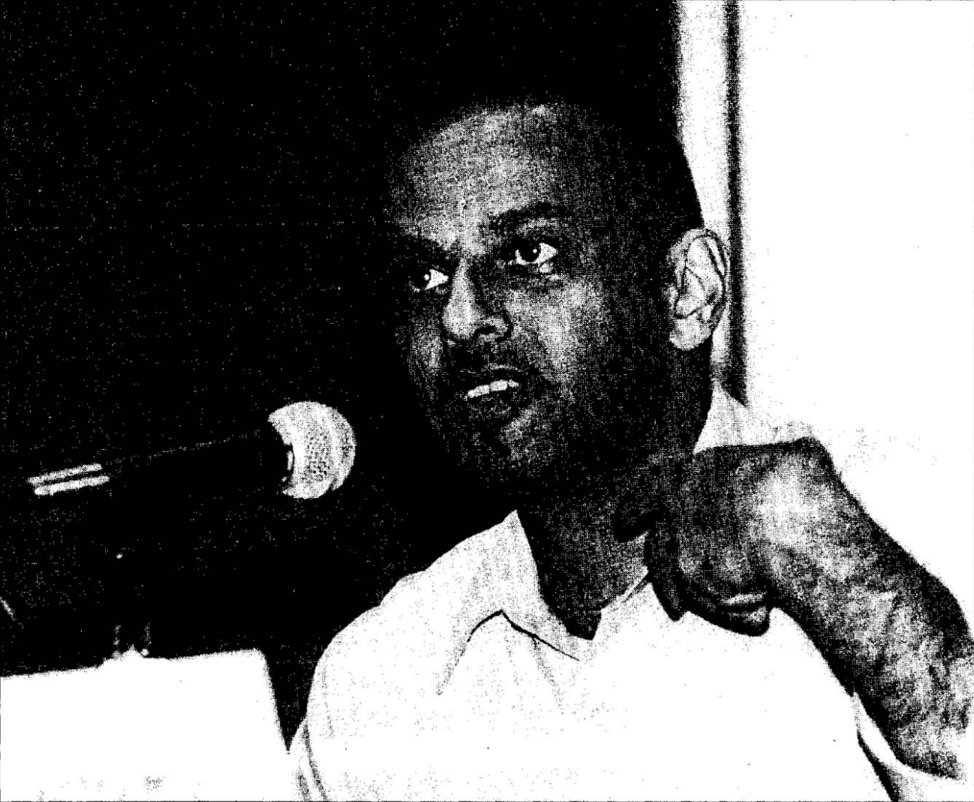
Moustafa Bayoumi. Photo by John Smock
I would like to start with three tableaus, one involving an Asian immigrant, another
looking at Brother Malcolm, and the third a study in sound. All three are signifying the idea of Islam in the United States, finding a context in which to belong along with a place to disagree and providing me a text with which to continue.
The Mufti
Islam in African America has a history as long as memory, when Muslim slaves from Africa wrapped their faith tightly around them as invisible armor against daily degradation. But the practice does not seem to continue. Religious revivalists in the early part of the twentieth century, mostly in the North, where large numbers of new migrants sought the strength of a community, found populations willing to listen and eager to believe. In 1913, Timothy Drew donned a fez and claimed Moroccan heritage for his people in the Moorish Science Temple. For all its imaginative reconstruction, the Moorish Science Temple has little under the surface to connect it to worldwide Islam. But its spirit of displacing the term "Negro" from blacks; of thinking of darker-skinned peoples as Asiatics and Moroccans; of allying Drew Ali with "Jesus, Mohammed, Buddha, and Confucius is part of the productive tension between separatism and universalism that will follow all African-American Islam throughout the rest of the century. But it would be in the next decade, with the growth of the Ahmadiyya community, that the Asian connection forges ahead.
One night in January 1920, a gentle and bespectacled Muslim by the name of Mufti Muhammad Sadiq left London for New York to become one of the first “Pioneers in the spiritual Colonization of the Western world This phrase, conveyed by the then-leader of the Ahmadiyya movement in India, Mirza Mahmud Ahmad, to the Mufti’s work, interestingly linked Ahmadiyya missionary activity with British rule and with its own missionary activity, along with the pioneer mythology of the new world. The Ahmadis had objected to the manner in which British missionaries were defaming Islam by reviling the Prophet Muhammad, and set out not just to correct this error but also to illustrate how Jesus was a prophet of Islam. They had observed how missionaries in the East had succeeded in misrepresenting Islam and felt that a proactive agenda of missionizing was needed to counteract this damage. Recent Hindu-only movements in India also fueled the drive to survive in a world of plural faiths. “Reason itself revolts against this exclusiveness,” wrote the Ahmadi founder Ghulam Ahmed
The Ahmadiyya community began in late-nineteenth-century India with the figure of Mirza Ghulam Ahmad, a charismatic reformer who believed he had received divine revelations, starting in 1876, requiring him to promote the unity of all religions as manifest through Islam, whose chief object is “to establish the unity and majesty of God on earth, to extirpate idolatry and to weld all nations into one by collecting all of them around one faith It is a particular universalism. In seeking this unity, Ahmad would call himself “the Mahdi of Islam ... the Promised Messiah of Christianity and Islam, and an avatar of Krishna for the Hindus a claim that would ultimately oust him and his movement from the mainstream Muslim establishment. We should note how Ahmad’s ideas are an attempt to confront communal feelings in the India of his day and how this relationship between faith and nation would resonate in the American Ahmadiyya movement.
We can note, then, the links between the putative universalism of colonialism, which saw the spread of Western values as a mission manifest in direct and indirect colonial rule (la mission civilisatrice), and the missionary activities of the Ahmadis. Ahmadi missionizing, particularly in its pioneering New World aspects, thus borrows heavily from the script of European expansion and accepts modernity’s commonplace division between the spiritual and secular worlds (“the spiritual colonization”) in which the East is spiritual and the West material. A significant difference, however, divides the methodologies of Western expansionism and Ahmadi missionary activity, for the Ahmadis were addressing the rest of the world as a colonized people, and the religious foundation of their work is thus by definition a minority religion, unencumbered by state apparatuses or ideology. Its universalism percolates from below rather than being dusted from above, thus achieving a kind of dissident political flavor separate from the tastes of dominant rule.
In 1920, the movement, fresh from its missionary successes around the world (including England and West Africa) and full of the optimism that the new world is supposed to hold, sent its first missionary to the United States. Mufti Muhammad Sadiq boarded his ship in London and, each day, entertained his fellow passengers with his erudition. “Say, if you love Allah, follow me; then will Allah love you,” he is reported to have intoned. Before the end of the trip, Sadiq is said to have “converted four Chinese men, one American, one Syrian, and one Yugoslavian to Islam
The U.S. authorities were hardly as sanguine with Sadiq’s sagacity. They seized him before he could leave the ship, accusing him of coming to the United States to practice polygamy, and placed him in a Philadelphia detention house. So began a dark hour for the gentle Sadiq. Seven weeks later, he was released, but not before making nineteen other converts in jail, from Jamaica, British Guyana, the Azores, Poland, Russia, Germany, Belgium, Portugal, Italy, and France.
What Sadiq found when he reached the welcoming shores of the United States was a history of institutional racism and Asian exclusion laws for which he was unprepared. White nationalism would already be working against the Mufti’s message. Later he would write that if Jesus “had fancied to come to America” and applied for admission to the United States under the immigration laws, he would “not be allowed to enter this country because”
(1) He comes from a land which is out of the permitted zone. (2) He has no money with him. (3) He is not decently dressed. (4) His hands have holes in the palms. (5) He remains bare-footed, which is a disorderly act. (6) He is against fighting for the country. (7) He believes in making wine when he thinks necessary. (8) He has no credential to show that he is an authorized preacher. (9) He believes in practicing the Law of Moses [polygamy]
Originally conceiving of his work as broad-based, ecumenical, multiracial missionary activity, Sadiq soon realized that whites were bitter and fearful of his message and African Americans interested and open to it. Early reports indicate that several Garveyites attended his lectures and were among his first converts, and the white press seemed generally baffled and lost in its own prejudices when considering the movement. One account tells us, “All the audience has adopted Arabic names .... There is the very dark Mr. Augustus, who used to belong to St. Marks church in this city [Chicago], but who now sings a pretty Arabic prayer and acts rather sphinx-like. Half a dozen Garvey cohorts are counted, one in his resplendent uniform. There is one pretty yellow girl and another not so pretty
The fact is that the Ahmadiyya movement attracted women and men. It formed a community made up of black, brown, and white people in a scattering of cities across the eastern half of the United States (and St. Louis). But it mostly attracted African Americans, who were also given early leadership roles Participating in Islam vitally meant discovering the history of black contributions to Islam, a topic generating some interest broadly in the black press at the time. In these years, articles appeared in The Crisis (1913), the Messenger (1927), and Opportunity (1930) about Islam, notably about Bilal, the Abyssinian slave freed by Prophet Muhammad and Islam’s first muezzin, illustrating Islam’s historic connection with Africa It is important to underline that Islam in the Ahmadiyya community was not considered a religion just for blacks but a religion in which blacks had an alternative universal history to which to pledge allegiance. Christianity and narrow nationalisms allowed no such thing, as The Moslem Sunrise, the Ahmadi journal, argued. In 1923, it printed a half-page exhortation on “the real solution of the Negro Question,” calling on African Americans to see that
Christian profiteers brought you out of your native lands of Africa and in Christianizing you made you forget the religion and language of your forefathers—which were Islam and Arabic. You have experienced Christianity for so many years and it has proved to be no good. It is a failure. Christianity cannot bring real brotherhood to the nations. So, now leave it alone. And join Islam, the real faith of Universal Brotherhood
Universal brotherhood, of course, sounds similar to Universal Negro, as in the Improvement Organization, and links should be made between the philosophy of Garveyism and of the Ahmadis, but again not simply through the lens of separatism but through a reconfigured universalism. Considering the racial and religious divisions in the world, the Ahmadis reinterpreted the Islamic concept of tawheed, the oneness of God, as unifying the world, people, and faith around Islam (as Ghulam Ahmad wanted for India). In the American context, then, Ahmadi thought opened a critical space for race in the realm of the sacred. In this way, African Americans could metaphorically travel beyond the confines of national identities. They could become “Asiatics” and remain black, could be proud of their African heritage and feel a sense of belonging to and participation with Asia. Being pluraf in this scheme meant not having to feel the psychic tear of double consciousness, but a way of living wholly in the holy. This ecumenicalism could be very powerful, both spiritually and politically. Being opened-palmed about life when the secular world is clenching fists at you meant that your pluralist unity viewed the divisions of the world as contemptibly parochial.
By 1940, the movement could claim around 10,000 converts. Its impact would be wider still, and in his early years it would reach the ears of Malcolm X.
Brother Malcolm
Malcolm X, the eloquent minister of information for Elijah Muhammad, is commonly seen as speaking the fire of separatism and black pride until his fateful Hajj in 1964 tamed his message, as he discovered the true universal spirit of Islam. Conventional as this story is, with its Augustinian turns of the will, it fails when confronted with history. The rise and development of Malcolm's message is a story of the conflict between the particular universalism of Ahmadi-type Islam and the more narrow confines of Nation of Islam creed When we understand this, we can view the intellectual development of Malcolm as a way of thinking through the role of faith in determining consciousness, and that that activity itself for Malcolm was hardly a settled issue.
Consider, for example, the fact that early in his life and while considering the value of Islam while in prison, Malcolm was visited by an Ahmadi, Adbul Hameed, who was on his outreach to local populations. Abdul Hameed even sent Maicolm a book of Arabic Muslim prayers, which Malcolm memorized phonetically This contact may help to explain why, after being released from Charlestown prison on parole, Malcolm too identifies himself at least once as an “Asiatic,” which I have been arguing is not false consciousness of African-American history or self-hatred, but a strategic belief in the particular universal of Islam. The incident was as follows.
In 1953, Malcolm, who was now a fully fledged Muslim and member of Elijah Muhammad's flock, was pulled aside one day at his work at the Gar Wood factory in Wayne, Michigan, by the FBI. He had failed to register for the Korean War draft, the agent needled him, and was thereby jeopardizing his parole. Malcolm heeded the warning and registered, but how he registered is noteworthy. Under the section on citizenship, which read, “I am a citizen of ....” Malcolm inscribed “Asia.” In his form on being a conscientious objector, he stated his belief that “Allah is God, not of one particular people or race, but of All the Worlds, thus forming All Peoples into One Universal Brotherhood ." Asked to identify his religious guide. Malcolm wrote "Allah the Divine Supreme Being, who resides at the Holy City of Mecca, in Arabia Un like orthodox Nation of Islam creed, which would connect Allah with W. D. Fard and specify the religious guide as Elijah Muhammad, Malcolm identities Allah with the God or Islam and, like the Ahmadis, stresses the universal character of God. We could perhaps cynically see this move as a means to defeat the draft by identifying with a more orthodox religion than the Nation, but to do so is to miss the manner in which Malcolm would later repeatedly seek to integrate the Nation into the fold of worldwide Islam. In 1960, after the scholar C. Eric Lincoln coined the term “Black Muslims” for Nation followers, Malcolm objected vehemently. “I tried for at least two years to kill off that ‘Black Muslims,” he said. “Every newspaper and magazine writer and microphone I got close to [I would say] ‘No! We are black people here in America. Our religion is Islam. We are properly called “Muslims!'" But that 'Black Muslims' name never got dislodged
This tension between the Ahmadi vision of a particular universal vision of Islam and the Nation’s notion of an Islam for black people underscores the conflict between two very different roles for religion in the political sphere. Admittedly, the Ahmadi spirit is less confrontational, less public, less typical of the struggle we have come to recognize as identity politics, and yet it is still revolutionary in its own way by providing a radical ontology of self. To reorient one’s body toward the Orient means a refusal to engage with the first principles of white America’s definitions of blackness, but instead to cut to the heart of an old American principle, the freedom of worship. Yet unlike the primary demand placed on American religion, that religion be relegated solely to the private sphere, Islamic faith is seen as enveloping and thereby surpassing national belonging.
Reverberating through the African-American community, this notion that a reconfigured universal faith can free your mind and body gained ground. Although the Nation used the media (and the media used the Nation) to promote its belief, this other vision of Islam was quickly seeping into the pores of African-American communities around the United States, giving them a spiritual place to repudiate the nation of America—replacing it not with the Nation of Islam but with a new universalism. Genealogically, this idea should be seen as descending from the Ahmadiyya movement, and musically it had a soundtrack that large segments of the American public were listening to. Many of the major figures of mid-century jazz were themselves directly influenced by the Ahmadiyya movement, and the yearning for a universal and spiritual sound was in large part a result of Ahmadiyya labor.
A Love Supreme
In 1953, Ebony magazine felt the rise of Islam among the jazz musicians of the era was sufficiently important to publish its article on “Moslem Musicians.” “Ancient Religion Attracts Moderns” spoke its headline, and it centered on the importance of jazz among musicians. The drummer Art Blakey, we are told, “started looking for a new philosophy after having been beaten almost to death in a police station in Albany, Ga., because he had not addressed a white policeman as ‘sir' Talib Dawood, a former jazz player, and Ahmadi, introduced Blakey to Islam. Blakey's
house was a known center for Islamic learning, and in an important engagement at
Small’s Paradise in Harlem, he organized an all-Muslim seventeen-member band, the Messengers. Later, the band’s personnel would change, as would the name (to the Jazz Messengers), but the Islamic influence in jazz would continue
Other important figures of the period also converted to Islam. Yusef Lateef, Sahib Shihab, Ahmed Jamal, and McCoy Tyner would all convert, and Dizzy Gillespie, Miles Davis, and John Coltrane would all be significantly influenced by its spirit. It is with John Coltrane that I want to conclude this article, since his influence has been so remarkable in the jazz sound and because his debt to other Eastern philosophies is relatively well known, But his relationship to Islam has not, to my knowledge, been sufficiently acknowledged, despite the fact that it can be heard in his most famous work.
To have a soundtrack to a movement does not mean to play an anthem. I am interested in listening for the ways in which the yearning for a new kind of community, one based on a new universalism that has a base in Islam and can he heard in the ways in which the music is push ing itself. Coltrane's search for a tone that could extend the saxophone is well known, as is the critics' initial bewilderment at his pitch. He himself talked about his desire to incorporate the fullness of expression in his music. "I want to cover as many forms of music that I can put into a jazz context and play on my instruments," he wrote in his notebooks. "I like Eastern music; Yusef Lateef has been using this in his playing for some time. And Ornetle Coleman sometimes plays music with a Spanish content In an unreleased session from his Village Vanguard recordings, Coltrane is also playing with Ahmed Abdul Malik, a Sudanese bass and 'oud player who was part of Monk's band, a regular partner to Randy Weston, and an innovator in incorporating Middle Eastern modal organization in jazz improvisation. Coltrane's sideman regularly included Muslim musicians, from Philadelphia, and he himself, married to Naima (a Muslim), and, after 1957, increasingly interested in all things spiritual, regularly engaged his friend the piano player Hassan Abdullah in discussion about Islam
Space prevents me from etching in detail the milieu in which Co ltrane repeatedly encountered and considered Islam. Instead I want to move toward a conclusion in a musical note by considering the ecumenical sound of Islam Found in Coltrane' s most commercially successful recording, A Love Supreme. Significantly, Coltrane was often portrayed by the media of his day as blowing the sounds of black rage. The Angry Young Tenor was the musical equivalent of the angry Malcolm X. But Coltrane never saw his music this way. Responding to his critics, he said, "If [my mu sic] is interpreted as angry, it is taken wrong. The only one I’m angry at is myself when I don’t make what I'm trying to play Later he would be quoted as saying this about the philosophy of his music:
I think the main thing a musician would like to do is to give a picture to the listener of the many wonderful things he knows of and senses in the universe. That’s what music is to me—it’s just another way of saying this is a big, beautiful universe we live in, that’s been given to us, and here’s an example of just how magnificent and encompassing it is
If there is a tendency to view this wisdom as apolitical, liberal claptrap, it is I think misplaced. Searching for the universal in a minor key is not about escape and colonizing the spiritual experiences of the dark world to rejuvenate an exhausted Western sensibility, in the mode of Richard Burton through George Harrison. Coltrane's universal is a search for a big philosophy of sound that repudiates the thin, reedy existence of American racial politics, and it does so, often, by an invocation of Islam.
“During the year of 1957, I experienced, by the grace of God, a spiritual awakening which was to lead me to a richer, fuller, more productive life.” So wrote Coltrane in the famous liner notes for A Love Supreme. The notes continue in this tenor, and anyone with an ear attuned to Islamic language will hear its echoes. “NO MATTER WHAT ... IT IS WITH GOD. HE IS GRACIOUS AND MERCIFUL. HIS WAY IS IN LOVE, THROUGH WHICH WE ALL ARE. IT IS TRULY—A LOVE SUPREME.” Al-rahman, al-raheem, the Gracious, the Merciful. The two qualities that follow God everywhere in the Muslim tradition are invoked by Coltrane, who ends his text with “ALL PRAISE TO GOD.” Al-hamd’ ulillah. Consider the first track, “Acknowledgement.” Built around a simple, four-note structure, this piece is an attempt to unify and capture the rapture of the divine. Listen how, two-thirds of the way through, Coltrane meanders around the simple theme in every key, as if to suggest the manner in which God’s greatness truly is found everywhere, and then the ways in which the band begins to sing the phrase “A Love Supreme,” like a roving band of Sufi mendicants singing their dhikr. The words could change. As the Love is extolled, the phrase begins to include the sounds of “Allah Supreme,” another Arabic expression, Allahu Akbar. Coltrane makes the connection from A Love Supreme to Allah Supreme for his entire listening audience, forever delivering a sound of Islam to the world of American music.
To appreciate the depth of mutual involvement between blacks and Asians means acknowledging not just how histories of faith exist to be excavated, which illustrates a level of shared struggle toward an acceptable ontology for living in the racialized United States, but it also means investing the sacred with the possibilities for radical thought, even if its effects are less visible to us than the legacy of political activism through ideologies of separatism. Ahmadi Islam was the space where this place was opened up for many African Americans. It defines a certain aesthetics of living, where the text to life is in a language white America cannot read and the sounds of existence flutter beyond white America’s ears. This isn’t about being Omni-American, to use a phrase associated with Albert Murray, but it is about assimilating into the omnipresence of a just universal order. It is where blacks become Asians and Asians black, under color of divine law.
Notes
I would like to extend my thanks to Vijay Prashad and Sudhir Venkatesh for their warm invitation to present this article to the "Blacks and Asians" conference at Columbia University. This article was supported (in part) by a grant from the City University of New York PSC-CUNY Research Award Program.
FOOTNOTES
1C. Eric Lincoln, The Black Muslims of America. 3rd ed. (Grand Rapids, Mich.: Ecrdmanns. 1994), p. 49 .
2The Moslem Sunrise (July 1921), p. 3.
3Quoted in Yvonne Haddad and Jane Smith, Mission to America: Five Islamic Sectarian Communities in North America (Gainsville: University Press of Florida, 1993), p. 55.
4Hazrat Mirza Ghulam Ahm ad , Message of Peace (1908; Columbus, Ohio: Abmadiyya Anjum an Isha'at Islam Lahore, Inc., 1993), p. 23.
5Quoted in Richard Brent Turn er, Islam in the African American Experience (Bloomington: Indiana University Press, 1997), p. 112.
6Ibid., p. 115. See Sher Ali . "America's lntolerance," Review of Religions , Vol. 19 (April-May (920), p. 158.
7"If Jesus Comes to America," The Moslem Sunrise (April t 922 ), pp . 85-56.
8Roger Didier, "Those Who're Missionaries to Christians: Prophet Sadiq Brings Allah's Message into Chicago and Makes Proselytes," reprinted in The Moslem Sunrise (October 1922), p. 139.
9Aminah McCloud reports that eventually dissension arose among Ahmadis over the fact that more African Americans were not appointed to leadership positions and that the Indian customs of the missionaries and the immigrant Muslims eventually clashed with the African-American desires to apply the faith to domestic situations. See Aminah McCloud, *African American Islam* (New York: Routledge, 1995), p. 21. In the early years, however, the community was certainly highly multiracial in many ways, including its leadership roles. *The Moslem Sunrise* contains many such photographs and examples, including highlighting the role of one early “zealous worker for Islam, appointed a Sheikh to work among his people in the district of St. Louis and vicinity” named Sheikh Ahmad Din (formerly Mr. P. Nathaniel Jonson). See, for example, *The Moslem Sunrise* (July 1922), p. 119.
10A. Rogers, “Bilal Ibn Rahab—Warrior Priest,” *The Messenger*, Vol. 9 (July 1927), pp. 213–214. Rogers states: “When the Christian Negro points with pride to St. Augustine, the Numidian Negro, and tells what he did to advance Christianity, the Mohammedan one can point to Bilal, and tell what he did for Christianity’s greatest rival. The Mohammedan Negro is, however, hardly likely to do as Islam not only in theory, but in actuality, knows no color line. This probably accounts for its success in Africa” (p. 214). Also see A. T. Hoffert, “Moslem Propaganda: The Hand of Islam Stretches Out to Aframerica,” *The Messenger* (May 1927), pp. 141, 160. Hoffert writes, “A woman convert who had belonged to various churches spoke of her previous life like that of a dog or cat before its eyes are opened; they are going to have their share of good things and stand on their own feet. She spoke of the universality of Islam. its way of life, one God, one aim, one destiny” (p. 141). Blanche Watson, “The First Muezzin,” *Opportunity* (September 1930), p. 275. In November 1913, *The Crisis* magazine published the story “The Muslim Priest and the Heathen: An African Parable.” In the introduction to the story, A. O. Stafford writes, “The late Dr. Edward W. Blyden, the eminent Negro scholar [and a key figure in African-American Islamic history], states that the Azan or ‘call to prayer,’ which to this day summons throughout the Eastern world millions of Mohammedans to their devotions, was first uttered by a Negro—Bilal by name—whom Mohammed, in obedience to a dream, appointed the first muezzin or crier” (p. 345). This is the same year that Timothy Drew reinvented himself as Noble Drew Ali, leader of the Moorish Science Temple.
11"True Salvation of the American Negroes: The Real Solution to the Negro Question," The Moslem Sun- rise (April-July 1923). p. 184.
12It should be stressed that the dichotomy I am establishing here, between the particularism of the Nation and the ecumenicalism of the Ahmadis, is obviously more complicated in many circumstances, and that the Nation has at its heart the ability to see itself as a universal theology in certain respects, just as Ahmadi creed can be (and is often, by the mainstream Muslim community) understood as a more narrow and particular vision, especially since the Ahmadis themselves are marginalized by the mainstream Muslim establishment. The Nation also often employed Sunni Muslims as advisors and teachers, such as Abdul Basit Naeemu, editor of a couple small publications (Moslem World & the USA and The African-Asian World) and author of the introduction to Elijah Muhammad's The Supreme Wisdom, vol. 2 (Atlanta: Messenger Elijah Muhammad Propagation Society, n.d.), p. 3. These advisors and, later, Elijah Muhammad himself recognized the radical differences between Nation of Islam creed and mainstream Sunni beliefs yet justified the Nation's theology as being the best way to bring African Americans to Islam. At the very end of his life, it appears that Elijah Muhammad believed in mainstream Islam. Similarly, Louis Farrakhan, now facing his mortality as he battles cancer, has made significant gestures toward reforming the Nation of Islam creed toward an acceptable form of mainstream Islam.
13Louis DeCaro, On the Side ofMy People: A Religious Life of Malcolm X (New York : New York University Press, 1996). p. 136.
14Ibid., pp. 97-98.
15Malcolm X (as told to Alex Haley), The Autobiography of Malcolm X (1964; New York: Ballantine, (984), p.247.
16"Moslem Musicians Take Finn Stand Against Racism," Ebony (April 1953), p. 111.
17Charley Gerard , Jazz in Black and White: Race, Culture, and Identity in the Jazz Community (Westport, Conn.: Praeger, 1998), p. 75 .
18C. O. Simpkins, Coltrane: A Biography (Baltimore: Black Classic Press, 1975 ), p. 118.
19Ibid., p. 84.
20Ibid., p. 151.