Eight Lessons from the Black Front: a Primer
Farah Jasmine Griffin
What can the history and culture of Black people in the United States teach us in these confusing and uncertain times? How can it speak to those who are angered and hurt by the tragic and inhumane loss of life that occurred on September 11? What insight does it provide for those who want to understand the impulses behind those events? Though interrogating this history cannot be a substitute for focusing on United States relations to countries in the Middle East, it can shed light on the best and worst of the nation, helping Americans to have a more multidimensional sense of their country. After all, U.S. foreign and domestic policy inform and influence each other. This is something that American citizens of all ethnic and racial backgrounds often forget. The face that this country has shown outside of its national boundaries is unfamiliar to many Americans, but certainly not to Black Americans. Their history can provide undeniable evidence of our country at its worst and at its best; this country desperately needs a vision of both as we try to come to terms with the future.
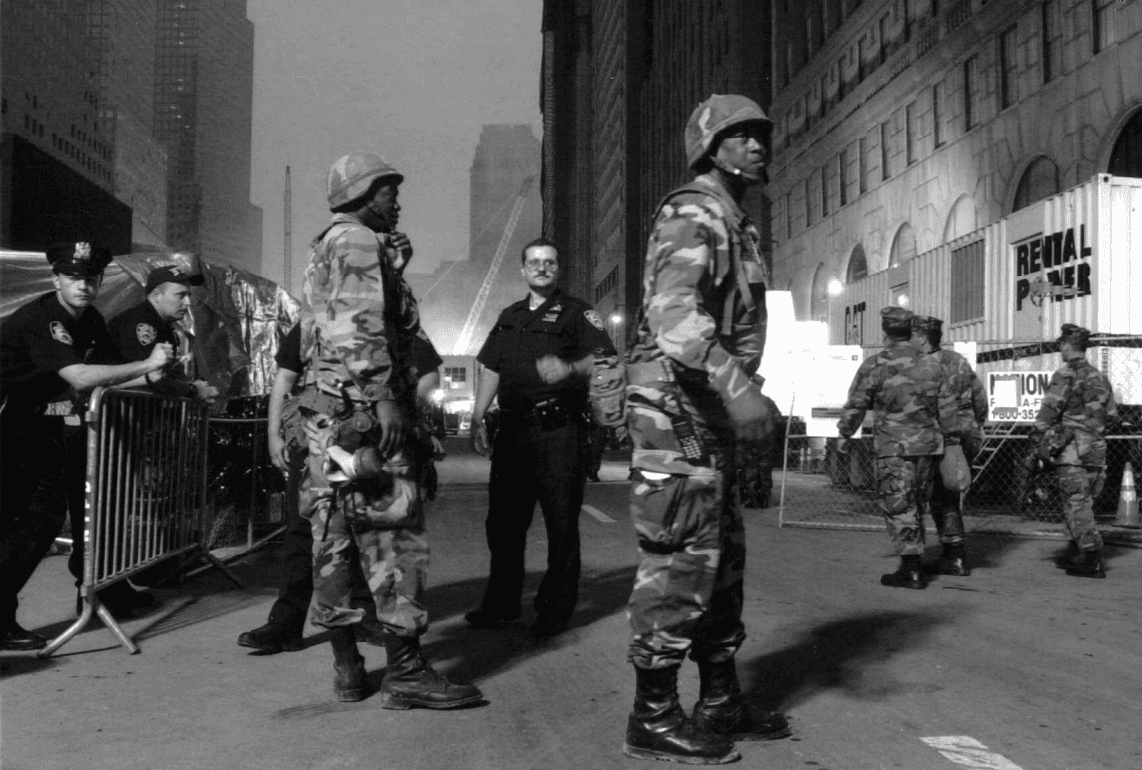
Ground Troops Near Ground Zero. AP Photo/Mark Lennihan
What valuable lessons do Black American history and culture teach us?
1. It is a history of a people who have always had to look beyond national borders for allies in their struggle to be free. This history gives us numerous examples of attempts to establish allies outside of the U.S. who would be sympathetic to and exert international pressure upon the forces that oppress us at home. Consequently, it teaches that we share a great deal in common with those beyond our borders who have suffered from inhumane policies of their own governments, especially if those governments are backed by the U.S. For this reason, many Black American political movements and organizations support the creation of a Palestinian state and were at the forefront of the fight against South African apartheid. But this did not begin in the twenty-first century. This sense of what historian Robin Kelley terms “black internationalism” is evident in the efforts of an abolitionist like Frederick Douglass, an antilynching activist like Ida B. Wells in England, Malcolm X in Ghana and Mecca, and the Black Panther Party in China or Cuba.
2. The historical experience of blacks in the United States teaches us to question who the government and the media identify as enemies. One need only recall Mike
Wallace’s interview with Malcolm X in the 1959 television exposé, “The Hate
That Hate Produced.” There is always more to the story than what we get from
government press conferences or network news analysis. It is for that reason that
Black America has always had its own alternative press that seeks to offer the “other
side” of the story.
3. Yet African-American history also teaches us to be careful of uncritically celebrating those who declare war on the U.S. The Timothy McVeighs and Adolph Hitlers of the world considered the U.S. government an enemy, but they were certainly no friends of Black America. The lesson is to make distinctions between potential Hitlers and potential Che Guevaras.
4. History teaches us to look for and sympathize with the invisible victims of national tragedies, because we have so often been, and continue to be, invisible. Take, for example, the thousands of undocumented workers who were killed in the World Trade Center attacks. Our past teaches us to celebrate the heroism of the firefighters and police officers who lost their lives trying to save other, while remaining cognizant of the structural reasons for the lack of racial diversity among the heroes.
5. The history of the Black freedom struggle in the United States reveals the way
one group of people can enjoy economic and political privilege built on the denial
of basic rights to other groups. It demonstrates the way that the privileged can maintain a willed innocence and naiveté about their complicity in the suffering
of others. It also teaches us that efforts to establish independence and self-determination are often met with white resentment and state-sanctioned violence.
Ida Wells’s economic analysis of lynching and the destruction of black businesses, property, churches, and schools from Tulsa to Atlanta offers cogent examples of this.
6. History shows how the unchecked powers of the state can pose a danger from within that is as great as terrorism from without. The Red Scare of the early twentieth century and the FBI’s COINTELPRO of the 1960s and 1970s are but two instances of this. To those who are the most recent victims of American racism in the form of racial, ethnic, and religious profiling, this history would say that racism is endemic to this society. It is the place to which it automatically returns; racism is always there, ready to unleash its ugly wrath. This is a lesson for those who have wanted to distance themselves from Black people as a way of being accepted, and also for Black Americans who feel a sense of “I feel no sympathy for you—now you understand what we have gone through.” This history says that both of these—the un- checked power of the state to survey, confine, and discipline persons thought to be suspicious and tolerance of racial and ethnic prejudice aimed at others—are conditions we ought to be familiar with and unwilling to accept.
The unchecked powers of the state can pose a danger from within that is as great as terrorism from without.
7. Another lesson is that Black and poor Americans are always the least shocked by those things that seem to rattle the rest of the country, but are ultimately among those who will suffer the most from such events.
8. History also tells the story of a culture of resistance, struggle, and profound beauty born of the uncertainty of being Black in the United States. This culture serves not only as a source of comfort when one is living in dangerous times, but also nurtures a will to be free and a vision of hope and possibility in the face of obstacles that seem insurmountable. It is a culture that does not take safety for granted, but accepts the conditions of danger and uncertainty and creates, not in spite of, but because of them. It is a culture that privileges risk taking and a radical democratic mode of being. Listen to the lyrics of the spirituals as they recognize humanity at its most vulnerable and then democratize access to the divine. And because they have multiple levels of meaning, they insist on democracy in the here and now as well. This culture creates anew as it builds on, challenges, and re-envisions the past. This is why quotation is important to jazz improvisation, sampling to hip hop. It is a culture that documents and nurtures the movements that have challenged the U.S. to live up to its ideals and has most strongly challenged the citizens of this country to live up to a higher standard of humanity. Now, more than ever, we need to be reminded of those ideals and of that humanity, and that this country has no monopoly on either.
Black and poor Americans are always the least shocked by those things that seem to rattle the rest of the country, but are ultimately among those who will suffer the most from such events.
The history of African Americans is part and parcel of the history of the United States at large. It belongs to all of us. Its lessons are a gift born of social struggle and social change.