From My Lens: A Pixelated Perversion
Redacted
[AUTHOR/PHOTOGRAPHER REDACTED
When America called Gordon Parks a “nigger,” he picked up a camera and shot right back Before we could ask for “poems that kill,” Parks’s weapon of choice was the porous grain of 35mm film The maestro breathed an air of clarity into his images that could not be ignored. Listening to his photographs, you can almost hear the heroic buzz of a snare drum in his assertion of the Tuskegee Airmen, an inquisitive oboe accompanying his imagination of the Invisible Man, and the skin-crawling violin anticipating the climatic finale of the infamous doll test When faced with the ugly brutality of what has become a wrought iron fortress overlooking Harlem—I thought it was my turn
It seems that Israel thought the Palestinians were niggers, too, and Columbia University found exchange programs with Israeli universities a viable enterprise. A spokesperson for the university stated, “We…benefit greatly from our dual-degree program with Tel Aviv University, a program that the university will continue to wholeheartedly support As the student movement stood in solidarity with our siblings in Palestine and their century of struggle against the state of Israel, we called for the university to divest from what the United Nations Commission of Inquiry has now labeled a genocide via the targeting of Palestinian children, crimes against humanity in the Gaza strip, and war crimes in the occupied West Bank

In refusing to oblige the demands of student protestors, Columbia conducted a campaign of student repression, marked by militarized violence The actions of the university unfolded under, and were escalated by, sustained pressure from government agencies and opportunistic political actors; and were licensed by a corporate media frame that cast overwhelmingly nonviolent protest as disorder It was under these conditions that my hands became familiar with the black metal of an SLR camera. Do not mistake me: I am not anyone’s photojournalist or conflict photographer. These portraits depict my relationship with the divestment movement on Columbia University’s campus during the 2023-2024 academic year. Close and intimate, each photo reminds me that Black art is the historical fertilizer of liberation movements in the United States.
I reject the common assertions that art is simply entertainment and culture is merely a commodity. Building from the work of Amiri Baraka and Dawoud Bey, my photographs are a weapon of the people made in collaboration with the people; not “taken,” “captured,” or “shot,” and never coerced. While it is common for protest photographers to shoot an image without warning, weaseling their way into intimate spaces of suffering, I refuse to create images in this manner. To imagine that there is no friction between a scene and the camera’s glass—to ignore the warping of an image when it is not made in the proper focal length, or what the photographer chooses to include and what to omit— is to disregard the fact that photos are made. As such, I am a comrade first and a photographer second. I came to the student movement as a friend and picked up the camera to create images for flyering and preserving scenes of our political rage and unrest. My face and name were known, and my images were used so far as my comrades allowed them. In this way, the camera could not be reduced to my weapon of choice, but rather my photography became a part of our revolutionary praxis, in service of the student movement on campus. Using my camera, I imbue the poetics of June Jordan, exemplified by her assertion that “poetry is a political action undertaken for the sake of information, the faith, the exorcism, and the lyrical invention, that telling the truth makes possible”
Unfortunately, valiant politics and flowery declarations cannot save my work from the consequences of surveillance. It has become abundantly clear that in the era of modern technology, photography also serves as one of the state’s weapons of choice. Ethnologists have gazed through the “colonial peephole” since the founding of photographic technology Black—and particularly Black femme—bodies have been oppressed through the capture of an image.
As the swirling ink of the photo paper emulsified, so too did racist and “objective” findings about the Black subject. Black bodies were compressed into data and quantifiable points to justify racial capitalism and utter Black destruction. If the pseudo-anthropological cultural ranking and polygenism were the bedrock for the codification of Black death in America, then the accompanying photographic archive presented Black bodies as soon-to-be-dead commodities Brilliantly described in Professor Kimberly Juanita Brown’s Mortevivum, the photographic universe engineers a reality in which “Black subjects are perceived and remanded to the space of photographic stasis that consumes and corrupts their ability to be autonomous outside of the violence of antiblackness” In the making of legible Black subjects, our bodies are recognized for their fungibility within the “journalistic economy” that disseminates these “objective” data acquisitions
College campuses have always held deep ties to colonial power and state violence. The founding charter of Columbia University, formerly King’s College, came directly from the monarch of Great Britain Columbia has been a laboratory for the containment of free inquiry since at least 1917, when its trustees fired two antiwar professors, and Charles Beard resigned in protest. Since 9/11, it has converted its Public Safety apparatus, its identification systems, and its cameras into instruments of political discipline Last year, the Foundation for Individual Rights and Expression conducted a ranking of 257 U.S. colleges and universities through a review of campus policies: Columbia was ranked 256th—Barnard, 257th
If Columbia sicked the NYPD on protestors in 2023 and 2024 just as they did in 1968, one might be tempted to think that nothing has changed. Columbia's history of student activism will remind us that repression is not new. But strange tools of mechanized surveillance and rapidly advancing AI plague the field of activist work. And while the University Senate that condemned the invitation of the NYPD was created by the trustees in 1969; it holds no budget and no enforcement power. It can be rewritten by the body it was built to check Rather than resist Trump’s attempted takeover, Columbia was first in line to concede to the administration’s demands. A Columbia Spectator headline aptly illustrates the University’s position: “Trump told Columbia to hire officers with arrest power. The University was already planning on it” Particularly in the wake of the settlement the university made with the Trump administration, it seems clear that Columbia University’s board of trustees’ focus on campus “security” refers to the financial security of the university
The most flagrant opposition outside of campus was the doxxing trucks. Beginning October 25, 2023, the conservative nonprofit Accuracy in Media drove box trucks mounted with huge video screens through Morningside Heights, displaying the photographs and names of Columbia and Barnard students beneath the words "Columbia's Leading Antisemites." They returned on November 1, circulated for weeks, and came back in January. The students had signed nothing[xviii] Alongside these doxxing trucks was a website titled, “Columbia hates Jews,” that joined Canary Mission as another sloppily constructed database lambasting any alleged genocide-opposer whose face and name was identified, regardless of accuracy.
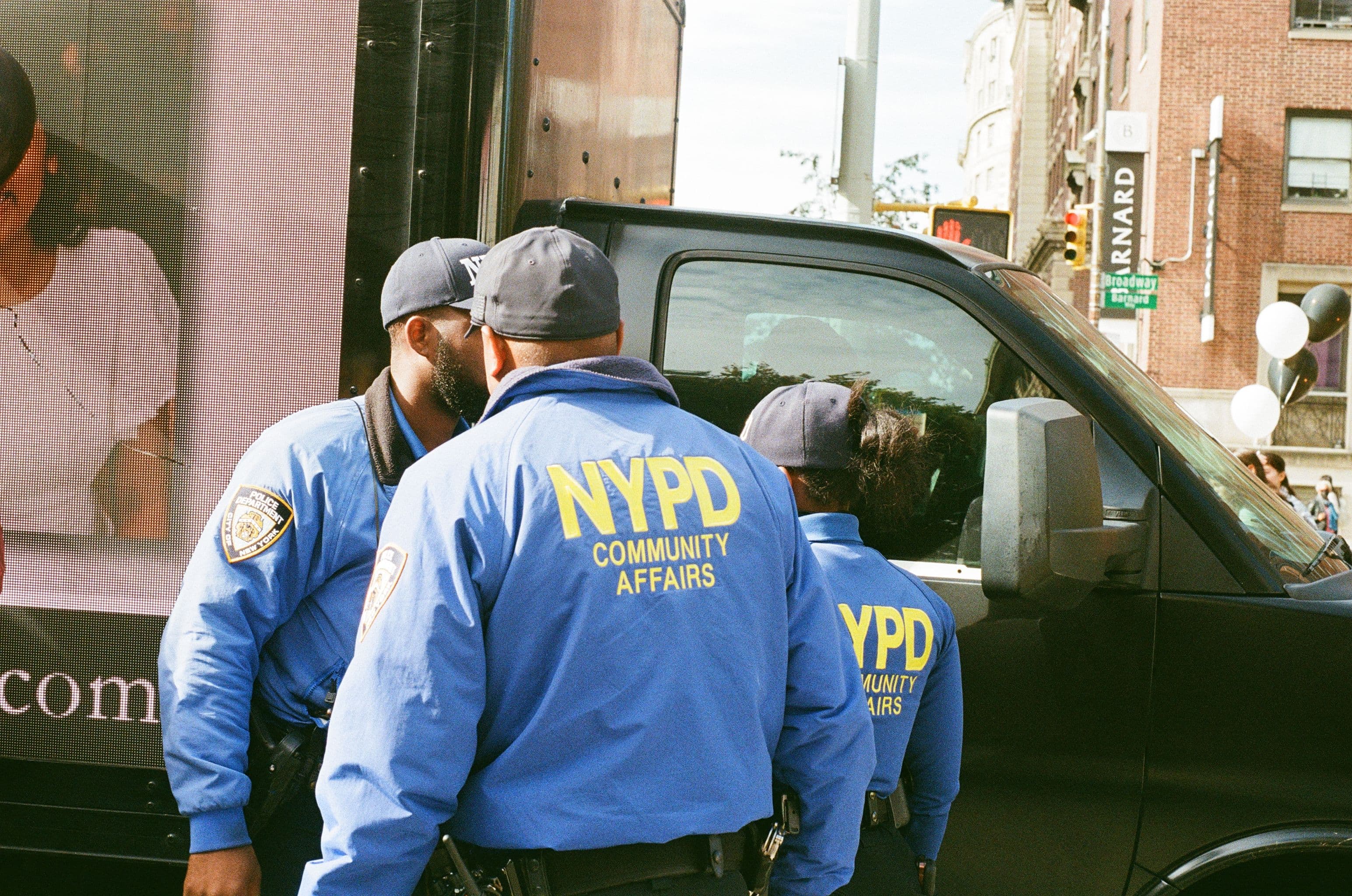
Columbia's response was immediate and asymmetrical. On November 1, 2023 The Task Force on Antisemitism was charged to find and recommend; while the Doxing Resource Group was charged to refer and coordinate. The latter group’s email did not work for the first week. The Doxing Resource Group guidance instructed the targeted to scrub their own data and delist from the University's directories, disclaiming the very resources it offered Meanwhile, the administration double downed their attention on strengthening their web of surveillance and control, which included new ID verification to access campus, surveillance cameras, access points to essential buildings for students, an increased deployment of private security personnel, as well as countless investigations, suspensions, expulsions, and evictions of any movement members they could identify The university defended these measures on the grounds of “safety”—to enforce a “secure” campus However, both seen and unseen forms of surveillance and putative security attempt to control student and faculty populations. By enforcing increasingly narrow access points that funnel students and faculty, they must face officers and confirm their belonging on campus with the swipe of an ID, communicating that their entrance to campus has been marked. Furthermore, as Joe Lewis describes in the journal Counterpoints:
Increasingly smaller cameras have allowed for monitoring that is deliberately not visible. The goal here is to catch individuals in the act of "misbehaving," like a highway speed trap. Catching enough perpetrators helps security forces to validate their own existence as crime-stoppers and to deter future perpetrators through the publication of crime records, criminal apprehensions, and security alerts.
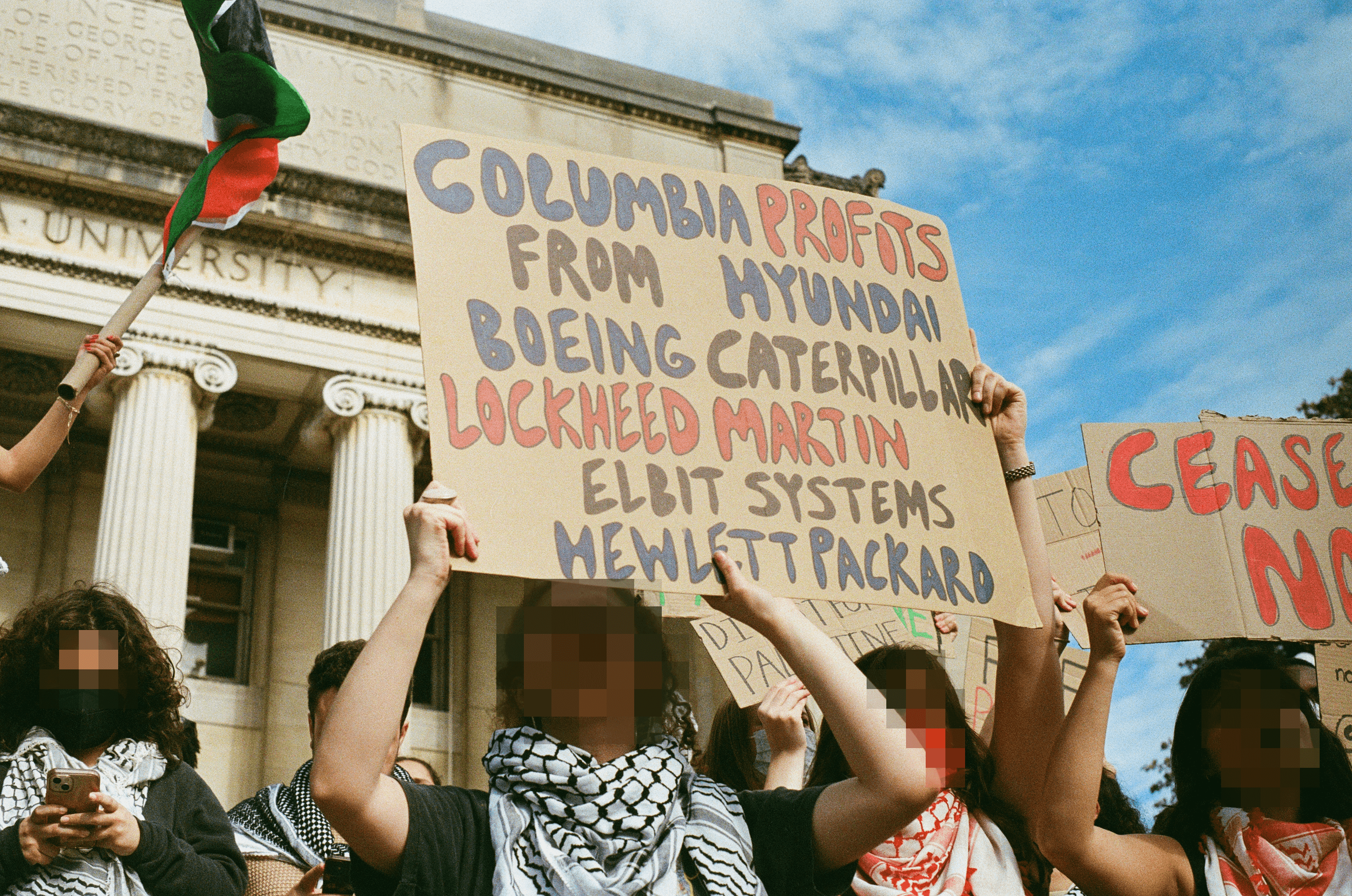
I was painfully aware that under draconian surveillance and violence, my photographs could be used by those in power to threaten my comrades; whether it be through doxxing, online and physical abuse, or disciplinary action from Columbia and Barnard. Since 2025, however, this tactic has advanced to online campaigns calling on the Secretary of State to engage in the extralegal government “disappearing” and deportation of pro-Palestinian student protesters such as in the case of Mahmoud Khalil When ICE came for Mahmoud Khalil, Columbia looked away. He had written the day before, asking for protection. The next night, agents took him from his university residence without a warrant
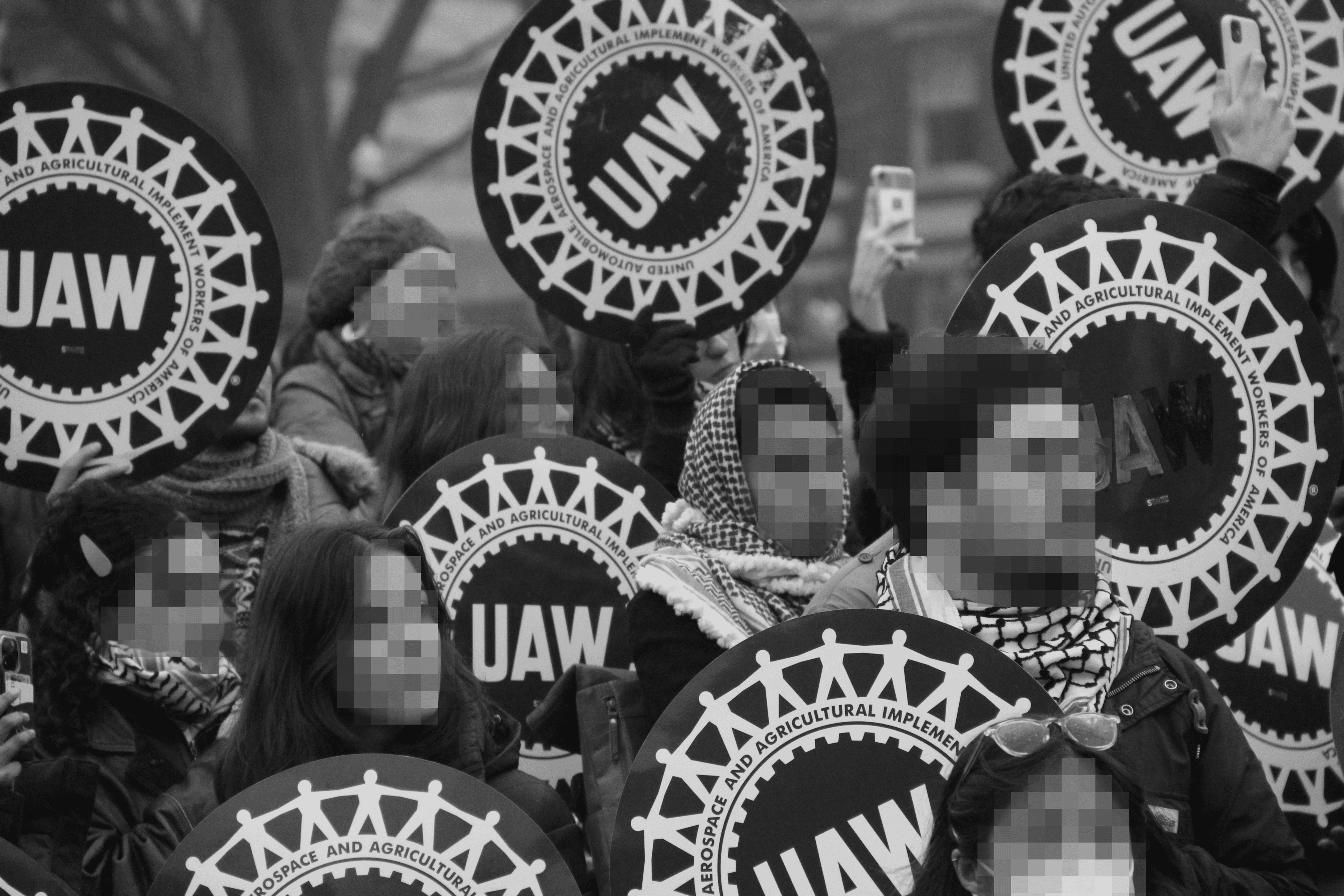
Over two years later, I have chosen to revisit these photographs through an interpolation of what Professor Christina Sharpe describes as “Black Redaction” Following her invocation of “seeing and reading otherwise; toward reading and seeing something in excess of what is caught in the frame,” I revisit these photos in an effort to protect my comrades—by, quite painfully, perverting them—obscuring beautiful, autonomous acts of resistance and sincerity with heavy-handed digital alteration. Perversion is an important word here.
While Sharpe elucidates a method of receiving and subverting (if not converting) images that have already been created, what does this mean to the maker of new ones? What is the significance of my retroactively distorting these photos from the original course and meaning I made? The camera can be seductive in that it seemingly halts a moment in time, convincing one of a scene’s meaning, when only a frame is shown. One must remember that the cold black metal between the photographer’s hands is constructed, and so too are its images. Now more than ever, photographers must respect one’s right to opacity If I, as the photographer, do not accept my responsibility as a steward of the people, how can I expect them to see us as people? While I could have chosen to keep these photographs hidden, I show their restricted, perverted form to imagine what I should have done. Rather than redact in the past tense, I re-image these photos to mark an otherwise avoidable violence.
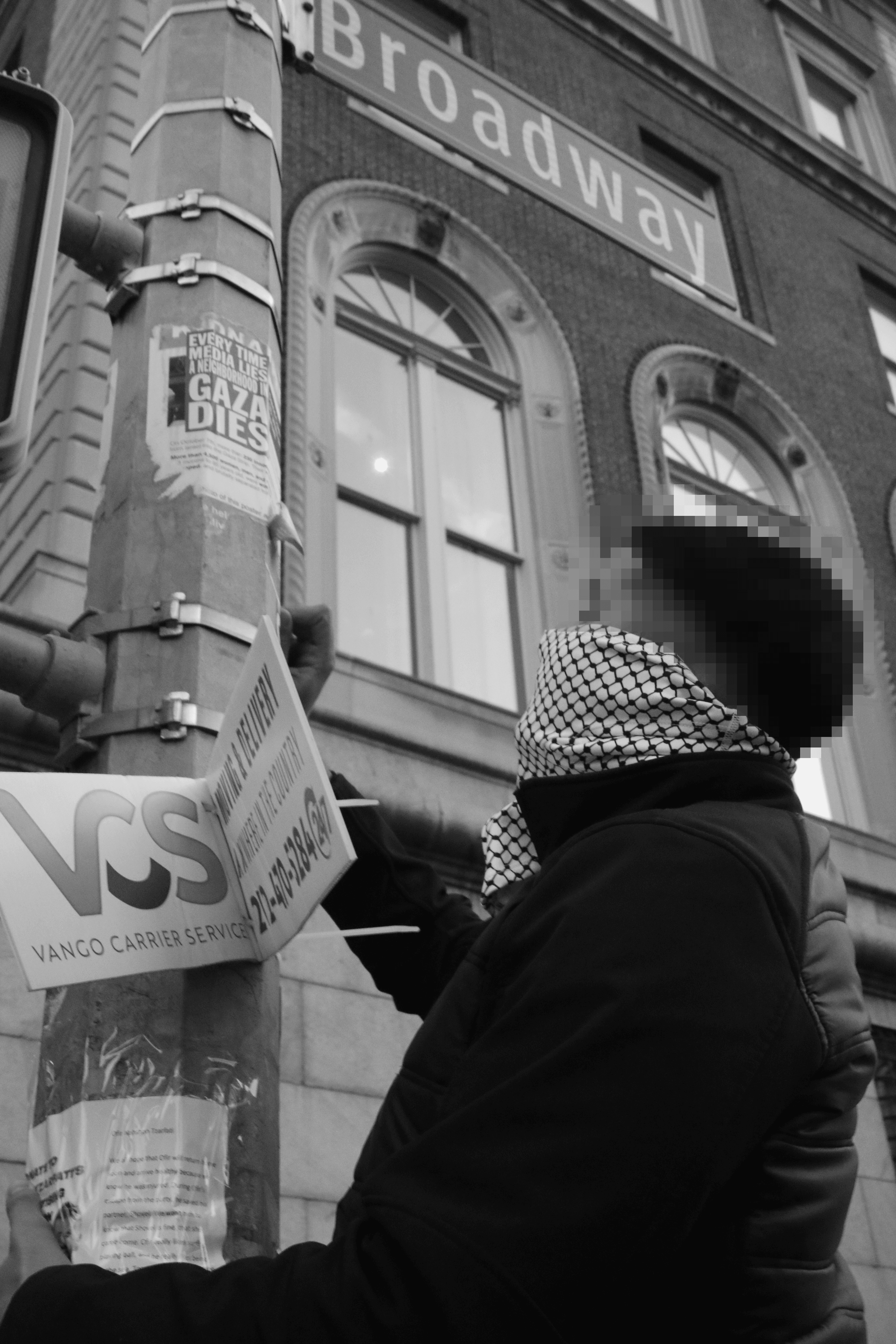
I never forget a face I’ve made a portrait with. Each one is etched into my brain. Rather than digitally scribble or scratch the images of faces that could be used against them, I’ve attempted to protect my comrades through the blurring and pixelation of their faces. But the erasure of their gaze is symbolic of an erasure of their lives. I cannot help but feel wounded by the violence that accompanies erasure.
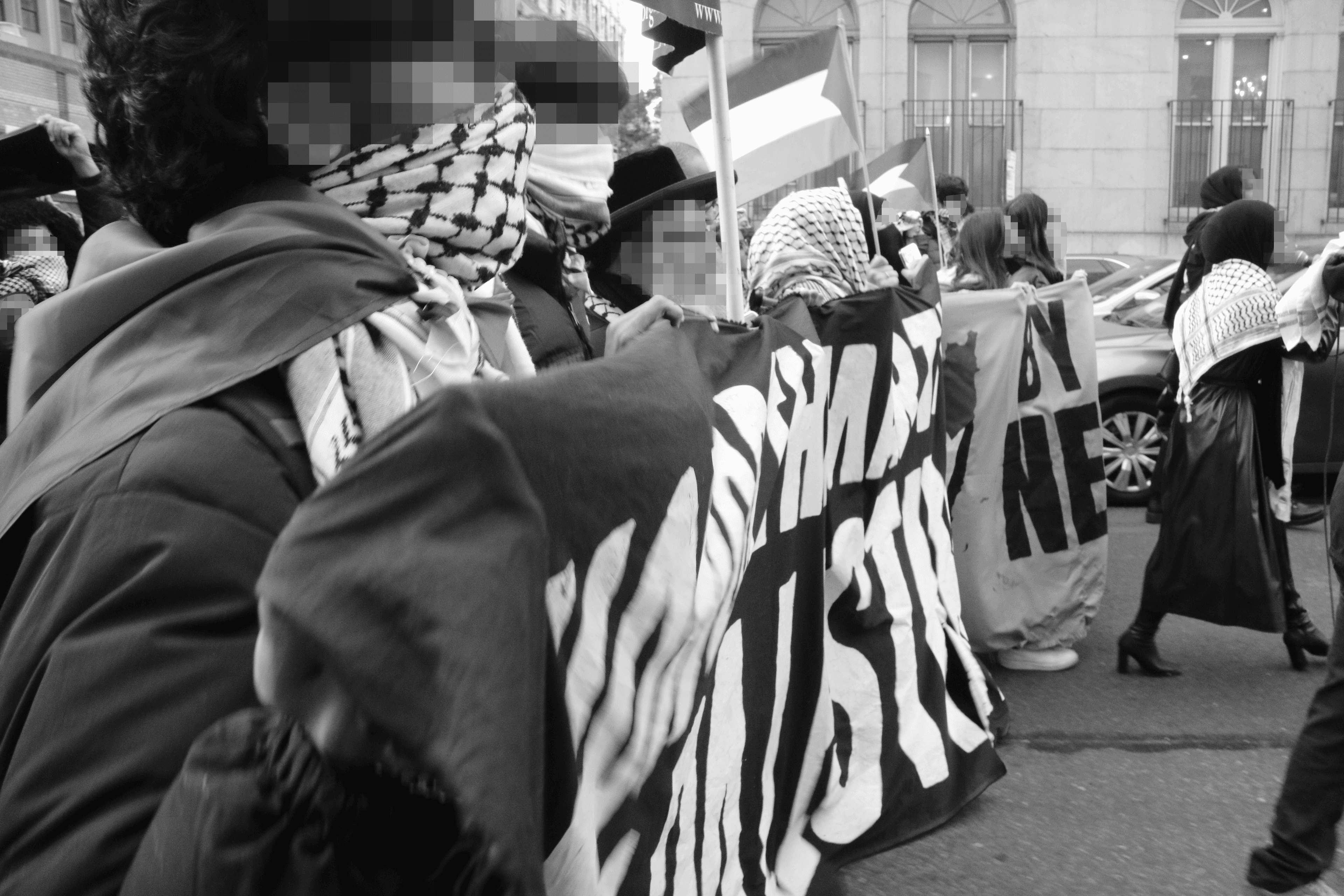
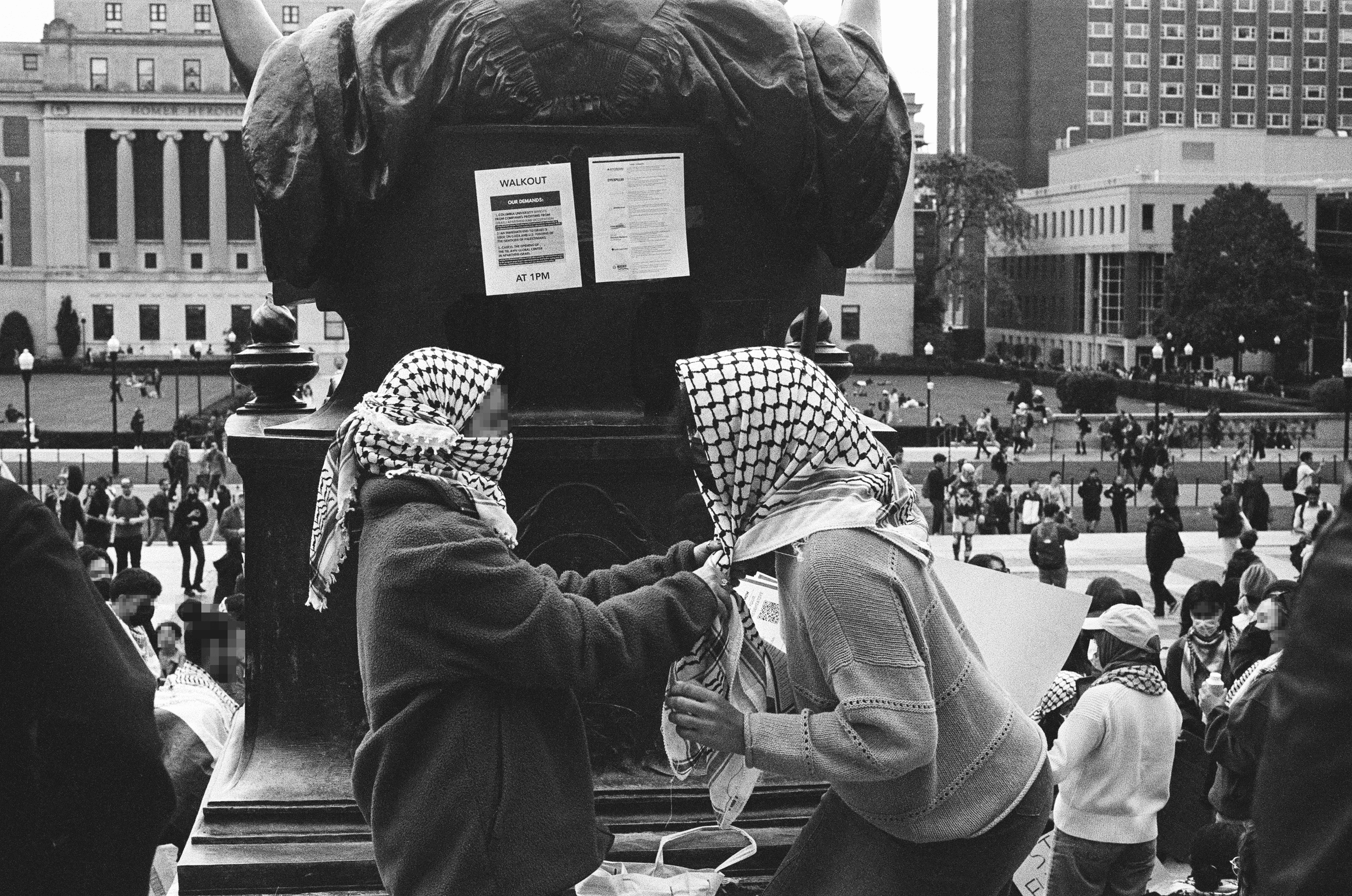
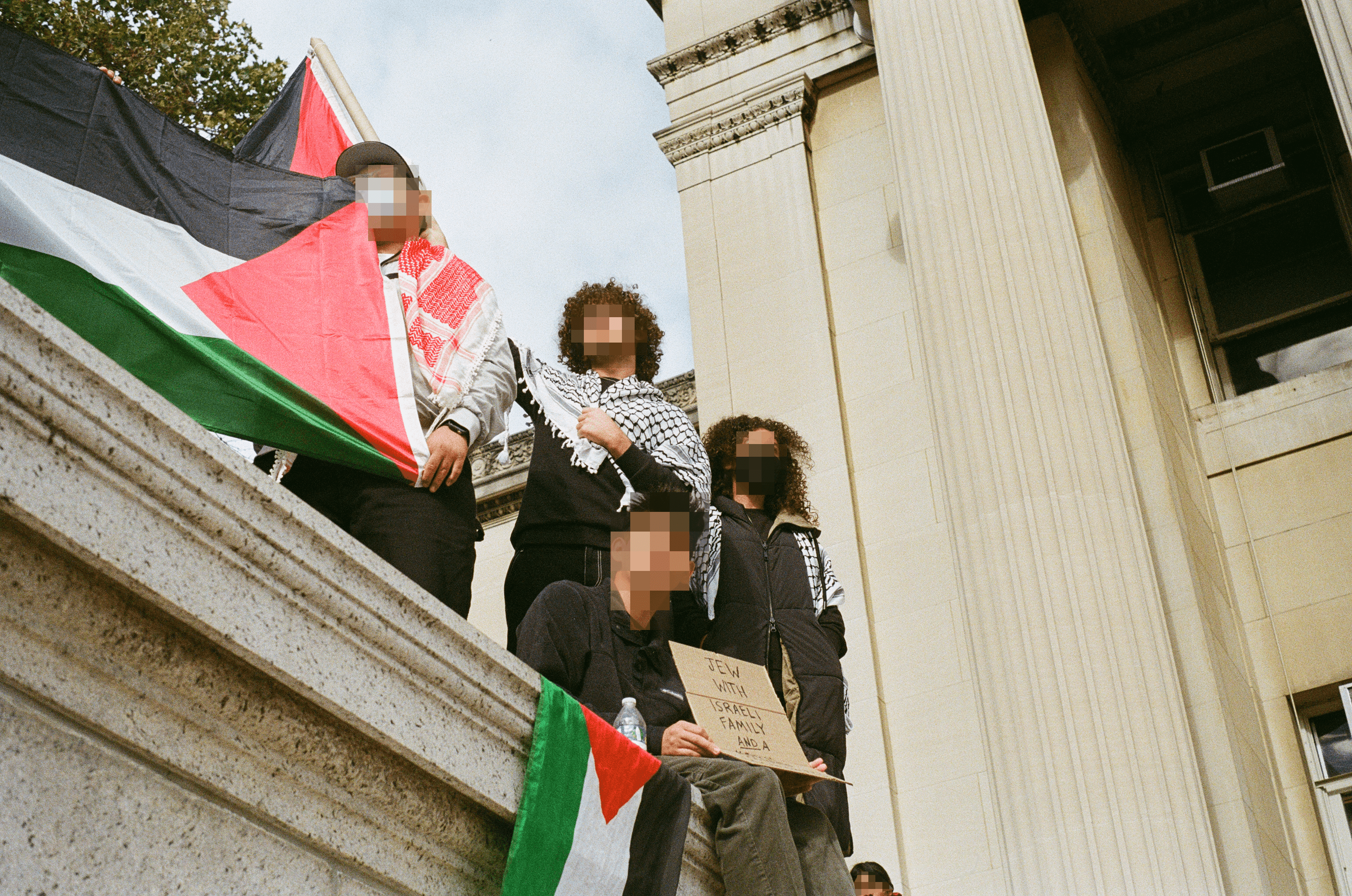
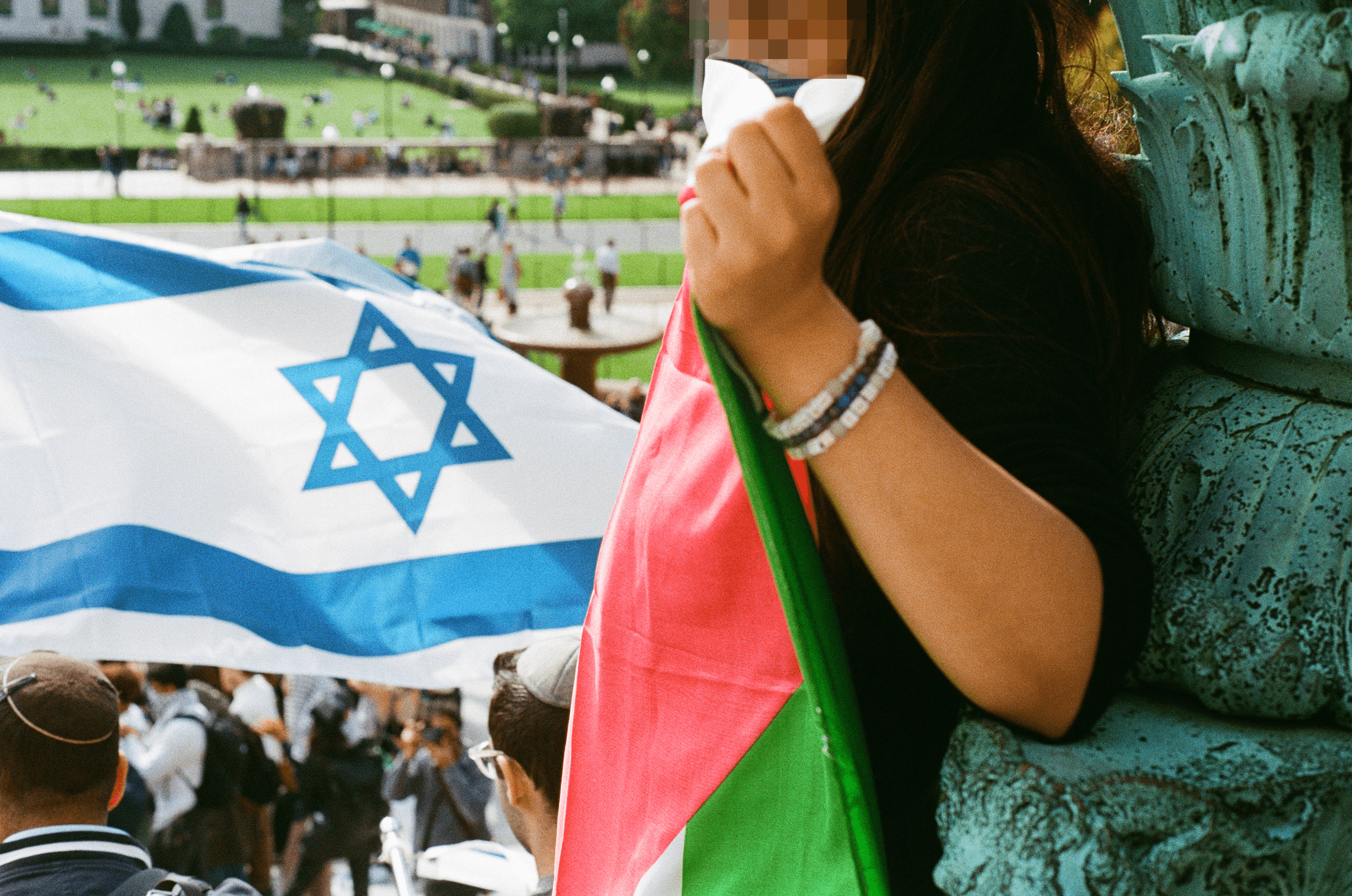
In blurring their faces, the living, fighting, and struggling people have been rendered into hollow figures that sit flatly on a screen. The viewer must imagine what lies behind this destruction. Therefore, I invite the viewer to imagine with me, and to enter the lifeworld of the photograph. In blurring the face of one comrade tying the keffiyeh around another comes a blurring of the care and dignity present within the scene. Most harrowing for me is the erasure of the person clutching their Palestinian flag with their back against a wall while the Israeli flag brazenly flies; her flag is already the victim of public censure, and by blurring her face I fear that I too have now censored her. Before, I would look at her, and her eyes would evade me. Closed. Anguished. I can only imagine the fear that compelled her to wear such a cumbersome mask—something that became standard practice during the doxxing crisis. Though the crowd is turned away, facing some unseen speaker, peering from below is not a man but a camera pointed to the flag of Israel as its bearers sit uncovered. She must have noticed me, no more than a few feet away, and yet I cannot shake the feeling that she stood alone. Just how far away did that camera put me?
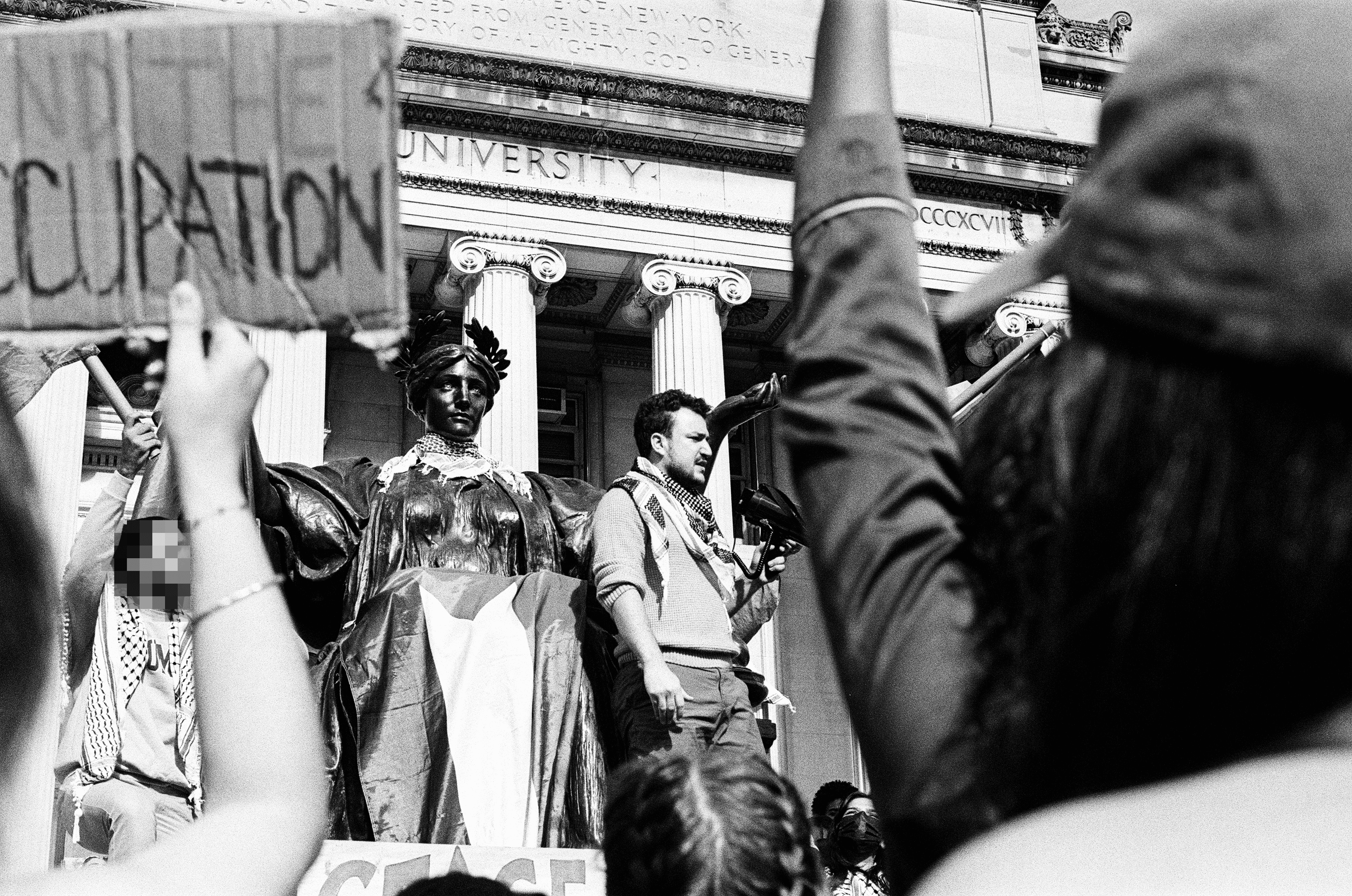
This short photo essay, though itself altered and certainly redacted, is one attempt to remember and recover this ardor and anguish. However, I have left our brother Mahmoud Khalil’s face whole and uncensored. To distort his face—which is now emblematic of our multipronged struggle—would allow the viewer to forget the depravity of the American empire. Thus, I chose a photograph that properly illustrates him as what he is: a leader.
As of June 2026, Mahmoud has taken his deportation case to the Supreme Court I hold my breath in fear of what may follow now that Mahmoud faces the possibility of rearrest at the hands of a murderous regime. I understand that these photos will not “save” Mahmoud. These photographs do not reach toward the recovery of a prior condition, but something nearer to invention: a future to be made You will never see these photographs in their original state. You will never know these people, and I will never explain who was where and when. While I mourn the loss of what was taken from these images, I invite you to enter what Professor Brown might call the blur Where resolution is disregarded and clarity is undefined, there exists a space in which the captured body dances free as a blurry figure—a space in which black blurs turn against the “window of the world” While these photographs are evidence that we were there, I will not allow you to know who we are. The empire needs no help tracing us through their repulsive surveillance systems. We will know who we are within our own memories and locked archives. Take a moment, as you look at Mahmoud’s unshielded face. Notice how his eyes evade the viewer and instead settle on the people.
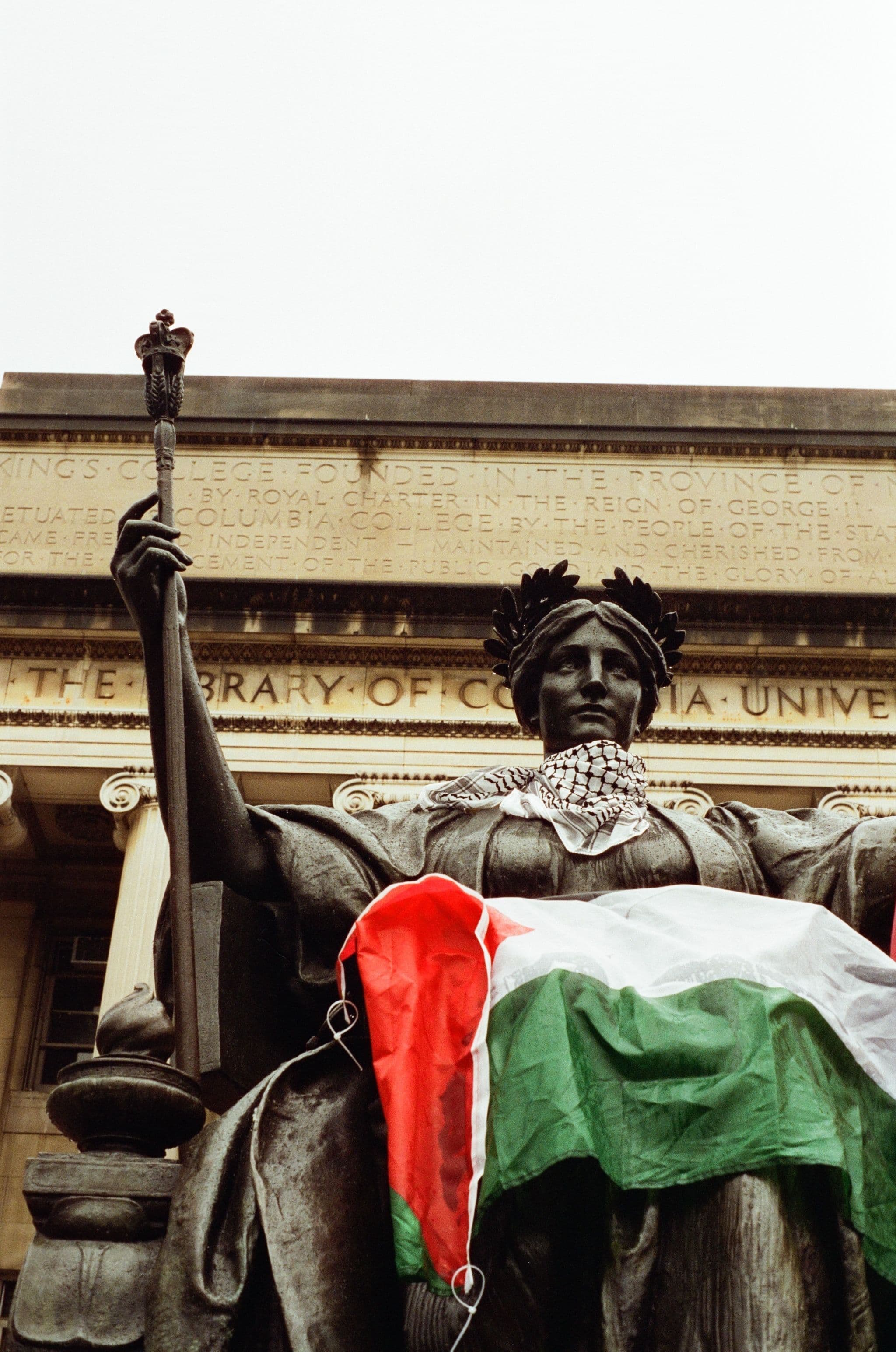
My request is that you do the same. While there are no safe spaces, we can keep each other safer. I hope that as you look into the eyes of Mahmoud, they become etched into your mind as they are in mine. Mahmoud was empathetic, even towards those who seemed to deserve it least. My photos cannot be separated from the struggles and the moment in which they were created. And so those memories, the full and uncensored radical love, will only be found between me, my comrades, and my future comrades who will find us through the archive after this moment has passed. For the time being, we are embattled
FOOTNOTES
1SOULS has chosen to redact the name of this author. While there is no protection, and it is better to speak, this gesture echoes the loving impetus and critical function of the author's work here: to "re-image … to mark an otherwise avoidable violence.” I could do no less than attempt to shield this student author and artist from the worst of what we have seen in the past three years; armed as we are only with our rigor and honest intentions, and leaning gingerly on what we had formerly understood as our constitutional rights, institutional protections, and norms of academic freedom. We know better, and/but we stand anyway — on the faith of our ancestors. The name Alan Judine stands in for the author's. While the first name draws on their family heritage (not surname), Judine evokes the photograph as a counter-archive of “beauty and devastating honesty” — following the principled photographer in Ann Petry's The Narrows (Griffin). Jubine, who Farah Griffin reads as “the narrative artist through which Petry speaks,” provides a meditation on the camera as a technology of racial and class visibility. See Lorde, on silence and speech — "Your silence will not protect you": Audre Lorde, "The Transformation of Silence into Language and Action," in Sister Outsider: Essays and Speeches (Trumansburg, NY: Crossing Press, 1984) and "It is better to speak / remembering / we were never meant to survive": Audre Lorde, "A Litany for Survival," in The Black Unicorn: Poems (New York: W. W. Norton, 1978). Farah Jasmine Griffin, In Search of a Beautiful Freedom: New and Selected Essays (New York: W. W. Norton, 2023), 153–54. Petry, Ann. The Narrows. 1953. With an introduction by Kaitlyn Greenidge. New York: Amistad, 2021. --Jafari Sinclaire Allen, Editor-in-Chief]
2Meeting the Man: James Baldwin in Paris, Documentary, short, directed by Terence Dixon (The Criterion Channel, 1970), 26 minutes; James Baldwin, The Cross of Redemption: Uncollected Writings, 1. Vintage internat. ed, ed. Randall Kenan, Vintage International (Vintage Books, 2011). Drawing from Baldwin’s consideration that “Algerians in France are the niggers of America” in Meeting the Man as well as his famous essay “The Uses of the Blues,” I make use of the slur not as a descriptor but as a political alignment. In likening the plight of Palestinians with that of Black Americans, I center a fold in the colonial-to-imperialist project in which the American/Israeli state has “create[d] a body of people who have very little to lose, and there is nothing more dangerous in any republic, any state, any country, any time, than men who have nothing to lose.”
3Gordon Parks and Wing Young Huie, A Choice of Weapons (Minnesota historical society press, 2010); Amiri Baraka, “Black Art” in The Leroi Jones/Amiri Baraka Reader, Amiri Baraka and William J. Harris, eds., Expanded ed (Basic Books, 2009), 219.
5Joe Lewis, “CHAPTER TEN: The College Campus as Panopticon: How Security and Surveillance Are Undermining Free Inquiry,” Counterpoints 410 (2013), 135.
4Tina Campt, Listening to Images (Duke University Press, 2017); “THE TUSKEGEE AIRMEN, 1943 - Photography Archive - The Gordon Parks Foundation,” accessed March 18, 2026, https://www.gordonparksfoundation.org/gordon-parks/photography-archive/the-tuskegee-airmen-1943#5; “Invisible Man, 1952 - Photography Archive - The Gordon Parks Foundation,” accessed March 18, 2026, https://www.gordonparksfoundation.org/gordon-parks/photography-archive/invisible-man-1952; “Doll Test, 1947 - Photography Archive - The Gordon Parks Foundation,” accessed March 18, 2026, https://www.gordonparksfoundation.org/gordon-parks/photography-archive/doll-test-19472?view=slider#5..
6“Tel Aviv | Columbia Global Centers,” accessed June 15, 2026, https://globalcenters.columbia.edu/tel-aviv; Zachary Schermele, “Columbia University Has Several Ties to Tel Aviv. One of Them Explains a Lot.,” USA TODAY, accessed July 9, 2026, https://www.usatoday.com/story/news/education/2024/05/09/columbia-university-tel-aviv-ties/73545218007/. Oscar Noxon, “Columbia College Overwhelmingly Passes Divestment Referendum,” Columbia Daily Spectator, accessed January 15, 2026, https://www.columbiaspectator.com/news/2024/04/22/columbia-college-overwhelmingly-passes-divestment-referendum/.
7David Gritten and Stephanie Hegarty, “UN Commission of Inquiry Says Israel Committing Genocide in Gaza by Deliberately Targeting Children,” June 23, 2026, https://www.bbc.com/news/articles/c0jy96w6pw2o. This assertion additionally rests on what the United Nations Commission of Inquiry, Amnesty International, and Israel’s own B’Tselem have determined to be genocide. The determination that Israel’s conduct in Gaza constitutes genocide within the meaning of Article II of the 1948 Convention on the Prevention and Punishment of the Crime of Genocide has been reached independently by multiple investigative and legal-analytic bodies applying the Convention’s text and the standard of intent (“only reasonable inference” from the totality of conduct) articulated by the International Court of Justice in Bosnia and Herzegovina v. Serbia and Montenegro (2007). The two most rigorous are evidentiary investigations, not advocacy syntheses: United Nations Human Rights Council, Independent International Commission of Inquiry on the Occupied Palestinian Territory, including East Jerusalem, and Israel, Legal Analysis of the Conduct of Israel in Gaza Pursuant to the Convention on the Prevention and Punishment of the Crime of Genocide, U.N. Doc. A/HRC/60/CRP.3 (16 September 2025)—chaired by Navi Pillay, former UN High Commissioner for Human Rights—finding four of the five enumerated acts established and genocidal intent proven both by the direct evidence of senior officials’ statements and by the only-reasonable-inference test (https://www.ohchr.org/en/press-releases/2025/09/israel-has-committed-genocide-gaza-strip-un-commission-finds); and Amnesty International, ‘You Feel Like You Are Subhuman’: Israel’s Genocide Against Palestinians in Gaza, Index MDE 15/8668/2024 (5 December 2024), a 296-page investigation drawing on 212 interviews, satellite and visual evidence, and 102 catalogued official statements, of which 22 by senior officials were assessed as direct evidence of intent (https://www.amnesty.org/en/documents/mde15/8668/2024/en/). These findings are corroborated across the discipline and within Israel: International Association of Genocide Scholars, Resolution on the Situation in Gaza (31 August 2025), the field’s largest scholarly body, concluding by 86 percent of voting members that Israel’s actions “meet the legal definition of genocide” (https://genocidescholars.org/wp-content/uploads/2025/08/IAGS-Resolution-on-Gaza-FINAL.pdf); B’Tselem, Our Genocide, and Physicians for Human Rights–Israel, in a joint determination (28 July 2025), the first Israeli organizations to reach this conclusion (https://www.btselem.org/press_releases/20250728_our_genocide); Human Rights Watch, Extermination and Acts of Genocide: Israel Deliberately Depriving Palestinians in Gaza of Water (19 December 2024), finding specific acts of genocide (https://www.hrw.org/report/2024/12/19/extermination-and-acts-genocide/israel-deliberately-depriving-palestinians-gaza); and, among scholars of the Holocaust and of genocide, Raz Segal, “A Textbook Case of Genocide,” Jewish Currents (13 October 2023) (https://jewishcurrents.org/a-textbook-case-of-genocide), and Omer Bartov, “I’m a Genocide Scholar. I Know It When I See It,” New York Times (15 July 2025) (https://www.nytimes.com/2025/07/15/opinion/israel-gaza-holocaust-genocide-palestinians.html; freely accessible discussion at https://www.democracynow.org/2025/7/17/omer_bartov), both Israeli-born. The proceeding in Application of the Convention on the Prevention and Punishment of the Crime of Genocide in the Gaza Strip (South Africa v. Israel) remains at the merits stage; the Court’s orders of 26 January, 28 March, and 24 May 2024 found a plausible risk to rights protected under the Convention and imposed binding provisional measures, but the Court has not yet adjudicated the merits (South Africa’s reply is due 22 November 2027) (https://www.icj-cij.org/case/192). The determinations above neither rest on nor await that judgment. —Ed]
8This characterization consolidates four strands of a documentary record. On the University's authorization of police intervention: President Minouche Shafik's letter of April 30, 2024 to NYPD Deputy Commissioner Michael Gerber invoked the University's emergency authority, requested that the Department clear Hamilton Hall and all campus encampments, and asked that police maintain a presence on campus through May 17 to prevent the encampments from being reestablished; see "Columbia University Protesters Taken into Custody After Police Enter Campus. Here's What We Know," CBS New York, May 1, 2024, https://www.cbsnews.com/newyork/news/nypd-moves-in-columbia-university-student-protests/. This was the second such request; Columbia had first summoned the NYPD on April 18, 2024, producing more than one hundred arrests. On the character of the police operation: officers entered an upper floor of Hamilton Hall by way of a bridge extended from an NYPD armored vehicle into a second-story window ("Police Enter Columbia University's Hamilton Hall Amid Pro-Palestinian Protests," NPR, April 30, 2024, https://www.npr.org/2024/04/30/1248012619/columbia-university-gaza-protests); flash-bang devices were deployed inside the building (CBS New York, above); NYPD Chief of Department Jeffrey Maddrey stated that he had authorized the use of "distraction devices" for the first time in many years, and the operation constituted the largest mass arrest at Columbia since 1968 ("Columbia Broke Its Own Rules in Calling Police to Arrest Student Protesters," Fortune, May 7, 2024, https://fortune.com/2024/05/07/columbia-created-new-rules-protests-police-report/); Assistant Chief Carlos Valdez, commanding officer of the NYPD Emergency Service Unit, publicly defended the deployment of a tactical team ("Columbia University Protests: NYPD Officer's Gun Discharged at Hamilton Hall," ABC7 New York, May 3, 2024, https://abc7ny.com/columbia-university-protests-nypd-officer-fired-unintentional-shot-at-hamilton-hall-protesters-cleared-from-nyu-and-the-new-school/14759327/). An Emergency Service Unit officer discharged his firearm inside the occupied building; the shot struck a wall frame, no one was injured, and the Manhattan District Attorney's Police Accountability Unit opened a review. The discharge was first reported by THE CITY and confirmed by the District Attorney's office two days after it occurred: "NYPD Officer Fired Gun Inside Columbia's Hamilton Hall, Manhattan DA's Office Confirms," THE CITY, May 2, 2024, https://www.thecity.nyc/2024/05/02/nypd-officer-fired-gun-columbia-hamilton-hall-raid/. In the interval, Mayor Eric Adams and senior police officials conducted media appearances characterizing the operation as "precision policing" and released a produced video of the raid that made no mention of the shot; Deputy Commissioner of Public Information Tarik Sheppard subsequently acknowledged that the Department had been in "no rush" to disclose it. See "NYPD Were in 'No Rush' to Disclose Gun Firing Inside Hamilton Hall, Officials Say," THE CITY, May 3, 2024, https://www.thecity.nyc/2024/05/03/nypd-columbia-unversity-hamilton-hall-gun-firing/. Police ordered press away from Hamilton Hall before the entry and restricted media access to the operation; see "Inside Columbia, City College's Darkest Night with Police," Time, May 1, 2024, https://time.com/6973166/columbia-university-city-college-pro-palestinian-protests-arrests/. On the University's own finding against itself: the Columbia University Senate, acting under Section 22 of the University Statutes, found that the Administration had acted in ways "contrary to the norms and traditions of the University," specifically with respect to the jeopardization of academic freedom, breach of privacy and due process, and violation of shared governance principles; the report further found that the Hamilton Hall occupation could have been resolved without recourse to the NYPD. University Senate, Columbia University, The Sundial Report: The 2023–2024 Protests at Columbia University (New York: Columbia University Senate, March 31, 2025), https://senate.columbia.edu/sites/senate.columbia.edu/files/content/Reports_2024-25/The%20Sundial%20Report_3.31.2025.FINAL_.pdf. The Senate's executive committee had opposed the police call unanimously and the Senate voted 62–14 to open an investigation into the leadership ("Columbia University Protests: Protesters Say They're at an Impasse with Administrators," ABC7 New York, April 26, 2024, https://abc7ny.com/columbia-university-pro-palestinian-protests-lead-to-more-arrests-and-unrest-at-nyc-colleges/14737294/). Fortune reports the Senate's conclusion that the police call violated the consultation framework established in the aftermath of 1968. On the collapse of the criminal charges: of forty-six persons charged with trespass in connection with the Hamilton Hall occupation, the Manhattan District Attorney's Office dismissed thirty-one cases for insufficient evidence, noting that no police officers had been injured during the arrests. Erik Ortiz, Daniel Arkin, and Melissa Chan, "Manhattan DA Drops Charges Against Most of the Columbia University Protesters from Hamilton Hall," NBC News, June 20, 2024, https://www.nbcnews.com/news/us-news/manhattan-da-drops-charges-columbia-university-protesters-hamilton-hal-rcna157976; see also "Charges Dropped Against Most of Columbia University's Hamilton Hall Protesters," CBS New York, June 20, 2024, https://www.cbsnews.com/newyork/news/columbia-university-protest-arrests-charges-dropped/. For the University's contrary account, and that of the City, see Shafik's statement to the Columbia community of May 1, 2024, and Mayor Adams's assertion that there were "no injuries or violent clashes" (Time, above). On the disciplinary and administrative apparatus that followed. In March 2025 the University Judicial Board expelled, suspended for multiple years, or temporarily revoked the degrees of students who had occupied Hamilton Hall, days after the arrest of Mahmoud Khalil by Immigration and Customs Enforcement; see "Columbia Students Who Occupied Hamilton Hall in Pro-Palestinian Protest Expelled, Suspended," ABC News, March 13, 2025, https://abcnews.com/US/columbia-university-students-occupied-hamilton-hall-expelled-suspended/story?id=119774163. In July 2025 the Board issued expulsions, suspensions of one to three years, and degree revocations to more than seventy students in connection with the May 7, 2025 demonstration in Butler Library's Lawrence A. Wien Reading Room; see "UJB Issues Expulsions, Suspensions, and Degree Revocations to Over 70 Students for Butler Demonstration," Columbia Daily Spectator, July 22, 2025, https://www.columbiaspectator.com/news/2025/07/22/ujb-issues-expulsions-suspensions-and-degree-revocations-to-over-70-students-for-butler-demonstration/; "Columbia University Disciplines Students Involved in Butler Library Takeover," CBS New York, July 22, 2025, https://www.cbsnews.com/newyork/news/columbia-university-butler-library-takeover-expulsions-suspensions/. Columbia University Apartheid Divest places the cumulative total at approximately eighty students expelled or suspended; "Columbia University Suspends, Expels Nearly 80 Students over Gaza Protests," Al Jazeera, July 23, 2025, https://www.aljazeera.com/news/2025/7/23/columbia-university-suspends-expels-nearly-80-students-over-gaza-protests. In the same period the University acquired a standing arrest capacity: thirty-six "special patrol officers," appointed by the New York Police Department and subject to the orders of the police commissioner, who under the New York City administrative code "possess all the powers and discharge all the duties" of regular patrol officers and must deliver those they arrest to the local precinct. Jonathan Allen, "Columbia University Adds 36 New Campus Patrol Officers with Powers of Arrest," Reuters, April 5, 2025, https://www.usnews.com/news/world/articles/2025-04-05/columbia-university-adds-36-new-campus-patrol-officers-with-powers-of-arrest; cf. Columbia University Department of Public Safety, "Public Safety Update on Special Patrol Officers, Masking, and Identification," March 2025, https://publicsafety.columbia.edu/news/public-safety-update-special-patrol-officers-masking-and-identification. Senate leadership, including executive committee chair Dr. Jeanine D'Armiento, reported that the president's office repeatedly declined to identify the authorizing authority (Allen, above). Columbia disputed Reuters's characterization after publication. Finally, counsel for the University stated in open court that Columbia had already transmitted records to the House Committee on Education and the Workforce, which had demanded on February 13, 2025 all disciplinary records associated with eleven campus incidents; see "Columbia Students Say Congress Is Trying to Suppress Free Speech," Gothamist, March 25, 2025, https://gothamist.com/news/columbia-students-say-congress-is-trying-to-suppress-free-speech; "Judge Tells Columbia and Barnard to Refrain from Turning Over Student Disciplinary Records for Now," NY1, March 20, 2025, https://ny1.com/nyc/all-boroughs/news/2025/03/20/judge-tells-columbia-and-barnard-to-refrain-from-turning-over-student-disciplinary-records-for-now. —Ed]
9A quantitative content analysis of 170 articles from Al-Jazeera English, CNN and Fox News covering US campus protests between 7 October 2023 and 7 October 2024 found that negative frames predominated across the sample while legitimizing frames were least common; that CNN and Fox News converged in their reliance on official sources and negative portrayals; and that Fox News framed the movement as antisemitic and as spectacle while relying almost exclusively on comments of officials. Djamil Kerrouche and Mohamad Hamas Elmasry, "Revisiting the Protest Paradigm: Al-Jazeera English, CNN and Fox News Framing of Pro-Palestine Campus Protests," Journal of Arab & Muslim Media Research, published ahead of print, 20 May 2026, https://doi.org/10.1386/jammr_00124_1. ACLED, "US Student Pro-Palestine Demonstrations Remain Overwhelmingly Peaceful," ACLED Insight, https://acleddata.com/brief/us-student-pro-palestine-demonstrations-remain-overwhelmingly-peaceful-acled-insight. ACLED further identifies the arrest of more than one hundred students at Columbia on 18 April 2024 as the event that inaugurated the national wave, with student demonstrations rising more than fivefold in April over March. Columbia students established the Gaza Solidarity Encampment on the morning of 17 April 2024, the same day President Minouche Shafik testified before the House Committee on Education and the Workforce at a hearing titled "Columbia in Crisis"; the encampment was cleared and more than one hundred students arrested on 18 April, one day later. See "Protests Engulf Columbia University and Other Campuses with Encampments, Arrests," ABC News, https://abcnews.com/US/columbia-university-student-protests-israel-gaza-war-continue/story?id=109493377; and, for the opening statements, "Statements from the April 17 Congressional Committee Hearing," Columbia News, 18 April 2024, https://news.columbia.edu/news/statements-april-17-congressional-committee-hearing. Two of Shafik's counterparts at peer institutions had resigned following testimony before the same committee months earlier. On 24 April 2024, Speaker of the House Mike Johnson appeared on the steps of Low Library flanked by Republican colleagues, called for Shafik's resignation if she could not "immediately bring order to this chaos," threatened federal funding for institutions that failed to protect Jewish students, and stated that if the situation were not contained "there is an appropriate time for the National Guard." "House Speaker Mike Johnson Calls on Columbia University President to Resign During Tense News Conference," CNN, 24 April 2024, https://www.cnn.com/2024/04/24/politics/johnson-columbia-university-president/index.html; "Speaker Johnson Calls on Columbia University President to Resign and Threatens Federal Funding for Colleges," NBC News, 24 April 2024, https://www.nbcnews.com/politics/congress/speaker-johnson-calls-columbia-university-president-resign-threatens-f-rcna149249. On 8 March, Immigration and Customs Enforcement detained Mahmoud Khalil at his Columbia residence. On 13 February the House Committee on Education and the Workforce had demanded all disciplinary records relating to eleven campus incidents; see "Columbia Students Say Congress Is Trying to Suppress Free Speech," Gothamist, 25 March 2025, https://gothamist.com/news/columbia-students-say-congress-is-trying-to-suppress-free-speech. On 21 March 2025 Columbia announced the policy changes sought by the administration, including special patrol officers with arrest authority and restrictions on masking. On 23 July 2025 Columbia agreed to pay $200 million to the federal government over three years and $21 million to settle Equal Employment Opportunity Commission investigations, without admitting wrongdoing, in exchange for restoration of federal research funding. Claire Shipman, "Resolution of Federal Investigations and Restoration of the University's Research Funding," Office of the President, Columbia University, https://president.columbia.edu/news/resolution-federal-investigations-and-restoration-universitys-research-funding. —Ed]
10Lauren Muller, ed., June Jordan’s Poetry for the People: A Revolutionary Blueprint (Routledge, 1995), 3.
11Catherine E. McKinley et al., The African Lookbook: A Visual History of 100 Years of African Women (Bloomsbury Publishing, 2021), 120.
12Lee D. Baker, From Savage to Negro: Anthropology and the Construction of Race, 1896-1954 (University of California Press, 1998); Kimberly Juanita Brown, Mortevivum: Photography and the Politics of the Visual, On Seeing (The MIT Press, 2024), 11 & 55.
13 Kimberly Juanita Brown, Mortevivum: Photography and the Politics of the Visual, On Seeing (The MIT Press, 2024), xxi
14 Ibid, xxii
15“Our History | Columbia University in the City of New York | Columbia University in the City of New York,” accessed January 16, 2026, https://www.columbia.edu/content/university-history.
16Joe Lewis, “CHAPTER TEN: The College Campus as Panopticon: How Security and Surveillance Are Undermining Free Inquiry,” Counterpoints 410 (2013) [The genealogy is longer than the current crisis. In 1917, six months after US entry into the First World War, Columbia's trustees, with the approval of President Nicholas Murray Butler dismissed James McKeen Cattell and Henry Wadsworth Longfellow Dana for antiwar activity. Cattell was fired for urging Congress to exempt conscientious objectors, Dana for his work with the pacifist People's Council. This episode contributed directly to the founding of the New School for Social Research. See "The Twentieth-Century Saga of an Iconoclastic University," Academe 105, no. 1, American Association of University Professors, https://www.aaup.org/academe/issues/105-1/twentieth-century-saga-iconoclastic-university; For more on Columbia’s suppression of Anti-Nazi protest in 1936, see Snopes, "Yes, Columbia University Expelled Student for Leading Anti-Nazi Demonstration in 1936," https://www.snopes.com/fact-check/columbia-university-expelled-student-anti-nazi-demonstration/. Note that this is the same President Butler who declined to defend anthropologist Franz Boas, the most formidable American opponent of eugenic race science; welcomed the German ambassador to Columbia in November 1933, six months after the Nazi book burnings; and did not merely preside over the de facto Jewish quota, but also supplied its animating contempt — acknowledging the history of Jewish persecution only to recast Jewish students as graspers after special privilege. The main library is named after Butler) The post-2001 phase begins with the establishment of external monitoring apparatuses. The presence of cameras is unremarkable at any urban university; the poinjt here is their conversion into an instrument of political discipline. See "Inside Columbia's Surveillance and Disciplinary Operation for Student Protesters," Columbia Daily Spectator, 12 September 2024, https://www.columbiaspectator.com/news/2024/09/12/inside-columbias-surveillance-and-disciplinary-operation-for-student-protesters-3/. Columbia's CCTV policy authorizes the retention and use of footage in "the investigation or prevention of crime or violation of University policy," and provides that signage announcing the presence of cameras is permitted but not required. Columbia University, "CCTV Monitoring and Recording Policy," https://universitypolicies.columbia.edu/content/cctv-monitoring-and-recording-policy. The perimeter itself has been progressively hardened: following the April 2024 encampment the university closed its gates and instituted a tiered access-restriction system in July 2024; by the fall of 2025 ID-scanning booths had been installed at the principal entrances. "Columbia Installed New Public Safety Security Booths. Some Students Aren't Happy," Columbia Daily Spectator, 24 September 2025, https://www.columbiaspectator.com/news/2025/09/24/columbia-installed-new-public-safety-security-booths-some-students-arent-happy/. Compare the earlier, and materially different, matter of NYPD surveillance of Muslim student associations at Columbia and more than a dozen other Northeastern institutions, disclosed by the Associated Press in February 2012, which the university stated it learned of only through press reports; that surveillance was conducted by the state, not the institution. Lee C. Bollinger, "A Message Regarding NYPD Surveillance of Muslim Student Groups," Office of the President, Columbia University, February 2012, https://president.columbia.edu/news/message-regarding-nypd-surveillance-muslim-student-groups. —Ed]
17“Columbia University | The Foundation for Individual Rights and Expression,” accessed June 18, 2026, https://www.fire.org/colleges/columbia-university/free-speech-rankings.Harriet Engelke, “Barnard and Columbia Claim Bottom Two Spots in Annual FIRE College Free Speech Rankings,” Columbia Daily Spectator, accessed June 18, 2026, https://www.columbiaspectator.com/news/2025/09/10/barnard-and-columbia-claim-bottom-two-spots-in-annual-fire-college-free-speech-rankings/.
18The Charter of 1810, an act of the New York State Legislature that remains operative, established a self-perpetuating board and vested in the Trustees "full power and authority" to "direct and prescribe the course of study, and the discipline to be observed in the said college," and to "make all ordinances and by-laws which to them shall seem expedient for carrying into effect the designs of their institution." Columbia University, Charters and Statutes, revised September 2025, https://secretary.columbia.edu/sites/secretary.columbia.edu/files/content/University%20Charters_Statutes_as%20of%20September2025_REVISED.pdf, The 1754 royal charter of King's College permitted Protestants to serve as governors and excluded Roman Catholics and Jews. Columbia's own Faculty Handbook states that the twenty-four Trustees "have given the University Senate certain policymaking responsibilities subject to their reserve powers," and that "the Trustees retain the final responsibility for the University and authority over all of its affairs." Columbia University, "Administration," Faculty Handbook, https://facultyhandbook.columbia.edu/content/administration.
19https://www.columbiaspectator.com/news/2025/04/03/trump-told-columbia-to-hire-officers-with-arrest-power-the-university-was-already-planning-on-it/
20Elissa Nadworny and Jordan Owens, “What We Know about Columbia’s $221 Million Settlement with the Trump Administration,” Education, NPR, July 25, 2025, https://www.npr.org/2025/07/25/nx-s1-5479240/columbia-trump-administration-settlement-details; “Federal Resolution Agreement | Columbia University in the City of New York,” accessed July 10, 2026, https://www.columbia.edu/content/federal-resolution-agreement; “What the Columbia Settlement Really Means,” Knight First Amendment Institute, accessed July 10, 2026, http://knightcolumbia.org/blog/what-the-columbia-settlement-really-means; “Combating Antisemitism | Columbia University in the City of New York,” accessed July 9, 2026, https://www.columbia.edu/content/combating-antisemitism.
21The trucks first appeared at Columbia on 25 October 2023 and returned on 1 November; the plaintiffs' complaint describes several weeks of circulation, and a further truck circled the Morningside campus on 31 January 2024 as part of what Accuracy in Media (AIM) announced as "national days of activism." AIM also purchased internet domains in the students' individual names. Its president, Adam Guillette, formerly a vice president of Project Veritas, personally drove one of the trucks. See "'Doxxing Truck' Displaying Names and Faces of Affiliates It Calls 'Antisemites' Comes to Columbia," Columbia Daily Spectator, 25 October 2023, https://www.columbiaspectator.com/news/2023/10/25/doxxing-truck-displaying-names-and-faces-of-affiliates-it-calls-antisemites-comes-to-columbia/; Brian Bushard, "Doxxing Truck Takes Columbia," Forbes, 26 October 2023, https://www.forbes.com/sites/brianbushard/2023/10/26/doxxing-truck-takes-columbia-heres-what-to-know-about-the-truck-that-posts-names-of-students/; "Columbia University on Edge After 'Doxxing Truck' Targeting Students," Gothamist, https://gothamist.com/news/columbia-university-on-edge-after-doxxing-truck-targeting-students-antisemitic-incidents; "Columbia Student Sues Conservative Group over Doxing Truck," Inside Higher Ed, 15 November 2023, https://www.insidehighered.com/news/quick-takes/2023/11/15/columbia-student-sues-conservative-group-over-doxing-truck; and Joseph Zuloaga, "Conservative Media Group Behind 'Doxxing Truck' Returns to Columbia, Launches New Website," Columbia Daily Spectator, 31 January 2024, https://www.columbiaspectator.com/news/2024/01/31/conservative-media-group-behind-doxxing-truck-returns-to-columbia-launches-new-website/ The individuals named had not signed the letter of 11 October 2023; that letter was signed by student organizations, and AIM identified individuals as those organizations' leaders, erroneously in each of the three cases later before the court. On 5 March 2026, Justice Phaedra F. Perry-Bond of the New York Supreme Court denied AIM's and Guillette's motion to dismiss in its entirety, rejecting their First Amendment and anti-SLAPP defenses and finding that the plaintiffs had sufficiently alleged actual malice. See "Three Students' Libel Lawsuit over Columbia 'Doxing Truck' Can Go Forward," Volokh Conspiracy, Reason, 12 March 2026, https://reason.com/volokh/2026/03/12/three-students-libel-lawsuit-over-columbia-doxing-truck-can-go-forward/
22 The Doxing Resource Group was announced on 1 November 2023. “Anti-Doxing and Online Harassment Policy | University Policies,” accessed July 10, 2026, https://universitypolicies.columbia.edu/content/anti-doxing-and-online-harassment-policy; “Announcing Doxing Resource Group | Office of the President,” accessed July 10, 2026, https://president.columbia.edu/news/announcing-doxing-resource-group. The group's public guidance enumerates seven remedial actions, all of them undertaken by the person targeted. It disclaims its own recommendations, noting that the linked resources "have not been fully vetted and/or adopted as policy or practice by Columbia University." Columbia University Life, "Resources to Assist After Online Targeting/Doxing," https://universitylife.columbia.edu/doxing-resources. Compare the charge to SIPA's task force, chaired by Professor Michael Nutter, which was to "develop recommendations to prevent doxing, protect the identities and personal information of our students," reported in "Columbia SIPA Students Stage Walkout in Support of Doxxed Peers," The Morningside Post, https://morningsidepost.com/articles/sipa-students-stage-walkout-in-support-of-doxxed-peers.
23Sharon Otterman, “Judge Vacates Punishments of Columbia Students Who Occupied a Building,” New York, The New York Times, March 3, 2026, https://www.nytimes.com/2026/03/03/nyregion/columbia-protesters-discipline.html; Lara-Nour Walton, Columbia Expelled Student Protesters for the First Time in Over 50 Years. But Activists Won’t Back Down., March 7, 2025, https://www.thenation.com/article/activism/columbia-expels-student-protesters-milstein-library/; “Combating Antisemitism | Columbia University in the City of New York,” accessed July 9, 2026, https://www.columbia.edu/content/combating-antisemitism; “University Statement Regarding UJB Determinations | Office of Public Affairs,” June 29, 2026, https://communications.news.columbia.edu/news/university-statement-regarding-ujb-determinations; “Morningside Campus Access Levels | Public Safety,” accessed July 10, 2026, https://publicsafety.columbia.edu/content/morningside-campus-access-updates;Saul Quintanar, “Columbia Installed New Public Safety Security Booths. Some Students Aren’t Happy.,” Columbia Daily Spectator, accessed July 9, 2026, https://www.columbiaspectator.com/news/2025/09/24/columbia-installed-new-public-safety-security-booths-some-students-arent-happy/; Sarah Huddleston, “Columbia Recommends Heightened Surveillance Measures to ‘Minimize Potential Disruptions’ Ahead of Admitted Student Programming,” Columbia Daily Spectator, accessed July 10, 2026, https://www.columbiaspectator.com/news/2024/03/21/columbia-recommends-heightened-surveillance-measures-to-minimize-potential-disruptions-ahead-of-admitted-student-programming/; Sarah Huddleston, Note: By nature of Columbia’s restricted campus, much of the reporting on Columbia’s policies and procedure must rely on internal messaging to affiliates, public statements by the University, and statements collected by student journalists.
24“About Us | Public Safety,” accessed July 10, 2026, https://publicsafety.columbia.edu/content/about-us.
26See Akela Lacy et al, "Columbia Flouted Its Own Policies and Let ICE Into University Buildings," The Intercept, 8 March 2026, https://theintercept.com/2026/03/08/columbia-ice-raids-warrant-khalil/, quoting the correspondence; and Prem Thakker, "Emails Show Mahmoud Khalil Asked Columbia for Protection a Day Before He Was Detained," Zeteo, 10 March 2025 https://zeteo.com/p/scoop-emails-show-mahmoud-khalil-ask-columbia-protection-ice . The University's own subsequent formulation was narrow: it "supports students' right to protest," and "no member of Columbia's leadership or its trustees has ever requested, invited, or coordinated the presence of ICE agents against members of our community." "Mahmoud Khalil Returns to Columbia University One Year After His Arrest," NY1, 10 March 2026, https://ny1.com/nyc/manhattan/news/2026/03/10/mahmoud-khalil-returns-to-columbia-university-one-year-after-his-arrest.
25Eliza Shapiro, “Immigration Authorities Arrest Pro-Palestinian Activist at Columbia,” New York, The New York Times, March 9, 2025, https://www.nytimes.com/2025/03/09/nyregion/ice-arrests-palestinian-activist-columbia-protests.html; “New Milestone: Over 2 Million Illegal Aliens Out of the United States in Less Than 250 Days | Homeland Security,” accessed July 10, 2026, https://www.dhs.gov/news/2025/09/23/new-milestone-over-2-million-illegal-aliens-out-united-states-less-250-days; Maanvi Singh, “ICE Raided Their City, Taking Parents, Spouses and Friends. That’s Not Where It Ends,” US News, The Guardian, July 8, 2026, https://www.theguardian.com/us-news/ng-interactive/2026/jul/08/ice-raided-their-city-thats-not-where-it-ends; Aala Abdullahi and Geoff Hing, “ICE Detained Them, and Then They Vanished,” The Marshall Project, June 1, 2026, https://www.themarshallproject.org/2026/06/01/ice-transparency-immigrants-disappear-transfers; US/El Salvador: Deportees Forcibly Disappeared | Human Rights Watch, March 16, 2026, https://www.hrw.org/news/2026/03/16/us/el-salvador-deportees-forcibly-disappeared.
27Christina Sharpe, In the Wake: On Blackness and Being (Duke University Press, 2016), dup;9780822373452/1,117 https://doi.org/10.1215/9780822373452.
28Édouard Glissant, Poetics of Relation, Nachdr. (University of Michigan Press, 2009).
29 Leila Fadel, “Mahmoud Khalil Takes Deportation Case to the Supreme Court,” Law, NPR, June 4, 2026, https://www.npr.org/2026/06/04/nx-s1-5837643/mahmoud-khalil-takes-deportation-case-to-the-supreme-court; Eliza Shapiro, “Immigration Authorities Arrest Pro-Palestinian Activist at Columbia,” New York, The New York Times, March 9, 2025, https://www.nytimes.com/2025/03/09/nyregion/ice-arrests-palestinian-activist-columbia-protests.html.
30Christina Crosby and Janet R. Jakobsen, “Disability, Debility, and Caring Queerly,” Social Text 38, no. 4 (2020): 77–103, https://doi.org/10.1215/01642472-8680454.
31Kimberly Juanita Brown, Mortevivum: Photography and the Politics of the Visual, On Seeing (The MIT Press, 2024), 105 & 112.
32Kimberly Juanita Brown, Mortevivum: Photography and the Politics of the Visual, On Seeing (The MIT Press, 2024), 112.
33Edmund T. Gordon, “The Austin School Manifesto: An Approach to the Black or African Diaspora,” Cultural Dynamics19, no. 1 (2007): 93–97, https://doi.org/10.1177/0921374007077280.