Linking African and Asian in Passing and Passage:The Pagoda and The True History of Paradise
Lisa Tun
Ships tekin’ Chinese people to Cuba and Sout’ America to work in de sugar field because African slavery done. A lot a crimp, dem beat up people and put den pon de ship ... I hear de Prince Alexander tekin’ Chinese laborers to Jamaica. When I reach Jamaica, I will find a boat goin’ Cuba. I don’t ’fraid even though I hear some bad story ’ bout what happen to indentured people. Indentured Chinese is jus’ like African slave, I hear. Me no believe it... Almos’ seven hundred Chinese 'pon de boat goin’ Jamaica. Right away I see is true: I sign meself ina slavery. We down in de ship and we don't see daylight. Hakka an’ Cantonese too. People fightin’. People sick. People hungry an’ t'irsty ... Too much people. Too much story.
—Margaret Cezair-Thompson, The True History of Paradise
How many days now, how many nights, had he lain there—the rats walking his face and teasing his veins, waiting; his trousers cruddy with stains and stinking; his tongue swollen with thirst and leathery in his mouth; his head in torment... These were not the stupendous journeys his father had outlined. How had his people been swayed like this, fired up by this, when in truth the Chinese he had seen below, during his nocturnal stalkings, were there dying, were there starving and ill with disease, were there chained to one another, chained to iron railings? Chained. An iron gang.
—Patricia Powell, The Pagoda
Two recent novels by Afro-Jamaican writers attempt to bring the Chinese diasporic experience in the Caribbean into creative realization. The Pagoda ( 1998) by Patricia Powell concerns the saga of the Chinese middle passage during the 1860s and life in Jamaica up through the 1890s The True History-of Paradise (1999) by Margaret Cezair-Thompson presents a multiracial, multigenerational narrative of Jamaica that includes "Mr. Ho Sing" and his descendants among the main protagonists The appearance of these two novels amplifies cur rent work from the Caribbean diaspora and provides insight s regard ing the perception of Asians in the narrative of nation building in the Caribbean. Naturally, one can not talk of the Asian diaspora in the Caribbean without examining the East Indian presence (in some countries, such as Guyana and Trinidad, East Indians constitute approximately half of the population). In fact, Cezair-Thompson's The True History of Paradise begins with the burial of a young lndo-Jamaican woman, an event that casts a shadow for the remainder of the novel. This article, though, will focus on the Chinese diaspora, since it provides a focus for Powell's novel and her conceptualization of the passage.
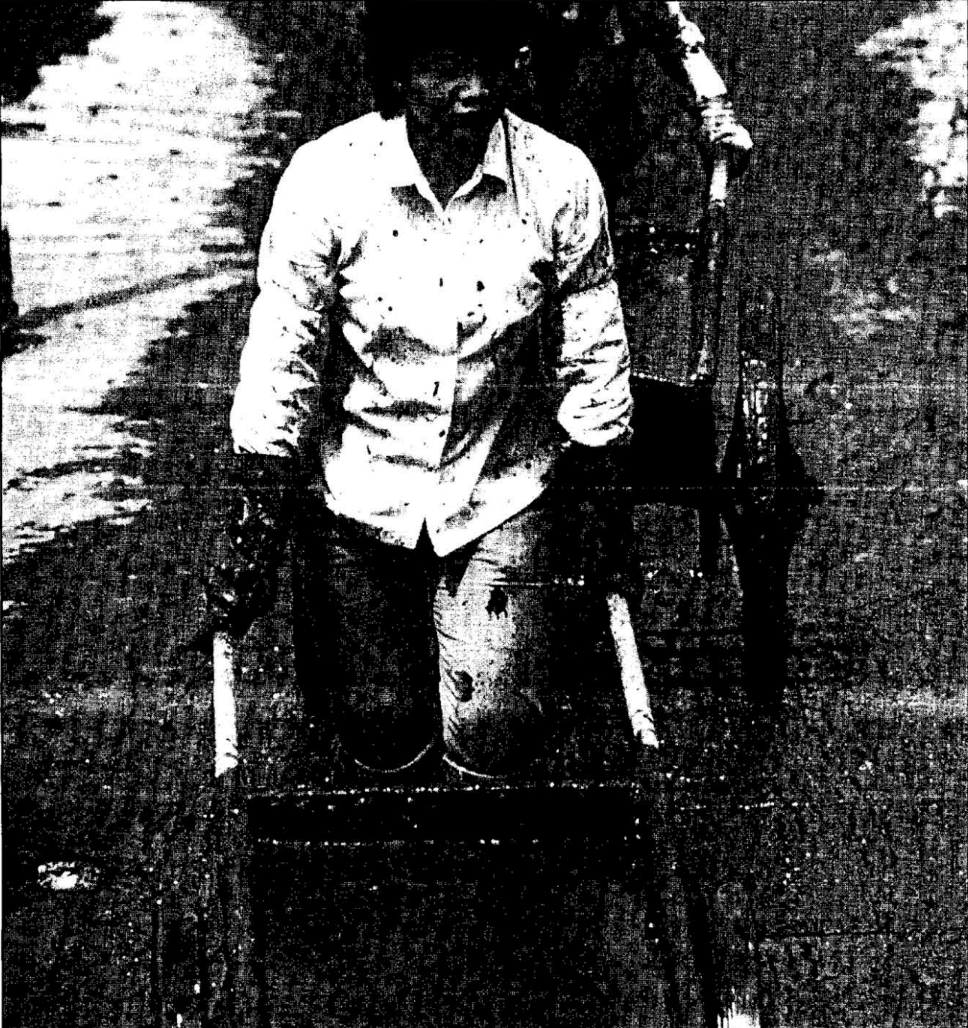
Hard Labor. Courtesy of Impact Visuals
During the past fifteen years, Chinese of the Caribbean have provided literary interpretations of creolized experience in the Caribbean. Among others, these include Willi Chen's vignettes of comic violence in King of the Carnival (1988), set in Trinidad; Easton Lee’s poetry collection From Behind the Counter (1998) and Victor Chang’s short story “Light in the Shop” (1997), set in Jamaica; Jan Lo Shinebourne’s The Last English Plantation (1986) and Timepiece (1988), novels about Indo-Chinese women in the context of Guyanese self-determination; Meiling Jin’s Gifts from My Mother (1985) and Songs of the Boatwoman (1996), poetry and stories of Chinese Guyanese diaspora. More recently, there are Jamaican poets such as Stacyann Chin and Lori Tsang, who have voiced their art in New York. Much earlier was Severo Sarduy’s novel of Cuban cultural multiplicity, which plays on the instability (and absurdity) of language/meaning and the search for a Chinese opera diva in el Barrio Chino, De donde son los cantantes (1967).
Each writer offers a markedly different vision of creolized culture and cultural politics. But the creative impulse reveals, at the least, a desire to inscribe narratives of the Chinese diaspora into an inclusive Caribbean narrative and history. Severo Sarduy, himself a Cuban with Chinese ancestry, expressed this sentiment when he emphasized that Chinese culture, along with the African and Spanish, was at the center of Cuban identity formation. He went so far as to state in an interview: “Los chinos han sido muy importantes en Cuba porque, aparte de su influencia en el orden cultural, están en el centro de la concepción del mundo cubano The Jamaican writers Patricia Powell and Margaret Cezair-Thompson include the Chinese in works that draw on the inheritance of colonialism and the contestations of race and gender. Powell and Cezair-Thompson are writing about the Chinese in the context of creole culture, a concept that has been placed on the margins of Chinese diasporic discourses. In their works, creolization emerges as an “historically affected socio-cultural continuum but does so in terms that expand this continuum to also include Asians in the making of Jamaican history and culture.
“Creolization” in Chinese diasporic study has remained marginal until recently. The “immigrant narrative” has dominated representations of Chinese diasporas, calling on tropes of immigrant success, “middleman” roles, cultural traditions, and generational conflict. Both Powell and Cezair-Thompson, however, write cultural narratives that emerge from the conflict and cooperation of different racial groups, not a benign cultural process but one fraught with contesting claims of raced and gendered survivals. In both novels, the Chinese characters are grocers whose shops are burned down. Cezair-Thompson makes reference to the Anti-Chinese Riots of 1918. Powell makes a shop burning the central event of her novel. She hoped to open dialogue rather than foreclose it:
I wanted to convey the idea of a Chinese history in Jamaica still writing itself, still making itself, still largely undocumented ... I wanted to create this open-ended feel to the novel as another way of reflecting on the absence of a conclusive Chinese history and alerting readers to the fact that the story is simply part of an ongoing dialogue about the documentation of Chinese history and culture in the Caribbean
While still working on the novel in 1996, Powell also acknowledged the question of authority in this work: “I can’t imagine what space I’ll occupy with the publication of The Pagoda After completing the novel, Powell again referred to the imposition of authenticity: “It took me a long time to write this because I felt I didn’t know if I had any business writing about this. But again, I wanted to push myself The act of a black and female author writing from a diasporic location, creating “Mr. Lowe” as the main protagonist—a cross-dressing Chinese woman in nineteenth-century Jamaica who becomes intimately involved with a light-skinned Jamaican woman who is passing as white, no less—becomes immediately vulnerable to marketplace demands for authenticity and authority. Furthermore, Powell suggests a reading of diasporic formation as transgressive and subversive. In the process, the text opens questions of identity as removed from identity politics and more akin to questions of locating power.
Powell focuses on the coolie and small shopkeeper history at the turn of the century, whereas Cezair-Thompson focuses on the middle-class/upper-class strata of Jamaica of 1980s. Powell’s descriptions of Chinese coolies and shopkeepers actually reveal grounding in historical research (not that this should be required of fictional work) while, at the same time, the text situates diasporic culture as a shifting renegotiation in itself. I focus here primarily on Powell’s use of passing and passage as doubled-edged tropes that construct a Chinese diasporic narrative as linked to African diasporic experience in the history of colonialism and nation building Although passing and passage bring cross-racial linkage in The Pagoda, they also destabilize the racial narrative, resulting in a creative interpretation of diaspora as a continually challenged formation. For this reason—the linkage between Asian and African diasporic experience—a reading of such works may offer interventions in the fields of Asian American, Asian diaspora, and Caribbean studies. Identifying a linkage in itself is not necessarily of great significance, but rather more interesting are the tropes and methods that both writers have used to construct these linkages (I use the term “linked” to suggest commonality and shared history, but not equivalency or homogeneity in experience).
What is unusual about Powell’s and Cezair-Thompson’s novels is that both implicitly and explicitly link the Chinese to the African via the middle passage. Powell and Cezair-Thompson (to a lesser degree) depict the Chinese transoceanic passage in terms of the coolie trade, including details on the more slavelike aspects of the coolie passage. In actuality, both authors produce a Caribbean story of the passage that hybridizes features of the coolie passage to both the former English and the former Spanish Caribbean and that hybridizes the history of both the Chinese indentured laborer and Chinese kidnapped slave, although it is the latter history (kidnapped Chinese) that is least known although well documented. Like the Africans who preceded them, Chinese coolies were brought to the Americas in the holds of European and American ships, “under the hatches Some Chinese journeyed voluntarily, but large numbers were taken by force. The trafficking of Chinese coolies to Cuba was known as the “coolie-slave trade In this case, labor historians conclude that the majority of the almost quarter-million Chinese of the Spanish colonies of Cuba and Peru were taken against their will, with approximately 50 percent mortality within eight years. The fact that newspapers documented sixty-eight Chinese coolie mutinies on coolie ships, some resulting in total death of the human cargo, suggests that the Chinese were hardly free emigrants at sea The term “coolie” comes from the Hindi kudi, meaning “bonded labor,” and the Chinese ku li, meaning “bitter labor.” By including this history, both authors offer Caribbean narratives that provide linkage between Asian and African labor histories in the CaribbeanThe creative narrating of the passage allows for the tracing of diasporic emergence and process in profoundly human and sometimes violent terms.
The representation of diasporic culture as mainly predicated on “process” rather than the recuperation of “origin” is illustrated when Jamaican novelists such as Powell (particularly) and Cezair-Thompson offer “memories” of the passage. The question of origin, “Where do I come from?” becomes eclipsed by questions of emergence and process, such as, “How did I come to be Powell’s novel emphasizes more of the “how” and not just the “where.” The protagonist asks in a moment of frustration: “What would it matter whether or not his daughter knew how he’d arrived there on the island exactly and why? What would it matter how he and Cecil had lived down in the gut of that ship? How he and Miss Sylvie lived up there in that house all these years? How the daughter was born and who were the rightful parents?” (24). The protagonist’s preoccupations concern remembering the “how.” Likewise, Cezair-Thompson’s character Mr. Ho Sing arrives aboard the Prince Alexander (an actual ship that arrived in Jamaica in the 1880s). He tells his story but dwells little on a story of origin. Instead, he emphasizes the “Awright, awright, I goin’ tell you how I reach Jamaica. But keep in mind what I really want to tell you ‘bout is Miss Rema and Marshal Bloom, an’ how a ’ooman an’ a racehorse did mek an ole man life sweet” (77). Of the nine pages devoted to Mr. Ho Sing’s monologue, only one paragraph refers to his village in China. Mr. Ho Sing’s “me one dream” is captured instead in a symbol of motion and risk, Marshal Bloom, a racehorse. Around Mr. Ho Sing’s deathbed, the family awaits his last words. Mumbling, he clutches the shirt of a Chinese translator. Perhaps he’ll whisper, Take me back to China. Instead, the translator says, to the surprise of the family, “Him say ‘Gimme one a dem Benson an’ Hedges.’ A ripple went through the room, the hilarity of it all, the old man begging a cigarette, not in Chinese, but in the Jamaican patois that they all spoke” (9). Mr. Ho Sing emerges as a primary Jamaican character and an example of “Asian Creoleness speaking in the richness of patois...
***MISSING PAGE FROM THE ARCHIVES***
... during the nineteenth century “Passage” and “passing” become established as concurrent strands of boundary crossing and transgression in diaspora. As Lowe's life progresses, he deploys multiple identities; he becomes “father,” “mother,” “husband,” “lover,” “whore,” “shopkeeper.” Passing, in this case, becomes more than a binary course (the passing from “one” to the “other”). Lowe engages in multiple, simultaneous passings. Powell’s work allows for the reading of diaspora as a passage through cultural formation with deliberate deployment of social and sexual capital. Powell adopts the narrative conceit of referring to the woman Lowe as “he” and “Mr. Lowe” throughout the text, in keeping with “the fabulous masquerade that was his life” (33). Thus “passing” occurs in the meta-narrative—the references to Lowe as “he” and “Mr.” continue long after the early revelation of his sex. The continued reference to Lowe as “he” by the author, reader, and imagined characters replicates the struggle over the terrain and ownership of Lowe’s body. At the same time, it allows for transgressive recognition of Lowe's performance as both a “man” and a “woman.” This reading of the text raises the necessary question: How should one refer to Lowe? As “Lau A-yin,” his/her Chinese name as revealed at the end of the story? As Mr. Lowe? As “she” who is “Mr. Lowe”? As “Mrs. Lowe,” since Lowe and Sylvie are living together under the pretense of marriage? Perhaps the question in itself is limiting—“How should one refer to Lowe?” implies the limits of language and the totalizing nature of naming. But for the purposes of consistency with the text’s narrative strategy, I refer to Mr. Lowe as “he” while also referring to Lowe’s experiences as a woman who performs gender. In this sense, The Pagoda offers possibilities for a reading that ruptures standardized narrative treatments of gendered body and mind.
This litany of Lowe’s multiple questions leads one to ask: Is this a Caribbean orientalism? The text invites such a reading—the familiar recitation of exotic Asian, the mysterious Other, feminized native, deceptive “Oriental” on the island of Jamaica The use of the “pagoda” as a Chinese symbol in the novel also smacks of a touristic orientalizing of Lowe's past. Although these aspects certainly invite an orientalist critique, another kind of reading exposes contradictions. Lowe is not passive (partly what “oriental” implies); Lowe is not “feminine” (he resists this categorization); and Lowe disrupts essentialist notions of gender and sexuality (partly what “orientalism” implies). Lowe's mysteriousness and deceptiveness are juxtaposed with those of Miss Sylvie, the deceptive Jamaican passing as white. For both of them, their deceptiveness is posed as survival. The contradictions invite a reading that accounts for subversion. Lowe engages in a struggle with racialized and gendered hierarchies that ultimately lead to a web of masking and unmasking by various parties. At times, the novel reads like a postmodern, cross-dressing with identities destabilized and confounded: Lowe as a woman passing as a man is raped by the ship captain Cecil; Lowe bears the captain’s child in secret, a baby girl, and continues to masquerade as a man; Lowe cohabits with a white Jamaican woman named Miss Sylvie, whom Cecil introduces to Lowe; Lowe’s daughter is misled to believe that Sylvie is her mother and Lowe is her father; Sylvie’s black servant burns down Cecil’s shop and Cecil in it; Sylvie later reveals herself to be an “‘octoroon” who is passing as white, has murdered her white husband, and has given away her three dark-skinned babies for fear of being discovered as black; Lowe engages in sexual relations with men and women and finally falls in love with Sylvie, even though she leaves him. The plot thickens, and it is easy to become engrossed in (or dismiss this as) high drama Yet this is drama that breaches all the conventions of class, color, and sex. Lowe thinks of the complex trap that he is in: “Here he was Chinese, and here he was co-habiting with this white-skinned woman, Miss Sylvie, and here he was now living in the biggest house in the district with a dark-skinned maid and a dark-skinned yard boy” (108). The many plot twists speak to the complex codes of racial and class tensions in nineteenth-century Jamaica while also implicating gender and sexuality. Lowe’s life becomes a power struggle of resistance, negotiation, and strategies of passing. As a Chinese woman who performs as “he” and “she,” Lowe is a survivor but an “outsider” in the hierarchies of race and gender. The regulation of social status becomes directly tied to the regulation of the racialized body. Lowe curses “the audacity of these porcelain alabaster people to want to control his life so thoroughly and completely” (107). Regulation of the racialized body is illustrated in Lowe’s relationship with the ship captain Cecil. Lowe attempts to kill Cecil twice, yet Lowe also realizes that he needs Cecil to survive. Cecil rapes Lowe but then becomes Lowe's benefactor and sets up Lowe as “Mr. Lowe,” the manager of a small shop that Cecil owns. Cecil also introduces Lowe to fair-skinned Miss Sylvie, who provides a “front” of respectability for Lowe while Cecil is mostly away engaging in the coolie trade. Lowe is sponsored yet confined by a white ship captain and a “white” woman of means. She is one of “the porcelain alabaster people who for decades through marriage tried to bleach stains of black Africa from their skins” (91). Ironically, it is the captain’s coolie trafficking, the exploitation of other Chinese, that provides the capital for Lowe (and Sylvie) to survive while also entrapping Lowe in a lifelong and life-threatening secret. Lowe, as a liminal figure in the making of creolized culture, stands as a symbol of its limitations and boundaries. Powell’s novel speaks to codes enforced upon the body and the complicity of the community in constructing the Other to reinforce social “order.” The chain of blackmail in the novel implies the regulatory power of such codes, with the most successful blackmail entailing life-threatening consequences. Within Sylvie’s house are contained the knowledge of “crimes” against normative society: transgressions of race, gender, sexuality, and class. Sylvie as black woman passes as a high-class white woman and wife, and Lowe as destitute Chinese woman passes as a male shopkeeper and husband. They are sleeping with each other. Lowe wonders, if the town found them out, “would they just descend on the house with their tins of kerosene and catch them on fire? Would they parade both him and Miss Sylvie through the road, stoning them with rocks and lashing them with insults? Would they tie them to posts and leave them there in the scorching sun to die?” (129). As a means of survival, Lowe continues his association with Cecil and Sylvie—as Lowe says, “we all do things to save our lives” (7). These things are uneasy associations based on punitive constructs of knowledge, power, and implicit violence sanctioned by a communalism of heterosexual and racial strictures Lowe “could detect the precise moment at which innocent conversations verged on violence, when a demure innuendo could leap out of hand, when boundaries were crossed” (118).
As a Chinese, Lowe is made aware of the clear line between white and the “others.” As a result, he resists Sylvie by refusing to respond during sex and yet allows Sylvie’s performance of sex to continue. In their most intimate moments, Lowe’s experience of sex with Sylvie becomes conflated with racialized and gendered betrayal: “For who is to say she wouldn’t fold up her fantasies into him and turn him further into something he wasn't, as his father had done and then Cecil? And who is to say she wouldn't abandon him once her mission was accomplished. Who is to say?” (113–114). Sylvie’s need for Lowe contains scripted roles of power. Sylvie needs “Mr. Lowe” as a “husband” publicly (particularly as she continues her relationship with a “Miss Whitley” on the side) but also desires that Lowe privately wear corsets and be a “wife.” Lowe resists being feminized as the wife, not because he rejects femaleness but because he rejects the disempowerment associated with Sylvie’s fantasy. The instance of being Chinese and wife and lesbian lover to Sylvie, in this moment, becomes tripled in its potentials for Lowe’s disempowerment Likewise, the captain Cecil’s need for Lowe contains scripted roles of power and fantasy. It is ambiguous whether Cecil fantasizes Lowe as a “girl” or a “boy,” particularly as he cuts Lowe’s hair and dresses him, again, as a boy. The captain’s assaults on Lowe are from behind: “his callused hands rough on Lowe’s shoulders, his breathing quick and sharp in Lowe’s ears; Cecil's face buried in the back of Lowe’s head” (96). With “everyone else having claims to his body” (179), the struggle over “cultural” expression is the struggle over the body and the mind. Lowe’s transgendered actions reveal a certain agency that Lowe decides to exercise even at great risk. Thus Powell creates a character of the diaspora who breaks social taboos upheld by normative conventions.
Lowe and “So He Operate”
Powell’s linking of Lowe and Sylvie in passage and passing, Chinese and African, becomes the novel’s marker for beginning to fathom the island’s multiracial past. Lowe and Sylvie both contend with systems of color and capital that structure the terms of self and community. Both Lowe and Sylvie are blackmailed and held under debt by Cecil, who is described as coming from a family of slave traders (67). In fact, Lowe’s passage is aboard a former slaver ship that Cecil inherits. Slave ships were the models for coolie ships, and the same slave-trading nations, shippers, investors, and plantations reaped profits by turning to the coolie trade Powell also links the African and coolie passages by indicating the transatlantic route (25, 45). Coolies were taken to the Caribbean via both transpacific and transatlantic routes. The novel’s connection of coolie ships to slave ships, and their routes, is reflective of the maritime history and global economy of the nineteenth century. Whereas Lowe is indebted to a coolie trader, Sylvie lives under the shadow of her first husband, a slave trader, a “big government man with money and clout and a face to hold up and a lot of people working for him and capturing black people and still selling them” (143, also 219). Coolie trade and slave trade cast shadows over Lowe's and Sylvie’s lives and order the social structure in which they live. Sylvie reveals her own coercion as a black woman under colonial regimes of color and class. Sylvie’s husband, a powerful white man, discovers that she is a “nigger” (146) and plans to kill her “for shaming him like that” (146). As Sylvie reveals, she kills him first: “‘I kill a man, Lowe... I kill a man, a white man. My husband’” (142). When Sylvie reveals herself, Lowe feels for the first time that he understood “her silences and her double life,” and he saw “that their fates were linked together” (144). It is only after this revelation that Lowe begins to love Sylvie (178, 222). Yet Lowe's secret euphoria becomes short-lived as he thinks, “There was still the daughter to contend with, his marriage to Miss Sylvie, and the fabulous masquerade that was his life” (33). The ramifications of the social and racial configurations that the colonial system created still remain.
Powell’s vision of Jamaica’s history of color and creolization is one that reveals the struggle and the fissures. She stated in an interview,
I’ve been thinking about the racial/ethnic/political/social spaces that those Jamaicans who are neither of African nor European descent occupy. About the space they occupy in the minds of the dominant racial group. In researching the history of the Chinese in Jamaica, I've had to reflect on the images of the Chinese that are portrayed in Caribbean literature and culture, and the racial fears and stereotypes of the Chinese I absorbed while growing up in Jamaica. It's been making me think, too, about the East Indians and the other non-white/black groups and their experiences of exile and displacement, their experiences of otherness and of home, there on the island
Powell illustrates the operations of colonialism that foment friction between Africans and Asians. Lowe comes to a painful awareness of being despised and misunderstood. Lowe refers to the black violence against Chinese as “common accord for them to burn down the Chinese people's shops. Common accord for them to loot. The more militant types intending to clear his [Lowe’s] people out of the country” (32). In public, Lowe is even avoided by an old Chinese restaurant proprietor, whose face tightens when Lowe attempts to speak a few words of Chinese (56). The Chinese warn each other not to amass publicly, speak Chinese, or draw attention to themselves. The country is composed of “men of a million assortments of brown,” but it is “erased of its original inhabitants” and “composed of a transplanted citizenry” (55). Lowe’s experience of “transplantation” and the island's creolization is an uneven and conflicted one, in a nation and political process that is not automatically inclusive in itself. The novel also indicates a new kind of presence; Lowe notices “America’s growing involvement” and “increasing unemployment” (168). As Lowe struggles with the realization “they had been brought there only to supply cheap labor and keep down wages. They had been brought there only to keep the Negro population in check” (45), the burning of the shop hangs over Lowe as he attempts to rebuild his own trust in the people around him and grapples with his own anger. Lowe begins to resent the villagers for their resentment of him, a circle of suspicion and hate. Yet Lowe knows little of their lives and history, and they know little of him.
Social relationships become fractured, due to interests of the ruling class. It is “the few Europeans who controlled the country, ever since they arrived” (6). The divisive history erodes Lowe’s relations with the villagers and his daughter. Although the term “benefactor” imparts positive connotations, Cecil aids Lowe's survival but only on Cecil's terms, terms that isolate Lowe and divide Chinese from black. Lowe’s attempts to build relations with black Jamaicans are thwarted by the self-serving actions of Cecil: “For every time Cecil came, it disrupted the relationship he [Lowe] had built up with the villagers ... Every time Cecil came, he [Lowe] was assaulted with the memories of the ship” (95–96). Although Lowe recognizes the logic of survival, he barely contains his anger, wanting Cecil dead for a life of entrapment, “shackled to the shop,” the target of unwanted envy and hostility. Lowe hides this history from the villagers and also from his daughter, thus resulting in familial estrangement: “For what else could he have said: that her father was a trickster, a rapist, a thief, a smuggler of illegal Chinese, a kidnapper, a madman, a demagogue?” (66).
It is a shop burning that destroys Cecil, who is in the shop. Here Powell rewrites history, as the burnings of Chinese shops in Jamaica resulted in the deaths of Chinese, not white men. The displacement of the Chinese shopkeeper death with Cecil’s death skews the history of anti-Chinese violence and shop burnings. As a result, Powell's novel sidesteps the ramifications of racialized “Othering” and the loss of Chinese lives. But at the same time, the creative decision points to something deeper. The novel effectively narrates the conflict between [African] – [Chinese] but also shifts this conflict to [African/Chinese] – [European]. The creative decision displaces the localized violence and points the finger at the macro-structure of colonial politics. Cecil, the white man-capitalist-trader-owner, dies as a consequence of his profits and ownership of the people. Lowe gains a modicum of freedom upon Cecil's death: “strangely enough he was relieved ... He felt clean and unburdened from the shop and from Cecil's plans ... somewhere deep in him he knew that for the first time he could sort out what it was he wanted to do with his life ... He could rethink again those reasons that had brought him to the island and try to live out some of his dreams” (32). The burning of the shop fulfills one of Lowe's deepest desires, as he had wished Cecil dead before.
Lowe’s History “From the Edges”
What the minority voice cannot tell becomes history unrecorded: “He would have no history for his daughter; he had told her nothing, taught her nothing” (233). The narrative depicts Lowe's isolation as cultural isolation driven by colonial politics rather than simply “cultural differences,” and in this way anchors the culturalist argument in terms of power formation. Lowe’s and his daughter's entry into Jamaican society are accompanied by the resentment of white merchants and black villagers and the burning of the shop (57). Lowe manages to place his daughter in a “convent school which only as an exception admitted the children of the Chinese and those of the porcelain alabasters” (114) and manages to make a meager living in a shop while local villagers watch with simmering envy. But it is the telling of history that becomes critical for Lowe, something that implies the sharing and knowing of history as critical to the building of a creole culture, that being the inclusion of multiple histories. By Lowe's telling his story, Powell’s narrative writes the story of the Chinese passage into a Jamaican narrative. Lowe attempts to share the passage with his grandson, couched in “storytelling,” calling Cecil (the boy’s grandfather) a man who “try hard” (70) yet also revealing him as a man who
two, three times a day he bring them [Chinese] out for air, walk them up and down the deck, a chain gang of them clanking as they drag the iron. He hose them down with lye and then water to kill crab lice and then leave them there little to dry off, to yabber at one another ... Half of them were already dead and thrown overboard or just leaning up next to one another, stiff with rigor mortis. (71)
Lowe's telling also leads to a lasting relationship with the Afro-Jamaican Omar, who stays with Lowe in the end. It is Lowe's tellings that help him (and Omar) to make sense of the circumstances under which Lowe came to and entered Jamaica. It is repeatedly reinscribed as the memory enters his mind over and over, as “the shelves of his mind tumbled again, down into the rusty hull of Cecil's ship” (47)
As Omar tells Lowe, the way to tell the story is “from the edges” (228). Images and sounds of slapping waves, decaying maps, tied wrists, the ship’s hum, steps of men, and a dark cabin repeatedly enter “the edges” of Lowe’s consciousness. At moments, the shop, the ship, and the house overlap as metaphors of containment, and with this Lowe’s identities as shopkeeper, whore, and wife. At the shop, he paces between the “barred windows of the shop that looked out at the squalling rain, and back again to the locked door that faced the empty square. And back again to the barred window that looked out at the silvery slant of persistent squalls” (97). This echoes Lowe’s ship passage and confinement and his earlier circumstance as a girl-wife waiting behind the “barred windows of a house” (179). Ship/house/island become conflated. The dynamics of passage and passing, and the politics of class, color, and gender, are accentuated in the power structures of a coolie ship, ship-as-island, house as society. These become a combined metaphor for a life story that Lowe must negotiate.
The term “whore” also becomes a metaphor that links the colonial underclass for Lowe and Omar. Repeatedly, “whore” enters Lowe’s telling of passage and passing as a figurative and literal term that speaks to Lowe being prostituted by Cecil on several levels. When Lowe charges that Cecil “turned me into his whore,” Omar replies, “He turn everybody into whore, sir, man and woman. Young or old. He blackmail everybody, sir. So he operate” (227). Lowe puts it to Omar:
And then there was the pregnancy, and all through that he was so good. I didn’t know ’bout the man markets, I didn’t know ’bout the hellish plantations that kill people with work. You know how many Chinese die on the ship with me? I didn’t know which life was better, the one underneath him whenever he want, the one tie up, shackle underneath the ship. And then he sew the clothes so people wouldn't know, in the heart of night he smuggle me out. Put me up at some friend or other. Pay some woman to help me deliver the baby, strengthen me again. Then he give me the shop. Give me the money, but every time coming back for more of me, wanting to humiliate me, remind me. (227)
The allegory of race and labor, and its costs, is summed up by Omar, who repeats, “Yes, sir, so he operate.”
The ownership of Lowe as underclass Chinese is marked by his elevation to the “whore” of the captain. Lowe becomes the captain’s “mistress” while below are “eight hundred of us [Chinese] pack up down there. Eight hundred. And you should see how little the ship ... Five hundred of them kidnap ... Yes. Kidnap. Drag out of bed deep into the night. Tie up and beat up and bundled off—” (68). Lowe’s limited ability to escape is compounded with fear that hordes of men might descend on him if he should resist the captain. Lowe also fears “being thrown down below into that sewer of human waste with the other Chinese” (100). This passage thus reinforces the forced art of passing: the art of consciousness and of controlling one’s movement, being, and expression. It becomes a technique of survival for Lowe on board as it would be for the remainder of his life, as woman and immigrant made “Other” and “illegal.” Lowe
learned how to stifle sneezes and hold back coughs, how to lock the muscles in his rectum and tighten his kidneys, how to squat for long long hours behind crates of shimmering silk and handcrafted fans, dodge between cargoes of fine tea and silver dishes wrapped with ropes, dart between towering columns that divided the ship into small, neat boroughs. And always there was the fear clanging in his chest, thudding in the veins by his head. (16–17)
As the captain approaches, Lowe lunges out and stabs him in an unsuccessful defense. (This marks one of several times when Lowe initiates force—he later chokes his son-in-law and pulls a knife on Sylvie’s manservant. Lowe’s behaviors confound the stereotypical categorization of so-called “passive/female” or “active/male” behaviors.) The combination of sex, gender, class, and race evolve as the factors that characterize Lowe’s passage to Jamaica. Lowe's telling of this continues to the very end, when he writes a letter to his daughter, an act of passing down a “history.” The writing of the letter becomes a device for Lowe to address “past and future” to his daughter, who becomes the next generation in a creolized nation, marked by the legacy to which she was born as a biracial daughter, conceived by rape on a coolie ship and now married to an Afro-Jamaican.
Lowe and the Writing of “Surprise” History
Powell's novel suggests a definition of belonging for the Chinese in the commitment to stay and build the community. Lowe becomes vested in maintaining a claim to a “narrative” of Jamaica, even after the blackmail, the antagonism of the local villagers, and the destruction of his shop. Lowe remains committed to his life in Jamaica with dreams of opening a community center or school. When Sylvie suggests that they leave Jamaica, he is incensed: “Jesus Christ, where? We belong here, this where we live” (142). For him, there is no such thing as a “fresh history,” something that Sylvie offers by proposing that she take him to another island. She repeatedly talks to Lowe about moving to Barbados or Panama (149). Lowe rejects the idea as simply undesirable and does not “want to live out anybody else’s fantasy ... He wanted to have the Pagoda right here on the island” (145). Lowe’s commitment to community building and to Jamaica thus makes him more a part of Jamaica’s creole identity. Still there is cultural negotiation—creolization as a loss of language. Among other things, Lowe writes of the pagoda to his daughter, suggesting that the daughter might learn about Chinese-Jamaican history and hear some of the Chinese language that was erased. Importantly, it is fellow Jamaicans who aid in the building of the pagoda and who eventually become Lowe’s closest friends, Jake and Omar. The diasporic story, as presented here, resists the standardized understanding of diaspora as the extended practice of maintaining heterosexual structures and reproducing patriarchal traditions. In the last version of the letter Lowe writes to his daughter, he begins with a queering of his history. The sharing of his body as politic becomes an act of claiming/writing his history and body. His body had become “a familiar source of commentary” (172) for Cecil, Sylvie, and members of the community, but now also for himself. Although Lowe’s “passing” is constructed as a strategic method of survival, it is also an act of queering and transgendering Lowe’s diasporic history such that it is not easily commodified or homogenized Yet Lowe’s letters are never sent during the course of the book. Lowe’s history is tenuous and contingent, along with Miss Sylvie’s “decaying correspondence” and Cecil's moldy, disintegrating travel journal “with pages that had been ripped out” (65). Lowe's own writing of history is only viewed by himself. Thus Lowe’s own desires are simultaneously intimated, “presented,” yet still unvoiced and unshared history. He discovers that “People don’t like surprises. They don’t like the truth” (240). Moments of Lowe's struggle are presented as grim yet dryly humorous. When Lowe tells Omar point-blank, “You know I'm a woman,” and begins to strip, confirming Omar’s suspicions, Omar panics and says, “Oh God Mr. Lowe,” and runs out the room. The surprise is a historical act(s) outside the narratives of normative society. Lowe’s truth is one of several truths or perhaps the resistance to fixing one “truth.” The novel implies that “official” history is maintained yet subverted by the people on another level. Those in Sylvie’s house, along with people in the village, have known of Lowe’s passing for a long time. As Omar once said to him, “These eyes don’t miss anything at all, Mr. Lowe. I see everything. I know what is going on in that house. I know the show” (126). As well, a village woman named Joyce Fine informs Lowe that his laugh is what gave him away as a woman and “sometimes is a walk, a look, sometimes is a silence, a dis-ease” (153). She adds: “But you know, Lowe, everybody seduceable. Man or woman” (153). The “dis-ease” is one of fear, as Lowe apprehensively thinks of Joyce’s policeman husband. (The brief story also alludes to the rumored cause of the Anti-Chinese Riot in 1918, that of a relationship between a Chinese shopkeeper’s wife and a policeman.) Joyce’s “wink” at Lowe, her complicit knowledge of Lowe’s passing, and her philosophy that everyone is sexual whether “man or woman” is also a “wink” shared by the villagers. The complicity of the villagers and Lowe is one of recognition but also one of boundaries that divide the unspoken from spoken and the official history from the “surprise” history. Lowe’s efforts become a constant struggle to write history or to claim his body. Lowe writes his surprise history in letters that seem to never get sent, and then he writes more. He signs the last one, “Lau A-yin,” his birth name. Still, throughout the novel, Lowe has been unable to shake the name “Mr. Lowe.” Lowe has discovered that the power to name and represent becomes a struggle between society, state, and individual. Creole culture, with the need to name and represent the history of all its subjects, from its subjects, becomes an ongoing creolization that relies on continual challenge to its constitution, something that the novel implies by the writing of this letter and the writing of Lowe’s “body.”
FOOTNOTES
1The Pagoda (New York; Knopf, 1998).
2The True History of Paradise (1999; New York ; Plume. 2000).
4Edward Brathwaite, The Development of Creole Society in Jamaica 1770-1 820 (Oxford; Clarendon, 1977 ), pp. 309-3 10. I also thank Donette Francis for suggestions regarding "creole identity" during my revision of this article.
3Emir Rodriguez Monegal, El Arte de Narrar (Caracas: Monte Avila Eduores, 1968), p. 277.
5Patricia Powell, "The Dynamics of Power and Desire in The Pagoda," in Adele Newson and Linda Strong-Leek, cds., Winds of Change (New York; Peter Lang, 1998), p. 194.
6Faith Smith, "An Interview with Patricia Powell," Callaloo, Vol. 19, no. 2 (19 96), pp. 324-329.
7Craig S. Semon, Book review of The Pagoda, Montachusett Telegram & Gazelle. February 6, 2000. p. 6.
8I do not suggest a trope that is emptied of historical significance and experience. In the case of Chinese coolies, the trope is one of historical grounding. See Joan Dayan 's concerns regarding the middle passage as metaphor in "Paul Gilroy 's Slaves, Ship s, and Routes; The Middle Passage As Metaphor," Research in African Literatures. Vol. 27 . no. 4.
9See Harper's Monthly and The New York Herald Sun for articles during the 1850s to 1870s on American involvement in the coolie trade. See Juan Perez de la Riva, Juan Jimenez Pastrana, Jose Balrar, Basil Lubbock (maritime history), Evelyn Hu DeHart, Denise Helly, Gary Okihiro, and Rebecca Scott. Also see travel literature of the era. See Lisa Yun, "Under the Hatches," Amerasia Journal (forthcoming 2001); and Lisa Yun and Ricardo Laremont. "Chinese Coolies and African Slaves," Journal of Asian American Studies, Vol. 4. no. 2 (June 2001).
10At the same time, the Chinese passage has been exploited and appropriated as a propaganda tool for white labor politics. Conflating “coolie” passage with all Chinese immigration, some American politicians argued to halt Chinese immigration in the nineteenth century. See Stuart Lyman, “The Chinese Question and American Labor Historians,” New Politics, Vol. 7, no. 4 (Winter 2000); and John Tchen, New York Before Chinatown: Orientalism and the Shaping of American Culture, 1776–1882 (Baltimore: Johns Hopkins University Press, 1999). Similarly, the “illegal” passages of Chinese and Africans in the twentieth century have been strategically used by the American media and politicians for bordering and consolidating “American nation.”
11Walton Look Lai, The Chinese in the West Indies 1806-1995 (Kingston, Jamaica; University of West Indies Press, 1998). p. 96. Also see Denise Helly. ed ., Cuba Commission Report ( 1876; Baltimore; Johns Hopkins University Press, 1993).
12Chinese migratory experience to the Caribbean, Latin America, and South America also varied according to the time period of entry in the Caribbean. The second wave of Chinese migration, after the coolie period, consisted of laborers but also merchants and small business entrepreneurs. Also see Patrick Bryan, “The Creolization of the Chinese Community in Jamaica,” in Rhoda Reddock, ed., Ethnic Minorities in Caribbean Society (St. Augustine: University of the West Indies, 1996); Trey Sue-A Quan, Calle Reapers (Sue: Vancouver, 1998); Margery Kwok Crawford, Scenes from the History of the Chinese in Guyana (Guyana: Crawford, 1989); Margery Kirkpatrick, From the Middle Kingdom to the New World (Guyana: Kirkpatrick, 1993).
13Also see Stuart Hall, “Thinking the Diaspora,” Small Axe (September 1999), pp. 1–18, in which he states: “Cultures, of course, have their ‘locations.’ But it is no longer easy to say where they originate. What we can chart is more akin to a process of repetition-with-difference or reciprocity-without-beginning” (p. 10); “culture is not just a voyage of rediscovery, a return journey. It is not an archeology. Culture is a production . . . We are always in the process of culture formation” (p. 16).
14Also sec Jean Bernabe. Patrick Chamoiseau, Raphael Confiant, and Mohamed B. Taleb Khyar, " In Praise of Creoleness," Callaloo (Autumn 1990), pp. 894, 886-909.
2020. See Lai, *The Chinese in the West Indies*, pp. 149–153, 166–167; Crawford, *Scenes from the History of the Chinese in Guyana*, pp. 3–6, 112; Kirkpatrick, *From the Middle Kingdom to the New World*, pp. 65–70.
21See also various critiques of David Henry Hwang's play M Butterfly (which includes a cross-dressing character who performs gender and racial fantasy) that interrogate the politics of body/race, orientalism, and subject performativity, such as Dorinne Kondo's About Face (New York: Routledge, 1997) and David Eng's essay “Heterosexuality in the Face of Whiteness,” in David Eng and Alice Hom, eds., Q & A: Queer in Asian America (Philadelphia: Temple University Press, 1998).
22The popular genre of televised Latin novelas is well known for its particular brand of soap opera that often reinforces middle-class norms of color, class, and sexuality. I suggest the term “cross-dressing novela” to mean one that flip-flops norms while maintaining the genre of high drama.
23One *New York Times* reviewer dismissed the novel as a misconceived modern romance: “It can be a glorious thing to make a modern romance out of a remote time and person, to heighten the colors as you go along, painting pictures for the sake of having pictures. The trouble is that *The Pagoda* feels more like painting for the sake of painting, a technical exercise from an astonishingly fluent writer who may be suffering just a temporary passion deficiency (Michael Pye, Book reveiw, New York Times, November 1, 1998, Sect. 7, p. 15;, col. 1).
24See Thomas Glave, “Toward a Nobility of the Imagination: Jamaica’s Shame,” *Small Axe* (March 2000), pp. 122–125; Timothy Chin, “Jamaican Popular Culture, Caribbean Literature, and the Representation of Gay and Lesbian Sexuality in the Discourses of Race and Nation,” *Small Axe* (March 1999), pp. 14–33; Timothy Chin, “‘Bullers’ and ‘Battymen’: Contesting Homophobia in Black Popular Culture and Contemporary Caribbean Literature,” *Callaloo* (Winter 1997), pp. 127–141; Lawson Williams, “Homophobia and Gay Rights Activism in Jamaica,” *Small Axe* (March 2000), pp. 107–111; and “Boom Bye-Bye Bally-Boy,” *The Economist* (February 17, 2001), p. 42.
25Sec also Richard Fungs essay "Looking for My Penis," in Russell Leong, ed.. Asian American Sexualities (New York: Routledge. 19( 6).
26See Yun and Laremont , "Chinese Coolies and African Slaves:" for multiple sources on Chines e coolie trade interests.
27Smith, "An Inter view with Patricia Powell." p. 328.
28This echoes Edgar Holden's article in *Harper's Monthly* (1864), reprinted in Octavius Howe and Frederick Matthews, *American Clipper Ships*, Vol. I (Marine Research Society, 1926–1927; reprint New York: Dover, 1986), p. 334. The article described the coolie ship *Norway* as having a guard of armed men on a ten-foot-high barricade that stretched from rail to rail, guarding against possible coolie rebellion. Below were packed 1,037 coolies “down the whole length of both lower decks” on “tiers” of “shelves” “without sides or dividing partitions.”
29Also see Eng and Hom, eds., Q & A: Queer in Asian America; Leong, ed., Asian American Sexualities; special issue on gay, lesbian, and transgendered writing, Callaloo, Vol. 23 no. 4; Basil Walters's interview with Stacyann Chin, “The Unspeakable Things About Stacyann Chin,” The Jamaica Observer, June 1, 2001; and Siobhan B. Somerville, Queering the Color Line: Race and the Invention of Homosexuality in American Culture (Durham, N.C.: Duke University Press, 2000), in which she examines Jean Toomer's use of the word “queer” as a sign for both sexual and racial ambiguity.