No Global Justice, No Global Peace
Bill Fletcher Jr.
When I saw the pictures of planes crashing into the World Trade Center, I was struck with disbelief, as most people were. The massive loss of civilian life shook me to the core. Several days later, when I was looking through the obituary section of the Washington Post, I saw a picture of a little girl and wondered why one so young had passed away. I discovered that she had been on the plane that hit the Pentagon. As the father of a 12-year-old girl, I sat there at the kitchen table and cried.
One of my friends was staying at a hotel about three blocks from the World Trade Center. She saw the second plane hit; she saw the second tower collapse; and, probably worse than anything, she saw men and women jumping from the buildings. I did not see any of this, yet I have those images forever impressed in my mind.
I was shaken—I am still shaken. To make matters worse, on the night of September 10, I had had a very unsettling dream about an airliner flying very close to the ground, in and out of tunnels, seemingly out of control. I have been very unsettled.
I needed to debrief with other political activists about the events of September 11. At the same time, I found myself listening with growing fury to the words of President Bush, and I was incredulous as his ratings rose in the polls. I felt sick to my stomach as the U.S. government acted as if it were the victim of this tragedy, playing cynically with the results of the 9/11 horror.
September 11 can never be justified, but it must be understood. There is never an excuse or reason to intentionally attack civilians. I mean that with regard to going after civilian targets or using civilian vehicles, in this case aircraft, to go after military targets. That little girl, whose face will forever remain a part of me, had no choice in her fate. She never volunteered for a suicide mission. She didn’t follow the path of Islamic fundamentalism. She simply wanted to go to California. And now she’ll never get there.
In the past, most revolutionary movements and national liberation struggles made a clear distinction between hard targets and soft targets, that is, between military targets and civilians. When civilians were killed, there was always an acknowledgment, if not an apology. Those that carried out the 9/11 terror attacks made no such distinction. Their failure to do so will have long-lasting implications, not just for them, but for us here in the U.S. They can never be considered friends or allies of progressives. And they certainly were not progressives themselves, nor were those others who survived them.
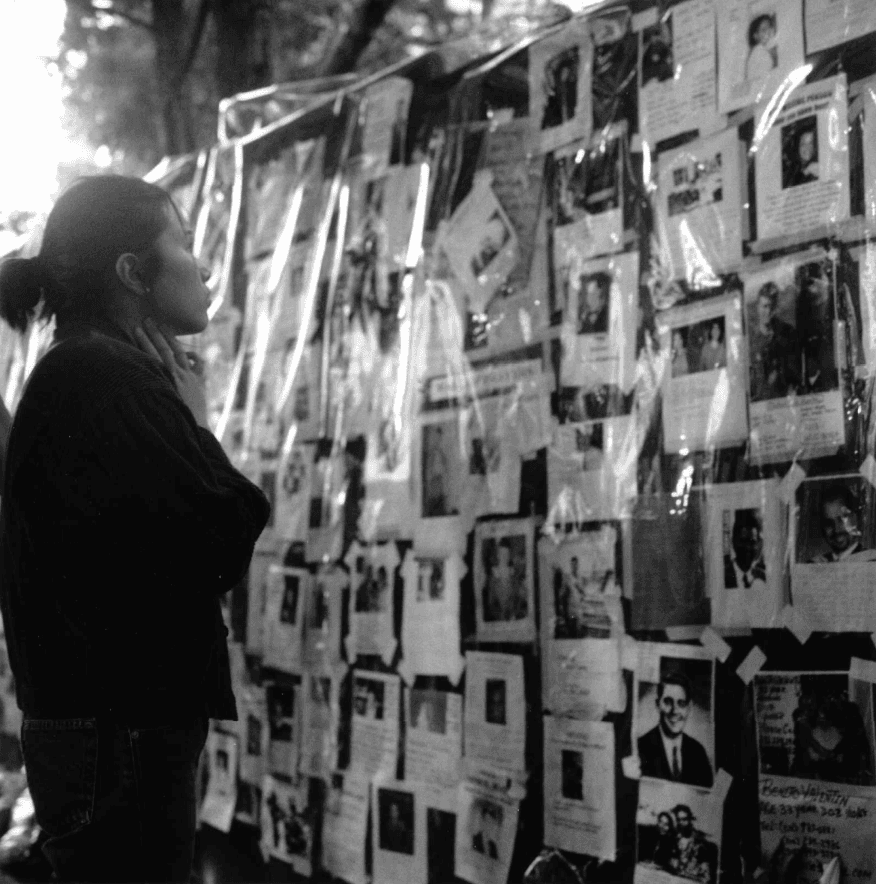
Missing. Photo by Philippe Cheng
The problem we on the left face is that many Americans do not wish to open their minds to understand the roots of what took place. In order to understand 9/11 we have to face the fact that the U.S. is hated across this planet—and not because we have such great values. September 11 was also the anniversary of one of the most ignominious examples of state terrorism in the last 30 years: I am speaking about the coup d’état in Chile, which overthrew the duly elected government of Salvador Allende in 1973 and installed a brutal, right-wing junta led by Augusto Pinochet. This coup was organized with the cooperation of the U.S. and is the reason that charges have been filed in Latin America against one Henry Kissinger, former Secretary of State for these United States.
The problem, however, is not just the U.S.—it is the West. We have to come to grips with Britain, which continues to occupy the north of Ireland; with the blockade against Iraq, where thousands of people are regularly dying; with the genocide in Rwanda that was apparently covertly supported by the French and ignored by the West until somewhere around a million people were murdered.
Global injustice does not simply take the form of coups and civil wars that are supported or tolerated by the West. What about the deaths of millions of Africans because of AIDS? That can be attributed to what can only be described as pharmaceutical genocide—a genocide that happens because African nations cannot obtain or manufacture generic drugs for fear of being on the receiving end of sanctions for violating the World Trade Organization (WTO) agreements.
The WTO structural adjustment proposals undermine the sovereignty of countries in the global South. Think of being forced to deal with a loan shark: either a country follows the directions of the international financial institutions, or the country gets no assistance. And, what happens when a nation follows this direction? Eduardo Galeano summed it up quite well in describing a situation involving the late Julius Nyerere, former President of Tanzania. Top-level staff from the World Bank asked Nyerere why he—and his path to development—had failed. He replied: The British Empire left us a country with 85 percent illiterates, two engineers, and 12 doctors. When I left office, we had 9 percent illiterates and thousands of engineers and doctors. I left office 13 years ago. Then our income per capita was twice what it is today; now we have one-third less children in our schools and public health and social services are in ruins. During these 13 years, Tanzania has done everything that the World Bank and the International Monetary Fund have demanded. And, Julius Nyerere passed the question back to the World Bank experts:
“Why have you failed?”
We, in the West, all too often think that we help the countries of the global South by making charitable contributions—fewer individuals die of starvation here, fewer die of tuberculosis there. Yet we fail to get to the root of the problem. We fail to acknowledge that the policies being pursued by global capitalism, whether in the guise of the WTO, the World Bank, International Monetary Fund, or various governments, are antithetical to the free and sovereign development of the countries of the global South.
We Americans acts as if pleading ignorance protects us from incrimination.
We plead ignorance and remain silent. We enjoy the comforts of our lives and switch the channels on our television sets when something too controversial or unsettling is displayed. We treat the periodic bombing of Iraq as if it were something out of a video game. During at least the last half of the 1990s, we talked of a great economic boom. Not only was the period not a boom for the mass of U.S. workers, but about half of the world was either in a depression or a recession.
We act as if pleading ignorance protects us from incrimination: “... I didn’t know about Pinochet. ... I didn’t know about Mossadegh. ... I didn’t know that children are dying of starvation in Iraq. ... I didn’t know ...”—and the list goes on and on. We have to ask ourselves at some point, why did we not know? And, if we did know, why did we remain silent?
There was to be a massive global justice march in Washington, D.C., on September 29 and 30 of last year. After September 11, that march was canceled. The problem was not the cancellation or refocusing of the march in the direction of peace. The problem is that for many activists the global justice movement has been canceled as well. A global justice movement has never been so badly needed. Now is the time when we on the left should be working with the average person, exploring and debating the roots of the 9/11 terror, discussing global injustice. Now is the time to awaken people from their illusions.
In rebuilding a global justice movement, we need to consider two points. One, it will be difficult, and we will meet with serious resistance. The movement is actually challenging the way we live, the way resources are distributed across the planet. Take the fact, for instance, that the U.S., only a fraction of the world’s population, uses somewhere around 20 percent of the world’s resources. The global justice movement is now necessary because a different sort of patriotism is necessary. The movement must encourage working-class people here in the U.S. to see their friends and allies as not those sitting in corporate boardrooms on Wall Street, but as those working at auto plants in Sao Paulo, Brazil, maquiladoras in Mexico, mines in South Africa, sweatshops in Indonesia. This calls for walking away from blind patriotism and, instead, embracing a patriotism for the working class, for what it has accomplished, for the struggles it must undertake.
September 11 was also the anniversary of one of the most ignominious examples of state terrorism in the last 30 years—a coup that was organized with the cooperation of the U.S.
Second, this is about more than education. The global justice movement has always done an outstanding job of exposing outfits like the WTO and IMF. The demonstrations across the world have made it clear to these trade ministers and their lackeys that they can run, but not hide. The global justice movement has ripped the covers off deals that the globalizers would rather conduct in secret.
Yet this is not enough. To shift the world balance of power and to implement a redistribution of wealth on a planetary scale, we must have more than outstanding demonstrations; we must have more than insightful columns; we must have more than outrage. We must gain political power! We must mount a struggle to shift the balance of power in our various nations and introduce a remarkably different approach—some would call it radical—in international relations.
Political power will not be won in the absence of strong and massive organization. It will not be won on the basis of powerful language and great oratory. It will not be won through reacting to the actions of capital. It will be won by advancing a program of struggle and a vision of a world that steps away from the barbarism of globalization and fights for a restoration of humanity. This can happen only through peace, justice, and democracy. Those currently in power must be asked to vacate their seats at the table, and they must be replaced by those who are currently the dispossessed, the marginalized. This will, indeed, give a new and current meaning to the notion of the meek inheriting the Earth.