Racism in a Time of Terror
Manning Marable
I. Notes from Ground Zero
I am still mourning time here in New York City. It has been several months since the terrorist attack destroyed the World Trade Center towers, but the tragedy remains brutally fresh and terribly vivid to millions of residents in this overcrowded metropolis. The horrific spectra of 3,000 human beings incinerated in less than 100 minutes, of screaming people free-falling more than a thousand feet to their deaths cannot be comprehended or even explained.
As I first witnessed the smoke billowing across the city’s skyline, I knew that the criminals who had obliterated the World Trade Center and part of the Pentagon were attempting to make a symbolic political statement about the links between transnational capitalism and U.S. militarism. But by initiating acts of mass murder, any shred of political credibility sought by those who plotted and carried out these crimes was totally destroyed. There can be no justification, excuse, or rationale for the deliberate use of deadly force and unprovoked violence against any civilian population. This was not essentially an act of war, but a criminal act, a crime against not only the American people, but all of humanity. All of those who planned, financed, and assisted in carrying out these crimes must be apprehended and brought to justice—but, I would add, under the aegis of international law and the United Nations.
In the immediate days following the terrorist attacks, some elements of the sectarian U.S. left, including a few Black activists, took the bizarre position that those who carried out these crimes were somehow “freedom fighters.” These “left” critics implied that these vicious, indiscriminate actions must be interpreted within the political context of the oppression that gave rise to those actions. In short, the brutal reality of U.S. imperialism, including America’s frequent military occupation of Third World countries, somehow justifies the use of political terrorism as a legitimate avenue for expressing their political resistance. It is certainly true that the American left must vigorously and uncompromisingly oppose the Bush administration’s militaristic response to this crisis, because the unleashing of massive armed retaliation will inevitably escalate the cycle of terror. Progressives, however, should also affirm their support for justice—first and foremost, by expressing our deepest sympathies and heartfelt solidarity with the thousands of families who lost loved ones in this tragedy. How can a left which claims to defend workers’ rights ignore the fact that among the victims of the World Trade Center attack perhaps as many as 1,000 labor union members were killed; that 1,500 children in metropolitan New York were left without a parent; and that hundreds of undocumented immigrants possibly perished in the flames of September 11, but their families are unable to step forward to governmental authorities because of their illegal residence in the U.S.?
Political condemnation of the Al Qaeda group should not, however, support their demonization, their description as “cowards” or “evil doers,” in the words of President Bush. We can denounce their actions as criminal, while also resisting the Bush administration’s and media’s racist characterizations of their political beliefs as “pathological” and “insane.” Bush’s extremist rhetoric only feeds racist attacks against Middle Eastern peoples and Muslims here in the U.S. Perhaps one of the most effective criticisms would be to highlight the important differences between the sectarianism of Islamic fundamentalism and the rich humanism that is central to the Islamic faith. In the eloquent words of the late Muslim intellectual Eqbal Ahmad, Islamic fundamentalism promulgates “an Islamic order reduced to a penal code, stripped of its humanism, aesthetics, intellectual quests, and spiritual devotion. It manipulates the politics of resentment and fear, rather than sharing and alleviating the oppression of the masses in the Third World.”
The African American is unquestionably a recognized member of the American national household—but has never been a member of the American family.
I think that as Americans, we must also make a clear distinction between “guilt” and “responsibility.” The Al Qaeda group was indeed guilty of committing mass murder. But the U.S. government was largely responsible for creating the conditions for reactionary Islamic fundamentalism to flourish. During Reagan’s administration, the Central Intelligence Agency (CIA) provided over three billion dollars to finance the Mujahadeen’s guerilla war against the Soviet Union’s military presence in Afghanistan. The CIA used Pakistan’s Inter-Services Intelligence, or secret police, to equip and train tens of thousands of Islamic fundamentalists in the tactics of guerilla warfare.
According to one 1997 study, the CIA’s financing was directly responsible for an explosion of the heroin trade in both Mujahadeen-controlled Afghanistan and in Pakistan. By 1985, the region had become, states researcher Alfred McCoy, “the world’s top heroin producer,” supplying 60 percent of U.S. demand. Heroin addicts in Pakistan subsequently rose “from near zero in 1979 . . . to 1.2 million by 1985.” Our Pakistani “allies” operated hundreds of heroin laboratories. The Taliban regime consolidated its authoritarian rule in the mid-1990s in close partnership with Pakistan’s secret police and ruling political dictatorship. And the Clinton administration was virtually silent when the draconian suppression of women’s rights, public executions, and mass terror became commonplace across Afghanistan. As The Nation columnist Katha Pollitt observed just before the demise of the Taliban dictatorship, women “can’t work, they can’t go to school, they have virtually no healthcare, [and] they can’t leave their houses without a male escort.” The Bush administration’s current allies in Afghanistan, the so-called Northern Alliance, are no better. As Pollitt noted, both fundamentalist groups were equally “violent, lawless, misogynistic [and] anti-democratic.”
One fairly standard definition of “terrorism” is the use of extremist, extralegal violence and coercion against a civilian, or noncombatant, population. Terrorist acts may be employed to instill fear and mass intimidation, to achieve a political objective. By any criteria, Al Qaeda is a terrorist organization. Most Americans have rarely experienced terrorism, but we have unleashed terrorism against others throughout our history. The mass lynchings, public executions, and burnings at the stake of thousands of African Americans in the early twentieth century were homegrown, domestic acts of terrorism.
The genocide of millions of American Indians was objectively a calculated plan of mass terrorism. The dropping of the atomic bomb on Japanese cities during World War II, resulting in the fiery incineration of several hundred thousand civilians, was certainly a crime against humanity. The U.S.-sponsored coup against the democratically elected government of Chile in 1973, culminating in the mass tortures, rapes, and executions of thousands of people, was nothing less than state-financed terrorism. There is a common political immorality linking former Chilean dictator Augusto Pinochet, Osama bin Laden, and former U.S. Secretary of State Henry Kissinger: they all believed that their political ends justified their means.
II. The City That Never Sleeps
This global tragedy was most profoundly felt by the eight million residents of New York City. It is difficult, if not impossible, to explain the deep emotional loss people feel here, the emptiness of spirit, as if one’s soul has been taken. The sense of personal insecurity and civic uncertainty has permeated all things. The sheer enormity of the crime and the media’s moving presentations of the many individuals who perished and of their grief-stricken families created the image of a city united, both in its pain and its determination. Rudolph Giuliani, who for nearly eight years played a profoundly polarizing role as the city’s aggressive, confrontational mayor, assumed overnight the image of compassionate leader. Journalists and novelists tried to put into words the qualities that gave all New Yorkers the capacity to endure. As Roger Rosenblatt observed in the New York Times: “What makes the city different is a civilized wildness born of compression. Deep in their hearts, New Yorkers live comfortably with a thrilling irrationality, perhaps because the city itself is so hard to believe.” The post-“9/11” image of a unified city, transcending boundaries of class and color, became so widely (and quickly) popularized that when Democratic mayoral candidate Fernando Ferrer suggested that he was campaigning for “the Other New York,” he was widely accused of racial divisiveness and “identity politics.”
Yet despite this sense of municipal pride, the harsh reality is that this remains a deeply divided city. American apartheid is strikingly and visually apparent in almost every neighborhood. As recently reported in the public affairs journal City Limits, the 2000 Census indicates that “in New York City, the ostensible capital of diversity, the segregation of Asians, Latinos, and black residents from white households is at virtually the same level today as it was in 1960.” Out of 331 metropolitan areas surveyed in the United States, New York City now ranks first in both Asian-white segregation and Latino-white segregation. New York’s black-white residential segregation also became worse during the Giuliani years, moving from seventh overall in the 1990 Census to third place, just below Detroit and Milwaukee. New York City’s Latino population doubled in the 1990s, yet the vast majority of new immigrants were concentrated in Spanish-speaking enclaves like Washington Heights and Sunset Park. As the white population became a minority group within a city that was predominantly defined by people of color, many middle- and upper-class whites retreated from any meaningful, direct interaction with segregated Black communities. As City Limits observes, New York's children, like other children throughout the country, increasingly live their lives “in segregated neighborhoods, schools, clubs, sports teams, and friendship networks.”
The city’s hypersegregated neighborhoods not only perpetuate distrust and social isolation behind color-coded barriers, but also obscure from public attention other major social problems, reflected in the statistics of poverty and unemployment. In the immediate aftermath of 9/11, an estimated 80,000 people in the city’s metropolitan area lost their jobs. About 60 percent of the jobs lost, however, paid under $23,000 per year. The largest single group of workers who became unemployed after September 11th were waiters and waitresses, numbering over 4,200. The Fiscal Policy Institute of New York calculates that the average hourly salary of these waiters and waitresses was $7.08. The second occupation group most devastated by the World Trade Center's collapse were nearly 3,400 cleaning and maintenance workers who took home an average of $14.90 per hour. The next five occupations most affected were retail sales representatives (2,843 unemployed, averaging $9.15 per hour), food preparation workers (2,284 unemployed, averaging $8.90 per hour), cashiers (2,282 unemployed, averaging $7.36 per hour), housekeeping workers (1,840 unemployed, averaging $13.42 per hour), and food preparation and fast-food servers (1,718 unemployed, averaging $7.09 per hour). Most of these individuals were employed at hotels, bars, restaurants, and in private transportation. Only 4 percent were employed at Wall Street brokerage firms. The vast majority of these jobless low-income workers did not benefit from the hundreds of millions of dollars donated to charities for the World Trade Center's victims. Only one-third of the jobless workers were covered by unemployment insurance, partially because in most instances, self-employed and part-time workers cannot qualify for unemployment insurance. As of the end of November 2001, a second federal aid program, Disaster Unemployment Assistance, has extended benefits to only 2,350 jobless workers.
In a time of political terror,the “terrorist” becomes the most dangerous Other and is recognized by certain “subhuman” qualities and vague characteristics—language, strange religious rituals, unusual clothing, and so forth.
New York City newspapers and the local all-news cable channel continuously displayed photos of the victims, with the majority appearing to be either persons of color or recent immigrants. Over four-fifths of these workers did not, or probably could not afford, to live in Manhattan. About one-half lived in Brooklyn and Queens, with another 12 percent residing in the Bronx. Many of the jobs destroyed in Manhattan were in Chinatown, not Wall Street. The Fiscal Policy Institute's survey found that about 20 of that neighborhood's 200 sewing sweatshops went under financially. Over 1,000 members of UNITE, the city’s garment workers’ union, had been fired by early November. As autumn turned into winter, New York's mostly volunteer-staffed food pantries and soup kitchens were reaching the limits of their capacity. As of November 2001, Food for Survival was supplying food for 275,000 meals a day and City Harvest providing another 20,000 daily meals—yet Joel Berg, director of the New York City Coalition Against Hunger, estimated that 30 percent of all pantries would soon have to “turn people away because they ran out of food.”
Politically, the net effect of 9/11 in New York City was tremendous fragmentation within the city’s liberal-left political establishment. Throughout Giuliani’s controversial administration, literally hundreds of civil rights, labor, women’s, and community-based organizations have marched, picketed, and protested. Everyone assumed that the city’s Public Advocate, Mark Green, a well-known Upper West Side liberal, would be elected the new mayor with little difficulty. But the severe impact of 9/11 diverted the attention of community-oriented coalitions and progressive groups toward addressing more immediate political issues. Some organizations focused attention on efforts to raise public awareness about the dangers involved in the U.S. war effort in Afghanistan; others emphasized the threat to American civil liberties and constitutional rights represented by new federal antiterrorism legislation. Civil rights organizations highlighted problems of anti-Muslim hate crimes and ethnic profiling by law enforcement officers. Grassroots activists who worked primarily on low-income persons’ issues found themselves soon overwhelmed by the crises of widespread joblessness and food shortages. Individual donors and some foundations redirected funds largely to relief efforts and away from community-oriented and antiracist organizing. Very few groups dedicated to progressive change had the infrastructural capacity to engage in emergency activities, while at the same time maintaining their commitments to long-term objectives. The result, in many ways, was a sense of diffused energies, the performance of good and humanitarian activities lacking the broad, strategic vision essential for restructuring the city’s power structure. At the general election in November, less than 30 percent of the city’s registered voters bothered to go to the polls. In a city where registered Democrats outnumber Republicans by a margin of five to one, a novice candidate, Republican billionaire Michael Bloomberg, narrowly defeated the veteran Democratic politician, Mark Green. Power remained firmly in the hands of those who owned the city, while its Black and brown population slid farther into economic recession and political marginalization.
III. Toward a National Security State
Did everything “fundamentally change” in the aftermath of the 9/11 attacks? Yes, there was an upsurge of public patriotism and national chauvinism, an understandable desire to “avenge” the innocent victims of the Al Qaeda network’s terrorism. Perhaps these terrible events marking the real “beginning” of the twenty-first century are, however, not a radical departure into some new, uncharted political territory, but rather the culmination of deeper political and economic forces set into motion more than two decades ago.
The core ideology of Reaganism—free markets, unregulated corporations, the vast build-up of nuclear and conventional weapons, aggressive militarism abroad and the suppression of civil liberties and civil rights at home, and demagogical campaigns against both “terrorism” and Soviet Communism—is central to the Bush administration’s policy initiatives today. Former President Ronald Reagan sought to create a national security state, where the legitimate functions of government were narrowly restricted to matters of national defense, public safety, and providing tax subsidies to the wealthy. Reagan pursued a policy of what many economists term “military Keynesianism,” the deficit spending of hundreds of billions of dollars on military hardware and speculative weapons schemes such as “Star Wars.” This massive deficit federal spending was largely responsible for the U.S. economic expansion of the 1980s.
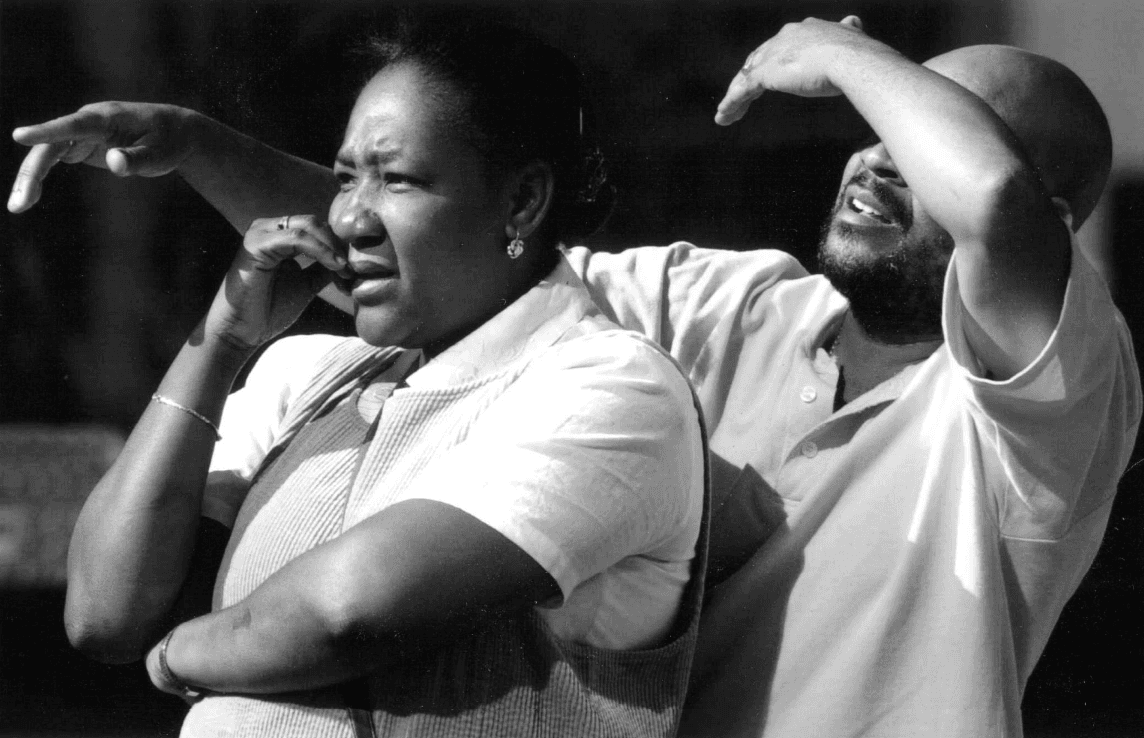
Looking Toward Disaster, September 12, 2001. AP Photo/Mike Derer
Simultaneously, the Soviet Union was pressured into an expensive arms race that it could not afford. The fall of Soviet Communism transformed the global political economy into a unipolar world, characterized by U.S. hegemony, both economically and militarily. The result was a deeply authoritarian version of American state power, with increasing restrictions on democratic rights of all kinds, from the orchestrated dismantling of trade unions to the mass incarceration of racialized minorities and the poor. By the end of the 1990s, two million Americans were behind bars, and over four million former prisoners had lost the right to vote, for life. “Welfare as we know it,” in the words of former President Clinton, was radically restructured, with hundreds of thousands of women householders and their children pushed down into poverty.
Behind much of this vicious conservative offensive was the ugly politics of race. The political assault against affirmative action and minority economic set-asides was transformed by the right into a moral crusade against “racial preferences” and “reverse discrimination.” Black and Latino young persons across the country were routinely “racially profiled” by law enforcement officers. DWB, “driving while black,” became a familiar euphemism for such police practices. As the liberal welfare state of the 1960s mutated into the prison-industrial-complex state of the 1990s, the white public was given the unambiguous message that the goal of racial justice had to be sacrificed for the general security and public safety of all. It was, in short, a permanent war against the black, the brown, and the poor.
The fall of Communism transformed a bipolar political conflict into a unipolar, hegemonic New World Order, as the first President Bush termed it. The chief institutions for regulating the flow of capital investment and labor across international boundaries were no longer governments. The International Monetary Fund, the World Trade Organization, and transnational treaties such as NAFTA exercised significantly greater influence over the lives of workers in most countries than their own governments. By the year 2000, 51 of the world’s 100 wealthiest and largest economies were actually corporations, and only 49 were countries. The political philosophy of globalization was termed “neoliberalism,” the demand to privatize government services and programs, to eliminate unions, and to apply the aggressive rules of capitalist markets to the running of all public institutions, such as schools, hospitals, and even postal services. The social contract between U.S. citizens and the liberal democratic state was being redefined to exclude the concepts of social welfare and social responsibility to the truly disadvantaged.
A new, more openly authoritarian philosophy of governance was required, to explain to citizens why their longstanding democratic freedoms were being taken away from them. A leading apologist for neoauthoritarian politics was New York mayor Rudolph Giuliani. In 1994, soon after his initial election as mayor, Giuliani declared in a speech: “Freedom is about authority. Freedom is about the willingness of every single human being to cede to lawful authority a great deal of indiscretion about what you do and how you do it.” As we all know, the Giuliani administration won national praise for reducing New York City’s murder rate from 2,000 a year down to 650 a year, and violent-crime rates plummeted. But the social cost to New York’s black, brown, and poor communities was far more destructive than anything they had known previously. The American Civil Liberties Union estimates that between 50,000 to 100,000 New Yorkers were subjected annually to “stop-and-frisk” harassment by the police under Giuliani. The city’s notorious Street Crimes Unit terrorized black and Latino neighborhoods.
The national-security state apparatus we are constructing today is being designed primarily to suppress domestic dissent and racially profiled minorities, rather than to halt foreign-born terrorists at our borders.
Many white liberals in New York City passively capitulated to this new state authoritarianism. It is even more chilling that in the wake of the September 11 attacks, New York Times journalist Clyde Haberman immediately drew connections between “the emotional rubble of the World Trade Center nightmare” and Amadou Diallo, the unarmed West African immigrant gunned down in 1999 by 41 shots fired by four Street Crimes Unit police officers. “It is quite possible that America will have to decide, and fairly soon, how much license it wants to give law enforcement agencies to stop ordinary
people at airports and border crossings, to question them at length about where they have been, where they are heading, and what they intend to do once they get where they’re going,” Haberman predicted. “It would probably surprise no one if ethnic profiling enters the equation, to some degree.” Haberman reluctantly acknowledged that Giuliani may be “at heart an authoritarian.” But he added that “as a wounded New York mourns its unburied dead, and turns to its mayor for solace,” public concerns about civil rights and civil liberties violations would recede. Haberman seems to be implying that the rights of individuals like Amadou Diallo are less important than the personal safety of white Americans.
As the national media enthusiastically picked up the Bush administration’s mantra about the “War On Terrorism,” a series of repressive federal and state laws were swiftly passed. New York State’s legislature, in the span of one week, created a new crime—“terrorism”—with a maximum penalty of life in prison. Anyone convicted of giving more than $1,000 to any organization defined by state authorities as “terrorist” will face up to 15 years in a state prison. When one reflects that, not too many years ago, the U.S. considered the African National Congress a terrorist organization and that the Palestine Liberation Organization is still widely described as terrorist, the danger of suppressing any activities by U.S. citizens who support any Third World social justice movements now becomes very real.
At all levels of government, any expression of restraint or caution about the dangerous erosion of our civil liberties is equated with treason. The antiterrorism bills in the New York State Assembly were passed with no debate, by a margin of 135 to 5. The U.S. Senate, on October 12, passed the Bush administration’s antiterrorism legislation by 96 to 1. The militarism and political intolerance displayed in the Bush administration’s response to the September 11 attacks created a natural breeding ground for bigotry and racial harassment. For the Reverend Jerry Falwell, the recent tragedy was God’s condemnation of a secularist, atheistic America. He attributed the attacks to “the pagans and the abortionists and the feminists and the lesbians,” to “the ACLU [and] People for the American Way.” Less well publicized were the hate-filled commentaries of journalist Ann Coulter, who declared: “We should invade their countries, kill their leaders, and convert them to Christianity.” Similar voices of racist intolerance are also being heard in Europe. For example, Italian Prime Minister Silvio Berlusconi stated that “Western civilization” was clearly “superior to Islamic culture.” Berlusconi warmly praised “imperialism,” predicting that “the West will continue to conquer peoples, just as it has Communism.” Falwell, Berlusconi, and others illustrate the direct linkage between racism and war, between militarism and political reaction.
The carpet-bombing of the Taliban seems to Third World observers to have less to do with the suppression of terrorism and more with securing future petroleum-production rights in Central Asia.
Even on college campuses, there have been numerous instances of the suppression of free speech and democratic dissent. When City University of New York faculty held an academic forum that examined the responsibility of U.S. foreign policies for creating the context for the terrorist attacks, the university’s chief administrator publicly denounced them. “Let there be no doubt whatsoever,” warned CUNY Chancellor Matthew Goldstein, “I have no sympathy for the voices of those who make lame excuses for the attacks on the World Trade Center and the Pentagon based on ideological or historical circumstances.” Conservative trustees of CUNY sought to censure or even fire the faculty involved. According to the Chronicle of Higher Education, hundreds of Middle-Eastern college students have been forced to return home from the U.S. as a result of widespread ethnic and religious harassment. At UCLA, library assistant Jonnie Hargis was suspended without pay from his job when he sent an e-mail on the university’s computers that criticized U.S. support for Israel. When University of South Florida professor Sami Al-Arian appeared on television talking about his relationships to two suspected terrorists, he was placed on indefinite paid leave and ordered to leave the campus “for his [own] safety,” university officials later explained. The First Amendment right of free speech, the Constitutional right of any citizen to criticize policies of our government, is now at risk.
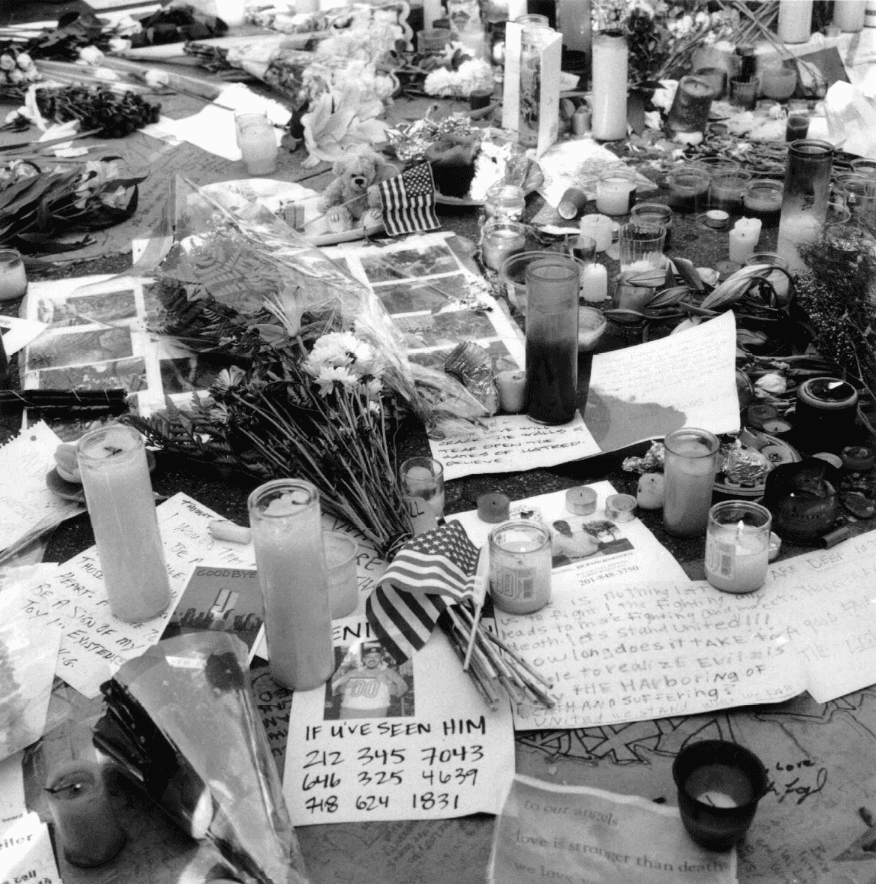
"If U've Seen Him." Photo by Philippe Cheng
Perhaps the most dangerous element of the Bush administration’s current campaign against democratic rights has been the deliberate manipulation of mass public hysteria. Millions of Americans who witnessed the destruction of the World Trade Center are still experiencing post-traumatic anxiety and depression. According to The Wall Street Journal, during the last two weeks of September pharmacies filled 1.9 million new prescriptions for Zoloft, Prozac, and other antidepressants, a 16 percent increase over the same. period in 2000. Prescriptions for sleeping pills and short-term anxiety drugs such as Xanax and Valium also rose 7 percent. The American public has been bombarded daily by a series of media-orchestrated threats, focusing on everything from the potential of crop-dusting airplanes being used for “bio-terrorism,” to anthrax-contaminated packages delivered through the U.S. Postal Service. People are constantly warned to carefully watch their mail, their neighbors, and one another. Intense levels of police security at sports stadiums and armed National Guard troops at airports have begun to be accepted as “necessary” for the welfare of society.
We are now beginning to see “dissident profiling”: the proliferation of electronic surveillance, roving wiretapping and harassment at the workplace, the infiltration and disruption of antiwar groups, and the stigmatization of any critics of U.S. militarism as disloyal and subversive. As historian Eric Foner has recently noted, “Let us recall the FBI’s persistent harassment of individuals like Martin Luther King, Jr., and its efforts to disrupt the civil rights and anti-war movements, and the CIA’s history of cooperation with some of the world’s most egregious violators of human rights. The principle that no group of Americans should be stigmatized as disloyal or criminal because of race or national origin is too recent and too fragile an achievement to be abandoned now.” I believe that one cannot preserve democracy by restricting and eliminating the democratic rights of any group or individual. To publicly oppose a government’s policies that one believes to be morally and politically wrong, as Dr. Martin Luther King, Jr., asserted, is to express the strongest belief in the principles of democracy.
Those of us who oppose our government’s course of action must clearly explain to the American people that the missile strikes and indiscriminate carpet bombings we have unleashed against Afghanistan peasants will not make us safer. The policies of the Bush administration actually put our lives in greater danger, because the use of government-sponsored terror will not halt brutal retaliations by the terrorists. The national-security-state apparatus we are constructing today is being designed primarily to suppress domestic dissent and racially profiled minorities, rather than to halt foreign-born terrorists at our borders. In 2000 alone, there were 489 million persons who passed through our border inspection systems. Over 120 million cars are driven across U.S. borders every year, and it is impossible to thoroughly check even a small fraction of them. Restricting civil liberties, hiring thousands more police and security guards, and incarcerating more than 1,000 Muslims and individuals of Arab descent without due process only foster the false illusion of security. The “war on terrorism” is being used as an excuse to eliminate civil liberties and democratic rights here at home.
IV. The Racial War at Home
This “war at home” also has a profoundly racial dimension. Because U.S. democracy was constructed on institutional racism, the government has always found it difficult to present a clear, democratic argument to advance its interests in the pursuit of warfare. Instead, it relies on and manipulates the latent racism and xenophobia at all levels of society. Usually, racism is used to target external enemies, such as “Japs” during World War II. But in general, whenever the U.S. mobilizes militarily and goes to war, white racism goes with it hand in hand.
The extreme degree of racial segregation in New York City provides part of the explanation for the rash of hate crimes committed here after September 11. For example, in the days immediately following the attack, according to the Asian-American Legal Defense and Education Fund, a Sikh man in Richmond Hill, Queens, “was assaulted with a baseball bat and shot at with a BB gun,” and a “Huntington, Long Island, man tried to run down an Asian woman with his car.” Arab and Muslim street vendors and storeowners throughout the city experienced verbal and physical harassment and were threatened with economic boycotts. Such incidents, of course, were not confined to New York City. The New-York-based South Asian American Leaders of Tomorrow (SAALT) issued a report based on over 400 media sources documenting 645 separate incidents of hate-inspired violence against Arabs, Asians, and Muslims in the U.S. during the first week after September 11. These included 3 murders, 49 assaults, and 92 incidents of arson and property damage.
Those who are coded or classified by appearance, dress, language, or name as Muslim or of Arab background have been rudely escorted off airplanes and Amtrak trains, and many have been detained without formal charges or access to attorneys. Anecdotal evidence suggests that a significant number, perhaps even the majority, of the people of color singled out for harassment as potential “terrorists” have not been Muslims or Arabs at all. In Seattle and other West Coast cities, dozens of Hawaiians, Central Americans, South Asians, and even American Indians have been subjected to verbal insults and harassment because they “appear” to be vaguely “non-American.” On the East Coast, many Sikhs and Hindus have been victimized, along with non-English-language speakers and non-European undocumented immigrants. Most white middle-class Americans in the so-called heartland of the country, the Midwestern states, lack both the cultural capacity and geopolitical awareness to make fine distinctions between “Muslims” and racialized others who happen to be non-Muslims.
The great exception to this phenomenon of new racialization in the time of terror, curiously, appears to be the African American. Persons of African descent, having lived on the American continent since 1619, occupy a unique position in the construction of white American identity and national consciousness. State power was deliberately constructed to exclude black participation; but black labor power was absolutely essential in the economic development of the nation. Black culture, moreover, contributed the most creative and original elements, which defined American national culture and various forms of representation.
Thus, the African American is unquestionably a recognized member of the American national household—but has never been a member of the American family. Yet there is a necessary kind of dialectical connection here, linking the false superiority of whiteness as a political and social category in the U.S. to the continued and “normal” subordination of blackness. Without “blacks,” whiteness ceases to exist as we know it. White supremacy has difficulty imagining a world without black people, but has no reservations about the indiscriminate mass bombing of Afghanistan peasants, or supporting an embargo against Iraq, which is responsible for the deaths of hundreds of thousands of Muslim children, according to many international human rights observers.
The great sociologist Oliver C. Cox understood this contradiction, the subtle distinctions between white racism, social intolerance, and xenophobia. As Cox put it: “The dominant group is intolerant of those whom it can define as anti-social, while it holds race prejudice against those whom it can define as subsocial. In other words, the dominant group or ruling class does not like the Jew at all, but it likes the Negro in his place.” In a time of political terror, the “terrorist” becomes the most dangerous Other and is recognized by certain “subhuman” qualities and vague characteristics—language, strange religious rituals, unusual clothing, and so forth. The “terrorist Other” is thus presented to the white public as an uncivilized savage who has richly merited our hatred and must be destroyed to assure our safety and the preservation of the American Way of Life.
There is a clear link between 9/11 and the shameful political maneuvering committed by the U.S. at the United Nations World Conference Against Racism, held in South Africa only days before the terrorist attacks.
The fundamental contradiction that has always confronted black Americans during these periods of racist wars is whether or not to take advantage of this situation in order to advance up the racial and political hierarchy. Check out the displays of American flags, for example, on the fronts of black middle-class suburban homes and businesses. On New York City subways in the months immediately following 9/11, I saw more black and Latino persons wearing red-white-and-blue buttons, caps, and other patriotic paraphernalia than in the past 20 years.
The media was overflowing with stories about the “new American patriotism,” and people of color were frequently featured on center stage. How many times were we reminded that Colin Powell, after all, is President Bush’s Secretary of State, and Condoleezza Rice is his National Security Adviser. The majority of the Congressional Black Caucus voted in favor of authorizing the use of U.S. military force against Afghanistan. Nevertheless, it is also true that African-American activists and many black elected officials have been consistently the sharpest and most vocal critics of the war and the suppression of civil liberties and have actively defended the rights of American Muslims. But I also suspect that the new xenophobia is viewed by some African Americans as not entirely a bad thing, if jobs that had previously gone to non-English-speaking immigrants now go to blacks. There is considerable hostility in cities such as Detroit and Houston between impoverished and working-class black urban neighborhoods and Arab shopkeepers and small storeowners. Blacks in 2000 voted overwhelmingly for the Gore-Lieberman ticket, while at least 40 percent of Arab Americans supported Bush-Cheney, based in part on their political and religious hostility toward Lieberman.
Part of the frustration the African-American community feels is found in our complicated love-hate relationship with our own country. That U.S. democracy was crudely constructed on the mountain of black bodies destroyed by centuries of enslavement, segregation, and exploitation is abundantly clear to us. Yet there is also that knowledge gleaned from our centuries-old struggle for freedom, that the finest ideals of American democracy are best represented by our own examples of sacrifice. This was undoubtedly behind W.E.B. Du Bois’s controversial editorial, “Close Ranks,” which endorsed African-American participation in the U.S. war effort during World War I. It is important to remember, however, that immediately after World War I erupted the “Red Summer” of 1919, during which hundreds of African Americans were lynched, beaten, and even burned at the stake. We cannot overturn the structural racism against us if we accommodate or compromise with war and racism against others.
V. The U.S. and the Third World
The bombing campaign against the people of Afghanistan may be described in future history books as “The U.S. Against the Third World.” The launching of military strikes against peasants did little to suppress global terrorism and only eroded American credibility in Muslim nations around the world. The question, repeatedly asked in the U.S. press, “Why do they hate us?” can only be answered from the vantage point of the Third World’s widespread poverty, hunger, and economic exploitation.
The U.S. government cannot engage in effective multilateral actions to suppress terrorism, because its behavior illustrates its complete contempt for international cooperation. The U.S. owed $582 million in back dues to the United Nations, and it paid up only when the 9/11 attacks jeopardized its national security. Republican conservatives demand that the U.S. should be exempt from the jurisdiction of an International Criminal Court, a permanent tribunal now being established at The Hague, Netherlands. For the 2001 World Conference Against Racism, the U.S. government authorized the allocation of a paltry $250,000, compared to more than $10 million provided to conference organizers by the Ford Foundation. For three decades, the U.S. refused to ratify the 1965 United Nations Convention on the Elimination of Racism. Is it any wonder that much of the Third World questions our motives? The carpet-bombing of the Taliban seems to Third World observers to have less to do with the suppression of terrorism and more with securing future petroleum-production rights in Central Asia.
The U.S. media and opinion makers repeatedly have gone out of their way to twist facts and distort the political realities of the Middle East by insisting that the Osama bin Laden group’s murderous assaults had nothing to do with Israel’s policies toward the Palestinians. Nobody else in the world, with the possible exception of the Israelis, really believes that. Even Britain, Bush’s staunchest ally, links Israel’s intransigence toward negotiations and its human rights violations as having contributed to the environment for Arab terrorist retaliation. In late September, during his visit to Jerusalem, British Foreign Secretary Jack Straw stated that frustration over the Israeli-Palestinian conflict might create an excuse for terrorism. Straw explained: “There is never any excuse for terrorism. At the same time, there is an obvious need to understand the environment in which terrorism breeds.” Millions of moderate and progressive Muslims who sincerely denounce terrorism are nevertheless frustrated by the extensive clientage relationship the U.S. has with Israel, financed by more than $3 billion in annual subsidies. They want to know why the U.S. allowed the Israelis to relocate more than 200,000 Jewish settlers—half of them after the signing of the 1993 peace agreement—to the occupied Palestinian territory.
How does terrorist Osama bin Laden gain loyal followers from northern Nigeria to Indonesia? Perhaps it has something to do with America’s massive presence in Saudi Arabia. The Washington Post recently revealed that in the past two decades, U.S. construction companies and arms suppliers have made over $50 billion in Saudi Arabia. Today, over 30,000 U.S. citizens are employed by Saudi corporations or by joint Saudi-U.S. corporate partnerships. Just months ago, Exxon Mobil, the world’s second largest corporation, reached an agreement with the Saudi government to develop gas projects worth between $20 and $26 billion. Can Americans who are not orthodox Muslims truly comprehend how morally offensive the presence of 5,000 U.S. troops in Saudi Arabia is for them?
There is a clear link between 9/11 and the shameful political maneuvering committed by the U.S. at the United Nations World Conference Against Racism held in Durban, South Africa, only days before the terrorist attacks. There the U.S. government opposed the definition of slavery as “a crime against humanity.” It refused to acknowledge the historic and contemporary effects of colonialism and racial segregation on the underdevelopment and oppression of the non-European world. The majority of dark humanity is saying to the U.S. that racism and militarism are not the solutions to the world’s major problems. Transnational capitalism and the repressive neoliberal policies of structural adjustment represent a dead end for the developing world. We can only end the threat of terrorism by addressing constructively the routine violence of poverty, hunger, and exploitation that characterize the daily existence of several billion people on this planet. Racism is, in the final analysis, only another form of violence.
VI. History’s Common Judgment
To stop the extraordinary violence of terrorism, we must stop the daily violence of class inequality and poverty. To struggle for justice—to find new paths toward reconciliation across the boundaries of religion, culture, and color—is the only way to protect our cities, our country, and ourselves from the terrible violence of terrorism. Because without justice, there can be no peace.
What I have learned from the experience of being near Ground Zero on 9/11 is the simple truth that sometimes, even for intensely political people, “politics” is not enough. No political ideology, no crusade, no belief in a virtuous cause, can justify such moral bankruptcy. Yet, because of the military actions of our own government, any claims to moral superiority have now disintegrated in the minds of the black and brown world. The American bombings have indeed destroyed the ruthless Taliban regime, but have killed hundreds and possibly thousands of innocent civilians. As the brutal boundaries are blurred between the killers and the victims, we must share history's common judgement, making sinners of us all. As T.S. Elliot observed seven decades ago:
... Because these wings are no longer wings to fly.
But merely vans to beat the air
The air which is now thoroughly small and dry
Smaller and dryer than the will
Teach us to care and not to care
Teach us to sit still.
Pray for us sinners now and at the hour of our death
Pray for us now and at the hour of our death
WORKS CITED
Aguiar, Anna, “Darkness at Deepvali,” City Limits 25 (November 2001): 9.
Alterman, Eric, “Requiem for a Liberal,” The Nation 273 (November 26, 2001): 12.
Alvarez, Lizette, “House Approves $582 Million For Back Dues Owed to U.N.,” New York Times, September 25, 2001.
American Friends Service Committee Report, “After September 11: Standing on the Brink of a ‘Brave New World.’” www.afsc.org/JusticeVisions.htm
“Barbara Lee’s Stand,” The Nation 273 (October 8, 2001): 5.
Bennett, James, “Muddle Over Arafat-Peres Meeting Is Frustrating for Bush,” New York Times, September 25, 2001.
Editorial, “An Outpouring of Dollars,” New York Times, October 1, 2001.
Flynn, Stephen E., “Safer Borders,” New York Times, October 1, 2001.
Foner, Eric, “The Most Patriotic Act,” The Nation 273 (October 8, 2001): 13.
Fuentes, Annette, “Fractional Numbers,” City Limits 25 (November 2001): 10-12.
Haberman, Clyde, “Diallo, Terrorism and Safety vs. Liberty,” New York Times, September 13, 2001.
Hartcollis, Anemona, “CUNY Chief Repudiates Forum Remarks,” New York Times, October 4, 2001.
Herbert, Bob, “Hunger in the City,” New York Times, November 22, 2001.
McKinley, Jr., James C., “Unified State Legislators Pass Tougher Anti-Terrorism Laws,” New York Times, September 18, 2001.
McMurtrie, Beth, “Arab Students in U.S. Head Home, Citing Growing Hostility,” Chronicle of Higher Education 48 (October 5, 2001): A42-A44.
Morgan, Dan and David B. Ottaway, “The Friend of My Enemy Is...: Saudi Royals’ Ties with the United States Inflame Islamic Radicals,” Washington Post National Edition, October 1-7, 2001.
Niebuhr, Gustav, “Falwell Apologizes for Saying An Angry God Allowed Attacks,” New York Times, September 18, 2001.
“Outspoken Faculty Members Suspended,” Seattle Post-Intelligencer, October 13, 2001.
Pacenza, Matt, “9/11, A Flood in the Soup Kitchen,” City Limits 25 (November 2001): 5.
Parker-Pope, Tara, “Anxious Americans Seek Antidepressants To Cope With Terror,” Wall Street Journal, October 12, 2001.
Pollitt, Katha, “Put Out No Flags,” The Nation 273 (October 8, 2001).
Rosenblatt, Roger, “Just Crazy About the Place,” New York Times, November 22, 2001.
Russ, Hilary, “Organizers Tweak Priorities After September 11,” City Limits 25 (December 2001): 8-9.
FOOTNOTES
1T.S. Elliot, “Ash-Wednesday,” 1930, in T.S. Elliot, The Complete Poems and Plays, 1909–1950 (New York: Harcourt, Brace and World, 1962), pp. 60–67.