Reconsidering Community Building: Philanthropy Through a Structural Racism Lens
Keith Lawrence
In the United States, an array of community-building and community-development organizations has been working to improve conditions in distressed urban settings for at least the past four decades. During this period, key attributes of the way the field has evolved have been a focus on disproportionately minority clientele and a reliance on the support of government and philanthropic institutions. Each characteristic has influenced how community builders visualize their roles and design local intervention strategies. So it is important that those concerned about the future of the field understand their significance.
First of all, we need to acknowledge community building’s history of reliance on nonlocal institutional support. Very few of the community-based service providers, technical assistance and training organizers, and other nonprofit actors who now occupy the community-building mainstream have managed to build their capacities exclusively with local, grassroots resources. Most have had to rely on external resources from the public and private sectors.
Since the late 1970s, however, there has been less public support. So private, mainly philanthropic, foundation funding has been the mainstay of the field nowadays. According to the Chronicle of Philanthropy, nonprofits received almost $28 billion in grants from foundations in 2000. The journal also noted that philanthropic grant making has increased over the past few years. It did not specify how much was given to community-building nonprofits, but judging from the size and vitality of this sector today, we can safely assume it has been a considerable share.
Nevertheless, community builders have always viewed external support as a slightly mixed blessing. On the one hand, they welcome the access to resources that are unavailable locally. On the other, they have often felt that the funder-client relationship limited their ability to be as responsive, flexible, and patient as local challenges sometimes dictated. Even so, most community builders probably would acknowledge that they have had considerable input in the design of foundation-sponsored programs and that external funding constraints have been a small price to pay for what has been accomplished with those dollars.
The Pragmatic Approach
For better or worse, philanthropy has become an indispensible aspect of community building. In the 1980s many community builders developed a more pragmatic attitude about funding than they may have held in previous decades. Urban problems grew dramatically in that decade, while public investment in urban solutions plummeted. Economic restructuring, the drug epidemic, homelessness, and other crises began to devastate already fragile inner-city neighborhoods. Local nonprofits were called upon to do more with less. Local business support was sparse and narrowly focused. Except for faith-based organizations, few service providers had significant indigenous capacity for sustained effort. At the same time, public policymakers began to emphasize self-help and human capital initiatives. They also began to make public funding more contingent on linkages across related programs and the availability of local matching funds. In this climate, many young organizations committed to tackling joblessness, substance abuse, homelessness, and inadequate housing vigorously sought any funding that might be available, particularly more flexible and less conditional philanthropic dollars.
Most in the community-building mainstream welcomed this growth in philanthropic involvement. But some within and outside that mainstream have been uncomfortable with the idea of foundation leadership in community building, particularly with respect to issues of power and race. Some in this field strongly doubt that major foundations can move in a progressive direction on these issues. Indeed, they would insist that the field wean itself away from philanthropic dependence and move toward greater grassroots accountability.
Others are willing to take a more balanced view of philanthropy. They recognize that blanket dismissals ignore the efforts of many foundation officers who are personally committed to racial equality. Also, they are more aware of the critical role these institutions have come to play in extending American democracy. This is not to suggest that they fail to recognize the potential pitfalls of foundation influence on how community builders approach issues of race and institutional power. But they prefer to take the position that, at the very least, those within community building who are interested in nudging the field closer to a mission of racial equality should seek to involve philanthropies that appear amenable to that idea. The assumption is that funders, practitioners, and researchers attuned to urban poverty could forge a new grant-making paradigm based on an awareness of structural racism.
Racial Sorting
Structural racism refers to the complex ways in which historical oppression, culture, ideology, political economy, public policy, and institutional practices interact to produce social dynamics that reproduce and reinforce a hierarchy of color that privileges whiteness and marginalizes blackness. One of these dynamics is “racial sorting.” This label describes processes operating at the spatial, institutional, cultural, and cognitive levels in our society to maintain white privilege. Another dynamic can be described as “racial progress and retrenchment.” This is the historical and ongoing reality that various forms of civic resistance to racial inequality bring discrete areas of racial progress, but that those racial equity gains tend to be undermined by negative racial outcomes in related areas. For example, advances on the public-school desegregation front were undermined by a proliferation of white suburban school districts. The two broad dynamics may play out differently in different regions and policy domains. But the general proposition is that sorting and the “progress-retrenchment” syndrome continually work to preserve historically embedded racial disadvantage.
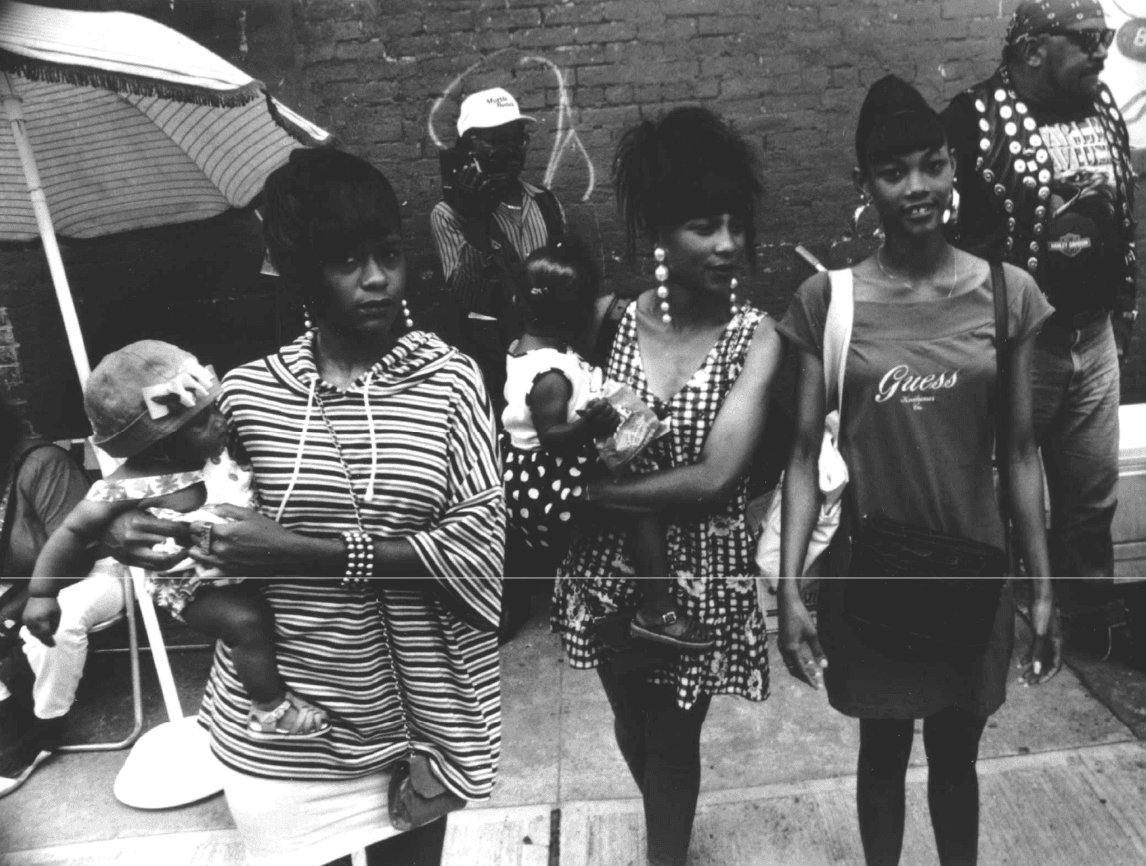
Mothers. Photo by LeRoy Henderson
The contention is not that foundation grant makers overlook racial equity as a necessary social outcome, but that they could do more to encourage structural thinking in this regard. They could do more to help construct a counternarrative to the “underclass” theory of disadvantage that has informed public and private urban remedial attention for three decades now. The underclass perspective, in sum, holds that a subset of Americans lies outside the economic and cultural mainstream and that their reconnection to it hinges upon their own efforts to overcome personal and local pathologies. This new narrative would explain that the “underclass” is really a symptom of fundamental inadequacies in our social-policy mechanisms and political economy, that these systems have failed to deliver the equal opportunity promised to large segments of our society, and that these failures are largely rooted in an undemocratic social bias built into those systems—race. The goal should be to help everyone within the community-building field recognize that, fundamentally, this is why urban poverty largely impacts African Americans, Latinos, and other dark-skinned minorities; and why, in most major metropolitan settings, the geography of opportunity and success correlates highly with racial distribution. In other words, philanthropy could help promote within community building a conventional wisdom that local interventions must also change the undemocratic dynamics of structural racism.
The good news is that there are a few important voices within philanthropy already calling for a closer analysis of race within the community-building context. What we do not know is how foundation elites in general will respond to a race analysis that surfaces white privilege, racial equity, and political power as priority concerns and that places a democracy-building agenda squarely on the table.
“Equalizing” Forces
As already noted, some race- and equity-conscious community builders prefer to take a balanced view of mainstream philanthropy. They bring a more nuanced understanding of the important role that foundations, as secondary institutions, play in the American democratic context. Part of this understanding is that Americans have always relied on secondary institutions to extend democratic equality: e.g., public schools, trade unions, political parties, and organized religion. Some have called these “equalizing institutions” since, altogether, they help create a common social fabric and additional opportunity pathways for those without social advantages. To the extent that institutionalized philanthropy has given a broader cross section of the public access to areas and opportunities once the exclusive preserve of elites—such as higher education, or the arts, or specialized training—it has been part of this equalizing stratum.
Traditionally, one way philanthropy has played this role has been by supplementing the work of other institutions that provide collective, public benefits, e.g., public libraries, public broadcasting, cultural and other preservationist organizations, and of course, community-building organizations. Over the years, philanthropic contributions to these areas have been welcome (albeit far from adequate) counterweights to the erosion in public will to provide such collective “goods.” In the community-building arena, foundations put into effect this equalizing spirit nowadays by promoting and supporting “comprehensive community initiatives” (CCIs). These are place-based, mainly urban endeavors that emphasize capacity building on several levels.
However powerful, the social capital idea is inadequate as a key feature of community well being because, at its core, it minimizes the role of state and national structures in local development.
Though commendable in many respects, however, this CCI approach has proven inadequate, in part, because it doesn’t address systemic sources of inequality. Comprehensiveness explicitly acknowledges multiple causalities when it comes to chronic poverty. But the tendency of these initiatives is to focus too narrowly on people and place. This actually may be counterproductive, because the “progress and retrenchment” feature of structural racism continually undermines individual and localistic gains. Ultimately, it may be futile to address only the most proximate problems and needs of the poor and ignore overarching, nonlocal factors that help recreate that condition.
One explanation for this CCI posture might be that although CCIs (and the foundations that sponsor them) do recognize structural barriers, they may not see how local practice could be tailored to address them. Another explanation might be ideological. Permanent metropolitan inequalities are not popularly conceptualized as systemic issues, but rather as consequences of personal and local shortcomings within a political economy that is basically equitable and race-neutral. Following from this is an assumption that once these dysfunctional local components are stabilized and given basic supports, they would be able to fit into and negotiate that political economy independently.
Inevitably, this mindset generates excessive reductionism in practice. Operational theories of change overemphasize the individual and local, rather than broader systemic transformation. And race is minimized into an interpersonal and intergroup issue, largely abstracted from history and broader social meaning.
Racial Group Equity Principle
Nowadays, community-oriented philanthropy is heavily involved in many areas of great social significance—employment opportunity, education reform, health care access, child and youth development, criminal justice, urban sprawl, and so on. Leading urban community-building grant makers generally view social justice as an explicit or implicit part of their missions. Whether or not these self-perceptions are well founded, philanthropic funders of community initiatives would do well to reexamine their fundamental assumptions about social justice and about their comparative advantages as social-justice agents. They might begin by adopting a racial equity standard for social justice and a commitment to socializing this throughout the community-building culture.
A good place to begin might be with a critical reexamination of the mainstream “master narrative” of inner-city disadvantage that some foundation elites have found persuasive. Foundations can facilitate the research and collaboration necessary for the creation of new narratives that better account for history, institutional factors, and white privilege. Part of the new story might be that racial-group designation and position are key components of human capital. The wider society needs to hear from other authoritative voices that race is a social resource that often trumps merit. Together, influential foundation elites can work to reduce the social value of race as strenuously as they champion individualistic interventions like job training and access to social services and affordable housing and educational opportunity. Systemic change (that is, at the institutional as well as social-psychological levels) seems to be needed to truly rectify minority disproportions in urban outcomes.
The good news is that there are a few important voices within philanthropy already calling for a closer analysis of race within the community-building context.
Part of the new narrative, in other words, might be that individual successes alone are unlikely to add up to neighborhood transformation. They need to be complemented by deliberate collective strategies to engender fundamental systemic changes and halt processes that recreate racial marginalization. This kind of comprehensiveness may be required because racial marginalization operates at all levels of the culture and political economy to sort Americans institutionally, spatially, and psychologically, by race. The narrative might explain that sorting has been an American historical phenomenon, operating to reproduce a racial hierarchy in all critical domains of social life.
It might further explain that everyone occupies a niche within this hierarchy, and that it persists because race is an ongoing, dynamic social-construction project. Demographic and economic shifts drive this process of racial formation. But the essential aspect of this hierarchical dynamic may be that it is shaped by concepts of whiteness and blackness. Race is a fluid concept that, historically, has been negotiated between the dominant white majority and oppressed minority groups. The backdrop for negotiation has always been a scale of privilege on which Anglo-Saxon whites occupy the upper level and dark-skinned Africans the lowest. In terms of social standing, everyone else operates somewhere in-between, but continually work to improve their ranking. The evidence of this dynamic is that at various historical moments, designations of whiteness have shifted, sometimes through the mechanisms of the courts.
The new story of inner-city distress might go on to explain that the racial sorting these places demonstrate has been a natural aspect of the ways in which American society has unfolded historically. This seeming lack of malevolent manipulation since slavery and the Jim Crow period makes the racial hierarchy exceedingly resilient. Piecemeal efforts to dismantle the structure of oppression (e.g., legal remedies like civil rights laws) are countervailed and often neutralized by facets of it that remain unchallenged (e.g., whites’ prerogative to move away, en masse, from others lower down on the racial hierarchy and to have that mobility supported by real estate, transportation, and tax policies).
Probably more than anything else, this awareness of continual racial progress and retrenchment needs to inform the idea of comprehensive community building. Community builders and their clients need to know that they are engaged, fundamentally, in a struggle for the capacity—or power—to stave off institutional and societal interests that, when opposed on one front, press forward on others to reestablish racial hierarchy. Comprehensiveness could also come to mean a resolve to build alliances and coalitions beyond local “place” to eliminate the very source of disproportionate minority disadvantage, which is racial hierarchy and white privilege.
Redefining Core Values
Philanthropic institutions exert great influence over the intellectual frameworks guiding community practice. Over the last two decades or so, they helped facilitate the transmission of concepts like “human and social capital,” “social networks,” “soft skills,” “regionalism,” and many others, from the social-science academy into the community-building lexicon. Many of these ideas now occupy the mainstream of community-building thought. The dominant definitions of virtually all these concepts, however, do not reflect the structural or endogenous perception of race and racism discussed above. At best, they reflect race neutrality. This limitation provides an excellent opportunity for philanthropic leadership.
As part of the socialization of new narratives on disadvantage, foundations could encourage research that interrogates core community-building ideas from a racial-equity standpoint. Along with the ones listed above, there are concepts like “empowerment,” “participation,” “coalition building,” “sustainability,” and “capacity.” But to illustrate how such core ideas might be reconstructed, let us take a brief look at one that has had great resonance: social capital.
Social Capital
Social capital, loosely defined here as the degree to which community members share trust and other qualities inherent in social relationships, has acquired great legitimacy. Community builders have come to view it as an essential collective resource for sustained economic and social development, just like finance and other more traditional forms of capital.
An interesting aspect of popular understanding of social capital is that it is mainly regarded as an indigenous community resource. Community members supposedly generate and harness it for themselves by recognizing and strengthening internal bonding ties to each other and bridging ties to resourceful external and internal actors. Successful communities are assumed to have adequate stocks of these forms of social capital and distressed ones to lack necessary amounts. Following this logic, place-based revitalization initiatives are encouraged to nurture and enhance social networks within their neighborhoods and linkages to resourceful partners on other levels.

Menacing Clouds. Photo by Philippe Cheng
However powerful, this social capital idea is inadequate as a key feature of community well-being. The reason is that, at its core, it minimizes the role of state and national structures in local development. In complex modern societies, those levels of government are indispensable elements in sustainable community development. Quite simply, modern communities need foundations of basic infrastructural, social service, business, and other supports upon which to build. Strong internal ties and resourcefulness alone are unlikely to suffice as basic building blocks. Also required are collective goods that only government can provide equitably and reliably. Indeed, when we look at communities in the U.S. that work today, it is not hard to see and understand the vital role that collective, institutional resources have played, and continue to play, in fostering local social capital. Decent parks and community centers allow families to meet and share information; living-wage jobs with benefits provide more time for informal social interaction; safe streets allow neighbors and children to socialize; small classes allow parents to really get to know teachers.
Race is a fluid concept that, historically, has been negotiated between the dominant white majority and oppressed minority groups.
In short, the “social” in social capital should remind us that only society as a whole (through its opportunity institutions) can provide the threshold amounts of basic collective goods needed for building community. The local or relational social capital that ensues then works to strengthen and sustain those public or institutional resources.
Race factors into this because institutional social capital is a limited and deeply contested commodity. Race is a basis for intense political contestation in America. Communities of color are at a distinct disadvantage in the contest for institutional social capital because they tend to be poorer and less powerful. Moreover, the marginalization that results from racial sorting and retrenchment makes it difficult for these communities, on their own, to develop the political clout needed to bargain effectively for a more equitable share.
Applying a structural lens brings into focus a much more comprehensive image of social capital and thus more of its implications for community building. We see that social capital inheres also in local relationships with internal and external institutions that dispense critical public goods. Greater recognition of social capital’s public policy dimension, rather than just its local and civic attributes, suggests that other kinds of informal bonds—the ones associated with governance—may be just as critical. Community builders may need tools to investigate and develop the more conventional social-capital elements that research literature labels “social networks” or “ties,” “sense of community,” “social cohesion,” and “informal social control,” to see how these might be supplemented or expanded to reflect the institutional dimension.
A New Way to Look at Community Building
Community-oriented philanthropies committed to promoting social justice could provide much needed new leadership by advancing a racial-equity paradigm for community-building thinking and practice. They might challenge the field to reconcile its dominant individualistic and localistic perspectives with realities of racial hierarchy. They could raise questions about the wisdom of the current goal of building inner-city capacity for eventual entry into the socioeconomic mainstream, while racial hierarchy remains unchallenged. Does social justice or social equity mean acceptance of a permanent racial-disparity gap, as long as disadvantaged individuals of color can be lifted above the poverty line?
Tackling this problem in community building does not require the debunking of current theories guiding the field, but rather their enlargement or rehabilitation to accommodate structural racism. Two broad steps in this direction might be:
- The encouragement of a new round of “field building” by a collective of race-conscious funders, practitioners, and researchers. This would involve the extensive overhaul of the field’s core assumptions, principles, and values. Of particular importance would be the development of a new set of research, capacity building, power analysis, and evaluation tools relevant to racial-equity goals.
- The construction and dissemination to multiple audiences—policymakers, the media, business leaders, and communities—of new narratives of inner-city disadvantage. These would counterbalance conventional explanations with historically grounded, structural explanations of how processes of marginalization contribute to the maintenance of a racial underclass.
Although some foundations may be receptive to carrying forward these ideas, the initial impetus may have to come from influential parties outside those institutions. Here, the research arm of the community-building field could be a useful stimulus for what might ultimately amount to a much-needed change in the community-building culture.