Resident's Journal : By and For Public Housing Tenants: An Interview with Editor Ethan Michaeli
Sudhir Alladi Venkatesh
Sudhir Alladi Venkatesh: What was the context in which you decided to begin Resident’s Journal?
Ethan Michaeli: Resident’s Journal was launched in 1996, approximately a year and a half after federal officials took over the Chicago Housing Authority (CHA). Officially, the U.S. Department of Housing and Urban Development (HUD) takeover of CHA was a response to executive director Vince Lane’s failure to address infamous housing conditions at the developments—high crime rates, rodent and vermin infestation, broken elevators, a corrupt and inefficient bureaucracy, and a hostile relationship with other city agencies. But the HUD takeover almost certainly had a strong political component as well: The Democratic National Convention was scheduled to be held in Chicago’s United Center, which abuts the Henry Horner Homes development, just one year after the takeover. With President Bill Clinton’s reputation and re-election as a reformer of the nation’s social welfare state at stake, Democratic officials wanted to eliminate CHA as a potential symbol of failed federal programs.
The initial team of HUD officials was soon replaced with a group led by Joseph Shuldiner, until then the HUD Assistant Secretary in charge of all the nation’s public housing stock. He had successfully run the New York City and Los Angeles housing authorities before coming to HUD. As part of his effort to improve the agency, to forge relationships with resident leaders, and to change the public perception of residents, he announced plans to initiate a resident-written newspaper. I was immediately intrigued by the idea, having heard often from residents that mainstream media misrepresented them and failed to provide them with useful information. Moreover, I encountered many residents who demonstrated both talent and interest in journalism. I was selected as newspaper editor (by the hiring committee, which included resident leaders and CHA officials about whom I had written) largely because of my experience covering the CHA and working with residents; several of the candidates had expressed reservations about recruiting or training residents in the developments. Before accepting the position, I asked CHA for a written guarantee they would not censor or otherwise shape the editorial content of the publication. I felt that editorial independence would be a critical component of the publication’s ability to attract and retain residents to its ranks. That independence, therefore, was a necessary precondition for the success of the plan to allow the publication to develop into a not-for-profit enterprise within five years.
SAV: How do you describe the politics of the paper?
EM: Although Resident’s Journal does not take political or advocacy positions, the residents’ articles nevertheless offer a perspective that can be perceived as political. Resident’s Journal correspondents offer a wide variety of news items from a variety of perspectives. Each issue includes coverage of the redevelopment of public housing as well as news for seniors, neighborhood-specific information, and articles from youth reporters. The residents’ articles, instead, focus on quality-of-life issues such as the continuing challenges faced by the overwhelming majority of residents who remain in their developments, the particular process of relocation as it affects individual families, and the availability and quality of services for people moving from welfare to work, for example. The residents’ concerns reflect the realities of life for those at the lowest income levels in the nation and the growing income gap between those populations and middle-income Americans. With average incomes of between $6,000 and $9,000 per year per household, public housing communities made up ten of the 15 poorest census tracts in the United States in the last census.
SAV: In what ways are tenants benefiting from the paper?
EM: Resident’s Journal is distributed free to every public household in the city as well as to health care facilities, community centers, and religious institutions—some 35,000 copies of each issue. Tenants use Resident’s Journal in a variety of ways. Many receive information that helps them make decisions about their lives, such as where they might choose to relocate or how they can take advantage of a previously unknown public housing program. For other residents, the publication serves the traditional media role of a watchdog over a government bureaucracy. Resident’s Journal often uncovers CHA practices and policies which contradict their stated intentions. Though CHA claims to offer the residents choice in relocating, for example, Resident’s Journal articles have exposed CHA officials’ and managers’ individual efforts to limit tenants’ choices in order to ease their own workloads. Where CHA claims to be “getting out of the program business,” and “integrating public housing residents with other city communities,” Resident’s Journal has exposed transfers of millions of dollars from CHA to city agencies without a means of tracking outreach or services to CHA residents.
Last, Resident’s Journal changes mainstream media coverage of public housing communities both by offering a different perspective on the news and by challenging the prevailing stereotypes of public housing residents. Resident’s Journal’s very presence among other media contradicts recurring images of public housing tenants as lazy, illiterate, and unconnected to broader communities.
SAV: What have been your experiences with other institutions of news coverage and journalism, and what makes your perspective distinct from their work on public housing?
EM: Mainstream media are sometimes frustratingly reluctant to include the perspectives of public housing tenants in articles and discussions about the future of public housing communities. Media organizations tend to accept assumptions about the behavior of public housing tenants, the need for mixed-income communities, and the effect of certain types of architecture on the lifestyles of public housing residents. Mainstream media simultaneously tend to ignore and accept the second-rate services provided to public housing residents. I believe this skewed coverage is a direct result of our failures as a society to address issues of race, gender, and poverty. Mainstream media circumvent public housing residents because they are overwhelmingly low-income African-American women. The net result is that conversations about the past, present, and future of public housing rarely—if ever—achieve satisfactory conclusions. Chicago Housing Authority officials make promises that are repeated year after year without being fulfilled; experts pronounce theories that are never tested by residents’ experiences; social service providers wring their hands.
Because it is written for and by public housing tenants, Resident’s Journal obviates practical solutions to residents’ problems and concerns. By extension, Resident’s Journal offers realistic solutions to the problems faced by many other low-income Americans.
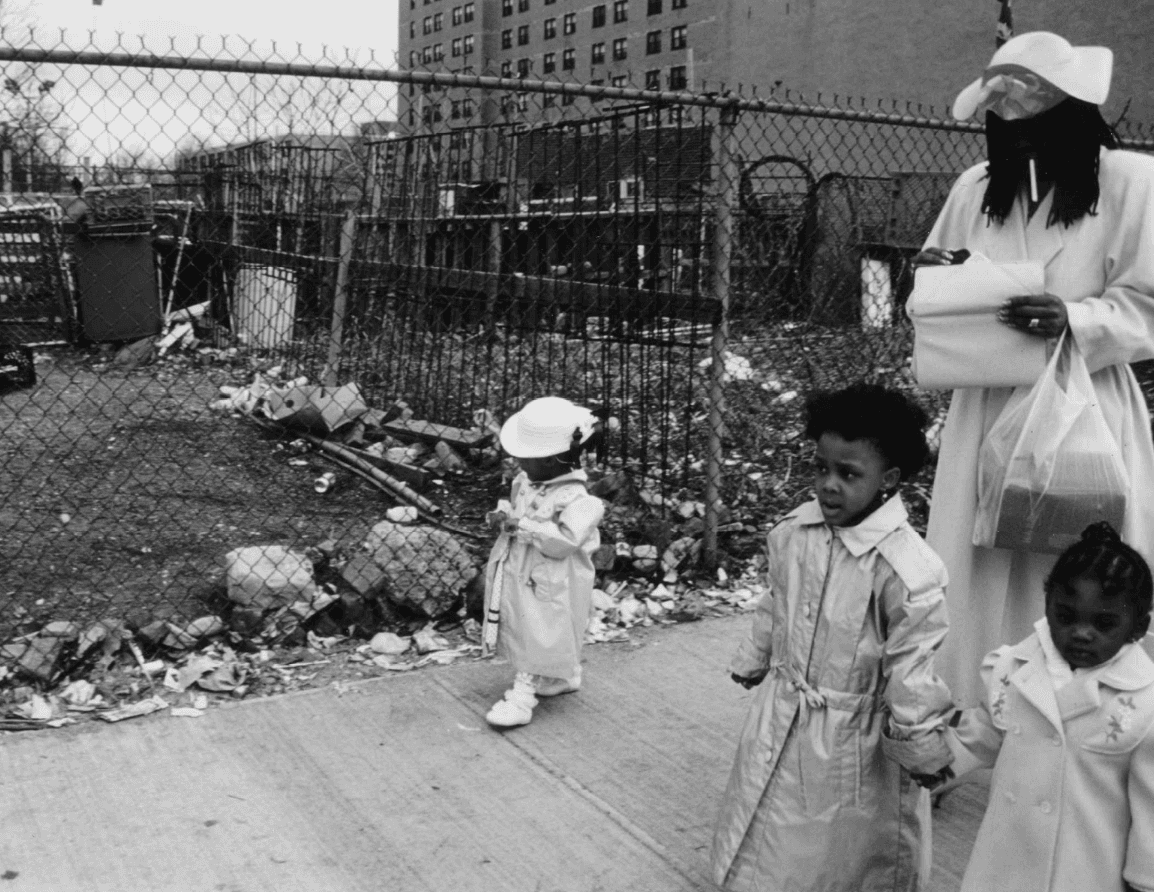
A Sunday Walk. Philippe Cheng
SAV: You have interacted with the philanthropic community fairly extensively, from foundations to other not-for-profit agencies. If I understand correctly, much of your revenue comes from grants as opposed to advertising and subscriptions—the historically traditional sources of journalistic revenue. What have you learned from your experiences and, what if anything, would you suggest to persons in the philanthropic community (funders, program officers) to make their work more responsive to race, in general, and various communities of color in particular?
EM: I believe many foundations, funds and not-for-profit agencies are sincerely interested in benefiting persons from low-income African-American and Latino communities. These organizations, however, generally lack a practical means of reaching out to these communities and translating their funding processes so that low-income community residents can access their resources. A natural sense of competition for limited funds, moreover, tends to hinder the ability of public housing tenants and other low-income residents to secure funding. Individual staff and board members of many foundations and not-for-profit groups view low-income communities as potential clients rather than as partners. The reality, however, is that the low-income residents both attract funds and offer realistic definitions and solutions to their own problems.
Many nonprofit organizations proclaim their desire to work with and/or serve public housing residents, and many foundations provide funds to these groups to interact with public housing residents. Yet, as time passes, these groups become frustrated that they are unable to work with residents or maintain relationships with residents. Foundations are likewise frustrated with the groups’ apparent inability to reach these communities.
Foundations should ensure that their funds directly reach the targeted communities in the form of services and employment. Foundations should carefully review applicants’ abilities and track records in reaching communities of color. Do the boards and staffs of these groups reflect the compositions of the communities they seek to serve? If they do not, does the organization have a realistic plan to recruit community-based board members and train and hire community residents for professional positions? Foundations might consider reserving small grants programs ($10,000 or less) exclusively for fledgling community-based organizations to accomplish basic tasks such as achieving not-for-profit status and developing their boards.
Technical assistance for these tasks should be provided directly by the foundations in the interest of building a long-term relationship. Larger funding programs could be reserved for groups that partner with community-based groups, such as a joint effort with an organizing/advocacy group and a local advisory council, block club, or similar group. These efforts should be geared toward employing a member of the community-based partner in a decision-making role at the organizing/advocacy group. The fundamental measure of the success of these partnerships should be the delivery of resources into the communities, such as hiring a member of the community-based organization in a decision-making role in the organizing/advocacy group.