Rethinking Global Justice: Black Women Resist the Transnational Prison-Industrial Complex
Julia Sudbury
Since the 1970s, exponential growth in the use of incarceration in the United States, combined with racial targeting in the use of state surveillance and punishment, has marked the prison as a primary site of contemporary Black liberation struggles. Black women and girls, as well as other low-income people of color, have been particularly devastated by prison expansion and the accompanying withdrawal of resources from community infrastructure and economic supports for low-income families, in part in order to fund costly law enforcement and prison budgets. [1] While federal Canadian penal policies have historically been held up as a model of sanity and restraint in comparison to the U.S., there are growing synergies between sentencing and penal policy in both nations. At a provincial level, conservative politicians have vigorously pursued a neoliberal tough-on-crime approach, leading to the emergence of ‘‘no frills‘‘ provincial superjails, some built or managed by U.S. Corporations. [2] At a federal level, critics have predicted a U.S. style prison building boom as the newly elected Harper government has begun to fulfill its promise to ‘‘turn around’’ 30–40 years of ‘‘soft’’ criminal justice policy. [3] The adoption of increasingly punitive policies coupled with the construction of new prisons and jails has led activists to decry the emergence of a transnational prison-industrial complex with roots across Canada’s southern border. Faced with ever-shrinking options given these social and economic transformations, Black women often turn to survival strategies that are increasingly criminalized. Poverty, racism, gender violence, and sometimes addiction intersect to create a cycle of survival, criminalization, and repeated incarceration. At the same time, as mothers, grandmothers, and community activists, Black women who are not incarcerated bear the burden of caring and advocating for loved ones who have been locked up as well as their dependents.
The concept of the prison-industrial complex, popularized by activist-scholars to draw attention to the economic basis of prison expansion has, since the mid 1990s, been the focus of a revitalized anti-prison movement. [4] New anti-prison organizations, dedicated to downsizing and ultimately closing prisons, have sprung up across the U.S. and Canada, while existing prisoners’ rights groups have expanded. This article explores the role of Black women anti-prison activists in the U.S. and Canada and argues that anti-prison organizing is a critical yet overlooked site of anti-globalization activism. The article identifies six main categories of anti-prison work—human rights advocacy; challenging ‘‘post-incarceration sentences’’; campaigns for decarceration through legal reform; moratorium activism; abolitionist organizing for alternatives to the prison-industrial complex; and campaigns for the release of political prisoners—and examines Black women’s labor as community activists and movement intellectuals in each.
The Prison Crisis and the Global Economy
The transnational prison boom of the past three decades is most directly linked to the ‘‘law-and-order’’ agenda that has lengthened prison sentences and widened the net of activities dealt with through imprisonment. [5] However, delving beneath these immediate causes makes visible the global socio-economic trends that have presented mass incarceration as a viable ‘‘solution’’ to contemporary social problems. This section identifies three interlocking factors that underpin the disproportionate growth of Black incarceration in the U.S. and Canada. First, I examine the impacts of globalization and economic restructuring on low-income communities. The rise in low-waged casual labor and cutbacks in welfare, education, health care, and social provision all contribute to Black women’s economic insecurity, leading to the use of criminalized survival strategies. Second, I explore the war on drugs, a set of policies and practices that are U.S.-led but global in nature, and that have led to an exponential rise in domestic and international imprisonment. Finally, I describe the emergence of the transnational prison-industrial complex, a symbiotic relationship between corporate and governmental interests that has fuelled prison expansion in the U.S., Canada, and increasingly globally.
Economic Restructuring and the War on the Poor
The introduction of Reaganomics in the 1980s signaled the beginning of a lasting shift in U.S. economic policy that would have global implications. Arguing that ‘‘small government’’—a combination of reduced spending on social provision, reduced government restrictions on corporate profit-making, and tax cuts—was necessary to stimulate economic growth and stem unemployment, the Reagan administration gradually rolled back the supports and protections relied on by many working families. Despite the rhetoric of small government, Reagan dramatically increased government spending on the military and imprisonment. During the 1980s, both federal and state criminal justice budgets grew exponentially as prison populations swelled due to tough-on-crime legislation and the war on drugs. [6]
At a global level, Reaganomics can be seen as a political response to corporate economic restructuring. From the 1970s, corporations began to separate their manufacturing and administrative components. U.S. and European-headquartered corporations were quick to capitalize on the low-waged, non-unionized women workers in nations in Asia, Latin America, and the Caribbean, many of which were still struggling with the legacies of colonialism and underdevelopment. As manufacturing moved overseas, economies in advanced industrialized countries began to shift toward service industries and specialized management and technology. A segmented labor market emerged, consisting of highly paid, high tech positions for highly educated workers and more numerous low-waged, non-unionized, and casual positions. With well-paying unionized skilled trade jobs in decline, women and men in urban communities were faced with unemployment or dead-end jobs that did not pay enough to support a family. Cutbacks and trickle-down economics were a double-pronged tool used by successive governments in the U.S. and Canada to reduce the potential economic burden of a growing population that was surplus to the needs of global capital. Criminalization and warehousing was the necessary weapon of choice deployed to minimize the potential for social unrest and dissent.
Making Addiction a Crime:The War on Drugs
In 1973, the state of New York’s Rockefeller Drug Laws ushered in a new era of punitive anti-drug measures and started a shift toward determinate sentencing, with fixed sentences related to the quantity of drugs involved, regardless of the individual’s history or circumstances. [7] These laws and others modeled after them disproportionately impacted African–Americans and Latino/as and swelled prison populations. By the early 1980s, Reagan had formally announced the ‘‘war on drugs’’ as a government priority and throughout the 1980s the federal government pumped billions of dollars into combating this newly identified ‘‘enemy.’’ [8] With federal initiatives led by the ‘‘drug czar’’ and dramatic media representations fuelling public fears, mandatory sentencing was soon introduced by states throughout the country. The war on drugs soon spread across the border, as Canada adopted a tough stance on drug use and importation. As judges were compelled to hand down lengthy sentences, even where they felt that the defendant posed little threat to public safety, the number of Black women in prison and the length of time they spent inside, grew exponentially throughout the 1980s and 1990s.
The war on drugs has coincided with the retrenchment of health services in general, and drug treatment facilities in particular. Increasingly, Black women struggling with drug addiction are processed through the criminal punishment system rather than receiving drug rehabilitation and support for underlying issues, such as mental illness and trauma. Rather than viewing a rise in drug use as evidence of a public health crisis requiring large infusions of public funding into treatment centers, education, mental health facilities, and clean and sober living arrangements, the war on drugs identifies drug use as a threat to public safety and pumps funds into the arrest and incarceration of both users and suppliers of criminalized drugs.
The war on drugs is both racialized and gendered. In the 1990s, low-income African–American communities were particularly impacted by the emergence of a moral panic over crack cocaine. While the majority of crack users are white, use and retail of the drug was depicted as a Black phenomenon. [9] As such, policing operations focused on low income urban Black communities, sweeping up female family members and users as well as people working as low-level dealers and distributors. The crack-cocaine disparity in sentencing ensured heavy sanctions for those caught in the net, leading to a burgeoning population of drug war prisoners serving lengthy sentences. In Canada, public fears fuelled by graphic media depictions of Jamaican ‘‘yardies’’ and ‘‘drug mules,’’ similarly led to police targeting and criminalization of Black Canadian communities. [10] These drug war prisoners opened the door to profitable corporate involvement in criminal punishment.
Profiting from Punishment: The Rise of the Transnational Prison-Industrial Complex
The term prison-industrial complex was first used by urban theorist Mike Davis to describe a multibillion-dollar prison building boom in California that, he argued ‘‘rivals agribusiness as the dominant force in the life of rural California and competes with land developers as the chief seducer of legislators in Sacramento.’’ [11] Angela Y. Davis describes the prison-industrial complex as a symbiotic relationship between state criminal punishment agencies, politicians, and corporations and other interest groups manifested most obviously in the transformation of prisoners into profits. [12] Private prisons, for example, transform the act of depriving a human being of freedom from an exercise of state power into a transaction that can be traded on the stock market. The corporations and their stakeholders who profit from these transactions in turn both benefit from and actively promote criminal justice policies that guarantee rising rates of incarceration. [13] Prison expansion has also generated a host of profit-making opportunities for both multinational and local construction firms, architecture firms, and manufacturers of security and telecommunications equipment, as well as for service industries, including real estate agents, banks, and restaurants. In the context of globalization, prison construction and privatization have become denationalized. Today a prison in South Africa or Canada is likely to have been financed, designed, built, or managed by a U.S.-headquartered multinational corporation. Thus, this is a critical way in which low-income communities of color have become integrated into the global economy.
Although the prison-industrial complex emerged in the United States, the past two decades have witnessed its transformation into a transnational phenomenon. [14] As politicians internationally have pushed their own versions of U.S.-style tough-on-crime strategies, global prison populations have begun to rise inexorably. As a result, these countries have again turned to the U.S. as a solution to the dilemma of how to lock more people away while minimizing the cost of growing prison populations. Mass warehousing in U.S.-style ‘‘no frills’’ superjails, often housing over a thousand prisoners, has gradually replaced the smaller prisons usually favored in penal regimes geared toward rehabilitation. In both the global North and South, U.S.-style mass incarceration is increasingly being deployed as a solution to the social problems generated by globalization. In both locations, prisons warehouse the ‘‘refugees of globalization’’—migrant women driven to urban centers in the South and across borders into the North, as well as low-income women of color who are the survivors of neoliberal economic policies and the war on drugs.
Mapping the Movement
The anti-prison movement is made up of a plethora of organizations, campaign and lobby groups, activist collectives, non-profits, prisoner associations, and student groups.
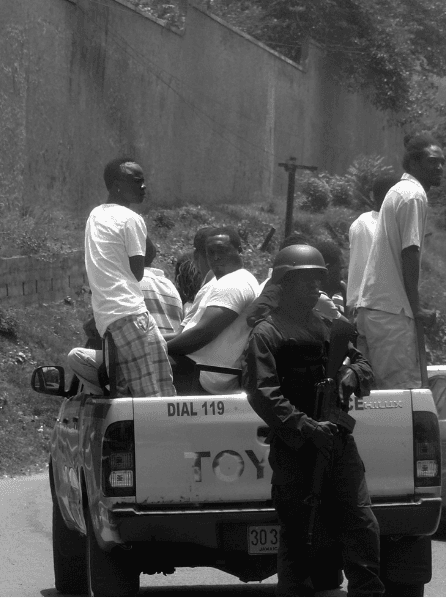
‘‘Jamaican Police’’ 2008 © Therese Gopaul-Robinson.
While the organizations that make up the movement are diverse in their organizing strategies, goals, and philosophies, we can identify six broad categories of anti-prison work. These are human rights advocacy; challenging ‘‘post-incarceration sentences’’; campaigns for decarceration through legal reform; moratorium activism; abolitionist organizing for alternatives to the prison-industrial complex; and campaigns for the release of political prisoners. These categories are overlapping and interrelated; for example, one organization may carry out both human rights advocacy with individual prisoners and broader abolitionist political education or campaigns against new prison construction. Together, these organizations constitute a vibrant movement that is challenging the use of racialized criminalization and mass incarceration as a solution to the problems generated by the globalization of capital and the rise of neoliberal hegemony.
Breaking Down the Walls: Human Rights Advocacy
Black women activists who focus on support and advocacy develop close relationships of solidarity and friendship with prisoners, visiting them and exchanging correspondence regularly. In addition, they are involved in negotiating with prison authorities on behalf of individual prisoners, and lobbying for policy changes at the local and national level. Key issues for those working in women’s prisons include medical neglect, compassionate release for terminally ill prisoners, child custody issues, sexual assault and coercion, and justice for survivors of domestic violence. Organizations involving Black women that focus on the human rights of people in women’s prisons include Justice Now, California Coalition for Women Prisoners, Legal Services for Prisoners with Children, CLAIM in the U.S., and PASAN, Black Prisoners Support, and the Canadian Association of Elizabeth Fry Societies in Canada.
California Coalition for Women Prisoners (CCWP) is ‘‘a grassroots racial justice organization that challenges the institutional violence imposed on women and communities of color by prisons and the criminal justice system.’’ [15] Founded in 1995, CCWP formed in response to appalling medical care in the California state women’s prisons. CCWP was co-founded by Charisse Shumate, an African–American woman who was sentenced to life for defending herself against an abusive partner. While imprisoned at Central California Women’s Facility, Shumate became the lead plaintiff in the groundbreaking legal case Shumate vs. Wilson, a class action suit on behalf of women who had been victims of medical neglect in the state prison system. Shumate died in 2001 of complications from sickle cell anemia, cancer, and hepatitis C. However, the case, which accused medical staff at CCWF and the California Institute for Women in Frontera (CIW) of ‘‘deliberate indifference’’ to the health concerns of prisoners tantamount to cruel and unusual punishment, resulted in a settlement in which the California Department of Corrections agreed to upgrade the prison health care system. [16]
CCWP’s ongoing work aims to break down the barriers between prisoners and their families and communities of origin. Regular visits to Central California Women’s Facility and Valley State Prison for Women enable CCWP staff and volunteers to build relationships with women inside, provide advocacy and support organizing efforts inside prison. An annual Family Visiting Day provides transportation for family members from the Bay Area and Los Angeles to visit their incarcerated loved ones in California’s Central Valley and aims to rebuild connections between incarcerated women and their children throughout the year. The newsletter The Fire Inside is another tool in the struggle to counter the isolation of people in women’s prisons. The newsletter is circulated inside and outside of prisons in California, and provides a forum for prisoners’ critical analysis, poetry, and artwork. While CCWP began as a coalition between predominantly white progressive women on the outside and women of color in prison, increasingly, Black women and other women of color have taken on active roles at every level of the organization. The formation of the Sistah to Sistah and Compañeras programs which connect Black women activists and Latinas, respectively, with Black women and Latina immigrant prisoners, is one way in which CCWP has made efforts to build bridges between women of color organizing inside and outside of the prison walls.
In the past decade, anti-prison activists have begun to address the gender complexity and variation that exists within and outside of the prison population. Black transgender and gender non-conforming prisoners and prison activists have pointed out that not all of those imprisoned in women’s prisons identify or live as women, and that not all those who identify and live as women are housed in women’s prisons. As a result of advocacy by these activists, CCWP and other organizations that previously focused on women only, have begun to recognize and address the needs of transgender and gender non-conforming prisoners in women’s prisons. Non-conformity to gender categories in the context of a total institution organized on the basis of a rigid gender binary renders transgender and gender non-conforming prisoners of color vulnerable to brutal forms of gender policing. [17] By foregrounding the leadership and concerns of transgender and gender non-conforming people of color, prisoner advocacy groups such as the Prisoners HIV and AIDS Action Network (PASAN) in Canada, the Trans/Gender Variant in Prison Committee (TIP), the Transgender, Gender Variant and Intersex Justice Project and the Sylvia Rivera Law Project in the U.S. push the mainstream transgender movement and the wider anti-prison movement to embrace an anti-racist politic of radical gender liberation. [18]
Chronic overcrowding has led to worsening conditions for prisoners. As a result of the unprecedented growth in sentenced populations, prison authorities have packed three or four prisoners into cells designed for two, and have taken over recreation rooms, gyms, and rooms designed for programming and turned them into cells, housing prisoners on bunk beds or on the floor. These new conditions have created challenges for activists, who have found them- selves expending time and resources in pressuring prison authorities to provide every prisoner a bed, or to provide access to basic education programs. As prison populations continue to swell, anti-prison activists are faced with the limitations of reformist strategies. Gains temporarily won are swiftly undermined, new ‘‘women-centered’’ prison regimes are replaced with a focus on cost-efficiency and minimal programming and even changes enforced by legal cases like Shumate vs. Wilson are subject to backlash and resistance. [19] Of even greater concern is the well-documented tendency of prison regimes to co-opt reforms and respond to demands for changes in conditions by further expanding prison budgets. The vulnerability of prison reform efforts to cooption has led Angela Y. Davis to call for ‘‘non-reformist reforms,’’ reforms that do not lead to bigger and ‘‘better’’ prisons. [20] Despite the limited long-term impact of human rights advocacy and reforms, building bridges between prisoners, activists, and family members is an important step toward challenging the racialized dehumanization that undergirds the logic of incarceration. In this way, human rights advocacy carried out in solidarity with prisoner activists is an important component of a radical anti-prison agenda. Ultimately, however, anti-prison activists aim not to create more humane, culturally sensitive, women-centered prisons, but to dismantle prisons and enable formerly criminalized people to access services and resources outside the penal system.
The New Civil Rights Movement: Challenging Post-Incarceration Sentences
After three decades of prison expansion, more and more people are living with criminal convictions and histories of incarceration. In the U.S., nearly 650,000 people are released from state and federal prisons to the community each year. [21] Organizations of formerly incarcerated people focus on creating opportunities for former prisoners to survive after release, and on eliminating barriers to reentry, including extensive discrimination against former felons. The wide array of ‘‘post-incarceration sentences’’ that felons are subjected to has led activists to declare a ‘‘new civil rights movement.’’ [22] As a class, former prisoners can legally be disenfranchised and denied rights available to other citizens. While reentry has garnered official attention, with President Bush proposing a $300 million reentry initiative in his 2004 State of the Union address, anti-prison activists have critiqued this initiative for focusing on faith-based mentoring, job training, and housing without addressing the endemic discrimination against former prisoners or addressing the conditions in the communities which receive former prisoners, including racism, poverty, and gender violence. Organizations of ex-prisoners working to oppose discrimination against former prisoners and felons include All of Us Or None, the Nu Policy Leadership Group, Sister Outsider and the National Network for Women Prisoners in the U.S., and Justice 4 Women in Canada.
All of Us Or None is described by members as ‘‘a national organizing initiative of prisoners, former prisoners and felons, to combat the many forms of discrimination that we face as the result of felony convictions.’’ [23] Founded by anti-imperialist and former political prisoner Linda Evans, and former prisoner and anti-prison activist Dorsey Nunn, and sponsored by the Northern California–based Legal Services for Prisoners with Children, All of Us Or None works to mobilize former prisoners nationwide and in Toronto, Canada. The organization’s name, from a poem by Marxist playwright Bertold Brecht, invokes the need for solidarity across racial, class, and gender lines in creating a unified movement of former prisoners. Black women play a leading role in the organization, alongside other people of color. All of Us Or None focuses its lobbying and campaign work at city, county, and state levels, calling on local authorities to end discrimination based on felony convictions in public housing, benefits, and employment, to opt out of lifetime welfare and food stamp bans for felons, and to ‘‘ban the box’’ requiring disclosure of past convictions on applications for public employment. In addition, the organization calls for guaranteed housing, job training, drug and alcohol treatment, and public assistance for all newly released prisoners. [24]
In the context of the war on drugs, many people with felony convictions also struggle with addictions. The recovery movement, which is made up of 12-step programs, treatment programs, community recovery centers, and indigenous healing programs run by and for people in recovery from addiction, offers an alternative response to problem drug use through programs focusing on spirituality, healing, and fellowship. However, the recovery movement’s focus on individual transformation and accountability for past acts diverges from many anti-prison activists’ focus on the harms done to criminalized communities by interlocking systems of dominance. As a result, anti-prison spaces seldom engage with the recovery movement, or tap the radical potential of its membership. Breaking with this trend, All of Us Or None has initiated a grassroots organizing effort to reach out to people in 12-step programs with felony convictions. This work is part of their wider organizing efforts that aim to mobilize former prisoners as agents of social change. Building on the strengths of identity politics, these organizations suggest that those who have experienced the prison-industrial complex first-hand may be best placed to provide leadership in dismantling it. As former prisoners have taken on a wide range of leadership positions across the movement, there has been a shift away from leadership by white middle-class progressives, and a move to promote the voices of those directly affected by the prison-industrial complex.
Shrinking the System: Decarceration
Politicians who promote punitive ‘‘tough-on-crime’’ policies rely on racialized controlling images of ‘‘the criminal’’ to inspire fear and induce compliance among voters. Once dehumanized and depicted as dangerous and beyond rehabilitation, removing people from communities appears the only logical means of creating safety. Activists who pursue decarceration challenge stereotypical images of the ‘‘criminal’’ by making visible the human stories of prisoners, with the goal of demonstrating the inadequacy of incarceration as a response to the complex interaction of factors that produce harmful acts. Decarceration usually involves targeting a specific prison population that the public sees as low-risk and arguing for an end to the use of imprisonment for this population. Decarcerative strategies often involve the promotion of alternatives to incarceration that are less expensive and more effective than prison and jail. For example, Proposition 36, the Substance Abuse and Crime Prevention Act, which passed in California in 2000 and allowed first- and second-time non-violent drug offenders charged with possession to receive substance abuse treatment instead of prison, channels approximately 35,000 people into treatment annually. [25]
Drug law reform is a key area of decarcerative work. Organizations and campaigns that promote drug law reform include Drop the Rock, a coalition of youth, former prisoners, criminal justice reformers, artists, civil and labor leaders working to repeal New York’s Rockefeller Drug Laws. The campaign combines racial justice, economic, and public safety arguments by demonstrating that the laws have created a pipeline of prisoners of color from New York City to newly built prisons in rural, mainly white areas represented Republican senators, resulting in a transfer of funding and electoral influence from communities of color to upstate rural communities. [26] Ultimately, the campaign calls for an end to mandatory minimum sentencing and the reinstatement of judges’ sentencing discretion, a reduction in sentence lengths for drug-related offenses and the expansion of alternatives, including drug treatment, job training, and education.
Former drug war prisoners play a leadership role in decarcerative efforts in the field of drug policy reform. Kemba Smith, an African–American woman who was sentenced to serve 24.5 years as a result of her relationship with an abusive partner who was involved in the drug industry, is one potent voice in opposition to the war on drugs. While she was incarcerated, Smith became an active advocate for herself and other victims of the war on drugs, securing interviews and feature articles in national media. Ultimately, Smith’s case came to represent the failure of mandatory minimums, and in 2000, following a nation-wide campaign, she and fellow drug war prisoner Dorothy Gaines were granted clemency by outgoing President Clinton. After her release, Smith founded the Justice for People of Color Project (JPCP), which aims to empower young people of color to participate in drug policy reform and to promote a reallocation of public expenditures from incarceration to education. While women like Kemba Smith and Dorothy Gaines have become the human face of the drug war, prison invisibilizes and renders anonymous hundreds of thousands of drug war prisoners. The organization Families Against Mandatory Minimums (FAMM) challenges this process of erasure and dehumanization through its ‘‘Faces of FAMM’’ project. The project invites people in federal and state prisons serving mandatory minimum sentences to submit their cases to a database and provides online access to their stories and photographs. [27] The ‘‘Faces of FAMM’’ project highlights cases where sentencing injustices are particularly visible in order to galvanize public support for sentencing reform. At the same time, it dismantles popular representations of the war on drugs as a necessary protection against dangerous drug dealers and traffickers, demonstrating that most drug war prisoners are serving long sentences for low-level, non-violent drug-related activities or for being intimately connected to someone involved in these activities.
Decarcerative work is not limited to drug law reform. Free Battered Women’s (FBW) campaign for the release of incarcerated survivors is another example of decarcerative work. The organization supports women and transgender prisoners incarcerated for killing or assaulting an abuser in challenging their convictions by demonstrating that they acted in self-defense. Most recently, FBW secured the release of Flozelle Woodmore, an African–American woman serving a life sentence at CCWF for shooting her violent partner as an 18 year old. Released in August 2007, after five parole board recommendations for her release were rejected by Governors Davis and then Schwarzenegger, Woodmore’s determined pursuit of justice made visible and ultimately challenged the racialized politics of gubernatorial parole releases. [28] While the number of women imprisoned for killing or assaulting an abuser is small—FBW submitted 34 petitions for clemency at its inception in 1991, and continues to fight 23 cases—FBW’s campaign for the release of all incarcerated survivors challenges the mass incarceration of gender-oppressed prisoners on a far larger scale. FBW argues that experiences of intimate partner violence and abuse contribute to the criminalized activities that lead many women and transgender people into conflict with the law, including those imprisoned on drug or property charges, and calls for the release of all incarcerated survivors. Starting with a population generally viewed with sympathy—survivors of intimate partner violence—FBW generates a radical critique of both state and interpersonal violence, arguing that ‘‘the violence and control used by the state against people in prison mirrors the dynamics of battering that many incarcerated survivors have experienced in their intimate relationships and/or as children.’’ [29] In theorizing the intersections of racialized state violence and gendered interpersonal violence, FBW lays the groundwork for a broader abolitionist agenda that refutes the legitimacy of incarceration as a response to deep-rooted social inequalities based on interlocking systems of oppression.
By gradually shrinking the prison system, Black women activists involved in decarcerative work hope to erode the public’s reliance on the idea of imprisonment as a common- sense response to a wide range of social ills. At the other end of anti-expansionist work are activists who take a more confrontational approach. By starving correctional budgets of funds to continue building more prisons and jails, they hope to force politicians to embrace less expensive and more effective alternatives to incarceration.
No More Prisons: Moratorium
Prison moratorium organizing aims to stop construction of new prisons and jails. Unlike campaigns against prison privatization, which oppose prison-profiteering by private corporations, and seek to return imprisonment to the public sector, prison moratorium work opposes all new prison construction, public or private. In New York, the Brooklyn-based Prison Moratorium Project (PMP), co-founded by former prisoner Eddie Ellis and led by young women and gender non-conforming people of color, does this work through popular education and mass campaigns against prison expansion. Focusing on youth as a force for social change, New York’s PMP uses compilations of progressive hip hop and rap artists to spread a critical analysis of the prison-industrial complex and its impact on people of color. PMP’s strategies have been effective; for example, in 2002 the organization, as part of the Justice 4 Youth Coalition, succeeded in lobbying the New York Department of Juvenile Justice to redirect $53 million designated for expansion in Brooklyn and the Bronx. [30] PMP has also worked to make visible the connections between underfunding, policing of schools, and youth incarceration through their campaign ‘‘Stop the School-to-Prison Pipeline.’’ By demonstrating how zero tolerance policies and increased policing and use of surveillance technology in schools, combined with underfunded classrooms and over- stretched teachers, has led to the criminalization of young people of color and the production of adult prisoners, PMP argues for a reprioritization of public spending from the criminal justice system to schools and alternatives to incarceration. [31]
Moratorium work often involves campaigns to prevent the construction of a specific prison or jail. In Toronto, for example, the Prisoner Justice Action Committee formed the ‘‘81 Reasons’’ campaign, a multiracial collaboration of experienced anti-prison activists, youth and student organizers, in response to proposals to build a youth ‘‘superjail’’ in Brampton, a suburb of Toronto. [32] The campaign combined popular education on injustices in the juvenile system, including the disproportionate incarceration of Black and Aboriginal youth, with an exercise in popular democracy that invited young people to decide themselves how they would spend the $81 million slated for the jail. Campaigners mobilized public concerns about spending cuts in other areas, including health care and education, to create pressure on the provincial government to look into less expensive and less punitive alternatives to incarceration for youth. While this campaign did not ulti- mately prevent the construction of the youth jail, the size of the proposed facility was reduced. More importantly, the campaign built a grassroots multiracial antiprison youth movement and raised public awareness of the social and economic costs of incarceration.
Moratorium campaigns face tough opposition from advocates who believe that building prisons stimulates economic development for struggling rural towns. Prisons are ‘‘sold’’ to rural towns that have suffered economic decline in the face of global competition, closures of local factories, and decline of small farms. In the context of economic stagnation, prisons are touted as providing stable, well-paying, unionized jobs, providing property and sales taxes and boosting real estate markets. The California Prison Moratorium Project has worked to challenge these assertions by documenting the actual economic, environmental, and social impact of prison construction in California’s Central Valley prison towns. According to California PMP:
We consider prisons to be a form of environmental injustice. They are normally built in economically depressed communities that eagerly anticipate economic prosperity. Like any toxic industry, prisons affect the quality of local schools, roads, water, air, land, and natural habitats. [33]
California PMP opposes prison construction at a local level by building multiracial coalitions of local residents, farm workers, labor organizers, anti-prison activists, and former prisoners and their families to reject the visions of prison as a panacea for economic decline. [34] In the Californian context, where most new prisons are built in predominantly Latino/a communities and absorb land and water previously used for agriculture, PMP facilitates communication and solidarity between Latino/a farm worker communities, and urban Black and Latino/a prisoners in promoting alternative forms of economic development that do not rely on mass incarceration. Scholar-activist Ruth Wilson Gilmore’s research on the political economy of prisons in California has been critical in providing evidence of the detrimental impact of prisons on local residents and the environment. [35] As an active member of CPMP, Gilmore’s work is deeply rooted in anti-prison activism and in turn informs the work of other activists, demonstrating the important relationship between Black women’s activist scholarship and the anti-prison movement. [36]
A World Without Prisons: Abolition
This system of locking people in cages cannot be fixed or reformed; it must be abolished. [37]
Many anti-prison activists view campaigns for decarceration or moratorium as building blocks toward the ultimate goal of abolition. These practical actions promise short and medium-term successes that are essential markers on the road to long-term transformation. However, abolitionists believe that like slavery, the prison-industrial complex is a system of racialized state violence that cannot be ‘‘fixed.’’ The contemporary prison abolitionist movement in the U.S. and Canada dates to the 1970s, when political prisoners like Angela Y. Davis and Assata Shakur, in conjunction with other radical activists and scholars in the U.S., Canada, and Europe, began to call for the dismantling of prisons. [38] The explosion in political prisoners, fuelled by the FBI’s Counter Intelligence Program (COINTELPRO) and targeting of Black liberation, American Indian and Puerto Rican independence movements in the U.S. and First Nations resistance in Canada as ‘‘threats’’ to national security, fed into an understanding of the role of the prison in perpetuating state repression against insurgent communities. [39] The new anti-prison politics were also shaped by a decade of prisoner litigation and radical prison uprisings, including the brutally crushed Attica Rebellion. These ‘‘common’’ prisoners, predominantly working-class people of color imprisoned for everyday acts of survival, challenged the state’s legitimacy by declaring imprisonment a form of cruel and unusual punishment and confronting the brute force of state power. [40] By adopting the term ‘‘abolition’’ activists drew deliberate links between the dismantling of prisons and the abolition of slavery. Through historical excavations, the ‘‘new abolitionists’’ identified the abolition of prisons as the logical completion of the unfinished liberation marked by the 13th Amendment to the United States Constitution, which regulated, rather than ended, slavery. [41]
Organizations that actively promote dialogue about what abolition means and how it can translate into concrete action include Critical Resistance (CR), New York’s Prison Moratorium Project, Justice Now, California Coalition for Women Prisoners, Free Battered Women, and the Prison Activist Resource Center in the U.S. and the Prisoner Justice Action Committee (Toronto), the Prisoners’ Justice Day Committee (Vancouver) and Joint Action in Canada. CR was founded in 1998 by a group of Bay Area activists including former political prisoner and scholar-activist Angela Y. Davis. Initially, CR focused on popular education and movement building, coordinating large conferences where diverse organizations could generate collective alternatives to the prison-industrial complex. Later work has included campaigns against prison construction in California’s Central Valley and solidarity work with imprisoned Katrina survivors. CR describes abolition as:
[A] political vision that seeks to eliminate the need for prisons, policing, and surveillance by creating sustainable alternatives to punishment and imprisonment . . . . An abolition- ist vision means that we must build models today that can represent how we want to live in the future. It means developing practical strategies for taking small steps that move us toward making our dreams real and that lead the average person to believe that things really could be different. It means living this vision in our daily lives. [42]
In this sense, prison abolitionists are tasked with a dual burden: first, transforming people’s consciousness so that they can believe that a world without prisons is possible, and second, taking practical steps to oppose the prison-industrial complex. Making abolition more than a utopian vision requires practical steps toward this long-term goal. CR describes four steps that activists can get involved in: shrinking the system, creating alternatives, shifting public opinion and public policy, and building leadership among those directly impacted by the prison-industrial complex. [43] Since its inception in the San Francisco Bay Area, Critical Resistance has become a national organization with chapters in Baltimore, Chicago, Gainesville, Los Angeles, New Orleans, New York, Tampa/St. Petersburg, and Washington, D.C. As such, CR has played a critical role in reinvigorating abolitionist politics in the U.S. This work is rooted in the radical praxis of Black women and transgender activists.
In addition to dismantling the prison-industrial complex, abolition means generating alternative strategies for dealing with interpersonal harms that threaten the safety of individuals from oppressed groups. Organizations like Justice Now, Critical Resistance, Creative Interventions, Incite! Women of Color Against Violence, the Audre Lorde Project’s Safe Outside the System Collective, and PMP invite community members to envision what accountability, justice, and safety would look like in a world without prisons. For example, PMP’s workshop ‘‘A World Without. . .’’ encourages participants to find solutions to community problems and build community safety without prisons or police. Similarly, Justice Now facilitates community conversations about collective strategies to tackle violence against women and create accountability that do not rely on criminalization and punishment. In this way, these organizations challenge us to start building communities that are a reflection of the world we want to live in, providing real safety based on justice, and a focus on healing and transformation rather than punishment and imprisonment.
Liberating Dissent: Political Prisoner Campaigns
Anti-prison activists have played a vital role in challenging the assumption that prisons exist to safeguard public safety. Instead, they have revealed that mass incarceration has evolved as the state’s primary response to economically and politically marginalized communities. That is, prisons exist to safeguard the state and corporate interests through technologies of incapacitation and brutalization directed at communities of color and other disenfranchised people, not to prevent violence against these communities. In this context, campaigns for the release of political prisoners, political exiles, and prisoners of war play an important role in stripping away the façade of the prison as public protector and making visible the brutal face of state repression. Most political prisoners in the U.S. trace their encounter with state repression to the revolutionary racial justice and anti-imperialist movements of the late 1960s and 1970s. The continuing presence of insurgents from the Black Liberation, American Indian, Chicano Power, Puerto Rican Independence and anti-imperialist movements in U.S. prisons and in exile is a stark reminder of the continuing battle waged by the state against radical dissent. In Canada, environmentalist, anti-globalization, and indigenous activists have made up the bulk of political prisoners, as those seeking to protect natural resources and First Nations sovereignty from the incursions of global capital have clashed with militarized state forces. Organizations working for the release of political prisoners, political exiles, and prisoners of war include the Jericho Movement, the Malcolm X Grassroots Movement, the Mobilization for Mumia Abu Jamal, the Hands off Assata Campaign, the National Committee to Free Puerto Rican Prisoners of War, Comite 98, and SUMOUD—which means steadfastness in Arabic—a political prisoner solidarity group based in Toronto that focuses on Palestinian prisoners held by Israel.
Within the anti-prison movement, there has been considerable debate about the utility of the concept ‘‘political prisoner.’’ Political exile Assata Shakur has argued that all prisoners in the U.S. are victims of an unjust political regime, and therefore can be considered ‘‘political’’ prisoners. Other activists have expressed concerns that campaigns for the release of political prisoners create a vanguard within the prison that is seen as more deserving of release than ‘‘common’’ prisoners. Political prisoner advocates, they argue, risk implicitly legitimating incarceration for the majority of prisoners who are imprisoned for drug-related and survival crimes, if they limit their campaigns to calls for clemency for a small group of prisoners defined as unjustly punished. In this sense, not all political prisoner work can be described as anti-prison. Anti-prison political prisoner campaigns are those that make connections between political prisoners, the prison-industrial complex, and wider systems of dominance, demonstrating how the social conditions opposed by political prisoners are also the conditions that have created the racialized criminalization of ‘‘common’’ prisoners. [44]
Black women former political prisoners such as Ramona Africa play a critical role in the anti-prison movement. Combining personal experience of police brutality, criminalization, and imprisonment, a radical analysis of white supremacist patriarchal capitalism and a revolutionary vision of alternatives to the current system, Black women political prisoners bring a radical vision and urgent energy to the movement. Ramona Africa served seven years in prison after she survived the 1985 massacre of eleven MOVE members in a bombing and armed attack carried out by the FBI and Philadelphia police on the MOVE communal residence. [45] After her release, Africa went on to become the MOVE Minister of Communication, and to work for the release of journalist and political prisoner Mumia Abu-Jamal. Traveling widely to garner support for Mumia and other political prisoners, Africa articulates a trenchant critique of state violence, refuting hegemonic constructions of ‘‘the criminal’’ by pointing to state sanctioned harms as the real ‘‘crimes’’:
How is it that this country can thirst for the blood of Mumia Abu-Jamal and call him a murderer while the same government made sure that none of those responsible for bombing my family and burning babies alive is sitting on death row next to Mumia? . . . We are talking about peace. We are not the warmongers and we are sick and tired of those in authority declaring war on the people, killing the people, shooting people down and then, when people rise up in defense of ourselves, we’re called violent, we’re called criminals. [46]
MOVE’s philosophy of the sacredness of life and natural law leads its members to uphold the right of all living beings to self-defense. From this paradigm, MOVE calls for the release of all political prisoners, not only those who have been imprisoned for something they did not do, but also those who have been forced to carry out illegalized acts of self and community defense. In this sense, Africa’s work on behalf of political prisoners radically deconstructs the innocent/guilt binary, demonstrating that any resistance to an illegitimate ‘‘world system’’ is a revolutionary act rather than a criminal one.
Campaigns for the freedom of political prisoners, prisoners of war, and political exiles infuse antiprison work with an anti-imperialist, internationalist politic. For example, activists in the U.S. and Canada have drawn parallels between political imprisonment and repression in North America and in the Palestinian Occupied Territories and have actively sought to build solidarity with Palestinian prisoners of war. The Jericho Movement’s name refers to the city of Jericho in the West Bank, which was seized by Israel during the Six- Day War of 1967 and houses the Jericho prison where twenty Palestinian political prisoners are held. Jalil Abdul Muntaqim, founder of the Jericho Movement, argues that the most effective solidarity work that African–American activists can do on behalf of the Palestinian political prisoners is to resist U.S. imperialism and domestic oppression. [47] In Canada, abolitionist organization Prisoner Justice Action Committee (PJAC) also works in solidarity with Palestinian prisoners of war. Film festivals hosted by PJAC to raise awareness of and build resistance to the prison-industrial complex feature films and speakers on political prisoners in the U.S., Canada, and the Palestinian Occupied Territories. PJAC also works with SUMOUD, a political prisoner solidarity organization based in Toronto that seeks the release of approximately 10,000 Palestinians held in Israeli prisons and makes connections with the imprisonment of indigenous, immigrant, and racialized people in North America.
Work on behalf of political insurgents also assumes an anti-imperialist and internationalist stance because of the continuing exile of numerous U.S. revolutionaries. Approximately 70 political exiles, including members of the Black Panther Party for Self-Defense and the Black liberation movement remain in exile in Cuba. [48] The most well-known of these, Assata Shakur, was liberated in 1979 and granted exile in Cuba by Fidel Castro. The Hands off Assata Campaign was formed by Black women activists in coalition with antiracist, feminist, anti-war, indigenous, Cuba solidarity and antiglobalization organizations in response to the U.S. government’s creation of a $1 million bounty for Shakur’s capture and re-imprisonment in 2002. The Hands off Assata Campaign draws attention to the impact of continuing hostility and economic embargo by the U.S. government toward Cuba. Cuba’s continued support for Black insurgents and steadfast refusal to view Assata and other exiles as ‘‘terrorists’’ provides an alternative to the U.S. government’s continued persecution of the insurgents, which continues even in the face of evidence that the FBI’s counterintelligence program used illegal measures to ‘‘neutralize’’ them in the 1960s and, 70s. The relationship between Cuba and the U.S. Black liberation movement also offers an alternative to hegemonic representations of Cuba and more broadly those of socialism and revolutionary social change. In the context of the anti-prison and Black liberation movements, Cuba has become a symbol of resistance to the inevitability of U.S. imperial dominance, whether through military or economic means. By standing in solidarity with Cuba, the Hands Off Assata campaign locates its work within a broader internationalist, anti-imperialist, and anti-capitalist anti-prison agenda.
Rethinking Global Justice
In the context of domestic economic restructuring, aggressive military interventions abroad and the global spread of neoliberal socio-economic policy agendas, increasing attention has been paid to the multifaceted global justice movement. Global justice activists counter the global hegemony of U.S. economic and military power with radical optimism by declaring that ‘‘Another World is Possible.’’ While the global justice movement has captured the imaginations and mobilized the energies of poor, disenfranchised, landless, and migrant communities across the global South, the movement in the U.S. and Canada has tended to be viewed as largely white, middle class, and highly educated. Commentators who have noted the under-representation of working-class Black people and other people of color in the movement, have argued that this is due to an inter- action of factors, including lack of awareness about the domestic impact of global processes and institutions, and the failure of white anti-globalization activists to couch their agenda in terms that resonate with the survival imperatives of embattled communities of color. [49]
The organizations profiled in this article reveal a different face of the global justice movement. [50] These activists work locally, yet their activism poses a significant challenge to the global processes that impoverish, dehumanize, and criminalize Black people and people of color in the U.S., Canada, and internationally. Like all good global justice work, anti-prison work is ‘‘glocal,’’ a term coined by Nawal El Saadawi at the second World Social Forum to describe the complex interaction of the local and global in grassroots anti-globalization organizing. By building solidarities and affective ties across prison walls, defending the civil rights of former prisoners, shrinking and ultimately dismantling prisons, and confronting state violence and political censorship, Black women anti-prison activists interrupt the inevitability and legitimacy of mass incarceration as a legitimate state response to the economic dislocation and social unrest generated by globalization and U.S. Empire. The prison—as much as the Nike megastore, the free trade zone sweat- shop, the World Trade Organization (WTO) ministerial, or the Group of Eight Summit— is a critical site where globalization touches the ground and can become a target of localized resistance. Black women anti-prison activists are therefore major change agents in the global movement for economic, social, and racial justice.
WORKS CITED
1. Rebecca Bohrman and Naomi Murakawa, ‘‘Remaking Big Government: Immigration and Crime Control in the United States,’’ in Global Lockdown: Race, Gender and the Prison-Industrial Complex, ed. J. Sudbury (New York: Routledge, 109–126). The other major shift of public spending priorities has been from the welfare state to the global war on terror.
2. Julian V. Roberts, Loretta J. Stalans, David Indermaur, and Mike Hough, Penal Populism and Public Opinion: Lessons from Five Countries (New York: Oxford University Press, 2002).
3. Alex Roslin, ‘‘Stephen Harper opens door to prison privatization,’’ Georgia Straight, November 22, 2007, http://www.straight.com/article-119340/stephen-harper-opens-door-to-prison-privatization (accessed October 22, 2008).
4. Julia Sudbury, ‘‘A World Without Prisons: Resisting Militarism, Globalized Punishment and Empire,’’ Social Justice 31: (1–2) (2004): 9–30.
5. Katherine Beckett and Theodore Sasson, The Politics of Injustice: Law and Order in America (Pine Forge Press, Thousand Oaks, CA, 1999).
6. Christian Parenti, Lockdown America: Police and Prisons in the Age of Crisis (New York: Verso, 1999).
7. For example, anyone convicted of selling two ounces or possessing four ounces of narcotics would receive a sentence of 15 years. Marc Mauer, ‘‘The Causes and Consequences of Prison Growth in the United States,’’ in Mass Imprisonment: Social Causes and Consequences, ed. D. Garland (London, Thousand Oaks: Sage Publications, 2001), 6.
8. The federal budget for the war on drugs grew from $1.5 billion in 1981 at the beginning of Reagan’s term to $6.6 billion in 1989 and hit $17 billion ten years later. Mauer, ibid.
9. Although the majority of crack users are white, nearly 90 percent of those convicted in federal court for crack-cocaine distribution are African–American. U.S. Sentencing Commission, Special Report to Congress: Cocaine and Federal Sentencing Policy (Washington, DC: US Sentencing Commission, April 1997), 8.
10. Sonia Lawrence and Toni Williams, ‘‘Swallowed Up: Drug Couriers at the Borders of Canadian Sentencing’’, ‘‘University of Toronto Law Journal’’ 56(4) (2006), 285–332.
11. Mike Davis, ‘‘Hell Factories in the Field: a Prison-Industrial Complex,’’ The Nation (20 February 1995): 260–267.
12. Angela Y. Davis, Are Prisons Obsolete? (New York: Seven Stories Press, 2003).
13. Edwin Bender, A Contributing Influence: The Private-Prison Industry and Political Giving in the South (Helena, MO: Institute on Money in State Politics, 2002), 4.
14. Julia Sudbury, ‘‘Transatlantic Visions: Resisting the Globalization of Mass Incarceration,’’ Social Justice, 27(3) (2000): 133–150.
15. California Coalition for Women Prisoners. http://www.womenprisoners.org
16. Legal Services for Prisoners with Children ‘‘Wanted—Justice in the Desert: The Struggle Continues for Humane Treatment inside the Skilled Nursing Facility at Chowchilla,’’ Legal Services for Prisoners with Children News (Summer/Fall 2002): 4.
17. Richard Edney, ‘‘To Keep Me Safe From Harm?: Transgender Prisoners and the Experience of Imprisonment,’’ Deakin Law Review 9(2) (2004): 331–333.
18. Transforming Justice, the first national conference on transgender imprisonment issues was held in San Francisco in October 2007. See http://www.transformingjustice.org/summary.html
19. For example, Charisse Shumate accused the CDC of using the settlement to divide prisoners, by blaming unpopular changes that had nothing to do with the case on Shumate v. Wilson. Ten years after the settlement, activists continue to decry medical neglect in the state’s prisons, and to demonstrate against avoidable deaths of women in Valley State Prison’s intensive care facility.
20. Angela Y. Davis and Dylan Rodriguez, ‘‘The Challenge of Prison Abolition: A Conversation,’’ Social Justice 27(3) (2000): 212–218.
21. U.S. Department of Justice, ‘‘Reentry,’’ http://www.reentry.gov/
22. All of Us or None, ‘‘All of Us or None: A National Organizing Effort to Strengthen the Voices of Formerly-Incarcerated People, Felons and Our Families,’’ http://www.allofusornone.org/pdf/ allornonebooklet.pdf
23. All of Us Or None, ‘‘Who We Are,’’ http://www.allofusornone.org/
24. All of Us Or None, East Bay Peace and Justice Summit Briefing Packet, 2004.
25. Drug Policy Alliance, ‘‘California Proposition 36: Substance Abuse and Crime Prevention Act of 2000,’’ http://www.prop36.org accessed 15 January 2007.
26. Drop the Rock, ‘‘The Rockefeller Drug Laws are a form of Institutionalized Racism,’’ http:// www.droptherock.org/racial_discrimination.htm
27. Families Against Mandatory Minimums.‘‘Faces of FAMM’’http://www.famm.org/ExploreSentencing/ TheIssue/FacesofFAMM.aspx
28. Bob Egelko, ‘‘Governor Backs Down, will not Oppose Parole,’’ San Francisco Chronicle, 3 August 2007.
29. Free Battered Women, ‘‘What We Believe: Our Mission and Guiding Principles,’’ http://www. freebatteredwomen.org/aboutus.html
30. Dasun Allah, ‘‘Youth Jail Fund Detained,’’ The Village Voice, July 24–30 2005.
31. See http://www.nomoreprisons.org
32. Prisoner Justice Action Committee, ‘‘The 81 Reasons Campaign Statement,’’ http://www.pjac.org
33. California Prison Moratorium Project, ‘‘About Us,’’ http://www.calpmp.org/aboutus
34. California Prison Moratorium Project, PMP Handbook (Fresno, undated).
35. Ruth Wilson Gilmore, Golden Gulag: Prisons, Surplus, Crisis and Opposition in Globalizing California (Berkeley: University of California Press, 2007).
36. Other Black women scholar-activists whose work and political involvement has informed the antiprison movement include Angela Y. Davis, Beth Richie, Joy James, Julia Sudbury, Juanita DU ́ az-Cotto and Rai Reece.
37. Critical Resistance, ‘‘Abolition,’’ http://www.criticalresistance.org
38. Fay Honey Knopp et al. Instead of Prisons: A Handbook for Abolitionists (New York: Prison Research Education Action Project, 1976).
39. Ward Churchill and Jim Vander Wall, The COINTELPRO Papers: Documents From the FBI’s Secret Wars Against Dissent in the United States (Boston: South End Press, 1996).
40. Kim Gilmore, ‘‘Slavery and Prisons—Understanding the Connections,’’ Critical Resistance to the Prison- Industrial Complex. Social Justice 27(3) (Fall 2000): 195–205. Christian Parenti, Lockdown America: Policing and Prisons in the Age of Crisis (New York: Verso, 1999).
41. Joy James, ed., The New Abolitionists: (Neo)Slave Narratives and Contemporary Prison Writings (New York: SUNY Press, 2005).
42. Critical Resistance. ‘‘What is Abolition?’’ http://www.criticalresistance.org
43. Critical Resistance, ‘‘What is Critical Resistance?’’ http://www.criticalresistance.org
44. For an extensive discussion of these concepts see Dylan Rodriguez, Forced Passages: Imprisoned Radical Intellectuals and the U.S. Prison Regime (Minneapolis: University of Minnesota Press, 2004). Rodriguez (pp. 3–7) reminds us that many ‘‘common’’ prisoners become radicalized through their experiences of the oppressive prison regime, and as such, the line between political and common prisoner is more fluid than imagined in traditional formulations.
45. Founded by John Africa in 1972, MOVE is a predominantly Black religious revolutionary organization that embraces a philosophy that all life is sacred, that natural law rather than man-made law should be followed, and that self-defense is a God-given right. MOVE, ‘‘MOVE: Belief and Practice,’’ http://www.onamove.com/belief/
46. Ramona Africa. Speech at Kent State University. 4 May 2000, http://www.may41970.com
47. Statements on Palestinian prisoners of war by U.S. political prisoners including Muntaqim are available online at http://www.thejerichomovement.com/palestine.html
48. Marc Lacey, ‘‘U.S. Fugitives Worry About a Cuba without Castro,’’ New York Times, 12 May 2007.
49. Elizabeth Betita Martinez, ‘‘Where Was the Color in Seattle? Looking for Reasons Why the Great Battle was so White,’’ Colorlines 8 (Spring 2000).
50. The U.S. Social Forum, which took place in Atlanta in June–July 2007, also made visible the centrality of anti-prison work to the global justice movement. The Forum, a regional offshoot of the World Social Forum, was a grassroots gathering of up to 15,000 activists dedicated to sharing strategies to overcome economic globaliza- tion and U.S. imperialism. Anti-prison activism was profiled in a plethora of workshops with titles such as ‘‘The Cradle-to-Prison Pipeline,’’ ‘‘Leading from Inside: Organizing With People In Women’s Prisons’’ and ‘‘The Wars Abroad and at Home: Connecting Militarism, Growth of Prisons, Immigration, and the Global Economy.’’ See https://www.ussf2007.org/