

VOL. 25
Steps Leading to the Sky: June Jordan’s Black Feminist Frictions
Marina Magloire
DOI: 10.66455/10999949.2026.AMXA8790
In 1982, Black feminists Audre Lorde and June Jordan stopped corresponding after years of a warm, respectful acquaintanceship. Jordan’s last archived letter to Lorde, dated December 3, 1982, ends with: “You have acted in a wrong and cowardly fashion. That is your responsibility.” The conflict between Lorde and Jordan was triangulated through their mutual friendship with Adrienne Rich, who, earlier that summer, had declared herself a Zionist feminist in two open letters to feminist periodicals, Off Our Backs and WomaNews. Both Jordan and Lorde were dear friends of Rich, and each has decades of personal and professional correspondence with Rich in their respective archive. Today, Rich is known as an anti-Zionist poet—she was active in anti-Zionist Jewish organizations beginning in the mid-1980s, and in 2009 she endorsed an academic and cultural boycott of Israel However, in Jordan’s searing critique of Rich’s 1982 stance, and some Black women’s defense of Rich, we see the fractures that divided self-described US-based Third World feminists in the 1980s as they grappled with the implications of imperialist violence abroad.
Against the backdrop of the Israeli invasion of Lebanon and the atrocities committed by Israeli-backed militias at the refugee camps of Sabra and Shatila earlier that year, Jordan’s conflict with her friends Lorde and Rich was not merely interpersonal, but shaped by power dynamics between Black and Jewish feminists in the 1980s. Jordan’s unwavering stance on Palestinian liberation, reiterated at great personal cost throughout her career, stands in sharp contrast to the gaping silence between Lorde’s description of Israel as “a newly born hope for human dignity” in 1982 and her avowal of Palestinian rights in 1989 Using original archival research in the papers of June Jordan at the Schlesinger Library and Audre Lorde at the Spelman College Archives, this paper excavates a painful and at times unflattering history of uneven solidarities. Far from mere voyeurism or cancellation, this essay strives to push Black feminism towards a strategic consideration of the lessons that stem from conflict, mistakes, and changing one’s mind Including never-before published archival photographs taken and captioned by Jordan during her 1996 trip to Lebanon, this essay considers how Jordan’s distinctive approach to solidarity put her at odds with some of her peers and contemporaries.
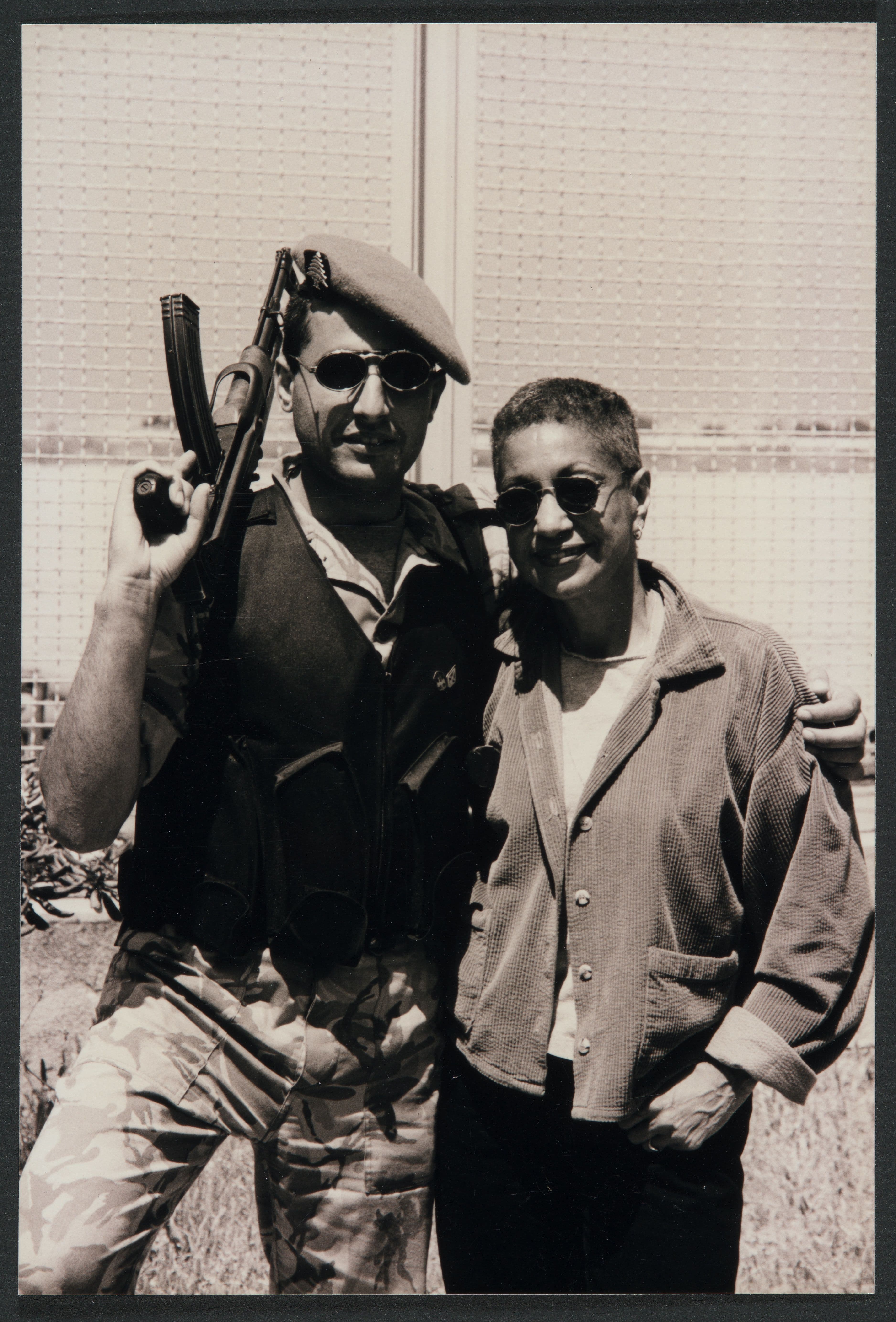
June Jordan with Lebanese soldier in 1996, © Christopher D. Meyer
My research in the correspondence archives of Audre Lorde and June Jordan builds upon pre-existing scholarship on Jordan’s activism by Keith P. Feldman and Erica R. Edwards. To date, Erica Edwards and Alexis Pauline Gumbs are the only scholars to have briefly discussed the archive detailing Lorde and Jordan’s disagreement, which Edwards highlights as evidence of the sometimes fraught nature of “Black feminist experiments with third worldism. Though the record of the conversation that led to their falling out is openly available in Audre Lorde’s archive, most scholars have yet to fully consider the ideological difference between the two poets that surfaced in this epistolary disagreement. This is perhaps because it brings up prickly, difficult-to-digest truths about a treasured literary ancestor: Lorde and her peers appear to choose their friendship with a white woman and self-identified Zionist over Jordan, a Black woman protesting a brutal war of aggression against Palestinian and Lebanese people. There is a silence in scholarship around Lorde and Jordan’s strained relationship post-1982, perhaps because the information disrupts the idea of a coherent Black feminist politics created by an ideologically-aligned group of Black women in the 1970s and 1980s. Nevertheless, now more than ever, it is important to disarticulate the legacies of different Black feminist thinkers, to consider the practice and the limitations of Black American feminists’ anti-imperialist solidarities, and to critically examine blind spots in Third World coalition-building of the 1970s and 1980s.
Many of Jordan’s peers eventually took more daring public stances on Palestinian rights in the decades after 1982. However, Jordan’s anti-Zionism and her refusal to prioritize her friendships with Zionist-identified women was quite distinct for the women’s movement of the time, which often relegated Arab American women to the role of either anti-Semitic terrorists or passive victims. Jordan was an anti-Zionist at a time when many of her contemporaries in the women’s movement, including other Black women, believed that anti-Zionism was antisemitism, and that the Zionist project could be made more humane through legislative reform in Israel Though Jordan also commends the efforts of Israeli peace activists in essays like “Life After Lebanon,” for her, Palestinians’ right to a homeland is not predicated on the recognition of Israeli or American Jews. Throughout her work, the Palestinian land claim exists as fact, as reality, as promise. The prospect of a world safe for Palestinians shaped Jordan’s views on what a world safe for Black people could look and feel like. Jordan refused to feel at home in a world that normalized Arab death, and her writings from the 1980s onward display a rigorous home-making process that refuses the comforts and empty promises of a “home” based on blood and the displacement of other people, however far away they may seem.
A Note on Method
The four letters at the heart of the conflict between Lorde and Jordan are found in the Audre Lorde Papers at the Spelman College Archives. Whenever possible, I have cross-referenced the correspondence folders of other writers mentioned in these letters in the June Jordan Papers at the Schlesinger Library. The Audre Lorde Papers organizes Lorde and Jordan's correspondence from the 70s into the early 80s in a folder dedicated solely to Lorde's correspondence with Jordan. This is the clearest and most complete record documenting the devolution of Lorde and Jordan's correspondence from friendly banter to the four cataclysmic letters that marked the end of their correspondence in 1982. The first relevant archival document is an open letter denouncing Adrienne Rich’s Zionism, written by Jordan for publication in the feminist periodical WomaNews; then there is a letter to WomaNews seeking to block the publication of Jordan’s letter, signed by Barbara Smith and Audre Lorde, among eight others; then, a placating but unapologetic explanation from Smith to Jordan; and finally, an indignant response from Jordan to Smith and Lorde While it is clear that Lorde agreed (at least initially) that Jordan’s letter should not be published, Lorde’s words are curiously absent from these four letters. She signed the letter in support of censoring Jordan, but Lorde was not an original recipient of Jordan’s open letter, and unlike Barbara Smith, she never replied to Jordan directly. However, Lorde’s decision to preserve the intact paper trail of the correspondence as a part of her archive signals Lorde’s continued investment in the debate as a participant rather than a bystander, and the possibility that she wanted to preserve it for posterity It is possible that Lorde did not save a copy of an outgoing letter to Jordan, or that Lorde attempted to respond to her by some other means. For her part, Jordan’s archive does not preserve any incoming or outgoing letters from the moment of the 1982 conflict, perhaps implying that she wished to forget or close the door on the whole incident.
Based on a cover letter to the editors of WomaNews dated October 10, 1982, Jordan had sent copies of her open letters to Black women writers whom she viewed as comrades, such as Alice Walker and Toni Cade Bambara, or interlocutors, such as Barbara Smith. In a letter addressed to Smith and Lorde dated December, 3, 1982, Jordan writes, “I am privileged to stand with the prompt and serious and clear response of my sisters on this matter,” implying that at least some of those copied responded affirmatively to her statement through phone calls or other ephemeral forms of communication In cross-referencing the correspondence folder for June Jordan in Bambara’s archive at Spelman, as well as all correspondence records from 1982 in the Alice Walker Papers at Emory, neither contain any letters from Jordan on the subject Barbara Smith does not currently have a publicly available archive for consultation, and has admitted in later interviews that she did not consider Jordan a friend, thus limiting the possibility of mapping their relationship through archival documents
Due to the blistering tone and high emotions of the letters in the Spelman archive, it is highly likely that the conversations between all of those directly involved in the 1982 schism (including June Jordan, Audre Lorde, Barbara Smith, and Adrienne Rich) spilled over into phone calls and one-on-one conversations that remain uncaptured by written correspondence. The material and mental toll that the event took on all the women involved is difficult to measure, and its results are impossible to quantify based on the written archive. This written archive most accurately captures Jordan’s attempt at public articulation of anti-Zionism and her feelings of hurt and betrayal when it was undermined by her peers, but it does not illuminate what comfort Jordan may have received from Alice Walker, or another close friend she turned to in her righteous despair. Nor does the archive capture how Barbara Smith, Audre Lorde, and eight other women sat down to write a letter to quash Jordan’s—Did they convene urgently, in someone’s living room, or did they speak on the phone? Did someone spearhead the writing of the letter, while others merely affixed their signatures? Did any of them have regrets? Even the logistics of how Jordan’s open letter came to be omitted from WomaNews remain a mystery, given that the newspaper published letters as a “bulletin board” without central editorial oversight
Answering these questions would require a careful process of oral history, an endeavor I hope to undertake in the future, which deserves its own time and space to allow multiple living participants to contextualize their experiences of the 1982 events Although my interpretation of events raises difficult questions about the ideological trajectory of women who eventually voiced public support for Palestine, to view this as an attack on any individual would profoundly miss the point. As was the case when the opponents of Jordan’s 1982 open letter dismissed it as a personal attack on Rich rather than as a political statement. Because the goal of this article is not to justify, indict, or exonerate any individual who participated in the events, my argument hinges on the public traces of this interpersonal debate. The record of published writings and publicly-accessible archives shows: Jordan’s open letter was never published, and even though some of the women who opposed its publication later joined her in public expressions of solidarity with Palestine, in 1982 they chose to be silent on Palestinian rights and vocal in their support of the right of Jewish feminists to be Zionists. Regardless of the intention behind it, the strategic alliances of figures like Rich, Smith, and Lorde shaped the zeitgeist of the women’s movement.
Though their alliance based on sexuality cut across racial lines, their exclusion of Jordan from their concept of a lesbian feminist Black-Jewish alliance in 1982 reflects this allegedly multiracial coalition’s exclusion of Palestinian/Arab women and their allies. Jordan found herself on the outskirts of this coalition because as a bisexual woman, her sexuality was not as subject to public visibility (and its attendant vitriol and disapprobation) as that of her lesbian-identified contemporaries. However, in their construction of a community that could safely hold their sexuality, some Black and Jewish lesbians strategically chose to prioritize the claims to oppression voiced by Zionist feminists of European descent. This reveals a contradiction in the politics of these avowed Third World feminists because, in the words of Jewish feminist Jenny Bourne, “the connection between racism and imperialism is for most black people a lived experience which links them directly with the struggles of all Third World peoples, they cannot but view the state of Israel as an agent of western imperialism, a colonising state and an oppressor of non-white peoples.” I view Jordan’s open letter as a dissenting perspective that was, in 1982, forced out of the public realm by her peers, never to be debated until the Gaza genocide twenty-two years after her death. By bringing Jordan’s unpublished words into the public eye, as she intended, I seek to consider the wider implications of the event beyond individual hurt and blame. The archival correspondence is more than a salacious glimpse into interpersonal drama. It is a record of the occasional dissonance between Black feminism’s avowed theories of coalition-building and solidarity with oppressed peoples, and its actual practice.
To make my claims, I rely on a triangulated method of archival research that supplements June Jordan’s post-1982 correspondence with the rich array of published materials (essays, poetry, open letters, position papers, and articles) cited in the letters. I have searched these published and unpublished materials for signs of how the 1982 conflict continued to shape the lives and work of all the women involved, while knowing that this depiction is necessarily incomplete. By tracing evolving views on Israel-Palestine in the post-1982 writings of the involved parties, I offer assessments of how the aftermath of the conflict sparked self-reflection and political growth among this group of American feminists for years after. The goal of this essay is not to dissect the inciting incident like a crime, but to follow its beam like a flashlight narrowly illuminating an obscured path behind us.
The Paper Wars: Anatomy of a Falling Out
The falling out began with an open letter titled “Feminism, Anti-Semitism, and Racism: Taking Our Stand Against Zionism and White Supremacy,” published in the feminist periodical Off Our Backs in July 1982. It was authored by Women Against Imperialism (WAI), a San Francisco-based group of anti-imperialist women, many of whom were Jewish. In the letter, the collective critiques “a growing tendency in the women’s movement to say that Jewish women are ‘Third World’ or at least not white. This ignores the fact that Jewish people in America, despite anti-semitism, are part of a white supremacist social order that holds down Black, Chicano-Mexicano, Native American and Puerto Rican peoples.” From there, they make an argument for solidarity with the Palestinian people, based on the premise that “The Jewish settlers in Israel play the same role as whites in South Africa. [….] As long as Israel’s right to exist is accepted, so is the colonization and genocide of the Palestinian people. This idea of Jewish complicity with global white supremacy was controversial at the time, especially among Jewish women in the women’s movement who were attempting to theorize anti-Semitism as a form of oppression on par with racism and imperialism.
This tension was visually and discursively represented by a Zionist feminist statement on the opposing page, titled “…what does Zionism mean?” It was authored by six women who went by the collective moniker Di Vilde Chayes (Yiddish for “the wild beasts,”), the most famous of whom was the poet Adrienne Rich. Di Vilde Chayes self-identified as “Jewish lesbian/feminists of Eastern European (Ashkenazi) background.” Despite their awareness of the “complexities” of Israel’s displacement of Palestinians, Rich and her co-signatories were unequivocal about Israel’s right to exist: “Zionism is one strategy against anti-Semitism and for Jewish survival. Anti-Zionism Is Anti-Semitism” [underlined in original]. Perhaps most galling of all was their claim that anti-Zionism was also racist, “since it refuses to acknowledge that two-thirds of the Jews of Israel are people of color. Given that this statement was authored entirely by white American Jews, their concern for the plight of Jews of color feels more like a rhetorical tool designed to shut down debate from other people of color than a genuine bid for coalition-building. These two competing letters indicate that there was no consensus on Zionism even among Jewish feminists, let alone among the non-Jewish women of color who found themselves implicated in the debate. As Feldman argues in A Shadow Over Palestine, “the proliferation of letters to the editor, position papers, and debates at conferences in the late 1970s and early 1980s bears out, some U.S. women of color feminists persistently addressed the special relationship between Zionism, anti-Semitism, and racism as inflected through the vicissitudes of U.S. imperial culture.
Furthermore, the two letters in Off Our Back were inflected by the beginning of the Israeli invasion of Lebanon a month prior. In June of 1982, Israel invaded Lebanon and began a nine-week siege on the capital city of Beirut in order to target the Palestinian resistance movement there. During this war and the ensuing carnage against Palestinian refugees led by Israeli-backed paramilitary groups, over twenty thousand Palestinian refugees and Lebanese civilians were killed. Rashid Khalidi argues that “because of American backing for Israel and tolerance of its actions [...] the 1982 invasion must be seen as a joint Israeli-US military endeavor—their first war aimed specifically against the Palestinians. Back in the US, mainstream media publications like ABC, NBC News, Time Magazine, and The New York Times reported for the first time with sympathy on the Palestinian struggle and displayed outrage at Israel’s atrocities. Amy Kaplan argues that during this war, “Israel had lost the claim to innocence that it had maintained during prior wars. Its messaging was no longer unassailable, and its worldview no longer smoothly nor automatically reflected that of the American news audience. In August of 1982, even Ronald Reagan called the Israeli prime minister, Menachem Begin, and warned him that “the symbol of his war was becoming a picture of a 7 month old baby with its arms blown off. The average American citizen could not claim, like the satirical narrator of Jordan’s poem, “Apologies to all the People in Lebanon”: “I didn’t know and nobody told me and what / could I do or say, anyway? The point of Jordan’s poem was that no one in America could claim ignorance of the terrible deeds their tax dollars were paying for that bloody summer of 1982, and in light of that knowledge, a refusal to speak or act against it becomes willful.
Even after Israel’s war of aggression against Lebanon dominated the American news cycle throughout the summer, Di Vilde Chayes doubled down on their commitment to Zionism in a second letter published in October of 1982 in Off Our Backs and WomaNews. They continued to position themselves as “Zionists—committed to the existence of Israel—who are outraged at Israel's attack on Beirut and are equally outraged at the world wide anti-Semitism that has been unleashed since the invasion of Lebanon. Irena Klepfisz, a signatory on both letters, later regretted the timing of the letters, which “made us seem indifferent to the brutal events” of the war Much like their initial response, even Klepfisz’s remorse is colored by the desire to seem even-handed while making false equivalencies between an unspecified anti-Semitism and the concrete reality of twenty-thousand Arabs massacred, a form of rhetorical bad faith that persists to this day.
It is understandable that Jordan would feel betrayed by Rich’s contribution to both these letters. She had been friends with Rich since 1976, and their personal correspondence depicts a deep intellectual comradeship in which the two poets exchanged work, ideas, and emotional support. Later, Jordan recalls being shocked by Rich’s letter, given that in all of their previous conversations Rich had never identified as a Zionist nor as Jewish For Jordan, seeing Rich label the political stance of anti-Zionism as racist, all while staking a claim to racialization and Third World struggle to which she had no right, may have left Jordan questioning the intellectual bond they had built over their shared political and aesthetic commitments. The power differentials between Rich and Jordan—who was older, more famous, and white—might have further exacerbated Jordan’s sense that Rich’s support was predicated on Jordan’s Blackness being merely identitarian and not political.
“It should surprise no one that we, Black and Third World people everywhere, attach fundamental importance to the question of Palestine,” says Jordan in her response to Di Vilde Chayes’ statement Driven by her grief and outrage at the massacres at Sabra and Shatila in September, in which thousands of Palestinians were murdered by militia groups over the course of two days, Jordan wrote an open letter called “On Israel and Lebanon: A Response to Adrienne Rich from One Black Woman,” dated October 10, 1982. Her address to Rich was both personal (she names Rich alone among the signatories of the two letters) and pedagogical (it is an open letter to be published in WomaNews, and thus intended for public consumption). Using the words “genocide” and “holocaust,” Jordan lays out the shocking array of war crimes committed by Israel over five months—phosphorous bombs, the destruction of civilian infrastructure, the massacre at Sabra and Shatila—and criticizes Rich’s failure to take responsibility for these atrocities as the tangible outcomes of the Zionism she claims to espouse. This idea of responsibility runs through Jordan’s response like a live wire, culminating in this astonishing statement:
I claim responsibility for the Israeli crimes against humanity because I am an American and American monies made these atrocities possible. I claim responsibility for Sabra and Shatilah [sic] because, clearly, I have not done enough to halt heinous episodes of holocaust and genocide around the globe. I accept this responsibility and I work for the day when I may help to save any one other life, in fact.
Because Rich does not take responsibility, Jordan models it for her. This is perhaps the most important rhetorical turn in Jordan’s letter, though it goes unacknowledged in subsequent responses from other readers. Jordan recognizes that being part of an ethno-nationalist state, whether born or chosen, carries the obligation to critique its violence. The fact that a Black woman born in a nation that rejects her can make this statement, with far more humility than Rich’s selective, cherry-picked identification with Israeli statehood, is a testament to the transformative possibilities of Jordan’s identity politics.
![“Refugee camp of Shatilah in Beirut” [sic] Photo by June Jordan, © Christopher D. Meyer](/_next/image?url=https%3A%2F%2Fcdn.sanity.io%2Fimages%2Fneqqlok6%2Fproduction%2F8e235cbffa464f15623b57b0bda15ae1d2d301b2-4672x6430.jpg&w=3840&q=75)
“Refugee camp of Shatilah in Beirut” [sic] Photo by June Jordan, © Christopher D. Meyer
Due to the intervention of a group of Black and Jewish feminists, Jordan’s open letter was never published, and exists only (as far as I have seen) in the unpublished archive of Lorde’s correspondence. Lorde was notified of Jordan’s letter by Barabara Smith, and joined Smith and eight other women in writing a letter to the editors of WomaNews to block the publication of Jordan’s response on the grounds that it “contributes to an atmosphere of increased polarization between Jewish and Black women. Although they agreed with Jordan that “the Vilde Chayes’ two open letters reflect insufficient political concern for the fate of the Palestinian people,” the letter’s signatories thought that Jordan’s singling out of Rich was tantamount to “character assassination.” They argue that Jordan demonstrates “insensitivity to Jews as a group” by questioning Rich’s self-identification as a Zionist, they point out the fact that Di Vilde Chayes wrote their second letter before Sabra and Shatila (though it was published after) and thus cannot be accused of being indifferent to it, and they lament the fact that Jordan “did not express her anger toward the group’s politics in a responsible way. Overall, the letter seems more interested in chastising Jordan for her tone and timing than in engaging with the content of her four-page critique
News of Jordan’s letter and her alleged attack on Adrienne Rich traveled far within the lesbian feminist community. In a letter to Cheryl Clarke, who was not named in any of the correspondence to WomaNews, Jordan addresses the accusation that she singled out Adrienne Rich:
She is the only national writer who signed both of those statements on Lebanon and, hence, it was her signature that gave national consequence to the sentiments expressed […] You will be relieved to know that what you refer to as the : ‘scrupulous’ freedom of the press of the women’s community does not extend to somebody not white and not Jewish and insisting that a non-Jewish and non-European life is quite as valuable as any other and that, therefore, the terms genocide and holocaust must be applied to what the Israelis have accomplished in Lebanon. Hence the statement will not appear. So you can breathe easy on behalf of poor Adrieene [sic] who can support genocide but can’t be trusted to answer a three page statement, by her self
Though it is unclear who ultimately made the decision to suppress Jordan’s letter, it does appear that there was an interracial community impulse to protect Rich, and that the importance of Jordan’s public support for Palestine was either ignored or labeled as anti-Semitic. In a blistering response to both Lorde and Smith, Jordan writes: “Do not call me an anti-Semite. Bridle your fucking arrogance and let a little reality into your mouths […] I will match both of you anytime anywhere on the subject of who is veriably [sic] unswerving in her activism against such evils as anti-Semitism (anti-Jews and anti-Palestinian and anti-Arab, per se) and in her activism to produce effective coalitional politics. Indeed, in 1982 alone, Jordan’s multiple expressions of outrage against the war in Lebanon through poetry, prose, and public speaking engagements echo loudly against the silence and equivocations of the feminists who sought to suppress her open letter.
As I have noted previously, there is no written correspondence, in Lorde’s archive or in Jordan’s, between the two women after 1982. Jordan and Rich, on the other hand, rekindled their friendship after a four-year gap and continued to be close until Jordan’s death in 2002. In an interview with Peter Erickson in 1994, Jordan details her failing out and reconciliation with Rich. While both were participating in an anti-apartheid poetry reading in New York in 1986, Jordan approached Rich and said, “I completely and absolutely detest your views on Israel and I love you. Upon reading this interview, Rich wrote to Jordan, “I thought if anything we had forgiven each other […] Some of your remarks in the interview have hung over me all weekend, of reviving the acute personal + political misery of that time. How much difference it would have made if you could, then, have written to me as a person + not as a public object. Though Rich was angry at Jordan for airing their personal business in this interview, she signed the letter, “My love for you is unshakeable.”
During their four years apart, it is evident that Jordan and Rich continued to think of one another. Jordan considered Rich’s public avowals of Zionism to be fair ground for public critique, and she remained committed to addressing the issue in the years after 1982. In a letter to Carol Haddad, founder of the Feminist Arab-American Network (FAN), Jordan describes a 1984 reading in which she was set to “[confront] Adrienne Rich for the first time since the Israeli invasion of Lebanon which, as you know, was when she chose to become a “public” “Zionist”, I am feeling determined, anew, to do something appropriate. Meanwhile, as early as the winter of 1982, Rich wrote the essay “Split at the Root: An Essay on Jewish Identity,” which grappled with the meanings of her family’s suppressed Jewish identity and their internalized self-hatred resulting from the trauma of antisemitic violence. Though she does not mention her turn to Zionism earlier that year, she seems to begin a process of self-reflection that will eventually lead to an anti-Zionist reevaluation of her Jewish identity formation. She wrote, “Not just a way of saying, in 1982 Right Wing America, I too, will wear the yellow star. It’s a moving into accountability, enlarging the range of accountability. Was this move towards accountability a step towards grappling with the substance of Jordan’s critique? Presciently, Rich wrote to Jordan in 1979: “You do understand, don’t you, that white women have almost no idea of how to meet or respond to black women’s anger? At this earlier stage in their friendship, Rich was speaking in general terms and did not appear to include herself in the category of white woman who might respond to a Black women’s anger with tears and defensiveness. In fact, she valued “the idea of writing to each other letters which are like notes exploring the edges of our political thinking.However, the edge of political thinking is not a placid place. Perhaps this was not evident until she met (and initially failed to respond to) the full force of Jordan’s anger.
After their 1986 reconciliation, Rich and Jordan continued to brush against old wounds even as their anti-Zionist politics became more aligned. In 1987, for example, Jordan sent Rich an article called “Homelands of the Mind: Jewish feminism and Identity Politics,” by British Jewish feminist Jenny Bourne. Like the 1982 letter by Women Against Imperialism, Bourne argues that “although there has been massive persecution against us over many centuries and in many lands […] we do not now face in western societies the type of systemic exploitation which relegates black and Third world people to ‘the lower depths’ and threatens to keep them there. Bourne laments the way that she saw fellow Jewish feminists have abandoned materialism in favor of their own version of identity politics and identifies the invasion of Lebanon as a key moment in which Jewish feminists failed to acknowledge the material realities of the atrocities committed by Israel in their name. In her reply to Jordan, Rich scathingly refers to this viewpoint as “pretty predictable British Leninist rhetoric,” and takes umbrage at Jordan’s impulse to send it to her: “What I would ask you to examine in your heart is why you sent me the article and what message you meant to convey […] If you want to open dialogue with me about my relationship to the Jewish people, or to the Jewish progressive movement, why not do that, on your own terms, instead of sending me this British woman’s article? Indeed, Bourne quotes Di Vilde Chayes’ July 1982 statement as an example of the bad faith conflation between anti-Zionism and antisemitism, so Rich had some cause to believe that Jordan was making a pointed statement by sending her the essay.
In a measured reply, Jordan points out that she also sent the essay to Angela Davis, Alice Walker, and Sara Miles: “I felt eager to let my closest intellectual comrades have a look, whether they will agree or disagree with J.B./me, or whatever […] I am not particularly interested to open a dialog with you about your relationship to the Jewish people. What I particularly want to do is share ideas as I come upon them and to engage in exchange of reactions, regardless of whether my comrades agree or disagree. She signs the letter with her love and an enclosed poem. Jordan’s use of the word “comrade” to describe this set of friends is notable for its connotations of shared political commitments, rather than the more politically neutral term “friend.” This goal gets lost if we assume that Jordan’s 1982 reaction to Rich, Smith, Lorde et al. was a fit of pique rather than an invitation for public discourse about a political issue with people who considered themselves public intellectuals. It was not the fact that her friends disagreed with her that seemed to hurt her the most, but the fact that they refused to engage with her ideas about Lebanon and Palestine and foreclosed the possibility of a debate in the wider feminist community.
There are a variety of reasons beyond pettiness that Jordan could have chosen to send Bourne’s article to Rich: a genuine desire for dialogue, a sign that their conflict was far behind them, and of course, a not mutually exclusive desire to say I told you so. Jordan’s enthusiasm for the essay makes sense within the wider context of her work. Bourne’s critique that for Jews, “ ‘What is to be done’ has been replaced by ‘who am I’ ” aligns tightly with many of Jordan’s writing against identity reductionism Jordan also believed that “It is not only who you are […] but what we can do for each other that will determine the connection. Jordan’s words serve as a reminder that their connection cannot be reduced to an easy identification of their overlapping identities as women who love women, but must be renewed every day through a commitment to their shared political goals.
Sometimes Jordan’s deemphasizing of legible identitarian markers left her on the outside of her social and professional groups. Alexis Pauline Gumbs has argued that Jordan’s identification as bisexual, rather than as a lesbian, alienated her from women like Barbara Smith, Audre Lorde, and others who faced professional consequences and interpersonal attacks for their public identification as lesbians. In Gumbs’ words, “Audre and many other self-identified Black lesbians interpreted the fact that June never identified as a lesbian as a betrayal. According to Gumbs and Smith herself, these personal differences around queer identification often had interpersonal consequences, as in the case of their mutual participation on a panel on Black feminism at the National Black Writers Conference at Howard University in 1978. “I was basically hung out to dry,” says Smith. “It was a really blistering experience that day. Not so much because of what people on the panel said, but what the 500 people in the audience had to say, which was basically I needed to go bury myself somewhere because I was a lesbian. Gumbs describes Smith as “traumatized by the events of that panel,” notably by the fact that Jordan, who was moderating the panel, “never stood up for (Sister) Barbara directly. In order to avoid replicating the false equivalencies made between antisemitism and anti-Blackness, however, I also find it necessary to avoid equating the discrimination faced by American lesbians with the torture, death, and displacement of the Palestinian people that has been underwritten by American tax dollars. Jordan’s shortcomings as a panel moderator may contextualize the lack of personal allegiance that Smith may have felt for her, but they do not justify or excuse an effort to censor Jordan’s principled critique of Rich’s publicly avowed Zionism.
Given that the two were not close, Jordan simply may not have been a person to whom Smith felt an obligation beyond the professional. In a letter to Jordan justifying her opposition to Jordan’s open letter, Smith makes clear that she is prioritizing Black-Jewish coalition building over Jordan’s freedom of expression: “I am positive that your statement, if it had been published would have done nothing but halt principled discussion among different groups of women and would instead have given the go-ahead for Third World and Jewish women in particular to go at one another’s throats. This is similar to the explanation Smith gives in a recent recounting of her decision: “We saw that letter being published and widely circulated–attacking Adrienne Rich–as being like an intervention that would not just make a rift among different kinds of women, specifically Black and Jewish women, it would make a chasm like the Grand Canyon. We're not just talking about something minor. We were very concerned because we were trying to build something.” The something they were trying to build appears to have been based in a coalitional lesbianism whose axis of communality appeared to be Black and Jewish women’s shared experiences of homophobia and misogyny. Citing her negative experiences in predominantly straight spaces within the women’s movement and the Black liberation movement, Smith later explains that, as lesbians, “we were so isolated, so marginalized that places where we might've been involved in robust discussions about this struggle for Palestinian freedom, we were not necessarily welcome at those places. However, this insinuation that pro-Palestinian activism in the 1980s might have been too homophobic to include lesbians does not appear to be based in an effort to explore spaces discussing Palestinian liberation.
Rather than basing their coalition against the people and publications that attacked the validity of both Black lesbian and Arab life, the 1982 rift illustrates an instance in which Black women prioritized coalition-building with the white lesbian women they knew over solidarity with the Arab women they did not know (and, in fact, chose not to hear). Despite the fact that Jordan was not close with Smith and that she never had the same intimate friendship with Lorde as she did with (for instance) Alice Walker, her tone in her response to Smith and Lorde is one of genuine shock that they allowed their interpersonal relationships to influence what she saw as an issue of life vs. death. In Jordan’s case, her individual friendships with Jewish women (including Adrienne Rich) did not stop her from seeking out the counsel of Arab and Arab-American women, who had been largely ignored by the women’s movement. The exclusion of Arab and Arab-American women from the conversations about Israel was a significant but widespread blind spot within the American women’s movement. The volume of panels, articles, and books exploring anti-Semitism against white-American Jews far exceeded, and at times deliberately obscured, the discourse around the active annihilation of Arab people in Lebanon and Palestine, and the overt discrimination faced by Arab-Americans.
At the 1982 National Women’s Studies Association conference, Carol Haddad gave a speech entitled “Anti-Arabism.” Reprinted in Off Our Backs in 1983 (preceded by June Jordan’s poem “Apologies to all the People in Lebanon,” at Haddad’s request), Haddad urges American feminists to move past anti-Arab stereotypes to “seek out Arab and Arab-American feminists, and integrate the perspective of these sisters into feminist thought and debate. Our survival as a movement, and as a civilization, depends on it. It seems that Jordan did just that. In July of 1984, Jordan wrote to Carol Haddad about reading her speech in Off Our Backs: “at about 3:30 A.M., straight through, and, once again, the monstrous silence, the monstrous intimidation, the monstrous wrong annihilating Arab peoples as people, and Palestinian men, women and children as human beings, overwhelmed me.” Two years after 1982, Jordan had meaningfully incorporated the plight of Arab and Palestinian people into her emotional landscape and into her vision of feminism.
Feldman argues that in Jordan’s writings on Palestine and Lebanon, she “fashioned her work in the midst of a rupture within second-wave feminisms that put her in conversation with nascent Arab-American feminist and Arab-American literary formations. Even within multiracial feminist circles tasked with considering racism and oppression, Feldman also notes that, “Largely absent in Jewish feminist anxiety around Israel were substantive engagements with Arabs and Palestinians as subjections endowed with a complex personhood,” and remarks upon the absence of Arab women writers in This Bridge Called My Back (originally published in 1983 by Kitchen Table Press), whose only mention of Palestine is a brief reference to the Sabra and Shatila massacre in Cherríe Moraga’s introduction to the first edition Mainstream feminist publications with largely white editorial boards, like Ms magazine, both reflected and enforced this aporia. Letty Pogrebin, one of the founding editors of Ms, regularly published and spoke in support of Zionism. In her June 1982 article, “Anti-Semitism in the Women’s Movement,” Pogrebin equates antiblack racism and antisemitism through the argument that “Zionism is simply an affirmative action plan on a national scale. To discuss Black-Jewish relations, she also quotes Barbara Smith’s assertion that “It is necessary for both groups to make an effort to comprehend each other’s situation. Smith’s diplomatic quote in the article, as well as the prominence and space the essay takes up in the publication, shows the immense influence of Zionist writers and editors in the circulation of feminist documents in the 1980s. Especially given their founding of Kitchen Table Press as a grassroots, donation-funded operation in 1980, Smith and Lorde could little afford to alienate Jewish allies in the publishing industry who could provide financial support for their nascent woman of color press.
Published two years after the conflict with Jordan, Smith’s essay “Between a Rock and Hard Place” continues to walk the tightrope between Black feminist autonomy and the need for Jewish allyship. In her essay, Smith acknowledges Black women’s complicity in anti-Semitism as people raised in an anti-Semitic country, but she cautions Jewish women that Black women’s critiques of their politics cannot be boiled down to anti-Semitism.: “Jewish women need to acknowledge the potential for racism in singling out Black and other women of color and that racism has already occurred in the guise of countering anti-Semitism.
Smith is not afraid to critique the fact that “Jewish women’s desire for support and recognition has also resulted at times in attempts to portray our circumstances and the oppression of racism and anti-Semitism as parallel or even identical. The mentality is manifested at its extreme when white Jewish women of European origin claim Third World identity. In some ways, Smith’s argument precedes elements of Bourne’s argument to which Jordan reacted so favorably in 1987, in which Bourne argues that, “to be accounted for politically has, for Jewish feminists, meant if not a clear competition with black feminists, an attempt at least to jump on their bandwagon and mechanically equate their struggle against oppression. Smith rejects the competition between the two groups, but in choosing to address Black women’s antisemitism at a time of escalating Israeli violence, she risks over-emphasizing Jewish oppression and minimizing the larger threat of Zionist violence against Third World peoplesSmith anticipates this critique and worries “that addressing anti-Semitism sets me up to look like a woman of color overly concerned about ‘white’ issues. What I fear losing, of course, is the political support and understanding of other women of color, without which I cannot survive. But survive she does. Alluding, perhaps, to the events of 1982, Smith writes:
The polarizations have directly and painfully affected me and people close to me. One major problem (which I hope this essay does not contribute to) is that far too often these battles have been fought on paper, in published and unpublished writing. Besides the indirectness of this kind of confrontation, I want to say how sick I am of paper wars, when we are living on a globe that is literally at war, where thousands of people are dying every day, and most of the rest of the world’s people still grapple for the barest necessities of food, clothing, and shelter
As a veteran of the paper wars of 1982, Smith’s hope that her later essay could escape the phenomenon of polarization was perhaps in vain. Smith’s essay, along with many of the writings discussed in this article, and even this article itself, is the product of a polarization it did not cause. All these papers are ultimately superfluous to the task of providing for people’s material needs, yet many seek a world in which the wars of flesh and blood are ended. In 2023-2024, Smith’s advocacy as a member of Jewish Voice for Peace in the wake of October 7th contributed to the city of Albany passing a resolution in support of a ceasefire in Gaza, attesting to her antiwar stance beyond the written word
The true casualty of the paper wars was the relationship between Lorde and Jordan. Jordan was neither as close to Lorde as she was to Rich, nor as distant as she was from Smith. But there is no archival evidence that Lorde and Jordan ever reconciled, even after Jordan and Rich rekindled their friendship. Perhaps Jordan was able to forgive Rich and not Lorde because she had expected greater solidarity from a Black woman. Unlike with Rich, the Jordan-Lorde rift was not only a matter of Lorde’s views on Israel—it was a deeply personal betrayal of one Black woman by another. “So much for dialog/support/any kind of community,” Jordan wrote in her letter to Lorde and Smith And of course, the personal was political—Lorde’s failure to identify with the Palestinian struggle over her personal connections with white women had heartbreaking implications for a solidarity movement in which Jordan often found herself to be a lone voice of critique in American cultural spaces overrun by Zionists, in which the foreign policy opinions of Black women were either dismissed or attacked Lorde’s support would not only have made a difference for Jordan personally, but it could also have marked a small but important shift in the political landscape of Palestine solidarity in America, which has only recently begun to achieve mainstream traction.
Jordan and Lorde met as professors at the City University of New York, bonded by their support for student protests in support of an open admissions policy that would address the educational inequities their Black and brown students faced in accessing higher education. Gumbs notes that, “In the late 1970s, Audre and June no longer worked in the same place, but their communication increased. They wanted to get together, but they had many near misses. Even before their falling out in 1982, it is clear that Jordan and Lorde had very different opinions on the state of Israel, as evidenced by Lorde’s description of her youthful optimism about the creation of Israel in Zami: A New Spelling of My Name, published earlier that year: “the state of Israel represented a newly born hope for human dignity. Lorde was fourteen in 1948, and heavily influenced by her young Zionist classmates at Hunter High School, but as an adult in 1982, she did not indicate later consideration of the Palestinians whose dispossessed land made possible the kibbutz on which her Jewish friends labored, to her envy. The year was now 1982, not 1948, but the state of Israel rose again to drive a wedge between Lorde and her friend June Jordan. Both women were Black feminist poets born to West Indian immigrants in New York, both were former professors at CUNY, and they were warm acquaintances up until 1982. Both would eventually die of breast cancer. As a number of scholars and biographers have noted, they shared political alignment on many issues relating to race and gender.
Perhaps Jordan was moved to give Lorde a phone call before her death, and because of the material nature of the archive, their reunion was left unrecorded. Or perhaps, as Alexis Pauline Gumbs notes, their reconciliation was in some ways too late—Jordan’s next written words to Lorde were posthumous, in an unpublished tribute written a year after Lorde’s death. Prompted by Lorde’s death, Jordan acknowledges that, and in spite of the divisions wedged between them by racist ideologies, she and Lorde were striving for a common goal: “At different points our lives diverged as did our chosen paths for struggle[.] But we did not ever fully disentangle from joined combat against hatred and the annihilation of all bigotry[.] For her part, Lorde kept the somewhat unflattering record of her falling out with Jordan as part of her meticulously self-curated archive, which leads me to believe that Lorde continued to walk with Jordan long after their paths diverged.
Jordan and Rich’s rekindled friendship can perhaps shed light on Jordan and Lorde’s evolving feelings for one another, which remain uncapturable by a written archive. Rich’s poem “Negotiations” was published in Rich’s 1989 collection Time’s Power, but it also was enclosed in a 1987 letter to June Jordan, suggesting its ties to their falling out and eventual reconciliation:
“Someday if someday ever comes we’ll go
back and reread those poems and manifestos
that so enraged us, in each other’s hand
I’ll say, But damn, you wrote it so
I couldn’t write it off You’ll say
I read you always, even when I hated you.
In their four years apart, it appears that Rich could not entirely “write off” the content of Jordan’s anti-Zionist critique, however much its tone may have personally hurt her. Perhaps the same went for Lorde and Jordan. In her poem “Intifada Incantation: Poem #8 for b.b.L.,” Jordan writes, “I COMMIT / TO FRICTION AND THE UNDERTAKING / OF THE PEARL. These lines can be taken as a mantra for Jordan’s role in compelling members of her community to identify with and assume responsibility for the plight of the Palestinian people. It can be inferred that Rich’s anti-Zionism, and probably Lorde’s, was generated by the friction of Jordan’s uncompromising commitment, and by the example of her willingness to lose friendships and opportunities by standing up to the Israel lobby.
This friction may have resulted in Lorde’s one public declaration in support of Palestine: the Oberlin commencement address of 1989. Lorde finally came to the realization that Black-Palestinian solidarity was “not a matter of altruism, but a matter of survival.” This is the poetic refrain repeated throughout the speech itself, which devotes a paragraph to the plight of Palestinian people among other interconnected oppressions, including the case of the Central Park Five, South African apartheid, income inequality in America, and the AIDS epidemic. Delivered three years before she died, Lorde addressed the plight of the Palestinian people briefly but directly: “Encouraging your congresspeople to press for a peaceful solution in the Middle East, and for recognition of the rights of the Palestinian people, is not altruism, it is survival. Her argument here is that the struggles of oppressed people are intertwined, a rejoinder to those who would say that solidarity is a mere extending of charity to unrelated people in need, rather than a larger preservation of all human life against the forces that seek to undermine it. The speech is itself a statement on the interconnectedness of all forms of racialization and oppression, and an echo to what Jordan had written in her open letter to Adrienne Rich seven years prior: “the issue of Palestinian people is the issue of the value of human life.
Jordan and Lorde have often been invoked in the same breath as examples of Black women’s solidarity with Palestine. The oft-quoted lines from Jordan’s poem, “Moving towards Home”—“I was born a Black woman / and now / I am become Palestinian.”—are rarely discussed in the context of her wider anti-Zionist activity that involved protests, fundraisers, numerous poems and articles, correspondence with Arab and Arab American feminists, and a trip to Lebanon in 1996 This commitment to the Palestinian cause hamstrung her career for nearly a decade, resulting in death threats, a loss of writing opportunities, and social ostracization within multiracial feminist circles This is not to make a tit-for-tat comparison between Lorde and Jordan, but to identify anti-Zionism as a practice, not a statement. Identifying the differences between Jordan’s practice and Lorde’s singular statement allows us to make discerning judgments about the gap between words and action, and to assess the change and fluidity behind seemingly static proclamations of solidarity.
Black Feminist Anti-Imperialism and the Future of Home
In her essay, “Life After Lebanon,” Jordan describes being surrounded and harassed by “large whitemen, two of them Israeli poets” at a poetry reading, and the intercession of three of her friends who got her out of the venueThe event in question, held in New York on November 28, 1982, was a UNICEF poetry fundraiser for children in Lebanon titled “Moving towards Home,” after Jordan’s poem. Mahmoud Darwish was invited to have read at the event, but he was denied a visa. According to Feldman, “The United States has classified him as ‘inadmissible’ under the Ideological Exclusion Clause of the immigration laws and refused Darwish’s entry to join MOVING TOWARDS HOME. Darwish had just survived the siege on Beirut against which Jordan had so adamantly protested earlier that year, so it seems like a great cruelty that the two poets were not allowed to meet. They met, however, in writing, and in mutual dreaming of a homeland foreclosed. In “Moving towards Home,” Jordan writes that, due to the acts of genocide against Palestinian and Lebanese people in 1982, “there is less and less living room,” even from her position as an American citizen watching these atrocities from afar Years later, in the wake of the Oslo Accords, Darwish wrote, “It is true that the occupation has left the bedroom, but it is still sitting comfortably in the living room and in all the other rooms. It controls the water faucet, the electricity switch, and the blueness of the sea […] Is this not better than nothing? There is a fortuitous parallelism between the two living room metaphors, both describing systems of foreclosed sovereignty in which an oppressive state continues to occupy the intimate lives of the oppressed, in spite of its alleged concessions and reforms. Both poets demand a living room that cannot be enclosed by the walls of someone else’s house.
In its title and structure, “Moving Towards Home” presents a forward motion, a restless search for a home at which she never arrives. Which begs the question: why isn’t she home yet? Is not the American living room where the news of the atrocities in Lebanon and Palestine rolls over her in a wave of newspapers, broadcasts, and letters—is that not the only home she has ever known? Jordan’s poetry and prose is suffused with a longing for home. She has a career-long fixation on the concept, returning again and again to what it is not, where it is not. She describes growing up Black in America as “a house where every true mirror shows us the face of somebody who does not belong there.
The Israeli nation-state initially held an allure for some Black people, including Audre Lorde, James Baldwin, Paul Robeson, Bayard Rustin, W.E.B. Du Bois, and Ta-Nehisi Coates, often rooted in their identification with Jewish people as a forcibly displaced people seeking a homeland. Nadia Alahmed notes, “Israel was initially considered a symbol of the victory of the oppressed, as envisioned by many Black intellectuals […] They saw it as a people originating in the Middle East triumphing against Western aggression and the horror of the Holocaust.It is important to consider these instances in light of what Dana Olwan calls “assumptive solidarity,” which she uses to complicate the ties between Palestinian and the Indigenous peoples of North America and to highlight “the importance of moving towards an understanding of solidarity that does not conceptualize innocence or sameness as prerequisites for liberation movements and justice struggles.Such assumptions of sameness or innocence as a bond between oppressed people, she argues, leaves room for a solidarity in name only, based on over-simplifications and empty statements rather than undertaking the often arduous and unsettling work of building coalition across difference. For some Black writers, the work of solidarity was precipitated by trips to Israel and encounters with border walls and overt displays of anti-Palestinian racism, forcing them to confront their previously expressed sympathy or curiosity about the Zionist project, as in the case of James Baldwin and, later, Ta-Nehisi Coates. Coates writes, “I had gone to Palestine, like I’d gone to Senegal, in pursuit of my own questions, and thus had not fully seen the people on their own terms. Coates’ decisions to connect his trip to Senegal with his trip to Palestine highlights a diasporic longing for Africa and for an unalienated identification with home. As a descendent of enslaved Africans, Jordan pulls at the root of potential Black-Zionist sympathies by shifting her discourse away from a nostalgic African homeland divorced from the desires of its present-day inhabitants.
The first stanza of “Moving towards Home” is difficult to read and thus seldom included in excerpted quotes from the poem. It is a litany of violence, outnumbering in lines the small but strong flame of Jordan’s personal living room. After a recounting of rape, murder, and dismemberment at the hands of Israeli soldiers, the poem pivots towards the home-making of the second stanza, hinging on a crucial backward glance at all the victims of Israeli violence rather than its perpetrators: “These are the ones from whom we must redeem / the words of our beginning. Intifada is one such word of our beginning, a reclamation of Palestinians ways of homemaking and building. Intifada as a concept was clearly galvanizing for Jordan. In her field notes from her 1996 trip to Lebanon, interspersed throughout her records of Israel’s murderous acts is the capitalized word “INTIFADA,” like the response to a call. What makes Jordan’s solidarity so enduring was that Jordan was not just concerned with the violence leveled against the Palestinian people by the US and Israel, but also deeply inspired by the Palestinian resistance. This was quite radical in 1982, as Amy Kaplan argues that despite increased sympathy for Palestinian war victims, “The focus of the American media quickly shifted from the suffering of Palestinians to the anguish of the Israelis,” as American Zionists began to reframe the war as an aberration and a stain on the ultimately noble project of Israeli statehood
Jordan’s poem “Apologies to All the People in Lebanon” was first printed in the Village Voice in July of 1982, in the midst of the media battle for Israel’s soul. It speaks to the pervasiveness of media coverage of the 1982 Israeli invasion of Lebanon, and the hypocrisy of her contemporaries who claimed ignorance of an event that was continually broadcast on every American television set—“You can expect but so much / from those of us who have to pay taxes and watch / American TV. The role of television in the poem functions as both an instrument of information and estrangement, filtered through the repeated “they said” to indicate media bias in its portrayal of Israeli victimhood and Palestinian aggression. However, as Zahra Hussein Ali notes, “Jordan, who relies on American TV to give her the political "world picture," seems resolute in denigrating the propagandized image of American media as a reliable vehicle of truth and in unveiling its disciplinary perspectives that homogenize the viewers' perceptions and shape the meaning of the genocide to accord with a dominant Eurocentric discourse. The problem identified by the poem is not a lack of access to information, but a passive consumption of that information and a tacit identification with the safety of American spectatorship. Against the grain of the material comforts and privileges of the American living room, Erica Edwards argues that “Jordan articulates Black literary feminism as the radicalization of safety. Whenever possible, Jordan left her American living room to testify from active sites of armed struggle—as she did in her 1996 essay “Eyewitness in Lebanon.” Visiting Lebanon for the first time in 1996, Jordan reorients home based on her own five senses—the grooves of bullet holes worn into concrete, the scent of jasmine—rather than her television’s attempts to manufacture the American public’s consent Her unpublished photographs from Sabra and Shatila refugee camps, the site of the massacre that had haunted her in 1982, offer a visual illustration of the poem “Moving towards Home”: from the injured, the martyrs, and the orphans to the efforts to (re)establish home. She takes numerous photographs of tenuous, tenacious life: laundry lines strung through the rubble, a young man adjusting his shoe next to bullet-pocked stairs. Her commitment to photographing stairs feels almost metaphorical in its recurrence, and her poignant annotations of them symbolize the same forward and upward motion towards home that animates the rest of her work: “Lebanese sunlight soft on stone steps of a refugee camp” and “Steps leading to the sky / Refugee camp of Sabra.
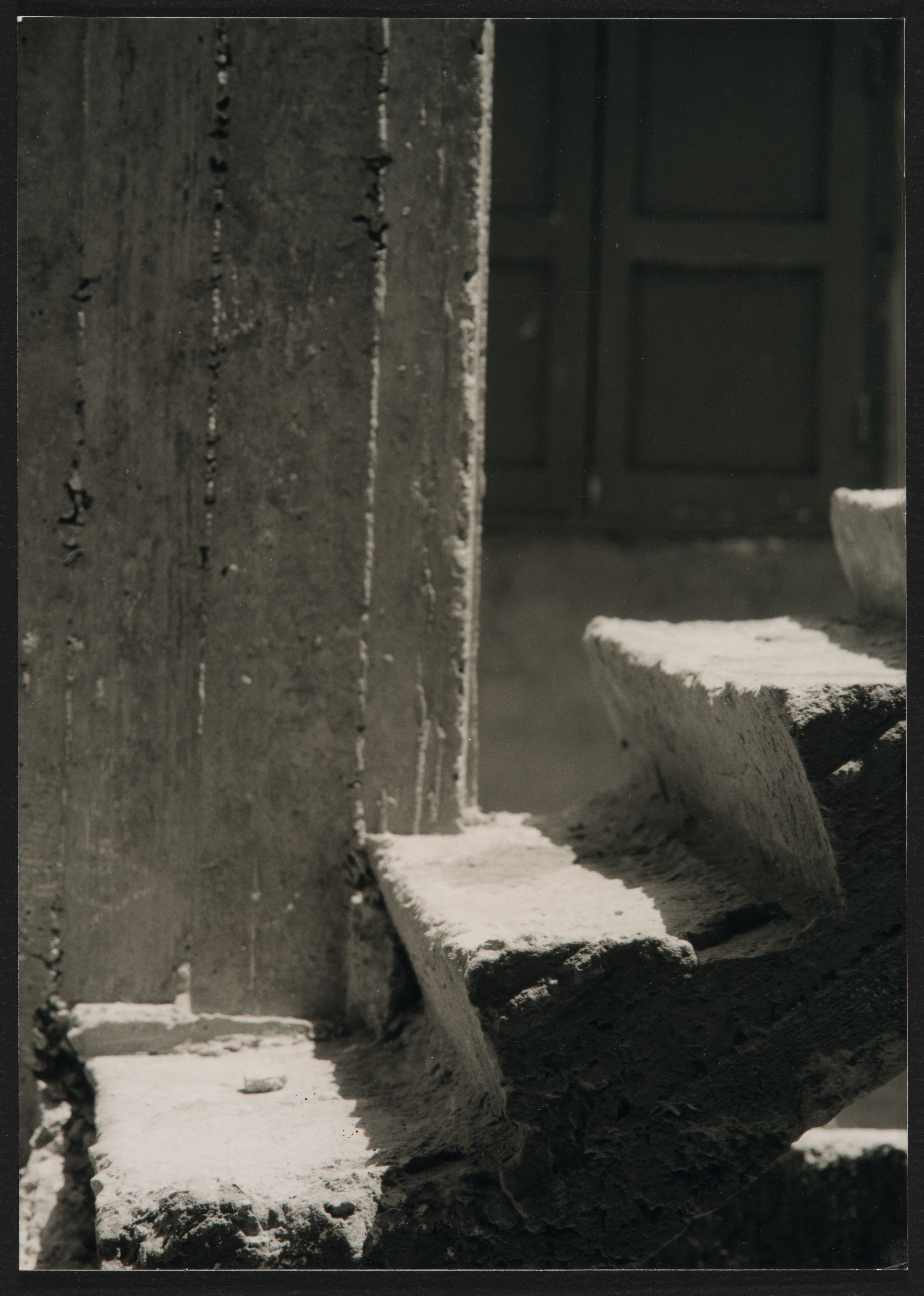
“Lebanese sunlight soft on stone steps of a refugee camp”, Photo by June Jordan, © Cristopher D. Meyer
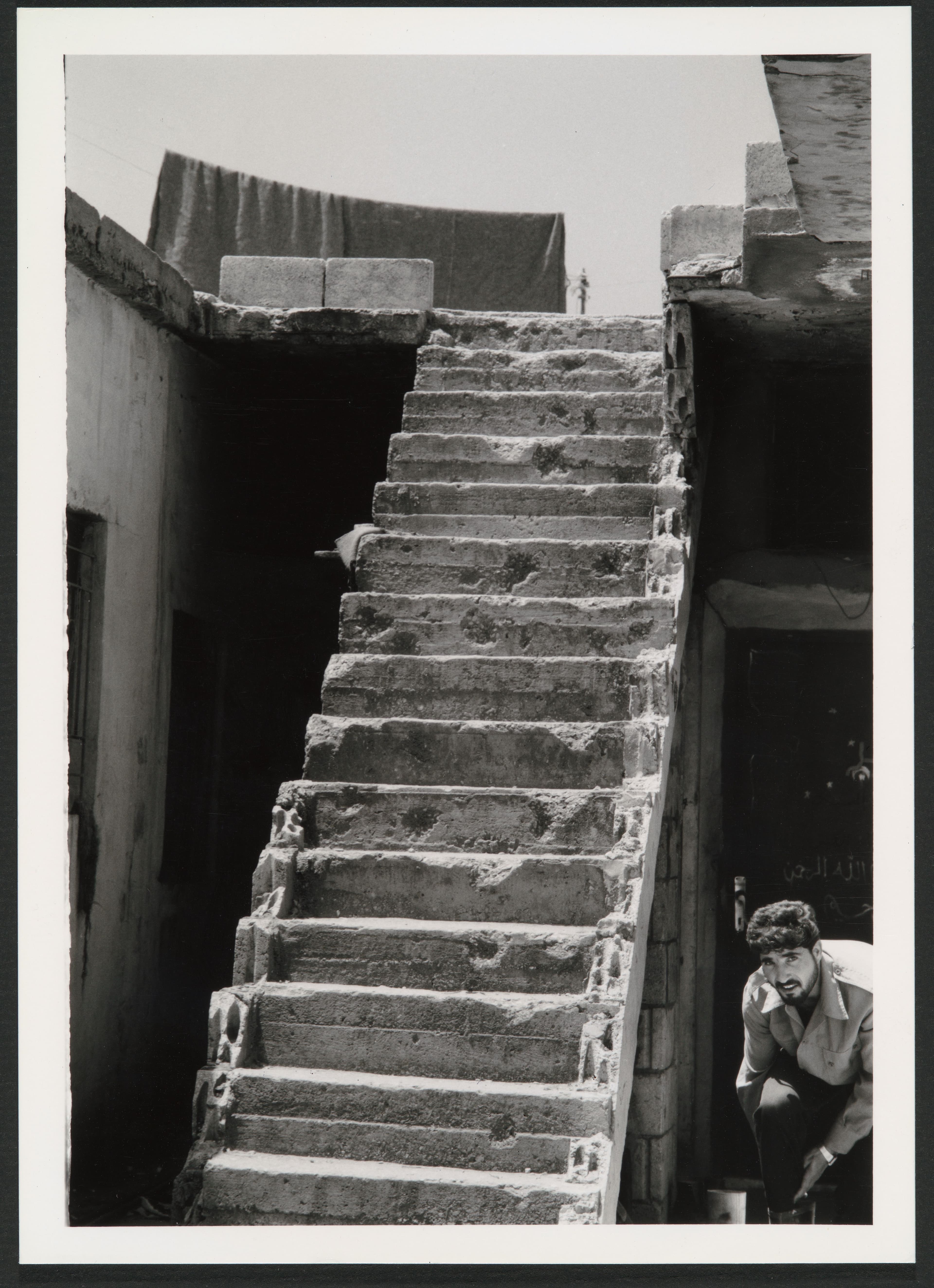
“Steps leading to the sky / Refugee camp of Sabra / Lebanon, 1996”, Photo by June Jordan, © Cristopher D. Meyer
All of Jordan’s political activity can be described as steps leading to the sky of unknown future rather than an idealized past. Unlike some of her of her contemporaries, Jordan viewed home as a rebuilding rather than a return, and she was only interested in an African past only insofar as it aided the building of liberation struggles in the present. “we disagree […] about ancestor worship,” she wrote to Alice Walker in 1981:
We differ because I am emphatically oriented towards [sic] the present and the future reality and I am interested in the past only as it may be helpful now, or tomorrow. As I consider the horrors of our current situation I must reflect, moreover, that the past hasn’t done such a hot job, all in all. If I were to worship any people, generically, it would be our children: all of the children of the world who, God willing, will be very different from us because their lives carry the promise of that difference
In this subtle shift of attention from ancestors to children, Jordan clarifies her political commitments to living people and ongoing struggles. Jordan was an internationalist thinker with a present-tense and materialist understanding of solidarity. Like a searchlight, her poetry and essays swing from South Africa to Nicaragua to Cuba to Hawaii to Iraq in support of their ongoing movements for liberation and self-determination. Palestine fits naturally into the broad range of her anti-imperialist sympathies, and with poems such as “Moving towards Home,” “Apologies to All the People in Lebanon,” and “Intifada Incantation,” and essays like “Life after Lebanon” and “Eyewitness in Lebanon” demonstrate the long arc of a twenty-year commitment to anti-imperialist struggles in Southwest Asia through the endless series of wars and imperialist incursions to which they responded. These works are testaments to her ability to move through the shame of complicity as an American taxpayer to the galvanizing responsibility of being among “Some of Us [Who] Have Not Died. In later poems and essays, she never stopped fighting against the occupation of Palestine and against anti-Muslim and anti-Arab sentiment in the US and Israel. After September 11th, when Jordan was in the final throes of her battle with the breast cancer that would claim her life the following year, she still took the time to denounce the racism and Islamophobia animating the War on Terror. Her friend, the Lebanese poet Etel Adnan, once wrote to her with wry approval: “They never forgive you for thinking that Arabs are human beings.
This anti-imperialist sensibility was developed dialogically with the friends who chose to be in political struggle alongside her. In 1983, Jordan sent one of her poems about Nicaragua to Adnan, who had also recently published a poem in solidarity with Nicaraguans Adnan remarked on the “magical coincidence of the basic elements of both poems, one of yours and mine,” and responded in kind with the coincidental poem in question. It ends:
it is the multiplication
not of bread but of death
it is not Lebanon
it is not Nicaragua
it is Mother Earth bleeding
and we are still in her belly
unborn
This notion of an “unborn” potential for home, is something that animates Jordan’s conversations and comradeship with Adnan and Walker. It is, perhaps, what she expected from Rich, Smith and Lorde in her invitation for them to identify with a cause beyond their nationality, sexuality, and personal friendships. The unborn world, and the living room that she invites everyone to inhabit, is bigger than all of these things. Jordan describes her poetry as “things that I do / in the dark / reaching for you / whoever you are,” and in the darkness of the world womb, we cannot only reach for the known and visible faces if we are trying to be born
If, as Edwards argues, “Jordan’s call to internationalist sabotage brings the question of language to the space of the home,” Jordan’s definition of home is radically expansive Black American’s capacity to make home is directly linked by the ability of colonized people to reclaim theirs. Written months after her falling out with Rich, Lorde, and Smith, Jordan’s “Black Folks and Foreign Policy” can be seen as an intra-community reckoning based on the betrayals and complicities of 1982, speaking in no uncertain tone to the Black readers of the mainstream Black publication Essence. She describes Black Americans as residents of the Big House, “and what’s more, we pays de Massa taxes for our troubles! Meanwhile, “The fields beyond belong to the Vietnamese, the Black peoples of southern Africa, the Palestinians of northern Africa, and the Brown and the Black peoples of Nicaragua—our victim cousins making their way to freedom.” The historical role of enslaved people in the Big House, according to Jordan, was “watching de Massa do his thing, throwing salt or arsenic in the soup.” Gesturing towards the weapon of poisoning in insurrections by enslaved people, Jordan does not indicate that the fundamental responsibility of those close to “de Massa” has changed. In Jordan’s formulation, from the safety of the Big House, we have two options: throwing salt into the master’s soup and thus making it more edible, more palatable; or throwing arsenic, and poisoning the whole endeavor. Jordan’s Manichean formulation is meant to grate on the nerves of complicity. The house slave/field slave dichotomy is common in Black nationalist discourse, as in Malcolm X’s 1963 speech “Message to the Grassroots.” In an era of an over-simplified and gendered denigration of the complicity of the house slave and the valorization of the resistance field slave, however, Jordan takes care not to dismiss the contributions of enslaved women forced to work in the Big House:
Inside the Big House our mothers and grandmothers worked down on their knees so that we could stand up. They kept their eyes on a house ahead of them, a house full of family come to freedom. Now we sleep inside that Big House. Will we let ourselves and our family in the fields just grovel down and die, domesticated by de Massa? Or will we join our cousins the field—and clean it up
In the “house/field” metaphor, none of the enslaved are truly at home. The lower-case house, which the mothers and grandmothers before us envisioned, is elsewhere, beyond the burning cane fields and the poisoned soup. The Big House is only where we “sleep;” home is what we build on top of its ruins. Jordan is making a Black feminist genealogical imperative demanding justice on behalf of the enslaved women whose labor ensured our survival. It is a Black feminist politics based not in identitarian similarity but in the mutual project of making the world a home worthy of our belonging. “Black Folk and Foreign Policy” encourages Black Americans to understand that home is yet to be built. Not in an idealized African past, not in a complacent American present, but in a global anticolonial future. This formulation is a dialogical extension of Lorde’s famous metaphor, which also invokes the master’s house: “the master’s tools can never dismantle the master’s house. On that, the two could finally agree.
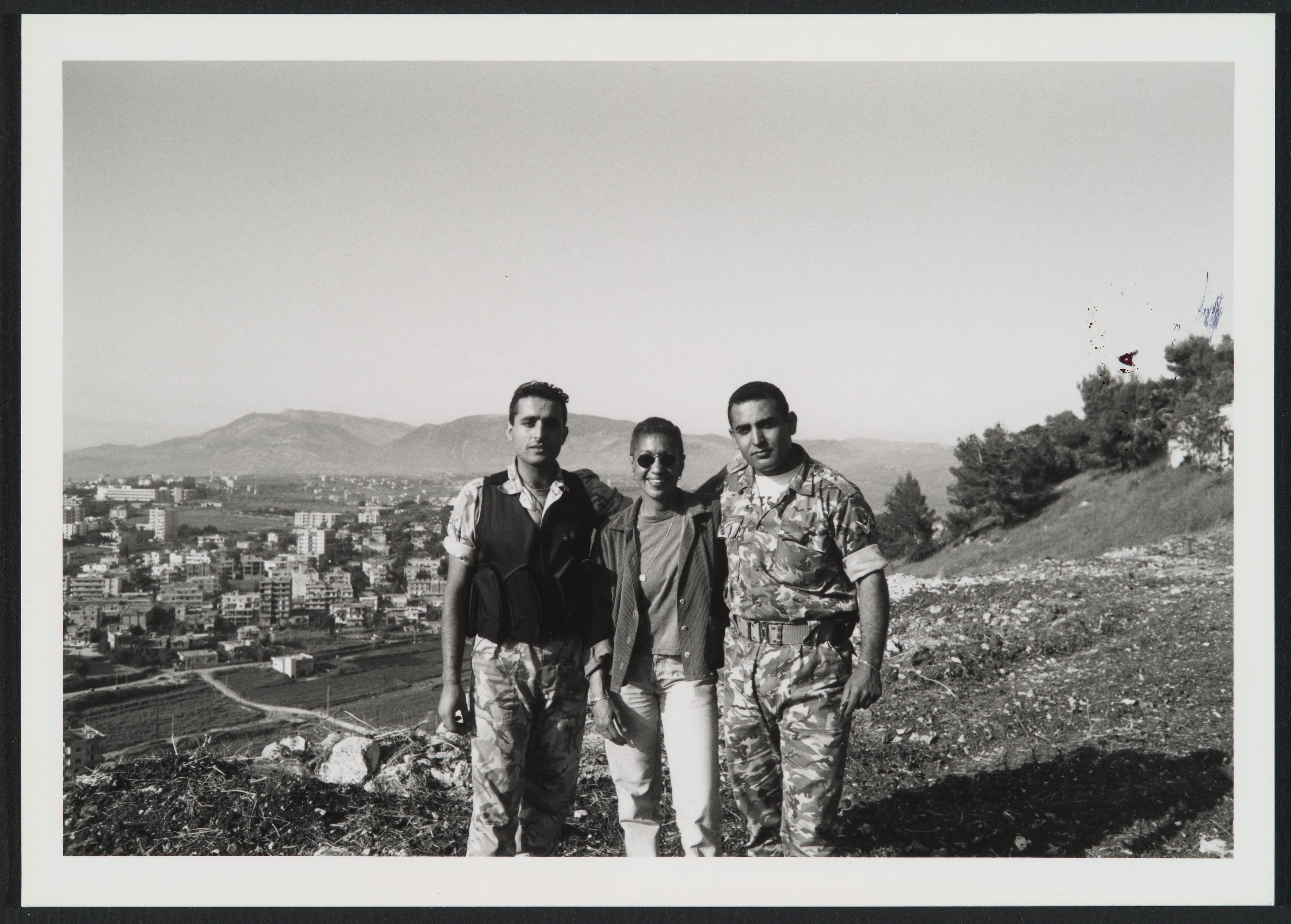
June Jordan with Lebanese soldiers 1996, © Christopher D. Meyer
WORKS CITED
[1] Adrienne Rich, “Why Support the U.S. Campaign for the Academic and Cultural Boycott of Israel?” February 8, 2009. https://mronline.org/2009/02/08/why-support-the-u-s-campaign-for-the-academic-and-cultural-boycott-of-israel/
[2] Audre Lorde, Zami: A New Spelling of My Name: (Berkeley: Crossing Press, 1984), 86.
[3] This article is an expansion of a shorter essay: Marina Magloire, “Moving Towards Life,” Los Angeles Review of Books, August 7, 2024. https://lareviewofbooks.org/article/moving-towards-life/
[4] Erica R. Edwards, The Other Side of Terror: Black Women and the Culture of US Empire (New York: New York University Press, 2021), 199.
[5] For example, Barbara Smith writes, “In [Israel] more progressive groups like the New Jewish Agenda are defining a more complex political stance of supporting the continued existence of the state of Israel, while voicing criticisms of current policies and recognizing the rights of Palestinians to a homeland.” Barbara Smith, “Between a Rock and a Hard Place,” in Yours in Struggle: Three Feminist Perspectives on Anti-Semitisim and Racism (New York: Long Haul Press, 1984), 82.
[6] Two of the four archival documents (Jordan’s original open letter and Smith’s response to Jordan) can now be found online: June Jordan, “On Israel and Lebanon: A Response to Adrienne Rich from One Black Woman,” The New York War Crimes, September 11, 2024, https://newyorkwarcrimes.com/june-jordan-on-israel-and-lebanon-a-response-to-adrienne-rich; and Barbara Smith, “On the Record: Barbara Smith on Palestine, June Jordan, Audre Lorde, and Adrienne Rich,” https://www.blackwomenradicals.com/blog-feed/on-the-record-barbara-smith-on-palestine-june-jordan-audre-lorde-and-adrienne-rich
[7] Unlike archives compiled and donated by the estate of a deceased person, Lorde made the decision to bequeath her archives to Spelman before her death, and thus presumably exercised control over which documents were included. See Johnetta B. Cole and Beverly Guy Sheftall, “Audre Lorde and Spelman College,” The Feminist Wire February 27, 2014, https://thefeministwire.com/2014/02/audre-lorde-spelman-college/.
[8] June Jordan, letter to Barbara Smith and Audre Lorde, December 3, 1982. Spelman College Archives, box 3, folder 63. The archives consulted in this essay will henceforth be abbreviated as follows: Spelman College Archives (SPEL) and Schlesinger Library (SCHLES).
[9] Toni Cade Bambara Papers, Box 1: Personal Correspondence 1970-1995 (SPEL) and Alice Walker Papers, box 9, folder 8, Rose Manuscript, Rare Book, and Archive Library, Emory University.
[10] Smith, “On the Record.”
[11] Sarah Schulman, email correspondence, November 13, 2024.
[12] To me, it feels more appropriate to render the perspectives of living participants in oral history interview transcripts, rather than as an interwoven quotes within this article, to encompass parts of the story which are valuable beyond the argument of this piece.
[13] Women Against Imperialism, “Feminism, Anti-Semitism, and Racism,” Taking Our Stand Against Zionism and White Supremacy” Of Our Backs July 1982, 20.
[14] Evelyn T. Beck, Nancy K. Bereano, Gloria Z. Greenfield, Melanie Kaye, Irena Klepfisz, Bernice Mennis and Adrienne Rich, “…what does Zionism mean?”, in Off Our Backs, Vol. 12, No. 7 (July 1982), p. 21.
[15] Keith P. Feldman, A Shadow over Palestine: The Imperial Life of Race in America (University of Minnesota Press: Minneapolis, MN, 2015), 196.
[16] Rashid Khalidi, The Hundred Years’ War on Palestine: A History of Settler Colonialism and Resistance, 1917-2017 (New York: Henry Holt and Co., 2020), 162.
[17] Amy Kaplan, Our American Israel: The Story of an Entangled Alliance (Cambridge, MA: Harvard University Press, 2018), 141.
[18] Khalidi, The Hundred Years’ War on Palestine, 156.
[19] June Jordan, “Apologies to all the People in Lebanon,” in Directed by Desire: The Collected Poems of June Jordan (Port Townsend, WA: Copper Canyon Press), 380.
[20] Evelyn T. Beck, Nancy K. Bereano, Melanie Kaye, Irena Klepfisz, Bernice Mennis and Adrienne Rich, “di vilde chayes: Zionists deplore killings in lebanon and criticize nature of anti-israel protests” in Off Our Backs, Vol. 12, No. 9 (October 1982), 27.
[21] Alisa Solomon, “Building a Movement: Jewish Feminists Speak out on Israel,” Bridges 1, no. 1 (1990), 48.
[22] Peter Erickson and June Jordan, “After Identity,” Transition, no. 63 (1994): 142.
[23] June Jordan, “On Israel and Lebanon: A Response to Adrienne Rich from One Black Woman,” October 10, 1982. SPEL, box 3, folder 63.
[24] The copy in Lorde’s archive appears to be a Xerox of Smith’s direct copy from Jordan, which was headed by a handwritten message: “Dear Barbara wanted you and Cherríe [Moraga] to know this is happening. Best, j.j.” SPEL, box 3, folder 63.
[25] “Black Women/Jewish Women–Openings for Dialogue,” November 9, 1982, SPEL box 3, folder 63.
[26] Jordan notes this in her response: “That you assume that I knew when Rich’s statements were written as against when they were published and that you thought that should matter as much or more than what her published statements said, in fact, are further facts about both of you that I find bizaare [sic] and disgusting”, ibid.
[27] June Jordan to Cheryl Clarke, November 2, 1982, SCHLES, June Jordan Papers, box 21, folder 9.
[28] June Jordan to Barbara Smith and Audre Lorde, December 3, 1982, SPEL, Audre Lorde Papers, box 3, folder 63.
[29] Erickson and Jordan, “After Identity,” Transition, no. 63 (1994): 142.
[30] Adrienne Rich to June Jordan, September 5, 1994. SCHLES, June Jordan Papers, box 42, folder 2.
[31] June Jordan to Carol Haddad, July 1 1984. SCHLES, Feminist Arab-American Network Papers, Box 3, folder 4.
[32] Adrienne Rich, Blood, Bread, and Poetry: Selected Prose 1979-1985 (New York: W.W. Norton, 1986), 123.
[33] Adrienne Rich to June Jordan, November 20, 1979, SCHLES, June Jordan Papers, box 41, folder 17.
[34] Adrienne Rich to June Jordan, September 8, 1981, SCHLES, June Jordan Papers, Box 41, folder 18.
[35] Jenny Bourne, “Homelands of the mind: Jewish feminism and Identity Politics,” Race and Class 29.1, 1987, 15.
[36] Adrienne Rich to June Jordan, November 29, 1987, SCHLES, June Jordan Papers, box 42, folder 1.
[37] June Jordan to Adrienne Rich, December 7, 1987, SCHLES, June Jordan Papers, box 42, folder 1.
[38] Bourne, 1.
[39] Jordan, “Report from the Bahamas,” in Some of Us Did Not Die (New York: Basic/Civitas Books, 2002), 219.
[40] Alexis Pauline Gumbs, Survival is a Promise: The Eternal Life of Audre Lorde (New York: Farrar, Straus and Giroux, 2024), 304.
[41] Smith, “On the Record.”
[42] Gumbs, 306.
[43] Barbara Smith to June Jordan, November 29, 1982, SPEL, Audre Lorde Papers, box 3, folder 63.
[44] Smith, “On the Record.”
[45] Carol Haddad, “Anti-Arab-ism,” Off Our Backs March 1983, 22.
[46] Feldman, 187.
[47] Ibid., 195.
[48] Pogrebin, “Anti-Semitism in the Women’s Movement,”Ms Magazine, June 1982, 65.
[49] Ibid, 71.
[50] Smith, “Between a Rock and a Hard Place,” 75.
[51] Ibid.
[52] Bourne, 13.
[53] Edwards, The Other Side of Terror, also points out that in this introduction, Smith displays “greatest concern” for Black women’s divisive behaviors, 200. Smith also criticizes Black women’s alleged antisemitism in the introduction to Home Girls: A Black Feminist Anthology (New Brunswick, NJ: Rutgers University Press, 2000), xlvi, and more recently on her personal Twitter account: “When people who support #FreePalestine use anti-zionism to mask their #Antisemitism they are wrong. They set back our struggle & undermine #Solidarity. Let’s do better.” Barbara Smith @TheBarbaraSmith, “When people who support #FreePalestine,” October 20, 2023. https://x.com/TheBarbaraSmith/status/1715352788526305603.
[54] Barbara Smith, “Between a Rock and a Hard Place,” 68.
[55] Ibid., 74.
[56] K.E. Harloe, “A Talk with Barbara Smith,” Flaming Hydra February 21, 2024. https://flaminghydra.com/a-talk-with-barbara-smith/
[57] June Jordan to Barbara Smith and Audre Lorde, December 3, 1982, SPEL, Audre Lorde Papers, box 3, folder 63.
[58] Jordan, “Life After Lebanon,” in Some of Us Did Not Die, 187-195.
[59] Gumbs, Survival is a Promise, 301.
[60] Audre Lorde, Zami, 86.
[61] June Jordan, “In the Middle of Fighting For Freedom We Found Ourselves Free.” Jewish Currents May 29, 2024. https://jewishcurrents.org/in-the-middle-of-fighting-for-freedom-we-found-ourselves-free
[62] Adrienne Rich to June Jordan, February 2, 1987, SCHLES, June Jordan Papers, Box 42 folder 1.
[63] Jordan, Directed by Desire, 564.
[64] Audre Lorde, Commencement Address: Oberlin College, May 29, 1989, in I Am Your Sister. Collected and Unpublished Writings of Audre Lorde, edited by Rudolph P. Byrd, Johnnetta Betsch Cole, and Beverly Guy-Sheftall, Oxford University Press, New York: 2009, 213-218.
[65] Jordan, “On Israel and Lebanon,” October 10, 1982. SPEL, box 3, folder 63.
[66] June Jordan, “Moving Towards Home,” in Directed by Desire, 400.
[67] Valerie Kinlock, June Jordan: Her Life and Letters (Westport, CT: Praeger Press, 2006), 162.
[68] Jordan, “Life After Lebanon,” 192.
[69] Feldman, 213-4.
[70] Jordan, “Moving Towards Home,” 400.
[71] Mahmoud Darwish, In the Presence of Absence, trans. Sinan Antoon (New York: Archipelago Books, 2006), 125.
[72] Jordan, “Nobody Mean More to Me Than You and the Future Life of Willie Jordan,” in Some of Us Did Not Die, 157.
[73] Nadia Alahmed, “The Shape of the Wrath to Come: James Baldwin’s Radicalism and the Evolution of his Thought on Israel,” James Baldwin Review 6.1 (Sept 2020): 41.
[74] Dana M. Olwan, “On Assumptive Solidarities in Comparative Settler Colonialisms,” Feral Feminisms 4, https://feralfeminisms.com/assumptive-solidarities/
[75] Ta-Nehisi Coates, The Message (New York: One World, 2024), 221.
[76] Jordan, “Moving towards Home,” 399.
[77] Kaplan, 149.
[78] Jordan, “Apologies to all the People in Lebanon,” 382.
[79] Zahra A. Hussein Ali, “The Aesthetics of Memorialization: The Sabra and Shatila Genocide in the Work of Sami Mohammad, Jean Genet, and June Jordan,” Criticism (Detroit) 51.4 (Sept 2009): 612.
[80] Edwards, 216.
[81] June Jordan, “Eyewitness in Lebanon,” in Life As Activism: June Jordan’s Writings from The Progressive (Sacramento: Litwin Books, 2014), 183-5.
[82] Photos by June Jordan, SCHLES, June Jordan Papers, Box PD, Folder 99.
[83] June Jordan to Alice Walker, February 21, 1981, SCHLES box 44, folder 16.
[84] Jordan, Introduction, Some of Us Did Not Die, 13.
[85] Etel Adnan, letter to June Jordan, March 25, [1985]. SCHLES, June Jordan Papers, box 28, folder 8.
[86] This could be any of five poems on Nicaragua later published in Jordan’s 1985 poetry collection, Living Room.
[87] Etel Adnan, letter to June Jordan, August 22, 1983. SCHLES, June Jordan Papers, box 28, folder 8.
[88] Jordan, “Who Look at Me,” in Directed by Desire, 7.
[89] Edwards, 222.
[90] Jordan, “Black Folks and Foreign Policy,” Essence June 1983, 162.
[91] Ibid.
[92] Lorde, Sister Outsider, Essays and Speeches (Berkeley: Crossing Press, 2007), 110-3.
FOOTNOTES
1Adrienne Rich, “Why Support the U.S. Campaign for the Academic and Cultural Boycott of Israel?” February 8, 2009.
2Audre Lorde, Zami: A New Spelling of My Name: (Berkeley: Crossing Press, 1984), 86.
3This article is an expansion of a shorter essay: Marina Magloire, “Moving Towards Life,” Los Angeles Review of Books, August 7, 2024. https://lareviewofbooks.org/article/moving-towards-life/
4Erica R. Edwards, The Other Side of Terror: Black Women and the Culture of US Empire (New York: New York University Press, 2021), 199.
5For example, Barbara Smith writes, “In [Israel] more progressive groups like the New Jewish Agenda are defining a more complex political stance of supporting the continued existence of the state of Israel, while voicing criticisms of current policies and recognizing the rights of Palestinians to a homeland.” Barbara Smith, “Between a Rock and a Hard Place,” in Yours in Struggle: Three Feminist Perspectives on Anti-Semitisim and Racism (New York: Long Haul Press, 1984), 82.
6Two of the four archival documents (Jordan’s original open letter and Smith’s response to Jordan) can now be found online: June Jordan, “On Israel and Lebanon: A Response to Adrienne Rich from One Black Woman,” The New York War Crimes, September 11, 2024, https://newyorkwarcrimes.com/june-jordan-on-israel-and-lebanon-a-response-to-adrienne-rich; and Barbara Smith, “On the Record: Barbara Smith on Palestine, June Jordan, Audre Lorde, and Adrienne Rich,” https://www.blackwomenradicals.com/blog-feed/on-the-record-barbara-smith-on-palestine-june-jordan-audre-lorde-and-adrienne-rich
7Unlike archives compiled and donated by the estate of a deceased person, Lorde made the decision to bequeath her archives to Spelman before her death, and thus presumably exercised control over which documents were included. See Johnetta B. Cole and Beverly Guy Sheftall, “Audre Lorde and Spelman College,” The Feminist Wire February 27, 2014, https://thefeministwire.com/2014/02/audre-lorde-spelman-college/.
8June Jordan, letter to Barbara Smith and Audre Lorde, December 3, 1982. Spelman College Archives, box 3, folder 63. The archives consulted in this essay will henceforth be abbreviated as follows: Spelman College Archives (SPEL) and Schlesinger Library (SCHLES).
9Toni Cade Bambara Papers, Box 1: Personal Correspondence 1970-1995 (SPEL) and Alice Walker Papers, box 9, folder 8, Rose Manuscript, Rare Book, and Archive Library, Emory University.
10Smith, “On the Record”
11Sarah Schulman, email correspondence, November 13, 2024.
12To me, it feels more appropriate to render the perspectives of living participants in oral history interview transcripts, rather than as an interwoven quotes within this article, to encompass parts of the story which are valuable beyond the argument of this piece.
13Women Against Imperialism, “Feminism, Anti-Semitism, and Racism,” Taking Our Stand Against Zionism and White Supremacy” Of Our Backs July 1982, 20.
14Evelyn T. Beck, Nancy K. Bereano, Gloria Z. Greenfield, Melanie Kaye, Irena Klepfisz, Bernice Mennis and Adrienne Rich, “…what does Zionism mean?”, in Off Our Backs, Vol. 12, No. 7 (July 1982), p. 21.
15 Keith P. Feldman, A Shadow over Palestine: The Imperial Life of Race in America (University of Minnesota Press: Minneapolis, MN, 2015), 196.
16Rashid Khalidi, The Hundred Years’ War on Palestine: A History of Settler Colonialism and Resistance, 1917-2017 (New York: Henry Holt and Co., 2020), 162.
17Amy Kaplan, Our American Israel: The Story of an Entangled Alliance (Cambridge, MA: Harvard University Press, 2018), 141.
18 Khalidi, The Hundred Years’ War on Palestine, 156.
19June Jordan, “Apologies to all the People in Lebanon,” in Directed by Desire: The Collected Poems of June Jordan (Port Townsend, WA: Copper Canyon Press), 380.
20 Evelyn T. Beck, Nancy K. Bereano, Melanie Kaye, Irena Klepfisz, Bernice Mennis and Adrienne Rich, “di vilde chayes: Zionists deplore killings in lebanon and criticize nature of anti-israel protests” in Off Our Backs, Vol. 12, No. 9 (October 1982), 27.
21Alisa Solomon, “Building a Movement: Jewish Feminists Speak out on Israel,” Bridges 1, no. 1 (1990), 48.
22Peter Erickson and June Jordan, “After Identity,” Transition, no. 63 (1994): 142.
23June Jordan, “On Israel and Lebanon: A Response to Adrienne Rich from One Black Woman,” October 10, 1982. SPEL, box 3, folder 63.
24The copy in Lorde’s archive appears to be a Xerox of Smith’s direct copy from Jordan, which was headed by a handwritten message: “Dear Barbara wanted you and Cherríe [Moraga] to know this is happening. Best, j.j.” SPEL, box 3, folder 63.
25“Black Women/Jewish Women–Openings for Dialogue,” November 9, 1982, SPEL box 3, folder 63.
26Jordan notes this in her response: “That you assume that I knew when Rich’s statements were written as against when they were published and that you thought that should matter as much or more than what her published statements said, in fact, are further facts about both of you that I find bizaare [sic] and disgusting,” ibid.
27June Jordan to Cheryl Clarke, November 2, 1982, SCHLES, June Jordan Papers, box 21, folder 9.
28June Jordan to Barbara Smith and Audre Lorde, December 3, 1982, SPEL, Audre Lorde Papers, box 3, folder 63.
29Erickson and Jordan, “After Identity,” Transition, no. 63 (1994): 142.
30Adrienne Rich to June Jordan, September 5, 1994. SCHLES, June Jordan Papers, box 42, folder 2.
31 June Jordan to Carol Haddad, July 1 1984. SCHLES, Feminist Arab-American Network Papers, Box 3, folder 4.
34 Adrienne Rich to June Jordan, September 8, 1981, SCHLES, June Jordan Papers, Box 41, folder 18.
33Adrienne Rich to June Jordan, November 20, 1979, SCHLES, June Jordan Papers, box 41, folder 17.
32Adrienne Rich, Blood, Bread, and Poetry: Selected Prose 1979-1985 (New York: W.W. Norton, 1986), 123.
36Adrienne Rich to June Jordan, November 29, 1987, SCHLES, June Jordan Papers, box 42, folder 1.
35Jenny Bourne, “Homelands of the mind: Jewish feminism and Identity Politics,” Race and Class 29.1, 1987, 15.
37June Jordan to Adrienne Rich, December 7, 1987, SCHLES, June Jordan Papers, box 42, folder 1.
39Jordan, “Report from the Bahamas,” in Some of Us Did Not Die (New York: Basic/Civitas Books, 2002), 219.
38Bourne, 1.
42Gumbs, 306.
41Smith, “On the Record.”
40Alexis Pauline Gumbs, Survival is a Promise: The Eternal Life of Audre Lorde (New York: Farrar, Straus and Giroux, 2024), 304.
44Smith, “On the Record.”
43Barbara Smith to June Jordan, November 29, 1982, SPEL, Audre Lorde Papers, box 3, folder 63.
45Carol Haddad, “Anti-Arab-ism,” Off Our Backs March 1983, 22.
49Ibid, 71.
48Pogrebin, “Anti-Semitism in the Women’s Movement,”Ms Magazine, June 1982, 65.
47Ibid., 195.
46Feldman, 187.
50Smith, “Between a Rock and a Hard Place,” 75.
54Barbara Smith, “Between a Rock and a Hard Place,” 68.
53 Edwards, The Other Side of Terror, also points out that in this introduction, Smith displays “greatest concern” for Black women’s divisive behaviors, 200. Smith also criticizes Black women’s alleged antisemitism in the introduction to Home Girls: A Black Feminist Anthology (New Brunswick, NJ: Rutgers University Press, 2000), xlvi, and more recently on her personal Twitter account: “When people who support #FreePalestine use anti-zionism to mask their #Antisemitism they are wrong. They set back our struggle & undermine #Solidarity. Let’s do better.” Barbara Smith @TheBarbaraSmith, “When people who support #FreePalestine,” October 20, 2023. https://x.com/TheBarbaraSmith/status/1715352788526305603.
52Bourne, 13.
51Ibid.
55Ibid., 74.
56K.E. Harloe, “A Talk with Barbara Smith,” Flaming Hydra February 21, 2024. https://flaminghydra.com/a-talk-with-barbara-smith/
58Jordan, “Life After Lebanon,” in Some of Us Did Not Die, 187-195.
57June Jordan to Barbara Smith and Audre Lorde, December 3, 1982, SPEL, Audre Lorde Papers, box 3, folder 63.
60Audre Lorde, Zami, 86.
59Gumbs, Survival is a Promise, 301.
61June Jordan, “In the Middle of Fighting For Freedom We Found Ourselves Free.” Jewish Currents May 29, 2024. https://jewishcurrents.org/in-the-middle-of-fighting-for-freedom-we-found-ourselves-free
62Adrienne Rich to June Jordan, February 2, 1987, SCHLES, June Jordan Papers, Box 42 folder 1.
63Jordan, Directed by Desire, 564.
65Jordan, “On Israel and Lebanon,” October 10, 1982. SPEL, box 3, folder 63.
64Audre Lorde, Commencement Address: Oberlin College, May 29, 1989, in I Am Your Sister. Collected and Unpublished Writings of Audre Lorde, edited by Rudolph P. Byrd, Johnnetta Betsch Cole, and Beverly Guy-Sheftall, Oxford University Press, New York: 2009, 213-218.
67Valerie Kinlock, June Jordan: Her Life and Letters (Westport, CT: Praeger Press, 2006), 162.
66June Jordan, “Moving Towards Home,” in Directed by Desire, 400.
71 Mahmoud Darwish, In the Presence of Absence, trans. Sinan Antoon (New York: Archipelago Books, 2006), 125.
70Jordan, “Moving Towards Home,” 400.
69Feldman, 213-4.
68Jordan, “Life After Lebanon,” 192.
72Jordan, “Nobody Mean More to Me Than You and the Future Life of Willie Jordan,” in Some of Us Did Not Die, 157.
75Ta-Nehisi Coates, The Message (New York: One World, 2024), 221.
74Dana M. Olwan, “On Assumptive Solidarities in Comparative Settler Colonialisms,” Feral Feminisms 4, https://feralfeminisms.com/assumptive-solidarities/
73Nadia Alahmed, “The Shape of the Wrath to Come: James Baldwin’s Radicalism and the Evolution of his Thought on Israel,” James Baldwin Review 6.1 (Sept 2020): 41.
77Kaplan, 149.
76Jordan, “Moving towards Home,” 399.
82 Photos by June Jordan, SCHLES, June Jordan Papers, Box PD, Folder 99.
81June Jordan, “Eyewitness in Lebanon,” in Life As Activism: June Jordan’s Writings from The Progressive (Sacramento: Litwin Books, 2014), 183-5.
80Edwards, 216.
79Zahra A. Hussein Ali, “The Aesthetics of Memorialization: The Sabra and Shatila Genocide in the Work of Sami Mohammad, Jean Genet, and June Jordan,” Criticism (Detroit) 51.4 (Sept 2009): 612.
78Jordan, “Apologies to all the People in Lebanon,” 382.
83June Jordan to Alice Walker, February 21, 1981, SCHLES box 44, folder 16.
85Etel Adnan, letter to June Jordan, March 25, [1985]. SCHLES, June Jordan Papers, box 28, folder 8.
84Jordan, Introduction, Some of Us Did Not Die, 13.
86This could be any of five poems on Nicaragua later published in Jordan’s 1985 poetry collection, Living Room.
87Etel Adnan, letter to June Jordan, August 22, 1983. SCHLES, June Jordan Papers, box 28, folder 8.
88Jordan, “Who Look at Me,” in Directed by Desire, 7.
90Jordan, “Black Folks and Foreign Policy,” Essence June 1983, 162.
89Edwards, 222.
91Ibid.
92Lorde, Sister Outsider, Essays and Speeches (Berkeley: Crossing Press, 2007), 110-3.
Past Editions
1.
“They didn’t come to save us after Katrina, but they are coming for us now”: Black men, Marronage, and the eco-fascist conjuncture
Justin Hosbey
2.
A Bird Sang (the Blues) to Me: Collage as Black Study
Rebecca Louise Carter
3.
An Ambivalent Zionism: Walter White, Black Internationalism, and the Politics of Partition
Amy Barenboim
4.
At the End of the World: On the Temporal Limits of Katrina Recovery
Alix Chapman
5.
Divestment and Its Terrain: Abolition, the State, and Racial Capitalism
Philip V. McHarris
6.
Eye of the Storm: Commemorating Katrina as Political Praxis
Shreya Subramani, Christien Tompkins & Kaya Williams
7.
On the Black International Gaze
Zachary Mondesire
8.
Pick Up This Book and Use It: Abolition, Anthropology, and the Archive in Tip of the Spear and Excited Delirium
Kaya Naomi Williams
9.
Review of The Petro-state Masquerade: Oil, Sovereignty, and Power in Trinidad and Tobago, by Ryan Cecil Jobson
Anna Feign
10.
Steps Leading to the Sky: June Jordan’s Black Feminist Frictions
Marina Magloire
11.
Unmaking Carceral Disasters: A Post-Katrina Timeline of Struggles Against the New Orleans Punishment Regime
Lydia Pelot-Hobbs
12.
Untitled (Introduction to SOULS Vol. 25)
Jafari Sinclaire Allen