The Light of History
Linda Burnham
That light of outrage is the light of history springing upon us when we’re least prepared And oh, how unprepared we were for September 11. In many ways, the United Nations World Conference Against Racism seems like a lifetime ago. Those of us who participated in the conference did so in the hopes that we could help create new conditions, new understandings, and new strategies for the struggle against racism. That we could help move the international community another step forward in its fitful efforts to eradicate racism, ethnic conflict, and xenophobia. Our time in South Africa was intense, and we came home intending to work together to evaluate what was gained and what was lost and to share our rich experiences with all of you here at home. Instead, we, along with the rest of the world, were overtaken by the horrific, unconscionable acts of 19 desperate and murderous men. The light of history did indeed spring upon us when we were least prepared, and the shape of the world shifted dramatically on that September morning.
The U.N. Conference was rapidly overshadowed, relegated to a dim, possibly irrelevant pre-September 11 past. For our delegation, part of the struggle to find our bearings in these deeply unsettling times has been to cull some of the lessons of Durban and link them, as best we can, to current circumstances.
If it was about anything, Durban was about how the past bears down upon the present, about how unevenly the weight of history is borne. The battle over reparations was central. It widened out from compensatory measures for descendants of the African slave trade in the Americas—an issue that made its way in from the outer margins of political discourse due principally to the dogged persistence of African-American activists in the U.S.—to include the full legacy of colonialism in Africa, Asia, Latin America, the Middle East, the Caribbean, and the islands of the Pacific.
The yawning, ever-widening gap between the nations of the North and the nations of the South raised the question of debt relief—who owes what to whom, and why. In Durban the question was asked: Having been robbed for centuries, are not the nations of the South due restitution from their assailants? Can the appetite for gobbling up the wealth of other nations and peoples to support the ill-gotten prosperity of North America and Europe ever be curbed? And the answer from the North: The U.S., fattened on the land, lives, and liberty of conquered nations and enslaved peoples, said no—not today, not tomorrow, not in this millennium. What is on offer is not compensation, restitution, reparations, and heartfelt regrets, but new forms of global plunder. And Belgium, head of the European Union, its hands still damp and sticky with the blood of the Congo, said no, we don’t want to talk about it. The legacy of colonialism is not relevant to our discussion of current-day racism, and we won’t have it mentioned in the final document. This was not simple recalcitrance. It was willful, shameful denial of the past in the service of preserving racist, profoundly unequal relations between nations and peoples in the present and far into the future. The U.S. and Israel, unprepared to face the horrendous consequences of past or present policy, turned on their heels and walked out. It was not lost on many of us, as guests of the people of South Africa—whose recent triumph over a most egregious form of twentieth-century racialism we all celebrate—that the U.S. and Israel had also stood arm in arm, until the bitter end, in providing support and encouragement to the terrorists of the apartheid state. What has this to do with September 11 and its aftermath? The U.S. impulse to “rule and rule without end, forever and ever” (the phrase is W.E.B. Du Bois’s) is not an impulse to dominance simply for its own sake, but dominance for the sake of the protection of wealth—wealth already stolen and wealth anticipated. If that dominance requires alliance with unsavory despots, corrupt regimes, and fanatical reactionaries, so be it.
With a consensus built on fear, racism, and heightened xenophobia, we descend into war without borders and without end.
The deal struck with the Taliban, through Pakistan and the CIA, must have seemed like a thousand others made round the world: We will turn a blind eye to the imposition of repressive, theocratic decrees. We will turn a deaf ear to the torment of girls, women, and homosexuals. We will ensure that the American public remains comfortably ignorant of the bargain struck and its terrible toll on the suffering Afghan people. And in exchange, with the abundance of armaments our taxpayers provide, you will keep at bay any and all forces viewed as hostile to U.S. interests in the region. Though the details may differ, such deals are operative worldwide, backed by massive military presence on every continent and all the seas. But this deal turned sour as fundamentalist tyrants, encouraged, armed, and emboldened for 15 years, developed their own fearsome agenda. The Soviet Union was brought to its knees in part because of its defeat in Afghanistan. But the U.S. had only 12 short years to revel in the downfall of its enemy and enjoy the pleasures of capitalism triumphant. And then the fundamentalist fanaticism and patriarchal warlordism it had so generously subsidized turned round to seize it by the neck.
An aside that is not beside the point: As those jets screeched toward the World Trade Center and the Pentagon, some people in the Americas commemorated another September 11, 28 years ago. On that day in 1973, U.S.-trained military commanders, under the leadership of Augusto Pinochet—yet to be brought to justice for his crimes against humanity—toppled the democratically elected president of Chile, Salvador Allende. The U.S. could not abide the tenure of a socialist reformer who put the interests of his people before the interests of corporate America—as it could not abide Lumumba in Congo or Arbenz in Guatemala or Sandino in Nicaragua or Bishop in Grenada. And what the U.S. cannot abide, it attempts to destroy.
Ruth Manorama, a fierce advocate for the rights of India’s Dalits, spoke with passion at a Women of Color Resource Center workshop in Durban. The Dalits were a huge presence at the U.N. Conference, insisting that thousands of years of caste discrimination be brought to an end. Ruth and other Dalit leaders reminded us that while religion may bring solace, comfort, and a moral compass to some, it can be, at the very same time, an instrument of repression and degradation for others. Those others may be co-religionists, those of other faiths, or secularists. And often enough it is women who suffer. Millions of crimes against women are committed each day in the name of religion, custom, and tradition. Religious fundamentalism—whether Christian, Islamic, Judaic, or Hindu—constitutes a mortal threat to women.
If the events of September 11 represented an awful, imaginative leap toward previously unimaginable terror, the response represented a massive failure of the imagination—a fallback to the military option and a reckless willingness to join in the spiral of violence. Apparently not a moment’s thought was given to alternatives: to working within the framework of international law, to using the mechanisms of the United Nations, to accepting the authority of the International Criminal Court, and to convening an international tribunal to consider right action.
Instead, with a consensus built on fear, racism, and heightened xenophobia, we descend into war without borders and without end. New “terrorist havens” are added to the potential hit list on a regular basis—Iran, Iraq, Indonesia, Malaysia, the Philippines. And the national security state institutes measures constricting civil liberties that we will all live to regret. And now anthrax. I think we need no further proof that to fortress America is not a viable strategy. Neither the gated communities of the upper classes, nor the Star Wars missile defense shield, nor the ominous Office of Homeland Security can protect us from the consequences of a world overflowing with men, women, and children in a fate, from cradle to grave, from grinding poverty, grinding labor, and crippling disease. Let us remember that within two weeks of the Twin Towers tragedy the airline industry had managed to squeeze $15 billion out of the sides of the federal budget. The insurance industry is in line to get its share, and others line up at the trough—the very same trough that can’t provide funds for women on welfare or free medical care for seniors on fixed incomes.
Neither the gated communities of the upper classes, nor the Star Wars missile defense shield, nor the ominous Office of Homeland Security can protect us from the consequences of a world overflowing with men, women, and children whose fate, from cradle to grave, is grinding poverty, crushing labor, and crippling disease.
Fifteen billion dollars. Could the U.S. not survive the demise of one or two of our multiple airline carriers? What if that $15 billion were devoted to eliminating infant and maternal mortality worldwide? Or to AIDS treatment and prevention? Or to water, sanitation, and electrification? Or to eliminating school fees, raising teachers’ salaries, building schools, and buying books and computers? To the education of the girls of Afghanistan? Or to adequately housing the homeless and those who find shelter in the shanty towns, favelas, and migrant shacks around the world? What if that $15 billion and another $15 billion after that were devoted to finding a truly just solution to the unending crisis in the Middle East?
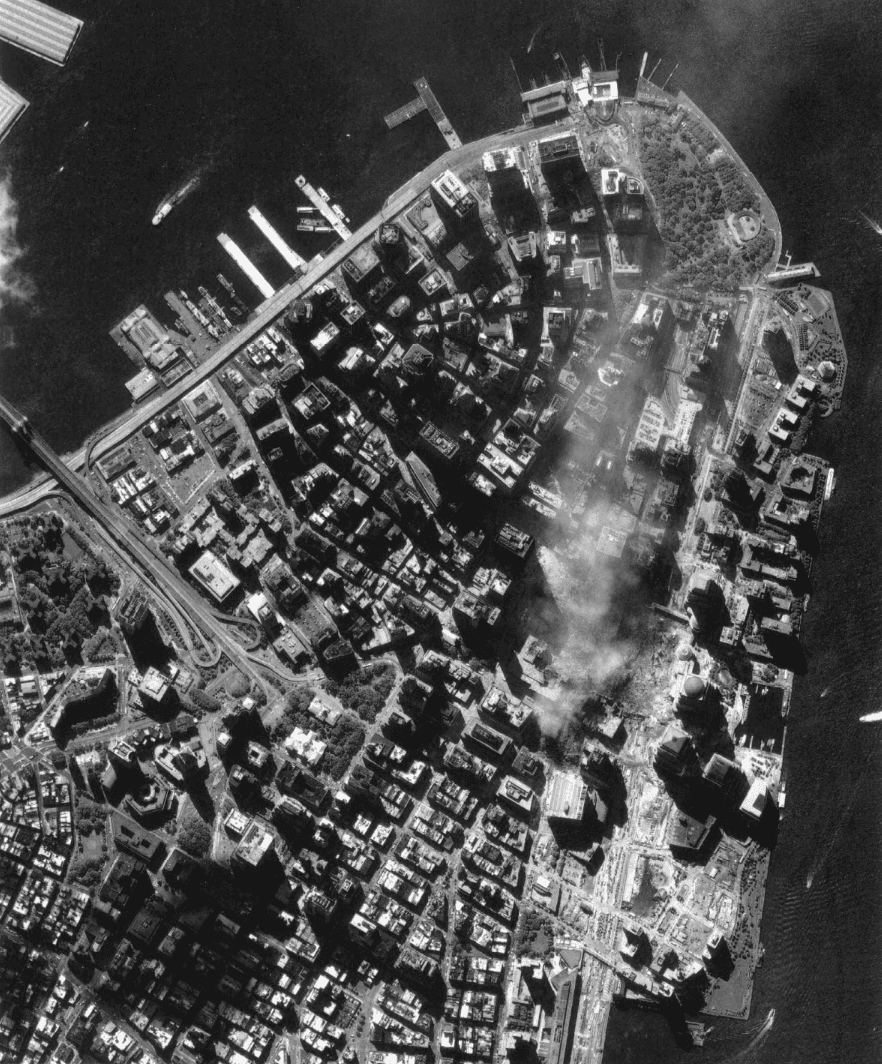
Smoldering Ruins, Satellite View, September 15, 2001. AP Photo/Spaceimaging.com
Dream on, girl. Is that what you say? Well, we must dream on, because the dream of endless greed, aggression, and world dominance has been revealed for the appalling nightmare it always was. The fortress has been breached. And it will be breached again and again as long as we have a hand in feeding the desperation, alienation, and disillusionment that stoke the myriad forms of murderous male rage. Either we walk out of the fortress together into the sunlight of our creation, or we shall be tethered together deep in the shadows, vulnerable and permanently afraid.
Our time in Durban did give us hope, despite the actions of the U.S. government and others who refused to honestly engage the struggle against racism. We marched through the streets with thousands upon thousands of energized, organized, politically conscious South Africans determined to hold their government accountable to their needs. We met with incredible women in Durban and in Johannesburg—women who are leaders in their communities and nations, leading the fight for the rights of girls and women, for the rights of racial, ethnic, and religious minorities. Our hopes were raised and our vision expanded in intense exchanges of experiences and strategies with dedicated activists from around the world whose lives are committed to the struggle for justice. So Durban was both an encounter with the ugly face of racist resistance and a source of sorely needed optimism.
If the events of September 11 represented an awful, imaginative leap toward previously unimaginable terror, the response represented a massive failure of the imagination—a reckless willingness to join in the spiral of violence.
I got an e-mail from a friend the other day. The subject line read “Trying to wrap my soul around all this,” and my friend talked about how profoundly unsettled she has been over the past weeks. I think that this is true for most of us. If our souls are not slipping toward despair, they are restless and agitated. It is time, then, to turn to whatever it takes to steady our souls and keep our spirits in touch with the generosity of our planet and with all that is creative and transformative in the human species. Hug your children, your grandchildren, or your neighbor’s children and promise them a future. Dig in the earth and plant some bulbs as a token of faith in the coming of spring. Turn to the musicians, poets, and artists who restore your optimism in the ultimate capacity of humankind to co-evolve in peace. Learn from the spiritual leaders whose lives are dedicated to being, seeking, and teaching peace. For you will need steady souls and buoyant spirits in the difficult days ahead.
And, as you draw on sources of strength and inspiration, remember Barbara Lee’s courage. Remember the heart it took to stand up and say, “I must vote my conscience.” Remember the backbone it took to resist the craven consensus of 421 of her colleagues. Remember that each of us must struggle, as she did, to live up to the true definition of a patriot, in this description by Adrienne Rich: “A patriot is one who wrestles for the soul of her country as she wrestles for her own being. A patriot is a citizen trying to wake from the burnt-out dream of innocence to remember her true country
Stand for peace as Barbara Lee did, as though the future of the planet depended upon it. For indeed, it surely does.
These words were delivered as a speech in October 2001, in Oakland, California, at the Women of Color Resource Center's Third Annual Sisters of Fire Awards and Reportback from the United Nations World Conference Against Racism held in Durban, South Africa.
FOOTNOTES
1From Adrienne Rich, "Through Corvalitas Under Rolls of Cloud."
2From Rich, "An Atlas of the Difficult World."