

VOL. 25
“They didn’t come to save us after Katrina, but they are coming for us now”: Black men, Marronage, and the eco-fascist conjuncture
Justin Hosbey
DOI: 10.66455/10999949.2026./KJYT7181
Film credit:
Executive Producers: Justin Hosbey and J.T. Roane
Directors: Jona Alexander and Alexis Young
Assistant Director: Justin Hosbey
Graphic Designer: Alexis Young
“I think that's why men were in "Mama's Baby, Papa's Maybe." That is what I was trying to suggest about certain performances of maleness on the part of black men, and what I was hoping to suggest is that black men can't afford to appropriate the gender prerogatives of white men because they have a different kind of history; so you can't just simply be patriarchal. You have to really think about something else as you come to that option. If there is any such thing as a kind of symbiotic blend or melding between our human categories, in this case of the diasporic African, then this is the occasion for it. Men of the black diaspora are the only men who had the opportunity to understand something about the female that no other community had the opportunity to understand, and also vice versa… I think it is a kind of humanity that we seem very far from, and that I used to think black culture was on the verge of creating. I think I am less sure now that we're on the verge of creating that than I was growing up.”
-Hortense Spillers, in conversation with Saidiya Hartman, Farah Jasmine Griffin, Shelly Eversley, & Jennifer L. Morgan, Women’s Studies Quarterly, Spring/Summer 2007, 304
As I sit down to reflect on the 20th anniversary of Katrina, three questions come to mind: What have I learned from Katrina? What, still, have we yet to learn from Katrina? And finally, how can we, as Black scholars, understand Katrina in a way that sharpens our analysis for the next century of Black life in the ecologically imperiled American South? At the Katrina 20 People’s Movement Assembly at the Ashe Cultural Arts Center in New Orleans in late August 2025, community organizers, scholars, organic intellectuals, and native New Orleanians struggled with a similar set of questions. Inside of the Ashé Powerhouse on Oretha Castle Haley Boulevard in Central City, we gathered, talked, listened, and tried to make sense of the past 20 years in an effort to cultivate “institutions of life.” After breaking into small groups to discuss the present conjuncture and share stories about how we navigated turning points in our own lives, we collectively produced a “situational analysis” of New Orleans 20 years removed from the storm.
Our assembly articulated the following key points – First, we are entering an era of unsheathed fascism, and there will be extreme efforts to control our bodies, minds, and resources. These efforts are deadly, global, and facilitated by technologies that billionaires control (As Women with a Vision’s Executive Director Deon Haywood argued, “they will go far to reach the least of us.”) One analysis argued that fascism feeds on and fuels the global climate crisis, emerging from people who were displaced by Katrina and experienced vigilante and/or police violence in their efforts to survive the storm and reestablish permanent residence in the city (Drake 2014; Thompson 2008). The final point emerged from Emery Wright, the Executive Director of Project South: the future is contested.
The key takeaway from our collective thought was that we are embedded within a critical turning point, and potentially an epistemological rupture. Katrina’s afterlife elaborates the nexus of state power and climate crisis; the climate crisis exacerbates the fascistic, authoritarian grounding wires of the US settler state. As local communities worked to recover from the traumatic effects of Katrina’s devastation, a regional, reactionary “Neo-Bourbon” political regime (as articulated by Clyde Woods [2017]) more deeply entrenched its power, turning New Orleans into a living laboratory of racial and class enclosure amid ecological crises. The city’s multiracial ruling class almost completely outsourced its commitment to disaster recovery to private capital and “philanthropy,” quasi-privatized the city’s public school system (Hosbey 2026; Tompkins 2024), proliferated its carceral apparatus (Hosbey 2025; Pelot-Hobbs 2023), and constructed an AI-driven, predictive policing system designed by the Palantir corporation (Winston 2018.) The climate dystopia that many vulnerable communities in the US hazily see emerging on the horizon has already been tested and consolidated in Louisiana (and innumerable communities across the Global South.) A community member in attendance at the Katrina 20 Congress framed the current moment perfectly – “they didn’t come to save us after Katrina, but they are coming for us now.”
This event helped crystallize the narrative development of this essay’s accompanying video project. This visual essay, “They didn’t come to save us after Katrina, but they are coming for us now,” was filmed in 2024 during a Black Ecologies summer field school in Bulbancha, the Choctaw word for the landscape currently known as New Orleans. Bulbanchameans “land of many tongues.”The Black Ecologies field schools are summer research institutes where undergraduate students, academics, artists, and cultural workers convene to understand how Black and Indigenous communities confront the material consequences of what Francoise Vergès (2017) deemed, “the racial capitalocene.” Our field schools have gathered in Tidewater Virginia, New Orleans, Durham, and the Mississippi Delta, and have been led by myself, Drs. J.T. Roane, Danielle Purifoy, and Teona Williams. The goal of each summer institute is to transform our theoretical work in the field of Black ecologies into a praxis grounded in the material realities of working-class Black communities that are on the frontlines of climate disaster (Hosbey and Roane 2021; Purifoy 2025; Roane and Hosbey 2019; Williams 2026; Williams et al 2025.) In New Orleans, we organized ourselves around the themes of post-Katrina public schooling as a modality of racial enclosure (Sojoyner 2016), historical and contemporary forms of marronage, Black aquatic relations, and the ecological consequences of the prison industrial complex.
In reflecting what I learned during the Black Ecologies field school in Bulbancha, I thought of Sylvia Wynter’s 1994 Essay, “No Humans Involved: A Letter to My Colleagues.” Here, Wynter shares an admonition that her colleague St. Clair Drake often made to his students: in Black Studies, there are “street tasks” and “intellectual tasks” (69). Street tasks can take the form of protests, political organizing, direct action, and outright rebellion, to confront the violence and inequality that overdetermines the lives of working class and low-income Black people. Drake reminded his students that alongside these street tasks, there were also intellectual tasks that Black scholars must undertake. These intellectual tasks must reinforce the street tasks by provoking our present system of knowledge – a regime that considers Black life fungible and Black communities as “sacrifice zones” – to the point of epistemological rupture. Drake’s admonition framed the collective work that produced this visual essay. The care work and forms of communal protection provided by Black men, or the “street tasks” explored in this short film intervene into a long durée of crisis, disaster, fascism, and plantation-driven capitalism in Louisiana. This video essay aspires to be an intellectual task that complements the work being conducted by these men. It is a call to action and a call to arms.
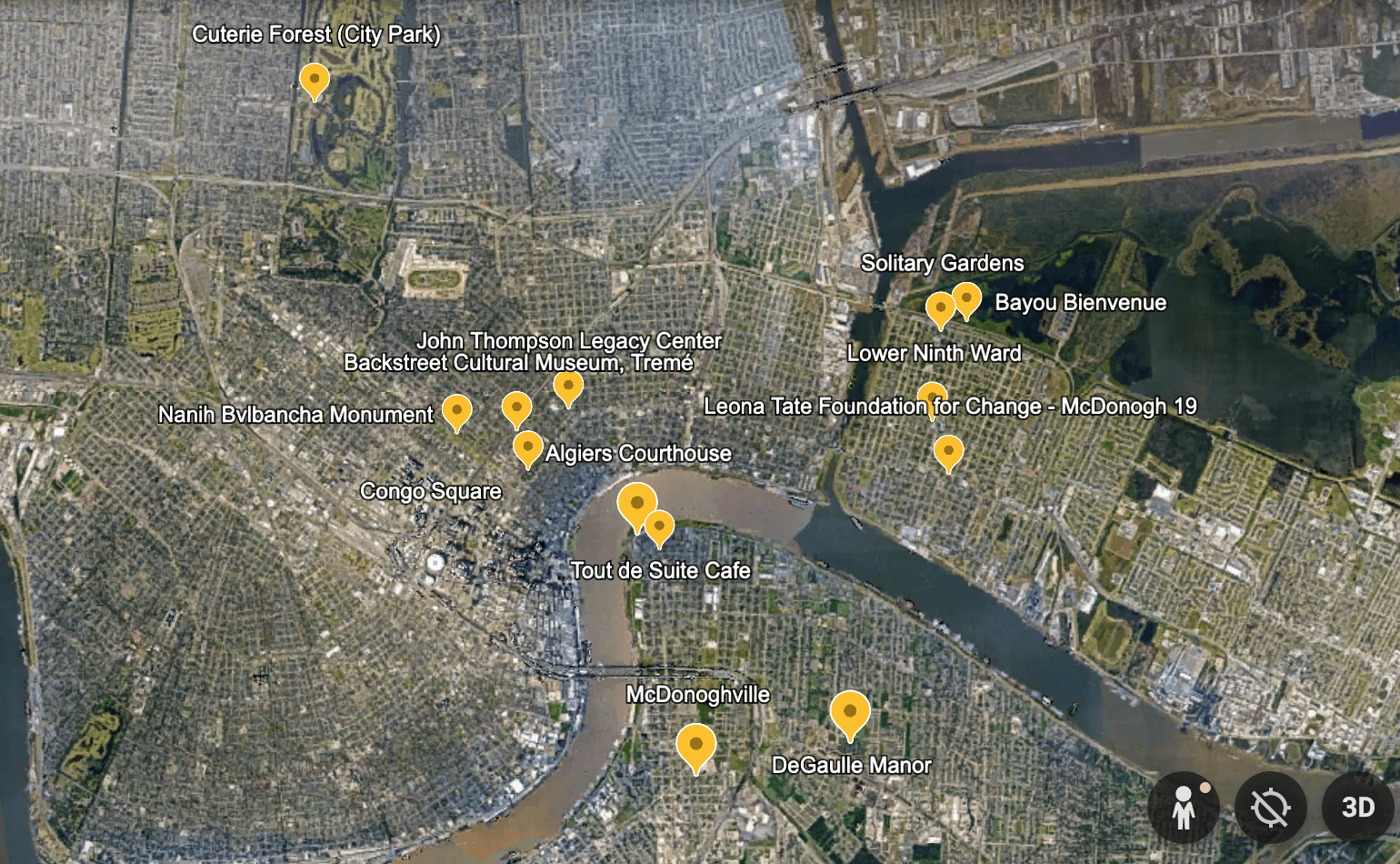
Figure 1
Figure 1 – Sites visited during the Black Ecologies Summer Field School in New Orleans and highlighted in the video essay
At present - the Federal Emergency Management Agency (FEMA) (referred to locally as FEMA 2.0) is negatively impacting how outer metro New Orleans parishes experience even small-scale disasters, the state of Louisiana is redrawing its congressional maps to further dilute the electoral potential of Black Louisianans, and mainstream news reports surrender to a climate vision in which New Orleans no longer exists within the next 100 years (Milman 2026). Every parish in metropolitan New Orleans has had at least 17 declared disasters since 2020 – this is four times the national average. Critical concerns for Black life emerge at this conjuncture: in the petrostate known as Louisiana, how will Black communities respond to the oil shocks of early 2026? In the aftermath of the most recent oil glut tethered to an American imperial exploit in Iran during the 1980s, New Orleans’ Black unemployment rate skyrocketed to 25 percent (Woods 2017). What will be the effects of the impending oil shock related to the US-Israel War on Iran? This convergence of events suggest that the time is now – we must figure out the material and ideological bases of the fortification, protection, and provision for our communities.
As I have previously written, the eco-fascist convergence of the prison industrial complex and climate disaster in Louisiana proposes disastrous futures for Black folks in the face of ecological collapse. The state’s plantation-prison nexus is concretized in the Louisiana State Penitentiary (Angola Prison), where intensifying regimes of violence and racialized forced labor constitute “an eco-fascist horizon that replies on the hyperexploitation of incarcerated people to rebuild broken levees, clean up oil spills, and facilitate accumulation for both local and global corporations” (Hosbey 2025). The insights from the Black men in this video essay suggest that marronage might be a productive strategy for warding off the regimes of violence and forced labor planned for poor and working-class Black communities as Louisiana’s physical landscape becomes more imperiled. J.T. Roane and I (2021) have also written about these legacies of displacement and marronage in New Orleans, articulating how Louisiana’s maroons escaped from local plantations and created communities deep within hostile, “undeveloped” wetlands in order to craft a “totally different form of living” that was no longer predicated on the racial enclosure model of Louisiana’s political economy. Danielle Purifoy (2025) argues that the formal abolition of slavery did not end this practice of marronage, it only altered the terms through which Black people negotiated the creation of extralegal spaces that allowed freedom and autonomy. In the ongoing wake and "weather" of climate disaster, Amari Johnson's work (2025) brilliantly reminds us that marronage remains a critical Black spatial practice in New Orleans, and our short film explores some of these semi-autonomous zones on the West Bank with Malik Rahim and General Reco.
To that end, in the accompanying video essay, Baba Marcus Akinlana reflects on Juan Malo and Mama Cecille, two formerly enslaved people who escaped to the wetlands to build an infamous maroon community that was reviled by white plantation owners and light-skinned Afro-Creole elites for producing what J.T. Roane (2018) has articulated as a “fleeting Black commons.” To be clear – marronage is not freedom, or a panacea for the structural conditions that will soon confront Black folks in Louisiana. However, I believe that we can learn important lessons on how to survive state abandonment and the wicked plans to further enclose Black life by learning and adapting these maroon histories and ecologies to our present conjuncture. Communal care and totally different articulations of gender will be critical in this endeavor. In the face of an eco-fascist horizon, men of the African Diaspora are going to have to be intensely self-critical, eschew heteropatriarchal authority while still protecting their communities from harm in all ways necessary, and contribute to communal care and the maintenance of kin relations in a new way. The accompanying video essay explicates New Orleans’ maroon legacy as a historical iteration of “intergenerational kin work” (Burton 2023) and collective care, and highlights examples of Black men in contemporary New Orleans manifesting what that care can look like in the future.
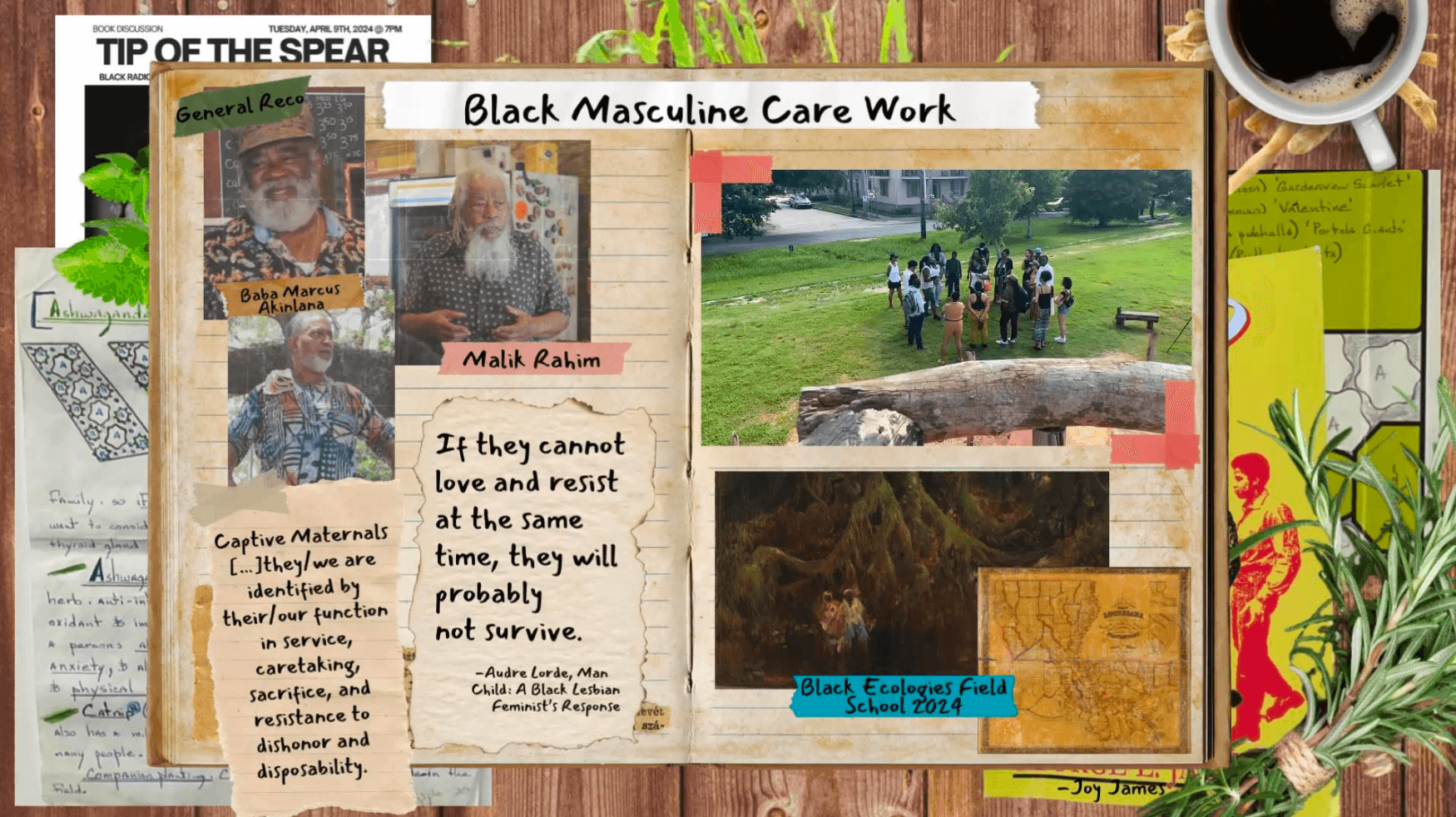
Figure 2
Figure 2 – screen capture from short film that explores “Black Masculine Care Work”
This video essay highlights Black men in New Orleans whose community work is directly informed by the historical legacy of marronage in southern Louisiana. Malik Rahim, for example, refers to himself as a maroon, and explains in the film how maroon communities formed on the West Bank of New Orleans to resist both the plantation regime and the comprador class of Afro-Creole elites across the river. Baba Marcus Akinlana gives us a tour of the Cuterie Forest in New Orleans’ City Park as he explains Juan Malo and Mama Cecille’s histories, in a landscape akin to they might have encountered in times past. Chopper contributes to the communal work being done in the Lower Ninth Ward’s Solitary Gardens, providing holistic care and counseling for community members who have escaped the clutches of Louisiana’s carceral state and the medical industrial complex. Notably, the men profiled in this film are political activists, spiritual leaders, and apothecaries. Their geographic purview spans from the West Bank to the Lower Ninth Ward to Gentilly. While this video essay focuses on Black men and their intracommunal care and spiritual practices, the film should not be interpreted as a hagiography for the Black male ego, nor as a reification of cisheteropatriarchal authority, which causes deep harm and mistrust in our communities. Riffing off the work of Orisanmi Burton, the intention of this focus is to elucidate aspects of the intergenerational kin work and “Black masculine care” (2021) maroons have enacted under conditions of enslavement and domestic warfare.
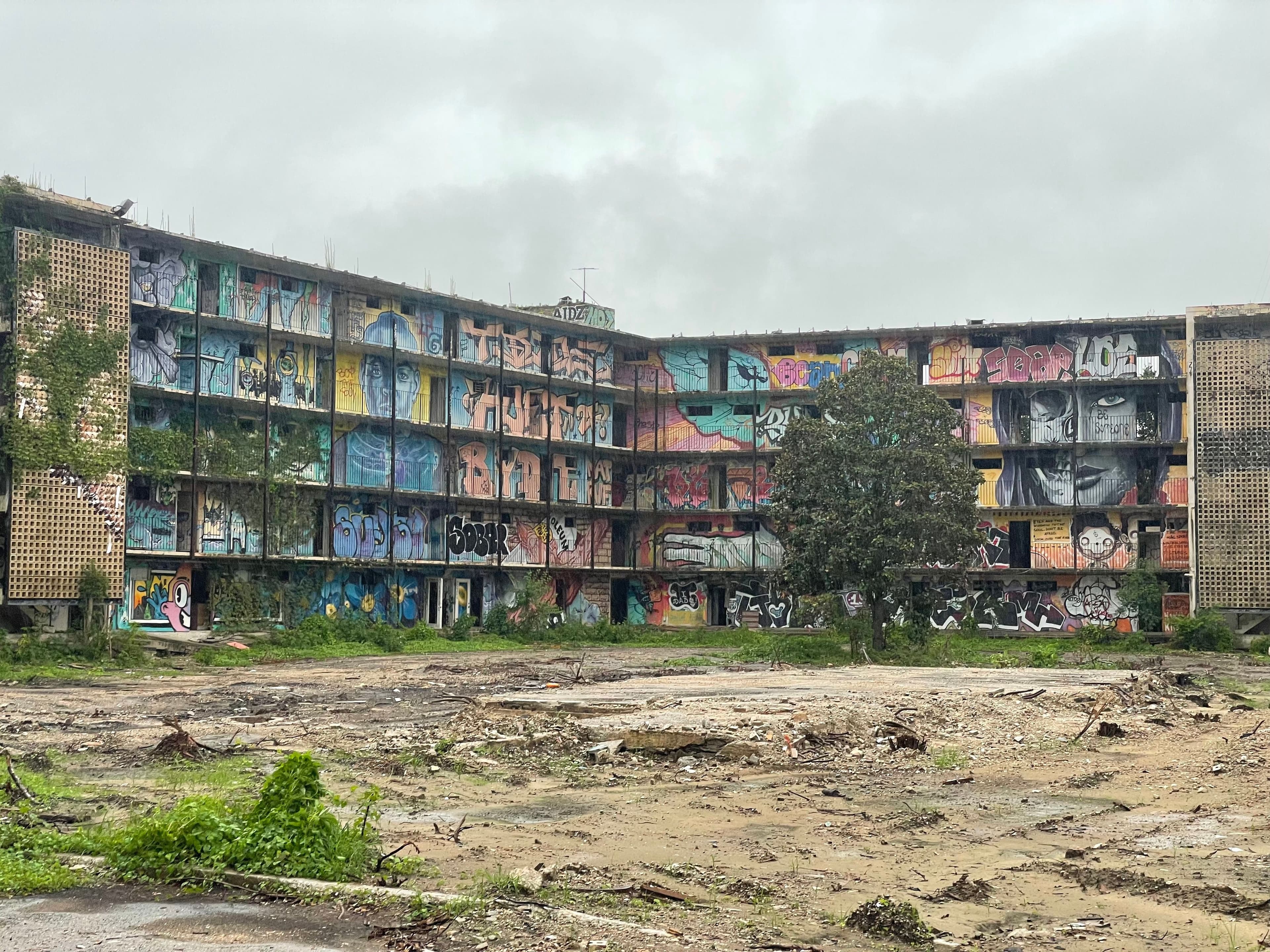
Figure 3
Figure 3 – The Crescent City Gates Apartments, formerly known as DeGaulle manor
Again, as Drake argued, “there are intellectual tasks, and there are street tasks.” Can our work embody the dexterity required to traverse both street tasks and intellectual tasks under heightened duress? Particularly under, what Burton (2021, 2023) argues, are conditions of “domestic warfare”? Black studies scholars should begin taking practical lessons from the maroons that fascinate and propel us. A recurrent theme embedded throughout this video essay is dexterity. Dexterity – a key mode of maroon mobility – will be an important aspect of analyzing, interpreting, and mobilizing Black communities as the ecological collapse intensifies. Here, dexterity is not the same thing as resilience, which is another lesson we should retain from Katrina. In my ethnographic research in Black New Orleans, a theme that emerges in several interviews is “I am tired of being resilient.” “What if I’m actually not resilient, then what? Do I not have the right to live, still?” Forced resilience is akin to bondage, but what lessons can we learn from maroons, who navigate hostile ecologies while building community? Our field school participants learned of one example of maroon dexterity while meeting with Malik Rahim, who gave us a tour of the abandoned DeGaulle Manor housing projects on the West Bank of New Orleans.
Two years after Hurricane Katrina, Malik Rahim and the Common Ground Collective rejuvenated the abandoned DeGaulle Manor housing projects, built a community-led health clinic there, rehabbed apartment homes so that displaced New Orleans could return home, and provided a free food program for residents. In a geography where the state could no longer sustain the fiction of its sovereignty in a moment of extended crisis, Rahim and his comrades assessed the post-Katrina situation, realized that there were standing apartment homes that people could live in with a little hard work, and they made it happen. This mode of insurgent political and spatial practice was a “street task” in the face of state failure, akin to what Ryan Jobson (2024) articulates as “road work” in a different, yet similar petrostate, Trinidad and Tobago. Trained by Faye V. Harrison (2008) to understand New Orleans as a key node in the circum-Caribbean, I wonder: In the face of Louisiana’s fragile ecology, what would it mean for working class Black neighborhoods to organize on a block-by-block, neighborhood basis in preparation of ecological disruption, similar to the Cuban emergency response system? For each block to have an exit plan, a cache of emergency provisions, and a safe house miles away for folks to hunker down in? These are articulations of maroon dexterity that are currently being practiced in New Orleans, experimentations in communal care that I will not explicate outside of the visuals contained in this essay.
The ongoing climate crisis and the state’s authoritarian appendages will require Black folks to radically revise and scale up what community care and relation will look like across local, national, and global scales. It will require work from all of us, across gender, sexuality, ability, and class. In this vein, Alix Chapman’s (2026) work elucidates how instrumental working class and low-income queer Black New Orleanians were to the cultural and material bases for the gradual (yet still uneven) return of Black New Orleans after the storm. This is another key lesson of Katrina, the critical ways that working class queer Black folks enact important communal care and cultural work that serves as a resplendent form of connective tissue within Black communities, in what Victor Ultra Omni (2023) brilliantly articulates as “intertwined kinship.”The Black men profiled in this film have committed their lives to protecting and caring for the Black people in their communities across all lines of class, gender, kinship, ability, and sexual identity.While sometimes imperfect in its execution, the maroons in this film have worked to create an environment in which all Black people will be protected from state violence and ecological collapse. Learning from their example, we should refuse the false binaries of gender distinction that structure some contemporary debates in Black study and everyday Black discourse, to articulate and embody what Hortense Spillers believed we were on the verge of – a new conception of gender altogether. Or, what Toni Cade Bambara might have called “Blackhood.” Perhaps Louisiana’s collapsing floor can serve as a springboard for a new mode of gender relation akin to Juan Malo and Mama Cecille.
I hope this film can serve as illumination and inspiration for other deeply committed Black men across the African diaspora caught in the crossfire of a rapidly consolidating eco-fascism. The collapsing walls imperil us, but they do not doom us, if dexterity remains a central guiding principle to our thinking, our analysis, our organizing, our survival, or our wake work. What have we learned 20 years after Katrina? The future is indeed contested.
Dedicated to: Malik Rahim, Marcus Akinlana, General Reco, Chopper, Robert King, Herman Wallace, Albert Woodfox, Andrew Joseph Jr., Jabbar Gibson, Gary Tyler, Mark Essex, and the multitude.
WORKS CITED
Burton, O. 2021. “Captivity, Kinship, and Black Masculine Care Work under Domestic Warfare.” American Anthropologist 123 (3): 621–32. https://doi.org/10.1111/aman.13619.
Burton, O. 2023. Tip of the Spear: Black Radicalism, Prison Repression, and the Long Attica Revolt. University of California Press.
Chapman, A. 2026. Raising the Bottom: Bounce Music and Black Queer Performance in Post- Katrina New Orleans. Duke University Press.
Drake, J. M. 2014. “Insurgent Citizens: The Manufacture of Police Records in Post-Katrina New Orleans and Its Implications for Human Rights.” Archival Science 14 (3–4): 365– 80. https://doi.org/10.1007/s10502-014-9224-2.
Harrison, F. V. 2008. Outsider within: Reworking Anthropology in the Global Age. University of Illinois Press.
Henry, K. L. 2023. “Feasting on Blackness: Educational Parasitism, Necropolicy, and Black Thought.” International Journal of Qualitative Studies in Education, August 23, 1–17. https://doi.org/10.1080/09518398.2023.2248089.
Hosbey, J. 2025. “Angola Prison’s Black Ecologies.” Environment and Planning F, 26349825241296077. https://doi.org/10.1177/26349825241296077.
Hosbey, J. 2026. “‘We Don’t Do the Recovery School District’: Education and the Antiblack Terms of Neoliberal Recovery in Black New Orleans.” Antipode 58 (1): e70118. https://doi.org/10.1111/anti.70118.
Hosbey, J. and J. T. Roane. 2021. “A Totally Different Form of Living: On the Legacies of Displacement and Marronage as Black Ecologies.” Southern Cultures 27 (1): 68–73. https://doi.org/10.1353/scu.2021.0009.
Jobson, R. C. 2024. The Petro-State Masquerade: Oil, Sovereignty, and Power in Trinidad and Tobago. The University of Chicago Press, 2024.
Johnson, A. 2025. Under a Black Star: The Maroon Impulse in New Orleans. University of Minnesota Press.
Milman, O. 2026. “‘Point of No Return’: New Orleans Relocation Must Start Now Due to Sea Level, Study Finds.” US News. The Guardian, May 4. https://www.theguardian.com/us-news/2026/may/04/new-orleans-sea-levels-relocation-climate-crisis.
Pelot-Hobbs, L. 2023. Prison Capital: Mass Incarceration and Struggles for Abolition Democracy in Louisiana. University of North Carolina Press.
Purifoy, D. 2025. “Scenes from the Insurgent [Black] Forest.” Cultural Dynamics 37 (3): 170–86. https://doi.org/10.1177/09213740251363572.
Roane, J. T. 2018. “Plotting the Black Commons.” Souls 20 (3): 239–66. https://doi.org/10.1080/10999949.2018.1532757.
Roane, J. T. 2022. “Black Ecologies, Subaquatic Life, and the Jim Crow Enclosure of the Tidewater.” Journal of Rural Studies 94 (August): 227–38. https://doi.org/10.1016/j.jrurstud.2022.06.006.
Roane, J. T., and J. Hosbey. 2019. “Mapping Black Ecologies.” Current Research in Digital History 2. https://doi.org/10.31835/crdh.2019.05.
Sojoyner, D. M. 2016. First Strike: Educational Enclosures in Black Los Angeles. University of Minnesota Press.
Spillers, H, S. V. Hartman, F. J. Griffin, S. Eversly, and J. L. Morgan. 2007. “‘Whatcha Gonna Do?’: Revisiting ‘Mama’s Baby, Papa’s Maybe: An American Grammar Book’: A Conversation with Hortense Spillers, Saidiya Hartman, Farah Jasmine Griffin, Shelly Eversley, & Jennifer L. Morgan.” Women’s Studies Quarterly 35 (1): 299–309.
Thompson, A.C. 2008. “Post-Katrina, White Vigilantes Shot African-Americans With Impunity.” Accessed June 1, 2025. https://www.propublica.org/article/post- katrina-white-vigilantes-shot-african-americans-with-impunity.
Tompkins, C. P. 2024. A Burdensome Experiment: Race, Labor, and Schools in New Orleans after Katrina. University of California Press.
Ultra Omni, V. 2023. “Crystal Labeija, Femme Queens, and the Future of Black Trans Studies.” TSQ: Transgender Studies Quarterly 10 (1): 16–22. https://doi.org/10.1215/23289252-10273140.
Vergès, F. 2017. “Racial Capitalocene: Is the Anthropocene Racial?” Verso Blog, 30 August. https://www.versobooks.com/blogs/3376-racial-capitalocene.
Williams, T. 2026. “Black History Is a Place: The Promise of Black (Public) Geographies.” Annals of the American Association of Geographers, April 13, 1–14. https://doi.org/10.1080/24694452.2026.2639714.
Williams, T, C. Keeve, C. Watkins, et al. 2025. “Black Livingness and Insurgent Ecological Politics: Thinking across Black Geographies / Atlantics / Ecologies.” Dialogues in Human Geography, August 6, 20438206251364964. https://doi.org/10.1177/20438206251364964.
Winston, A. 2018. “Palantir Has Secretly Been Using New Orleans to Test Its Predictive Policing Technology.” The Verge, February 27. https://www.theverge.com/2018/2/27/17054740/palantir-predictive-policing-tool-new-orleans-nopd.
Woods, C. 2017. Development Arrested: The Blues and Plantation Power in the Mississippi Delta. Verso Books, 2017.
Wynter, S. 1994. “‘No Humans Involved’: An Open Letter to My Colleagues.” Knowledge for the Twenty-First Century 1 (1).
Past Editions
1.
“They didn’t come to save us after Katrina, but they are coming for us now”: Black men, Marronage, and the eco-fascist conjuncture
Justin Hosbey
2.
A Bird Sang (the Blues) to Me: Collage as Black Study
Rebecca Louise Carter
3.
An Ambivalent Zionism: Walter White, Black Internationalism, and the Politics of Partition
Amy Barenboim
4.
At the End of the World: On the Temporal Limits of Katrina Recovery
Alix Chapman
5.
Divestment and Its Terrain: Abolition, the State, and Racial Capitalism
Philip V. McHarris
6.
Eye of the Storm: Commemorating Katrina as Political Praxis
Shreya Subramani, Christien Tompkins & Kaya Williams
7.
On the Black International Gaze
Zachary Mondesire
8.
Pick Up This Book and Use It: Abolition, Anthropology, and the Archive in Tip of the Spear and Excited Delirium
Kaya Naomi Williams
9.
Review of The Petro-state Masquerade: Oil, Sovereignty, and Power in Trinidad and Tobago, by Ryan Cecil Jobson
Anna Feign
10.
Steps Leading to the Sky: June Jordan’s Black Feminist Frictions
Marina Magloire
11.
Unmaking Carceral Disasters: A Post-Katrina Timeline of Struggles Against the New Orleans Punishment Regime
Lydia Pelot-Hobbs
12.
Untitled (Introduction to SOULS Vol. 25)
Jafari Sinclaire Allen