TRANSFORMING ETHNIC STUDIES: Theorizing Multiculturalism, Diversity, and Power
Manning Marable
The future of American democracy in the twenty-first century will be largely defined by people of color: Asian Americans, American Indians, Pacific Island Americans, Latinos, black Americans, and Arab Americans. Numerically, we collectively become a majority of the U.S. population by the middle of the century. The politics of ethnic studies therefore should begin with this political reality, creating the theoretical and conceptual frameworks for the democratic transformation of U,S. society.
Although the focus of our conference highlights the connections and conflicts of Asians and blacks, I would like to address primarily the theoretical and political relationships of black or Africana studies, Asian-American studies, and ethnic studies to the project of social transformation, and especially to the
destruction of racial hierarchies. Intellectual work never occurs in a political vacuum. Historical and theoretical investigations of racialized ethnic groups can enhance the capacity for the subaltern to see itself in new ways. Ethnic studies as an intellectual project must be central to a large public conversation about what the multi cultural future of the United States will be.
Oppression in the United States, or anywhere else in the world, has never been one dimensional. From its beginning , this nation was largely constructed around interlocking systems of prejudice, power, and white heterosexual male privilege, in which the vast majority of the population was defined outside the acceptable boundaries of the mainstream.
There was the hierarchy of race: the social construction of whiteness as a category of privilege, the racial stereotyping of the vast majority of non-Europeans, the genocidal elimination of most American Indians, and the enslavement of people of African descent. 200. The result of these trends was immediately apparent in enrollment figures. In the fall of 1998. in the entire University of Ca lifornia system. there were 29 percent fewer African Americans and 16 percent fewer Latinos accepted for admission compared to the fall of 1997.
In December 1998. the Federal Communications Commission announced that it would not appeal to the Supreme Court to reinstate affirmative action policies that had promoted the employment of racialized minorities and women in the media.
In early January 1999. the University of Texas at Austin abandoned its extensive program to recruit black and Hispanic faculty because it feared that it would be overruled by the courts. On January II . 1999. the affirmative action program that had admitted many African-American students to the University of Georgia was declared illegal in federal court. Seeing the legal hand writing on the political wall, the University of Massachusetts at Amherst decided to reduce its emphasis on minority recruitment efforts and to focus more on nonracial criteria, such as
socioeconomic status, in its admissions policies. Then on April 1, 1999, a white lecturer who had been denied employment at San Francisco State University and had sued on the grounds of reverse discrimination won $2.75 million in a jury trial. Step by step, in court decisions, public referenda, and shifts in educational and employment policy. "diversity" is aggressively being dismantled.
Affirmative action programs in Europe are frequently called "positive discrimination," and perhaps we would have been better off if we had used this term also in the United States. Affirmative action is a strategy of corrective preferences, aimed at creating the social conditions and environment in which racialized minorities are more fully represented in all levels of society. College admissions and recruitment have always involved preferences: Prospective students who possessed a demonstrated athletic ability might be given preferential consideration over other
applicants with similar test scores and academic records, but without athletic prowess. Colleges factor in legacies as part of their admissions decisions. If entire classes or groups have been denied admission to institutions for generation after generation, we cannot expect that pattern of exclusion to be eliminated without taking corrective measures.
Many of you undoubtedly know the thesis of the new study, The Shape of the River:
Long-Term Consequences of Considering Race in College and University Admissions, by two former Ivy League presidents, Derick Bok of Harvard and William G. Bowen of Princeton, Their study of elite colleges documents the success of race-based preferences that admitted African-American students with lower grades and SAT scores than their white class mates. Black stude nts graduated
from the se elite institutions at higher rates than African-American students with similar test scores who attended less competitive schools. Their study shows that black graduates of elite colleges and universities also earned advanced degrees in professions such as law, medicine, and business at the same rate as whites. Twenty years after graduation, the black graduates were more likely to be actively involved in community service and public affairs than their white counterparts. Whites also benefited from affirmative action by learning from classmates with diverse cultures, backgrounds, and experiences.
An honest conversation about affirmative act ion would require sympathetic progressive-minded whites to acknowledge that much of the anti-affirmative action rhetoric among many former liberals is really a retreat from a meaningful engagement on issues of race, and that the vast majority of Americans who have benefited materially from affirmative action have not been black at all, but have the individual stories of these racial or ethnic minorities. It must integrate their cultural perspectives, divergent socioeconomic experiences, and political histories into a broader, enriched discussion about both the commonalities and differences among cultures and values, the tragedies and triumphs in the making of American society. There is a creative tension between particularity and universality as we make the connections between these groups in literature, art, music, the development of family and kinship networks, and a host of other areas. Where tension and honest dialogue exist, the recognition of difference and commonality, the environment for learning is extraordinary.
Any critical study of the complex, multilayered relationship between Asians and blacks in the United States must begin with the historical background of Asia's extensive interactions with the African continent and its people. Historians have long established the links of economic trade between China and eastern Africa bordering along the Indian ocean. Islam created a transnational faith community that extended from what is today northern Nigeria to Indonesia and Malaysia. The political, economic, and cultural interactions between Arabs and Africans, are represented, for example, by both the Swahili language on one hand and the oppressive east African slave trade on the other, developed over many centuries. One also finds parallels and connections between Asians and Africans in the development of the Americas and Caribbean societies. About 15 million Africans were involuntarily transported as chattel slaves to the western hemisphere between the years 1550 and 1870. People of African descent, working in sugarcane fields from Bahia, in northeast Brazil, to the South Carolina and Georgia coast, constructed cultures, traditions, and societies that drew from their African past but that also reflected their new material conditions and social realities. Similarly, European colonialism and imperialism was responsible for the international coolie trade, the coerced migrations of Chinese and Indians into Africa, the Caribbean, and the Americas.
As the ethnic studies scholar Lisa Yun has observed, sometimes the same ships that were used to transport enslaved Africans across the notorious Middle Passage of the Atlantic were later used to bring coolie labor across the Pacific. For the slave, coolie, or non-European indentured worker, the actual physical conditions of exploitation were almost indistinguishable. The construction of Asian diasporas created new societies: the Cape Malays of the Western Cape Colony, South Africa; the Indian communities of Natal, South Africa; the Indians of Uganda, Kenya, and Tanzania; the Indian communities of Trinidad and Guyana; the Chinese laborers
who built the railroads from the Pacific across the mountains in the western United
States in the mid-nineteenth century; and the Japanese agricultural workers of Hawaii. We share common histories of slavery and indentured servitude, of physical exploitation, political disfranchisement, social exclusion, and cultural marginalization. Despite the obvious differences between Asians and people of African descent in their cultures and languages of origin, the Asian and African diasporas broadly overlap each other, with complex and often remarkable patterns of assimilation and shared struggles for freedom.
W.E.B. Du Bois's famous 1915 essay, "The African Root of the War," documenting the centrality of European colonial expansionism as the driving force behind World War I, is echoed in the revolutionary writings of Sun Vat-sen and Ho Chi Minh. Mohandas Gandhi brought nonviolent civil disobedience and the philosophy of satyagraha, "soul force," to the struggle against racism in South Africa, and Martin Luther King, Jr., adapting Gandhi's model to the conditions of the U.S. South, helped to launch the Montgomery bus boycott in 1955. The political project of
Third World nonalignment in the aftermath of World War II was essentially an Asian-African collaboration, uniting Sukarno of Indonesia, India's Nehru, Nkrumah of Ghana, and Nassar of Egypt. Both Malcolm X and later Muhammad Ali, in different ways, became heroes in the Afro-Asian and Islamic worlds. The struggle against French colonialism of non-European people link Vietnam with Algeria, and both with the Haitian revolution of Toussaint L'Ouverture. Jazz, hip-hop, and reggae are as integral in the popular youth culture of Beijing and Tokyo as they are in Kingston, Brixton, and Harlem. So when we discuss ethnic studies with an emphasis on Asians and blacks, it is essential to start with our profound interactions and parallel developments and then to consider areas of group conflict and divergence within that historical framework.
Historically, the oppressed have defined themselves largely and often unthinkingly by the boundaries of identities that we re super-imposed on them. Jean-Paul Sartre once referred to this social dynamic as "overdetermination." Oppress ed people living at the bottom of any social hierarchy are constantly reinforced to see themselves as the "Other," as individuals who dwell outside of society's social contract, as subordinated categories of marginalized, fixed minorities. Frequently, oppressed people have utilized these categories and even terms of insult and stigmatization, such as "nigger" or "queer," as a site for resistance and counterhegemonic struggle.
The difficulty inherent in this kind of oppositional politics is twofold. First, it tends to anchor individuals to narrowly defined, one-dimensional identities that are essentially the "inventions" of others. For example, how did African people become known as " black," or, in Spanish, “Negro”? Europeans launching the slave trade across the Atlantic 400 years ago created the terminology as a way of categorizing the people of an entire continent with tremendous variations in language, religion, ethnicity, kinship patterns, and cultural traditions. Blackness, or the state of being
black, was completely artificial; no people in Africa call themselves black. Blackness only exists as a social construct in relation to something else. That “something else” became known as whiteness. Blackness as a totalizing category relegates other identities—ethnicity, sexual orientation, gender, class affiliation, religious traditions, kinship affiliations—to a secondary or even nonexistent status.
In other words, those who control or dominate hierarchies, whether through their ownership of the means of production or domination of the state, have a vested interest in manufacturing and reproducing categories of difference. An excellent recent example of this occurred in the United States in 1971, when the U.S. census bureau “invented” the category “Hispanic.” The term Hispanic was imposed on a population of, at the time, 16 million people, reflecting divergent and even contradictory nationalities, racialized ethnicities, cultural traditions, and political loyalties: black Panamanians of Jamaican or Trinidadian descent who speak Spanish; Argentines of Italian or German descent; anti-Castro, white upper-class Cubans in Miami's Dade County; impoverished Mexican-American farmworkers in California's Central Valley; and black Dominican service and blue-collar workers in New York City's Washington Heights. Yet when states or hierarchies name the “Other,” the act of naming creates its own materiality for the oppressed. Government resources, economic empowerment zones, and affirmative action scholarships are in part determined by who is classified as Hispanic and who is not. Identities may be situational, but when the power and resources of the state are used to categorize groups under a "one size fits all" designation, the life chances of individuals who are defined within these categories are largely set and determined by others.
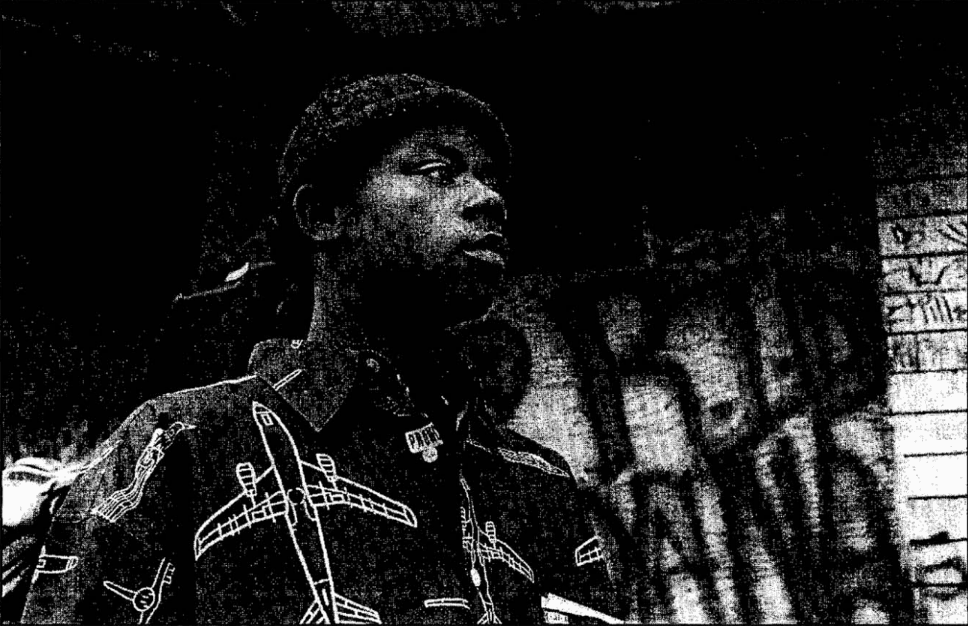
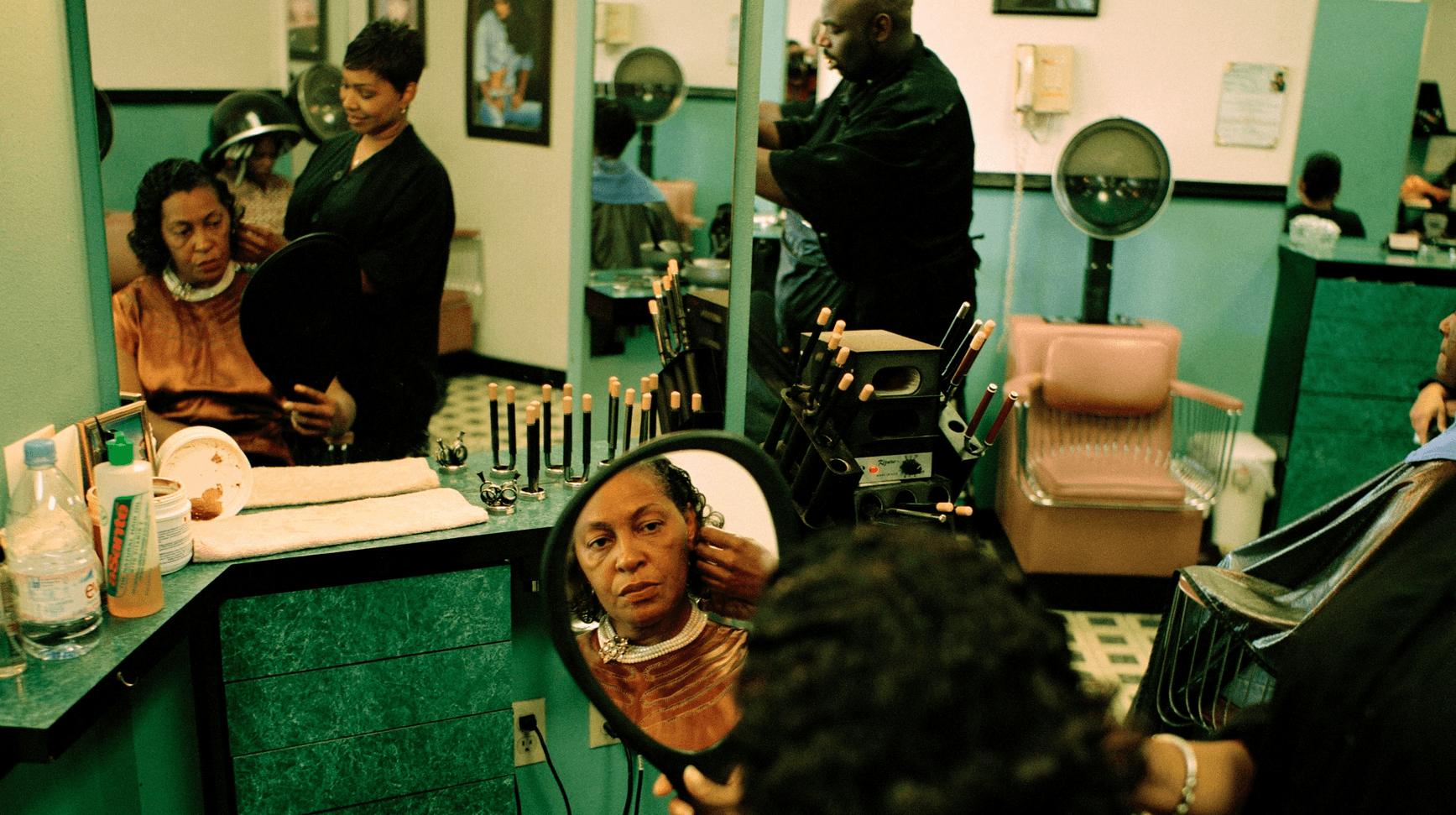
Searching. Photo by Helen M. Stummer
For example, in the state of New Jersey, black motorists arc almost five times more likely to be stopped by that state's highway patrol than are whites. In 1999, investigators found that 34 percent of all police stops of vehicles on one section of the New Jersey state turnpike involved either Latinos or blacks. Only one percent of all stops led to vehicle searches. Guess who was searched? More than 75 percent of all motorists searched were either Latino or African American. An April 2000 study found that blacks in New York City are denied loan applications at banks at twice the rate of whites, even when they have identical incomes. African Americans who earn more than $60,000 a year have a higher rejection rate than whites who earn under $40,000 a year. The racial profiling on our high ways, the crime of "DWB"—driving while black—is mirrored in the economic redlining of the ghettoes and barrios of central cities, denying credit and capital to people of color. Blacks traditionally have twice the unemployment rates of whites, and historically have always been the last hired and the first fired. But from the privileged terrain of whiteness, unemployed black workers are viewed as simply unlucky at best, or lazy at worst.
In the Bronx last year, Amadou Diallo was shot nineteen times by officers of the New York Police Department, not for what he said, not for what he did, but for what he looked like. Amadou Diallo was not murdered because of his behavior, but because of the racialized image of him in the heads of four white police officers. In Detroit, Vincent Chen was brutally murdered by several unemployed autoworkers, who blamed Japanese automobile sales for their layoffs. Vincent Chen was a Chinese American, not of Japanese descent, but his lynching was the result not of his actions or behavior, but of the racist stereotype of him, which had been widely
popularized in the American media. In any public opinion survey in the United States for the past thirty years, if you ask Americans for the first thing that comes to mind when you say the word "Arabs," the immediate and overwhelming response is "terrorists." Over 100,000 Japanese Americans were incarcerated in concentration camps during World War II, yet German Americans and Italian Americans were not. Why? Racism matters.
It is, of course, crucial that oppressed groups construct oppositional social movements to resist their subordination and exploitation, but narrowly defined identity-based movements, by themselves, lack the capacity and even the vision necessary to transform society. The simple and inescapable reason is that oppression itself is never one dimensional.
Examine the public record of George W. Bush. When Bush first ran for governor of Texas in 1994, he aggressively defended the state's law criminalizing sexual relations between same-sex partners, as a "symbolic gesture of traditional values." Bush opposed domestic partner benefits and the progressive civil union statute in Vermont. The Texas governor also opposed the Employment Nondiscrimination Act, an important civil rights issue for the lesbian, gay, bisexual, and transgendered (LGBT) community. And for months, Bush refused to meet personally with the Log Cabin Republicans, a membership organization of over 11 ,000 lesbians and gay men who are active in the Republican Party. Bush even promised the conservative
columnist Cal Thomas that he would never hire a "practicing homosexual."
George W. Bush also opposed the reproductive rights of women and affirmative action programs designed to reduce racial and gender inequality. He has executed scores of mostly brown, black, and poor people on Texas's death row, while assuring us that all of the condemned were guilty. From his conservative political position, George W. Bush actually makes the interconnections between sexuality, class, gender, and race. And from the vantage point of the left, so should we.
We will never eliminate the cultures of violence toward LGBT people and all women if we cannot make the social, theoretical, and political connections between violence, hierarchies, and power. We cannot comprehend or understand, for example, why African-American women are more than twice as likely to develop certain chronic and disabling health conditions compared to white women (such as lupus, sarcoidosis, and heart disease), or why they are significantly more likely to die from diseases such as breast cancer, unless we approach our study of public health from the intersection of gender, sexuality, race, and class. How can we effectively combat housing, employment, and other forms of heterosexist discrimination , if white lesbians and gay men fail to link these important issues with the antiracist struggle for reparations and affirmative action? The historic campaign for civil rights pursued by African Americans across the U.S. South during the desegregation campaigns of the 1950s and I960s was never just a "black issue." The pursuit of a culture of human rights and civil liberties for LGBT people has never been solely a "gay or lesbian issue." What we have fought for is something far more important than the simple affirmation of narrowly defined identities.
Oppressed people now find themselves increasingly pitted against each other as they scramble to seize the crumbs that fall off the national banquet table. All too often, we compete against each other at the margins, refusing to recognize that it was our labor power that built the table, the banquet hall, and the kitchen. Instead of asking just for access and opportunity, we should be collectively fighting for power.
Stereotypes even within oppressed peoples' communities tend to reinforce such divisions. Much as Asian Americans are presented as "model minorities," lesbians and gays are packaged in the media as mostly wealthy and well educated and overwhelmingly white. For example, one 1996 market survey done in conjunction with a lesbian/gay-oriented advertising agency, determined that 21 percent of all gay people had household incomes of over $100,000, and 22 percent have graduate degrees. But the danger of the stereotype of gay affluence is that it may provide the political justification for the homophobic right to insist that such a privileged upper-class group needs no civil rights protections.
What are the real socioeconomic characteristics of the LGBT community'? A 1994—1995 Dallas-based survey of 470 gay men aged seventeen to sixty-nine found that 44 percent earn less than $30,000 a year, and almost half of that group report annual incomes under $20,000. Another study, by the economist M. V. Badgett, shows that gay men who work full-time earn as much as 27 percent less than similar heterosexual men, even when variables such as occupation, location, and education are controlled for. Heterosexism can be measured, in part, as income inequality, in a parallel manner to racism and patriarchy. Thus the struggle for lesbian/gay rights must be grounded in the broader class effort to achieve income parity and economic justice for all minorities. Making the practical connections between the politics of sexuality and race means talking honestly about the fact that as of 1999 one of every 50 African-American males and one of every 160 black females were HlV positive, and that African Americans now represent at least one-half of the new HIV infections.
We cannot understand the nature of oppression unless we link gender studies to race , class, and sexuality issues. Andrea Smith, an antiviolence and Native American activist writing in the journal Color Lines (winter 2000), observes that in the 1970s as many as 30 percent of all Puerto Rican women and 25 to 40 percent of American Indian women were sterilized without their consent. Smith also cites statistics showing that "women of color are 64 percent of the [U.S.] female priso n population and serve longer sentences for the same crime as do white women or men of color." The Women of Color Center of Berkeley, California, issued a remarkable report, Working Hard, Staying Poor: Women and Children in the Wake of Welfare Reform, that graphically illustrates the intersectionalities of oppression. As of 1998, African Americans, who represent 12.5 percent of the U.S. population, comprise 26.4 percent of all poor people. Latinos comprise 23.4 percent of those below the federal government's poverty line. Although only 8.2 percent of all non-Hispanic whites are poor, 12.5 percent of all Asian and Pacific Island Americans are below the poverty line.
Immigrants are 50 percent more likely to be poor than the native born . In female-headed households with children, the statistics are much worse: 21 percent of all non-Hispanic white female-headed households were poor in 1998, compared to 46 percent for African Americans and 48 percent for Latinas. With the abolition of Aid to Families with Dependent Children, within two years 50 percent of Mexican-American former welfare recipients in Santa Clara, California, reported food shortages, as had 26 percent of all Vietnamese-American women. In Wisconsin, one out of three Hmong women recipients had run out of food at some point during a six-month period. A 1998 study in San Francisco of immigrant households whose food stamps had been cut found that 33 percent of all immigrant children were experiencing moderate to severe hunger. A white feminism that does not acknowledge the profound interconnections of race , class, sexuality, and gender cannot develop a language that speaks to the vast majority of the world's women.
Perhaps the greatest threat to U.S. democracy today is the vast, unprecedented expansion of what Angela Y. Davis and other scholars have termed the "prison industrial complex." Today in the United States, there are over 2 million people in prisons and jails, plus another 5.7 million people on parole or probation or awaiting trial. In a racist society, it should not surprise anyone that Latinos and African Americans suffer disproportionately under this system of mass incarceration. Currently, one-third of all young black men in their twenties are in prison or jail or under state supervision. But let us use the gender lens to investigate what is also happening. According to the statistics compiled by the Prison Activist Resource Center, of Berkeley, California, there are today nearly 900,000 women under correctional supervision of some type. Since 1980, the female inmate population in the United States has increased more than 500 percent. Who is being imprisoned? Eighty percent of imprisoned women have children, and of those women, 70 percent are single mothers. Most women prisoners were either unemployed at the time of their arrest or earned less than $15,000 in the year prior to their arrest. About 80 percent of all women inmates are sent to prison for non-violent crimes. Our prisons and jails have become vast warehouses for the poor and unemployed, for racialized minorities of women and men alike.
This conference has been designed to examine the parallels and discontinuities between Asian and black Americans, with the objective of encouraging more comparative and historical scholarship across the boundaries of racialized ethnic identities. Such comparative research might also help to improve the practical political relationships between Asian and African Americans in multi-ethnic urban communities. But the politics of diversity will continue to remain divorced from state power so long as the racialized Others fail to incorporate the language of gender, sexuality, and class into their perceptions of themselves. Latinos, blacks, and Asian Americans do not occupy distinct social geographies or isolated political economies. Despite the still pervasive pattern of residential segregation, people of color increasingly live and work together as neighbors. Our conflicts with one another are sometimes intense, in part because we share so much of the history of oppression. The scholarship of ethnic studies must be transformed from its original identity-based location toward a critical theory of power, interrogating multiple structures of hierarchy and inequality. This new ethnic studies may thus prepare the path for a new kind of transformed urban politics beyond the historic black-white paradigm.