

VOL. 25
Untitled (Introduction to SOULS Vol. 25)
Jafari Sinclaire Allen

Carrie Mae Weems, See No Evil, Hear No Evil, Speak No Evil. 1995.
I. Polaroids: An Invitation
A young Black person is rendered three times during what I imagine is a moment of crucial decision—at the shoreline, . In the first frame, the figure’s arms fall to their sides in disciplined poise—their eyes are closed; in the second, hands are firmly folded against their mouth; in the third, arms lift and palms and thumbs clasp and plug ears. You know this gesture of the three wise monkeys well: A three-part survival technique.
Carrie Mae Weems made See No Evil, Hear No Evil, Speak No Evil—the triptych that visually grounds our volume—in 1995, her first work in color. Worth much more than three thousand words, I imagine her subject refusing the technique. Those are eyes about to open. That is a mouth that will not stay covered. At any moment, those hands will drop from their ears. Not merely to hear, which one can do with head down in obeisance and eyes averted from the powerful; but to see, forthrightly, what they would rather we not see, to say what they would rather we not say, and then to insist—to persist—out loud, in the record, in mixed company.
Likewise, against the monkeys' putative wisdom, this volume chats back: See. Say. Insist. We imagine the frame expanded in every direction beyond the beautiful portrait, revealing an entire collective arrayed to do the same. No longer crucially alone, it matters less that they—we—are afraid. That is the argument of this volume, celebrating more than twenty-five years of uninterrupted publication of Souls, compressed into three Polaroids.
The moment, of course, demands it. In the time it has taken to make this volume, the University of Texas at Austin folded its Department of African and African Diaspora Studies into a generic administrative unit; Florida stripped Black-studies courses of their standing and cut the research money faculty depend on; Kentucky suspended a Pan-African studies doctoral program outright. The federal government has opened civil-rights investigations into dozens of universities at once; the language of civil rights is being turned against the people it was written to protect. Student hearings were transformed into kangaroo courts, campuses were seized and occupied. Civil rights have been rolled back and rolled over. Not only in the US, but also around the world where more recent inroads are also being . And yet, before we mistake any of this as “unprecedented,” let us be precise—because precision is itself a refusal. What the wider academy is experiencing as a shock is, for us, a reminder. (And yet, I have not yet said it…).
A journal keeps a slower clock than a newsfeed. By the time these digital pages reach you, some of the headline outrages we name will have been overtaken by others. Editorial Board member Kevin Quashie reminded us that the registers of any one season shift before an issue can appear, and that the long work of Souls—of Black Study(ies) itself—has been to hold the long, intersected histories of violence, aesthetic, political and social thought, that a single volume can only briefly throw into relief. Read what follows as a way of entering Black Study(ies) time: a long view of the present and clear dangers and opportunities of the moment.
In 1995, at Howard University's Charter Day, Toni Morrison walked her audience through the steps by which a nation arrives at a “final solution”—among them: construct an internal enemy; isolate and demonize it; enlist the media that profits from spreading chaos; palisade the art forms, she said—make tall barriers that make them seem inaccessible; criminalize the enemy and build the holding arenas, above all for its children. Ms. Morrison's observation of the tenth and final step is: “Maintain, at all costs, silence.” Silence. The covered mouth. The closed eye. Ears that refuse to hear. She was reminding us that racism’s twin—fascism—is not new and can make nothing new. It only reproduces the conditions it feeds on: fear, denial, and a people too overwhelmed and beaten down to fight.
Ms. Morrison was not the first to read this weather, nor the . Brother George Jackson, writing toward the end of his life from inside a California prison, put it without ornament: “fascism is already here.” Jimmy bore witness, throughout his incandescent lifetime, to the wrath he watched gathering over the thoughtless and entitled, falsely innocent American. M. Aimé Césaire had shown, a half-century before them all, that what Europe—shuddering from the horrors of war on its own shores—called fascism was best understood as the violence of the colony coming home. The radical Black tradition has been reading this weather for at least a hundred years. We are not surprised by the storm. So, when Carrie Mae Weems’s subject takes their hands from their mouth, they are doing the most traditional thing a Black artist or intellectual can do.
II: Founding and Re-Founding: Harlem, Chicago, The World…
Manning Marable came to Harlem in 1993 to build the Institute for Research in African American Studies (IRAAS), and founded an annual called Race and Reason, in the fall of 1994. It was a research reader in the lineage of Du Bois's Phylon and the old Atlanta University annuals—a once-a-year gathering of what IRAAS was thinking and doing that ran for four years. In January 1999, IRAAS reached for something far more ambitious—a quarterly: Souls: A Critical Journal of Black Politics and Culture. Cheryll Y. Greene, a veteran of book and magazine publishing, edited and managed it through those founding years. But the first managing editor Manning named many will not know: Linda Jean Rocawich, who agreed to help build Souls and did not live to see it grow. The very first issue carries an In Memoriam to her, set just beneath the Du Bois epigram Manning chose. The journal began, that is, already in mourning, already in debt to a woman's labor. It would not be the last time.
The lead essay of issue one—Manning's essay on Harlem and the Million Youth March—sees the patriarchy plainly. He notes, pointedly, that while saying next to nothing about the assault on civil rights then underway in Washington, the great marches of the long 1980s offered Black America a program of “racial self-help, spirituality, and patriarchy”; noting that Black feminists and gay and lesbian activists stood in open opposition to this regime. Manning names it but does not build an analysis out of it. Perhaps the moment had not yet demanded that of Souls, or of him. After all, the DuBoisian inheritance is strong. These are the first words printed on the first page of volume one, issue one:
[T]he Negro is a sort of seventh son, born with a veil, and gifted with second-sight in this American world… One ever feels his two-ness—an American, a Negro; two souls, two thoughts, two unreconciled strivings; two warring ideals in one dark body, whose dogged strength alone keeps it from being torn asunder. The history of the American Negro is the history of this strife—this longing to attain self-conscious manhood, to merge his double self into a better and truer self. — W.E.B. Du Bois
Here is an assertion of a veiled second-sighted two-ness carried in the body of a man, straining toward a manhood that can stand free, alongside other American men. Today, we walk through this threshold with sharper tools. We are completing the line. Finishing a sentence that could not be composed except for this heritage. Souls' double and triple consciousnesses—and jeopardy, I hear Frances Beal say—echoed by many others who are not men, and/or refuse manhood under these and various . Black folks from across the globe who were always already inside the veil, part of the collective imagining—many of whom seemed unheard or lost in (non-)translation.
When Manning joined the ancestors in 2011, this journal could have ended with its founder. It did not—because Leith Mullings would not let it. Manning's partner in life and in work, with whom he made Let Nobody Turn Us Around, Leith was a giant in her own right. She asked Barbara Ransby to carry the journal forward.
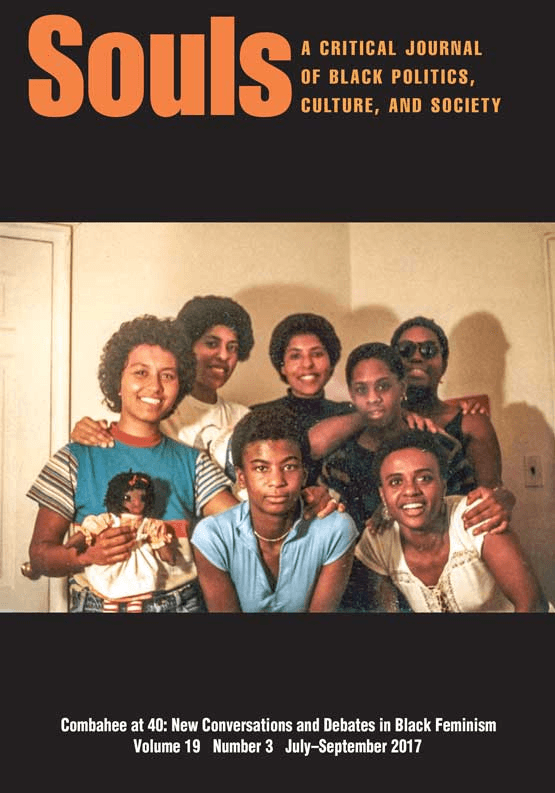
Barbara—our second Editor-in-Chief (now our Editor Emerita), took it up and carried Souls to the Department of African American Studies at the University of Illinois at Chicago, which stewarded the journal for a full decade (2012 to 2022). She turned up the volume on a frequency that had been playing low, anchoring the journal in radical Black-feminist thought. She steadied it through the move with her first issue, the 2012 “Election Issue,” then ran it through the Trayvon-to-Ferguson years and the rise of the Movement for Black Lives: the Trayvon-era "Torture, Trauma, Violence, and Self-Defense" (2013), framed by the Zimmerman verdict; the fiftieth-anniversary "Freedom Summer" (2015). Barbara Ransby made Souls a home for precisely the work the founding had gestured toward and left undone: a 2016 special issue on African American women's labor history, guest-edited by Prudence Cumberbatch, Dayo F. Gore, and Sarah Haley, with comments from the field by Saidiya Hartman, Tera W. Hunter, Premilla Nadasen, and Jessica Millward; and, in 2017, the fortieth anniversary of the Combahee River Collective, co-edited with Barbara Smith and Margo Okazawa-Rey. During the UIC years, Souls eulogized our elders in its pages with the honor they were owed—Vincent Harding, Ahmad Rahman, and Keorapetse Kgositsile. Through all of it Barbara kept Souls rigorous, lively, and unafraid.
And now the journal has come home to Harlem. Volume 24’s last issue was our first featuring work on a platform of our own. Volume 25—this twenty-fifth anniversary volume—is the first that is open, free, and on a purpose-built platform, with no one standing between the editorial collective and you.
Which is to say: Souls has always been a journal of Black study(ies) as intimacy and diasporic imagination—named in mourning, carried by women, gesturing past its own founding grammar toward full intramural Blackfullness, inside the .
III. That Which Cannot Not Be Said. (Or, I said what I said)
This brings us to our scary, for some, thematic formulation—Divest/Invest, borrowed from environmental, anti-apartheid, abolition, Gaza-solidarity, and M4BL activist movements. The call was occasioned by a divestment we all watched and in which many actively participated. A multiracial coalition of students—at Columbia, and on campuses around the world—forced the word divest back into the center of public life, revived the old anti-apartheid demand, and paid for it at high costs. We wrote the call in that weather: this volume is a child of that moment.
I will not pretend to fully know why so few manuscripts centering Palestine were submitted for publication, despite our Divest/Invest call. Some of it is fear, certainly—it has become genuinely dangerous to write certain sentences and keep one’s job, one’s visa, or one’s funding. Not indifference, but the chilling effect of a coordinated assault. It is the affect of it too—this is becoming our structure of . Another reason is focus: Black scholars, artists, and advocates have had their hands to the hoe on several important research projects around the world. Katrina at twenty years; Haiti and the long bill of reparations; Sudan; US electoral politics; and the disciplines themselves. Fear and focus both, under a fascistic regime. But Sarah Haley named the trap exactly: we would either say it, or the conspicuous absence, she warned, would speak louder than the word: ◼︎◼︎◼︎◼︎◼︎◼︎◼︎◼︎.
We have named genocide in this volume—not asserted as a slogan, but evidenced, contextualized, and argued in the open and among As Marina Magloire shows in this volume, long before this current sweltering season of fear; in 1982, June Jordan publicly condemned the Israeli invasion of Lebanon and bore the backlash that followed, holding that there is no Black freedom sealed off from the freedom of others, Palestinians among them. We find no evidentiary or ethical basis to overturn this truth.
When we brought the theme and aspiration for SOULS to the editorial collective, Elleza Kelley pressed hard, and usefully. Twenty-five years, she argued, might be marked not by another journal issue, but by a rupture—a divestment, as she put it, “from the institutional form of the academic journal itself.” Perhaps, the anniversary was handed to the students in protest rather than to the faculty in lateral boycott. Institute a break, she said. We took the challenge seriously—choosing to begin again—the founding grammar set down, not set aside; and a fuller one taken up. After a quarter-century, this is its own kind of break. The rupture Elleza named and the dynamic, contestable continuity I am claiming are not opponents. They are two hands of one gesture—hands dropping away from ears.
Kendall Thomas asked us to weigh what it means to center divestment—a word that, at bottom, asks an institution to do something—against the word that stands behind it: resistance. Black studies, he reminded us, has never been merely reactive to institution’s refusal to spend their money differently; at root it is an affirmative exercise of Black intellectual and political agency—Black knowledge production as a Black freedom project. We hold both. Divest/Invest is the call within the freedom project of Black study(ies)—building, not only demanding or refusing.
Divestment is more than withdrawal. The Black intellectual tradition has been asking, for generations, what it would mean to pull our labor and imaginations out of arrangements that were never built to hold us—and to invest in, or build, our own homes. Steeped in this tradition; we conceived the theme widely—promiscuously, even. Divestment from whiteness as the organizing center of thought; divestiture of masculinism, even of gender, as the default grammar of the political—a divestiture Omis’eke Tinsley pushed us to make literal: she reminded the board that the bodies broken at the encampments were often bodies of queer and trans people, and that the war on Black trans life and the war on Gaza are cut from one cloth—a connection too few are yet willing to draw. We called for work on or exemplifying studied dis-investment from the misapprehension of “rigor,” and silly appeals of “objectivity” that prevent true intellectual daring. This divestment would mean a reinvestment in the hard, exacting work of systematically thinking with the body—following desire and rage and grief where they lead and risking imaginative leaps that the disciplines were built to forbid.
Volume 25 attends to the declension of the word divest—sell-off, spin-off, carve-out. Questioning who holds the controlling shares: divest/invest rhymes with boycott and reparations. We also tarry here with the older life of divest, before the markets claimed it: when to divest meant to disrobe: to strip a sovereign of the robes of office. Kendall recalled that genealogy for us and named what is at stake—not a portfolio but (self)sovereignty: who is unrobed, and who is crowned.
Then, there is the divestment we made ourselves. Ms. Morrison, in that same essay, warned that fascism is known by its compulsion to convert every public good into private profit—to make the commons pay rent; to turn citizens into taxpayers and neighbors into consumers. Ideology, she said, is only fascism’s sales pitch. When we left Taylor & Francis and built this platform, therefore, we were not merely changing publishers. We were divesting—pulling this journal out of an arrangement that extracted the labor of Black scholarship and sold our words back to all of us at a premium—and investing, rather, in a home of our own. A scholarly journal pulled back out of a multinational’s paywall and handed, free, to anyone who needs it is a refusal of that conversion. To be sure: the platform we built is expensive. It is laborious. “But beautiful,” I hear Nancy Wilson . But, beautiful: we did this on purpose. Evidenced by scribblings in the margins of Qurans and Bibles; nkisi carried, and juju braided into hair or marked on the body; the independent church, the Black press, the mimeograph and the home library or salon (beauty and literary!): self-determination and reaching toward sovereignty is the oldest Black art and science there is. The consciousness raising circle in which you remember or invent or rename yourself, in the company of friends. Today, we out here on Maya Angelou's Internet—stepping into a mighty and righteous tradition, (again) in treacherous times.
IV. This Volume
Here, then, is how the conversation begins to unfold on the platform. Volume 25 comes in two issues—this one, arriving on the heels of Juneteenth, as more belated but no less important news that you are free. Issue two will follow at the end of the year. Still, this is one volume and one long conversation. Divest/Invest is the question put to every contributor, in every genre.
We open the Souls Journal with June Jordan. Marina Magloire’s “Steps Leading to the Sky” recovers a painful 1982—not only the devastating Sabra and Shatila massacre; but also the fallout from June's open letter naming Israel's war on Lebanon as genocide, and the tragedy of missed opportunities—both for airing June’s position, and for solidarity among the most prominent US based Third World and Black feminists of the moment. Centering June’s sense of home as something built, not returned to, Marina illustrates the poet and essayist’s commitment to anti-Zionism as a practice not a statement—which proved costly. Resisting conventions of rendering Black feminists as a monolith of radicality or progressivism; her account stands as a crucial and unflattering object lesson and cautionary tale. Amy Barenboim’s “An Ambivalent Zionism” gives us the prehistory of that refusal: Walter White—the NAACP internationalist made an unwilling nationalist—at the 1948 partition and Nakba. Here an older Black Zionism—the emigrationist dream of return to Africa that Blyden and Garvey modeled on the Jewish national movement, gives way to ambivalence, and then to critique. Zionism enters the long Black intellectual tradition as a model of return and, by the long 1980s symbolizes dispossession that Jordan insists we refuse. These essays impel us to ask what can and cannot be said—to whom, on whose behalf, and for what purposes? Is it ever a good idea to close one’s eyes…?
Divestment names what to refuse, while other traditions imagine what to build. Philip V. McHarris's “Divestment and Its Terrain” illustrates divest/invest as one contested tactic; traced from anti-apartheid through BDS, Indigenous land defense, and climate justice—tested against what the state does when asked to defund itself. Zachary Mondesire turns our question on discursive and political investment back on us, asking why a “Jim Crow epistemology” makes Palestine legible to Black internationalism while Sudan, Congo, and Haiti go under- or un-read—a reckoning he stages through the rise and fall of TransAfrica.
Marking twenty years after breached levees illustrated, in Katrina’s aftermath, the results of the long-ago breached promise of true Black citizenship: the first issue of our 25th anniversary volume closes on New Orleans. The special section “After the Storm” was guest-edited, alongside our staff, by Shreya Subramani, Christien Philmarc Tompkins, and Kaya Williams. To guest-edit a section is to commission and coax. To read and wait and read again—holding an exacting vision, on a deadline. The co-editors return to Manning Marable's 2006 Souls essay, positioning commemoration itself as political praxis. Lydia Pelot-Hobbs charts Katrina as a carceral disaster and highlights twenty years of the organizing that fought it; Rebecca Louise Carter explores “restorative kinship” that worked against the denial of Black personhood as well as the violent severing of social bonds, to heal and sustain families and communities. Alix Chapman’s essay, “At the End of the World: On the Temporal Limits of Katrina”, examines the temporal logics of post-Katrina recovery, probing the Black queer and working-class futures readily, though not fully, foreclosed by the racial capitalist imperative towards “progress.” Finally, in a moving-image and essay contribution to our “Dispatches from the Ebony Tower” section, Justin Hosbey illustrates practices of Black masculine care work in and around New Orleans as rituals of commemoration.
In Books in Conversation, Anna Feign reads Ryan Cecil Jobson's Petro-state Masquerade and its “road work,” where power lies in the streets rather than with the state alone; Kaya Naomi Williams takes Orisanmi Burton's Tip of the Spear and Aisha Beliso-De Jesús's Excited Delirium as a case for an anthropology that values Black life and can be picked up and used.
In Dispatches from the Ebony Tower, “From My Lens,” a photo-essay and commentary, asserts the author’s place in an insurgent Black critical artistic lineage. Sitting with post-encampment grief—that protection should look like erasure—the Columbia student confronts their original 2023 encampment protest photographs—blurring faces of students who could be targeted. For our part, SOULS has chosen to redact the name of this author, given the potential for doxxing and other negative outcomes we cannot control. While there is no protection, and it is better to speak, our editorial gesture echoes the loving impetus and critical function of the author's work of reimagination “… to mark an otherwise avoidable .” Hugo ka Canham and Devin Atallah speak life from the rubble of two genocides—Namibia and Palestine—divesting from ahistoricism, academic and clinical disciplines, and poor reading practices that would occlude or unsee them. “There is no need for any more words,” they write—choosing “... to divest from the maladies of whiteness and instead care for and witness Black and Indigenous lives in our brokenness and in search of our fullness.”
Section editor Darryl Robertson inaugurates “Dispatches from the Inside,” highlighting creativity and study emerging from inside jails and prisons; in a lineage from Abraham Johnstone to Malcolm X to currently incarcerated writers who we will publish periodically in this subsection. In “Anti-Immigrant Violence as an Extension of Anti-Black Carceral Warfare,” AZ—also writing under a pseudonym, because the conditions the essay describes place the author at risk of deportation—refuses the liberal fiction of the “innocent migrant” to argue that anti-immigrant violence is part and parcel of a long anti-Black carceral war. Finally, Columbia Black Study(ies) BA/MA alumnus Tyler Isaiah Campbell answers Whitman and Pound with the only canon he owes: Jeezy out of a Crown Vic, Iverson's crossover, mother's humming—“I don't read the dead if they never spoke my name.”
V. Here Come The Ushers…
So: welcome home.
Some of you have kept this journal alive for twenty-five years—you wrote for it, reviewed for it, taught from it, argued with it in the crowded margins; you paid for it. Others, looking to join the conversation, we are meeting for the first time. In any case, you are welcome here. Welcome to not only read, but also to write, teach, argue; and to pay for it. This is how we must do.
A word about what this is. Souls: A Critical Journal of Black Politics, Culture, and Society began and remains a peer-reviewed scholarly journal—deeply researched articles and review essays, held to the standard the field expects and deserves. What you've arrived at is not only the journal. SOULS is a purpose-built, free, open-access platform for Black Study(ies), hosted by IRAAS and the Department of African American and African Diaspora Studies at Columbia. The journal is now one room in a much larger house, built by marshaling all the collective tools that are, in fact, ours to hone and deploy as skillfully as we can manage, toward liberation. Like an oyster .
The SOULS platform invites the formal article to sit in conversation with the photo essay; the translation, interview, or oral history; archival reprint or finding aid; the work of a movement, and the work made in a classroom. In “Dispatches from the Ebony Tower”—borrowing the name of Manning's 2000 volume—we publish registers that the quarterly print issue could never quite hold; including creative work, opinion, multimedia, and urgent analyses that exceed the boundaries of peer review. In “Dispatches from the Inside”, we extend the conversation to writers and thinkers who do that study while incarcerated. In the future you will find the Souls Conversation—staging a commissioned piece alongside a panel of reviewers’ commentary and the author’s reply, so that you can watch the conversation emerge in the open.
None of this works if it only flows one way. Consider this an invitation. If you are a scholar with an argument, send us the article. If you are an artist, a curator, or DJ, an archivist, an organizer, or teacher; there is a form here that fits what you make. If you are a student—including a student forging a path outside the academy entirely—this is where a first publication can begin. In all your offerings to SOULS, we will insist that you attend to your forebearers and conversation partners—in the tradition, we insist that you give us your best and that you show your work. If you simply want to read, argue back in a letter; repost to colleagues or classrooms, or the world, that counts too. The collective, diverse, Blackfull conversation is the point.
In “Peril,” Ms. Morrison wrote that “a writer's life and work are not a gift to mankind; they are its necessity.” She held that the protection of writers is a thing writers owe one another. A journal is one way we pay that debt: a place for the sentence you could lose your job for uttering, the poem you might otherwise swallow rather than try your tongue when the price may be high. So let me name some of the people who keep SOULS insisting to the highest standards. Jaala Alston, our Managing Editor, holds everything in its place—word by word, pica by pica, reviewer email by cajoling reviewer email. This genealogy runs from Linda Rocawich and Cheryll Greene, Karen Jackson-Weaver and Kristen Clarke (Associate, and Assistant Editor, respectively); to Vanessa Agard-Jones, Elizabeth Hinton, and Marco Durce Roc—straight to her desk.
And let me thank those who were present at the creation and have come back to our editorial board: La Marr Jurelle Bruce and Alexis Pauline Gumbs, who learned the craft of editorship under Cheryll Greene's hand; Zaheer Ali, Dana-Ain Davis, and Premilla Nadasen, from the first editorial working group Manning and Vanessa convened in 2006; and Mignon Moore, who sat on the board in the early 2000s. As always, gratitude to our beloved and tireless Black Study(ies) at Columbia staff, and faculty—all of whom serve on the at large editorial board—and our beloved (former) students who dedicate much time to SOULS. They include James Kitson, MA ’25 our Senior Editor; and our Senior Editorial Assistants—Marcha Daniels, BA ‘26; Josiah Dali Keys, BA ‘26; Dominique DeSean Burden, MA ‘26; Amy Barenboim, M.Phil ‘23; Kaylon Cannon, BA ‘22, MA ‘28; Sam Davis, PhD ‘27; and Syuba Malin Thurai, BA ‘27. They are the reason these pages cohere. The work they do is mostly invisible and entirely indispensable. I am grateful and proud beyond what this paragraph can hold. To the Souls Editorial Collective, who gathered before the launch—pressing me on rupture and continuity, on resistance and divestment, on what we owe the students and what we owe the word—thank you for your wisdom. To our Editor Emerita, Barbara Ransby; to the memories of Leith, and Manning, who imagined all of it: thank you for the mighty foundation and high barre. To Ms. Carrie Mae Weems, who allowed us to put her work—an image first captured in three Polaroids—on our cover, imagining for us so much of what this volume took hundreds of thousands of words to argue: our deep and abiding thanks.
Click anywhere on the site. Turn the page. Share, comment, re-post. Chat back.
— Jafari
FOOTNOTES
1See Audre’s Litany for Survival here: https://www.poetryfoundation.org/poems/147275/a-litany-for-survival. Special thanks to Anthony Flores, the Gladstone Gallery, and Ms. Carrie Mae Weems for facilitating the use of Ms. Weems' triptych.
2 https://www.bbc.com/news/articles/cwy2d6eg050o IRAAS is currently engaged in an effort to learn more about the current global picture of Black Studies. Please let us know what is happening anywhere in the world, via this survey (translations soon come): https://docs.google.com/forms/d/e/1FAIpQLSdSwGAWGIG54D8XYHvBNAECHBAbdYUZ_3_nokhwwBnnYPEoBg/viewform
3 Thank you, Christina, for this evocative and useful formation. See https://thenewinquiry.com/the-weather/ and Christina Sharpe, In the Wake: On Blackness and Being (Duke University Press, 2016).
4 These multiplicities have come to characterize our current study. See here early iterations, in the original contexts of radical Black (lesbian) feminist thought, outside of the academy: Beal, Frances. "Double Jeopardy: To Be Black and Female." In Black Woman's Manifesto, 7–13. New York: Third World Women's Alliance, 1970; Combahee River Collective. "The Combahee River Collective Statement." In Home Girls: A Black Feminist Anthology, edited by Barbara Smith, 264–274. New Brunswick, NJ: Rutgers University Press, 1983 (2000).
5 Audre Lorde invented the neologism Blackfullness in her 1990 interview with Charles H. Rowell, "Above the Wind: An Interview with Audre Lorde," in Callaloo (Vol. 23, No. 1). “… Being surrounded by Black people's faces, some of whom I like, some of whom I don't like, some of whom I get along with, some of whom I don't get along with, is very affirming. Basically, there is a large and everpresent Blackfullness to the days here that is very refreshing for me, although frustrating sometimes, because as in so many places, we have so many problems with how we treat each other. But that's part and parcel of learning to build for the future.”
6During formatting, we noticed that our type would not render the traditional black lined redaction, following Christina Sharp’s notion of “Black redaction” discussed within In the Wake, 104–134.
7 Raymond Williams. 1977. Marxism and Literature. Oxford: Oxford University Press.
8 Multiple investigative and legal-analytic bodies applying Article II of the 1948 Convention on the Prevention and Punishment of the Crime of Genocide have independently determined that Israel’s conduct in Gaza constitutes genocide according to the meaning of the Convention’s text and the standard of intent (“only reasonable inference” from the totality of conduct) articulated by the International Court of Justice in Bosnia and Herzegovina v. Serbia and Montenegro (2007). The two most rigorous are evidentiary investigations, not advocacy syntheses: United Nations Human Rights Council, Independent International Commission of Inquiry on the Occupied Palestinian Territory, including East Jerusalem, and Israel, Legal Analysis of the Conduct of Israel in Gaza Pursuant to the Convention on the Prevention and Punishment of the Crime of Genocide, U.N. Doc. A/HRC/60/CRP.3 (16 September 2025)—chaired by Navi Pillay, former UN High Commissioner for Human Rights—finding four of the five enumerated acts established and genocidal intent proven both by the direct evidence of senior officials’ statements and by the only-reasonable-inference test (https://www.ohchr.org/en/press-releases/2025/09/israel-has-committed-genocide-gaza-strip-un-commission-finds); and Amnesty International, ‘You Feel Like You Are Subhuman’: Israel’s Genocide Against Palestinians in Gaza, Index MDE 15/8668/2024 (5 December 2024), a 296-page investigation drawing on 212 interviews, satellite and visual evidence, and 102 catalogued official statements, of which 22 by senior officials were assessed as direct evidence of intent (https://www.amnesty.org/en/documents/mde15/8668/2024/en/). These findings are corroborated across the discipline and within Israel: International Association of Genocide Scholars, Resolution on the Situation in Gaza (31 August 2025), the field’s largest scholarly body, concluding by 86 percent of voting members that Israel’s actions “meet the legal definition of genocide” (https://genocidescholars.org/wp-content/uploads/2025/08/IAGS-Resolution-on-Gaza-FINAL.pdf); B’Tselem, Our Genocide, and Physicians for Human Rights–Israel, in a joint determination (28 July 2025), the first Israeli organizations to reach this conclusion (https://www.btselem.org/press_releases/20250728_our_genocide); Human Rights Watch, Extermination and Acts of Genocide: Israel Deliberately Depriving Palestinians in Gaza of Water (19 December 2024), finding specific acts of genocide (https://www.hrw.org/report/2024/12/19/extermination-and-acts-genocide/israel-deliberately-depriving-palestinians-gaza); and, among scholars of the Holocaust and of genocide, Raz Segal, “A Textbook Case of Genocide,” Jewish Currents (13 October 2023) (https://jewishcurrents.org/a-textbook-case-of-genocide), and Omer Bartov, “I’m a Genocide Scholar. I Know It When I See It,” New York Times (15 July 2025) (https://www.nytimes.com/2025/07/15/opinion/israel-gaza-holocaust-genocide-palestinians.html; freely accessible discussion at https://www.democracynow.org/2025/7/17/omer_bartov), both Israeli-born. The proceeding in Application of the Convention on the Prevention and Punishment of the Crime of Genocide in the Gaza Strip (South Africa v. Israel) remains at the merits stage; the Court’s orders of 26 January, 28 March, and 24 May 2024 found a plausible risk to rights protected under the Convention and imposed binding provisional measures, but the Court has not yet adjudicated the merits (South Africa’s reply is due 22 November 2027) (https://www.icj-cij.org/case/192). The determinations above neither rest on nor await that judgment.
9 Nancy Wilson, "But Beautiful," track 1 on But Beautiful, Capitol Records, 1969.
10 This is my attempt to shield this student author and artist from the worst of what we have seen in the past three years; armed as we are only with our rigor and honest intentions, and leaning gingerly on what we had formerly understood as our constitutional rights, institutional protections, and norms of academic freedom. See this volume, “From My Lens: A Pixelated Perversion”; Audre Lorde, "A Litany for Survival," in The Black Unicorn: Poems (New York: W. W. Norton, 1978.
11 See our dear, complex, sister Zora Neale Hurston’s incisive play in Hurston, Zora Neale. "How It Feels to Be Colored Me." In The Norton Anthology of African American Literature, edited by Henry Louis Gates Jr. and Valerie Smith, 3rd ed., vol. 1, 968–971. New York: W. W. Norton & Company, 2014.
Past Editions
1.
“They didn’t come to save us after Katrina, but they are coming for us now”: Black men, Marronage, and the eco-fascist conjuncture
Justin Hosbey
2.
A Bird Sang (the Blues) to Me: Collage as Black Study
Rebecca Louise Carter
3.
An Ambivalent Zionism: Walter White, Black Internationalism, and the Politics of Partition
Amy Barenboim
4.
At the End of the World: On the Temporal Limits of Katrina Recovery
Alix Chapman
5.
Divestment and Its Terrain: Abolition, the State, and Racial Capitalism
Philip V. McHarris
6.
Eye of the Storm: Commemorating Katrina as Political Praxis
Shreya Subramani, Christien Tompkins & Kaya Williams
7.
On the Black International Gaze
Zachary Mondesire
8.
Pick Up This Book and Use It: Abolition, Anthropology, and the Archive in Tip of the Spear and Excited Delirium
Kaya Naomi Williams
9.
Review of The Petro-state Masquerade: Oil, Sovereignty, and Power in Trinidad and Tobago, by Ryan Cecil Jobson
Anna Feign
10.
Steps Leading to the Sky: June Jordan’s Black Feminist Frictions
Marina Magloire
11.
Unmaking Carceral Disasters: A Post-Katrina Timeline of Struggles Against the New Orleans Punishment Regime
Lydia Pelot-Hobbs
12.
Untitled (Introduction to SOULS Vol. 25)
Jafari Sinclaire Allen