Yellow Power: The Formation of Asian-American Nationalism in the Age of Black Power, 1966-1975
Jeffrey O. G. Ogbar
The black power movement had a profound effect on the symbolism, rhetoric, and tactics of radical activism outside of the African-American community during the tumultuous late 1960s. Scholars have long credited the civil rights movement for fomenting the emerging movements of women, gays, and others in the late 1960s and early 1970s Although the black struggle for civil rights undoubtedly affected the growing efforts of other marginalized and oppressed groups in the United States, it was the black power movement that had some of the most visible influences on the radical activist struggles of Latinos, Asians, and Native Americans, giving rise to a visible movement of radical ethnic nationalism. By 1968, young activists from Asian-American communities had been impressed and inspired by the militancy, political analysis, and organization as well as symbolism of black nationalists and black power advocates. No organization influenced these burgeoning militants more than the Black Panther Party.
The Black Panther Party experienced precipitous growth in 1968, with over thirty chapters emerging across the country. Thousands of African-American militants were willing to embrace the Black Panther Party as a vanguard organization to lead the national struggle against oppression, and Asian Americans took notice. Not only black people but other people of color and even poor whites had languished under the domination of white supremacy in the United States. In the late 1960s, the militant call for black power also reverberated in the barrios and ghettoes throughout the country, engendering such organizations as the Brown Berets, Young Lords, Red Guard, and American Indian Movement.
The creation of the Third World Liberation Front in the San Francisco Bay Area mobilized and inspired thousands of Asian-American students, as it had other students of color and many whites. Berkeley’s Asian Student newspaper provided a history of the Asian student movement and acknowledged the influence that black students brought to the college arena. “Our black brothers and sisters were the first to cry out in protest in the civil rights movement and were the first to make militant radical demands for the transformation of society. Out of this grew the Asian Student Movement
The first major group of Asians to arrive in the United States was the Chinese. Thousands immigrated to the western states in the mid-to-late nineteenth century as free laborers. Although many worked on the expanding railroad system, others mined gold in California or undertook other laborious jobs. They were quickly met with anti-Chinese mob violence and rioting throughout the region when white workers complained of job competition with Asians. In 1852, California passed a “foreigners tax” to help exclude Chinese from gold mining. Other anti-Chinese legislation was passed on the local, state, and federal levels, including the Chinese Exclusion Act of 1882, which banned Chinese immigration. Japanese and Filipino immigrants faced similar bouts with racial discrimination and codified policies that severely circumscribed the opportunities of Asians, who were concentrated in the West. The number of Asian immigrants dropped off significantly in the 1920s with nativist laws that limited immigration from Asian countries. Forced into small communities of limited political, social, or economic power, many Asian Americans avoided militant agitation for rights. Some groups even petitioned the courts for legal status as “whites” to avoid the systemic oppression experienced by people of color. They were unsuccessful
Significant changes had emerged in the political landscape by the late 1960s. Influenced by the cultural and political currents of black nationalism and black power, Asian-American militants found themselves consciously transforming the public image of their pan-ethnic “nation.” Rejecting the stereotype of the timid, obsequious, and quiet Oriental, young Asian-American militants affirmed themselves as radical harbingers of progress who were no longer enamored of whiteness. In 1968, the Asian-American Political Alliance (AAPA) was formed at the University of California (UC) at Berkeley, for the first time bringing together disparate ethnic groups of Asian students. Richard Aoki, a Japanese American raised in West Oakland, joined the Black Panther Party (BPP) while at Merritt College with Huey P. Newton and Bobby Seale. He later joined the AAPA, after his transfer to UC Berkeley. Aoki, a field marshal for the Panthers, explains that he “went underground to look-into the Asian Movement to see if we could develop an Asian version of the BPP.” Aoki soon became the spokesperson for the AAPA. The AAPA developed close ties with the Black Panther Party and the Red Guard, an Asian-American organization modeled after the Panthers They often cosponsored demonstrations and panels calling for justice for the Panthers and an end to “the pig repression of the Vanguard Party.” With some members donning berets and sunglasses, the AAPA organized students around issues related to both university and nonuniversity communities. As Vicet Wong, a founding member of AAPA notes, “It wasn’t just a local thing or just for our little group in college. We identified with the struggles that were going on then. We fought harder because we didn’t see it as just our own fight For Wong and others, their presence on college campuses was simply an opportunity to wage their struggle in the context of the academic domain and the larger society. The two—campus and community—were not mutually exclusive.
Students demanded more faculty and students of color as well as an end to the Vietnam War, police brutality, and the hyperexploitation of Asian farmworkers. The Berkeley AAPA worked with a growing number of visible Asian-American student leaders in the state, such as Jack Wong, a student activist at UC Santa Barbara. These student activists called for more Asian-American representation in college administrations, but also put the politics of prospective Asian-American administrators under heavy scrutiny. Asian ancestry was not enough for AAPA support. Wong called the Japanese-American acting president of San Francisco State College a “tool of the white power establishment” for resisting demands of the Third World Liberation Front (TWLF). Not satisfied with simply calling President Hayakawa an Uncle Tom, Wong and others also called him an “Uncle Charlie,” derived from the fictitious Charlie Chan detective series It was clear that the younger generation of Asian Americans had made a break with their parents’ popular image as tolerant, apologetic, and meek permanent foreigners, unwilling to jeopardize their pursuit of white acceptance by complaining too much. Also, as the derisive term used to ridicule Hayakawa suggests, ethnicity was being subsumed by a larger identity that was determined by the rubric of race. A Japanese American was being called an offensive name that was originally coined for a Chinese person. Declaring a firm alliance with Chicano and black students, the AAPA declared:
We Asian-Americans believe that heretofore we have been relating to white standards of acceptability, and affirm the right of self-definition and self-determination. We Asian-Americans support all non-white liberation movements and believe that all minorities in order to be truly liberated must have complete control over the political, economical and educational institutions within their respective communities
Dedicated to the mission of strong community ties beyond academia, Berkeley students traveled to Agbayani Village, a poor rural California retirement community for farmworkers, half of whom were Filipino men. These elderly were typically without a family and alone. Students provided development work and petitioned for farmworker rights In 1973, the Asian Student Union formed a community committee responsible for developing student support for issues in Chinatown, Manilatown, and Japantown.
Often considered less audacious with their radical politics than their white, black, or Latino counterparts, Asian-American student activists were visible in the political discourse of the era, particularly on the West Coast. They provided films and sponsored panels on socialism, the Chinese Revolution, and class struggle as well as antiwar activities The relations between campus militancy and community militancy were as inextricable in Asian-American communities as they were in black communities. Activists positioned themselves as purveyors of a new ethnic consciousness and part of a new generation of progressive change.
The number of Asian-American radical organizations outside of academia grew considerably as the decade came to a close. The most visible organization was the Red Guard, which emerged from the Bay Area’s dynamic political and cultural climate. Founded in 1969, the Guard was named after Mao Tse-tung’s unit of young revolutionaries who burned the property of capitalists and counterrevolutionaries during the Chinese Revolution. The Red Guard saw the Panthers, across the bay, as an example of radical resistance to racial and class oppression. Armed, the Guard openly declared itself a communist organization, a bold move in Chinatown. Fully aware of the intense taboo against radical leftist political activity in the Chinese-American community, the Guard initiated a series of projects to meet the basic needs of the people. It was able to prevent the closing of a tuberculosis testing center in Chinatown, exposing the fact that the TB rate in San Francisco’s Chinatown was the one of the highest in the country. The Guard also worked with the Asian Legal Services and had 1,000 cases of people who resisted the draft, via the Asian American Draft Help Center. The Guard’s Breakfast for Children program chiefly fed black children from public housing projects in or around San Francisco’s Chinatown. The program was modified to feed poor elderly, which brought many Asian senior citizens to the program
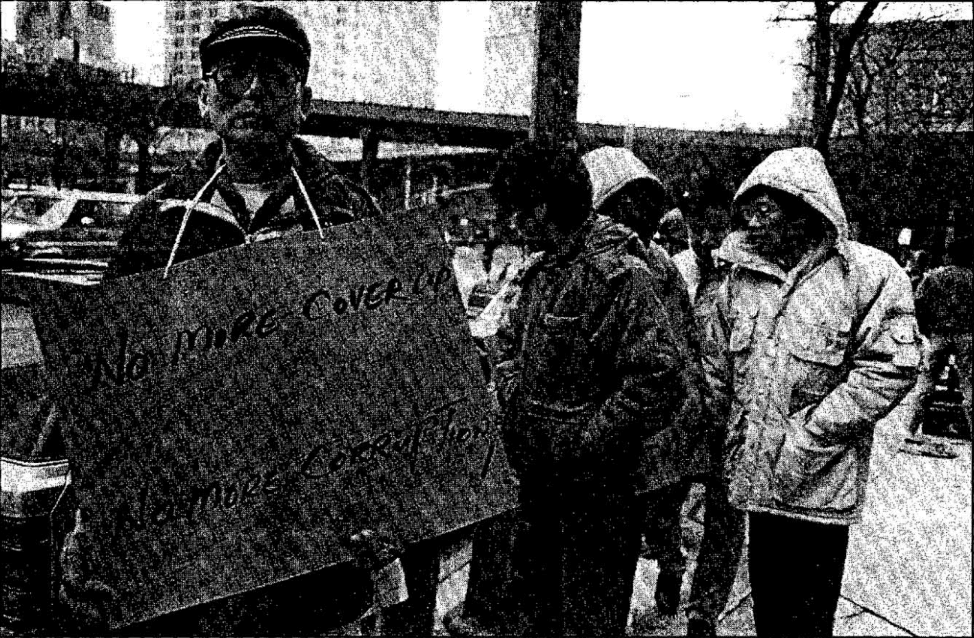
Labor Protest. Photo by Donna Binder
Although the Guard saw itself as a Chinese-American version of the Black Panther Party, it was also very well aware that the dynamics of the black and Chinese-American communities were different, despite some similarities. Alex Hing, a cofounder of the Guard, who assumed the title Minister of Information (one of several titles that mirrored the titles of the Party), explains, “We tried the model ourselves after the Panthers. When it didn’t work, we gave it our own characteristics To that end, the Guard hoped to serve the people in the same manner as had the Party. But it also had a strong political and cultural affinity to Asia and was particularly concerned about the role of China in global affairs. Moreover, the Guard understood Chinese-American anxiety over the tenuous status of Chinese as American citizens. Only in 1965 did the U.S. government lift its over seventy-year immigration restriction on Chinese. By campaigning for U.S. recognition of Beijing, the Guard demonstrated its political and cultural identification with mainland China. It also invited the repression of the FBI and CIA.
The Red Guard’s activities, which included efforts to seat China at the United Nations, were firmly connected to the larger leftist domestic community that proved to be of serious concern for U.S. foreign policy during the Cold War. Increasingly, leftists, influenced by the rapidly changing geopolitical landscape, assumed the mantle of radicalism in the contextual framework of anti-imperialism. Anti-imperialism had a profound resonance among radicals who were self-described “Third World People.” This term declared their affinity with the struggles of people in Africa, Asia, and Latin America. It also postulated that “internal colonialism” was the mechanism by which people of color were subjugated in the United States. This rhetoric invariably found considerable coverage in the press of both communist and capitalist countries.
International news coverage reported on the plight of black people in the United States to millions worldwide and even influenced the emergence and symbolism of radicals outside of the United States. The urban rebellions, shoot-outs with police, assassinations, and student upheaval were reported in countries that the United States considered friendly as well as in those it considered hostile, causing headaches for the State Department. For communist countries, the social and political unrest were indicative of the inherent contradictions of a capitalist and imperialist society. Following the assassination of Martin Luther King Jr., in 1968, Mao Tse-tung led hundreds of thousands of Chinese demonstrators to denounce white supremacy in the United States. Mao was certainly not alone. Fidel Castro, president of Cuba, and other leaders of socialist countries eagerly exploited the news of civil unrest to denounce the United States and its subjugation of black people. The world took notice when Tommie Smith and John Carlos were suspended from 1968 U.S. Olympic activities after their clenched-fist black power demonstration on the award stand. The Cuban men’s 400-meter relay team announced that in support of Smith and Carlos, it was sending its medals to Stokely Carmichael, who had visited Cuba earlier that year. Athletes from other countries also expressed sympathy with the struggle of black people in the United States
The militant struggle of black people received more international media attention as the collective efforts of black power advocates provided a subtext to the American Cold War dichotomy of “democracy” versus “communism.” This was, of course, a false dichotomy that assumed that the United States was prodemocracy, when it was actually procapitalism. As demonstrated in friendly foreign relations with Zaire, Haiti, South Africa, Rhodesia, and scores of other undemocratic states, capitalism was more important than democracy for U.S. foreign policy makers.
For many international observers, the intensification of violent clashes between Black Panthers and the police through 1969 made the Party the rightful revolutionary vanguard of the country’s burgeoning left. The communist countries North Korea and China issued favorable statements regarding the Panthers by 1969. In 1970, the International Section of the Black Panther Party, led by Eldridge Cleaver, established an “embassy” in North Korea. David Hilliard, Panther Chief of Staff, requested representation from the Red Guard for the eleven-member trip to North Korea. Alex Hing joined Hilliard and others traveling to North Korea, Vietnam, and Algeria. Although the Guard enjoyed international press and greater visibility in the United States, police harassment led to a steady decline in members
Like other radical organizations of the era, the Red Guard attracted a youthful membership, peaking with about 200 members before police repression reduced membership to a few dozen. Their uniforms, which included army field jackets and red berets, were instant targets for the police. Red Guard members complained about systematic police harassment, being unable to walk down the street without being put up against the wall, frisked, and asked for identification. Their offices were constantly raided, often without sufficient pretense. In a Cold War climate of fierce anticommunism, the FBI and CIA were eager to undermine the Red Guard and the Panthers for their domestic and international political activism. With joint efforts between federal and local law enforcement agencies, the Red Guard experienced significant challenges from police and the intelligence community, leaving the organization moribund by 1971
Unlike the Panthers, the Guard avoided the Custer-like defenses of its office during police raids, despite an armed standoff that a member had with police. A March 1969 issue of the *Red Guard* paper states that four “pigs” arrested Tyrone Won, who was leaving Red Guard headquarters with a disassembled rifle. Later, while released on parole, Won joined a Black Panther who was also fleeing police and escaped to Mexico, where they hijacked a plane for Cuba. In 1971, the remaining members decided to disband the Red Guard. Most joined other Asian-American leftist organizations, particularly I Wor Kuen (IWK), a New York-based organization that had become national by the early 1970s
Founded in 1969, the I Wor Kuen was named after a secret society of Chinese rebels who tried to expel Westerners from China and depose the Ch’ing dynasty beginning in 1895. Called “Boxers” in the West, the I Wor Kuen attacked Westerners and Western influence in China, evoking outrage from the West, which eventually repressed what became known as the Boxer Rebellion. In the United States, the IWK was led by Yu Han and Yu Man, two graduate students from mainland China. The IWK was systematically formed to operate as an extension of the radical ethnic nationalism of the era. It was a Maoist organization that was ideologically modified to adapt to the highly racialized climate of the United States while simultaneously adhering to the class-centered language of Maoism and Marxism. As a former member, Lee Lew-Lee, explains, “The IWK was like the Black Panther Party, the Young Lords and the Red Guards.” In fact, he continues, “the IWK was patterned after the Red Guards Like the Red Guard, Chicano Brown Berets, and (most important) the Black Panthers, the IWK hoped to form an essential vanguard in its ethnic community to mobilize its people for a class-based revolution that would destroy racial and class oppression. Synthesizing theories of class struggle from Frantz Fanon, Mao, Lenin, and Marx as well as the ever dynamic Panthers, the IWK considered U.S. Chinatowns internal colonies. Neocolonialism, for the IWK, provided a sound explanation of the system of oppression that exploited Chinese Americans and other people of color in the United States
While attempting to organize the Asian-American community, the IWK, like the Red Guard, was confronted by deep-seated hostility from Chinese Americans who rejected communist China and thought that leftist activities would reflect negatively on the Asian-American community at large. Hoping to protect the Asian-American community against any police state repression or future attempts to relocate citizens into camps, the IWK maintained a largely marginal voice in Asian-American political discourse, despite its growth, which allowed it to work closely with the Red Guard and eventually absorb many of its remaining members. In 1975, it merged with the predominately Chicano August 29th Movement to form the League of Revolutionary Struggle
The Red Guard, AAPA, and IWK pulled heavily from middle-class, college-educated groups, but a Los Angeles-based organization emerged in 1969 that, like the Panthers, attracted many “brothers off the block.” The Yellow Brotherhood (YB) was formed out of a nexus of political militancy, ethnic pride, and general social pathos. The first radical Asian-American organization of young militants in the city, the Yellow Brotherhood had a membership of former gang members, ex-convicts, and ex-servicemen. Many were nisei and sansei—second- and third-generation Japanese Americans—who were unnerved by the political reticence that seemed to characterize their communities, particularly in an age when other ethnic groups had galvanized around radical ethnic nationalism. Speaking about their parents, one former YB member states, “They’re hypersensitive or hyper-apologetic. We [the younger generation] picked up some of that.” Another follows, “that is why the Yellow Brotherhood was so controversial. We weren’t hyperapologetic.” Whereas many Japanese Americans were instructed to resist racism by seeking white approval through cultural assimilation, the YB joined the chorus of black cultural nationalists that vilified assimilation with whites. “We were told to outwhite the white and groups like the YB ... said ‘Fuck the whites. Fuck that shit For Guy Kurose and others, the time had come for radical political organization in the Asian-American community. But for Kurose, it was initially an uphill battle that he was not willing to wage.
At age sixteen, Guy Kurose, a Japanese American, joined the Seattle branch of the Black Panther Party. Raised in the black community, he naturally gravitated to black power with his friends. “I ... listened to [James Brown singing] ‘Say it loud, I’m black and I’m proud.’ I wanted to be there too.” Unable to fully extricate himself from socially dysfunctional behavior, however, Kurose, like many other Panthers, carried his lumpen life into the Party. “I was a renegade Panther. We were what Bobby Seale called ‘jackanapes,’ kids that had good intentions but were relating strongly to hoodlumism.” Deeply involved with the black power movement, Kurose was unaware of any community of young Asian revolutionaries, until a visit from Mo Nishida, Victor Shibata, and Warren Furutani from California. His immediate reaction: “I don’t need to talk to no Japanese motherfucker who thinks he’s white, man.” He stayed in the Party until he entered college, where he joined the Asian Student Coalition and carried over the radicalism that he learned in the Party, even fighting police on campus
Kurose later moved to Los Angeles, where he worked closely with other Asian radicals in leftist groups such as the Yellow Brotherhood, Joint Communications, and the Asian American Hardcore. Although the Yellow Brotherhood, like the Panthers, pulled heavily from nonacademics, it also struggled over “jackanape” activities. Los Angeles had a serious gang presence that was also part of the Asian-American community. Gangs such as the Ministers, Shokashus, and Constituents became politicized in the late 1960s, as had the Slausons, Gladiators, and Businessmen in the black community. But as Kurose noted, “Gangsters don’t give a shit about Red Books The YB challenged the pervasive notion of Asian meekness, yet simultaneously struggled with self-destructive tendencies. Former members take pride in being the “first ones talking shit and kicking ass” but admit that they were marginalized by the larger Asian-American community in ways not experienced by black nationalists in their communities. This alienation did not stop other militant, street-based Asian organizations from developing, however.
The Asian American Hardcore, like the Yellow Brotherhood, attracted former junkies, gang members, and convicts. Mo Nishida, a former member, explains that the Hardcore grew out of the tumultuous political and cultural climate of the black power movement in general and the Black Panthers in particular. “I think that the idea was percolating around because of the notoriety of the Panthers.” The Panthers were eager to recruit what they considered the toughest elements of the black community, the lumpenproletariat. For the Panthers, the lumpen composed the vanguard class of the impending revolution. “When the Panthers came forward, the idea of trying to get some of our people back from the other side of capitalism came up, so some of us talked about needing to form a group like that. With the Panthers as a model, we could serve the people The Hardcore established an office on Twenty-Third and Vermont Avenue and began detoxification programs for drug addicts, as well as a political education class, Christmas programs for the poor, and other programs for the elderly. The group, taking a sartorial cue from the Panthers, as others had, wore fatigues and red berets as part of its uniform. Clearly, the Panthers loomed large for the small band of revolutionaries in Los Angeles.
Members of the Hardcore met with Panthers, including national leaders like Eldridge Cleaver and Bobby Seale. Yet, as Nishida says, “We were small potatoes compared to those guys ... but we never felt that way.” Like many self-described revolutionaries of the period, members of the Hardcore believed that the revolution was imminent, and the Panthers would be its vanguard party. “The Panther Party was the basic acknowledged leadership in the Revolutionary Nationalist Movement. They set the whole stage.” But when the FBI unleashed its unprecedented repression, in concert with local police, the Panthers were decimated as no political organization in U.S. history had been. “After the Panthers got wasted by COINTELPRO ... there was disillusionment about the political line of the Panthers.” Nishida explains that despite the Panthers’ revolutionary posture, “‘when they couldn't respond to the killings by the police, it [screwed] everybody’s mind up
After the revolutionary, gun-toting posturing of the Panthers evoked the deadly wrath of the government, many members of the Asian-American Hardcore moved into other arenas of political discourse, no longer desirous of following the Party line in toto. The Yellow Brotherhood and Asian American Hardcore were unique among Asian-American radical organizations in one major way: The demographic makeup of their membership was not typically middle class or college educated. As community-based organizations with strong ties to the street, the Brotherhood and Hardcore turned the stereotype of Asian Americans on its ear. Asian-descended young people rejected the term Oriental in the late 1960s and embraced a Pan-Asian term for the first time: Asian-American. Many organized around a simple Asian identity, unlike the typically nationality-based organizations prior to the late 1960s, such as the Japanese American Citizens League or the Chinese American Citizens Alliance. Affected by black power, they promoted the slogan “Yellow Power” and raised the clenched fist in union with other “Third World People” on college campuses and in streets across the United States. And although they avoided the type of deadly conflict with law enforcement agencies experienced by the Panthers, they offered material and moral support to the Party as well as a scathing critique of the political, social, and economic systems that converged to undermine the Panthers and others like the Party.
The yellow power movement and other forms of radical ethnic nationalism were not solely dependent on black power for symbolism, political direction, or motivation. In fact, the black and Asian movements necessarily influenced each other in alliances, networks, conferences, and general dialogue. Furthermore, the international dynamics that influenced black power similarly informed Latino and Asian struggle in the United States. Mao Tse-tung was an inspiration to Panthers as well as the Red Guard. Brown Berets and Young Lords had a particular affinity with Che Guevara, who was also an adored icon for the Panthers. The symbiotic relations were extant. Still, the black power movement helped form a period of social and cultural transformation that would have substantive effects on the cultural and political landscape of the United States.
The black power movement articulated the angst and anger of a generation created by the pervasive and insidious nature of racial subjugation in the United States. In no uncertain terms, it challenged the legitimacy of white supremacy—politically, culturally, and socially. The visibility of black power militants could not be ignored. They were featured on television shows, in newspapers, on college campuses, and on the radio. Popular culture paid great attention to the cultural transformation of the United States. In fact, the country was in a process of an upheaval of its long-lasting traditions of racial hierarchy, and no organization caught the media spotlight as did the Black Panther Party.
Although the historical backdrop provided different social, cultural, and political exigencies in the various communities, the Black Panther Party proved to be a matrix for Asian-American radicals. Imbued with a profound sense of duty, obligation, resistance, and idealism, these revolutionaries were inspired, motivated, and significantly influenced by the symbolism, rhetoric, and tactics of the black power movement in general and the Black Panthers in particular.
These proponents of radical ethnic nationalism glorified their ethnicity while they eagerly embraced a polysemic nationalist framework that pulled from Fanon, Marx, Lenin, and Mao. Too, they were significantly influenced by the political analysis of the Black Panther Party and its thesis of revolutionary struggle. But as seen above, black power’s influence on Asian Americans altered the popular discourse and public discussion of identity and equality in the United States in interesting ways. Outside and inside of the radical leftist ethnic nationalist communities were militants who rebuked whiteness and the implications of whiteness such as status dependent on the subjugation of people of color. In this contextual framework, many militants sought to “humanize” whites by stripping them of any trappings of cultural prestige or supremacy. The cornerstone to this effort was a rejection of integration, though desegregation was welcomed.
Black power dismissed the notion that black people would have a better quality of life with whites in closer proximity. The Promised Land that black nationalists envisioned was not the integrated world of which King dreamed. It was a black world, for, by, and about black people. For radical ethnic nationalists, it was both a world where whiteness was no longer the standard by which all else was judged and a class-free society. Yet, rejecting the traditional class-based rhetoric of the left, the radical ethnic nationalists merged radical interpretations of race and class in their movements. Radical ethnic nationalism revealed the vulnerability of whiteness. Whiteness was not sacrosanct or without flaw. It was corrupt and inextricably bound to the frailties of humanity.
Beyond the cultural and psychological effects that radical ethnic nationalism introduced to the New Left of the late 1960s and early 1970s, the movement was truly a unique phenomenon. There are no major examples of ethnic nationalist struggles that have established alliances as did young radicals of the black power era. Asian-American radicals merged ethnic nationalist rhetoric with a struggle that emphasized class conflict and interracial coalitions. When the Black Panther Party coined the slogan “All power to the people,” it was attempting to broaden the call for black power by transcending race. According to the Party chairman Bobby Seale, interracial coalitions are powerful examples of the people gaining strength in numbers in their efforts against the “power structure’s oppression Unique among political movements anywhere, this was an example of a radicalism that adapted to the highly racialized climate of the United States while adhering to the fundamental principles of leftist theories that generally criticized nationalism as bourgeois efforts to subvert true radicalism. At the center of this movement was the black power movement, providing the earliest examples of cultural nationalism and political organization around ethnic nationalist causes. The Black Panther Party served as a paradigm of radical ethnic nationalism and a vanguard party for the revolutionary nationalist movement. The Panthers provided an appeal that was unprecedented in the annals of radical struggle. For young Asia n-American militants, the Panthers offered a model that was inspirational, encouraging, and also a lesson in suecess and error.
FOOTNOTES
1A number of studies on the women's liberation and gay liberation movements point to the civil rights movement for inspirations, symbolism, and rhetoric. See Sara M. Evans, Born for Liberty: A History of Women in America (New York: Free Press, J 989 ), pp. 264-274. See also Dudley Clendinen and Adam Nagourney, Ourfor Good : The Struggle to Build a Gay Rights Movement in America (New York: Simon & Schuster Trade, 1999).
2The Asian Student, Vol. I, no. I (November 1973). p.1 3.
3Ronald Takaki, Strangers from a Different Shore: A History of Asian Americans (New York: Penguin Books, 1989) , pp. 13-1 5.
4"Yellow Power," Giant Robot. no. 10 ( 199X). p. 7 1; Bobby Seale, Seize the Time: The Story of the Black Panther Parry and Huey P. Newton (Baltimore : Black Classics Press, 199 1). pp. 72-73, 79.
5"Yellow Power," p. 7 1.
6Hokubei, Manichi, December 9, 1968, p. 2.
7Flyer, c. 1969. University of California, Berkeley Social Protest Collection (UCBS PC), Box 18, folder 25, Asian American Political Alliance.
8Asian Student Union flyer, n.d., UCHSP C. 1964-1 969. Box 18, folder 27, Asian Student Union.
9Ibid.
10"Yellow Power," pp. 79-80.
11Ibid., p. 79.
12"U.S. Women Dedicate Victory to Smith, Carlos." Nell' York Time s, October Zl , 1968. p. I.
13"Yellow Power," pp. 79-XIl.
14Ibid.
15Ibid.
16Ibid., p. 67.
17Ibid.
18Ibid., pp, 79- 80; Robin Kelley and Betsy Esch. " Black Like Mao: Red China and Black Revolution." Souls. Vol. I. no. 4 (Fall 1999). p. 26.
19"Yellow Power," p. 77.
20Ibid., p. 76.
21Ibid., p. 77.
22Ibid., p. 74.
23Ibid., p. 75. Although there have been deadly campaigns of repression against Native Americans, slave revolts, and colonial unrest in places like the Philippines, no political organization has experienced deadly conflict with the state apparatus comparable to the Black Panther Party. The Communist Party, the Industrial Workers of the World, and other leftist groups have had violent conflicts with state, local, and federal authorities, but none resulted in a death toll close to the over twenty Panthers killed by police between 1968–1970. Moreover, the amount of money spent to disrupt the Panthers was greater than for all organized crime during the late 1960s. The Party was the focal point for FBI COINTELPRO activities for at least a three-year period, beginning in 1968. Of the twelve COINTELPRO operations, the file on “Black Extremist Groups” was the second most expansive; the Communist Party USA was the largest. The file “White Hate Groups” ranked fourth with 5,457 pages. The smallest was “Pro Castro” with 59 pages. See http://Foia.fbi.gov/redindex.htm (March 27, 2000). For more elaborate discussion of FBI repression of political dissenters, see Brian Glick, *War at Home* (Boston: South End Press, 1989); Ward Churchill and Jim Vander Wall, *Agents of Repression* (Boston: South End Press, 1988); and Nelson Blackstock, *COINTELPRO: The FBI’s Secret War on Political Freedom* (New York: Vintage Books, 1976), passim. See also David J. Garrow, *The FBI and Martin Luther King, Jr.* (New York: Penguin Books, 1981), passim.
24Seale, Seize the Time. pp . 210-211.