

VOL. 10
Multiethnic Nations and Cultural Citizenship: Proposals from the Afro-Descendant Movement in Ecuador
Jhon Antón Sánchez
In this essay I discuss the multiethnic and pluricultural national model established in Ecuador with the reformed Constitution of 1998. The concomitant rise of Afro-descendant organizations has generated a positive environment for the elaboration of cultural politics intended to protect the citizenship rights of ethnic minorities, especially regarding the right to cultural identities. However, those rights are not guaranteed by the state and are not sufficient to surmount the challenges of poverty, economic inequality, racial discrimination, and social exclusion that Afro-descendant and indigenous communities experience.
This article analyzes the Afro–Ecuadorian movement’s circumstances given the political and social transformations currently underway in Ecuador, including its transition to a new constituent assembly, as it has been proposed by the current government. Afro–Ecuadorian organizations defend the multiethnic national model, pushing for a more democratic, participatory, and inclusive framework. The state proposes that it is capable of eliminating the structural racism that the ethnic minorities suffer. It proposes affirmative action policies that would allow greater guarantees of social, economic, and cultural rights, and would be mechanisms that could facilitate access to education, employment, and economic credit. Such measures could benefit social groups that are victims of racism and discrimination.
I begin by presenting a brief sketch of the multi- and pluricultural character of Ecuador and both the country’s ethnic diversity and its current political and social tran- sitions. The second part of the article is dedicated to the Afro–Ecuadorian community’s history and gives a brief overview of the slavery period. I then present a summary of the demographic, economic, and social conditions experienced by Afro–Ecuadorians, where I emphasize the degree to which the community faces both poverty and exclusion. This is followed by a discussion of the Afro–Ecuadorian movement, their proposals to the 2007 Constituent Assembly for a multiethnic nation and their demands for social inclusion and measures to combat the racism, poverty, and inequality that they have historically suffered.
The Cultural Diversity of Ecuador
Ecuador is a beautiful and small South American country, rich in natural resources and diverse in population. According to the 2001 census, 77% of the inhabitants are racially mixed, 10% white, 8% indigenous, and 5% Afro-descendant. This last group, the Afro–Ecuadorians, along with the indigenous population, is the poorest and most excluded sector of the country’s population, upon whom both structural racism and socio-economic inequality weighs heavily. Nevertheless, since the end of the 20th century, Afro–Ecuadorian organizations have become a significant presence in civil society. As in other Latin American countries, Afro-descendants in Ecuador have developed a social movement capable of making claims on the nation and on the dominant racially mixed society. Their social organizations have won cultural rights and have encouraged the development of national public policies that respond to the challenges of persistent discrimination.
In 1998, Ecuador enacted its 19th Constitution, establishing the country as a ‘‘multi- ethnic and pluricultural nation.’’ The Constitution established Afro–Ecuadorians as an ethnic and cultural group, or a ‘‘pueblo’’ (Article 83), subject to collective rights (Articles 84 & 85). Ecuador’s constitution is the only constitution in the Americas that affords such recognition to Afro-descendants, in particular acknowledging their right to the protection of their cultural identity, ancestral territories, and to improved opportunities for participation in the country’s economic development.
Today Afro–Ecuadorians, along with the Ecuadorian nation in general, confront new political, social, and economic challenges. Although Afro-descendants have significant cultural rights recognized in the Constitution, their condition of general poverty remains intact. They suffer racial discrimination, exclusion, and inequality.
For the past ten years Ecuador has been in deep economic and political crisis. Among the events of this decade, the country was forced to adopt the dollar as its national currency, three presidents were removed from office before completing their terms, and the state’s institutions suffered from compromised credibility. With the election of the new socialist President Rafael Correa in January 2007, the country is preparing for a profound reconstruction. A constituent assembly will soon draft a new Constitution, Ecuador’s 20th Magna Carta since gaining independence from Spain in 1830.
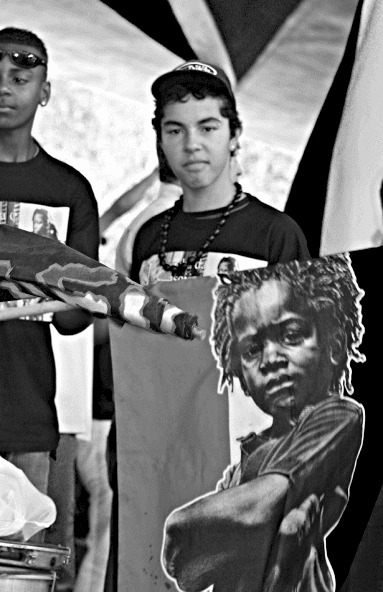
‘‘Dia Nacional da Consciência Negra, Brasil’’ 2007 © Marcio Ramos.
The central aim of the constituent assembly is to achieve political renewal in Ecuador. An intense debate is raging over how to change the political structures and institutions of a country characterized by a fragile democratic system, extensive social inequality and racial discrimination. Afro–Ecuadorian civil society has played a visible role in this debate; several organizations have developed proposals for combating inequality and racism. In particular, they propose that the new Constitution include a new concept of citizenship and democracy that departs from a cultural perspective, so that Ecuador can truly become a multiethnic and pluricultural nation.
This article analyzes the proposals that Afro–Ecuadorians have for the 2007 constituent assembly. Particular attention is directed towards a document titled ‘‘The Ecuador Desired by Afro–Ecuadorians,’’ drafted by the Institute for Afro–Ecuadorian Thought and Development, an organization comprised of Afro–Ecuadorian leaders and intellectuals. The reading of this document gives rise various questions: Do the proposals reflect the political agenda of Afro–Ecuadorian social movements? How do these organizations confront the challenge of exclusion, poverty, and racism? Are Afro–Ecuadorians relevant state actors, capable of producing or influencing extensive social transformations?
Afro-Ecuadorians: Origins, Slavery, and Resistance
In the 16th century Ecuador was known as the Real Audience of Quito, belonging to the Viceroy of Peru. Since 1535, the year Quito was founded, the presence of Africans has been notable (Tardieu 2006). During the colonial period, slave traders imported slaves from Cartagena or Panama. There, they bought Africans for 100 or 300 pesos, depending on their sex, age, health status, and knowledge (Jurado Noboa 1987). Once they were bought, the slaves were taken to Quito, Guayaquil, or Cuenca.
Various scholars note that enslaved Africans came to the Real Audience of Quito from many villages in Africa. According to Tardieu (2006) during the period 1568–1660, slaves from Ecuador came from four zones in Africa: (a) Guinea (Jolofos, Folupos, Bañol, Mandinga, Biafra, Biojó, Guinea, Nalú, y Zape); (b) San Tome ́, (Bran, Ararás, Popó, Caravalí, Mindas); (c) the Bantu ́ zone, (Congos, Monicongos, Musicongos Labolo, Angolas, Anchico, Casanga, Tshalá); and (d) the Northern African zone (Berbe ́sicos, Orán). Jean Kapenda’s ethnolinguistic studies (2001) locate some of the preserved last names in Ecuador to African origins, confirming the presence of diverse Afri- can nations in the country, among them: Mairongo, Congo, Cuabú, Anangonó, Kangá, Cango, Matamba, Quenambú, Quendambud, Cambindo, Ayoví, Minda, and Banquera.
The enslaved who were introduced into Ecuador performed distinct jobs in the gold and silver mines in Zaruma, Zamora, Cuenca, Quijos, and Esmeraldas. In the same areas other slaves worked on sugar, tobacco, and cotton plantations or in large vineyards. The most famous plantations were those of the Jesuits (Costales 1964). However, the most important slave-owning centers were in Guayaquil, Quito, Esmeraldas, Chota Valley, and Loja in the south of the country.
The slaves did not accept their enslavement. On the contrary, throughout all of the Americas they engaged in distinct forms of resistance that were often violent and threatening to the system. Enslaved people built hidden refuges, engaged in banditry, uprisings, sieges of cities, burning plantations, and there was also the emergence of small guerrilla groups (Chalá Cruz 2006).
One of the best known cases of resistance was Martina Carillo’s complaint from the plantation La Concepción, reclaiming her freedom before a tribunal in Quito in 1778 (Costales 1990; Savoia y Ocles 1999). In 1794 in Guayaquil, enslaved María de Chiquinquirá Díaz filed a complaint against her owner, priest Alfonso Cepeda, who was accused of not giving her the liberty that she deserved because her mother had been free (Chávez 2000).
The abolition of slavery in Ecuador was a process that started in 1821 when the legislators of Great Colombia ordained partial freedom. Although Ecuador declared its own independence in 1830, the country continued to enforce slavery. Only in 1851 did the coun- try decree the liberation of slaves previously indemnified by their owners. Though the Constituents of Guayaquil terminated slavery in Ecuador in 1852, slaves were still being granted their freedom to slaves in 1860.
Afro-Ecuadorians Today
Ecuador’s Afro-descendants are a demographic minority: their population does not surpass one million people. This group is spread throughout the country, but concentrated particularly in two regions: in the Coastal zone (the province of Esmeraldas) and in the central Andes (the region denominated by the ‘‘Chota Valley’’). Many Afro–Ecuadorians also live in the cities of Guayaquil, Quito, Ibarra, and Lago Agrio in the Amazon region (Antón Sánchez 2007: 15).
The available official statistics underscore the situation of poverty, marginalization, and discrimination confronted by Afro–Ecuadorians. The 2001 Census conducted by the National Institute of Statistics and Censuses (INEC) indicates that more than 70.6% of Afro–Ecuadorians live in poverty. In certain rural communities, the poverty level is as high as 99.6% [Technical Secretariat of the Social Front (STFS) 2005: 14]. In addition, Afro–Ecuadorians have higher illiteracy rates than the racially mixed and white populations. Their levels of schooling and access to university education are lower than that of other racial groups. A national survey on social development conducted in 2005 affirms that the Afro-descendant population has the highest rate of unemployment in the country (11%). In 2006 the average Afro–Ecuadorian person had a monthly average income of 210 U.S. dollars (USD), as compared to the white average income of 316 USD.
Nonetheless, despite these conditions of extreme inequality and poverty, Afro– Ecuadorians have developed significant strategic responses. Since 1990 their capacity for collective mobilization and their establishment as important civil society actors have been notable. In Quito, Guayaquil, Emeraldas, and the Chota Valley, their community organizations have conducted collective political battles to demand of the state social inclusion, democratic participation, and greater citizenship rights (De la Torre 2002; Tamayo 1996; Haldesman 2005).
The current Afro–Ecuadorian social movement has its roots in movements of the 1960s, ’70s, and ’80s (Maloney 1983). The movement is also strongly influenced by the last century’s Negritude movement, civil rights struggles in the United States, and by Afro-descendant organizational development in Colombia and Brazil (Antón 2007b). In the last decade of the 20th century the Afro-descendant organizational process in Ecuador grew significantly stronger. During this period the Ecuadorian nation experienced the escalation of neo-liberalism, the rise of discourses on multiculturalism, and an economic crisis that intensified poverty. As the state’s social programs became debilitated, social protest was radicalized; in particular, the indigenous movement emerged as a powerful social actor.
In the ’90s Ecuador’s social movements were presented with opportunities for the realization of their social and cultural demands. In the context of multiculturalism, indigenous and Afro-descendants mobilized and proposed a different vision of the state, the nation, democracy, and citizenship. In 1998, a Constitutional reform declared Ecuador to be a multiethnic and pluricultural nation. Afro-descendants are now recognized as a ‘‘people’’ subject to collective rights—the only country in the Americas that grants Afro-descendant populations such recognition. The Afro–Ecuadorian social movement, comprised of a network of some 350 social and cultural organizations, thus obtained a singular position in the public sphere.
The Afro-Ecuadorian Social Movement
Few scholarly studies of the Afro–Ecuadorian movement exist. Within the current literature there is a significant focus on ethnicity, identity politics, and social mobilization that emphasizes the indigenous movement as a point of reference. In 1983 sociologist Gerardo Maloney wrote a Master’s thesis about the social and political situation of Afro–Ecuadorians. His study emphasized the variables of race and class as central axes of the ethnic group’s problematic. He affirmed that ‘‘the topic of blacks has been dealt with within the context of politico-ideological systematic exclusion,’’ a situation which has limited the further development of their particular interests (1983: 12).
Between 1996 and 2005 various articles appeared about the Afro–Ecuadorian social movement (Tamayo 1996; Whitten and Quiroga 1998; Tadeo 1998; Halpern and Twine 2000; Hansdesman 2001, 2005; De la Torre 2002, 2004; Minda 1996; Walsh and Garc ́ıa 2002). These studies describe both regional and local dynamics of the movement’s organizational development. They reflect upon particular experiences in the Chota Valley, in the North of Esmeraldas, in the capital city of Quito and in Sucumbíos province. However, a complex analysis of the realities for Afro–Ecuadorians on a national scale does not exist, nor does an analysis of the social movement within the context of mobilizations against racism and discrimination by the larger African diaspora in the Americas.
The few studies about Afro–Ecuadorian civil society analyze the phenomenon from different perspectives. The first perspective derives from the North American theory of Resource Mobilization (TRM). This perspective emphasizes the corporate character of the Afro–Ecuadorian social movement and reduces it to interest groups propelled by the state, the church, and international bodies. This line of thinking is defended by Carlos de la Torre, who analyzes the organizational development processes of Afro-descendants in Quito. Another perspective is situated in European theories of New Social Movements. It presents the movement as a form of alternative modernity that privileges Afro-centrism and the struggle against racism. This takes a distinctive approach which aims at the con- struction of a more inclusive, pluralistic, and democratic national body, and is elaborated by Michael Halsdelmann, Catherine Walsh, and Juan Garcia.
This analysis of Afro–Ecuadorian social movements presented in this article takes account of various dimensions of the above mentioned frameworks while revealing the ways in which these analyses are problematic. To situate the phenomenon within corporatism or culturalism requires that we specify certain heterogeneous aspects of the Afro-descendant movement. For example, Peter Wade emphasizes that although the Afro-descendant movement may fit within the context of those that exploded with force in Latin America since the 1960s, these movements are not so new (2000: 116). They emerged at the beginning of the 20th century, when various groups of defenders of Black civil rights appeared. The most notable of these experiences occurred in the United States, Colombia, and Brazil.
In this sense, I believe that the nature of the Afro-descendant movement should be read within an extensive period of resistance. I locate the first antecedents in mobilizations realized by slaves during the European conquest and colonization of the New World. During that period there emerged palenques and quilombos (autonomous Afro-descendant communities). After independence, enslaved people sought their freedom through a combination of various strategies: participation in campaigns for liberation, the purchase of their freedom, and finally, through the abolition of slavery in the middle of the 19th century. Later, during the period of liberal modernity in the nascent Latin American states, Afro-descendants had to fight for citizenship in the context of scientific racism, and against the implementation of mestizaje as the dominant ideology of exclusion (Sansone: 2004; Agudelo 2006). In agreement with Wade, I suggest that the Afro-descendant movement has had a political agenda distinct from other Latin American social movements. According to Jesús García (2001), this agenda is constructed around an ethnic and racial identity, the struggle against racism, discrimination, and economic inequality. It deals with the challenges that impede the exercise of citizenship rights for Afro-descendants, and promotes an agenda for greater involvement in the political sphere and greater participation in the nation’s democracy.
I suggest that thanks to the actions of Afro-descendant social movements in the arena of Latin American democracy, topics such as identity, race, and ethnicity have gained great political importance on the continent. Focusing on these issues, Afro–Ecuadorians have demanded political recognition and have been able to position themselves as important citizen-actors. This is our point of departure for analyzing the Black movement in Ecuador as a social movement that, in agreement with J. García (2001), fights for citizens’ rights, including social, economic, and cultural rights. The movement also fights against persistent discrimination, structural racism, poverty, and inequality. In this manner, Afro-descendants contribute to the cultural modernization of their nations.
The 2007 Constitution: The Afro-Ecuadorian Political Proposal
This article now turns to an analysis of the proposals for Ecuador’s new Constitution, developed by a sector of the Afro–Ecuadorian organizations. In response to the political crisis and the county’s institutional weakness, new president Rafael Correa and a large part of the citizenry proposed the formation of a constituent assembly to change the state’s institutional framework and to create a new Constitution. This assembly was approved via referendum on April 15, 2007 in which more than 81.7% of the electorate voted in favor and was installed in October 2007 (Vanguardia, Number 83, April 2007, Quito).
This was preceded by an intense debate amongst the electorate in Ecuador in 2006 and a strong current of popular opinion insisted upon convening a new constituent assembly. In this context, a sector of the Afro–Ecuadorian social movement developed and distributed a document entitled, ‘‘The Ecuador We Envision and Want, as Afro–Ecuadorians,’’ signed by an NGO called the Institute for Afro–Ecuadorian Development and Thought (IPEDA). For the first time in many years, Afro–Ecuadorian civil society articulated their vision for the country, making public a proposal about the type of state, nation, economic development, citizenship, and democracy that they desired for Ecuador’s future.
The document has a central proposal: ‘‘As Afro–Ecuadorians, we propose that state political reform must be oriented towards strengthening inclusive and intercultural democracy and towards consolidating a multiethnic and pluricultural nation’’ [Instituto para el pensamiento y desarrollo de los afrodescendientes (IPEDA) 2006: 9]. With this, Afro– Ecuadorians insist on maintaining the multiethnic and pluricultural character of the nation, as it had been expressed in the Constitution of 1998. But in maintaining these principles, they demand that the country develop as a modern democracy that ‘‘guarantees to cultural and ethnic minorities and to subordinate social sectors, participation as subjects of cultural rights, in a manner that respects their differences, and makes cultural rights relevant, without racism or discrimination’’ (IPEDA 2006).
The defense of this section of the 1998 Constitution is a consequence of the victories which the Afro–Ecuadorian people won in the 1990s, above all in respect to collective rights. However, the document affirms that such rights have not been fully realized. Poverty and racial discrimination persist in their communities. They argue that this continues because the ‘‘1998 Constitution did not contemplate the path to changing the economic, social, and political structures. It did not combat the traditional model of governance, nor was it able to change the existing political, economic, and administrative system . . . ’’ (IPEDA 2006).
For Afro–Ecuadorians, political and social problems are concentrated in two arenas: a) ‘‘the political class that mocked the Constitution and has made democracy its own business, and b) the economic model of neoliberalism that has sunk the country into under-development.’’ For these reasons they consider constitutional reform urgent and a strategic means to strengthen intercultural democracy. For this to be possible, they propose these steps:
1. Restore a new, independent electoral system, that is pluralist and inclusive, that strengthens citizen representation.
2. Create a normative framework that regulates the political parties, and guarantees the participation of political and economic minorities.
3. Reinforce and amplify the mechanisms of citizen control: programmatic agreements, financial transparency, and the possibility to revoke politicians’ mandates.
4. Guarantee political electoral representation, and participation by ethnic and cultural minorities in the government.
5. Strengthen the autonomy of the organisms of control, in relation to influence from the political parties and hegemonic sectors.
In this specific manner, the Institute for Afro–Ecuadorian Development and Thought argues that Ecuador’s new Constitution must concretize the multiethnic and pluricultural nature of the nation, by introducing novel instruments into the country’s institutional framework that will ensure the political participation of ethnic minorities and an intercultural educational system.
According to the document, the participation and political representation of ethnic minorities, like Afro–Ecuadorians (5% of the total population) are essential elements for combating racism and discrimination. They assert that the new constitution must guarantee these groups the right to political representation in both the National Congress and in different state institutions. They propose participation quotas in the political parties, control of public administration, courts of justice, and in the entire public sector. This is envisioned as a measure of affirmative action intended to combat racism, a course of action that would be in accordance with international law, pacts, agreements, and declarations signed by the state
Another Afro–Ecuadorian objective for the constitution is the reform of the educational system. The IDPEDA’s document asserts that the country requires ‘‘the formation of a new Ecuadorian citizenry, with a civic nature, with a profound spirit of homeland, familiar with the values of democracy and exhibiting pride in the multiethnic and pluricultural nature of the nation.’’ The document proposes that the educational system guarantee the exercise of cultural citizenship. The State must endeavor to make education intercultural, and it must institutionalize a model of ethno-education and create a National Chairmanship of Afro-Descendant Culture.
Liberal Societies, Multiethnic Nations, and Cultural Citizenships
The proposal that IDPEDA presents for the new constituent assembly seeks a political reform that consolidates the nation’s multicultural character. It is a type of proposal which, in many modern and liberal societies, is defended by ethnic and cultural minorities. This author is in agreement with Kymlicka, who argues that the multiethnic nation is the best model that liberal societies can adopt to neutralize violent conflicts that arise from cultural differences between citizens (1996: 16–17). For Kymlicka, one of the principal characteristics of the modern world is its cultural diversity This diversity is a challenge and ethno-cultural conflicts have become the most common source of political violence in the world (1996: 13).
Nevertheless, in place of seeing cultural differences as irreconcilable spaces, that could bring us to a state of what Huntington (1996) calls a clash of civilizations, Kymlicka considers that or plurinational states could resolve modern concerns about cultural asymmetry and injustice. The challenge is to accommodate said cultural differences within a liberal democracy, even where positive and individual rights prevail by force. He explains that ‘‘in a multicultural state, an inclusive theory would include equally universal rights, assigned to individuals independent of their belonging to a group, as well as group-differentiated rights, which is to say: a special statue for cultural minorities’’ (19).
Authors such as Habermas (1999) and Taylor (1993) have spearheaded intense debates about cultural policies suitable for dealing with cultural differences within liberal democracies. For Michel Wieviorka, modern societies have dealt with minority cultural rights through three frameworks: (a) assimilation, making cultural particularities invisible in public space, but dissolving them into the normative standard of the dominant society; (b) tolerance, accepting differences so long as they do not create difficulties, and (c) the politics of recognition of minorities, so long as that practice does not question the society’s universal values (2003: 27). But Wieviorka warns that this debate is exhausted. In Latin America, for example, the complexity of cultural identities is resolved on a stage set by those identity groups that are able to dominate, in the context of mestizaje (whitening) or hybridization. In this manner, we enter into a phenomenon that Kymlicka (1996: 85) denotes multiculturalism, a political model that groups the diversity of cultural expression within in a social nucleus.
Multiculturalism, according to Wieviorka (2003: 28), is understood as ‘‘a policy inscribed in the state’s institutions, the law, governmental action, with the intention of giving different cultures recognition in the public sphere In this manner, multiculturalism is a response to cultural diversity. In a culturally diverse society, a multicultural political response is necessary, wherein recognition of identity differences among citizens is a crucial concern.
Here, the concept of identity assumes a tactical importance, not as an essential and personal element, but as something strategic and differentiating. According to Stuart Hall (1996: 17), identity is constructed within social discourses and power relations. Identity, in Hall’s perspective, is a ‘‘product of demarcation and difference,’’ which is to say, identity is constructed because of difference and not at the margin of it (Hall 1996: 19). In this manner, in a multicultural society like Ecuador, identity differentiation (linguistic, ethnic, religious, or national) becomes a principle characteristic of the citizenry And in liberal modern democracies, the question is how to guarantee to citizens with diverse and differentiated cultural identities not only individual and universal rights, but also those rights that refer exclusively to their cultural identities.
Kymlicka argues that differences in citizens’ identities can be regulated in a modern state in which a ‘‘universal theory of minority rights is applied,’’ that should generate specific rights for each cultural group. In particular, this refers to specific cultural citizenship rights for groups like Afro-descendants and indigenous peoples. This concept of citizen- ship is understood, following Iris Marion Young (1989) as being differentiated citizenship: those specified to the individual, in accordance with his/her culture.
To speak of cultural or differentiated citizenships implies that liberal democratic governments like Ecuador can implement specific measures to guarantee expression of differences in its citizenry, via policies that promote individual respect and peaceful coexistence. According to Kymlicka, these policies should be expressed in the consecration of cultural or collective rights. Those rights can take three forms: self-government, poly-ethnicity, or representation In particular, these minority rights respond to the need to overcome historic disadvantages or structural barriers present to racial or ethnic groups that traditionally have been excluded. In practice, this deals with rights to positive discrimination or affirmative action, like those put into practice in various countries like the United States and Colombia.
But affirmative action policies as a means to combat racism must be made more precise. For Wieviorka (2003), affirmative action, ‘‘is not a cultural recognition policy’’ (29) but a social policy that grants opportunities to individuals who suffer disadvantages because they belong to a certain historically mistreated minority group.
Afro-Ecuadorians Between Multiculturalism and Social Inclusion
This article has analyzed the political proposals that Afro–Ecuadorians have developed in response to the 2007 Constituent Assembly—proposals that are framed within theories of multicultural politics applied in liberal and modern democracies. These proposals oblige us to reflect upon the vision of nation and society desired by Afro–Ecuadorians—a society wherein the cultural rights of ethnic minorities are guaranteed via cultural policies and affirmative action.
But apart from general proposals for the transformation of the country, Afro– Ecuadorians are betting on strategies of social inclusion. For social organizations, inclusion is understood as a concrete strategy to break with the centuries of social, economic, and political exclusion to which Afro–Ecuadorians have been victim. This exclusion has existed since the period of slavery and has been sustained by means of structural racism and persistent discrimination. As a result, factors like socio-economic inequality and poverty are some of the principle challenges for descendents of Africans in Latin America, who make up more than 150 million of the continent’s population (Psachaopoulos and Patrinos 1994; Banco Mundial 2004)
Demands for social inclusion and for the construction of a model of nation based in multiculturalism are central themes in their political agendas. These are strategies that aim to end poverty and achieve the right to an education that considers their cultural specificities. Additionally Afro–Ecuadorians have other objectives: halting the loss of their ancestral territories, which are often rich in biodiversity and ending forced migration that has compelled Afro-descendants to settle in peripheral urban areas where they accept badly paid, poor quality, and precarious jobs (Bello and Hopnehayn 2001: 15).
Afro–Ecuadorian proposals for an inclusive democracy are framed within the transnational agenda of the Afro-descendant social movement. In the international arena, the actions of continental networks of Afro-descendant organizations have achieved influence in multilateral bodies like the United Nations and the Organization of American States (OAS). These institutions intend to provide a more global response to discrimination and poverty, and their positive effects are already visible. For example, the majority of Latin American countries have signed the International Convention for the Elimination of Racial Discrimination (CERD) Recently, at the 2001 United Nations World Conference Against Racism, Racial Discrimination, Xenophobia and Connected Forms of Intolerance conditions were established for a series of initiatives oriented to eliminating racial inequality
According to Peter Wade, these strategies for recognition and global struggle against racism make up part of a ‘‘postmodern celebration of diversity, that could call itself a post- modern nationalism, which defines the nation in terms of multiculturalism’’ (2001: 126). From the perspective of Amartya Sen (2004), these strategies are means by which nation-states counteract the effects of cultural domination that could be generated in the asymmetric encounters of globalization. Sen suggests that the modern play of cultural interrelations runs the risk of developing asymmetric cultures, as well as intolerance and disrespect for the diversity and cultural freedom of its citizens. For this reason, he proposes the need for democracies to ‘‘generate respect for diversity and the creation of more inclusive societies by adopting policies that recognize in explicit manner cultural differences, which is to say: multicultural policies’’ (2004: 2).
Conclusions
Afro–Ecuadorians have been pushing for the consolidation of a multicultural national model under an inclusive democratic regime as they move into the national constituent assembly of 2007. This model seeks to develop mechanisms by which all ethnic groups feel included and share in the benefits of the cultural rights that they deserve. To strengthen a model of the nation with these principles of inclusion will naturally be a challenge. Constitutional reforms must generate policies capable of transforming the cultural politics of a society that historically has been a ‘‘racial dictatorship’’ (Cervone and Rivera 1999). In Ecuador, which, according to Carlos de la Torre, has reproduced ‘‘different racialized social systems,’’ wherein, ‘‘racial inequality is articulated alongside class, regional and gender inequalities’’ (2002: 17), this transformation is necessary.
Additionally, the cultural policies necessary to achieve a multicultural and pluricultural nation imply a new concept of citizenship and recognition of cultural rights. Following Alvaro Bello, this new concept of citizenship is based not only in a structured process of individual civil rights, but also is a modern conception based in identity differentiation, cultural plurality, and recognition of collective rights (2004: 24). By this definition, citizenship can allow for greater participation based in interculturality and multiculturalism.
To put into practice a concept of cultural citizenship within the context of modern democracies and multiethnic states moves us towards a guarantee of economic and political participation for various cultural groups. It also responds in a coherent manner to the cultural conflicts that, in Latin America, have exploded in recent years. To understand the phenomenon of cultural citizenship is to understand that which Stavenhagen (1992) calls the ‘‘ethnic question.’’ That ethnic question clearly is still not resolved, as ethnic minorities continue to suffer from a host of social and economic ills and are disproportionately subject to governance crises of the region’s political systems.
WORKS CITED
Antón Sánchez, John. 2003. Organizaciones de la Sociedad Civil Afroecuatoriana, Cooperación Técnica BID ATN/SF-7759-EC. Quito, documento mimeografiado.
Banco, Mundial. 2003, Octubre. Desigualdad en América Latina y el Caribe. ¿Ruptura con la Historia? Banco Mundial. Edición de conferencia.
Bello, Alvaro. 2004. Etnicidad y ciudadanía en América Latina. La acción colectiva de los pueblos indígenas. Santiago de Chile: Cepal.
Bello, Álvaro & Martín, Hopenhayn. 2001. Discriminación Étnico Racial y Xenofobia en América Latina y el Caribe. Cepal, Serie Políticas Sociales 47.
Cervone, Enma & Fredy Rivera. 1999. Ecuador Racista: Imágenes e identidades. Quito: Flacso.
Costales, Piedad & Alfredo Costales. 1964. ‘‘Concertaje de Indios y Manumisión de esclavos’’ Llacta, No. 17.
Chalá Cruz, José. 2006. Chota Profundo. Quito: Abya Yala.
Cháves, María Eugenia. 2000. ‘‘María Chiquinquirá, una esclava litigante. Los recursos de una esclava guayaquileña para construir argumentos de libertad en el marco de los tribunales coloniales.’’ In Mujeres en Poder de la Palabra. Quito: Serie Haina.
De la Torre, Carlos. 2002. Afroquiteños, Ciudadanías y Racismo. Quito: Centro Andino de Acción Popular.
García, J. 2001. Comunidades Afroamericanas y transformaciones sociales. En Daniel Mato (comp) estudios Latinoamericanos sobre cultura y transformaciones sociales. Buenos Aires: Clacso.
Habermas, Jurgen. 1999. La Inclusíon del Otro. Barcelona: Paidos.
Hall, Stuart. 1996. ‘‘¿Quién necesita identidad?’’ In Stuart Hall & Paul du Gay, eds., Cuestiones de Identidad cultural, 13–40. Madrid: Amorrortu Editores.
Halpern, Adam, & France Winddance Twine. 2000. Antiracist Activism in Ecuador: Black-Indian Community Alliances. Race & Class, 42(2), 19–33.
Hopenhay, Martin. 2002. ‘‘Ciudadanía descentrada en tiempos de globalización.’’ In Marco Antonio Calderon, Pilles Assies & Tom Salam, eds., Ciudadanía, Cultura Polı ́tica y Reforma Del Estado en América Latina. Zamora: El Colegio de Michocan. IFE.
Huntington, Samuel. 1996. The Clash of Civilizations and Remaking of World Order. New York: Simon and Schuster.
Instituto para el pensamiento y desarrollo de los afrodescendientes. 2005. ‘‘El Ecuador que pensamos y queremos. Una propuesta de los afroecuatorianos para la reforma pol ́ıtica.’’ Quito, documento mimeo, 32.
Jurado Noboa, Fernando. 1987. ‘‘Esmeraldas en los siglos XVI, XVII y XVIII, sus tres afluentes negros coloniales.’’ In Rafael Savoia, ed., El Negro en la Historia. Aportes Para el Conocimiento de las Raíces en América Latina. Quito: Centro Cultural Afro–Ecuatoriano.
Kapenda, Jean. 2001. Diccionario Lingala-Español, Español- Lingala: Historia y Origen Africano del Negro Ecuatoriano. Quito: UNESCO/CCE.
Kymlicka, Will. 1996. Ciudadanía Multicultural: Una Teoría Liberal de los Derechos de las Minorı ́as. Barcelona–Buenos Aires: Paidos.
Páez de la Torre, Carlos. 2004. Crónica histórica de la Universidad Nacional de Tucumán: Período 1914– 1923: La etapa provincial y los comienzos de la nacionalización.
Psacharopoulos, Geoge & Padrinos Henry. 1994. Los pueblos indígenas y la pobreza en Ame ́rica Latina. Un Análisis empírico. In Los Estudios Sociodemográficos de los Pueblos Indígenas. Santiago de Chile: Cedale.
Quiroga, D. & N. Whitten. 1998. To Rescue National Dignity: Blackness as a Quality of National Creativity in Ecuador. In N. E. Whitten & T. Arlene, eds., Blackness in Latin America and the Caribbean. Bloomington, Indianapolis: Indiana University Press.
Sen, Amartya. 2004. ‘‘Libertad Cultural y Desarrollo Humano.’’ In Informe Sobre Desarrollo Humano 2004. PNUD. Madrid: Ediciones Mundi Prensa.
Stavenhagen, Rodolfo. 1992. La cuestión étnica. In Estudios Sociológicos. México DF: El Colegio de México.
Tamayo, Eduardo. 1996. Ecuador: Indigenous Peoples Create Political Movement. Latin American Information Agency, August 21.
Taylor, Charles. 1993. El Multiculturalismo y la Política de Reconocimiento. México DF: Fondo de Cultura Económica.
Tardieu, Jean. 2006. El negro en la Real Audiencia de Quito. Quito: Abya Yala.
Wade, Peter. 2000. Raza y Etnicidad en Latinoamérica. Quito: Abya Yala.
Walsh, Catherine, & Juan Garc ́ıa. 2002. ‘‘El pensar emergente movimiento afroecuatoriano.’’ In: Daniel Mato Coord., ed., Estudios y Otras Prácticas Intelectuales Latinoamericanas. Caracas: Clacso.
Wieviorka, Michel. 2003. ‘‘Diferencias culturales, racismo y democracia.’’ In: Daniel Mato, Coord. ed., Políticas de Identidades y Diferencias Sociales en Tiempos de Globalización, 17–32. Caracas: FACES-UCV.
Youg, Iris Marion. 1989. ‘‘Polity and Group Difference: A critique of the ideal of Universal Citizenship.’’ Ethics, 99(2), 250–274.
FOOTNOTES
1In particular, the International Convention against Racial Discrimination, the Declaration and Plan of Action of the Third World Summit against Racism and Discrimination of the United Nations (Durban 2001) and ILO Convention 169. In countries like the United States and Colombia, these policies have already been put into practice.
2‘‘At present, the majority of countries are culturally diverse. According to recent estimations, the 184 Inde- pendent states of the world contain more than 600 groups of live languages and 5000 ethnic groups. There are few countries whose citizens all share the same language or belong to the same national ethnic group’’ (Kymlicka 1996: 13).
3The author uses the expression ‘‘polyethnic state’’ for multiethnic. According to Kymlicka, the multiethnic state is circumscribed within the framework of the liberal theory of minority rights, which are as necessary as human rights in the context of efforts to achieve peace.
4It could be understood in two manners: integrated multiculturalism, that takes into account the same poli- tical demands for recognition as well as political struggles against inequality (as in the case of Sweden and Canada), and exploded multiculturalism, that separates the treatment of cultural differences from the topic of social inequalities (as in the case of Latin America and the United States). Wieviorka (2003: 28–29).
5In the case of Ecuador, Carlos de la Torre defines citizenry as the condition of the subject to ‘‘have a series of civil, political and social rights’’ (2002: 146).
6Rights of self-government are related to the interests of territorial autonomy, justice, and development of indigenous groups within nation-states. Poliyethnic rights—explains Kymlicka—aim to do away with discrimina- tion and prejudice. Additionally, they apply anti-racist cultural policies that permit racial, religious, or ethnic minorities to freely express their cultural pride. The objective is not self-government, but societal integration (53). Rights to representation relates to the visibility of subordinate groups in the political sphere. It considers that all liberal democratic nations should contemplate political pluralism, and include racial and ethnic minorities in its different electoral, representative, and government institutions.
7A report by the United Nations in 2004 reveals that 92% of Afro–Latinos live below the poverty line, and 35% are illiterate. ‘‘La pobreza castiga al 92% de los afroamericans,’’ in the Daily El Comercio, Quito, September 2004, A7.
8The signing and ratification was opened and approved by the General Assembly of the United Nations by means of Resolution 2106 A(XX) of December 21, 1965, and assumed with vigor on January 4, 1969. Ecuador is one of the ratifying countries.
9As a product of the Conference, the ‘‘Global Declaration against Racism’’ and the ‘‘Plan of Action against Racism’’ were approved. Today, five years since its passing, the continental organizations of Afro-descendants, in particular the Strategic Alliance of Latin-America and the Caribbean, developed a process of evaluating the impact of these measures. The process is known as Santiago plus Five.
Past Editions

1.
Afro-descendant Struggles for Collective Rights in Latin America: Between Race and Culture
Juliet Hooker
2.
Book Review: Contentious Curricula: Afrocentrism and Creationism in American Public Schools by Amy J. Binder
Jane Anna Gordon
3.
Book Review: Crossing Waters, Crossing Worlds: The African Diaspora in Indian Country edited by Tiya Miles and Sharon Holland Durham
LaRose Davis
4.
Book Review: Private Lives, Proper Relations: Regulating Black Intimacy by Candice M. Jenkins
Susana M. Morris
5.
Book Review: Your Average Nigga: Performing Race Literacy and Masculinity by Vershawn Ashanti Young
Kristen Hodge
6.
Call For Papers: Rudolph Fisher, Luminary of the Harlem Renaissance
SOULS
10.
Multiethnic Nations and Cultural Citizenship: Proposals from the Afro-Descendant Movement in Ecuador
Jhon Antón Sánchez
11.
Should Babylon Release The Cure?: True Reflections on Freedom, Art, Prison, and the “Reggae-Star Rapist”
Baz Dreisinger
12.
The Black Movement in Panamá: A Historical and Political Interpretation, 1994–2004
George Priestley & Alberto Barrow
13.
The Liberation Imperative of Black Genocide: Blueprints from the African Diaspora in the Americas
João H. Costa Vargas