

VOL. 10
Symposium Introduction: The Paradox of Black Political Leadership
David Covin
The idea for this set of essays was sparked by a 10-year retrospective held on Robert Smith’s influential book, We Have No Leaders, at the National Conference of Black Political Scientists’ (NCOBPS) meeting in March 2006. Participants discussed the book’s significance, praised it, blamed it, dissected it, and challenged it. Some came close to consigning it to the dust-bin of history. Last to speak was Professor Smith, himself, who delivered a passionate examination and defense of his work. He was clearly not a detached scholar, one who embraced the grandeur of objective contemplation from afar. He was passionate about his work - and its subject: African-descended peoples in the United States.
As much as I had relied on the book in my teaching and research, I was never sure of its central premise: that we had no leaders. Nor did Smith’s powerful argument at NCOBPS convince me. The conference did persuade me that Dr. Smith believed he was right, and that the kind of discussion that took place that day deserved a wider audience. I also believed the question of the character and quality of Black leadership was not limited to the United States and that it was central to the lives of African-descended peoples throughout the world.
I asked Robert if he would be willing to look at his book from the vantage point of over a decade after its publication. I told him that it would be part of a collection of essays looking at Black leadership from the perspectives of individual contributors. Luckily for us, he graciously consented to participate. I invited a number of scholars who had written and thought a good deal about the subject and welcomed them to approach the topic from whatever perspectives they chose—national, international, subnational, specific issues or perspectives. Everyone who had the time agreed to write.
As demanding as the subject is, I believe this collection does it justice, particularly from a United States-based standpoint. This surprised me, as I expected to see a lot of the blame game. I saw some of that, but what I saw more of was a search for a new world of possibilities. Though there is an international presence in this consideration, the weight of the focus is on the United States. Due to the expansive vision of these scholars, this is not a United States static in time and place. It is, instead, a world of wonders not often seen in print. The perspective provided by our Afro-Brazilian colleagues re-enforces the myriad manifestations of the African world. We in the U.S. are wont to cloak ourselves with the ‘‘exceptionalism’’ this country claims for itself. Our sisters from the world of orixas and blocos afros help us to see that pose for the charade that it is.
The Essays
These essays were developed independently. There was no mutual discussion or collaboration. It is therefore all the more remarkable that though they each differ radically in approach, theme, and even in subject matter, they make a powerful collective statement about Black leadership.
The first two essays, by Robert Smith and William Strickland, lay out the central themes to which the other writers return in their own ways. Smith deliberately seeks to expand on an aspect of his treatment which was marginalized in his 1996 tome: the context which constrains Black leadership. He examines the character of the political system within which Black leadership in the U.S. operates and how it acts to impede leaders. Bill Strickland answers, yes, and then asks: and what are we to do about it? He reminds us that we need to know what a revolutionary research agenda looks like.
Mark Sawyer’s essay raises the question of what a new world history would tell us about our domestic agenda and, more specifically, about the links between immigrant legislation and the responsibility of Black leadership. Like Smith and Strickland, he draws us to the centrality of economic questions in world history and tells us that some Black leaders’ misreading of history has been influenced by the egregious errors of some proponents of immigration reform.
Sawyer, like Smith and Strickland, challenges us both as academics and as moral human beings. If the immigrant movement is a progressive, moral, social movement, if it has the potential for enacting positive social change in the United States, what are we doing outside of it? As scholar-activists we must be able to understand the dynamics at work both in this country and in the wider world. We must be able to articulate them for the good of Black people and their leaders.
On that front, Luiza Bairros takes us directly to the world from which some of the 2 million Afro-Latinos in the United States originate. She introduces us to the challenges facing the Black leaders of the largest Black population in the Western hemisphere, the Afro-Brazilian. As the first National Coordinator of Brazil’s Unified Black Movement over 15 years ago, she speaks from her own experience and conducts a comparative examination of racial politics on a global scale. This comparative perspective is a lesson for all of us. She reminds us that (emphasis mine), ‘‘our future possibilities depend on political choices we make based on our reading of this historical moment.’’
In another submission from Brazil, Gevanilda Santos, Galauciane Aparecida de Souza, and Suelma Ines Alves de Deus show us what the world looks like to Afro-Brazilian leaders. They provide observations and analyses based on their attendance at the World Social Forum (WSF) in Nairobi in January 2007. All three are activists in the Sao Paulo-based Afro-Brazilian organization, SOWETO. All three are scholars. They went to Kenya not only to participate in the WSF, but also to connect with Africans on the continent. They saw both great similarities and great differences between the lives of Africans on the continent and in the Western hemisphere. Like Luiza’s, their observations are comparative. Centering their observations, a constant in these essays, are their understandings of ‘‘class exploitation and discrimination.’’
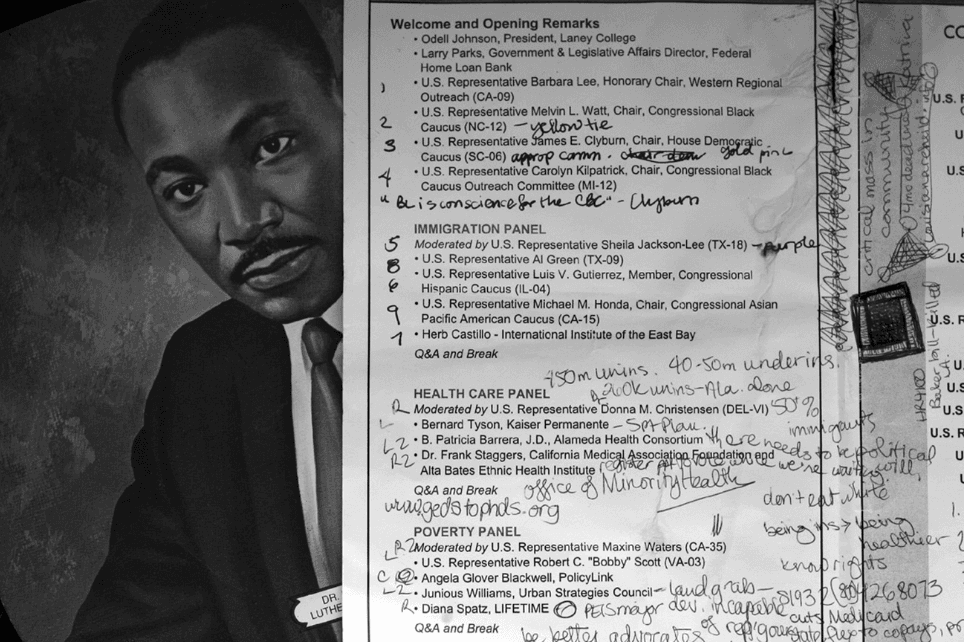
‘‘We Ought Not To’’ January 2006 © Gwen Harlow
They and their African colleagues on a WSF panel shared the comparative perspective. They all ‘‘denounced the Black population of the most acquisitive power on earth for turn- ing its back on impoverished African peoples.’’ This is an observation that, as intellectuals and leaders of the population in question, we must both take to heart and do something about. They denounced us. And through their denunciation, they remind us that we live in a world and that our responsibility is to think and act in the world. Our Brazilian interlocutors point out that if we want to contribute to a more efficacious struggle, we must have a clear understanding of who our people are, how they live, and where they live. The venues in which we live are not imaginary, and while we may use our imaginations to understand them more thoroughly, our imaginings must be rooted in a solid and detailed empiricism.
To finish, my essay returns to Smith’s 1996 assertion, We Have No Leaders. Smith borrowed the statement from Harold Cruse, who when asked about the role of Black leaders, once said, ‘‘What leaders? We have no leaders.’’ It is fitting and proper to return to Cruse because he raised the leadership questions addressed in this collection of essays in his opus, The Crisis of the Negro Intellectual. In my contribution I ask why, despite the numbers of Black leaders we can all name, many of us believe we don’t have any. I center my exploration of the question around the emphasis shared by DuBois and Strickland: How do we know the world; and around the question who do we mean by ‘‘we?’’ Pursuing these inquiries, I contend, may lead us to fruitful ways of thinking and acting as a people, cognizant of our role in the wider world
Past Editions

1.
A Community of Destiny: New Configurations of Racial Politics in Brazil
Luiza Bairros
2.
Book Review: Buried in the Bitter Waters: The Hidden History of Racial Cleansing in America by Elliot Jaspin
Tara Bynum
3.
Book Review: Chicago's New Negroes: Modernity, the Great Migration and Black Urban Life by Davarian Baldwin
Treva B. Lindsey
4.
Book Review: Many Minds, One Heart: SNCC's Dream for a New America by Wesley C. Hogan
Edward Mills
5.
Book Review: Race, Rock, and Elvis by Michael T. Bertrand
Joe Street
6.
Commentary: On Black Leadership, Black Politics, and the U.S. Immigration Debate
Mark Swayer
7.
Diary of a Journey to Nairobi: Impressions from the Brazilian Black Movement of the City and People Who Hosted the World Social Forum VII
Gevanilda Santos, Galauciane Aparecida de Souza & Suelma Ines Alves de Deus
8.
DuBois's Revenge: Reinterrogating American Democratic Theory…Or Why We Need a Revolutionary Black Research Agenda in the 21st Century
Bill Strickland
10.
Symposium Introduction: The Paradox of Black Political Leadership
David Covin
11.
System Values and African–American Leadership
Robert C. Smith
13.
The Limits of Black Pragmatism: The Rise and Fall of David Dinkins, 1989–1993
Ryan Reft
14.
The Praxis of Black Leadership in the Twenty-First Century
David Covin