

VOL. 20
The Power of Black Girl Magic Anthems: Nicki Minaj, Beyoncé, and “Feeling Myself” as Political Empowerment
Aria S. Halliday & Nadia E. Brown
“I’m Feeling Myself, Feeling Myself”
In 2015, hip-hop and pop artist Nicki Minaj released the song “Feeling Myself.” Accompanied by pop artist Beyonc'e, Nicki Minaj articulated a “Black Girl Magic” anthem that celebrated Black women’s experiences, cultural knowledge, and sexuality. Coined by Cashawn Thompson in 2013, “Black girls are magic” has been used as a unifying celebration of Black women; shortened to #blackgirlmagic, the phrase connotes a love and celebration for the unique experiences of Black women. Using “Feeling Myself,” Nicki Minaj and Beyonc'e furthered the growing sentiments on social media and elsewhere that encouraged Black women to have confidence in themselves, their appearance, and their knowledge. Inspired by their statement, we conducted research with younger Millennial1 Black women to explore how Black women use the song “Feeling Myself” to empower themselves among discussions of police brutality, anti-Blackness, and misogyny. Our focus group discussions with self-identified Black collegiate women sought to explore their experiences with representations of Black women in popular culture, political engagement, and understandings of Black girl magic in their everyday lives.
This article, then, examines the ways Millennial Black women use cultural production for self-articulation, empowerment, and sexual expression through a Black feminist/hip-hop feminist framework. As an extension of Black feminist theory, hip-hop feminism is a theoretical framework based in the hip-hop generation (those coming of age in the 1990s) to engage Black women in the contradictory spaces that encompass our lives, while foregrounding our experiences in search of our pleasure. Scholars of hip-hop feminism contend that “hiphop provides a space for young black women to express their race and ethnic identities and to critique racism … [and] also a site where young black women begin to build or further develop their own gender critique and feminist identity.”2 We contend these activities help to galvanize and organize other Black women as stepping-stones that often lead to political mobilization. Exploring the history of Black women’s political empowerment and organizing in the United States, visual language used in the song and music video that became popular online, and responses from our focus group participants to the song and video, this study explains how Millennial Black women experience popular culture that targets their experiences. They articulated self-confidence, women’s empowerment, and political messaging as major aspects of the “Feeling Myself” music video.3 Discussions of sexuality were also prevalent throughout the focus group discussions. From a hip-hop feminist framework, the growing prevalence of Minaj and Beyonc'e extends Joan Morgan’s hip-hop generation of the 1990s to the 21st century, wherein pop and hip-hop artists are working together to maintain popularity.4
The popularity of “Feeling Myself” and the influence of this Black girl anthem in the everyday lives of our participants illustrated the importance of the song to collegiate Black women in 2015 and 2016. While the students in our study made explicit distinctions in their own personal choices from that of Beyonc'e and Minaj, they overwhelmingly viewed the pop icons as role models of Black girl magic. As two of the most popular Black women performers of this generation, Nicki Minaj and Beyonc'e performing a song together also positions this particular moment in the 21st century at the nexus of musical genres competing for audiences, as well as generational discussions of Black womanhood and sexuality on display. Additionally, our focus on Beyonc'e and Minaj follows Regina Bradley’s assertion that “the most brazenly commodified representation of gender in hiphop is women’s sexuality.”5 By centering our discussions with Millennial Black women on this representation, we learn more about the contemporary cultural and political constructions of Black women’s sexuality. “Feeling Myself,” thus, exhibits expressions of Black femininity, heteronormative yet homoerotic connections between Black women, and younger Black women’s celebration interactions with popular Black women’s cultural production.
Combining political empowerment, cultural production, and Black women’s own language about their experiences, we explore how Black women’s cultural production and robust representations of Black women’s empowerment impact young Black women’s identity formation. We conclude with how this knowledge provides more ways to use popular culture representation to impact Black women and further cultivate Black women’s personal and political empowerment via popular culture.
Black Women’s Political Empowerment
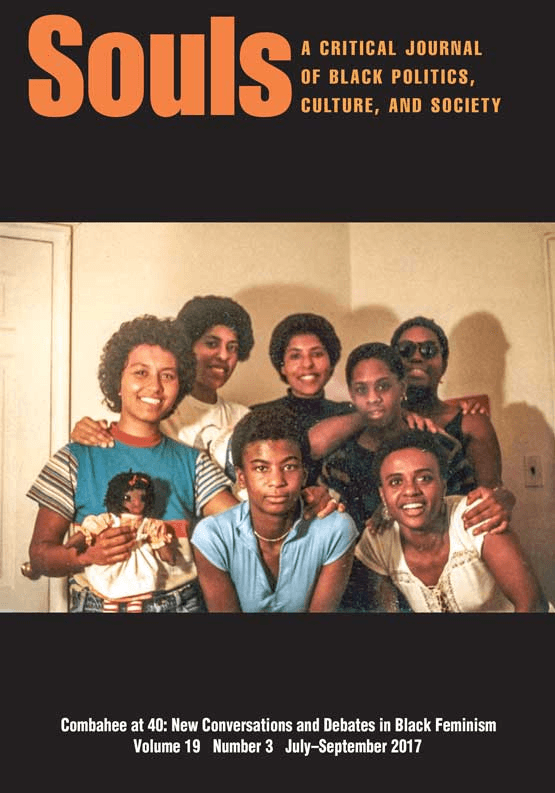
Black women’s political action has been cited as early as Harriet Tubman’s interactions with White suffragette groups and Sojourner Truth’s famous “Ain’t I A Woman” speech. Writing in the 1940s, Claudia Jones’s theory of “superexploitation” described how Black women are oppressed not only on the basis of race but on gender and socioeconomic status as well. Other historical examples of Black women’s political participation and feminist organizing are readily seen in the 1950s and 1960s with activists such as Ella Baker, Francis Beal, and Diane Nash, then the emergence of the Third World Women’s Alliance in 1968.6 The Combahee River Collective, a group of Black radical feminists, organized to address issues that specifically impacted Black women such as sexism, homophobia, racism, and class oppression starting in the mid-1970s. Black women’s work—from freeing the enslaved to organizing boycotts within civil rights organizations—illustrates a passion for bettering the lives of Black people throughout the United States and abroad.
The past twenty years have seen a rise in the scholarship on Black women’s political participation and empowerment—in hopes of recovering Black women’s experiences and declarations of feminist politics despite ignored and erased narratives.7 Three major themes within the scholarship are: (1) Black women use their particular lived experiences to facilitate political organizing, (2) Black women create and maintain political empowerment through community, and (3) Black women use the rise of social media to rouse political activism through digital communities. These themes not only highlight the ways Black women produce intersectional political organizations based on the ways race, gender, and sexuality affect their everyday lives and acts of resistance in the United States, but also how they utilize new technologies to mobilize across space and time.8 Historically, Black women have been forced to advocate for themselves, using whatever possible means to spread their stories and catalyze audiences.9 Through online blogs, groups, and, more recently, social media hashtags, Black women form a larger collective through which to find community and validation for their experiences. As such, the focus of our essay is Black women’s empowerment via popular culture as expressed through social media.
Like Kimberly Springer, we contend that Black women’s “activism does not emerge in a vacuum but is, instead, part of a complex system of institutions, economics, and personal beliefs.”10 For Black women, personal beliefs influence the ways that institutions are sustained and changed over time. In the 21st century, social media has become an integral site of Black women’s political empowerment because of the ways Black women shape the images and discourses that emerge on various platforms. Described as the “water cooler” of social media platforms, Twitter serves as a digital political theater where Black women contextualize their experiences and affirm the intellectual, emotional, and physical labor they exert.11 In 2014, the Pew Research Center’s “Social Media Report” found that adults aged 18–29, women, and African Americans were the most active groups on social media; the correlation here is that Black women between ages 18–29 are some of the most active social media users.
Kelly Macias argues that Black women “experience social media as an affirming, safe space for counter storytelling, education and transformation, negotiating identity and for connection to a larger, African diasporic identity.”12 In an exposition of Black feminist blogging, Moya Bailey and Alexis Pauline Gumbs found that “web activism” influenced the language they used offline to describe their experiences.13 Engagement online encouraged them to cultivate relationships in particularly Black feminist ways and build communities that reflected their values as well as their politics. In this way, present-day Black women use social media platforms to acknowledge and affirm Black women’s collective struggle much like their foremothers sought to previously.
Black women also use social media to celebrate their experiences, building narratives of love, support, and happiness alongside those of pain, abuse, and oppression. In 2013, CaShawn Thompson, @thepbg on Twitter, coined the phrase “blackgirlsaremagic” to combat negative media and personal critiques of Black women celebrities like Serena Williams and Viola Davis that positioned their bodies and skin complexions as ugly or monstrous.14 As a rallying cry for Black women, others shortened Thompson’s term to “Black Girl Magic” to celebrate the lived experiences of Black women as magical because of the ways they face a multiplicity of oppressions, such as racism and misogyny (among others). Over the past five years, the term “Black Girl Magic” (also “blackgirlmagic” or “#blackgirlmagic”) has gained traction in social media circles and has proliferated to other avenues. Black women like Linda Chavers, however, problematized Black women being described as “magic” because it could downplay oppression and further instantiate the stereotype of the “superwoman.”15 They cautioned against a phrase that seems to gloss over the complexities of the experiences of queer and trans* Black women within Black communal spaces. Despite some concern about “magic,” Black women on social media have found solace and community in the term.
Whether recognizing academic achievement or business acumen, winning Olympic medals or excelling as single mothers, Black women have created a community that affirms the diversity of Black womanhood as “Black Girl Magic.” Although “#blackgirlmagic” has not been articulated as principally political, it follows historical parameters for Black women’s community building and organizing. For example, like themes and terms expressed in cultural phenomena such as “I’m Black and I’m Proud,” “young, gifted, and black,” or films like Cleopatra Jones and Foxy Brown, “#blackgirlmagic” challenges hegemonic notions that demean and belittle Black women’s labor, beauty, and talent. Additionally, Black feminist themes and Black women’s political labor have been identified in civil rights–era music and rap music.16 “Black Girl Magic” calls Black women and others to acknowledge the “universal awesomeness of black women.”17 Celebrating Black women is indeed a political project that we acknowledge, and later explain, is grounded in historical and contemporary Black feminisms.
Data and Methodology
Our research centralizes Black women’s cultural experiences within Black women’s cultural production. Therefore, we conducted focus groups with younger Millennial Black women who were currently attending college to learn more about their experience with and attitudes towards Nicki Minaj and Beyonc'e’s “Feeling Myself.”18 As a methodological technique, a focus group allows for in-depth group interviews. Participants are selected because they are a purposive sample of a specific population targeted for further study or related to a given topic. As a result, participants are chosen because they are uniquely qualified to discuss the topic. The applicability, the selection of participants because of their knowledge base in a particular subject, is the key criteria for selection.19 In this case, as college-aged Black women, participants in our study represent a target population who may be familiar with the term “Black girl magic” and the music of Beyonc'e and Nicki Minaj. Black college-aged women are greatly exposed to American popular culture. Because of their age and position as college-educated Black women in the Midwest, other Black women their age or Black women of the same age who are not in college may express different attitudes. Although representative, their age and pop culture knowledge in proximity to the celebrities discussed may also illustrate a bias to support the terms “Black girl magic” and “Feeling Myself.”
Group dynamics and social interactions within each focus group greatly shape the kinds of data that are generated.20 This interaction is crucial, and offers deeper and richer data than what might be obtained from one-on-one interviews.21 The synergy of the group interaction generates a range of issues, albeit different yet interrelated, that might be raised by individuals, but in a relatively shorter time span than one-on-one interviews.22 Focus groups should be held over a period of time to allow for patterns in responses to emerge. Although each group will have different dynamics because of participants, focus groups will replicate the similar attitudes and beliefs. As such, it may be necessary to hold only three or four focus groups to understand a given topic.23
We held four focus groups but only two had a sufficient number of participants to conduct this research. The successful focus groups were held on August 29, 2016, at 3 p.m. and on September 21, 2016, at 6:30 p.m. in the Black Cultural Center on the campus of a large land-grant university in the Midwest. Focus groups lasted between one hour and an hour and a half. The total number of participants was five Black college women who were between the ages of 18 and 25. Because of the small number of participants in our study, we have opted to remove identifying information and to individuate the women via pseudonyms. The first focus group had two women and the subsequent focus group had three women. The participants in the first focus group were teammates on the university track and field team and as such, had a preexisting collegial relationship with one another. The second focus group consisted of strangers who were loosely connected as Black women on a majority-White campus who often participated in activities sponsored by the Black Cultural Center. The second focus group fit the standard description of the methodology with participants offering differing views, building on each other’s comments, and drawing new conclusions after being in conversation with one another. The participants in the first focus group held rather complementary views and often agreed with one another’s positions. Perhaps this was a byproduct of the participants wanting to remain friendly and to avoid possibly controversial conversations that may have negatively impacted their friendship or their working relationship as teammates.
The role of the group facilitator or moderator is significant in focus groups because of the mediation of group dynamics.24 The facilitator skillfully creates an environment, in which participants feel comfortable. A relaxed environment heavily impacts how forthcoming participants are, particularly in settings when participants are strangers. The facilitator must also pay special attention to non-verbal cues and signals that may impact the group’s dynamic. The facilitator in our focus groups pushed the students to clarify their comments and expand on ideas that were expressed which were contrary to earlier stated positions. The facilitator also helped to re-center the conversation if the discussion moved towards a topic that was not germane to the study.25 The facilitator, with the help of a research assistant, showed the entirety of the “Feeling Myself” music video to both focus groups. The facilitator also recorded both the audio and visual dynamics of the focus group. Recording the data in this way enabled the researchers to not only code for what was said during the focus groups but also body language and other non-verbal cues.
The researchers advertised broadly for participation in the focus groups. We advertised for four focus groups but were forced to cancel two groups due to poor attendance. Because Black women in our target population comprise a relatively small group within the campus population at this large Midwestern land-grant university, we had great difficulty in securing participants for our study. We advertised to various communities on campus, often drawing from our own professional and personal networks on campus.26 However, we were unable to solicit significant support from these networks to yield a sizable population for this study. As such, the results presented in this study are preliminary findings. We hope to duplicate this study in a community with a larger number of Black women who fit our target population.
Discussions of Black Girl Magic and Political Empowerment
Contemporary discussions of Black girl magic, in many ways, are an outgrowth of theoretical sophistication in Black feminist thought since Patricia Hill-Collins discussed the importance of confronting the stereotypes of Black femininity. HillCollins identified the hierarchies of race and gender imbedded in racism and sexism as well as internalized self-loathing that “otherize” Black women and estrange us from ourselves in Black Feminist Thought.27 Melissa Harris-Perry too elaborated on the prevalence of Black women’s stereotypes in U.S. culture. For Harris-Perry, these stereotypes of the Mammy, the Sapphire, and the Jezebel leave Black women trying to “find the upright in a crooked room.”28 Hip-hop feminism, more contemporarily, represents a feminist politic that holds the contradictions of identity and representation together in search of pleasure rather than separating perceived positive and negative images. We know from Nicole Fleetwood, however, that the images created by Black cultural producers impact how blackness is seen.29
For hip-hop feminists such as Regina Bradley, Brittney Cooper, Aisha Durham, Gwendolyn Pough, Joan Morgan, and Treva Lindsey, a hip-hop feminist perspective critiques both the prevalence of racism in mainstream feminism as well as misogyny within hip-hop-infused cultural spaces. Joan Morgan’s When Chickenheads Come Home to Roost established hip-hop feminism as a theoretical framework that aims to “fuck with the grays” or productively push against traditional Black feminisms that dismiss or demonize sexuality and messy contradictions as a central component of inquiry. More recently, Morgan restated her commitment to “the politics of pleasure” in Black feminist analysis as “a capacious casting of the erotic that includes Black women’s variegated sexual and non-sexual engagements with deeply internal sites of power and pleasure—among them expressions of sex and sexuality that deliberately resists [sic] binaries.”30 Central to hip-hop feminist theory, then, is Black women’s own creative and intellectual work within the hip-hop generation that bespeaks their commitment to sexual liberation.31 In this sense, self-proclaimed Black feminist artists such as Nicki Minaj and Beyonc'e should be central to present discussions of Black women’s pleasure, even as they may still perform blackness for white audiences.32 Therefore, our study sought to find the pleasure that Black women find in Black-women-authored celebrations of “Black girl magic” such as “Feeling Myself.”
For Black women cultural producers like Minaj and Beyonc'e, then, their collaborative efforts can speak expansively and distinctly to Black women across the United States and globally. For the college-aged women in our focus groups, Nicki Minaj and Beyonc'e’s “Feeling Myself” represented three major themes: self-confidence, women’s empowerment, and political messages. Albeit more limited, discussions of sexuality were also present throughout the focus group discussions despite particular thematic discussions.
Self-Confidence
For the participants, self-confidence was a major theme throughout the music video and in their use of the term “Feeling Myself.” As Tiana, a sophomore and self-identified “mixed” woman explained, Minaj and Beyonc'e’s performance throughout the video shows that a Black woman can be “completely and totally comfortable in her skin and excelling as herself.”33 Minaj and Beyonc'e are depicted as beautiful and powerful Black women, which highlighted the beauty of blackness to the participants. The focus group participants agreed that this performance illustrated Black women as the best at what they do. They felt pride in seeing Black women displayed this way, even as they may not have personally identified with their skin complexions or figures.
Despite the pride that participants felt by watching the music video, they identified that Minaj and Beyonc'e traded in stereotypes of Black women as hypersexual and promiscuous. Rather than using terms like “Venus” or “Hottentot,” which have been used to describe this particular performance of Black women, the term “bad bitch” was used in both focus groups to explain the ways that sexuality was overtly highlighted in Minaj and Beyonc'e’s performance throughout the music video.34 Of the four participants who used the term, none of them identified with the imagery of a “bad bitch” because they preferred to articulate non-sexual aspects of their identities. As a senior and college-athlete, Leah noted, “I prefer to think of myself as a queen,” illustrating that there is a distinction between how a “bad bitch” and a “queen” would be represented visually. Leah noted artists like Erykah Badu and India Arie to illustrate “queen” representations as regal, classy, and less overtly sexual than depictions of Minaj and Beyonc'e in their music videos and lyrics.
Although the music video illustrated “bad bitch” representations of Black femininity for the participants, Aaliyah was supportive of Minaj and Beyonc'e’s performance. Aaliyah—a technology major and active participant in programming at the Black Cultural Center—noted that this type of “Black girl magic” could even be an “accident.” She explained that when other Black women and girls recognize one’s work as a representation of Black womanhood, it is Black girl magic. In line with Harris-Perry’s articulation that Black women resist controlling and demeaning images, Aaliyah’s comment signifies the politics of recognition, which are central claims of citizenship, belonging, and identity.35 Political theorists from Hobbs to Arendt have demonstrated that individuals seek recognition in the public realm that highlights one’s uniqueness and value. Black women, as a historically marginalized group, have been denied accurate recognition in public, which has negative consequences for the political self and the citizen self.36 Black women’s lack of affirming self-recognition is coupled with the duality of simultaneous invisibility and hypervisibility of their social group. As such, Black women are not seen, and are generally unrecognizable in the American polity. Misrecognition of Black women denies this group political understanding, relegates their experiences as merely symbolic addresses of identity politics rather than substantive issues, and creates personal pain by being associated with a stigmatized group.
Aaliyah’s explanation mirrors politicized historical recovery work that some Black historians and political scientists have used to excavate genealogies of Black women’s labor. This explanation of “accidental Black girl magic” also provides a more expansive use of the term to include every day experiences and labor, where other Black women could use “Black girl magic” to celebrate one another’s activities and where others might steer away from the use of the term. This split in usage, in some ways, mirrors the adoption or rejection of Black feminist identification. Yet the culmination of tenacity, conflict, triumph, suffering, and sociopolitical advancement has led to “accidental Black girl magic” in which this group has challenged the politics of recognition. Individual Black women have pushed back against assumptions of inferiority in spite of enduring humiliation and abuse. Doing so has challenged negative public representations of Black women. Perhaps Melissa Harris-Perry best surmises what we term as “accidental Black girl magic,” by asserting “sisters are more than the sum of their relative disadvantages: they are active agents who craft meaning out of their circumstances and do so in complicated and diverse ways.”37 Millennial Black women, like those represented in our focus groups, actively work to locate themselves (including their self-confidence and esteem) in the few representations of Black women that are present in popular culture.
Women’s Empowerment
Women’s empowerment was another major theme that our participants highlighted in the music video. Tracey, Leah, Tiana, Aaliyah, and Khadijah all laughed about their use of “Feeling Myself” on social media to represent their own sense of self-confidence. Used as a hashtag on Instagram and Facebook, #FeelingMyself identified photos the participants felt were “good pictures.” Aaliyah shared that she listened to the song when getting dressed for an event or participating in a social activity. Aaliyah also mentioned that she used the song title as a hashtag because the song represented an “anthem of hyping yourself.” Tiana, too, mentioned that the song and term “makes me think about how great I am and being unapologetic.” In this way, Minaj and Beyonc'e were able to encourage these women’s celebration of their bodies and appearances as a form of “Black girl magic.”
Despite their acknowledged use of the hashtag “Feeling Myself” on their photos or while getting dressed for an event, Tracey and Leah argued that this form of “Black girl magic” only “celebrates being yourself but is stereotypical” and “doesn’t speak to other aspects of Black girl magic” that include education, careers, or sports. As college-athletes, though, it seems that Tracey and Leah’s critique of the video was tied to microaggressions they faced on campus as Black women. Specifically, Leah mentioned that she sometimes argued with other students who stated that she was on campus only because she received an athletic scholarship. Leah was quick to point out that she also received an academic scholarship.38 Although Tracey and Leah were reluctant to wholeheartedly claim the music video as an anthem because of its centering of physical appearance and sexuality, it seems that Minaj and Beyonc'e’s “bad bitch” rhetoric and appearance in “Feeling Myself” encouraged a sense of Black women’s empowerment with which they identified.
As an extension of women’s empowerment, the collaboration of these two pop stars also illustrated the need for Black women to work together to promote a succinct political voice. While Tracey and Leah did not believe that Black women have a unified political voice, Khadijah—a 19-year-old sophomore—argued that Black women’s unified political voice could be more prominent, especially on relating Black women’s experiences to a broader audience. Tiana and Aaliyah agreed on the necessity of advocacy for Black women and mentioned how Black women are always active in the fight against police brutality on behalf of Black men—a conversation that has been prominent on social media with the hashtag “#sayhername” and the release of Janelle Monae’s protest song “Hell You Talmbout.” The participants’ call for a more succinct political voice for Black women has been an ongoing discussion since the advent of civil rights in the United States.39 However, Aaliyah noted that Nicki Minaj and Beyonc'e performing together promoted a connection between Black women as a “bond with other Black girls because of our unique experiences.”
Political Messages
The participants in our study drew connections from Black women’s empowerment to political messages in a rather seamless way. Tiana argued that “Feeling Myself,” too, represented political messaging such as “speaking up for yourself” and “being confident in who you are” because of the attitudes Minaj and Beyonc'e throughout the music video. Khadijah explained that the song showed that by being powerful, you can “stop the world” like Beyonc'e. This comment illustrates an element of empowerment, not only from the visual representation of Minaj and Beyonc'e, but also the lyrical content. By Minaj and Beyonc'e depicting “random Black girl things” such as “twerking in the bathroom mirror,” Aaliyah believed that the representation of “carefree Black women” in the video empowered them. For them, the representation of Black women finding joy in their own experience exemplified what it means to be carefree as a Black woman—another example of their definition of “Black girl magic.” In short, for the participants in our study, Nicki Minaj and Beyonc'e illustrated “Black girl magic” by smiling, laughing, eating playfully, and dancing throughout the music video; albeit ordinary and perhaps arbitrary, these activities occurring with another Black woman could be considered empowering and therefore, “Black girl magic.”
All of the women in our study agreed that Beyonc'e and Nicki Minaj have political power that they do not use as much as they could. Khadijah noted that although Minaj is more willing to speak up on political and social justice issues, Beyonc'e almost exclusively uses her music to express discontent (such as with her most recent visual album Lemonade). Therefore, the participants in our study noted finding political empowerment in other Black women artists. Tracey and Leah included Erykah Badu and India Arie in the political pantheon of Black women artists, while Tiana, Aaliyah, and Khadijah listed Alicia Keys and Janelle Monae. For Leah, these artists spoke more to “real life issues” and “natural hair” as opposed to sexuality like Minaj and Beyonc'e. The participants felt closer to these artists because they believed that these artists represented them “more” than did Minaj and Beyonc'e. However, Aaliyah noted that Beyonc'e’s and Minaj’s giving “power to girls who cannot find it themselves,” illustrates the universality of “Feeling Myself” as a Black girl magic anthem, despite the participants’ affinity for other artists. Furthermore, these responses reflect the necessity of a variety of Black women artists as role models and representations as cultural products that represent the diversity of Black women’s experiences.
Paying particular attention to the participants’ body language revealed that they were uncomfortable discussing politics and their political opinions. The Millennial women in our study made little eye contact with the focus group facilitator during the direct questions about politics. Rather than looking directly at the facilitator or one another, the women in our study tended to look down, lean away, cross their arms or place objects (such as a bottle or water or book bag) on their lap. These classic signs of withdrawing or blocking became apparent only when the topic of conversation turned explicitly to politics. As such, the women in our study displayed signs of becoming uncomfortable with discussing their political opinions with the group.
While their body language indicated that the college-aged Black women in our study where less self-assured in discussing politics, the participants in our focus groups readily identified “Feeling Myself” as a “Black girl magic anthem” that had political messaging. The women in our study more readily equated political empowerment to being informed and using social media to galvanize others. Tiana, Aaliyah, and Khadijah expressed an unwillingness to express opinions online that might alienate them from certain populations. Khadijah, especially, was concerned that if she posted too many provocative things about social justice online, she could jeopardize her leadership positions in some campus organizations. Tracey and Leah, similarly, noted that they used social media to repost or retweet others’ comments on the role of race and gender in American society, rather than posting their own thoughts. The participants uniformly agreed that they were not as engaged with formal politics as they should be or would like to be. The women in our study did not engage in offline political activism. Rather, they preferred to assert their political preferences via social media and other online formats. The majority of the participants identified as Independents and did not talk explicitly about the upcoming 2016 elections, although they were keenly aware of the ways that this election reflected many of the racial dynamics they saw on their social media feeds. This group, akin to research on younger Millennials, is disengaged from formal electoral politics.40
Conclusion
The college-aged Black women in our study showcased the nuanced importance of Black Girl Magic for this population. Our participants saw parts of themselves, be it aspirational or functional, in “Feeling Myself” in which they could express the joys of being a Black woman. Much of this conversation centered on loving oneself, feeling good about how one looks, and having the confidence that comes from loving relationships with girlfriends. Beyonc'e and Nicki Minaj have left indelible impressions on these young women through their music and attitudes. For these women, “Feeling Myself” represents a good time, self-love, and positive affirmations.
Conversely, the song and music video also point to issues of concern for the women in the study. The participants in our focus groups were disenchanted with the overt sexuality of Beyonc'e and Minaj, often pointing to their dress and popular depictions of the Jezebel stereotype in the music video. As such, the women felt more empowered by popular Black women artists such as Alicia Keys and India Arie. The song “Feeling Myself” represents going out—getting ready for a night out on the town with girlfriends—in which one feels sexy and is filled with selfconfidence. However, this is not associated with political empowerment. Using hip-hop feminism to understand the 21st-century hip-hop cultural context within our study, we can better understand how participants identified “positive” feminist themes in the song and video, while also distancing themselves from seemingly hypersexual characterizations of Minaj and Beyonc'e for more perceivably empowering images like those of Keys and Arie.
As Millennial Black women, we were able to relate to the focus group participants in some ways. Because the authors actively engage in social media and are ardent listeners of Beyonc'e and Minaj, several aspects of the study were familiar. However, as researchers, we were aware of the pitfalls of relying on our insider status of sharing several similarities with our participants. Our outsider status, namely that we are not intimately familiar with being a college student in this time period, helped to provide the necessary distance from ourselves and our subjects. Furthermore, as researchers, we do not share the same sociocultural and political identities as the young women in our study. As such, we used Patricia Hill Collins’s concept of the “outsider within” to govern how our epistemic privilege, as credentialed insiders and as outsiders who are decentered in social contexts, enables us to use social science inquiry to examine cultural manifestations.41 The students’ responses and interactions with one another often provided a clear distinction between these younger Millennials and us. Furthermore, these women perceived the video in ways similar to the researchers, but we have distinct variations in our views of the implications that “Feeling Myself” and “Black Girl Magic” have on the current sociopolitical climate.
In summary, our study provides a snapshot of how college-aged Black women view themselves and express agency as exhibitors of “Black Girl Magic.” Their loose connections to formal electoral politics, but deep engagement with social justice vis-'a-vis hashtags and social media demonstrate how these women are defining political empowerment for themselves, on their own terms. “Feeling Myself” is an ideal that promotes self-confidence, women’s empowerment, and political messaging for Black women. These feelings are necessary in an era where Black women all too often wake up to find that another Black woman or man is now a hashtag because he or she has fallen victim to state-sponsored violence. The concept of “Black Girl Magic” may be the social, familial, and psychological glue that holds Black women together in a society that tries at every turn to tear Black women down.
WORKS CITED
1. We use this term to refer to the generational cohort born between 1982 and 2004. This is the cohort that directly follows Generation X. The women in our focus group were all attending college during the span of our discussions.
2. Whitney A. Peoples, “‘Under Construction’: Identifying Foundations of Hip-Hop Feminism and Exploring Bridges between Black Second-Wave and Hip-Hop Feminisms,” Meridians 8, no. 1 (2008): 19–52, 21.
3. Link to music video: https://rutube.ru/video/e67fc2c639352a9d373f1441307d8a47/ (accessed August 25, 2018).
4. Joan Morgan, When Chickenheads Come Home to Roost: A Hip-Hop Feminist Breaks It Down (New York: Simon & Schuster, 1999), 23.
5. Regina N. Bradley, “Barbz and Kings: Explorations of Gender and Sexuality in Hip-Hop,” in Cambridge Companion to Hip-Hop, edited by Justin A. Williams (New York: Cambridge University Press, 2015), 181.
6. Kimberly Springer, Living for the Revolution: Black Feminist Organizations, 1968–1980 (Durham, NC: Duke University Press, 2005), 22–25.
7. Nadia E. Brown, Sisters in the Statehouse: Black Women and Legislative Decision Making (New York: Oxford University Press, 2014); Cathy J. Cohen, “Deviance as Resistance: A New Research Agenda for the Study of Black Politics,” Du Bois Review 1, no. 1 (2004): 24–45; Cathy J. Cohen, Kathleen B. Jones, and Joan C. Tronto, Women Transforming Politics: An Alternative Reader (New York: New York University Press, 1997); Bettye Collier-Thomas, Jesus, Jobs, and Justice: African American Women and Religion (New York: Alfred Knopf, 2010); Patricia Hill Collins, Black Feminist Thought: Knowledge, Consciousness, and the Politics of Empowerment (New York: Routledge, 1990); Ruth Feldstein, How It Feels to Be Free: Black Women Entertainers and the Civil Rights Movement (Oxford: Oxford University Press, 2013); Paula Giddings, When and Where I Enter: The Impact of Black Women on Race and Sex in America (New York: Quill/W. Morrow, 1996); Ann Gordon and Bettye Collier-Thomas, African American Women and the Vote, 1837–1965 (Amherst: University of Massachusetts Press, 1997); Duchess Harris, Black Feminist Politics from Kennedy to Obama (New York: Palgrave Macmillan, 2011); Melissa V. Harris-Perry, Sister Citizen: Shame, Stereotypes, and Black Women in America (New Haven, CT: Yale University Press, 2013); Cindy Hooper, Conflict: African American Women and the New Dilemma of Race and Gender Politics (Santa Barbara, CA: Praeger, 2012); Danielle L. McGuire, At the Dark End of the Street: Black Women, Rape, and Resistance—A New History of the Civil Rights Movement from Rosa Parks to the Rise of Black Power (New York: Vintage, 2011); Sheila Radford-Hill, Further to Fly: Black Women and the Politics of Empowerment (Minneapolis: University of Minnesota Press, 2000); Salamishah Tillet, Sites of Slavery: Citizenship and Racial Democracy in the Post–Civil Rights Imagination (Durham, NC: Duke University Press, 2012).
8. James C. Scott, Weapons of the Weak: Everyday Forms of Peasant Resistance (Princeton, NJ: Yale University Press, 1987).
9. Danielle McGuire details the ways that Black women during the Civil Rights and Black Power movements used their particular experiences to challenge racism and sex discrimination; McGuire, Dark End of the Street.
10. Kimberly Springer, Still Lifting, Still Climbing: African American Women’s Contemporary Activism (New York: NYU Press, 1999), 4.
11. Pew Research Center, “Social Networking Fact Sheet,” Pew Research Center: Internet, Science & Tech, Pew Research Center, http://www.pewinternet.org/fact-sheets/social networking-fact-sheet/ (accessed August 25, 2018).
12. Kelly Macias, “Tweeting Away Our Blues: An Interpretative Phenomenological Approach to Exploring Black Women’s Use of Social Media to Combat Misogynoir,” Department of Conflict Resolution Studies Theses and Dissertations, January 1, 2015, 12, http://nsuworks. nova.edu/shss_dcar_etd/25 (accessed August 1, 2017).
13. Moya Bailey and Alexis Pauline Gumbs, “We Are the Ones We’ve Been Waiting For,” Ms (Winter 2010), 42.
14. Dexter Thomas, “Why Everyone’s Saying ‘Black Girls Are Magic,’” Los Angeles Times, http://www.latimes.com/nation/nationnow/la-na-nn-everyones-saying-black-girls-are-magic 20150909-htmlstory.html (accessed July 1, 2017).
15. Tamara Beauboeuf-Lafontant, Behind the Mask of the Strong Black Woman: Voice and the Embodiment of a Costly Performance (Philadelphia: Temple University Press, 2009); Linda Chavers, “Here’s My Problem With #BlackGirlMagic,” ELLE, January 13, 2016, http://www. elle.com/life-love/a33180/why-i-dont-love-blackgirlmagic/ (accessed July 1, 2017); Collins, Black Feminist Thought; Michele Wallace, Black Macho and the Myth of the Superwoman (New York: Verso, 1978).
16. Lakeyta Bonnette, Pulse of the People: Political Rap Music and Black Politics (Philadelphia: University of Pennsylvania Press, 2015); Shana Redmond, Anthem: Social Movements and the Sound of Solidarity in the African Diaspora (New York: NYU Press, 2013).
17. Julee Wilson, “The Meaning Of #BlackGirlMagic, And How You Can Get Some Of It,” The Huffington Post, January 12, 2016, http://www.huffingtonpost.com/entry/what-is-black girl-magic-video_us_5694dad4e4b086bc1cd517f4 (accessed July 1, 2017).
18. We received Institutional Review Board approval to conduct focus groups with this particular population. See the Appendix for a guideline for all questions asked.
19. Dee Burrows and Sally Kendall, “Focus Groups: What Are They and How Can They Be Used in Nursing and Health Care Research?”Social Sciences in Health 3 (1997): 244–53.
20. Harris-Perry, Sister Citizen.
21. L. Thomas, J. MacMillian, E. McColl, C. Hale, and S. Bond, “Comparison of Focus Group and Individual Interview Methodology in Examining Patient Satisfaction with Nursing Care,”Social Sciences in Heath 1 (1995): 206–19.
22. Fatemeh Rabiee, “Evidence Based Practice: Its Relevance to Nutritional Intervention Programmes,”Proceedings of Nutrition Society 58 (1999): 50A.
23. Burrows and Kendall, “Focus Groups”.
24. Richard A. Krueger, Focus Groups: A Practical Guide for Applied Research (Thousand Oaks, CA: Sage Publications, 1994).
25. One of the co-authors of this study facilitated discussions with participants.
26. As Black women researchers on the campus, both co-authors have relationships with Black-identified organizations and communities.
27. Hill Collins, Black Feminist Thought.
28. Harris-Perry, Sister Citizen, 60.
29. Nicole R. Fleetwood, Troubling Vision: Performance, Visuality, and Blackness (Chicago: University of Chicago Press, 2011).
30. Joan Morgan, “Why We Get Off: Moving Towards a Black Feminist Politics of Pleasure,” The Black Scholar 4, no. 36 (2015): 40.
31. Aisha Durham, Brittney C. Cooper, and Susana M. Morris. “The Stage Hip-Hop Feminism Built: A New Directions Essay,”Signs 38, no. 3 (2013): 721–37.
32. Aria Halliday, “Envisioning Black Girl Futures: Nicki Minaj’s Anaconda Feminism and New Understandings of Black Girl Sexuality in Popular Culture,”Departures in Critical Qualitative Research 6, no. 3 (2017): 65–77.
33. All of the participants were given pseudonyms to protect their anonymity. Tracey and Leah participated in the first group, while Tiana, Aaliyah, and Khadijah were together in the second group.
34. We define the term “bad bitch”by blending the scripts of the Diva and Gangster Bitch into a hybrid term that embodies present day colloquialisms. We take direction from Stephens and Phillips’s influential research on African American adolescents’sexual scripts as well as Cheryl Keyes’s four archetypes of Black women rappers: “Queen Mother,”“Fly Girl,”“Sista with Attitude,”and “Lesbian.” In some ways, “bad bitch” or what Regina Bradley calls “badwomen”encompasses all of these performance archetypes. Dionne P. Stephens and Layli D. Phillips, “Freaks, Gold Diggers, Divas, and Dykes: The Sociohistorical Development of Adolescent African American Women’s Sexual Scripts,” Sexuality and Culture 7, no. 1 (2003): 3–49; Cheryl L. Keyes, “Empowering Self, Making Choices, Creating Spaces: Black Female Identity via Rap Music Performance,”The Journal of American Folklore 113, no. 449 (2000): 255–89; Bradley, “Barbz and Kings.”
35. Harris-Perry, Sister Citizen, 35.
36. Ibid., 38.
37. Ibid., 46.
38. Laura M. Bernhard, “‘Nowhere for Me to Go’: Black Female Student-Athlete Experiences on a Predominantly White Campus,” Journal for the Study of Sports and Athletes in Education 8, no. 2 (August 1, 2014): 67–76. doi:10.1179/1935739714Z.00000000019; Erica M. Morales, “Intersectional Impact: Black Students and Race, Gender and Class Microaggressions in Higher Education,”Race, Gender & Class 21, no. 3/4 (2014): 48–66.
39. Rosalyn Baxandall, “Re-Visioning the Women’s Liberation Movement’s Narrative: Early Second Wave African American Feminists,”Feminist Studies 27, no. 1 (2001): 225–45. doi:10.2307/3178460; Wallace, Black Macho; Beverly Guy-Sheftall, Words of Fire: An Anthology of African-American Feminist Thought (New York: The New Press, 1995).
40. Angie-Marie Hancock, Solidarity Politics for Millennials: A Guide to Ending the Oppression Olympics (London: Palgrave Macmillan, 2011); Abby Kiesa, Alexander P. Orlowski, Peter Levine, Deborah Both, Emily Hoban Kirby, Mark Hugo Lopez, and Karlo Barrios Marcelo, “Millennials Are Involved Locally with Others but Are Ambivalent about Formal Politics,” in Engaging Youth in Politics: Debating Democracy’s Future, edited by Russell J. Dalton (New York: International Debate Education Association Press, 2011): 132–147.
41. Patricia Hill Collins, “Learning from the Outsider Within: The Sociological Significance of Black Feminist Thought,” Social Problems 33, no. 6 (1986): S14–S32.
Past Editions
1.
“Why Did the White Woman Cross the Street?”: Cultural Countermeasures against Affective Forms of Racism
Paula Ioanide
2.
Kimbanguism, Garveyism, and Rebellious Rumor Making in Post–World War I Africa
Adam Ewing
3.
The Politics of Repatriation and the First Rastafari, 1932–1940
D. A. Dunkley
4.
The Power of Black Girl Magic Anthems: Nicki Minaj, Beyoncé, and “Feeling Myself” as Political Empowerment
Aria S. Halliday & Nadia E. Brown