

VOL. 10
A Community of Destiny: New Configurations of Racial Politics in Brazil
Luiza Bairros
This article is motivated by my interest in understanding how the Black Movement has changed racial politics in Brazil over the last three decades. I see the central aspect of this change as the bankrupting of the myth of ‘ This is no longer the country’s hegemonic conception of race. The myth no longer satisfactorily explains social relations between whites and Blacks in Brazil. Four moments in our recent social history most clearly mark the slow death of the myth:
(1) In 1978, the creation of the Unified Black Movement (MNU). The process involved a number of Black groups, primarily in the South
(2) In 1988, the damage we imposed on the celebrations of the 100th anniversary of the abolition of slavery in Brazil, and the formal designation in the Constitution of racism as a crime
(3) In 1995, the March for Zumbi of Palmares against racism, for citizenship and life
(4) In 2001, our participation in the World Conference Against Racism in South Africa
The collapse of the myth of racial democracy means that in today’s Brazil there is no longer a hegemonic narrative operating with the same authority as before, a narrative which sees the privileges of being white and the disadvantages of being Black as ‘‘natural.’’ It also means that the consensus once held by elites on both the right and the left on how to think about Brazilian society in racial terms has been broken. Today there is also no consensus among elites with respect to how to deal with racism and racial inequalities. While the Brazilian state, in some fashion, launched initiatives with a view toward overcoming racial inequalities—whether by publishing statistics disaggregated by color, adopting affirmative action policies, creating governmental agencies to engage the racial question, or debating the proposition to include racial equality in the constitution—sectors of this same state took positions openly contesting the very initiatives they were required to uphold. The same schism was found in the academic arena and in mass communications, particularly with affirmative action proposals in public universities Although the public initiatives remain limited, they still challenge the postulate that equal opportunity is available in Brazilian society. That proposition is one of the principal premises of racial democracy. Those who benefit from racism systematically oppose attempts to end it, and now, free from the limits imposed by the etiquette of racial democracy, publicly spout their racist propositions, unmasked.
Each racial model generates forms of struggle compatible with it. If the model has lost its salience, then this also has an impact on the Black Movement. A general agenda of combating racism was vigorous through the 1980s, but since then, diverse, specialized configurations of racial identity, and a variety of political formations have made evident that Afro-Brazilians occupy a variety of spaces in society and represent different ways of experiencing racism and its effects. Thus, a major tendency within the Black population has been the propensity to organize in segments—as women, as lesbians, as rural residents of as youth, by arenas of social life: art, culture, and religions rooted in Africa, and so on. The so-called ‘‘Black formations’’ born in the 1970s and 1980s, generally devoted to a wide spectrum of themes associated with Black concerns, today have morphed into a range of variegated organizations, which include NGOs, networks, and forums.
The diversity represented in the specificity of Black organizations reveals, on the one hand, the maturation of our understanding of racism as a multi-faceted phenomenon man- ifested through its intersections with different dimensions of our lives. On the other, it raises the possibility of fragmentation. Each segment claims to be the Black Movement, or that it follows its own path, acts as it will individually, and with the capacity to respond to the challenges of the time.
In a way that’s different from what occurs among elites, we do not have a solid base for the creation of consensus, for the elaboration of our own interpretations of how racism operates in response to our actions, and for devising strategies to confront it. So much is that the case that neither of the two major positions which gave rise to the March for Zumbi + 10 during November 2005 succeeded in generating an approach that realized the potential inherent in the event for making the racial question visible in national politics, or that could point out alternatives directions for our struggle
Especially in this new scenario, it seems to me that our great challenge is to assure that the terms of dispute over another model, or another narrative on social relations between whites and Blacks in Brazil, be defined in our favor. Without a doubt what we have done up to this point has broken white hegemony over the interpretation of the Black experience in Brazil. Still, this has not been sufficient to guarantee our ability to define what racism is, the acceptable vocabulary for discussing it, and the necessary strategies for correcting the social privileges and disadvantages associated with the prevailing order.
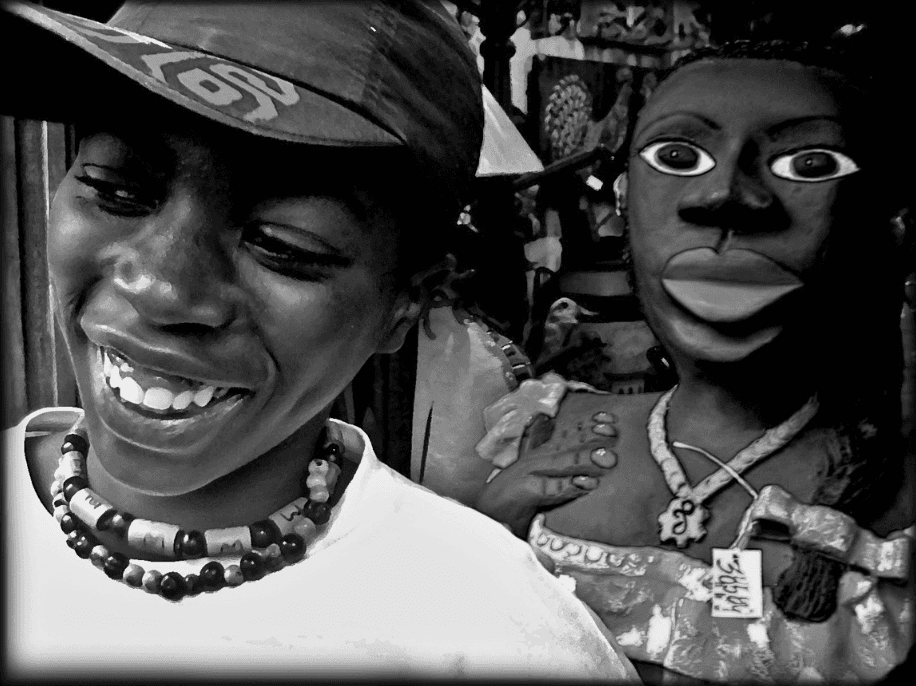
’‘Afro-Brazilian Symbolism’’ September 2007 © The Children At Risk Foundation (CARF) Brazil.
I suggest a minimum program to make our participation in the new conception of Brazilian racial politics effective. To construct a consensus on the new configuration, and within it, on the Black Movement, we must strengthen the conditions under which we produce our discourses and our practices in various spheres: academic, artistic, grass-roots political, in communications, and in others. At the same time it will be necessary to deepen our comprehension of the role of the state, of how to play to its limits and of the possibilities of internalizing important aspects of our demands. Some goals can only be realized by public action. This implies considering new actors, women and men, generally Black, who will be inserted into the organs of government—on federal, state, and municipal levels—with the responsibility of addressing an agenda that today goes under the generic name of ‘‘the promotion of racial equality.’’ From the point of view of the state, such actors, for all practical purposes, represent the interests of the Black community.
Meanwhile, it’s worth remembering that the expression, ‘‘the promotion of racial equality,’’ does not exactly correspond to the terms created by the Black Movement. Overlooking the significance of this can turn ‘‘combating racism,’’ the center of political action up to now, into a mere pretext for a practice that privileges the survival of organizations—governmental or not—and assuring the participation of some in the political sphere to the detriment of 80 million Black women and men whose interests they must represent.
Beyond this, the new configuration of Brazilian racial politics, in moving the racial question to venues beyond the Black movement, also requires us to rethink other arenas of political action, parliament, for example From a general consideration that we are the majority of the population, we must move to another that obliges us to act as a majority of the electorate and conquer the corresponding parliamentary representation!
We were victorious in the institutionalization of the racial question, but that very victory can also defeat us, if we enable it to render us as political actors separated from the social movement. Afro-North Americans, as Michael Mitchell remembers, ‘‘acquired major inclusion in the political process [but] have, simultaneously, lost the capacity to formulate questions directly in racial terms,’’ due to the,
Our future possibilities depend on political choices we make based on our reading of this historical moment, one which does not allow individual escapes. Racism changed as a result of our actions, but, fundamentally, it still requires that we recognize ourselves as part of a community of destiny.
FOOTNOTES
1Racial democracy was and is the widespread Brazilian belief that Brazil is not a racist society, that what- ever racism there is in Brazil is aberrant, isolated, and largely individual and that institutional racism does not exist. Therefore, there is no need to reconstruct Brazilian institutions to address racial concerns. Black and brown people can be found in influential positions throughout Brazilian society. There is widespread cohabitation of white, Black, and brown people. Whatever aggregate differences may be found between whites and Brazilians of color can be attributed to class differences coupled with the residual effects of slavery, which placed dark Brazilians, in the aggregate, in subordinate positions. ‘‘Racial democracy’’ also contrasts the Brazilian historical practice with those found elsewhere, such as Jim Crow and apartheid.
2Here ‘‘South’’ refers to a Brazilian categorization, specifically, the Southeast, which includes Sao Paulo and Rio de Janeiro.
3The damage during the celebration of the 100th anniversary of the abolition of slavery in 1988 was inflicted largely by the Black movement, which denounced the anniversary as a farce. The Golden Law, abolish- ing slavery in 1888, was signed by Princess Isabel, princess of the Brazilian Empire (Brazil, though an independent state, was not yet a republic, and was governed by an emperor). In articles, speeches, forums, seminars, and huge public demonstrations, as well as in marches held throughout the country, Black Movement militants said the Golden Law did nothing. It didn’t change the position of Afro-Brazilians at all (95% were already no longer enslaved, but still monumentally exploited and oppressed). Indeed, the abolition of slavery was due largely to the actions of Black people, their: rebellions, escapes, self-manumission, the establishment of independent, free communities called quilombos, and agitation, making the continuation of slavery unfeasible.
4Zumbi was the last leader of the quilombo of Palmares, an independent area of several towns, villages, and settlements in what is now the state of Alagoas. Palmares was established by Africans who had freed themselves from enslavement. It lasted 100 years. Over that time its residents successfully defended themselves in wars against the Dutch, the Portuguese, mercenaries, and colonial armies. They were finally defeated in 1695. Zumbi died in the last battle. His death was dated as November 20, 1695. The 1995 March was a celebration of Zumbi’s heroic death fighting for the freedom of Palmares 300 years earlier, and a demonstration against the racism, hypocrisy, and the responsibility for the perpetuation of the racism and rapaciousness of the state directed against the Afro-Brazilian population. Over 40,000 Afro-Brazilians traveled to the national capital, Brasilia, for this dramatic event.
5The Afro-Brazilian delegation of over 350 people was the largest delegation from the African diaspora. It had a tremendous impact on both the official and unofficial conferences held in Durban. The Afro-Brazilian organizations which had mobilized for the conference also had a striking impact on Brazil’s public discourse on race, leading directly to the implementation of affirmative action in some of the public universities and some sectors of public employment.
6Public universities in Brazil are free. They are also the country’s best and most prestigious universities. They rank with the top universities in the world. Admission to them is very difficult, requiring passing the strin- gent vestibular, an examination that can usually be mastered only by attending the country’s most elite, expensive, and selective high schools. Very few Black people attend those high schools.
7Qilombos still exist. Their residents have been afforded rights to their ancestral lands in the Brazilian constitution, but those rights are extremely difficult to enforce.
8This was a demonstration built on the tradition of the 1995 March. It was less dramatic and had less impact than its predecessor. It drew approximately 10,000 activists to the capital.
9Most Afro-Brazilian activists have devoted their time, energy, and resources to movement and movement formations and organizations, and to NGOs, rather than to the state. As a result, most Afro-Brazilians elected to parliament have no direct connection or responsibility to the Black movement, which is progressive and leftist. Many Afro-Brazilian legislators at the municipal, state, and national levels, do not identify as Black, and Afro-Brazilians do not operate as a cohesive voting bloc in the electoral process.
10Personal communication from Michael Mitchell (an influential and pioneering scholar of Afro-Brazilian politics, now at Arizona State University).
Past Editions
1.
A Community of Destiny: New Configurations of Racial Politics in Brazil
Luiza Bairros
2.
Book Review: Buried in the Bitter Waters: The Hidden History of Racial Cleansing in America by Elliot Jaspin
Tara Bynum
3.
Book Review: Chicago's New Negroes: Modernity, the Great Migration and Black Urban Life by Davarian Baldwin
Treva B. Lindsey
4.
Book Review: Many Minds, One Heart: SNCC's Dream for a New America by Wesley C. Hogan
Edward Mills
5.
Book Review: Race, Rock, and Elvis by Michael T. Bertrand
Joe Street
6.
Commentary: On Black Leadership, Black Politics, and the U.S. Immigration Debate
Mark Swayer
7.
Diary of a Journey to Nairobi: Impressions from the Brazilian Black Movement of the City and People Who Hosted the World Social Forum VII
Gevanilda Santos, Galauciane Aparecida de Souza & Suelma Ines Alves de Deus
8.
DuBois's Revenge: Reinterrogating American Democratic Theory…Or Why We Need a Revolutionary Black Research Agenda in the 21st Century
Bill Strickland
10.
Symposium Introduction: The Paradox of Black Political Leadership
David Covin
11.
System Values and African–American Leadership
Robert C. Smith
13.
The Limits of Black Pragmatism: The Rise and Fall of David Dinkins, 1989–1993
Ryan Reft
14.
The Praxis of Black Leadership in the Twenty-First Century
David Covin