

VOL. 10
Commentary: On Black Leadership, Black Politics, and the U.S. Immigration Debate
Mark Swayer
We must learn to live together as brothers, or perish together as fools.
—Martin Luther King Jr.
In the wake of the massive mobilization of immigrants in the U.S. in the Spring of 2006, I have looked in fascination and sometimes concern at the lack of response from Black leadership. While for some the response to anti-immigrant legislation has been formally clear, given the potential for racism and human rights abuses the response from Black leadership has been extraordinarily muted. In the context of that vacuum, the media has portrayed the feelings of African Americans as ranging from anti-immigrant to ambivalent. Many African Americans are fearful, some are hateful, and some just do not care. Black leadership has failed to grasp what is at stake in this debate and continues to fail to articulate a clear message on a number of social and economic issues of relevance to the African American community. On moral grounds, African Americans must stand by their tradition of being the guiding light for freedom and human dignity in the U.S. and around the world and support the legalization of the more than 12 million people in the U.S. struggling for basic rights and desperately trying to obtain what so many Americans take for granted: their citizenship. However, we as a community and leaders of our community must educate ourselves and make sure the media do not allow fear to drive our choices. But how do we fill the vacuum?
The immigration debate engages age-old questions for African Americans. Booker T. Washington in his famous Atlanta Exposition address urged U.S. industrialists not to turn to unknown foreigners who might take the country in unknown and negative directions, but to work closely with the known quantity of African Americans (Washington 1995). However, Washington and current Black leadership both have failed to understand the ongoing nexus between conceptions of race, nation, and citizenship and the dynamics of racial exclusion and class issues. These are especially salient in the post–civil rights era. When Washington’s counterpart (and sometimes nemesis) W.E.B. Du Bois proposed the concept of double consciousness, it was in profound recognition of the tension between a Black identity placed outside of the boundaries of being authentically American (Du Bois 1987). The same has been the case for Latinos and Asians, who are consistently constructed both as racialized and colonial subjects within the U.S. Thus, while we recognize that Latinos are not a ‘‘race,’’ not even in our non-scientific folk conception of such, we still understand that Latinos—and especially Mexican Americans—have in many cases what is known as racialized ethnicity (Martin Alcoff 2000; Grosfoguel 2003). That is, they are perceived to be endowed with a set of negative and immutable characteristics that, like African Americans, make them unassimilable and therefore unworthy of full citizenship rights. Why then is this not seen as a civil rights issue?
Much of Black leadership, academia, and the media have accepted a hegemonic definition of the Civil Rights Movement that focuses primarily on the social dimensions of racial exclusion and thinks of civil rights in entirely domestic terms. This narrative ignores the more inclusionary aspects of racial domination, i.e., the process of labor exploitation, cultural appropriation, colonial disruptions, and forced and semi-forced migrations that have been the hallmark of the development of Western nations in general and the U.S. in par- ticular (Sawyer 2006). Thinkers and activists like W.E.B. Du Bois, Malcolm X, Martin Luther King Jr., Paul Robeson, A. Philip Randolph, James Baldwin, Ella Baker, and others saw the process of racial oppression of African Americans in the U.S. as intimately related to earlier processes of slavery, colonialism and the aggressiveness of U.S. foreign policy in the region (Plummer 1996; Von Eschen 1997; Dudziak 2002; Singh 2005). African Americans were not brought to this country simply to be the object of racial hatred, genocide, and cultural destruction, but also in order to integrate them into a political economy of race that allowed them to be simultaneously dehumanized and exploited for their labor (Robinson 1991; Du Bois 1995).
There is nothing new about Mexican migration or migration from Central America and the Caribbean, and it all follows a similar pattern. The racist and nativist rants against Mexicans in particular but, also against Dominicans, Asians, and other migrants demonstrates this integrative process. The employability of Latinos in America’s worst jobs demonstrates how the construction of illegality and its maintenance through the racialized rhetoric of the perpetual and inferior colonial foreign subject, both legally and in practice marks undocumented migrants (particularly brown, indigenous ones) for labor exploitation and segmented participation in labor markets.
This is not to deny the psychological, and at times psycho-sexual, nature of racial animus. However, it is to note that if we make the mistake of thinking of racial oppression as only about creating social distance, we miss the workings of political economies of race that seek to extract labor at an unfair price from racialized domestic and immigrant populations. Thus, the history of U.S.–Mexico relations and programs like the Bracero Program, as well as U.S. colonial adventures in Central America and the Caribbean, demonstrate the link between our current immigration debate and the inextricable connection between race, racism, and nation. If we understand U.S. racism and white supremacy in their international forms in relation to colonialism, slavery as well as in racial constructions of national belonging that repeat themselves in places like the U.S., Canada, and Europe, we then understand that the struggle for rights for immigrants and against labor and other forms of exploitation is not a struggle that is alien or beyond the concern of African Americans. It is only if we hold a domestic and social definition of the civil rights movement that we can turn a deaf ear on the concern for immigrant human rights.
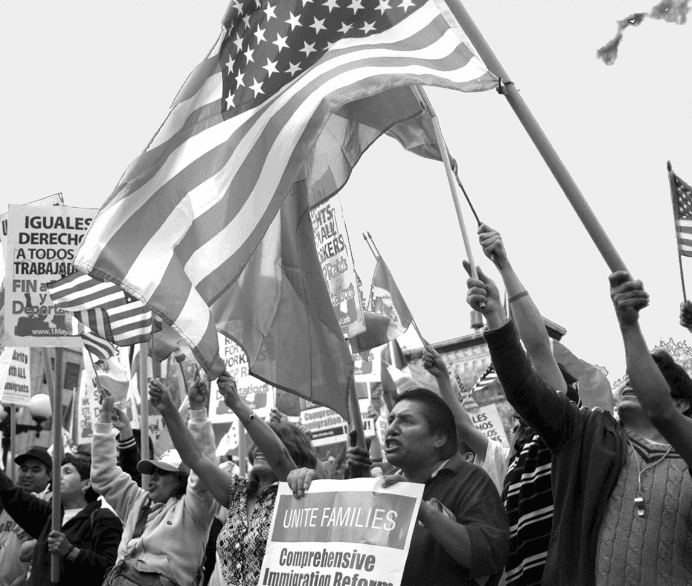
‘‘Enojo’’ May 2007 © Sebastian Almeida
We also must recognize the racialized and frequently racist language that has characterized the immigration debate in ways that should give African Americans pause. Samuel Huntington’s ‘‘Who are We’’ set off a profound debate on Latinos and immigration (Huntington 2004). Singling out Latinos (and especially Mexican migrants), Huntington suggested that they are unassimilable and pose a threat to the Anglo-Protestant culture that has made America the great country it is. Pundits like Lou Dobbs and Patrick Buchanan have taken a similar line in attacking Latinos. However, some Latino academics and commentators and their liberal defenders have made a tremendous mistake in response. In order to reply to Huntington, rather than denounce the obvious racism of his attacks, they have taken to emphasizing Latinos’ worthiness for citizenship by casting them as ‘‘ethnics’’ in a process of assimilation, similar to Italians and the Irish and in negative contrast with Blacks. These authors never challenge either Huntington’s implicit construction of a ‘‘white’’ dominant culture in America or his argument that race no longer plays a role in the life-chances of people of color.
Authors like Richard Alba, David Hayes Bautista, and Gregory Rodriguez also take this line and suggest that Latinos are the quintessential hardworking Americans who are seeking to assimilate into the norms and ideals of the U.S. They emphasize that— unlike African Americans–Latinos do not seem to be adopting a ‘‘culture of poverty.’’ The picture is clear. For these pundits Latino acceptance depends upon assimilation, racial distancing from Blacks, and not adopting an oppositional racial consciousness similar to Blacks. African Americans are rightly upset by these responses. However, these scholars are wrong on both normative and analytical grounds. Clearly, they do not speak for the entire Latino community. There is nothing ‘‘new’’ about Latino immigrants: Mexicans in particular have been a part of the American landscape for a long time and have consistently been racialized as both other and inferior. The virulent reactions to Mexicans and their children by white racist and mainstream organizations speaks to their ongoing racialization in American society. Similarly, these debates ignore the existence of Afro–Latinos and Black migrants from Africa and the Caribbean.
Thankfully, people on the street are not adopting this stance. Unlike pundits and some academics, the people on the street at the immigrant marches saw what they were struggling against as racism. Their signs expressed anti-racist slogans and also challenged the exploitation of their labor. They made the connection between the idea that current immigration policy makes them available for labor exploitation, just as Jim Crow and other manifestations of racism continue to make African Americans available for labor exploitation. As African Americans have learned to use their citizenship rights to challenge exploitation, employers have shifted to a new source of exploitable labor: undocumented immigrants.
While this might lead one to believe that Latinos are ‘‘taking African–American jobs,’’ the reality is far more complicated. There is no clear economic data that suggests that Latinos have taken African–American jobs where there have been cases of employer preferences for Latinos. These employers have tended to use undocumented Latinos’ lack of rights in order to guarantee their exploitation. The nexus between race, class, gender, and citizenship status reveals a complex web in which employers ‘‘prefer’’ the most exploitable labor, not individuals whom they see as equals, co-ethnics, or co-nationals. Thus, preference for immigrant labor should not be interpreted as a form of assimilation for Latinos. Further, these employers do not see, nor are they creating a path for upward mobility for Latino laborers. This is why whites in places like Orange County, California simultaneously exploit Latino gardeners, nannies, and pool cleaners while developing ordinances to increase deportability, deny educational access for their children, and restrictive zoning to maintain their marginality (Lacayo 2007). In this way, Latino barrios are far more similar to South African Bantustans than any of us might care to admit. The sting of de facto apartheid is felt just as sharply.
However, this alone does not overcome concerns from the African–American community. One major fallacy that is repeated often is the idea that Latinos have either taken African–American jobs or are responsible for African–American unemployment. The history of Los Angeles and other places that have received large numbers of immigrants tells a different story. African Americans moved from the South to the North and West in massive numbers, not in order to work as domestics, gardeners, and busboys, but to work in a growing manufacturing sector that offered middle-class wages and opportunities for upward mobility. Those jobs that helped build the Black middle class, have gone over- seas. They have not been ‘‘taken’’ by Mexican workers. Further, Black teachers, postal workers, and bus drivers in the unionized public service sector have benefited from immi- gration. Immigrants curbed the slide in urban populations around the country that was causing cut-backs in city budgets and reducing public services and jobs for the Black middle class. A recent PPIC study reveals that workers benefit from immigrant labor in both jobs and wages. These direct effects are masked by the countervailing forces mentioned above.
What is true is that Black and Latino workers share similar difficulties. Blacks and Latinos are dropping out of high school at alarming rates. Far from realizing the immigrant American dream, Latinos are fast becoming an intergenerational group of low- skilled exploitable workers who in subsequent generations face rates of incarceration similar to that of African Americans. To all of our detriment, Black and Latino political leadership have not pushed a policy agenda that challenges exploitation, deportability, and mass incarceration for Black and brown youth. Further, to the extent that wages for low-skilled workers are declining, the prudent response is to support unionization, human and labor rights, and a higher minimum or living wage. The recent efforts to improve the minimum wage and to support ‘‘card check’’ unionization that allows workers to overcome intimidation tactics by employers who fear workers with rights are steps in the right directions, but how often do African American political elites place these issues at the top of the agenda? These are the issues that also link the concerns of African Americans and Latinos together in ways that move beyond perceptions of group difference and/or threat. Unfortunately, there has been a significant retreat from these issues on the agendas of national and state politics. As the Latino high school drop-out rate approaches and tops fifty percent in many communities, we are not seeing the next great American success story, but a group who will likely be left behind as the new economy moves forward. Black leadership must redouble its efforts on central issues like job development, fair wages, prison reform, sentencing reform, crime prevention, universal health care, and quality education. These issues that are rarely on the front of the national political agenda are essential to both African Americans and Latinos. Further, an enforceable ‘‘living wage’’ is also in the interests of African American and immigrant workers of all colors and consistent with values of fairness and ethical assistance. Work should pay in America and too often for Black, brown, white, and yellow workers, legal or undocumented, it does not.
Even if you don’t agree with what I have written so far, it is clear that turning 12 million people in the U.S. into felons will not be good for African Americans. It will redirect scarce resources towards the capture and incarceration of such people. It will make them more vulnerable to employer exploitation and is simply inconsistent with values of human rights embodied by the African–American struggle. The racism inherent in such a policy fuels a beast that again will consign African Americans to irrelevance and will cast Latinos into further exploitation. The ordinances being passed by cities and towns to prevent renting to the undocumented and that turn migrants into virtual fugitives invites not only discrimination against immigrants, but discrimination against all Latinos regardless of status. Re-legalizing racial discrimination is a profoundly dangerous road. Further, the policies are not, as anthropologist Nicholas de Genova suggests, to actually achieve deportation of Latino immigrants but, to produce ‘‘deportability.’’ Deportability relegates Latino immigrants (and natives too) to a fugitive status from which they can be freely exploited since they cannot exercise normal citizenship rights under fear of deportation. Note that we have been here before with the Fugitive Slave Act, Plessy v. Ferguson, and myriad aspects of Jim Crow that—while not mentioning race—were no less directed at a particular racial group and were no less pernicious.
Perhaps our leaders do not understand how far in reverse we may go. In 2007, the Texas state legislature began considering the possibility of challenging the current interpretation of the 14th Amendment such that children born of undocumented immigrants would not be considered citizens. This radical change in the U.S.’s citizenship regime strikes at a core thread that guarantees those born in the U.S. the rights and some version of the privileges of citizenship. Jus solis rather than jus sanguine citizenship rights have been the hallmark of American democracy since the abolition of slavery. This is in jeopardy. We are looking towards a citizenship regime that will create new forms of racially stratified citizenship that will in turn condemn multiple generations of Latinos and other immigrants to marginal status.
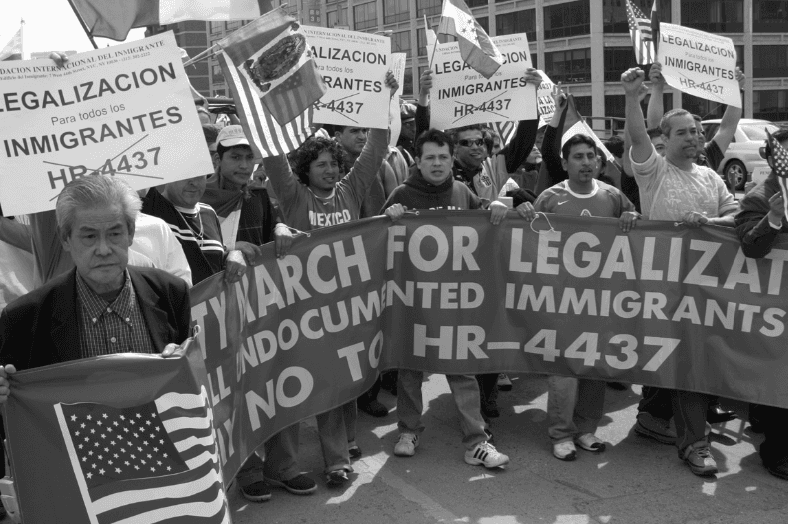
‘‘N.Y. Immigrants Rally’’ April 2006 © Cristian Pe ̃na
Further, the racialized language that casts Latinas as having ‘‘anchor babies’’ in order to stave off deportation and attempt to guarantee their own ability to remain in the U.S. bears a striking resemblance to the racist rhetoric that characterizes African–American women as having children in order to obtain welfare benefits. This racialized and racist language should be shocking to those concerned about America’s racial history.
The prospect of creating new and overtly racial forms of citizenship at the local and/or federal level is a dangerous slippery slope that is not merely about policies, but about fundamental principles of fairness and human rights. This shocking attack on a community and the proposals to convert millions of people living in our midsts into felons drew the convulsive response that constituted some of the largest protests in American history. I attended the May 1st (2006) rally in Los Angeles and the marchers saw their struggle as one for citizenship and empowerment and against racism, as many of their signs read. Others were in solidarity with displaced African Americans from Hurricane Katrina. Immigrants fighting for their rights are not picking a fight with Black folks. Do we, as African Americans, think we can go it alone and achieve our political goals in the future? What about the fact that a good 2 million of Latinos are ‘‘Black,’’ not to mention African and Caribbean immigrants? What have African Americans ever gained from joining with white racists? How will it harm African–American interests to have 12 million more voters who will likely support more social spending, unionization, and a range of other policies that are in line with the policy preferences of African Americans and especially the poorest among us?
By supporting this movement and fair, humane and rational immigration policies, a living wage, unionization, and battling racism wherever it exists, African Americans can make long-term and powerful political allies. Together, we can transform politics in this country, rather than playing a game of divide and conquer. Like it or not, African Americans are no longer the largest minority in the United States. That is a fact that will remain unchanged. If we don’t stand for our principles and we stand with racists, we guarantee our own future irrelevancy and moral decline. The bottom line is that African Americans need to help move the immigration debate and stand on principle rather than on narrow ‘‘interests’’ or ‘‘ethnic competition.’’ That means attacking racism and mobilizing around issues that will help African Americans advance. If we can’t stand with Latinos on this issue we will all fall.
The perfect example of this lack of vision was in the ultimately successful Proposition 187 campaign in California, that attempted to strip basic rights from immigrants and garnered a majority of African–American votes. It gave momentum to the conservative ballot initiative movement and paved the way for Proposition 209, the anti-affirmative action initiative, now being considered in other states as a result of its wins in California, Washington, and Michigan. There is a domino effect we need to understand. African Americans unwittingly sowed the seeds of our own destruction by not standing with Latinos on this issue.
On the other hand, victories by forces for democracy, rights, and citizenship can have the same momentum. Just as the victory for civil rights by African Americans helped create minimum wage laws, more humane and (less) racist immigration policies and other positive reforms in the United States, this movement can have the same effect. Now that Latinos are fighting racism and for citizenship rights, we—as African Americans—have a stake in their winning. If they/we win, our next fights will be for unionization, expanded voting rights, living wages, more funding to public education, and universal health care. These are all issues that immigrants, Latinos, and African Americans share. Further, we will also fight for affirmative action together because Latinos have been and continue to be supportive of these policies.
Currently, the immigrant rights movements are the most vocal element shattering the immoral right wing orthodoxy in America and fracturing the Republican Party. It is great that Latinos are, in many ways, exposing the hypocrisy of the Republicans and their failed policies by carrying the struggle to the streets. The power structure fears this movement, but if we are righteous we have nothing to fear. No one imagined that such a mass mobilization of people was possible in this era. ‘‘Americans are too apathetic, too comfortable, to try to change the world,’’ they say. But there are those among us who see the injustice of racism and exploitation and through their own lack of basic rights are best positioned to remind us of how tenuous, incomplete, and threatened those rights are. We have all lamented this apathy, but we must be ready to act when we see a movement that challenges injustice.
This is an enormous opportunity for us, both politically and analytically. As academics we must understand the growth and diffusion of this movement and develop strategies and tactics to understand how so many people can be mobilized so quickly. Further, we must take advantage of the opportunity to educate members of the African–American and Latino communities about our shared struggles for meaningful citizenship rights and against either their denial or proffering as second-class citizenship of any kind. It is a living struggle and we must struggle with our friends who share our values for justice and who also struggle against racism. As Martin Luther King Jr. once said, ‘‘In the end, we will remember not the words of our enemies, but the silence of our friends.’’ Thus, it is both pragmatic and righteous to support legalization now for the 12 million undocumented immigrants in the U.S. and to support a rational immigration policy that respects human and labor rights above ethnic pride and national purity.
Black leadership must now stand on principle. These principles must guide Black leadership even if in some local contexts Latino labor may mean short-term harm to vulnerable Black workers. The basic bedrock principles of racially equality and universal rights have been too hard-fought for African Americans to throw them away over a few mini- mum wage jobs. This is the trade-off that must be discussed in moral terms and in terms that articulate what has been our strongest high ground as African Americans.
WORKS CITED
Du Bois, W. E. B. 1987. The Souls of Black Folk. New York.
Du Bois, W. E. B. 1995. ‘‘Does Race Antipathy Serve Any Good Purpose? In F. L. Hord, & J. S. Lee, eds., I Am Because We Are: Reading in Black Philosophy. Amherst: University of Massachusetts Press.
Dudziak, M. L. 2002. Cold War Civil Rights: Race and the Image of American Democracy. Princeton, NJ: Princeton University Press.
Grosfoguel, R. 2003. Colonial Subjects: Puerto Ricans in a Global Perspective. Berkeley: University of California Press.
Huntington, S. P. 2004. Who Are We? The Challenges to American’s National Identity. New York: Simon & Schuster.
Lacayo, C. O. 2007. Santa-Ana: The REAL-ity of Orange County. National Conference of Black Political Scientists Crowne Plaza, San Francisco, California.
Martin Alcoff, L. 2000. In J. J. E. Gracia, & P. De Greiff, eds., ‘‘Is Latina/o Identity A Racial Identity?’’ Hispanics=Latinos in the United States, 23–44. New York: Routledge.
Plummer, B. G. 1996. Rising Wind: Black Americans and U.S. Foreign Affairs, 1935–1960. Chapel Hill: University of North Carolina Press.
Robinson, C. J. 1991. Black Marxism: The Making of the Black Radical Tradition. London: Zed Books.
Sawyer, M. Q. 2006. Racial Politics in Post Revolutionary Cuba. New York: Cambridge University Press.
Singh, N. P. 2005. Black Is a Country: Race and the Unfinished Struggle for Democracy. Cambridge: Harvard University Press.
Von Eschen, P. M. 1997. Race Against Empire: Black Americans and Anticolonialism, 1937–1957. Ithaca: Cornell University Press.
Washington, B. T. 1995. The Atlanta Exposition Address. In F. L. Hord, & J. S. Lee, eds., I Am Because We Are: Reading in Black Philosophy. Amherst: University of Massachusetts Press.
Past Editions



1.
A Community of Destiny: New Configurations of Racial Politics in Brazil
Luiza Bairros
2.
Book Review: Buried in the Bitter Waters: The Hidden History of Racial Cleansing in America by Elliot Jaspin
Tara Bynum
3.
Book Review: Chicago's New Negroes: Modernity, the Great Migration and Black Urban Life by Davarian Baldwin
Treva B. Lindsey
4.
Book Review: Many Minds, One Heart: SNCC's Dream for a New America by Wesley C. Hogan
Edward Mills
5.
Book Review: Race, Rock, and Elvis by Michael T. Bertrand
Joe Street
6.
Commentary: On Black Leadership, Black Politics, and the U.S. Immigration Debate
Mark Swayer
7.
Diary of a Journey to Nairobi: Impressions from the Brazilian Black Movement of the City and People Who Hosted the World Social Forum VII
Gevanilda Santos, Galauciane Aparecida de Souza & Suelma Ines Alves de Deus
8.
DuBois's Revenge: Reinterrogating American Democratic Theory…Or Why We Need a Revolutionary Black Research Agenda in the 21st Century
Bill Strickland
10.
Symposium Introduction: The Paradox of Black Political Leadership
David Covin
11.
System Values and African–American Leadership
Robert C. Smith
13.
The Limits of Black Pragmatism: The Rise and Fall of David Dinkins, 1989–1993
Ryan Reft
14.
The Praxis of Black Leadership in the Twenty-First Century
David Covin