

VOL. 10
Diary of a Journey to Nairobi: Impressions from the Brazilian Black Movement of the City and People Who Hosted the World Social Forum VII
Gevanilda Santos, Galauciane Aparecida de Souza & Suelma Ines Alves de Deus
Arrival on African Soil
On January 18, 2007, dozens of Brazilians descended a jetway into Nairobi, Kenya. The preceding day the sound of thunderous applause had greeted the same group’s first land- ing on African soil, in the city of Johannesburg, South Africa. That arrival began a journey that will leave its impact on our lives forever.
We brought with us many expectations and emotions. We felt like children returning to our mother’s house, until then unknown except by histories kept alive through the struggle of African descendants in the diaspora. The warm Nairobi reception began at the Jomo Kenyatta Airport, named in honor of one of the most popular and influential fighters for Kenyan independence. There, our Kenyan comrades awaited us, and from there, welcomed us into their homes. We had no problem communicating—they all looked after our well-being and showed their delight in our presence. Between smiles, we heard, ‘‘Karibu!’’
Exchanging Experience Between Popular Struggles
Our organization, Soweto, presented a panel at the Forum on the topic, ‘‘Experiences of Popular Education in the Struggle Against Racism and All Forms of Discrimination in Brazil’’ that included audience members from Brazil, the United States, France, India, Mozambique, and Angola. As educators we, along with our educational partner from Project Quixote, Gildean Silva ‘‘Panikinho’’ Pereira, described our experiences. All of us teach in public educational institutions. All of us hold advanced degrees. All of us are activists in Sao Paulo. We presented on our public education experiences and on the anti-racist struggle in Brazil. We introduced the methodology pioneered by Paulo Friere as we had applied it in four Brazilian contexts:
1. A community library course for youth in the favelas of Sao Paulo.
2. Workshops on memory and history that centered the process of growing older and the strengthening of racial identity.
3. A course on Black men’s and women’s resistance, identity, and socialism.
4. Workshops on hiphop as an instrument of popular education for children and youth in socially vulnerable circumstances.
After the presentations participants raised questions with each other and shared their organizations’ experiences. This discussion led not only to exchanges of experiences, but also to reflections on strategies for continuing our struggle. There was general agreement that poverty and racial discrimination were not only associated with the Black population of Africa, but with the diaspora as well. In Kenya in particular, the struggle is being furthered through community-based organizations (CBOs). The principal support for CBOs in Kenya, both in terms of human and financial resources, comes from churches and NGOs.
The participants from Mombassa, a Kenyan coastal city, were leaders of an organization that had been involved in the protection of orphaned children and adolescents. They brought to the table an important critique of class exploitation and prejudice. The situation of abandoned children and adolescents in Kenya is very serious. Continent-wide, large numbers of children have been abandoned as a result of civil war. The panelists denounced the Black population of the most acquisitive power on earth for turning its back on impoverished African peoples.
Impressions of Nairobi
In anticipating our visit to an African country, we brought with us what we considered common-sense notions of what we would see: misery, poverty, and the dangers we would encounter, ranging from human violence to the adversities of nature. To actually come to know an African country, specifically Kenya and the city of Nairobi, it was important for us to deconstruct the common sense images that bring stereotypes and prejudices with them. In order to do this, we had to internalize the daily lives of workers in the country, and to speak—worker to worker—regardless of the part of the world we came from. We decided to spend ten days in Kenya living at the consumption level determined by the value of the national currency, the shilling, and not the consumption level determined by the market catering to the U.S. dollar. We stayed in central Nairobi’s network of hotels that provided simple and accessible accommodations. We went to restaurants and bars frequented by local working people as well as some upscale ones. We found the menus good, the glassware and cutlery sterilized. Frequently we were offered a basin for washing our hands. We savored delicious African cooking based on beef or chicken dishes, all flavored with a spicy tomato sauce, generally accompanied by rice or ugali. All in all, the food was delicious and the prices accessible. There was, however, one thing not to our liking: the local custom was to serve ‘‘Taska,’’ a local beer, hot (room temperature). We Brazilians are hooked on our ice-cold beer.
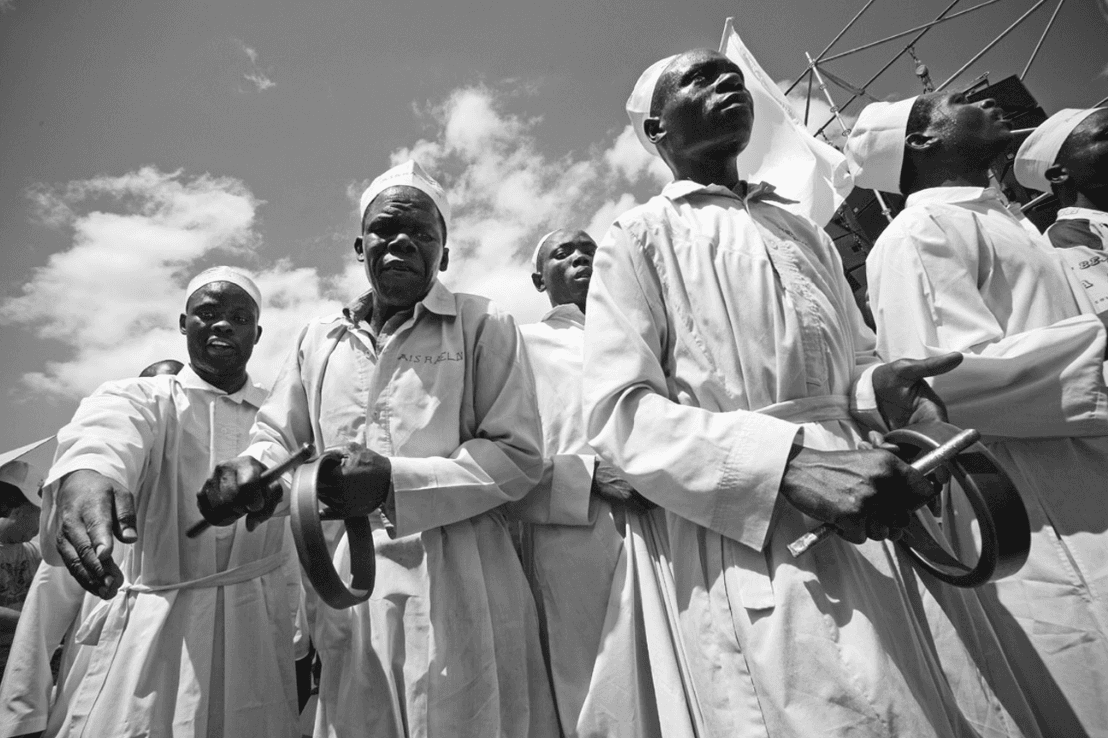
‘‘Opening March of the VII World Social Forum’’ June 2007 © Tatiana Cardeal
How did we locate such places? Asking and pleading for suggestions from tourist work- ers and workers in local businesses. They were very helpful, friendly, and supportive even to the extent of abandoning their own schedules to help us find a street or some other information we needed. We learned to say, as we parted company from our volunteer guides, ‘‘Asante sana,’’ (thank you very much), and we promptly heard in return, ‘‘hakuna matata’’ (okay, no problem).
How We Tamed Nairobi
In many respects, the city reminded us of Sao Paulo. Nairobi has a developed urban center. It has a well-planned street grid, broad avenues, shopping centers, imported cars, and congested traffic. It has a periphery that the people call ‘‘ghettos.’’ There are areas where popular stores are concentrated, where products are displayed on the sidewalks, jitney terminals, and places where many people come to mix and mingle. Walking at night in the city was peaceful for people like us who are curious, interested, and experienced in the education of street children. Security is privatized and preventative. There are many nocturnal guards and private security personnel outside buildings and stores. They share the spaces with the street people. The homeless population is huge. The practice of begging for money exists there as it does in Brazil.
In the slums, Dandora and Kibera are notable for their immense size, for garbage piles open to the sky, and their precariously perched houses. Nevertheless, the community’s labor is very well organized. Dressmakers, craftspeople, little bars, and restaurants are common. Even without government participation, there are social organizations that develop activities for children and adolescents by providing them critical information, human rights education, sports opportunities, and music. We were aided in getting to know the reality of Kenyan communities like Kibera and Dandora by being able to see their leaders struggling to transform an inhuman reality: children playing in garbage, a lack of water and basic sanitation, shabby and dangerous classrooms. On top of it all, the school system is private. Despite living in this cruel reality, the population has not lost hope and the joy of living. While walking through the alleys we heard from the little ones: ‘‘How are you? What is your name?’’ They went with us to organizational headquarters, to little businesses, to an artisan’s small shop, to a dressmaker’s tiny house, to a one-room barbershop, to a soccer field. In the process they taught us a few English words and they learned a little Portuguese.
Community residents denounce a failed housing policy that results in people living in dwellings made of sticks and mud, with zinc roofs and without basic sanitation or a system of potable, piped water. Local leaders condemn the government policy of making land deals with private parties to build houses for the poor, but once the houses are built, renting the popular units to the highest bidders.
To us, the privatization of public services in Kenya seems to be government policy. The republican government began in 1963 and the young Kenyan republic still retains much elite authoritarianism, a concentration of wealth linked to the interests of neocolonial powers, and a dismissal of the needs of workers recently arrived from rural villages. The government does not attend to the social needs of basic sanitation, education, and public transportation. The long-term vision is to privatize the principal public services.
In conversation the locals always praised Brazilian soccer players. When they learned we were Brazilians, they shouted, ‘‘Brazil, Amigo! Futebol! Ronaldinho!’’ The words flew. They said Kenya was not good at soccer and that Kenyans preferred to concentrate on running. The fact is that Kenyans walk a lot to flee the heat and uncertainties of mass transportation.
Because we lived in the center of Nairobi, we used matatos (local transportation similar to Sao Paulo’s jitneys) for everyday transport. There were various types of matatos. Some were station wagons from the 1950s of various colors and covered with graffiti, others were vans, but all drove on the left side of the road, unlike what we’re accustomed to in the Western hemisphere. A matato goes about 6 miles, carrying between 10 and 12 people at 55 mph over streets as full of holes as Brazilian ones after days of downpours and floods. There are fixed boarding and drop-off points. For us the final stop was closest to the Sports Arena where the World Social Forum (WSF) was held, and left us a 15 minute walk under the intense sun to get to our destination. To give you an idea of prices, the matato fare leaving from central Nairobi to the location of the WSF was from 20 to 40 shillings, the equivalent of 55–80 cents. This most accessible transportation option was not provided through the formal logistics of the WSF. The majority of participants used taxis from big fleets that negotiated for the right to the runs. There was no meter. The first price offered was 1200 shillings and with bargaining could be reduced to 300 (still 10 times the average matato price). The more one acted like a European tourist, little disposed to bargaining, the more expensive the ride.
We learned to bargain at the Masai Fair that took place every Tuesday. There was a lot of good craftwork, both attractive and cheap. On being asked the price, each craftsperson would place an initial price on the merchandise and lower it during the bargaining. They would say something like, ‘‘Then tell me how much you will pay for this item.’’ You must offer another price right away, and after a little haggling, we would hear, ‘‘OK, Brazilian friends.’’
As we walked the city we were led to revisit the great need of providing better services and security to the population. On many streets and avenues, choked with traffic, there are no signals for either cars or pedestrians. Crossing the streets becomes an adventure. The road to the coastal city of Mombassa, the country’s most important tourist center, is poorly lit, and full of pot holes. There is no formal bus terminal. The businesses have their little offices where they sell tickets. They watch the packages and the passengers on the sidewalk waiting for the bus to leave. The luxury buses are apparently comfortable, but the ordinary buses are dilapidated.
These are important impressions of the daily life if the Kenyan worker who, despite adversity, believes that another world is possible.
To see, to hear, and to feel this reality helps us to deconstruct stereotyped impressions that do not capture a sense of the place, and in time loses the sense of the importance of our reacting to the world on the basis of our solidarity with the African continent. That solidarity is based on our connection with African people who struggle for the preservation of a living environment and against the privatization of water, with all those who repudiate the payment of external debt by the countries of the South, with those who seek reparations for African countries and the diaspora, and with all who defend public health and who support the prevention of AIDS. As the South Africans said to us in Johannes-burg, ‘‘Africa is rich. Its people are poor because they continue to export the riches of Africa.’’
The image remains with us of the Forum’s closing ceremony in Uhuru Park at the center of Nairobi: speeches, music, dance, colorful shirts with slogans identifying the struggle linking the participants, the array of apparel from different cultures, the clicking of many cameras preserving the movement for later remembrance. We left the country filled with a nostalgia for the smiles, sympathy, generosity, gestures of camaraderie, of the hope Africans retain of emerging victorious, and of being a people free of the wounds left by the colonizer. And we sang, ‘‘a luta continua!’
Past Editions

1.
A Community of Destiny: New Configurations of Racial Politics in Brazil
Luiza Bairros
2.
Book Review: Buried in the Bitter Waters: The Hidden History of Racial Cleansing in America by Elliot Jaspin
Tara Bynum
3.
Book Review: Chicago's New Negroes: Modernity, the Great Migration and Black Urban Life by Davarian Baldwin
Treva B. Lindsey
4.
Book Review: Many Minds, One Heart: SNCC's Dream for a New America by Wesley C. Hogan
Edward Mills
5.
Book Review: Race, Rock, and Elvis by Michael T. Bertrand
Joe Street
6.
Commentary: On Black Leadership, Black Politics, and the U.S. Immigration Debate
Mark Swayer
7.
Diary of a Journey to Nairobi: Impressions from the Brazilian Black Movement of the City and People Who Hosted the World Social Forum VII
Gevanilda Santos, Galauciane Aparecida de Souza & Suelma Ines Alves de Deus
8.
DuBois's Revenge: Reinterrogating American Democratic Theory…Or Why We Need a Revolutionary Black Research Agenda in the 21st Century
Bill Strickland
10.
Symposium Introduction: The Paradox of Black Political Leadership
David Covin
11.
System Values and African–American Leadership
Robert C. Smith
13.
The Limits of Black Pragmatism: The Rise and Fall of David Dinkins, 1989–1993
Ryan Reft
14.
The Praxis of Black Leadership in the Twenty-First Century
David Covin