

VOL. 10
System Values and African–American Leadership
Robert C. Smith
In We Have No Leaders, published a decade ago, I concluded that African–American leaders—both establishment and radical—were largely irrelevant insofar as developing policies, programs, and strategies to reconstruct and integrate Black ghettos into the main- stream of American society The established Black leadership—the civil rights leaders and elected and appointed government officials—were irrelevant because they had been incorporated into the system and co-opted. A major result of the Civil Rights Movement of the 1960s, in addition to the enactment of major substantive legislation, was the integration or co-optation of the leadership of the movement into systemic institutions and processes. Co-optation is understood as the process of absorbing the leadership of dissident groups into a political system in response to mass discontent and threats (or perceived threats) to system stability or legitimacy. The process of co-optation was accelerated in the late 1960s and early 1970s as a result of the radicalism of the Black Power Movement and the rebellions in urban ghettos. By the 1980s virtually all of the talented leadership of Black America was incorporated or seeking incorporation into the system, contending that ‘‘working within the system’’ was the most important—if not the only—means to achieve the post–civil-rights era objectives of the Black community. However, I concluded that as a result of this process Black leaders had diminished their capacity to pressure the system to respond to Black demands, the most pressing of which was the need for employment opportunities in the context of some kind of overall program of internal ghetto reconstruction and development.
While the process of co-opting establishment-leaning Black leaders was accelerating in the late 1960s and early 1970s, radicals in the leadership group were becoming increasingly marginalized. This marginalization was itself partly a result of the co-optation process, but it was also the result of political repression, factionalism and a tendency toward utopian- ism within certain radical leadership circles. Consequently, by the late 1980s the most influential radical, non-establishment formation in the African–American community was the Nation of Islam: the authoritarian, sectarian religious sect lead by Louis Farrakhan.
We Have No Leaders was a direct, explicit critique of African–American leadership. There was also an implicit, largely unrecognized, critique of the political system in which they operate. As an epigram to Part III of the book (which dealt with the incorporation of Blacks into legislative and executive institutions at the federal level) I used a quote from a 1971 essay by Mervyn Dymally. Dymally, a former California state assemblyman, Lt. Governor, Congressman and now state senator, is also a sophisticated student of Black politics. Dymally wrote:
When we talk about Black politics we are not talking about ordinary politics. And we are not talking about ordinary politics because the American political system has not created a single social community in which the reciprocal rules of politics would apply. Conventional politics cannot solve this problem because conventional politics is a part of the problem. It is part of the problem because the political system is the major bulwark of racism in America. It is part of the problem in the sense that the political system is structured to repel fundamental social and economic change. We hear a great deal about the deficiencies, real or imagined, of certain Black leaders, but not enough attention, it seems to me is paid to the framework within which they operate. That framework prevents radical growth and innovation—as it was designed to prevent radical growth and innovation.
In this article I wish to engage in analysis, albeit brief, of how the values of the political system impede—indeed always have—the capabilities of African–American leaders to develop policies, programs, and strategies to achieve racial justice in the United States. Before doing so, however, I would like to review the evidence that has developed on the process of co-optation since We Have No Leaders was published. A review of this evidence reinforces the conclusions of the study. In the past ten years more and more Blacks have been incorporated into the system at higher and higher levels of authority. These leaders are less and less able to use their positions of authority to advance the interests of Africans Americans. Further, the evidence increasingly suggests that not only are these leaders ineffective in pressing the system for change but they are also increasingly less willing to try.
Inside the System: African American Leadership in the 21st Century
When I first started research on Black leaders in Washington in the early 1970s their numbers were small and they held few positions of status, power or influence in the Congress or the executive branch. The thirteen Black members of the House, operating in a newly created congressional caucus, had relatively little seniority and consequently chaired only one committee (on the District of Columbia) and seven (of 137) relatively minor subcommittees. Although the committee on the District of Columbia was a minor committee in terms of national politics, for the Black citizens who constituted a majority of the District’s population it was the major committee since it exercised jurisdiction over the city’s governance. For decades the District Committee had been chaired by a hostile southern Democrat. The ascendancy of Michigan’s Congressman Charles Diggs to the committee’s leadership provided District residents with a sympathetic person in a position of power. Diggs ultimately used that power to enact legislation granting ‘‘Home Rule’’ to the District, with the right to elect a mayor and city council. Yet, overall the Black caucus in Congress was a small body with few formal positions of power or influence

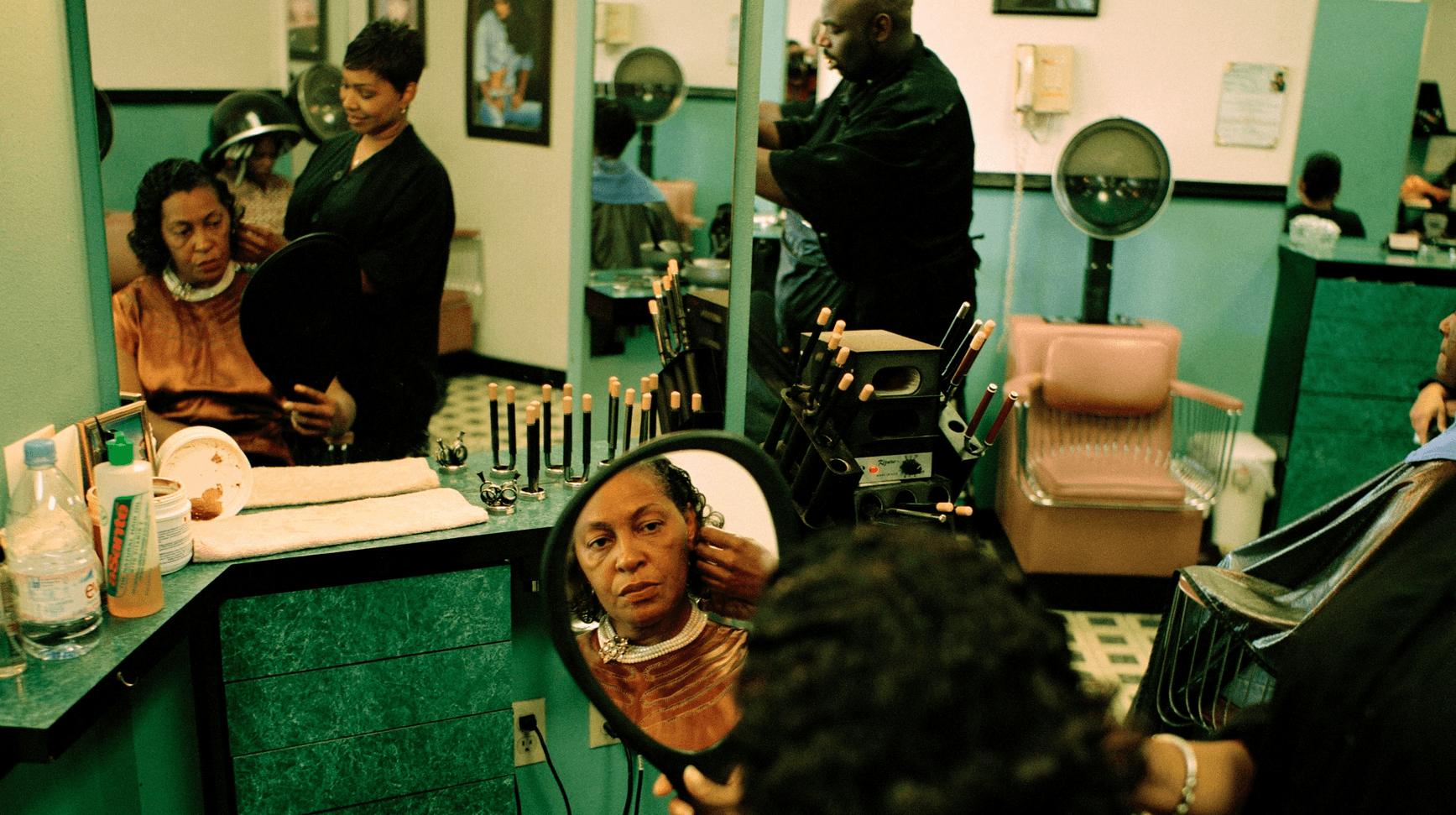
‘‘Untitled, New York’’ 1996 © Philippe Cheng
A similar situation existed for Blacks in the executive branch. There were no Blacks in the cabinet and although President Nixon appointed Blacks to 4% of executive branch positions, they were junior-level assistant and deputy assistant secretaries concentrated in the social welfare departments In these departments many of the officials were responsible for administering equal opportunity programs rather than substantive policy making. Although Blacks in the Nixon administration were small in number and held minor positions, they did organize a caucus (the Council of Black Appointees) to try to collectively influence administration civil rights policy, at one point threatening mass resignations to protest Nixon policies on school desegregation.
Thirty years later the progress of Black incorporation into legislative and executive branches has been remarkable. The Congressional Black Caucus has quadrupled in size and its members in the 110th Congress (2007–09) chaired five committees and seventeen subcommittees. The committees chaired by Blacks include Ways and Means—the oldest and most powerful committee in the Congress—and Judiciary, the committee responsible for crime legislation, civil rights, civil liberties, and the Constitution. In the 1970s no Black held a position in the Democratic party leadership, in the 110th Congress an African American (James Clyburn of South Carolina) holds the number three position—majority whip—in the leadership hierarchy (Congressman Bill Gray of Pennsylvania briefly held this position in the 1980s).
Similarly, the percentage of Blacks in the executive during this period tripled, rising from 4% in the Nixon administration to 12% in the Carter administration, 13% under Clinton, and 10% in the George W. Bush administration. The positions held by Blacks are not obscure, inconsequential positions like assistant and deputy assistant secretaries in HEW or HUD. On the contrary, in the Clinton administration Blacks held four of thirteen cabinet posts including Agriculture, Energy, Commerce, and Budget Director. In the George W. Bush administration African Americans twice held the senior cabinet post—Secretary of State—as well as such important posts as deputy attorney general, vice chair of the Federal Reserve, and head of the White House Domestic Policy Council.
Inevitably, as members of the Caucus have achieved seniority and power in the House they have tended to prioritize the interests of the Democratic Party over those of the Black community. The process of co-optation or institutionalization necessarily involves the embrace of the values of the system or the institution. Stinchcombe observes ‘‘the institutionalization of a value or practice can be fruitfully defined as the correlation of power with commitment to that value or practice; so that the more powerful a man is the more likely he is to hold the value.’’
This correlation of power with commitment to institutional values is well illustrated by the tenure of Congressman William Gray as House Budget Committee Chair. As a Caucus member Gray often helped prepare the group’s alternative budgets and defended them during House debates. Once he became Chair of the Budget Committee, however, Gray declined to support the Caucus budgets even with a symbolic ‘‘vote of commendation’’ as was cast by Thomas Foley, the Democratic Majority Leader. Gray explained his position by saying:
It’s not an issue of being Black. The issue is I’m Chairman of the Budget Committee, a Democrat. I build a consensus. I walk out with a budget. Now, do I vote against my own budget. . .? It’s not a problem of race. It’s a problem of what happens to any mem- ber of Congress who gets elevated to a position of leadership. I am not here to do the bidding of somebody just because they happen to be Black. If I agree with you, I agree with you. I set my policy. I think it’s a fair policy but that policy has nothing to do with being Black.
Congressman John Conyers responded that he took exception to Gray’s failure to cast a symbolic vote of solidarity with the Caucus, saying ‘‘I draw the line where he actively campaigns against the Black Caucus resolution.’’
Although Conyers was critical of Gray’s tenure as budget chair, it is likely he will confront similar dilemmas as Chair of the Judiciary Committee (even before he took the gavel, under pressure from Speaker Nancy Pelosi Conyers abandoned his pledge to investigate whether there were grounds to impeach President Bush). The Judiciary Committee has jurisdiction over a range of issues touching on the interests of African Americans, including felony disenfranchisement, disparities in sentences for crack and powdered cocaine and reparations for slavery and segregation. As a senior member of the Committee Conyers has over the years introduced bills dealing with reparations and felony disenfranchisement, but has been unable to get the Committee Chair to hold hearings. Now that the power to conduct hearings will rest with him, the question will be whether he will use that power to address these concerns or whether, like Chairman Gray, he will argue that ‘‘it’s not a question of being Black, [and that] as a Democrat I have to build a consensus—’’ a consensus that will result in the neglect of Black issues in his Committee.
From its first year the Congressional Black Caucus was known for presenting comprehensive agendas to the President and Congress, beginning with its 61 recommendations to President Nixon in 1971. However, since the Clinton administration the Caucus’ agendas have become modest or non-existent, leading William Raspberry, the veteran African– American columnist at the Washington Post, to write in 2001 of the ‘‘The Incredible Shrinking Black Agenda.’’ The principal items on the Caucus’ 2001 agenda were the appointment of a Black to the 4th Circuit Court and an accurate census. During the debate on the House floor shortly after Hurricane Katrina Los Angeles Congresswoman Maxine Waters ruefully admitted that in recent years the Caucus had forgotten about the problem of poverty in America, indicating that Katrina was a ‘‘wake-up call’’ not only for President Bush and the Republican Congress, but for the Caucus as well.
None of the Caucus agendas ever had a realistic chance of enactment, but they were useful in keeping before both Congress and the media some sense of what a reform agenda committed to racial equality would look like, laying the groundwork for action when the political climate might become more hospitable to activist government.
The incorporation of African–American leaders into the executive branch was always more problematic than in the Congress, since presidential appointees serve at the direction and pleasure of the President. Thus, they have far fewer opportunities to advance a Black agenda than members of Congress who serve largely African–American electorates. However, in spite of these constraints and their relatively small numbers and minor sub-cabinet posts, Blacks in the Nixon administration organized collectively to advance Black interests. The most far reaching post–civil-rights era policy reform—affirmative action—was designed and implemented by Arthur Fletcher and John Wilks, lower level functionaries in the Department of Labor. As Fletcher proudly told me in a 1972 interview, ‘‘affirmative action was my baby.’’
Since the Nixon administration, activism on the part of Black appointees has withered away. Not only did Black appointees not form caucuses in subsequent administrations, rarely since the Nixon administration did they meet collectively to discuss issues of concern to Blacks. The record of individual Black appointees in administrations from Carter to George W. Bush presents a mixed picture, although on balance Black appointees during this period remained silent on issues of concern to Blacks or actively worked to advance policies considered adverse to Black interests.
In the Carter administration United Nations Ambassador Andrew Young worked, without much success, to change the administration’s Cold War–oriented policy in southern Africa and HUD Secretary Patricia Roberts Harris tried—also without much success—to convince the President to propose a comprehensive urban policy. But also in the Carter administration Drew Days, the assistant attorney general for civil rights, and Wade McCree, the Solicitor General, prepared a brief in the Bakke case asking the Supreme Court to declare that any consideration of race in a university’s admissions decisions was ‘‘presumptively unconstitutional.’’ It was only after protests by the Congressional Black Caucus and the intervention of Vice President Walter Mondale that President Carter directed a reluctant McCree to rewrite the brief so that it would support the principle of affirmative action.
In the Reagan and two Bush administrations Black appointees generally supported without reservation the conservative positions of the administrations on race. In the Reagan administration Clarence Pendleton, the Chair of the Civil Rights Commission and Clarence Thomas, the Chair of the Equal Employment Opportunity Commission, went further, urging President Reagan to revoke the Nixon-era executive order (written by Fletcher) establishing affirmative action. In the second Bush administration Secretary of State Colin Powell publicly urged the President to support the University of Michigan’s affirmative action programs, but three administration Blacks—Ralph Boyd, the assistant attorney general for civil rights, Gerald Reynolds, the assistant secretary of education for civil rights, and Brian Jones the general counsel in the Department of Education—all argued that Bakke should be reversed and any consideration of race in university admissions should be declared unconstitutional. The African–American Secretary of Education (Rodney Page), the African–American Deputy Attorney General (Larry Thompson), and Condoleezza Rice supported the position eventually adopted by Bush, which sidestepped the constitutional issue but argued that the Michigan programs were racial quotas and therefore prohibited by Bakke. Rice reportedly helped the President make the decision and write his speech on the cases.
In the Clinton administration the large number of Black appointees was mostly silent on issues of concern to Blacks, most notably on his signing of the welfare reform bill passed by the Republican Congress. While three top-level white appointees in the administration resigned in protest and wrote op-eds and articles attacking the President, Blacks in the administration were accommodating. They were accommodating in a presidential decision that targeted poor Black women and their children and still threatens to do enormous harm to them.
This brief review of Black leaders inside the system since the late 1960s suggests that a leadership devoted wholly to working within the system is unable to produce very much in terms of benefits for their low income constituents. This means that a major result of the incorporation of Blacks into leadership within the system is that the Black community has diminished capacities to press its demands on the system. To some extent it is likely that for African Americans to fully realize their aspirations for full and fair inclusion in American society leadership willing to challenge the system will be required. Incorporation into the system makes a system-challenging leadership less likely.
Core System Values and the African American Quest for Equality
In We Have No Leaders, drawing on David Easton’s model for the study of political systems, I identified three core values of the U.S. system. These values define the pattern of ideational and structural relationships that characterize a political system. They are the values that elites or authorities inside the system seek to maintain. Indeed, Easton con- tends that ‘‘maintenance’’ of these values is the primary responsibility of system authori- ties or elites. The three core values that define the operation of the U.S. political system are capitalism, constitutionalism, and democracy. Each of these core values I argued to some extent constituted barriers to the realization of racial equality; values Congressman Dymally alluded to as impeding the kind of radical change and innovation necessary to overcome the legacies of slavery and segregation, and the operations of structural or institutional racism in the post–civil-rights era.
Capitalism
Capitalism is perhaps more central to the system than the values of democracy and con- stitutionalism. Ralph Bunche identified the principal problem with capitalism for Blacks in his critique of the New Deal during the 1930s. He wrote that Black leadership ‘‘appears unable to realize that there is an economic system, as well as a race problem in America and that when a Negro is unemployed, it is not just because he is a Negro, but more seriously, because of the defective operation of the economy under which we live—an economy that finds it impossible to provide adequate numbers of jobs and economic security for the population.’’
If capitalism requires a certain level of unemployment in order to maintain profits and price stability—as even liberal reform economists believe that it does—and racism is a value or practice in allocating joblessness—then axiomatically Black Americans will face disproportionately high rates of long-term joblessness. If this race-based joblessness is not ameliorated by an extensive social safety net then a culture of poverty (or what is referred to today as the Black underclass) is likely to emerge. Jones states these near axioms nicely when he argues that ‘‘the presence of the Black underclass is a logical, perhaps even necessary, outgrowth of the American political economy conditioned by white racism.’’
In his last year, Martin Luther King, Jr. recognized this axiom and came to believe that if African Americans were to achieve genuine equality, some modifications of capitalism along the lines of the Swedish welfare state would have to be adopted in the U.S. That is, King did not believe that individual initiatives and free market capitalism would be able to integrate Blacks into the economy. Nor did he believe—as Bayard Rustin, among others, argued—that the necessary reforms could be realized through the Democratic Party coalition or the democratic routines of lobbying and elections. In other words, King believed— on the basis of history and his own work—that significant racial progress in the U.S. could not come about without militant pressures from the Black community and other reform movements. That is why during his last year he was trying to organize a poor people’s march and movement.
Constitutionalism
The United States is not simply governed by a written constitution, as are many other political systems around the world. Rather, it has an ideology of constitutionalism; a belief in the Constitution or what Louis Hartz referred to as a ‘‘cult of constitution worship.’’ As Robert Dahl demonstrates in How Democratic Is the Constitution the Constitution is at war with democracy in America. For a people who claim to cherish democracy as a core value, the Constitution is a remarkably undemocratic document, including such features as the electoral college, an unelected, life-serving judiciary with policy-making responsibilities, and a powerful Senate in which representation is based on geography rather then the democratic principle of one person, one vote. Several of the Constitution’s undemocratic features directly inhibit the representation of African–American interests, and were designed to do so. However, the major problem is constitutionalism since ultimately what the Constitution means depends on the opinions of a few people (the justices of the Supreme Court) and generally these individuals have had opinions hostile to the interests of African Americans. Because most Americans accept the opinions of these individuals as the final word on how they should be governed, the Constitution becomes a barrier to the African–American quest for racial justice.
In Dred Scott, the Court’s first decision dealing with African Americans, it declared that they had no rights ‘‘but such as those who held the power and the government might chose to grant them.’’ Even after the Constitution was amended to confer human and civil rights on Africans, for almost a century the Court ignored the plain language and intent of the 14th Amendment. For most of the 14th Amendment’s history it has been more frequently used to protect the rights of persons other than Blacks, including those fictitious persons called ‘‘corporations.’’ During the brief era of the ‘‘Warren Court’’ (from the late 1940s to the 1980s) the Amendment was used as it was intended, but with the appointment of Justice Clarence Thomas (giving conservatives their first majority on the Court since the 1930s) the Court has once again reverted to its narrow, crabbed reading of the Amendment’s intent.
In a series of cases the Rehnquist Court substantially narrowed the remedial reach of affirmative action and (as of this writing) the Court may be poised to declare unconstitutional any use of race to achieve racial justice. In an earlier series of cases the Court invalidated the use of race as a means to assure racial equality in legislative representation, prompting Justice John Paul Stevens to write that it was ‘‘perverse’’ to permit the 14th Amendment to be used to assure equitable representation for Hasidic Jews, Polish Americans, and Republicans, among others, but not for ‘‘the very minority group whose history gave birth’’ to the Amendment in the first place.
In addition to the Court’s use of the Constitution to undermine African–American interests directly, since 1995 in a remarkable series of cases the Court has sharply limited the authority of Congress to protect civil rights and the rights of persons to sue states to compel their obedience to federally granted rights and privileges. For example, the Court declared the Violence Against Women Act unconstitutional, holding that in passing it Congress exceeded its Commerce Clause powers. The Civil Rights Act of 1964 is based on the Commerce Clause, as are virtually all of the nation’s civil rights and social welfare laws. In his opinion in these cases Justice Anthony Kennedy has been careful to note that the decisions did not call into question the 1964 Act, however, Justice Thomas (who wished to go further) would only say that his approach ‘‘did not necessarily require a wholesale abandonment ‘‘of these precedents.’’
Constitutionalism is thus once again a likely barrier to the aspirations of African Americans and their leaders in their quest for equality. In a recent book John Noonan, a judge on the 9th Circuit, argues that if these Commerce Clause and 11th Amendment precedents are not reversed, not only are civil rights in jeopardy, but so too is the capacity of the people to govern themselves through the democratic process.
Democracy
African Americans are a minority in the United States, constituting roughly 12% of the population. In designing the document the framers of the Constitution—and in particular James Madison—were especially concerned to protect minority rights in order to avoid what Madison called the ‘‘tyranny of the majority.’’ Several of the Constitution’s undemocratic features are in the document to protect minority rights. However, the minorities the framers were interested in protecting were not Blacks but slaveholders, men of wealth and property and persons living in states with small populations. African–American legal scholar Lani Guinier has engaged in theoretical musings about how to apply some of Madison’s principles to the tyranny of the white majority in relationship to the Black minority. For her work President Clinton labeled her ‘‘undemocratic’’ and withdrew her nomination for a post as assistant attorney general. President Clinton’s designation of Guinier’s ideas as undemocratic was ironic given that Clinton was sworn to uphold and protect an undemocratic Constitution.
African Americans constitute a permanent minority in the United States with none of the protections the American political tradition generally accords to such groups. As Ronald Walters argues, ‘‘the cost of social (permanent racial minority) status based upon an imperfect social contract for Blacks is that rarely has it been possible to participate in crucial decisions such as the selection of national leadership in a manner which reflects the ‘interests’ of Blacks...through what is called ‘sincere’ or ‘straightforward’ voting.’’
This cost is a major constraint on the capabilities of African–American leaders to func- tion efficaciously in American democracy. As Walters suggests, African Americans have distinctive ideological interests and policy preferences, locating them far to the left of the white majority. For example, on a composite index measuring six policy issues dealing with race 63% of Blacks were in the most left categories, compared to 9% of whites, whereas only 2% of Blacks were in the most right categories compared to 36% of whites. Seventy-three percent of Blacks think the government should reduce income differences between rich and poor, whereas only 44% of whites think the same; 39% of Blacks think the government should own all hospitals, whereas only 20% of whites take that position; and 47% of Blacks think that banks should be government owned, while only 18% of whites concur.
The African–American community, therefore, has distinctive interests and policy preferences. In the American democracy these interests and policy preferences are marginalized by a two-party system, which Clinton Rossiter describes as ‘‘the most conservative political arrangement in the western world.’’
In Uneasy Alliances: Race and Party Competition in America Paul Frymer argues that a two party system was established in the U.S. in order to marginalize Black interests and primarily to keep slavery off of the national policy agenda Analyzing the impact of the two party system on Black interests, Frymer demonstrates that both parties have incentives to co-opt rather than mobilize Blacks. This is because the two parties inevitably appeal to the ‘‘median’’ or ‘‘swing’’ voter, which in the United States has tended to be racially conservative white voters. This tendency to appeal to the median voter who is always white, frequently conservative, and sometimes racist, inevitably requires both of the parties to ignore or downplay issues of concern to Blacks. Comparative studies of party systems also show that multiparty systems tend to elect center-left coalition governments that adopt redistributive social policies more in line with the preferences of African Americans.
Conclusion
The African–American community—especially its disproportionately large fraction of poor people—faces enormous difficulties as the 21st century opens. Its leadership is almost wholly co-opted into the system; a system whose core values impose severe constraints on their capacity to advance the interests of the community. Wedded ideologically, institutionally, and economically to systemic structures of power, this leadership is adverse to independent or radical thought and action, having as one of its foremost concerns quiescence in the Black community and the maintenance and stability of the system.
Meanwhile, the once-vibrant radical tradition in African–American leadership is even more marginalized, given that much of the public space is monopolized by the leadership establishment. For the most part the established leadership probably understands how the system’s core values constrain their capabilities to deliver resources to their constituents. However, rather than engage in system-challenging behavior they engage in accommodationism.
Gunnar Myrdal first introduced the concept of accommodationism as a type of African– American leadership based on what he described as the two extreme strategies of behavior on the part of African–American leaders: protest or accommodation. Accommodation requires leaders to accept and not challenge the system and its prevailing relationships of inequality. Thus, leaders lead only in the context of seeking those changes in the conditions of Blacks that do not challenge system values or upset system elites. Because of their relative lack of power, Myrdal contended that accommodation was historically the ‘‘natural,’’ ‘‘normal,’’ or ‘‘realistic’’ relationship of Black leaders to the system.
Black leaders’ strategy shift from protest to accommodation since the 1960s is partly the result of their co-optation. The argument might be made that because civil-rights-era protests produced more results than accommodation, the relatively small degree of inclusion of Blacks into the system, when measured against the deteriorating conditions in the ghettos, does not justify the leadership’s embrace of accommodationist imperatives of the system. Nevertheless, accommodationism is paramount at the beginning of the 21st century. Either African–American leaders are unwilling to challenge the system because they have embraced its values and prioritize them over the interests of poor Blacks, or they believe they lack the necessary power to do so.
FOOTNOTES
1Robert Smith, We Have No Leaders: African-Americans in the Post-Civil Rights Era. Albany: State University of New York Press, 1996.
2Although not a member of the Caucus, Massachusetts Senator Edward Brooke served during this period as that body’s lone Black member.
3Robert Smith.
4Paul Frymer, Uneasy Alliance: Race and Party Competition in America. Princeton, New Jersey, Princeton University Press, 1999.
Past Editions




1.
A Community of Destiny: New Configurations of Racial Politics in Brazil
Luiza Bairros
2.
Book Review: Buried in the Bitter Waters: The Hidden History of Racial Cleansing in America by Elliot Jaspin
Tara Bynum
3.
Book Review: Chicago's New Negroes: Modernity, the Great Migration and Black Urban Life by Davarian Baldwin
Treva B. Lindsey
4.
Book Review: Many Minds, One Heart: SNCC's Dream for a New America by Wesley C. Hogan
Edward Mills
5.
Book Review: Race, Rock, and Elvis by Michael T. Bertrand
Joe Street
6.
Commentary: On Black Leadership, Black Politics, and the U.S. Immigration Debate
Mark Swayer
7.
Diary of a Journey to Nairobi: Impressions from the Brazilian Black Movement of the City and People Who Hosted the World Social Forum VII
Gevanilda Santos, Galauciane Aparecida de Souza & Suelma Ines Alves de Deus
8.
DuBois's Revenge: Reinterrogating American Democratic Theory…Or Why We Need a Revolutionary Black Research Agenda in the 21st Century
Bill Strickland
10.
Symposium Introduction: The Paradox of Black Political Leadership
David Covin
11.
System Values and African–American Leadership
Robert C. Smith
13.
The Limits of Black Pragmatism: The Rise and Fall of David Dinkins, 1989–1993
Ryan Reft
14.
The Praxis of Black Leadership in the Twenty-First Century
David Covin