

VOL. 10
The Limits of Black Pragmatism: The Rise and Fall of David Dinkins, 1989–1993
Ryan Reft
In April 1989 the National Conference of Black Mayors took place in Oakland, California. Crime, drugs, economic development, and reduced federal funding were discussed at great length, but—as one attendee noted—race emerged as a primary concern among the participants. Former Congressman Darren J. Mitchem pointed out that ‘‘within the white community, there’s a group that even if you walked on water wouldn’t vote for you Carl H. McCall noted that Black candidates faced a unique political obstacle when compared to their white counterparts because, ‘‘if the language of Black politicians is not sufficiently ‘militant’ ...sections of their Black base will abandon them, forcing such hopefuls to ‘use sharp language’ to solidify their base which in turn frighten[s] The answer, according to some, was to diminish the importance of race or to ‘‘deracialize’’ their campaign. Others maintained that the future lay in ‘‘Rainbow
Coalitions’’ like Chicago’s Harold Washington’s 1983 victory. Further confusing future electoral strategies, Republican and conference president Mayor James L. Usry related some advice a white political consultant had provided him in 1986 as he prepared for his race in predominantly Black Atlantic City, ‘‘Do not put your foot in one white house or one
Six months after the 1989 conference, machine politician David Dinkins became the
first Black mayor of New York City. Constructing a ‘‘Gorgeous Mosaic’’ consisting of
Blacks, liberal whites, Latinos, labor, and Jews, Dinkins defeated incumbent Ed Koch in the Democratic primary and then proceeded to ward off Rudy Giuliani in a tightly contested general election. Bridging the gap between Latinos and African Americans, Dinkins secured over 70 percent of the Latino vote in the general contest and 60 percent in the Impressively, he garnered the full support of the Harlem political community and the Brooklyn Nationalists, a traditional fault line for city wide Black electoral unity, receiving nearly 90 percent of the vote. However, this ethereal victory would not last. By the end of his first and only term, David Dinkins’ ‘‘Gorgeous Mosaic’’ had frayed. Writing for The Nation in 1993 Michael Tomasky criticized the incumbent mayor for marching in a Jewish parade that banned gays, but refusing to march in the traditional St. Patrick’s Day Parade for the same reason quipping, ‘‘Dinkins figures the Irish vote is lost, but the Jews are another matter. So politically, it’s smart to offend the Irish and stand up for the gays Ultimately, Tomasky saw Dinkins’ ‘‘Gorgeous Mosaic’’ as ‘‘the same old interest group palm greasing, just like the Irish pols used to play it, dressed up in a multicultural Playing against a backdrop of economic stagnation, racial mistrust, and skyrocketing crime, Dinkins struggled to keep his administration above water. His pragmatic machine-based approach found success in 1989, but the same strategy enacted four years later failed to deliver the same result. What can we make of David Dinkins’ watershed victory in 1989?
I. New York City 1989
As the 1980s came to a close New York City faced a deepening recession, a crack
, rising crime, a yawning budget deficit, simmering racial tension, and pervasive homelessness. Ed Koch’s third term ground to an end amid recriminations concerning endemic corruption within the New York Democratic . Compounding these difficulties was the fact many African Americans viewed Koch as hostile to their interests. The declining economy exacerbated an already contentious relationship, leading critics to ‘‘claim that he was polarizing the city along racial .’’ Promising to assuage the rising racial and ethnic tensions, David Dinkins emerged as the Democratic candidate for mayor. Dinkins had long served in the municipal government as City Clerk in the 1970s and as Manhattan Borough President (1985–1989). As part of the Dinkins had distinguished himself as a loyal competent machine politician but not one of any particular dynamism. While dissatisfaction with a mayor is certainly cause for an attempt to oust the incumbent, what conditions led Dinkins and others to believe 1989 was the year New York would elect its first African–American mayor?
The Jesse Jackson Factor
Jesse Jackson’s 1984 and 1988 campaigns mobilized Black New York politicians and activists. In 1984, Dinkins worked for Al Vann, the man who directed Jesse Jackson’s New York state campaign. Under Vann’s leadership, Dinkins cultivated relationships and experience, contributing to his own election to Manhattan Borough President in 1985. In 1988, Dinkins organized Jackson’s Rainbow Coalition through his office.
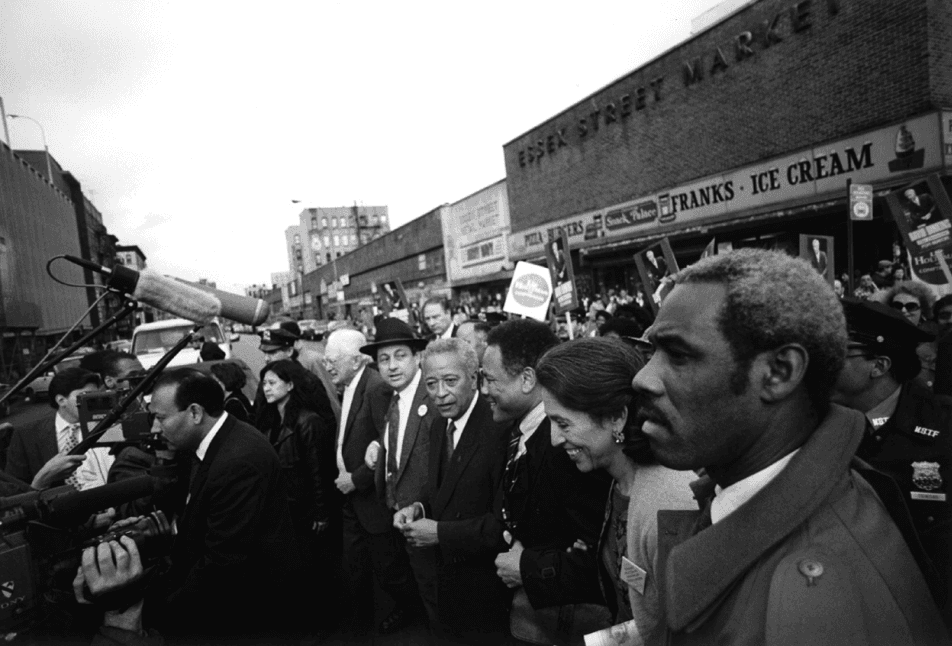
‘‘David Dinkins Mayoral Campaign, Manhattan’’ 1989 © Allan Molho
Jackson emphasized improving ties with Latino elected officials over pursuing the city’s Black elected officials. Dinkins was closely involved in this effort, thus improving his own connections to the Latino community. Furthering this connection, Jackson placed the Rainbow Coalition’s operation center at the headquarters of Local 1199, a one hundred thousand member largely Black and Latino hospital worker’s union. In addition, both Jackson races increased Black voter registration, mobilizing the community.
Municipal Reform
While the Rainbow Coalition movement helped mobilize, register, and unite minority
voters, a municipal reform to the city’s charter also contributed to Dinkins’ victory. The Board of Estimates had couched power in each of the boroughs, allowing for patronage and city funding to flow through the borough presidents. Each held power over city budgets and . As a result, each borough developed its own unique machine dynamic, Black politicians divided along specific borough lines, had the most power in Brooklyn and Manhattan. However, Brooklyn—with its large West Indian and Caribbean populations—cultivated a Black nationalist approach greatly at odds with the pragmatist ‘‘Harlem School,’’ as it was pioneered by uptown machine politico J. Raymond Jones. The elimination of the BOE placed increased authority in the mayor’s office, reduced the power of borough presidents, and encouraged political unity with a Black mayoral candidate as a rallying point.
The Harlem School
Though the legendary J. Raymond Jones is most associated with the Harlem accomodationist approach to electoral politics, Jones himself was less visible than another New York Black political leader of the time. In 1941 Adam Clayton Powell Jr. became the first Black person to earn a seat on the New York City Council. By 1944, Powell had joined Congress, having easily earned the Democratic nomination that year. Powell chafed at the racism of the capital itself and prided himself on his opposition to white power, referring to himself as ‘‘the first bad nigger in Jones, on the other hand, chose a less militant route.
Quietly, J. Raymond Jones ascended the Democratic machine structure. By 1964, he was the first Black to occupy the executive position in the organization. Jones believed Black political leaders ‘‘must be militant’’ but at the same time believed they should operate within the party From his position within Tammany Hall, Jones trained two generations of New York’s Black political leadership, including Percy Sutton, Basil Patterson, David Dinkins, and Powell’s eventual successor, Charlie Rangel. Dinkins adopted the quiet, party oriented, pragmatic approach that Jones epitomized and slowly climbed the rungs of the machine as well.
It is from this grounding that David Dinkins emerged convinced that quiet leadership, political loyalty, and pragmatic decision-making brought electoral success. Moreover, not only did the Democratic organization train Dinkins and help him establish a network of connections he would later utilize in running for mayor, it also insulated him from criticism when he did run for office. Normally, politicians running as machine candidates are punished by ‘‘good government’’ forces. However, the racial climate in 1989 provided a radically different context for Dinkins. First, his race meant that even though he was a typical ‘‘clubhouse’’ politico, no one assumed that he was an entrenched power broker, as one pro-Dinkins pollster was quoted, ‘‘it is tough to say that anyone who is Black has been any part of the power structure in Secondly, since many whites—especially Jewish voters—feared a Black nationalist candidacy, Dinkins’ membership in the Democratic organization promised their section of the electorate
Thus, though historically limiting for African Americans, the Democratic organization
enabled Dinkins to develop not only the skills necessary to succeed in electoral politics, but also created a political community which could harness a movement for a Black mayor, all while insulating him from charges of racial
Dinkins and the Black Community
I think Dave’s a wonderful guy, but let me tell you three things about him running for mayor: First, he’ll make a lousy candidate. Second, in the unlikely event that he does win, he’ll make a terrible mayor. Third, I will support him.
—
Even though Dinkins won the 1985 Manhattan borough presidency, he failed to truly
capture the imagination of many in the Black community. In running for mayor in 1989, Dinkins placed great emphasis on campaigning in white communities and seemed uncomfortable around lower income and poor Blacks, but as the campaign attempted to mobilize greater numbers of voters, it sought to assuage Black voters’ reservations. One such encounter between the grassroots Industrial Areas Foundation and the mayoral hopeful revealed this awkward dynamic. During an initial meeting with the IAF, Dinkins had both eaten his lunch and taken phone calls. In a second encounter, during a question and answer session with the group organized by his campaign director, conversation collapsed when Dinkins read from a prepared statement, sniping at the IAF membership in a moment of tension, ‘‘when we build new housing, we’ll be building new communities. ... And you ought to l As one organizer present commented, ‘‘We saw the depth
of race and the superficiality of race—all in ten
In another example of his aloofness from New York’s lower income Black communities, Dinkins was accused by the City Sun and others of neglecting African–American voters. Hoping to pacify his critics, Dinkins took to ‘‘the streets with a walking tour of a move that satisfied few. Earlier that same day, Dinkins had spoken at a small East Harlem Church where he had to ‘‘prod the congregation into
In a late June article, the New York Times remarked that race had been a subverted feature of the mayoral contest up to that point, but noted that ‘‘even those who would not cast a racial vote in June might do so in September, if the campaign becomes polarized along racial lines, or if some traumatic crime or other event arouses racial fears just before the For once, the Times appeared prophetic.
Yusuf Hawkins
In August 1989 16-year-old African–American Yusuf Hawkins was visiting Bensonhurst, Brooklyn with three friends. As Hawkins and his friends passed through the neighborhood, they were accosted by a gang of white Bensonhurst teens armed with baseball bats. One of the white youths shot Hawkins twice, killing him. Black activists reacted quickly, holding a march through Bensonhurst. Hostile residents of the neighborhood chanted ‘‘Where’s Tawana?’’ while holding watermelons out for the marchers Though he had been gaining ground on Dinkins, the incident threw Ed Koch’s campaign well off course. The incumbent chastised protesters for marching, while also denying that race had anything to do with the assault. As a result, Koch had to restrain his campaign’s criticism of Dinkins out of ‘‘fear of conforming to the emerging picture of him as a racially insensitive By contrast, Dinkins remained calm and collected, not lending himself to hyperbole but noting that Koch bore some responsibility for what had . As numerous activists made far more denunciatory statements, the mayoral front-runner assumed the role of ‘‘conciliator’’ or ‘‘healer,’’ reassuring whites that he was not radical, but also comforting Blacks by illustrating his concern for their community. A Black population that on many occasions needed prodding to show enthusiasm for Mr. Dinkins was now . Dinkins went on to defeat Koch in the primary by eight percentage points.
The general election revealed many things about David Dinkins, Rudy Giuliani—his
Republican challenger—and the city’s overall electorate. Despite winning the Democratic primary handily and holding a sizable lead in the campaign’s initial weeks, Dinkins managed to slowly bleed votes. Focusing on Dinkins’ personal financial history, the Giuliani campaign brought to light the fact that the Manhattan Borough President had failed to pay his income taxes from 1969 to 1972. In addition, Dinkins had sold stock to his son at greatly undervalued costs, which—though later dismissed as within legal bounds—raised . Coming on the heels of Koch’s corrupt third term, some white voters were driven away by Dinkins’ dodgy finances. His own explanations for the missing taxes were unclear and when pressed Dinkins repeatedly responded, ‘‘I haven’t committed a crime. What I did was fail to comply with the
What role did race play in his declining numbers? Even today, the former mayor is reluctant to directly blame race for the slim victory, yet he still goes to great lengths to question Giuliani’s .
Race as a Factor in 1989
In Changing New York City Politics, political scientists Asher Arian, Arthur S. Goldberg, John H. Mollenkopf, and Edward T. Rogowsky analyze New York’s 1989 elections. Acknowledging the importance of the Jackson campaign and noting the impressive construction of Dinkins’ ‘‘mosaic,’’ they come to many of the same conclusions as have other observers. When it comes to the issue of race, though, the authors depart from conventional analyses. While they grant that race influenced voting decisions, they argue that it did so in a way that was not necessarily ‘‘racial.’’ Instead, they argue that various issues appealed to different ethnic groups. When surveying voters for central concerns, respondents identified five main issues: drugs, crime, corruption, homelessness, and education. However, while most voters would have placed these factors within the top five, how each community prioritized issues . Moreover, even when in agreement about a particular problem, the differences in imagined solutions revealed glaring divisions between communities. Crime emerged as an issue of concern for all voters. Certainly, the Black and Latino community suffer disproportionately from , but while whites favored ‘‘law and order’’ responses, Blacks believed increased social services and access to education more effectively limited criminality. Thus, race itself did not determine votes, but how each group prioritized the problems and framed the solutions to them .
Some more conservative observers used the election to argue that white voters had
become more tolerant. In an editorial following the Democratic primary, the Wall Street Journal argued that ‘‘if in fact racial animosity was as intense as some commentators suggest, Mr. Dinkins’ candidacy would have been crushed in [Queens, the Bronx, and Even after the general election, the Journal emphasized Giuliani’s personality and campaign style as responsible for his loss saying that ‘‘he threw mud at David Dinkins’’ and had not given New Yorkers anything ‘‘positive or hopeful,’’ rather he had only
Perhaps the most equitable explanation lay in a combination of all views. Dinkins’
financial problems and his reaction to questions about them probably alienated portions of the white community unconcerned with his race. Similarly, some voters did not support Giuliani simply because Dinkins was Black, but rather differed with him on how to handle various problems, such as crime. Giuliani’s negative campaigning left many voters cold, as evidenced by a ‘‘white turnout that fell below Finally, though race worked against Dinkins, it also worked in his favor. Numerous media outlets promoted the idea that as a distinguished Black leader with a calming demeanor, Dinkins could ‘‘cool’’ racial tensions, bridging the gap between the white community and . Thus, African Americans and Latinos believed David Dinkins would bring increased services and aid to their local communities, while opening doors previously closed to them. In contrast, those whites who voted for Dinkins expected him to calm racial tensions and lower crime rates. Each based at least a portion of their beliefs on his race. However, fiscal and
economic conditions limited his ability to help the former, while decades of inequality and increased racial conflict prevented him from fulfilling the hopes of the latter.
No matter the margin of victory, David Dinkins had successfully crafted a ‘‘gorgeous
mosaic’’ of supporters. However, he only received a third of the white vote, entering office at the helm of a precarious alliance. Each group believed itself deserving of resources and the benefits of government largesse. Dinkins had to find a way to balance competing claims while also reaching out to the business sector and the majority of whites who had opposed him. It was here that Dinkins’ attempt to be a man for all seasons to all people unraveled.
II. The Dinkins Administration: The Difficulty of Coalitions
In a giddy January 1990 editorial the Memphis Tri-State Defender heralded the dawning of the Dinkins era, pronouncing him to be ‘‘potentially the most powerful mayor in New York City’s history.’’ It went on to explain that with the elimination of the Board of Estimates’ power over issues ranging from ‘‘land use’’ to ‘‘city budgets,’’ the power now in the mayor’s hands awarded him ‘‘a potential power base that no New York City mayor has To some extent this observation rang true: the elimination of the BOE did increase the mayor’s powers, but the office still remained constrained by numerous other factors, not least among them a shrinking tax revenue, declining economy, and expanding budget deficits. In addition, the mayor’s power was now to be shared between his office and the expanded city council. Even with the increased power, as a former Finance Commissioner pleaded in a Times editorial, the mayor did not even have full control over the budget .
Homelessness had exploded under the Koch administration and continued to bedevil ’. Crime and drugs became an omnipresent fear for many within the five boroughs. Large companies and businesses, including Morgan Stanley and Prudential, were either threatening to relocate outside of the city or had already done so. Combined with the various expectations of his diverse constituency and rising racial tensions, David Dinkins assumed office at a moment of peril rather than one easily correlated with triumphant power.
Economic Development and the Budget
David Dinkins was a traditional machine politician with traditional machine support.
As one liberal critic noted, much of his campaign had been funded by ‘‘the army of real estate barons, lawyers, lobbyists, and fixers who really run So when declining federal , falling tax revenues, and all intersected in 1990, Dinkins chose the path of fiscal austerity. The budget deficit was estimated conservatively at $1 billion. New York was suffering from a rapidly deteriorating infrastructure that demanded attention. Services such as day care, public health clinics, and after school programs were drastically cut. While the business community appreciated the frugality, Dinkins’ minority constituents resented the cuts because they utilized these programs at higher rates than other communities. Compounding New York’s fiscal nightmare was the impending renegotiation of the city’s municipal union
Hardly anti-development or anti-business, Dinkins continued a tradition that Koch had established by issuing tax abatements to several large companies. In many cases such tax abatements amounted to subsidies as Hardy Adasko, Senior Vice-President of the Economic Development Corporation, related, ‘‘most successful [tax abatement] packages included benefits to the Manhattan operations which in fact de facto deepened and obscured the [city’s] In general, he relays, development at the city level takes one of three routes: ‘‘lower taxes universally, lower taxes on the poorest or increased services to the poor and specific deals, more discretionary deals or programmatic deals that target companies. ... The three are ... always going to be in tension because the more you do of one the less you can do of the Following Koch’s example, Dinkins gave Morgan Stanley ‘‘a tax package of over $30 million to keep its 4000 jobs in Similar agreements were made with other institutions. Adasko argues that ‘‘[tax abatements were] necessary to put New York in a competitive position.’’
In terms of contracting, Dinkins’ early policies avoided instituting set-asides out of fear of alienating any of his constituencies. However, as his tenure continued, Dinkins took notice of a discrepancy in city contracting. Though 25 percent of the city’s business and construction firms were minority or female owned, they received only 7 percent of city contracts. The most notable field in which minorities and women seemed to suffer from discriminatory practices was construction. Acknowledging such concerns, the Dinkins administration took two major steps. First, Dinkins proposed increasing contracting to these groups to later saying, ‘‘when we left office it was around 17 percent. ...It worked, Secondly, in January 1993 Dinkins established an agreement between the city and 15 local construction unions. Known as ‘‘Project Pathways,’’ each union agreed to accept 250 apprentices from the city’s vocational schools’ graduating classes. Moreover, Dinkins instituted a policy in which any unions hoping to bid on school construction had to grant access to their apprenticeship programs to minority While both policies benefited his minority constituencies, each was established in the later half of his term, meaning that by the time his re-election campaign had begun, these reforms were still unfolding.
Homelessness and Housing
Throughout this time, New York City lacked affordable housing and its homeless population seemed to be swelling to frightening proportions. Though Dinkins tried various remedies to solve the problem, most seemed to alienate the working poor and lower middle class across racial lines, since now a significant portion of low-income housing had been reserved for the homeless. Moreover, poor communities resented the placement of shelters in their neighborhoods, since they believed that they drained resources where they were already scarce. As a result of both policy and finances, the Dinkins administration failed to increase services to these . The cost of maintaining shelters and creating permanent housing led to skyrocketing . Increasingly, it became an issue of credibility for the Dinkins administration from both a fiscal and public safety standpoint. Dinkins’ reluctance to enforce vagrancy laws led to more visible homeless presence on the . Many on the right complained that the homeless policy was too generous, encouraging people to ‘‘game’’ the system. Other critics argued that while the failed policy alienated the public and increased their resistance to future solutions to the homeless strategy, much of the pain could have been avoided had both Koch and Dinkins chosen to meet with community leaders, activists, and advocates to better determine the causes of homelessness and construct more effective measures.
In regard to housing in general, Dinkins made modest gains. However, the opposition the city government encountered from entrenched Black politicians reminded Dinkins of the difficulty of his coalition. Despite tight budgets, Dinkins had secured $18.4 million in funding for the ‘‘Bradhurst Redevelopment Plan.’’ The administration had also, over the course of four years, invested $200 million in housing for central Harlem. In each case, leading Black politicians and leaders viewed the developments as threats to their power and opposed them. Though the ‘‘Bradhurst Plan’’ would eventually follow through, it did so late in his mayoralty, meaning Dinkins could not campaign on its .
Again, as with economic development and the budget, many of Dinkins’ housing reforms had taken shape too late to be a part of public discourse by the re-election campaign season of 1993. Many supporters were left with the impression that Dinkins had failed to mobilize the government behind the needs of their communities with respect to homelessness, housing, city budgets, and economic development.
Crime
One of the most contentious issues of the early 1990s in many American cities, but especially in New York, was crime, though crime rates themselves are notoriously difficult to determine. For example, many crimes go unreported while others that do get factored into the overall crime rate can be petty, having little impact on the average citizen’s lives. Additionally, the public’s perception of crime, heavily influenced by media reports, often matters more than the true prevalence of crime itself. Dinkins took office as the crime wave of the late 1980s reached its peak. Unfortunately, his relations with the New York City Police Department deteriorated, culminating in the notoriously racist 1992 ‘‘police riot.’’ If whites truly saw crime through a ‘‘law and order’’ lens, then Dinkins’ contentious relationship with the NYPD must have been politically damaging.
In regard to reducing criminality, the Dinkins administration worked with state officials to craft ‘‘Safe City, Safe Streets’’ legislation. It expanded the size of the police force to levels above the Koch administration’s and instituted neighborhood policing, a tactic that increased community–police relations and resulted in a decline in crime . Ironically, this approach would be more aggressively enforced under Dinkins’ successor. While Rudy Giuliani seemed to benefit greatly from media coverage, Mayor Dinkins’ efforts were relatively ignored. Dinkins remarks, ‘‘everybody acknowledges that crime started to go down in '91, but during Rudy’s eight years no one acknowledged that, or very few acknowledged it...we never got any credit for
Two major events contributed to declining morale within the police department under Dinkins’ watch. One revolved around his attempts to assuage an angry Dominican population in Washington Heights that believed that an innocent Dominican named Jose ‘‘Kiko’’ Garcia had been shot and killed by the police. In an effort to limit civil disorder, Dinkins met with the slain man’s family and paid for his body’s transportation to the Dominican Republic. Many officers took this action as an affront to the entire force, believing Dinkins to be siding with the young man who was later shown to be active in the area’s drug .
In addition, the mayor’s insistence on an all-civilian Civilian Complaint Review Board rankled many NYPD . Resistance to the initiative culminated in what was refereed to alternately as a ‘‘police demonstration’’ and ‘‘police riot.’’ An estimated 10,000 police officers blocked the Brooklyn Bridge, prevented the free flow of traffic, drank openly, and harassed African Americans passing by City Hall. The Economist stated sardonically that ‘‘suspiciously easily, the march got out of The mayor was depicted both by protestors and in the media in crude racist terms. The New York Voice/Harlem U.S.A. reported ‘‘it was obvious to all that this protest stemmed from something other that the fact that the mayor wanted an all-civilian Civilian Complaint Review The NAACP’s Benjamin Chavis, writing in the New Pittsburgh Courier, described the scene ‘‘as a post-modern lynch mob full of racial bigotry and
Already seen by some citizens, fairly or unfairly, as ‘‘soft on crime,’’ Mayor Dinkins’
relationship with the NYPD hurt him as the re-election campaign approached. Perhaps as the ultimate irony, despite the fact the police behaved improperly, the mayor received the lion’s share of the blame when the police department went beyond accepted bounds of behavior. As Richard C. Wade, an urban historian at City University of New York, commented ‘‘The mayor has little control over the police force, but the public holds him
Race Relations
When David Dinkins became mayor it was widely believed that his presence in the office would help dampen racial fires. This view seemed especially prevalent among his white constituents. While New York avoided rioting on the scale of Los Angeles, the city endured several moments of collective trepidation in the 1990s. In addition to the Garcia shooting, two incidents in particular aroused visceral reactions from New Yorkers: the 1990 Korean boycotts and the 1991 Crown Heights Riots.
The Korean boycotts began in the fall of 1990 after an incident in which a Haitian
American claimed to have been physically assaulted by a Brooklyn Korean shop . The local African–American community boycotted the store along with others, with activists aggressively picketing local markets. The chants turned racist and the pregnant wife of one store owner lost a child after being physically . Though a court order had been obtained requiring protesters to remain fifty feet from targeted stores, the mayor refused to have the police enforce it. The boycotts continued until Dinkins made a symbolic statement by shopping in one of the stores, but his failure to enforce the court order eroded some of his support. This opened an early door for Rudy Giuliani and others to criticize his failed .
The second incident, and perhaps the defining moment of the Dinkins mayoralty, was the explosion of the Crown Heights Riots in 1991. In a harrowing three-day event, a seven-year-old Black child, Gavin Cato, was struck and killed by a Hasidic Jewish driver in the neighborhood. Rumors circulated that a Hasidic ambulance had picked up the injured Jewish parties, but had neglected to attend to the injured child. Though this rumor was later proven false, a ‘‘mob’’ of African–American youths killed a Jewish resident of the neighborhood. Two nights of rioting ensued, until Dinkins ordered a change in police tactics that ended the disturbances. Reminiscent of the actions of Mayor Lindsey during the Harlem Riots in the 1960s, Dinkins even went so far as to walk the streets of Crown Heights. Initially Dinkins’ actions were viewed positively, but the verdicts that followed the riots compounded the . The Jewish driver was not indicted for the child’s death and the jury ruled it an accident. The Black man arrested for the stabbing of the Jewish resident, Yankel Rosenbaum, was acquitted, despite being caught with the murder weapon and confessing to the crime. Rather than protest the decision, Dinkins stated famously, ‘‘I have no doubt the criminal justice system has operated fairly and This, combined with Dinkins’ attendance at Galvin Cato’s funeral, but not Rosenbaum’s, deepened Jewish resentment. Finally, a state report released in August 1993 criticized the mayor for his sluggish . The report reopened a wound that would plague Dinkins until the end of his tenure.
The Crown Heights Riots illustrated several problematic aspects surrounding both
David Dinkins and his rainbow coalition. First, relations between Jews and Blacks had deteriorated. Economic recession and the perception that Jews held disproportionate political and social power exacerbated tensions. When Dinkins attempted to intervene, the local Black community rejected his . Similarly, one policy expert noted Dinkins’ refusal to side with one party may have prevented further violence, but appeared to whites that he identified with ‘‘Blacks The Times remarked that ‘‘[the mayor’s] Black skin is no magical antidote to racial
Dinkins himself has acknowledged the damage that Crown Heights wrought on his
term in office. When questioned about the media’s coverage of the events, Dinkins states that it was ‘‘inaccurate. The police did not do a good job. It [ended] after I said, whatever you guys are doing, it’s not working.’’ As for the accusations by some journalists that Dinkins was anti-Semitic or complicit in the violence that erupted, Mr. Dinkins responded, ‘‘It was, I thought, very
III. The ‘‘Gorgeous Mosaic’’: 1993
By 1993, the coalition that had elected Dinkins had frayed. In the African–American community, the Dinkins administration reached out to the Caribbean population in Brooklyn. Though some support remained, many expressed strong reservations. When selecting the mayor for re-election Brooklyn Democrats revealed a deep ambivalence with 19 voting for his nomination, 10 against, and 10 .
Latinos echoed the concerns of Blacks. An early poll published in the New York Voice Inc/Harlem U.S.A. indicated that only 43 percent of those Latinos who had voted for Dinkins in 1989 were ready to do so in . Councilman Adam Clayton Powell Jr. argued that ‘‘the Latino community feels betrayed by Dinkins.’’ Bronx resident and contractor Louie Alvarez expressed a viewpoint held by a significant portion of New York’s minority communities, that ‘‘he doesn’t care about Latinos or Blacks....He only cares about white society.’’ Others noted his perceived inability to lead in moments of crisis, noting ‘‘the way he talked about Crown Heights and the problems with the Korean store, he messed
Voter ambivalence—and in some cases hostility—toward Dinkins led many to discount programs that his administration had implemented that were meant to provide needed health, education, and social services to at-risk communities. The Communicare program expanded health care into underserved . In terms of education and social services, the mayor instituted the Beacon School program, which enabled some schools to stay open later for recreation, adult education, and various services. Dinkins expanded this program quickly and the Giuliani administration maintained the program despite gutting its parent organization, the Department of Youth Services. It continued to receive funding well into Giuliani’s second term. Ironically, in the face of criticism from the left
concerning city services, Giuliani often cited the program as one of his accomplishments.
The 1993 Election
By mid-1992 New York had rebounded from the decade’s first two years, with the Wall Street Journal noting that, ‘‘Violent crime is down, at least one bond rating is up and New Yorkers are suddenly no longer talking about whether the city will survive, but when it will emerge from Even the executive director of the New York State Financial Control Board noted the fiscal restraint: ‘‘this year the city managed to take control of its daily problems. It’s like night and
Voter apathy toward Dinkins’ campaign emerged visibly during this time. During his
tenure the mayor had several opportunities to quell racial unrest. New York never suffered a Los Angeles style riot, but Dinkins’ actions in all of the city’s controversial incidents left aggrieved constituents dissatisfied. Second, though crime had been dropping since 1991, the police riots overshadowed the mayor’s achievements. His economic development efforts mirrored those of administrations prior, yet his tight fiscal budgets failed to win over a majority of the business community, who viewed the possibility of a Republican mayor as a better alternative. Four balanced budgets and fiscal austerity were not enough to outflank a pro-business GOP candidate. Similarly, Dinkins’ approach to homelessness failed to deviate sharply from Koch’s failed policies, while his modest successes in housing were blunted by intra-racial resistance. An unenthusiastic Black and Latino electoral base, a small shift in the white vote and lower turnout among his coalition partners doomed Dinkins’ re-election.
Voting along racial lines hardened, with white democrats supporting Giuliani at a 64 to 35 margin whereas in 1989 the difference was at Increased turnout on Staten Island, where a secession bill had been placed on the ballot, aided Giuliani. He emerged with a significant lead over Dinkins in
According to the election’s data, Dinkins lost the election by less than 2 percent of the vote. Though he earned 95 percent of the African–American electorate, turnout in that community did not reach the same levels as it had in 1989. Bill Fitch, writing in the Village Voice, remarked that ‘‘it was in the ghettos of Harlem and central Brooklyn, not simply [in] Staten Island, that Dinkins lost the In every borough, he received fewer total votes than in 1989. Much the same was true of Latino voters as well. Support among Jewish voters declined 3 percent, as did his support from both ‘‘white liberals’’ and Democrats in general.
Other factors contributed to Dinkins’ defeat. A rising anti-incumbency tide had just
begun, which culminated in the 1994 Republican take-over of Congress. White and Jewish populations had begun a more general shift to the right and new immigration patterns made coalitions more difficult to sustain. Jim Sleeper, a former Daily News columnist and New Republic contributor argued that ‘‘rainbow coalitions’’ were doomed to fail as demographics changed and new immigrant groups entered American society. As Sleeper put it, ‘‘old style civil rights’’ politics failed to appeal to new minorities, while others felt betrayed by such
Black commentators viewed Dinkins’ defeat in several ways. Some blamed racism,
saying ‘‘people feel betrayed ... people feel that we as Black Democrats played by the rules, and the rules were Others believed that Dinkins had ‘‘pandered too much to whites’’ failing to campaign enough in Black communities. Some blamed the Black community itself, as one campaign worker for Dinkins remarked acidly, ‘‘we got what we deserved and I When asked if the lack of mobilization of his base constituency may have contributed to his defeat, the former mayor demurred. Dinkins argued that Staten Island contributed heavily to his defeat, saying ‘‘that’s what hurt me more than anything else. People can say Crown Heights, they can say this, they can say the other, I’m saying Staten
Black intellectuals appeared as split over reasons for Dinkins’ loss as the larger community. Wilber Tatum, publisher of the New York Amsterdam News, denounced the mainstream media for failing to honestly present Dinkins’ tenure as mayor and his campaign for re-. Tatum acknowledged the Times endorsement of the incumbent, but claimed that ‘‘their news and editorials’’ undermined his hopes of gaining re-election. Others, including white journalists, pointed out similar media failings. Village Voice writer Wayne Barrett supported this view; he noted media bias in several areas, arguing that Giuliani’s past seemed to be ignored by the city’s major papers and
African–American Pulitzer Prize–winning journalist Les Payne commented that
Dinkins had taken his support within the Black electorate for granted, placing too much emphasis on winning over white . Bob Herbert argued that Dinkins had been elected not because he would eliminate crime or enhance quality of life, but rather because ‘‘Mr. Dinkins [would] calm things down...if Mr. Dinkins had been perceived as aggressive, he could have forgotten about being elected.’’ According to Herbert, Dinkins suffered from the tranquility that had settled upon the city such that ‘‘in a calmer atmosphere voters can look more closely at the conditions in which they are
Black intellectuals’ opinions regarding Dinkins’ failures varied as widely as the electorate itself, but several common themes emerged: Dinkins’ lack of Black mobilization, especially among the poor; fear of crime; media bias; racial bias; and his own failures of leadership.
Conclusion
Ultimately, David Dinkins entered office in difficult times. The city’s financial
situation, union obligations, debt payments, and shrinking tax base all contributed to limit his options. His promised social programs were slow to develop, leaving many of his minority constituencies frustrated and disillusioned. His pro-business policies produced budget surpluses by 1992, but these were then overshadowed by the Garcia shooting, the September police riots, and the August 1993 release of the Crown Heights report. His accomplishments: more affordable housing, new city contracting laws, balanced budgets, crime legislation, and the Beacon school programs, were often overshadowed. The former mayor could not outflank a Republican candidate on issues traditionally thought to be GOP strengths, such as crime and economic growth. He was unable to galvanize his base constituencies to offset increased turnout in Staten Island. Incremental losses among Jews, white liberals, and Latinos allowed increased white mobilization to overwhelm his
term’s ‘‘gorgeous mosaic.’’
Rudy Giuliani took office in 1994. Receiving the lion’s share of credit for crime reduction, few writers noted that he had continued many of the provisions that preceded him. Neighborhood policing, which has been praised for helping to reduce crime in New York, began under Dinkins. The Beacon school program also garnered support from Giuliani and was later used to his political advantage. Race played a part in Dinkins’ defeat, but so too did his failures in the stewardship of the city. Ethnic conflict and his response to it, especially after having been elected as a ‘‘healer,’’ undermined his strongest personality trait. Rather than appearing conciliatory, he appeared detached and out of touch. This allowed those few white voters that defected to excuse themselves for voting against him, while dulling Black and Latino turnout. It is very possible that Dinkins lost his bid for re-election due in part, to his race. Had he been white, perhaps voters would have been more forgiving of his inconsistencies. Yet, segments of the Black and Latino population had not forgiven him for his imperfect four years, reducing turnout in both communities. Blacks and Latinos expected more of Dinkins because of his race, despite the fiscal limitations placed on him by an economy in recession. In contrast, whites expected him to cool racial tensions because of his race, despite the fact that the mayor had little control over outbreaks of spontaneous social rage. In the end, because of race and the differing expectations it brought for each ethnic or racial constituency, David Dinkins was left with little political space in which to operate.
FOOTNOTES
1New York Times, ‘‘The Politics of Race,’’ 11 April 1989.
2Ibid.
3Ibid.
4Biles, Roger, ‘‘Mayor David Dinkins and the Politics of Race in New York City,’’ in African American Mayors: Race, Politics, and the American City, eds. David Colburn and Jeffery Adler (University of Chicago Press: 2001), 138.
5The Nation, ‘‘Identity Politics in New York City,’’ 21 June 1993.
6Ibid.
7Though the National Institute on Drug Abuse and other organizations have reported in recent years that the crack problem of the late 1980s and early 1990s was not as statistically significant as the media and govern- ment believed, it was perceived that way as evidenced by numerous essays and reports in both left leaning and conservative news sources. As will be briefly discussed later in the article, the perception of crime is almost as important as its reality. Thus, even if it was statistically misleading the media and government emphasized the crack epidemic to such an extent, the public believed it was a problem.
8Most notably the Queens and Bronx sections of the party,
9McConnell, Scott, ‘‘The Making of the Mayor,’’ Commentary, February 1990.
10New York Black political leaders Basil Patterson, Charlie Rangel, David Dinkins, and Percy Sutton all from what is known as the Harlem Pragmatic school, a democratic machine based wing of New York Black politics.
11Thompson, J Phillip, Double Trouble, 168.
12Kilson, Martin, ‘‘Adam Clayton Powell, Jr: The Militant Politician,’’ in Black Leaders of the Twentieth Century, eds. John Hope Franklin and August Meier (Chicago: University of Illinois Press: 1982), 267.
13Daily News, ‘‘J. Raymond Jones: Inside Outside,’’ 15 April 1999.
14New York Times, ‘‘Dinkins Ties to Clubhouse under Attack,’’ 10 October 1989.
15Ibid.
16New York Times, ‘‘As Political Lions go Gray, Harlem Wanes as Center of Power,’’ 3 February 2003.
17Biles, Roger, 135; John Flateau, who was a dean at Medgar Evers College commented, ‘‘they were the beneficiaries of a unique convergence of demographics, personal chemistry and a party political system that gave them a significant jumping off point...but as the Black population grew, it dispersed into Brooklyn and Queens. And so did the political power.’’
18Sleeper, Jim, The Closest of Strangers, 298.
19Ibid.
20New York Times, ‘‘For Dinkins Styles Range from Calm to Serious,’’ 31 July 1989.
21Ibid.
22New York Times, ‘‘Dinkins Out Front,’’ 23 June 1989.
23McConnell, Scott, ‘‘The Making of the Mayor,’’ Commentary, February 1990.
24Biles, Roger, 136.
25McConnell, Scott, ‘‘The Making of the Mayor,’’ Commentary, February 1990.
26New York Times, ‘‘The New York Primary: For Black Voters, an Evening of Inspiration and Giddy Celebration,’’ 13 September 1989.
27Thompson, J. Phillip, 190.
28Biles, Roger, 137.
29Interview with author, 18 April 2006.
30Arian Asher et al., Changing New York Politics (Routledge: New York: 1991), 98.
31New York Times, ‘‘For Dinkins Styles Range from Calm to Serious,’’ 31 July 1989; As one African– American woman commented to the New York Times, ‘‘Crime is an important issue—crime and drugs. The white media thought in the 0 60s when we were complaining about police brutality that we didn’t want the police. That’s not the point. A majority of the Black community wants these criminals off the streets and punished.’’
32Admittedly, Asher et al.’s attempt to eliminate the Bensonhurst incident along with earlier examples of racial violence—Howard Beach 1986 and the rape of the Central Park jogger—seems at best wishful thinking.
33Wall Street Journal, ‘‘A New York Mayor,’’ 14 September 1989.
34Wall Street Journal, ‘‘Lessons for Republicans,’’ 9 November 1989.
35New York Times, ‘‘Don’t Minimize Dinkins Victory,’’ 11 November 1989.
36Wall Street Journal, ‘‘Dinkins’ Win Tinged with Sadness,’’ 9 November 1989; Leon Wynter, the Wall Street Journal’s minority enterprise reporter at the time, hoped that ‘‘Because he is Black, Mr. Dinkins can be a bridge, in a city of rivers where the bridges have been falling down.’’
37Tri-State Defender Memphis, 24 January 1990.
38Which according to Shorris was unequaled for any other American metropolis, ‘‘no comparable burden is placed on any city in the country.’’
39Biles, Roger, 139.
40The Nation, ‘‘Identity Politics in New York City,’’ 21 June 1993.
4141. By 1991, federal aid’s proportion of the city’s budget had declined to 9.3% down from 17.9% in 1981.
42Growth in the city had come to a standstill. Income growth was the lowest it had been since 1982, employ- ment growth reached the same levels it had in 1980, while finance industry, as a result of the 1987 crash and general economic adjustments, was suffering a 2% decline.
43The city’s municipal workforce at that time consisted of 360,000 workers of whom 250,000 were members of trade unions. New York had one of the highest proportion of city workers per 100,000 than any other city in the United States.
44The EDC, as its known, is a quasi-governmental organization that operates as an in house consultant on planning issues, zoning, environmental review, streets, and other areas. The organization attempts to create growth rather than simply rewriting zoning laws. Thus, it hopes to expand economic development in five, ten, fifteen, and twenty year blocks depending on the specific situation.
45Interview with author, 17 April 2006.
46The Morgan Stanley deal secured their presence in Manhattan until 2002 and represented a continuation of Koch’s policies as the Wall Street Journal noted, ‘‘In the past two years, Prudential Insurance...Bear Stearns and four of the city’s major commodities exchanges have all made long term commitments to staying in New York in exchange for lucrative tax breaks.’’
47Wall Street Journal, ‘‘New York Mayor to Increase Contracts Given to Minorities,’’ 11 February 1992.
48Interview with author, 18 April 2006.
49Amsterdam News, ‘‘Construction Industry Agrees to Historic Minority Training Program,’’ 2 January 1993.
50Thompson, J. Phillip, ‘‘The Failure of Liberal Homeless Policy in the Koch and Dinkins Administration,’’ Political Science Quarterly, Vol. 111, No. 4, 655.
51If these costs totaled $10 million in 1980, by 1992 they exceeded $500 million.
52Meaning it focused singularly on housing rather than taking a broader perspective.
53New York Times, ‘‘Time to Fire Ms. Blackburne,’’ 22 February 1992. A number of financial indiscretions had opened Ms. Blackburne, one of Dinkins’ top housing officials, up to criticism. Though she had instituted a number of useful reforms in the Housing Authority including conducting an ‘‘internal New York City Housing Authority democracy campaign’’ and attaining increased federal funding for affordable housing units, she found herself battered by calls for her resignation. For Dinkins’ supporters, it became difficult to defend an office holder that allegedly spent $345,000 ‘‘redecorating the authority’s executive floor’’ among other questionable expenditures.
54New York Times, Public ‘‘Nuisance’’ Crackdown Starts with Vice Raid in the Bronx,’’ 23 June 1991; One example of this new approach emerged in June of 1991. The police began enforcing a seven year old year regulation known as the ‘‘Padlock Law’’ ‘‘which allows the authorities to use civil court orders to close sites where there are histories of arrests.’’
55Interview with Author, 18 April 2006.
56New York Times, ‘‘Officers Rally and Dinkins is Their Target,’’ 17 September 1992. As one officer lamented, ‘‘He never supports us on anything. ... A cop shoots someone with a gun who’s a drug dealer, and he goes and visits the family.’’
57Economist, ‘‘New York Police: Revolt of the Hessians,’’ 26 September 1992.
58Economist, ‘‘New York Police: Revolt of the Hessians,’’ 26 September 1992.
59New York Voice=Harlem U.S.A. ‘‘New York City Police Department Shamed and Dishonored by a Handful of Bigots,’’ 30 September 1992.
60New Pittsburgh Courier, ‘‘Stand with NY Mayor Dinkins,’’ 30 September 1992.
61New York Times, ‘‘The Police as Mayor’s Political Nightmare,’’ 27 September 1997.
62A jury later found the girl to have suffered nothing more than a superficial cut if that.
63Some protesters were reported to have made comments like ‘‘No fortune cookie today.’’
64Some protesters were reported to have made comments like ‘‘No fortune cookie today.’’ 64. The New Republic, ‘‘The End of the Rainbow,’’ 1 November 1993; Giuliani commented ‘‘If I were mayor and some Italian-Americans were intimidating a Black shopkeeper, I’d come down on them hard and fast.’’
65New York Times, ‘‘A Long Night in Crown Heights,’’ 21 August 1991.
66The Nation, ‘‘Racial Politics in New York,’’ 30 November 1992.
67The state report was issued just prior to the primary and general election that summer.
68New York Times, ‘‘He’s the Mayor, Not a Magician,’’ 23 August 1991.
69Thompson, J. Phillip, Double Trouble, 255.
70New York Times, ‘‘He’s the Mayor, Not a Magician,’’ 23 August 1991.
71Interview with Author, 18 April 2006.
72New York Amsterdam News, ‘‘Democrats Endorse Dinkins but Barely,’’ 29 May 1993.
73New York Voice Inc.=Harlem U.S.A, ‘‘Badillo Seeks Mayor Dinkins’ Support as Republicans Woo him for Giuliani’s Ticket,’’ 26 May 1993.
74New York Times, ‘‘Where Hispanic Voters Sided with Dinkins, Now Defection,’’ 14 October 1993.
75New York Times, ‘‘Care for Women is Lacking, Hospital Corporation Admits,’’ 13 March 1993; Commu- nicare attempted to expand health care into underserved areas by providing more clinics for patients to visit on a more regular basis, thus avoiding emergency rooms and maintaining better overall health. In its first year of existence the city hoped to increase care visits by 68,000.
76Wall Street Journal, ‘‘Back from the Dead,’’ 6 July 1992.
77Ibid.
78New York Times, ‘‘Tuesday’s Tea Leaves,’’ 5 November 1993.
79New York Times, ‘‘Staten Island Ferry Revives Battle of Boroughs,’’ 3 April 1994.
80Village Voice, ‘‘Road to Rudy: Dinkins Lost because He Ran an Issue Free Campaign,’’ 16 November 1993.
81The New Republic, ‘‘The End of the Rainbow,’’ 1 November 1993.
82New York Times, ‘‘For Blacks, Loss by Dinkins Undermines Hopes of Change,’’ 4 November 1993.
83Ibid.
84Interview with author, 18 April 2006.
85New York Amsterdam News, ‘‘The Election Wasn’t Won: It Was Stolen and Bought,’’ 13 November 1993.
86Village Voice, ‘‘Post Election Memo,’’ 16 November 1993.
87Chicago Sun-Times, ‘‘Low Black Turnout Hurt Dinkins’ Re-Election Bid,’’ 9 November 1993; Payne summarized Dinkins mayoral career succinctly, ‘‘[Dinkins] was to gentle to hurt his enemies and too afraid to reward his friends.’’
88New York Times, ‘‘In America: The Verdict,’’ 3 November 1993.
Past Editions


1.
A Community of Destiny: New Configurations of Racial Politics in Brazil
Luiza Bairros
2.
Book Review: Buried in the Bitter Waters: The Hidden History of Racial Cleansing in America by Elliot Jaspin
Tara Bynum
3.
Book Review: Chicago's New Negroes: Modernity, the Great Migration and Black Urban Life by Davarian Baldwin
Treva B. Lindsey
4.
Book Review: Many Minds, One Heart: SNCC's Dream for a New America by Wesley C. Hogan
Edward Mills
5.
Book Review: Race, Rock, and Elvis by Michael T. Bertrand
Joe Street
6.
Commentary: On Black Leadership, Black Politics, and the U.S. Immigration Debate
Mark Swayer
7.
Diary of a Journey to Nairobi: Impressions from the Brazilian Black Movement of the City and People Who Hosted the World Social Forum VII
Gevanilda Santos, Galauciane Aparecida de Souza & Suelma Ines Alves de Deus
8.
DuBois's Revenge: Reinterrogating American Democratic Theory…Or Why We Need a Revolutionary Black Research Agenda in the 21st Century
Bill Strickland
10.
Symposium Introduction: The Paradox of Black Political Leadership
David Covin
11.
System Values and African–American Leadership
Robert C. Smith
13.
The Limits of Black Pragmatism: The Rise and Fall of David Dinkins, 1989–1993
Ryan Reft
14.
The Praxis of Black Leadership in the Twenty-First Century
David Covin